COMMIT at SemEval-2016 Task 5: Sentiment Analysis with Rhetorical
Structure Theory
Kim Schouten and Flavius Frasincar Erasmus University Rotterdam
P.O. Box 1738, NL-3000 DR Rotterdam, the Netherlands
Abstract
This paper reports our submission to the Aspect-Based Sentiment Analysis task of Se-mEval 2016. It covers the prediction of sen-timent for a given set of aspects (e.g., sub-task 1, slot 2) for the English language using discourse analysis. To that end, a discourse parser implementing the Rhetorical Structure Theory is employed and the resulting informa-tion is used to determine the context of each aspect, as well as to compute the expressed sentiment in that context by weighing the course relations between words. While dis-course analysis yields high level linguistic in-formation that can be used to better predict sentiment, the proposed algorithm does not yet stack up to the high-performing machine learning approaches that are commonly ex-ploited for this task.
1 Introduction
With sentiment analysis being at the forefront of re-search, many avenues are explored to find that one new algorithm that will outperform all others. This drive towards excellence is of no surprise given the high practical value this type of algorithms have and the added value they can yield for businesses and consumers alike. This is especially true for aspect-level sentiment analysis, where sentiment scores are assigned, not to a document or sentence, but to the various characteristics, or aspects, of the entity un-der consiun-deration. Such a fine-grained analysis of, for instance, products or services, can provide many useful insights into consumer thinking.
The majority of the algorithms for aspect-level sentiment analysis is centered around the use of a machine learning classifier and involves tasks such as feature construction and parameter estimation. While the past has shown that this kind of algorithms have strong performance, other directions are also explored (Schouten and Frasincar, 2016). One of these is the concept-driven approach (Cambria et al., 2015), which functions at the semantic level, built upon a layer of natural language processing compo-nents. Another direction, which is the research we describe here, is using discourse analysis to improve sentiment classification.
Discourse analysis looks at how the various text segments interact with each other. For example, in
“So even though this laptop is ugly, bulky and way overpriced, I still like it.”, the first half of the sen-tence gives an explanation for the second part of the sentence. As illustrated in the above example, know-ing which parts of the text are ancillary and which parts of the text form the core of the sentence can play a vital role in classifying sentiment. In this case, the sentiment for the laptop in general is pos-itive, even though all of the discussed aspects are negative. Rhetorical Structure Theory (RST) (Mann and Thompson, 1988) describes the various dis-course units and their relations, and multiple RST parsers exist that can extract these discourse ele-ments (Marcu, 1997; Surdeanu et al., 2015).
This research shows how one can use RST to clas-sify aspect sentiment. The basic principles of RST are explained in Section 2. The following section showcases some related work on RST, while Section 4 describes how our pipeline is set up. The algorithm
is evaluated in Section 5, followed by conclusions and future work in Section 6.
2 Rhetorical Structure Theory
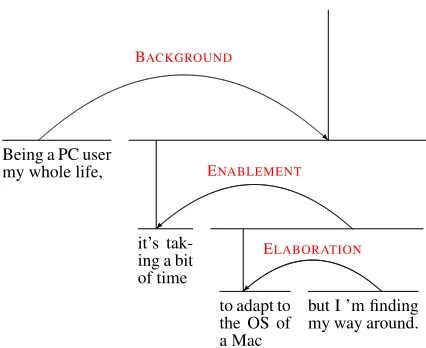
When performing an RST analysis, the text is first split into clauses, which are called elementary dis-course units (EDUs). These clauses form the ba-sic building blocks of the discourse tree. The RST parser then postulates relations between the EDUs, selecting them from a predefined list of discourse relations. There are two basic types of relations: mononuclear and multinuclear relations. The for-mer connects two discourse elements where one el-ement is supporting the other, whereas the latter con-nects two or more discourse elements that do not have such a clear division of roles. For example, in‘I’ve only had mine a day but I’m already used to it...’, the part before ‘but’ is ancillary and is called the satellite. It supports the second clause, which is called the nucleus, by setting up a contrast. An ex-ample of a multinuclear relation is‘It is in the best condition and has a really high quality.’ In this sen-tence, both elements are nuclei since none of them is specifically supporting the other and they are on the same level instead. EDUs that are linked by a dis-course relation together form a new clause that can be linked to another clause again. In this way, a hier-archical structure, which is called the discourse tree, can be formed that spans a whole document. In Fig-ure 1, the discourse tree is shown for the following example.
‘Being a PC user my whole life, it’s taking a bit of time to adapt to the OS of a Mac but I ’m finding my way around.’
3 Related Work
One of the first approaches that applies RST to sen-timent analysis is (Taboada et al., 2008). This work suggests to rank words within a satellite EDU dif-ferently from words that are within a nucleus EDU. Even such a simple use of discourse information al-ready leads to a higher performance of their frame-work. Note that because only EDUs are used, this method only exploits information from the leafs of the discourse tree.
R
BACKGROUND
Being a PC user
my whole life, ENABLEMENT
it’s tak-ing a bit of time
ELABORATION
to adapt to the OS of a Mac
[image:2.612.319.532.53.227.2]but I ’m finding my way around.
Figure 1: Full discourse tree of a simple review sentence (the curved lines denote a mononuclear relation between a nucleus and a satellite).
This is also true for the approach taken in (Heer-schop et al., 2011), which uses the same split be-tween words in a nucleus or words in a satellite. Additionally, they take the rhetorical relations these EDUs are in, into account. One of the outcomes of this research is that certain relations are more im-portant for sentiment analysis than others. Hence, words that are in a EDU with an important rela-tion should have a higher influence on the sentiment analysis than others. Another interesting idea was that some EDUs are in a contrasting relation and sentiment scores for words in these EDUs should be negated or flipped. In the described experiments, F1 increased with 15% compared to a baseline be-cause of the exploitation of discourse information. Note that this approach performs sentiment analy-sis at the sentence level, while we are applying dis-course analysis for aspect-level sentiment analysis.
Being closer to aspect-level, the method described in (Zirn et al., 2011) applies RST at the sub-sentence or clause level embedding it inside a Markov Logic Chain. The research mainly focuses on finding re-lations that negate the sentiment of a certain clause since this has a high impact on the total sentiment score. Compared to a Support Vector Machine base-line, the employed model shows a significant im-provement.
4 Framework
be defined first, since this varies from aspect to as-pect. Fortunately, we can exploit the discourse tree to select the relevant parts of the text with respect to a given aspect. Knowing the relevant parts of the sentence, the sentiment can be computed by having different weights on the various discourse relations and multiplying the sentiment scores for individual words through the relevant parts of the discourse tree, aggregating the partial scores to one final score that determines the sentiment class.
The first step consists of finding the leaf node(s) in the discourse tree that cover a given aspect. For explicit aspects, the exact position within the sen-tence is known (i.e., with thefromandtovalues) , so determining the relevant EDU is straightforward. Sometimes, an aspect spans multiple EDUs. This is the case for some explicit aspects and for all implicit aspects, since the latter do not have a specific target (i.e.,targetisNULLandfromandtoare zero). When multiple EDUs are returned by this step, the following steps are performed for each EDU, and the final results are aggregated at the end.
Since satellites are complementing the informa-tion presented in the nuclei, it stands to reason that, when determining the sentiment of an aspect that is described in a nucleus, we also utilize the informa-tion in the satellite that supports that nucleus. On the other hand, when an aspect is described in a satel-lite, we do not need to include the information of its nucleus since nuclei do not add information to satellites. This information asymmetry helps us to define the context of an aspect. We can look at the discourse tree and, starting at the leaf containing the aspect, move up the tree. As long as we are encoun-tering nuclei we need to go higher because the re-lated satellites need to be included in the context. Hence, as soon as we arrive at a satellite node, that node will be the root of the context tree, since its re-lated nucleus does not need to be included because of the reasons specified before. For the example in Figure 1, since the aspect ‘OS’ is in a nucleus, we go up to include its elaborating satellite, thereby ar-riving in a satellite node. Since the first encountered satellite node will be the root node of the context tree, we will not move up the discourse tree any fur-ther.
With the context tree available, each word is as-signed a sentiment score, using the Stanford
Senti-ment Tool (Socher et al., 2013). The sentiSenti-ment val-ues are then combined using Formula 1.
sent(si) =
X
tj∈si
sent(tj)×
Y
rn∈Psi
wrn,∀si ∈Sa.
(1) whereSa is the set of leaf nodes of the context tree for aspecta, sent(si) is the sentiment score
corre-sponding to leaf node si ∈ S, andPsi denotes all
edges on the path from the root node of the con-text tree to leaf nodesi. Furthermore, sent(tj) is
the sentiment score for word tj ∈ si andwrn
de-notes the weight associated with the rhetorical role of edgern. These weights are obtained by running a Genetic Algorithm, optimizing for accuracy.
In the final step, all of the sent(si) values for a given aspect are added to arrive at a final sentiment score for each aspect, as shown in Formula 2.
sent(sa) = X
si∈Sa
sent(si) (2)
To map the sentiment score of an aspect to a class label, we use a threshold to make the distinction between positive and negative classes. As suggested in (Heerschop et al., 2011), we compute the average sentiment score for all aspects that are positive as well as for all aspects that are negative. The thresh-old is then set as the mean of those two values. This helps to avoid the sentiment bias in reviews. Note than in its current form, the algorithm is only capa-ble of assigning a positive or a negative sentiment class to an aspect. Hence all neutral aspects will be misclassified.
Implementation Notes
The above framework is implemented using the Stanford CoreNLP (Manning et al., 2014) pipeline, including the already mentioned sentiment compo-nent (Socher et al., 2013), together with the CLU-LAB (Surdeanu et al., 2015) discourse parser.
5 Evaluation
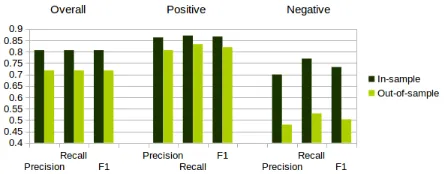
senti-Figure 2: Results on the restaurants data, specified per senti-ment class.
Figure 3: Results on the laptops data, specified per sentiment class.
ment value only (i.e., slot 3 for subtask 1) and only operates on English.
Restaurants Laptops
In-sample 79.1% 77.3%
10-fold cross-validation 76.1% 71.8% Official test data 71.8% 67.5%
Table 1:Results of the proposed algorithm on the two consid-ered datasets. Note that the official results on the restaurant data set are slightly higher than in the official ranking due to a few parsing errors with HTML entities in the submitted file.
As can be seen in Table 1, the algorithm suffers from overfitting, which is caused by optimizing the weights of the various RST relation types. Inter-estingly, the positive class of the restaurants dataset appears to be unaffected by this overfitting, as its performance on the cross-validated training data is only 2% lower than the in-sample accuracy. This is in stark contrast to the negative class, which suffers a sharp decrease in performance when going from in-sample to cross-validation. However, even com-paring the cross-validation results with the test data shows a gap in performance. This can be due to a number of reasons, where it is most likely that the test data is slightly different in terms of language us-age than the training data.
Looking at the precision and recall scores for the
positive and negative class in Figures 2 and 3, we can see that on the restaurants data, the negative class is poorly predicted, with both a low precision and a low recall. The positive class, however, is perform-ing only slightly worse than on the trainperform-ing data, with the biggest hit taken on the precision. For the laptops data, the situation is different. Here, both the positive and the negative class have a slightly higher recall than precision on the training data. Look-ing the test data, however, shows that the algorithm predicts too many negative aspects, as the precision for the negative class plummets, but the recall stays roughly the same. For the positive class, the reverse is true: since it only predicts positive in a limited number of cases, the precision is high, but recall is much lower than on the training data.
Negative comments are more difficult to find, as evidenced by the shown performance scores, be-cause of the greater range of expressions used for negative expressions. For example, besides using words with a known negative sentiment, people can express themselves using sarcasm or by describing some aspect and letting the reader conclude that that is sub-par.
6 Conclusions
[image:4.612.76.295.190.281.2]we have not yet tried a full range of possibilities. Last, embedding the discourse information in a clas-sifier like Support Vector Machines is worthy of in-vestigation to see the effect of combining high level linguistic information with the power of statistical inference.
Acknowledgments
The authors are supported by the Dutch national pro-gram COMMIT
References
Erik Cambria, Soujanya Poria, Federica Bisio, Rajiv Ba-jpai, and Iti Chaturvedi. 2015. The CLSA model: A novel framework for concept-level sentiment anal-ysis. In 16th International Conference on Computa-tional Linguistics and Intelligent Text Processing (CI-CLing 2015) (Part II), pages 3–22.
Bas Heerschop, Frank Goossen, Alexander Hogen-boom, Flavius Frasincar, Uzay Kaymak, and Franciska de Jong. 2011. Polarity analysis of texts using dis-course structure. In Proceedings of the 20th ACM International Conference on Information and Knowl-edge Management (CIKM, 2011), pages 1061–1070. ACM.
William C Mann and Sandra A Thompson. 1988. Rhetorical structure theory: Toward a functional the-ory of text organization. Text-Interdisciplinary Jour-nal for the Study of Discourse, 8(3):243–281.
Christopher D. Manning, Mihai Surdeanu, John Bauer, Jenny Finkel, Steven J. Bethard, and David McClosky. 2014. The Stanford CoreNLP natural language pro-cessing toolkit. InProceedings of 52nd Annual Meet-ing of the Association for Computational LMeet-inguistics: System Demonstrations, pages 55–60. Association for Computational Linguistics.
Daniel Marcu. 1997. The rhetorical parsing of natural language texts. In Proceedings of the Eighth Con-ference on European Chapter of the Association for Computational Linguistics (EACL 1997), pages 96– 103. Association for Computational Linguistics. Maria Pontiki, Dimitrios Galanis, Haris Papageorgiou,
Ion Androutsopoulos, Suresh Manandhar, Mohammad Al-Smadi, Mahmoud Al-Ayyoub, Yanyan Zhao, Bing Qin, Orph´ee De Clercq, V´eronique Hoste, Marianna Apidianaki, Xavier Tannier, Natalia Loukachevitch, Evgeny Kotelnikov, Nuria Bel, Salud Mar´ıa Jim´enez-Zafra, and G¨uls¸en Eryi˘git. 2016. SemEval-2016 task 5: Aspect based sentiment analysis. InProceedings of the 10th International Workshop on Semantic
Evalua-tion, SemEval ’16, San Diego, California, June. Asso-ciation for Computational Linguistics.
Kim Schouten and Flavius Frasincar. 2016. Survey on aspect-level sentiment analysis. IEEE Transactions on Knowledge and Data Engineering, 28(3):813–830. Richard Socher, Alex Perelygin, Jean Wu, Jason Chuang,
Christopher D. Manning, Andrew Ng, and Christopher Potts. 2013. Recursive deep models for semantic compositionality over a sentiment treebank. In Pro-ceedings of the 2013 Conference on Empirical Meth-ods in Natural Language Processing (EMNLP 2013), pages 1631–1642. Association for Computational Lin-guistics.
Mihai Surdeanu, Thomas Hicks, and Marco A. Valenzuela-Esc´arcega. 2015. Two practical rhetor-ical structure theory parsers. In Proceedings of the 2015 Conference of the North American Chapter of the Association for Computational Linguistics - Human Language Technologies (NAACL HLT 2015): Software Demonstrations.
Maite Taboada, Kimberly Voll, and Julian Brooke. 2008. Extracting sentiment as a function of discourse struc-ture and topicality. Technical Report TR 2008-20, Si-mon Fraser University School of Computing Science. C¨acilia Zirn, Mathias Niepert, Heiner Stuckenschmidt,