Paraphrasing for Automatic Evaluation
David Kauchak
Department of Computer Science University of California, San Diego
Regina Barzilay CSAIL
Massachusetts Institute of Technology [email protected]
Abstract
This paper studies the impact of para-phrases on the accuracy of automatic eval-uation. Given a reference sentence and a machine-generated sentence, we seek to find a paraphrase of the reference sen-tence that is closer in wording to the ma-chine output than the original reference. We apply our paraphrasing method in the context of machine translation evaluation. Our experiments show that the use of a paraphrased synthetic reference refines the accuracy of automatic evaluation. We also found a strong connection between the quality of automatic paraphrases as judged by humans and their contribution to automatic evaluation.
1 Introduction
The use of automatic methods for evaluating machine-generated text is quickly becoming main-stream in natural language processing. The most notable examples in this category include measures such as BLEU and ROUGE which drive research in the machine translation and text summarization communities. These methods assess the quality of a machine-generated output by considering its simi-larity to a reference text written by a human. Ideally, the similarity would reflect the semantic proximity between the two. In practice, this comparison breaks down ton-gram overlap between the reference and
the machine output.
1a. However, Israel’s reply failed to completely clear the U.S. suspicions.
1b. However, Israeli answer unable to fully remove the doubts.
Table 1: A reference sentence and corresponding machine translation from the NIST 2004 MT eval-uation.
Consider the human-written translation and the machine translation of the same Chinese sentence shown in Table 1. While the two translations con-vey the same meaning, they share only auxiliary words. Clearly, any measure based on word over-lap will penalize a system for generating such a sen-tence. The question is whether such cases are com-mon phenomena or infrequent exceptions. Empiri-cal evidence supports the former. Analyzing 10,728 reference translation pairs1 used in the NIST 2004 machine translation evaluation, we found that only 21 (less than 0.2%) of them are identical. Moreover, 60% of the pairs differ in at least 11 words. These statistics suggest that without accounting for para-phrases, automatic evaluation measures may never reach the accuracy of human evaluation.
As a solution to this problem, researchers use multiple references to refine automatic evaluation. Papineni et al. (2002) shows that expanding the number of references reduces the gap between au-tomatic and human evaluation. However, very few human annotated sets are augmented with multiple references and those that are available are relatively
1Each pair included different translations of the same
small in size. Moreover, access to several references does not guarantee that the references will include the same words that appear in machine-generated sentences.
In this paper, we explore the use of paraphras-ing methods for refinement of automatic evalua-tion techniques. Given a reference sentence and a machine-generated sentence, we seek to find a para-phrase of the reference sentence that is closer in wording to the machine output than the original ref-erence. For instance, given the pair of sentences in Table 1, we automatically transform the reference sentence (1a.) into
However, Israel’s answer failed to com-pletelyremovethe U.S. suspicions.
Thus, among many possible paraphrases of the reference, we are interested only in those that use words appearing in the system output. Our para-phrasing algorithm is based on thesubstitute in con-text strategy. First, the algorithm identifies pairs of words from the reference and the system output that could potentially form paraphrases. We select these candidates using existing lexico-semantic resources such as WordNet. Next, the algorithm tests whether the candidate paraphrase is admissible in the con-text of the reference sentence. Since even synonyms cannot be substituted in any context (Edmonds and Hirst, 2002), this filtering step is necessary. We pre-dict whether a word is appropriate in a new context by analyzing its distributional properties in a large body of text. Finally, paraphrases that pass the filter-ing stage are used to rewrite the reference sentence.
We apply our paraphrasing method in the context of machine translation evaluation. Using this strat-egy, we generate a new sentence for every pair of human and machine translated sentences. This syn-thetic reference then replaces the original human ref-erence in automatic evaluation.
The key findings of our work are as follows: (1) Automatically generated paraphrases im-prove the accuracy of the automatic evaluation methods. Our experiments show that evaluation based on paraphrased references gives a better ap-proximation of human judgments than evaluation that uses original references.
(2) The quality of automatic paraphrases de-termines their contribution to automatic
evalua-tion. By analyzing several paraphrasing resources, we found that the accuracy and coverage of a para-phrasing method correlate with its utility for auto-matic MT evaluation.
Our results suggest that researchers may find it useful to augment standard measures such as BLEU and ROUGE with paraphrasing information thereby taking more semantic knowledge into account.
In the following section, we provide an overview of existing work on automatic paraphrasing. We then describe our paraphrasing algorithm and ex-plain how it can be used in an automatic evaluation setting. Next, we present our experimental frame-work and data and conclude by presenting and dis-cussing our results.
2 Related Work
Automatic Paraphrasing and Entailment Our work is closely related to research in automatic para-phrasing, in particular, to sentence level paraphras-ing (Barzilay and Lee, 2003; Pang et al., 2003; Quirk et al., 2004). Most of these approaches learn para-phrases from a parallel or comparable monolingual corpora. Instances of such corpora include multiple English translations of the same source text writ-ten in a foreign language, and different news arti-cles about the same event. For example, Pang et al. (2003) expand a set of reference translations us-ing syntactic alignment, and generate new reference sentences that could be used in automatic evaluation. Our approach differs from traditional work on au-tomatic paraphrasing in goal and methodology. Un-like previous approaches, we are not aiming to pro-duceanyparaphrase of a given sentence since para-phrases induced from a parallel corpus do not nec-essarily produce a rewriting that makes a reference closer to the system output. Thus, we focus on words that appear in the system output and aim to determine whether they can be used to rewrite a ref-erence sentence.
recognition extensively rely on lexico-semantic re-sources (Haghighi et al., 2005; Harabagiu et al., 2001), and we believe that our method for contex-tual substitution can be beneficial in that context. Automatic Evaluation Measures A variety of au-tomatic evaluation methods have been recently pro-posed in the machine translation community (NIST, 2002; Melamed et al., 2003; Papineni et al., 2002). All these metrics computen-gram overlap between
a reference and a system output, but measure the overlap in different ways. Our method for reference paraphrasing can be combined with any of these metrics. In this paper, we report experiments with BLEU due to its wide use in the machine translation community.
Recently, researchers have explored additional knowledge sources that could enhance automatic evaluation. Examples of such knowledge sources in-clude stemming and TF-IDF weighting (Babych and Hartley, 2004; Banerjee and Lavie, 2005). Our work complements these approaches: we focus on the im-pact of paraphrases, and study their contribution to the accuracy of automatic evaluation.
3 Methods
The input to our method consists of a reference sen-tence R = r1. . . rm and a system-generated
sen-tenceW =w1. . . wpwhose words form the setsR
and W respectively. The output of the model is a
synthetic reference sentenceSRW that preserves the
meaning of R and has maximal word overlap with W. We generate such a sentence by substituting
words from R with contextually equivalent words
fromW.
Our algorithm first selects pairs of candidate word paraphrases, and then checks the likelihood of their substitution in the context of the reference sentence. Candidate SelectionWe assume that words from the reference sentence that already occur in the sys-tem generated sentence should not be considered for substitution. Therefore, we focus on unmatched pairs of the form{(r, w)|r ∈ R − W, w∈ W − R}.
From this pool, we select candidate pairs whose members exhibit high semantic proximity. In our experiments we compute semantic similarity us-ing WordNet, a large-scale lexico-semantic resource employed in many NLP applications for similar
pur-2a. It ishardto believe that such tremendous changes have takenplacefor those people and lands that I have never stopped missing while living abroad.
2b. For someone born here but has been sentimentally attached to a foreign country far fromhome, it isdifficultto believe this kind of changes.
Table 2: A reference sentence and a corresponding machine translation. Candidate paraphrases are in bold.
poses. We consider a pair as a substitution candidate if its members are synonyms in WordNet.
Applying this step to the two sentences in Table 2, we obtain two candidate pairs (home, place) and (difficult,hard).
Contextual SubstitutionThe next step is to de-termine for each candidate pair (ri, wj) whether wj is a valid substitution for ri in the context of r1. . . ri−12ri+1. . . rm. This filtering step is essen-tial because synonyms are not universally substi-tutable2. Consider the candidate pair (home,place) from our example (see Table 2). Wordshome and placeare paraphrases in the sense of “habitat”, but in the reference sentence “place” occurs in a differ-ent sense, being part of the collocation “take place”. In this case, the pair (home,place) cannot be used to rewrite the reference sentence.
We formulate contextual substitution as a binary classification task: given a context
r1. . . ri−12ri+1. . . rm, we aim to predict whether
wj can occur in this context at position i. For
each candidate word wj we train a classifier that
models contextual preferences ofwj. To train such
a classifier, we collect a large corpus of sentences that contain the word wj and an equal number of
randomly extracted sentences that do not contain this word. The former category forms positive instances, while the latter represents the negative. For the negative examples, a random position in a sentence is selected for extracting the context. This corpus is acquired automatically, and does not require any manual annotations.
2This can explain why previous attempts to use WordNet for
We represent context by n-grams and local
col-locations, features typically used in supervised word sense disambiguation. Both n-grams and
collocations exclude the word wj. An n-gram
is a sequence of n adjacent words appearing in r1. . . ri−12ri+1. . . rm. A local collocation also takes into account the position of an n-gram with
respect to the target word. To compute local colloca-tions for a word at positioni, we extract alln-grams
(n= 1. . .4) beginning at positioni−2and ending at positioni+ 2. To make these position dependent, we prepend each of them with the length and starting position.
Once the classifier3 for w
j is trained, we
ap-ply it to the context r1. . . ri−12ri+1. . . rm. For
positive predictions, we rewrite the string as
r1. . . ri−1wjri+1. . . rm. In this formulation, all substitutions are tested independently.
For the example from Table 2, only the pair (difficult,hard) passes this filter, and thus the sys-tem produces the following synthetic reference:
For someone born here but has been senti-mentally attached to a foreign country far from home, it ishardto believe this kind of changes.
The synthetic reference keeps the meaning of the original reference, but has a higher word overlap with the system output.
One of the implications of this design is the need to develop a large number of classifiers to test con-textual substitutions. For each word to be inserted into a reference sentence, we need to train a sepa-rate classifier. In practice, this requirement is not a significant burden. The training is done off-line and only once, and testing for contextual substitution is instantaneous. Moreover, the first filtering step ef-fectively reduces the number of potential candidates. For example, to apply this approach to the 71,520 sentence pairs from the MT evaluation set (described in Section 4.1.2), we had to train 2,380 classifiers.
We also discovered that the key to the success of this approach is the size of the corpus used for train-ing contextual classifiers. We derived traintrain-ing cor-pora from the English Gigaword corpus, and the av-erage size of a corpus for one classifier is 255,000
3In our experiments, we used the publicly available
BoosT-exter classifier (Schapire and Singer, 2000) for this task.
sentences. We do not attempt to substitute any words that have less that 10,000 appearances in the Giga-word corpus.
4 Experiments
Our primary goal is to investigate the impact of machine-generated paraphrases on the accuracy of automatic evaluation. We focus on automatic evalu-ation of machine translevalu-ation due to the availability of human annotated data in that domain. The hypoth-esis is that by using a synthetic reference transla-tion, automatic measures approximate better human evaluation. In section 4.2, we test this hypothesis by comparing the performance of BLEU scores with and without synthetic references.
Our secondary goal is to study the relationship between the quality of paraphrases and their con-tribution to the performance of automatic machine translation evaluation. In section 4.3, we present a manual evaluation of several paraphrasing methods and show a close connection between intrinsic and extrinsic assessments of these methods.
4.1 Experimental Set-Up
We begin by describing relevant background infor-mation, including the BLEU evaluation method, the test data set, and the alternative paraphrasing meth-ods considered in our experiments.
4.1.1 BLEU
BLEU is the basic evaluation measure that we use in our experiments. It is the geometric average of the n-gram precisions of candidate sentences with
respect to the corresponding reference sentences, times a brevity penalty. The BLEU score is com-puted as follows:
BLEU = BP· 4
v u u t
4
Y
n=1 pn
BP = min(1, e1−r/c),
wherepnis then-gram precision,cis the cardinality
of the set of candidate sentences andris the size of
the smallest set of reference sentences.
4.1.2 Data
We use the Chinese portion of the 2004 NIST MT dataset. This portion contains 200 Chinese doc-uments, subdivided into a total of 1788 segments. Each segment is translated by ten machine transla-tion systems and by four human translators. A quar-ter of the machine-translated segments are scored by human evaluators on a one-to-five scale along two dimensions: adequacy and fluency. We use only ad-equacy scores, which measure how well content is preserved in the translation.
4.1.3 Alternative Paraphrasing Techniques To investigate the effect of paraphrase quality on automatic evaluation, we consider two alternative paraphrasing resources: Latent Semantic Analysis (LSA), and Brown clustering (Brown et al., 1992). These techniques are widely used in NLP applica-tions, including language modeling, information ex-traction, and dialogue processing (Haghighi et al., 2005; Serafin and Eugenio, 2004; Miller et al., 2004). Both techniques are based on distributional similarity. The Brown clustering is computed by considering mutual information between adjacent words. LSA is a dimensionality reduction technique that projects a word co-occurrence matrix to lower dimensions. This lower dimensional representation is then used with standard similarity measures to cluster the data. Two words are considered to be a paraphrase pair if they appear in the same cluster.
We construct 1000 clusters employing the Brown method on 112 million words from the North Amer-ican New York Times corpus. We keep the top 20 most frequent words for each cluster as paraphrases. To generate LSA paraphrases, we used the Infomap software4 on a 34 million word collection of arti-cles from the American News Text corpus. We used the default parameter settings: a 20,000 word vocab-ulary, the 1000 most frequent words (minus a stop-list) for features, a 15 word context window on either side of a word, a 100 feature reduced representation, and the 20 most similar words as paraphrases.
While we experimented with several parameter settings for LSA and Brown methods, we do not claim that the selected settings are necessarily opti-mal. However, these methods present sensible
com-4http://infomap-nlp.sourceforge.net
Method 1 reference 2 references
BLEU 0.9657 0.9743
WordNet 0.9674 0.9763
ContextWN 0.9677 0.9764
LSA 0.9652 0.9736
[image:5.612.329.524.53.138.2]Brown 0.9662 0.9744
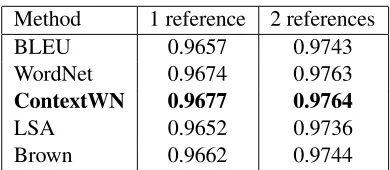
Table 4: Pearson adequacy correlation scores for rewriting using one and two references, averaged over ten runs.
Method vs. BLEU vs. ContextWN
WordNet
//
44ContextWN
//
-LSA X 44
[image:5.612.322.530.199.271.2]Brown
//
4Table 5: Paired t-test significance for all methods compared to BLEU as well as our method for one reference. Two triangles indicates significant at the 99% confidence level, one triangle at the 95% con-fidence level and X not significant. Triangles point towards the better method.
parison points for understanding the relationship be-tween paraphrase quality and its impact on auto-matic evaluation.
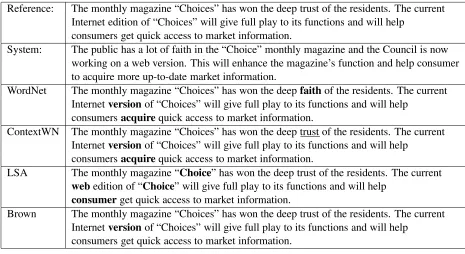
Table 3 shows synthetic references produced by the different paraphrasing methods.
4.2 Impact of Paraphrases on Machine Translation Evaluation
The standard way to analyze the performance of an evaluation metric in machine translation is to com-pute the Pearson correlation between the automatic metric and human scores (Papineni et al., 2002; Koehn, 2004; Lin and Och, 2004; Stent et al., 2005). Pearson correlation estimates how linearly depen-dent two sets of values are. The Pearson correlation values range from 1, when the scores are perfectly linearly correlated, to -1, in the case of inversely cor-related scores.
Reference: The monthly magazine “Choices” has won the deep trust of the residents. The current Internet edition of “Choices” will give full play to its functions and will help
consumers get quick access to market information.
System: The public has a lot of faith in the “Choice” monthly magazine and the Council is now working on a web version. This will enhance the magazine’s function and help consumer to acquire more up-to-date market information.
WordNet The monthly magazine “Choices” has won the deepfaithof the residents. The current Internetversionof “Choices” will give full play to its functions and will help
consumersacquirequick access to market information.
ContextWN The monthly magazine “Choices” has won the deep trust of the residents. The current Internetversionof “Choices” will give full play to its functions and will help
consumersacquirequick access to market information.
LSA The monthly magazine “Choice” has won the deep trust of the residents. The current webedition of “Choice” will give full play to its functions and will help
consumerget quick access to market information.
Brown The monthly magazine “Choices” has won the deep trust of the residents. The current Internetversionof “Choices” will give full play to its functions and will help
[image:6.612.71.536.54.308.2]consumers get quick access to market information.
Table 3: Sample of paraphrasings produced by each method based on the corresponding system translation. Paraphrased words are in bold and filtered words underlined.
the evaluation metric score is calculated on the docu-ment and the corresponding human adequacy score is calculated as the average human score over the segments. The Pearson correlation is calculated over these ten pairs (Papineni et al., 2002; Stent et al., 2005). This process is repeated for ten different documents created by the same process. Finally, a paired t-test is calculated over these ten different cor-relation scores to compute statistical significance.
Table 4 shows Pearson correlation scores for BLEU and the four paraphrased augmentations, averaged over ten runs.5 In all ten tests, our method based on contextual rewriting (ContextWN) improves the correlation with human scores over BLEU. Moreover, in nine out of ten tests Contex-tWN outperforms the method based on WordNet. The results of statistical significance testing are sum-marized in Table 5. All the paraphrasing methods except LSA, exhibit higher correlation with human scores than plain BLEU. Our method significantly outperforms BLEU, and all the other paraphrase-based metrics. This consistent improvement con-firms the importance of contextual filtering.
5Depending on the experimental setup, correlation values
can vary widely. Our scores fall within the range of previous researchers (Papineni et al., 2002; Lin and Och, 2004).
The third column in Table 4 shows that auto-matic paraphrasing continues to improve correlation scores even when two human references are para-phrased using our method.
4.3 Evaluation of Paraphrase Quality
In the last section, we saw significant variations in MT evaluation performance when different para-phrasing methods were used to generate a synthetic reference. In this section, we examine the correla-tion between the quality of automatically generated paraphrases and their contribution to automatic eval-uation. We analyze how the substitution frequency and the accuracy of those substitutions contributes to a method’s performance.
Method Score Substitutions
BLEU 0.0913
-WordNet 0.0969 994
ContextWN 0.0962 742
LSA 0.992 2080
[image:7.612.97.274.54.138.2]Brown 0.921 117
Table 6: Scores and the number of substitutions made for all 1788 segments, averaged over the dif-ferent MT system translations
Method Judge 1 Judge 2 Kappa
accuracy accuracy
WordNet 63.5% 62.5% 0.74
ContextWN 75% 76.0% 0.69
LSA 30% 31.5% 0.73
Brown 56% 56% 0.72
Table 7: Accuracy scores by two human judges as well as the Kappa coefficient of agreement.
not translate into better evaluation performance. For instance, our contextual filtering method removes approximately a quarter of the paraphrases sug-gested by WordNet and yields a better evaluation measure. These results suggest that the substitu-tion frequency cannot predict the utility value of the paraphrasing method.
Accuracy measures the correctness of the pro-posed substitutions in the context of a reference sen-tence. To evaluate the accuracy of different phrasing methods, we randomly extracted 200 para-phrasing examples from each method. A paraphrase example consists of a reference sentence, a refer-ence word to be paraphrased and a proposed para-phrase of that reference (that actually occurred in a corresponding system translation). The judge was instructed to mark a substitution as correct only if the substitution was both semantically and grammat-ically correct in the context of the original reference sentence.
Paraphrases produced by the four methods were judged by two native English speakers. The pairs were presented in random order, and the judges were not told which system produced a given pair. We employ a commonly used measure, Kappa, to as-sess agreement between the judges. We found that
negative positive
filtered 40 27
non-filtered 33 100
Table 8: Confusion matrix for the context filtering method on a random sample of 200 examples la-beled by the first judge.
on all the four sets the Kappa value was around 0.7, which corresponds to substantial agreement (Landis and Koch, 1977).
As Table 7 shows, the ranking between the ac-curacy of the different paraphrasing methods mir-rors the ranking of the corresponding MT evalua-tion methods shown in Table 4. The paraphrasing method with the highest accuracy, ContextWN, con-tributes most significantly to the evaluation perfor-mance of BLEU. Interestingly, even methods with moderate accuracy, i.e. 63% for WordNet, have a positive influence on the BLEU metric. At the same time, poor paraphrasing accuracy, such as LSA with 30%, does hurt the performance of automatic evalu-ation.
To further understand the contribution of contex-tual filtering, we compare the substitutions made by WordNet and ContextWN on the same set of sen-tences. Among the 200 paraphrases proposed by WordNet, 73 (36.5%) were identified as incorrect by human judges. As the confusion matrix in Table 8 shows, 40 (54.5%) were eliminated during the filter-ing step. At the same time, the filterfilter-ing erroneously eliminates 27 positive examples (21%). Even at this level of false negatives, the filtering has an overall positive effect.
5 Conclusion and Future Work
[image:7.612.348.505.54.98.2]We also introduce a novel paraphrasing method based on contextual substitution. By posing the paraphrasing problem as a discriminative task, we can incorporate a wide range of features that im-prove the paraphrasing accuracy. Our experiments show improvement of the accuracy of WordNet paraphrasing and we believe that this method can similarly benefit other approaches that use lexico-semantic resources to obtain paraphrases.
Our ultimate goal is to develop a contextual filter-ing method that does not require candidate selection based on a lexico-semantic resource. One source of possible improvement lies in exploring more power-ful learning frameworks and more sophisticated lin-guistic representations. Incorporating syntactic de-pendencies and class-based features into the context representation could also increase the accuracy and the coverage of the method. Our current method only implements rewriting at the word level. In the future, we would like to incorporate substitutions at the level of phrases and syntactic trees.
Acknowledgments
The authors acknowledge the support of the Na-tional Science Foundation (Barzilay; CAREER grant IIS-0448168) and DARPA (Kauchak; grant HR0011-06-C-0023). Thanks to Michael Collins, Charles Elkan, Yoong Keok Lee, Philip Koehn, Igor Malioutov, Ben Snyder and the anonymous review-ers for helpful comments and suggestions. Any opinions, findings and conclusions expressed in this material are those of the author(s) and do not neces-sarily reflect the views of DARPA or NSF.
References
B. Babych, A. Hartley. 2004. Extending the BLEU evaluation method with frequency weightings. In Pro-ceedings of the ACL, 621–628.
S. Banerjee, A. Lavie. 2005. METEOR: An automatic metric for MT evaluation with improved correlation with human judgments. InProceedings of the ACL Workshop on Intrinsic and Extrinsic Evaluation Mea-sures for MT and/or Summarization, 65–72.
R. Barzilay, L. Lee. 2003. Learning to paraphrase: An unsupervised approach using multiple-sequence align-ment. InProceedings of NAACL-HLT, 16–23. P. F. Brown, P. V. deSouza, R. L. Mercer. 1992.
Class-based n-gram models of natural language. Computa-tional Linguistics, 18:467–479.
I. Dagan, O. Glickman, B. Magnini, eds. 2005.The PAS-CAL recognizing textual entailment challenge, 2005. P. Edmonds, G. Hirst. 2002. Near synonymy and lexical
choice.Computational Linguistics, 28(2):105–144. A. Haghighi, A. Ng, C. Manning. 2005. Robust
tex-tual inference via graph matching. InProceedings of NAACL-HLT, 387–394.
S. Harabagiu, D. Moldovan, M. Pasca, R. Mihal-cea, M. Surdeanu, R. Bunescu, R. Girju, V. Rus, P. Morarescu. 2001. The role of lexico-semantic feed-back in open-domain textual question-answering. In
Proceedings of ACL, 274–291.
P. Koehn. 2004. Statistical significance tests for machine translation evaluation. In Proceedings of EMNLP, 388–395.
J. R. Landis, G. G. Koch. 1977. The measurement of observer agreement for categorical data. Biometrics, 33:159–174.
C. Lin, F. Och. 2004. ORANGE: a method for evaluating automatic evaluation metrics for machine translation. InProceedings of COLING, 501–507.
I. D. Melamed, R. Green, J. P. Turian. 2003. Precision and recall of machine translation. InProceedings of NAACL-HLT, 61–63.
S. Miller, J. Guinness, A. Zamanian. 2004. Name tag-ging with word clusters and discriminative training. In
Proceedings of HLT-NAACL, 337–342.
NIST. 2002. Automatic evaluation of machine trans-lation quality using n-gram co-occurrence statistics, 2002.
B. Pang, K. Knight, D. Marcu. 2003. Syntax-based alignment of multiple translations: Extracting para-phrases and generating new sentences. InProceedings of NAACL-HLT, 102–209.
K. Papineni, S. Roukos, T. Ward, W. Zhu. 2002. BLEU: a method for automatic evaluation of machine transla-tion. InProceedings of the ACL, 311–318.
C. Quirk, C. Brockett, W. Dolan. 2004. Monolingual machine translation for paraphrase generation. In Pro-ceedings of EMNLP, 142–149.
R. E. Schapire, Y. Singer. 2000. Boostexter: A boosting-based system for text categorization. Machine Learn-ing, 39(2/3):135–168.
R. Serafin, B. D. Eugenio. 2004. FLSA: Extending la-tent semantic analysis with features for dialogue act classification. InProceedings of the ACL, 692–699. A. Stent, M. Marge, M. Singhai. 2005. Evaluating