S Bandyopadhyay, D S Sharma and R Sangal. Proc. of the 14th Intl. Conference on Natural Language Processing, pages 65–74, Kolkata, India. December 2017. c2016 NLP Association of India (NLPAI)
Curriculum Design for Code-switching: Experiments with Language
Identification and Language Modeling with Deep Neural Networks
Ashutosh Baheti, Sunayana Sitaram, Monojit Choudhury, Kalika Bali
Microsoft Research Lab, India [email protected]
{t-susita, monojitc, kalikab}@microsoft.com
Abstract
Curriculum learningstrategies are known to improve the accuracy, robustness and convergence rate for various lan-guage learning tasks using deep archi-tectures (Bengio et al., 2009). In this work, we design and experiment with several training curricula for two tasks – word-level language detection and lan-guage modeling – for code-switched text data. Our study shows that irrespective of the task or the underlying DNN architec-ture, the best curriculum for training the code-switched models is to first train a net-work with monolingual training instances, where each mini-batch has instances from both languages, and then train the result-ing network on code-switched data.
1 Introduction
Code-switching (CS) refers to the linguistic phe-nomenon of fluid alternation between two or more languages during a single conversation or even an utterance (Myers-Scotton,1993). It is observed in all stable multilingual societies (Auer, 1995) and recent studies have shown that social media posts from such societies almost always contain small to moderate amount of CS (Bali et al.,2014; Dor-leijn,2016;Molina et al.,2016;Rudra et al.,2016;
Rijhwani et al.,2017). For instance, Rijhwani et al. (2017) shows that 2-12% (3.5% on average) of the tweets from the cities around the world are code-switched. It is therefore imperative to build speech and text processing technologies that can handle CS. Indeed, quite some amount of effort is being invested towards technology for CS (see Diab et al. (2014;2016),Sharma et al.(2015), and references therein).
It is of theoretical and practical interest to pon-der on the question: whether for a particular NLP task (say ASR, MT or POS Tagging), it is pos-sible to build CS models only from pretrained monolingual models or monolingual training data? Indeed, several studies in the past (Solorio and Liu, 2008;Vyas et al., 2014; Gadre et al., 2016;
Gonzalez-Dominguez et al.,2015) have proposed techniques for combining monolingual models or training data coupled with a little amount of CS data to build models of CS text or speech. These techniques have reported promising results. How-ever, all these studies, except (Johnson et al.,2016;
Rijhwani et al.,2017;Chan et al.,2009), have tried to combine the outputs of pre-trained monolingual models in intelligent ways. On the other hand, one might ask whether a single system trained on monolingual data from both the languages would be able to handle CS between these languages? And, if we also had a little amount of CS data, how best to use it during the training process?
In this paper, we explore various training strate-gies, also known as Curriculum (Bengio et al.,
2009) for DNN-based architectures for code-switching. In particular, we design a set of strate-gies or curricula involving various ordering of the monolingual and CS data. We experiment with these curricula for Language Identification(LID) and Language Modeling (LM) tasks. Our study shows that the best curriculum across the tasks as well as DNN architecture is the same one: first train a network with monolingual instances alter-nating between the languages, and then train the resultant network with CS data, if available. The models trained solely with monolingual data also achieve reasonably high accuracies.
gual data; this obviates the need for creation of large amount of CS datasets. Second, it also brings out the fact that training curriculum is extremely important while building CS models from mono-lingual data, and there seems to be an ideal way of ordering the training examples that works best across tasks and network structures.
2 Background and Motivation
In this section, we present a typology of the monolingual model combination strategies for CS, through which we will motivate the central idea of this work.
2.1 A Note on Terms
It is important to differentiate between inter-sentential and intra-inter-sentential CS. The former refers to a situation where each sentence (or some-times clause) is in a single language, but the lan-guage might change across the sentences. On the other hand, intra-sentential CS, which is also sometimes called Code-mixing, refers to a situa-tion where words in the same sentence/clause can be drawn from multiple languages.
Tasks that operate on sentence level context (like POS tagging, ASR and MT) do not re-quire any special technique for handling inter-sentential CS, except LID and sentence bound-ary detection. However, intra-sentential CS is more challenging to handle, and will be our pri-mary focus. In this paper, the terms monolin-gual modelandmonolingual datawill be used for cases where the data was collected and the model was built assuming that the input will be only in a single language. Such datasets might also con-tain some borrowed words and text in other lan-guage(s). On the other hand, we will use the term
CS datato imply datasets where all instances con-tain intra-sentential CS, even though most of the datasets released in the past for training CS mod-els, e.g., (Molina et al.,2016;Das,2016;Sequiera et al.,2015b), do contain fair amounts of monolin-gual and inter-sentential CS. The termCS model
will be used for systems that can handle monolin-gual, inter-sentential as well as intra-sentential CS.
2.2 A Taxonomy of CS Models
In order to succinctly represent the various types of CS models proposed in the literature, we will use the following notation. Letl1 and l2 be two
languages. Letx denote the input string, usually
a sentence, i.e., string of tokens, in l1, l2 orl12,
i.e., l1 ↔ l2 code-switched. Let y be the output
string of tokens in a target language (as in MT, ASR or POS tagging). Let gi andfi denote
mod-els trained on data fromli. Further, we describe a
special functionlid(x)which returns the string of language labels for each word;lid1(x)andlid2(x)
are projection functions which returns only those tokens ofxthat are inl1andl2 respectively.
CS models described in the literature can be broadly categorized into the following four classes (in descending order of amount of CS data re-quired for training).
Purely Supervised Models: When a large amount of annotated CS data is available, a super-vised model can be learnt simply from the mono-lingual and CS data. Thus,
y =g1∪2∪12(x) (1)
These models often use features or extra in-formation specific to CS, but do not particularly modify the training process or system architecture for handling CS. This approach has been applied to language identification, e.g., most submissions in the LID shared task in the Computational Ap-proaches to Code-Switching Workshops (Solorio et al.,2014;Molina et al.,2016); to POS tagging, e.g., most submissions in the ICON 2016 shared task on CS POS tagging (Das,2016) and also ( Ja-matia and Das,2014;Jamatia et al.,2015); and to ASR (Gebhardt,2011).
Combining Monolingual Models: In this ap-proach, the output of two monolingual systems on x is used as features for a third model (f12 in
Eq. 2). This third modelf is trained on a small
amount of CS data, and can use other features which often includes LID output.
y=f12(g1(x), g2(x), lid(x)) (2)
Solorio and Liu (2008) proposed this architec-ture for POS tagging of English-Spanish CS data, and Lyu et al. (2006) proposed a similar model for ASR. Both reported significant gain over the monolingual models by using very little CS data. Later works, such as (Sequiera et al., 2015a), along this line also reported promising results.
Divide and Conquer:In this approach, the in-put is first passed through a LID system and split into parts according to the language of the tokens. The token strings are then passed on to the respec-tive monolingual systems and the outputs are com-bined (shown as the operator⊕in Eq.3)
y=g1(lid1(x))⊕g2(x)(lid2(x)) (3)
This approach does not require any CS training data, but it does not work well for intra-sentential CS because splitting by language can lead to loss of context especially at the code-switch points. However, some benefits of this approach have been shown for POS tagging (Vyas et al., 2014), MT (Gadre et al.,2016) and ASR (Lyudovyk and Pylypenko,2014) respectively.
Zero Shot Learning: This is an extreme case, where only monolingual data from two or more languages is used to train a single system with the hope that it will work for CS data as well.
y=g1∪2(x) (4)
A recent work (Rijhwani et al., 2017) uses this technique very effectively for developing an LID system for 7 languages. While no annotated CS data is used for training, the system uses unlabeled data that is expected to contain CS data, for unsu-pervised training. Johnson et al. (2016) trains a neural MT system with data from two pairs of lan-guages,l1 ⇔ l2 andl1 ⇔ l3 and show that the
resultant model not only works forl2 ⇔l3(the so
called “zero shot learning” but also for CS input in these languages, albeit to a limited extent.
Factors such as lack of large-scale CS datasets, possibility of CS between any pair (or even triplet) of languages (which in turn implies the need for nearly a quadratic number of such datasets) and the difficulty in creation of CS datasets owing to the requirement of skilled multilingual annota-tors make Zero Shot Learning a very lucrative ap-proach CS. However, we do not know of any work that systematically explores the various training strategies and effective use of CS data in the con-text of Zero Shot Learning.
3 Training Curricula for CS
Originally proposed by (Elman, 1993), Curricu-lum learningrefers to a sequence of weight distri-butions over the training example, such that during the training process certain examples are used with higher weight at the initial stages of the training and other examples are used later (Bengio et al.,
2009). In general, it is believed that for complex non-convex optimization problems, training with
simpler examples first and introducing the com-plex examples at later stage has distinctive bene-fits. Empirically, it has shown promising results for several NLP tasks like parsing (Spitkovsky
et al.,2009) and language modeling (Bengio et al.,
2009; Graves et al., 2017). Shi et al. (2015) describe curricula for domain adaptation of Lan-guage Models, in which they order the data such that general data is presented to the RNN first, fol-lowed by in-domain data.
In principle, the purely supervised (Eq. 1) and the zero shot learning approaches (Eq. 4) should benefit from curriculum based training. It is well known that proficient bilingual children learn to code-switch without any exposure to CS data (Cantone,2007). This leads us to explore var-ious curricula for training with monolingual and CS data. While complexity of training instances can be defined across various dimensions, in this study we will restrict ourselves to only one aspect of the curriculum design - the language(s).
Let T1, T2 and T12 be respectively the set of
training examples inl1,l2 and intra-sentential CS
betweenl1 andl2. We will use the notationTi;Tj
to indicate a basic curriculum where the system is trained with all instances from Ti first, and then
with instances fromTj. Similarly,{Ti, Tj}will be
used to indicate the curiculum where the system is trained with instances from Ti andTj
simultane-ously; in the context of deep learning, this means eachmini-batchcontains samples fromTiandTj
(ideally, but not necessarily, in a ratio|Ti|:|Tj|).
Based on the ordering of the training in-stances, we define 7 different curricula: (C1)
T1;T2 (C2) T12;T1;T2 (C3) T1;T2;T12 (C4) {T1, T2} (C5) T12;{T1, T2} (C6) {T1, T2};T12
(C7){T1, T2, T12}. We consider the curricula (C0) T12(i.e., training with only CS data) and C7 (i.e.,
all instances randomized1) as the two baselines. In the next two sections, we will describe ex-periments with these curricula for deep learning models applied to two tasks – Language Identifi-cation (LID) and Language Modeling (LM), both for English (En) and Spanish (Es) CS.
4 Language Identification
Along the lines of (Rijhwani et al.,2017), we de-fine word-level LID as a sequence labeling prob-lem, where each token in the input sentence is la-beled with one of the three tags: l1, l2 and X
(meaning “none of the languges”, such as num-bers, punctuations, urls and hashtags). In the
1Strictly speaking, in C7 we ensure that in each
mini-batch there are training instances fromT1,T2andT12in cer-tain fixed ratio.
Language Train Dev Test
En 1240k 1006 13542
Es 1240k 1119 4874
[image:4.612.101.278.38.92.2]En-Es 17.5k 750 8678
Table 1: Datasets for LID (in number of words).
following subsections, we describe the datasets, DNN architecture, and experimental results.
4.1 Datasets
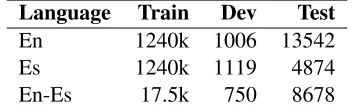
All our experiments are done on En and Es tweets, which are primarily drawn from two existing datasets: (Rijhwani et al.,2017) for monolingual training data, and (Solorio et al., 2014) for CS training data, and all dev and test datasets. Since we define LID as a classification problem, we con-sider each word with its context as an instance (instead of each tweet as an instance). Further, we differentiate between CS and monolingual in-stances as those where the context (a window of 2k
words around the target word) has or does not have a code-switch point, respectively. Table1 summa-rizes the size of the datasets. There are total 1328 switching points in the CS test data.
4.2 DNN Architecture
Fig. 1 shows the architecture of the DNN for LID. The model takes 2k+ 1 word window in-put with target word at the center, and predicts the language of the target word. In this word-context block, all the input words are projected into a
dw dimensional word-embedding space. The
em-bedding vectors of the k words in the left and
right contexts are averaged separately. These left-average, right-average and the current word em-bedding are merged into one3dwdimensional
vec-tor. This vector is passed to an intermediate Dense layer (with ReLu activation) ofdimdimension. To
speed up the convergence of the network, we add a batch normalization layer. Also, a dropout layer with 0.3 probability is introduced to prevent over-fitting. Finally, a softmax layer with two nodes, one for each language,l1 andl2, is used for
pre-dicting the output.
We define another architecture - the Char-LID modelwhere this basic LID model is augmented with a character-context block (as shown in the dashed box in the Fig. 1). We embed charac-ter tri-grams into adcdimensional space; an
[image:4.612.315.535.41.228.2]av-erage of all the character tri-grams of the target word is then concatenated with the embeddings of
Figure 1: DNN achitecture for LID
the first and last trigrams to generate a3dc
dimen-sional character-representation vector of the target word. In the Char-LID model, this vector is con-catenated to the aforementioned3dw dimensional
word vector, and is fed as the input to the interme-diate dense layer. Rest of the network is identical to the LID model. We expect the Char-LID model to work better for out-of-vocabulary words.
4.3 Experiments
The networks were implemented, trained and tested using the Microsoft’s Cognitive Toolkit (CNTK)(Yu et al.,2014). For all our experiments, we set2k = 3,d
w = 100, dc = 40,dim = 140,
and dropout rate = 0.3. The networks are trained using mean square error loss and Adadelta SGD under default parameter settings of CNTK. The word and character vectors were initialized uni-formly randomly.
Note that we do not use the DNN to predict the
X labels, as these are identified through regular
expressions during the pre-processing of the data and are never used as target words during training or testing. Details of how we handle the special and boundary cases (e.g., out-of-vocabulary words and contexts for target words in the beginning and end of a sentence) are discussed in the supplemen-tary material.
For each curriculum, we train the models for 20 epochs and choose the model that has maximum overall accuracy on the dev set. For curricula in-volving interleaving of instances of different types (e.g., C4 to C7), we presented the training data 2Experiments with different values of these parameters
led us to these numbers which seem to work well.
Curriculum All En-Es En Es LID Model
C0:T12 89.1 86.6 89.1 93.4
C1:T1;T2 37.0 48.3 17.8 70.3
C2:T12;T1;T2 35.4 54.2 0.1 100
C3:T1;T2;T12 84.1 78.0 95.5 63.6
C4:{T1, T2} 94.7 87.0 99.6 96.3
C5:T12;{T1, T2} 94.8 86.7 99.3 96.7
C6:{T1, T2};T12 95.1 89.1 98.8 95.8
C7:{T1, T2, T12} 94.4 87.7 97.5 97.4
Char-LID Model
C4:{T1, T2} 95.5 87.6 99.7 97.7
C5:T12;{T1, T2} 95.5 87.3 99.7 98.4
C6:{T1, T2};T12 97.1 93.7 98.7 98.3
[image:5.612.79.303.38.243.2]C7:{T1, T2, T12} 96.2 89.6 99.7 98.2
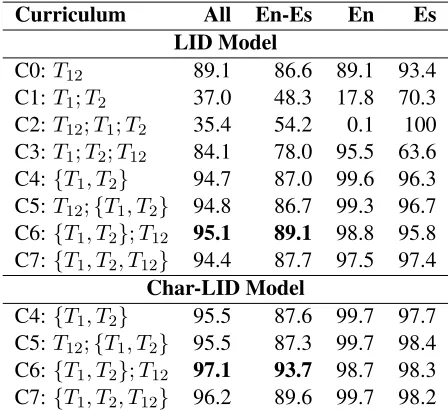
Table 2: Curriculum training accuracies (in %) for LID and Char-LID models. The maximum accu-racy for the models are in bold and are statistically significantly higher (p <0.001) than all other
val-ues in the column for that model.
to the network in randomized order. Thus, every minibatch is expected to contain the instances in ratio|T1| : |T2|. Since the |T12|training data is
significantly low compared to |T1| and |T2|, we oversample T12 by replicating the data 10 times
for curriculum C7. For curricula that involves or-dering of inputs by blocks (all except C4 and C7), we first train on the first block of instances for 20 epochs and choose the best model which is trained on the next block of instances for 20 epochs.
4.4 Results
In Table2we report thel1andl2labeling accuracy
on the En, Es and En-Es CS test sets, as well as the combined accuracy (column 1) on all the test instances. Due to the significantly poorer perfor-mance of C1, C2 and C3 for the LID model, these experiments were not conducted for the char-LID model. For C0, overall accuracy for the Char-LID model is 94.5% (Table3).
The key observations from Table2are: (a) cur-riculum C6 is most effective across the models; the performance on CS set increases significantly with only a marginal drop in accuracy on the monolin-gual data; (b) C6 achieves an 11% (55%) and 23% (47%) error reduction over the baseline curriculum C7 (C0) for the LID and Char-LID models respec-tively; (c) The improvements are highly significant atp <0.001for a paired t-test, which implies that
C6 is able to correct labeling errors made by C7 and other curricula, and hardly makes new label-ing errors; (d) Providlabel-ing the CS trainlabel-ing data as the last block is much more effective than providing it in the beginning or distributing it over the entire training curriculum; (e) On the other hand, mixing of monolingual data is more effective than provid-ing them in block; (f) Finally, it is also interest-ing to note that curriculum C4, where only mono-lingual training data is used, achieves reasonably high accuracies.
We manually inspected around 100 erroneously labeled words by the best C6 model. There are three noticeable error patterns: (a) errors around an X tag (approx. 15%), (b) errors at or near the interjections such as ”haha”, ”jaja”, ”lmao” etc. (approx. 15%), and (c) errors near the code-switch point and sentence boundaries (approx. 25%). Rest of the errors didn’t have any noticeable pat-tern, though we also discovered that some of the system labels classified as errors were actually correct and rather the gold standard label was in-correct (approx. 5%).
We also conduct two auxiliary sets of exper-iments to understand the effect of the ratio of monolingual training instances (|T1| : |T2|) and
that of the CS data to monolingual data (|T12| : |T1 ∪T2|). In the first experiment, we train the
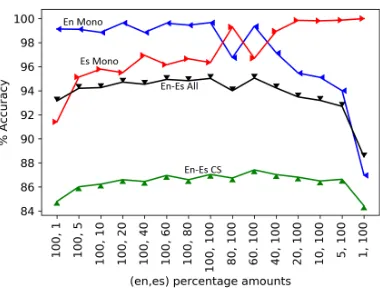
LID model where we vary the percentage of train-ing instances used from the En and Es monolin-gual datasets. The results are shown in Fig. 2. In the x-axis, we plot the percentage of training in-stances used from the En and Es training sets dur-ing each experiment, where En fractions (the first value in the tuple) increases from right to left, Es fractions (the second value) from left to right. It is evident from the plot that the system performance is not strongly sensitive to the ratio of|T1|:|T2|. Rather, it is more sensitive to the absolute amount of data available for training; when the data for either T1 orT2 drops significantly (less than 1%
of the training set here, as in the extremes of the plot), the accuracy is affected significantly.
Figure 2: en-es Skew experiment using Curricu-lum C4 in LID model
% of % of|T1|and|T2| |T12| 0 0.1 1 10
20 89.5 93.3 94.4 95.8
50 92.5 93.6 95.4 95.9
100 94.5 93.3 95.1 96.1
Table 3: Overall accuracy of the Char-LID model for C7 with varying amounts of training data.
much more pronounced (i.e., systematic increase of accuracy in each row from left to right) than that of CS data. This could be because of much higher sizes of the monolingual training sets as compared to the CS dataset.
We have also conducted some of these experi-ments with English-French CS data, which shows similar trends. Reader may refer to the supple-mentary material for more details.
4.5 Related Work on LID
There have been many works on LID for CS. See (Solorio et al.,2014;Molina et al.,2016; Rijh-wani et al.,2017) and references therein. Two sys-tems (Samih et al.,2016;Jaech et al., 2016) sub-mitted in the shared task on language detection in EMNLP 2016 use deep learning based techniques.
Samih et al. (2016) uses LSTMs on top of word and character context with a CRF classifier and achieves an accuracy of 96.3% on the same En-Es test set.Jaech et al.(2016) uses only the character sequence data with stacked CNNs to create a word embedding. Then it creates a global context by adding a bi-directional LSTM on top of it. Their system achieves 94.6 average F1 score for En-Es.
Chang and Lin(2014describes an RNN based sys-tem which is trained and tested on the EMNLP
2014 shared task dataset. This system outperforms all the submitted systems in that shared task.
The EMNLP shared task dataset had 6 labels in-cluding named entities and mixed language words which we did not consider in this work. Therefore, even though we evaluate on the same dataset, the accuracies are not directly comparable. However, since majority of the tokens are labeled En and Es, our results are certainly comparable to these state-of-the-art systems. Rijhwani et al. (2017) uses HMM model initialized by monolingual data and retrained it on unlabeled data using Baum-Welch algorithm. It achieves an average F-1 score of 97.8% for En and Es labels, which is only slightly better than our best performing system. However, the models described here do not use the unlabeled data, incorporating which could be an interesting future direction for this research.
5 Language Modeling
Statistical Language Models estimate the prob-ability of a word sequence given a large train-ing corpus. Language Modeling has applica-tions in various NLP and Speech processing tasks, most notably in MT and ASR. In this section, we describe experiments on building En-Es code-switched LM.
5.1 Datasets
Similar to our LID experiment datasets described in Table 1, we use the En and Es monolingual tweets from (Rijhwani et al.,2017) (described as the weakly-labeled data in the paper), and the language-labeled CS data from (Solorio et al.,
2014) for training. However, unlike the LID ex-periments, here a tweet, rather than a word, is con-sidered as an instance; any tweet with CS is a part of the CS training instance. Since we do not need the language labels for the LM training experi-ments, the tweets were stripped off those labels. We used 212k En tweets, 92k Es tweets and 798 En-Es CS tweets as training data. The amount of CS data used is a very small fraction (0.2%) of the size of the monolingual data and the amount of En data is more than double the Es data.
[image:6.612.108.272.243.314.2]−to compare the LMs (lower the better).
5.2 Models
We train both RNNLMs and ngram language mod-els on the same data to compare their perfor-mances on various training data curricula.
We use the RNNLM toolkit (Mikolov et al.,
2011) to train and test all our RNNLM models. The ngram models are also built with the same toolkit, which invokes the SRILM toolkit (Stolcke et al., 2002). During our initial experiments on finding the appropriate curriculum for training CS LMs, we use the single iteration recipe provided in the RNNLM toolkit. In this setting, the learn-ing rate is manually set to decrease after 4 epochs and no validation data is used.
We then use the regular LM training recipe in the RNNLM toolkit that makes use of a validation data set. We adjust the values of various hyper-parameters in our experiments. One crucial pa-rameter we adjust is the number of classes (700), according to a rule of thumb saying that the num-ber of classes should be approximately the square root of the vocabulary size. By doing this, we sac-rifice accuracy for speed of training our models; since the aim here is to analyze the trends rather than look at the absolute values, we believe this is a reasonable policy. Our models have a very large vocabulary size owing to the presence of two lan-guages and also due to large amount of spelling variations found in tweets. For the experiments with a single iteration, our models have 150 hid-den layers. Other hyper parameters are kept at their default values in the corresponding recipes in the RNNLM toolkit. In our final experiments with the full iteration recipe, we used CS data as validation and 100 hidden layers.
5.3 Experiments
We experiment with all the training curricula de-scribed in Sec.3, except C5 because from our ex-periments with C2 and C3, we find that adding CS data at the beginning produces worse results. For experiments involving{T1, T2}(i.e., curricula C4
and C6), we provide the input by interleaving the tweets fromT1andT2. Since En has almost twice
as many tweets as Es, the extra En tweets that re-main after interleaving all the Es tweets, are sim-ply appended to the training set. Finally, since we have very little CS data as compared to the mono-lingual data, for curriculum C7 we replicate the entireT12 dataset after every 10k instances from
{T1, T2}. Thus, we use 30 replicas of {T12} in
this curriculum. In addition to these curricula, we also build a baseline using only CS data (C0).
We build all the six models using the RNNLM single iteration setting first. Then, we build mod-els for the best performing curriculum using the multiple iteration recipe. In addition, we build 5-gram models for all the 6 curricula and the C0 baseline. However, since ngram models do not de-pend on the ordering, there are only four unique corpora for training them: (1) with only monolin-gual data: T1 ∪ T2, which is comparable to the
models for curricula C1 and C4; (2) with monolin-gual and CS data without replication:T1∪T2∪T12,
which is comparable to RNNLMs built using cur-ricula C2, C3 and C6; and (3) monolingual data and with replicated CS data3: T
1∪T2∪30·T12,
which is comparable to the RNNLM trained using curriculum C7 (4) only code-switched data T12,
which is comparable to the RNNLM trained using only CS data (comparable to C0).
5.4 Results
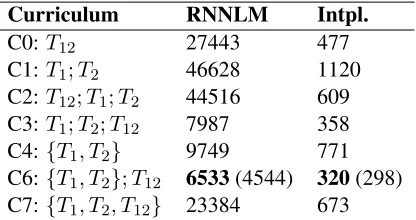
Table4shows the results of the LM experiments in terms of perplexity on the held-out test set. As we see from the numbers in first column, the best per-forming RNNLMs are those that are trained ini-tially with monolingual data and then trained with CS data (C3 and C6). The model that is trained initially with CS data and then with monolingual data (C2) performs as badly as the model that was trained with only monolingual data in blocks (C1). In addition, training models with alternate mono-lingual sentences gives better performance (C4, C5) than training it with large chunks of mono-lingual text (C1, C2). Training with monomono-lingual and CS data using curricula C3, C6 and C7 out-performs the CS-data only baseline (C0). Also, C4, that uses alternate sentences of monolingual data outperforms this baseline, probably due to the large difference in data size between the monolin-gual and CS data.
Although the PPL values for the RNNLM are very high, one must note that the test set consists entirely of CS sentences, whereas the amount of ”in-domain” (i.e., CS) data used in training is very low (0.2%). To improve our models, we build the best performing model, the one corresponding to C6, with multiple iterations; the PPL value for it is 3Since ngrams models strongly depend on frequency of
occurrence, we represent this using a slight abuse of notation to indicate 30 replications of theT12set
Curriculum RNNLM Intpl.
C0:T12 27443 477
C1:T1;T2 46628 1120
C2:T12;T1;T2 44516 609
C3:T1;T2;T12 7987 358
C4:{T1, T2} 9749 771 C6:{T1, T2};T12 6533(4544) 320(298)
[image:8.612.87.295.37.147.2]C7:{T1, T2, T12} 23384 673
Table 4: Perplexity results for RNNLM and inter-polated RNNLM+ngram LM. Values in parenthe-sis are for the multiple iteration model.
shown within parenthesis.
Table 4 (column 2) also shows the PPL for models obtained by interpolating the probabilities given by RNNLM and the 5-gram LM. The in-terpolation coefficient is kept fixed at 0.5. In all cases, the PPL of the ngram model is significantly lower than the RNNLM. For C1/C4, the 5-gram PPL is 915, for C2/C3/C6 it is 778 and for C7 it is 574. However, in all cases, interpolating the ngram model with the RNNLM gives the best re-sults. Experimenting with the interpolation coeffi-cient could potentially give better results.
5.5 Related Work on LM
Language Models for CS have been studied in the context of three main approaches: (a) Bilingual models that combine data from both languages, (b) Factored models that take into account strong in-dicators of CS like POS and LID, and (c) Mod-els that incorporate linguistic constraints for CS. Bilingual language models are typically trained using pooled text data (Weng et al.,1997). Geb-hardt (2011) describes a framework to use Fac-tored Language Models for rescoring n-best lists during decoding. The factors used include POS tags, CS point probability and LID.
In Adel et al.(2014b; 2014a; 2013) recurrent language models built on the same corpus are combined with n-gram based models, or converted to backoff models, giving improvements in per-plexity and mixed error rate. Li and Fung(2014) integrates Functional Head constraints for code-switching into the Language Model for decoding a Mandarin-English corpus.Li and Fung(2013) use inversion constraints to predict CS points and in-tegrates this prediction into the decoding process.
Our work is similar to the bilingual model ap-proach in that we pool data from both languages. However, we also add a very small amount of CS
data to our models in some of the experiments. In addition, we also focus on the ordering of the monolingual and CS data, which to our knowl-edge, none of the previous approaches do.
6 Discussion and Conclusion
The experiments presented here on the two tasks and three different DNN architectures show that across all these cases, C6: {T1, T2};T12 is the
most effective curriculum for training CS mod-els. C7: {T1, T2, T12} also performs quite well,
and in absence of CS data, C4: {T1, T2}seems to
be the most effective curriculum. Presenting the monolingual training instances in blocks produce the worst models, and neither is training with the CS data in the beginning any more effective than not using CS data at all.
This is similar to the findings reported in (Shi et al.,2015) in the context of RNNLM adaptation to specific domains. In general, empirical results on transfer learning of DNNs show that training with in-domain data at the end leads to better mod-els. This explains why training first with one lan-guage and then another is not ideal; in such cases the model adapts to the second language, as ob-served for C1, C2 and C3 in Table 2. For sim-ilar reasons, training with T12 at the beginning
provides no benefit. One could possibly argue that during training with {T1, T2} the upper
lay-ers (closer to input) of the networks learns the low level features of the languages. Then during the last phase of training withT12, the lower layers of
the network learns when to switch from one lan-guage to another, i.e., the CS specific features.
An interesting cognitive metaphor (albeit not an explanation) is as follows: an ideal bilingual is exposed to both the languages almost simultane-ously; such a user is able to code-switch even if never exposed to CS (as in C4); however, with exposure to CS, the frequency and perceived-naturalness of CS increases in his/her language use (as in C6). Of course, in multilingual communi-ties children grow up with both languages as well as CS between them (similar to C7). Thus, it is tempting to predict that with large amount of CS training data, i.e., when |T12| ≈ |T1| ≈ |T2|, C6
and C7 should perform equally well.
structure, etc., which could as well be harnessed for more effective curricula. Going forward, we would also like to explore techniques such as Self-paced learning (Kumar et al., 2010; Jiang et al.,
2015;Graves et al.,2017).
References
Heike Adel, K. Kirchhoff, N. T. Vu, D. Telaar, and T. Schultz. 2014a. Combining recurrent neural net-works and factored language models during decod-ing of code-switchdecod-ing speech. InINTERSPEECH. pages 1415–1419.
Heike Adel, K Kirchhoff, N T Vu, D Telaar, and T Schultz. 2014b. Comparing approaches to con-vert recurrent neural networks into backoff language models for efficient decoding. InINTERSPEECH. pages 651–655.
Heike Adel, N T Vu, and T Schultz. 2013. Combina-tion of recurrent neural networks and factored lan-guage models for code-switching lanlan-guage model-ing. InACL (2). pages 206–211.
Peter Auer. 1995. The pragmatics of code-switching: a sequential approach. In L. Milroy and P. Muysken, editors, One speaker, two languages, Cambridge Univ Press, pages 115–135.
Kalika Bali, Y. Vyas, J. Sharma, and M. Choudhury. 2014. ”I am borrowing ya mixing?” An analy-sis of English-Hindi code mixing in Facebook. In
Proc. First Workshop on Computational Approaches to Code Switching, EMNLP.
Yoshua Bengio, J. Louradour, R. Collobert, and J. We-ston. 2009. Curriculum learning. InThe 26th an-nual international conference on machine learning. ACM, pages 41–48.
Katja F Cantone. 2007. Code-switching in bilingual children, volume 296. Springer.
Joyce YC Chan, H. Cao, PC Ching, and T. Lee. 2009. Automatic recognition of cantonese-english code-mixing speech. Computational Linguistics and Chi-nese Language Processing14(3):281–304.
Joseph Chee Chang and Chu-Cheng Lin. 2014. Recurrent-neural-network for language detec-tion on twitter code-switching corpus. CoRR
abs/1412.4314.
Amitava Das. 2016. Tool contest on POS tagging for Code-mixed Indian Social Media Text. InICON.
Mona Diab, P. Fung, M. Ghoneim, J. Hirschberg, and T. Solorio, editors. 2016. Proc.of the 2nd Workshop on Computational Approaches to Code Switching.
Mona Diab, J. Hirschberg, P. Fung, and T. Solorio, ed-itors. 2014. Proc. of the 1st Workshop on Computa-tional Approaches to Code Switching. ACL.
Margreet Dorleijn. 2016. Can internet data help to un-cover developing preferred multilingual usage pat-terns? an exploration of data from turkish-dutch bilingual internet fora. Journal of Language Con-tact9(1):130–162.
Jeffrey L Elman. 1993. Learning and development in neural networks: The importance of starting small.
Cognition48(1):71–99.
Akshay Gadre, R. Begum, K. Bali, and M. Choudhury. 2016. Machine translating code mixed text: Pain points and sweet spots. InWILDRE.
Jan Gebhardt. 2011. Speech recognition on english-mandarin code-switching data using factored lan-guage models .
Javier Gonzalez-Dominguez, D Eustis, I Lopez-Moreno, A Senior, F Beaufays, and Pedro J Moreno. 2015. A real-time end-to-end multilingual speech recognition architecture. IEEE Journal of Selected Topics in Signal Processing9(4):749–759.
Alex Graves, M G Bellemare, J Menick, R Munos, and K Kavukcuoglu. 2017. Automated curricu-lum learning for neural networks. arXiv preprint arXiv:1704.03003.
Aaron Jaech, G Mulcaire, S Hathi, M Ostendorf, and N A Smith. 2016. A neural model for language iden-tification in code-switched tweets. EMNLP 2016
page 60.
Anupam Jamatia and A Das. 2014. Part-of-speech tag-ging system for Hindi social media text on twitter. In
The First Workshop on Language Technologies for Indian Social Media, ICON.
Anupam Jamatia, B Gambck, and A Das. 2015. Part-of-speech tagging for code-mixed english-hindi twitter and facebook chat messages. InRANLP.
Lu Jiang, D Meng, Q Zhao, S Shan, and A G Haupt-mann. 2015. Self-paced curriculum learning. In
AAAI. volume 2, page 6.
Melvin Johnson, M Schuster, Q V Le, M Krikun, Y Wu, Z Chen, N Thorat, F Vi´egas, M Wattenberg, G Corrado, et al. 2016. Google’s multilingual neu-ral machine translation system: Enabling zero-shot translation.arXiv preprint arXiv:1611.04558.
M Pawan Kumar, B Packer, and D Koller. 2010. Self-paced learning for latent variable models. In Ad-vances in Neural Information Processing Systems. pages 1189–1197.
Ying Li and P Fung. 2013. Improved mixed lan-guage speech recognition using asymmetric acoustic model and language model with code-switch inver-sion constraints. InICASSP. pages 7368–7372.
Ying Li and P Fung. 2014. Language modeling with functional head constraint for code switching speech recognition. InEMNLP.
Dau-Cheng Lyu, R-Y Lyu, Y-C Chiang, and C-N Hsu. 2006. Speech recognition on code-switching among the chinese dialects. In IEEE ICASSP 2006. vol-ume 1, pages I–I.
Tetyana Lyudovyk and Valeriy Pylypenko. 2014. Code-switching speech recognition for closely re-lated languages. InSLTU. pages 188–193.
Tomas Mikolov, S Kombrink, A Deoras, L Burget, and J Cernocky. 2011. RNNLM-recurrent neural net-work language modeling toolkit. In ASRU Work-shop 2011. pages 196–201.
Giovanni Molina, N Rey-Villamizar, T Solorio, F Al-Ghamdi, M Ghoneim, A Hawwari, and M Diab. 2016. Overview for the second shared task on lan-guage identification in code-switched data. EMNLP 2016page 40.
Carol Myers-Scotton. 1993. Dueling Languages: Grammatical Structure in Code-Switching. Clare-don, Oxford.
Shruti Rijhwani, R Sequiera, M Choudhury, K Bali, and C S Maddila. 2017. Estimating code-switching on Twitter with a novel generalized word-level lan-guage identification technique. InACL.
Koustav Rudra, S Rijhwani, R Begum, K Bali, M Choudhury, and N Ganguly. 2016. Understand-ing language preference for expression of opinion and sentiment: What do Hindi-English speakers do on Twitter? InEMNLP. pages 1131–1141.
Younes Samih, S Maharjan, M Attia, L Kallmeyer, and T Solorio. 2016. Multilingual code-switching iden-tification via lstm recurrent neural networks. In2nd Workshop on Computational Approaches to Code Switching,. pages 50–59.
Royal Sequiera, M Choudhury, and K Bali. 2015a. Pos tagging of Hindi-English code mixed text from so-cial media: Some machine learning experiments. In
Proceedings of ICON.
Royal Sequiera et al. 2015b. Overview of fire-2015 shared task on mixed script information retrieval. In
FIRE. pages 21–27.
Shashank Sharma, P Srinivas, and R C Balabantaray. 2015. Text normalization of code mix and sentiment analysis. InICACCI, 2015 International Conference on. IEEE, pages 1468–1473.
Yangyang Shi, M Larson, and C M Jonker. 2015. Re-current neural network language model adaptation with curriculum learning. Computer Speech & Lan-guage33(1):136–154.
Thamar Solorio and Yang Liu. 2008. Part-of-speech tagging for english-spanish code-switched text. In
Proc. of EMNLP.
Thamar Solorio et al. 2014. Overview for the first shared task on language identification in code-switched data. In 1st Workshop on Computational Approaches to Code Switching, EMNLPpages 62– 72.
Valentin I Spitkovsky, H Alshawi, and D Jurafsky. 2009. Baby steps: How less is more in unsupervised dependency parsing. NIPS: Grammar Induction, Representation of Language and Language Learn-ingpages 1–10.
Andreas Stolcke et al. 2002. SRILM-an extensible language modeling toolkit. InInterspeech. volume 2002, page 2002.
Yogarshi Vyas, S Gella, J Sharma, K Bali, and M Choudhury. 2014. POS Tagging of English-Hindi Code-Mixed Social Media Content. InProc. EMNLP. pages 974–979.
Fuliang Weng, H Bratt, L Neumeyer, and A Stolcke. 1997. A study of multilingual speech recognition. In EUROSPEECH. Citeseer, volume 1997, pages 359–362.
Dong Yu, A Eversole, M Seltzer, K Yao, Z Huang, B Guenter, O Kuchaiev, Y Zhang, F Seide, H Wang, et al. 2014. An introduction to computational net-works and the computational network toolkit. Mi-crosoft Technical Report MSR-TR-2014–112.