Language Identification in Code-Switched Text
Using Conditional Random Fields and Babelnet
Utpal Kumar Sikdar and Bj¨orn Gamb¨ack
Department of Computer and Information Science Norwegian University of Science and Technology
Trondheim, Norway
{sikdar.utpal,gamback}@idi.ntnu.no
Abstract
The paper outlines a supervised approach to language identification in code-switched data, framing this as a sequence labeling task where the label of each token is identified using a classifier based on Conditional Random Fields and trained on a range of different features, extracted both from the training data and by using information from Babelnet and Babelfy. The method was tested on the develop-ment dataset provided by organizers of the shared task on language identification in code-switched data, obtaining tweet level monolin-gual, code-switched and weighted F1-scores of 94%, 85% and 91%, respectively, with a token level accuracy of 95.8%. When eval-uated on the unseen test data, the system achieved 90%, 85% and 87.4% monolingual, code-switched and weighted tweet level F1-scores, and a token level accuracy of 95.7%.
1 Introduction
Today many short messages contain words from dif-ferent languages and it is a challenging task to iden-tify which languages the different words are written in. Often the messages contain text snippets from several languages, that is, showing code-switching. Sometimes the messages even contain code-mixing, where there is a mix of the languages inside a single utterance or even inside a token itself.
The first code-switching data challenge was orga-nized at EMNLP 2014 (Solorio et al., 2014). The task was to identify the language for each word in a text, classifying the words according to six la-bels: ‘Lang1’, ‘Lang2’, ‘Mixed’, ‘NE’, ‘Other’, and
‘Ambiguous’. The first two labels identify tokens from the main languages that are mixed in the text, while the third is for tokens with word-internal mix-ing between these languages; ‘NE’ for named enti-ties; ‘Other’ for language independent tokens (punc-tuation, numbers, etc.) and tokens from other lan-guages, and ‘Ambiguous’ denotes tokens that cannot safely be assigned any (or only one) of the other la-bels. This shared task was organized again this year (Molina et al., 2016), with new datasets and slightly different labels, adding ‘Unk’ for unknown tokens.1 Work on developing tools for automatic lan-guage identification was initiated already in the 1960s (Gold, 1967), and although analysing code-switched text is a research area which has started to achieve wide-spread attention only in recent years, the first work in the field was carried out over thirty years ago by Joshi (1982), while Ben-tahila and Davies (1983) examined the syntax of the intra-sentential code-switching between Arabic and French. They claimed that Arabic-French code-switching was possible at all syntactic boundaries above the word level.
Das and Gamb¨ack (2013) give a comprehen-sive overview of the work on code-switching un-til 2015. Notably, Solorio and Liu (2008) trained classifiers to predict code-switching points in Span-ish and EnglSpan-ish, using different learning algorithms and transcriptions of code-switched discourse, while Nguyen and Do˘gru¨oz (2013) focused on word-level language identification (in Dutch-Turkish news commentary). Nguyen and Cornips (2016) describe
1An eighth label ‘FW’ was included for foreign words, but no words in the English-Spanish corpora were tagged with it.
work on analyzing and detecting intra-word code-mixing by first segmenting words into smaller units and later identifying words composed of sequences of subunits associated with different languages in tweets(posts on the Twitter social-media site).
The paper is organized as follows: Section 2 pro-vides a description of the language identification method, whereby a supervised model was built using Conditional Random Fields to classify each token in a tweet into one of the seven categories based on different features, most of which are extracted from the training data, as described in Section 3. Results are then presented and discussed in Section 4, while Section 5 addresses future work and concludes.
2 Language Identification Method
The language identification system was built around a Conditional Random Field (CRF) classifier. We used the C++-based CRF++package (Kudo, 2013),
a simple, customizable, and open source implemen-tation of Conditional Random Fields for segment-ing or labellsegment-ing sequential data. Conditional Ran-dom Fields (Lafferty et al., 2001) are conditional, undirected graphical models that can easily incor-porate a large number of arbitrary, non-independent features while still having efficient procedures for non-greedy finite-state inference and training.
Conditional Random Fields calculate the condi-tional probability of values on designated output nodes given the values of (other) designated input nodes. The conditional probability of a state se-quences=< s1, s2, . . . , sT >given an observation sequenceo=< o1, o2, . . . , oT >is calculated as in Equation 1 (McCallum, 2003):
P∧(s|o) = Z1 o exp(
T X
t=1 K X
k=1
λk×fk(st−1, st, o, t)) (1) wherefk(st−1, st, o, t) is a feature function whose weightλk, is to be learned via training. The feature function values may range from−∞to+∞.
To make all the conditional probabilities sum up to 1, the normalization factorZois calculated in the same fashion as in HMMs (Hidden Markov Mod-els), that is, as given by Equation 2.
Zo= X
s exp(
T X
t=1 K X
k=1
λk×fk(st−1, st, o, t)) (2)
To train a CRF, the objective function to be maxi-mized is the penalized log-likelihood of the state se-quences given the observation sese-quences:
L∧ = N X
i=1
log(P∧(s(i)|o(i)))− K X
k=1 λ2
k 2σ2 (3)
where{< o(i), s(i) >}is the labelled training data.
The second sum corresponds to a zero-mean, σ2
-variance Gaussian prior over parameters, which fa-cilitates optimization by making the likelihood sur-face strictly convex. Here, we set the parameter
λ to maximize the penalized log-likelihood using Limited-memory BFGS (Sha and Pereira, 2003), a quasi-Newton method that is highly efficient, and which results in only minor changes in accuracy due to changes inλ.
2.1 Features based on training data
Two sets of features were developed to train the model: one extracted from the training data and the other based on information from Babelnet (Navigli and Ponzetto, 2012) and Babelfy (Moro et al., 2014), with most of the features and their settings being based on the training data. The complete set of fea-tures induced from training data was as follows: Local context. Local contexts play an important
role for identifying the languages. Here the two preceding and two succeeding words were used as local context.
Word suffix and prefix. Fixed length characters stripped from the beginning and ending of the current word. Up to 4 characters were removed. Word length. Analysis of the training data showed that the Spanish words on average were shorter than the English words. Words with 1–4 char-acters were flagged with a binary feature. Word previously occurred. A binary feature
which checks if a word already occurred in the training data or not.
All capitals. A binary feature which is set if the cur-rent word contains only capital letters. The fea-ture is very helpful for identifying named en-tities (since, e.g., abbreviations often refer to named entities).
Single capital letter: checks if the word contains a single capital letter or not.
All digits: set to 1 if the word contains only numer-ical characters. This is helpful for identifying tokens belonging to the ‘Other’ category. Alphanumeric: a binary feature which flags if
the word contains only digits and alphabetical characters together.
All English alphabet: checks if all a word’s char-acters belong to the English alphabet.
Special Spanish character: a flag which is set if the current word contains any Spanish-specific letters (´a, ´e, etc.).
Hash symbol: set to 1 if a word contains the sym-bol ‘#’, otherwise 0.
Rate symbol: set to 1 if the current word contains the symbol ‘@’.
Word with single letter. Many single letter words were observed to belong to Spanish, so this flag is set if the word length is exactly 1.
Two consecutive letters. Some words repeat two character sequences several times (e.g., ha-haha,jaja). Each token is split into two char-acter sequences and this binary feature is set if each two letter character sequences matches. Same letter occurred multiple times. Many
words in tweets contain sequences of the same character repeated many times (e.g., ewww, yaaaas). The feature is set if a letter occurred in a word more than two times consecutively. Gazetteer NE list. A list of named entities (NE)
was collected from the training data. This flag is set if a token matches an item on the NE list. Special character list. A list of special characters (e.g., emojis) was collected from the training data. If a tokens contains any character which is on the list, the binary feature is set.
2.2 Babelnet and Babelfy features
Three further features were developed from external resource, Babelnet (Navigli and Ponzetto, 2012) and Babelfy (Moro et al., 2014):
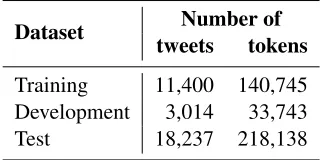
Dataset tweetsNumber oftokens
Training 11,400 140,745
Development 3,014 33,743
[image:3.612.342.504.61.141.2]Test 18,237 218,138
Table 1:Statistics of the tweet datasets
WordNet feature: Every token is passed to the Babelnet database for checking whether the to-ken exists in the English WordNet or not. If the token appears in the database, the feature is set to 1, otherwise to 0.
Multilingual WordNet: The Babelnet Multilingual WordNet is checked for Spanish, by passing each token to the Babelnet database and check-ing whether the token is present in the database or not.
Babelfy Named Entity: Named entities are ex-tracted from Babelfy and used as a feature, which is utilized for identification of the ‘NE’ category tokens.
3 Datasets
We used the datasets provided by the organizers of the EMNLP 2016 code-switching workshop shared task on language identification in code-switched data (Molina et al., 2016).2
Three types of data were provided: training, de-velopment and test. In the training and dede-velopment datasets, the total number of tweets are 11,400 and 3,014, respectively, with language identification off-sets given for each category. In the test data, the total number of tweets is 18,237 without annotations.
The number of tweets and the number of tokens in each of the three datasets are given in Table 1.
4 Results
We developed a supervised model for language iden-tification using the CRF++ classifier, implemented the different features described above, and trained the CRF++ classifier using these features. Initially, the classifier was trained using the training data and tested on the development data for Spanish-English.
System setup PMono-lingualR F Code-switched Weighted Token-level
1 P R F1 F1 Accuracy
Without external resources 0.94 0.92 0.93 0.82 0.85 0.83 0.904 0.943
[image:4.612.90.519.63.127.2]With external resources 0.95 0.93 0.94 0.82 0.87 0.85 0.911 0.952
Table 2:System performance on the development data, with and without the external resources (Babelnet and Babelfy)
Team Accuracy
IIIT Hyderabad 0.961
NepSwitch 0.958
NTNU 0.957
HHU-UH-G 0.953
Howard U 0.951
McGill U 0.941
UW group 0.926
GWU* 0.918
Arunavha Chana 0.527
Team lingual switchedMono- Code- Weighted
Howard U 0.90 0.87 0.890
IIIT Hyderabad 0.90 0.86 0.886
HHU-UH-G 0.90 0.85 0.878
NTNU 0.90 0.85 0.874
NepSwitch 0.89 0.85 0.870
McGill U 0.86 0.78 0.820
UW group 0.78 0.78 0.780
Arunavha Chana 0.80 0.71 0.760
GWU* 0.93 0.54 0.740
Table 3:Token level accuracy (left) and tweet level F1scores (right) on the test data for all participating systems
There were two types of evaluation, at tweet level and at token level. The tweet level precision (P), re-call (R) and F1-scores obtained on the monolingual
part of the development data were 95%, 93% and 94%, respectively. On the code-switched part of that data, the precision, recall and F1-scores were 82%,
87% and 85%, giving a weighted, total F1-score of
91.1%. For token level evaluation, the development data accuracy was 95.2%, as shown in Table 2.
Table 2 also gives the development data scores for a system trained without the second feature set, i.e., without the Babelnet and Babelfy features. As can be seen in the table, the contribution from those fea-tures is small but useful, adding 0.9% to the token-level accuracy and 0.7% to the tweet-token-level weighted F1 score, with the main contribution (2%) being on
recall for the tweets containing code-switching. Applying our system (NTNU) to the test data, the tweet level monolingual, code-switched and weighted F1-scores were 90%, 85% and 87.4%, with
a token level accuracy performance of 95.7%. A comparison of the results of the different sys-tems participating in the shared task is given in Ta-ble 3, for both token level and tweet level evaluation, with the performance of our system marked in bold face. For token level evaluation, the NTNU system
achieved third place in the shared task, with an ac-curacy difference between our system and the best performing system (IIIT Hyderabad) of only 0.4%.
At the tweet level, the NTNU system performed on par with the best systems on the monolingual tweets, while it scored 2% lower on the tweets that contained some code-switching, giving it fourth place on weighted F1-score. However, as can be
seen from the tables, the top-5 teams actually ob-tained very similar performance on all measures, and both at token and tweet level.
5 Conclusion
For this shared task, we have outlined an approach using a CRF based system for language identifica-tion in code-switched data, implementing a range of different features and achieving state-of-the-art results. Most of the features are extracted directly from training data, while some are induced by using Babelnet and Babelfy as external resources.
[image:4.612.85.503.162.320.2]References
Abdelˆali Bentahila and Eirlys E. Davies. 1983. The syntax of Arabic-French code-switching. Lingua, 59:301–330.
Amitava Das and Bj¨orn Gamb¨ack. 2013. Code-mixing in social media text: The last language identifica-tion frontier? Traitement Automatique des Langues, 54(3):41–64.
E. Mark Gold. 1967. Language identification in the limit.Information and Control, 10(5):447–474. Aravind K. Joshi. 1982. Processing of sentences with
intra-sentential code-switching. In Proceedings of the 9th International Conference on Computational Linguistics, pages 145–150, Prague, Czechoslovakia, July. ACL.
Taku Kudo. 2013. CRF++: Yet another CRF toolkit.
http://taku910.github.io.
John D. Lafferty, Andrew McCallum, and Fernando C. N. Pereira. 2001. Conditional Random Fields: Probabilistic models for segmenting and labeling se-quence data. In Proceedings of the 18th Interna-tional Conference on Machine Learning, pages 282– 289, Williamstown, Maryland, USA, June.
Andrew McCallum. 2003. Efficiently inducing features of Conditional Random Fields. InProceedings of the 19th Conference on Uncertainty in Articifical Intel-ligence, pages 403–410, Acapulco, Mexico, August. Association for Uncertainty in Artificial Intelligence. Giovanni Molina, Fahad AlGhamdi, Mahmoud
Ghoneim, Abdelati Hawwari, Nicolas Rey-Villamizar, Mona Diab, and Thamar Solorio. 2016. Overview for the second shared task on language identification in code-switched data. In Proceedings of the 2016 Conference on Empirical Methods in Natural Lan-guage Processing, Austin, Texas, November. ACL. 2nd Workshop on Computational Approaches to Linguistic Code Switching.
Andrea Moro, Alessandro Raganato, and Roberto Nav-igli. 2014. Entity linking meets word sense
disam-biguation: a unified approach.Transactions of the As-sociation for Computational Linguistics, 2:231–244. Roberto Navigli and Simone Paolo Ponzetto. 2012.
BabelNet: The automatic construction, evaluation and application of a wide-coverage multilingual semantic network.Artificial Intelligence, 193:217–250. Dong Nguyen and Leonie Cornips. 2016. Automatic
detection of intra-word code-switching. In Proceed-ings of the 14th Annual SIGMORPHON Workshop on Computational Research in Phonetics, Phonology, and Morphology, pages 82–86.
Dong Nguyen and A. Seza Do˘gru¨oz. 2013. Word level language identification in online multilingual commu-nication. InProceedings of the 2013 Conference on Empirical Methods in Natural Language Processing, pages 857–862, Seattle, Washington, October. ACL. Fei Sha and Fernando C. N. Pereira. 2003. Shallow
pars-ing with Conditional Random Fields. InProceedings of the 2003 Human Language Technology Conference of the North American Chapter of the Association for Computational Linguistics, pages 134–141, Edmon-ton, Alberta, May. ACL.
Thamar Solorio and Yang Liu. 2008. Learning to pre-dict code-switching points. InProceedings of the 2008 Conference on Empirical Methods in Natural Lan-guage Processing, pages 973–981, Honolulu, Hawaii, October. ACL.