Proceedings of the 2019 Conference on Empirical Methods in Natural Language Processing 4601
CAN: Constrained Attention Networks for Multi-Aspect Sentiment
Analysis
Mengting Hu1∗ Shiwan Zhao2† Li Zhang2 Keke Cai2 Zhong Su2 Renhong Cheng1 Xiaowei Shen2
1 Nankai University 2 IBM Research - China
[email protected],{zhaosw, lizhang, caikeke, suzhong}@cn.ibm.com
[email protected], [email protected]
Abstract
Aspect level sentiment classification is a fine-grained sentiment analysis task. To detect the sentiment towards a particular aspect in a sentence, previous studies have developed various attention-based methods for generat-ing aspect-specific sentence representations. However, the attention may inherently intro-duce noise and downgrade the performance. In this paper, we propose constrained atten-tion networks (CAN), a simple yet effective solution, to regularize the attention for multi-aspect sentiment analysis, which alleviates the drawback of the attention mechanism. Specif-ically, we introduce orthogonal regularization on multiple aspects and sparse regularization on each single aspect. Experimental results on two public datasets demonstrate the effective-ness of our approach. We further extend our approach to multi-task settings and outperform the state-of-the-art methods.
1 Introduction
Sentiment analysis (Nasukawa and Yi,2003;Liu,
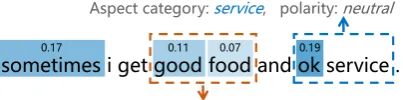
2012), an important task in natural language understanding, receives much attention in re-cent years. Aspect level sentiment classification (ALSC) is a fine-grained sentiment analysis task, which aims at detecting the sentiment towards a particular aspect in a sentence. ALSC is es-pecially critical for multi-aspect sentences which contain multiple aspects. A multi-aspect sen-tence can be categorized as overlapping or non-overlapping. A sentence is annotated as non-overlapping if any two of its aspects have no over-lap. Our study found that around85%of the multi-aspect sentences are non-overlapping in the two public datasets. Figure 1 shows a simple exam-ple. The non-overlapping sentence contains two
∗
This work was done when Mengting Hu was a research intern at IBM Research - China.
†
Corresponding author.
Aspect category: service, polarity: neutral
Aspect category: food, polarity: positive
0.17 0.11 0.07 0.19
[image:1.595.317.519.223.273.2]sometimes i get good food and ok service .
Figure 1: Example of a non-overlapping sentence. The attention weights of the aspectfoodare from the model ATAE-LSTM (Wang et al.,2016).
aspects. The aspectfoodis on the left side of the aspect service. Their distributions on words are
orthogonalto each other. Another observation is
that only a few words relate to the opinion expres-sion in each aspect. As shown in Figure 1, only the word“good”is relevant to the aspectfoodand
“ok” toservice. The distribution of the opinion expression of each aspect issparse.
To detect the sentiment towards a particular as-pect, previous studies (Wang et al.,2016;Ma et al.,
2017;Cheng et al.,2017;Ma et al.,2018;Huang et al., 2018) have developed various attention-based methods for generating aspect-specific sen-tence representations. In these works, the attention may inherently introduce noise and downgrade the performance (Li et al., 2018) since the attention scatters across the whole sentence and is prone to attend on noisy words, or the opinion words from other aspects. Take Figure1 as an example, for the aspectfood, we visualize the attention weights from the model (Wang et al.,2016). Much of the attention focuses on the noisy word“sometimes”, and the opinion word“ok”which is relevant to the aspectservicerather thanfood.
as-pects. The orthogonal regularization tends to make the attention weights of multiple aspects concentrate on different parts of the sentence with less overlap. We also introduce the sparse reg-ularization, which tends to make the attention weights of each aspect concentrate only on a few words. We call our networks with such regu-larizationsconstrained attention networks(CAN). There have been some works on introducing spar-sity in attention weights in machine translation (Malaviya et al.,2018) and orthogonal constraints in domain adaptation (Bousmalis et al.,2016). In this paper, we add both sparse and orthogonal reg-ularizations in a unified form inspired by the work (Lin et al.,2017). The details will be introduced in Section3.
In addition to aspect level sentiment classifica-tion (ALSC), aspect category detecclassifica-tion (ACD) is another task of aspect based sentiment analysis. ACD (Zhou et al., 2015; Schouten et al., 2018) aims to identify the aspect categories discussed in a given sentence from a predefined set of aspect categories (e.g., price, food, service). Take Fig-ure 1 as an example, aspect categories food and
service are mentioned. We introduce ACD as an auxiliary task to assist the ALSC task, benefiting from the shared context of the two tasks. We also apply our attention constraints to the ACD task. By applying attention weight constraints to both ALSC and ACD tasks in an end-to-end network, we can further evaluate the effectiveness of CAN in multi-task settings.
In summary, the main contributions of our work are as follows:
• We propose CAN for multi-aspect sentiment analysis. Specifically, we introduce orthogo-nal and sparse regularizations to constrain the attention weight allocation, helping learn bet-ter aspect-specific sentence representations.
• We extend CAN to multi-task settings by in-troducing ACD as an auxiliary task, and ap-plying CAN on both ALSC and ACD tasks.
• Extensive experiments are conducted on pub-lic datasets. Results demonstrate the effec-tiveness of our approach for aspect level sen-timent classification.
2 Related Work
Aspect level sentiment analysisis a fine-grained
sentiment analysis task. Earlier methods are
usu-ally based on explicit features (Liu et al., 2010;
Vo and Zhang, 2015). With the development of deep learning technologies, various neural atten-tion mechanisms have been proposed to solve this fine-grained task (Wang et al.,2016;Ruder et al.,
2016; Ma et al., 2017; Tay et al., 2017; Cheng et al., 2017;Chen et al., 2017; Tay et al., 2018;
Ma et al.,2018;Wang and Lu,2018;Wang et al.,
2018). To name a few, Wang et al. (2016) pro-pose an attention-based LSTM network for aspect level sentiment classification. Ma et al. (2017) use the interactive attention networks to generate the representations for targets and contexts sepa-rately. Cheng et al. (2017); Ruder et al. (2016) both propose hierarchical neural network models for aspect level sentiment classification.Wang and Lu(2018) employ a segmentation attention based LSTM model for aspect level sentiment classifica-tion. All these works can be categorized as single-aspect sentiment analysis, which deals with as-pects in a sentence separately, without considering the relationship between aspects.
More recently, a few works have been proposed to take the relationship among multiple aspects into consideration. Hazarika et al. (2018) make simultaneous classification of all aspects in a sen-tence using recurrent networks. Majumder et al.
(2018) employ memory network to model the de-pendency of the target aspect with the other as-pects in the sentence. Fan et al. (2018) design an aspect alignment loss to enhance the difference of the attention weights towards the aspects which have the same context and different sentiment po-larities. In this paper, we introduce orthogonal regularization to constrain the attention weights of multiple non-overlapping aspects, as well as sparse regularization on each single aspect.
Multi-task learning Caruana (1997) solves
multiple learning tasks at the same time, achieving improved performance by exploiting commonali-ties and differences across tasks. Multi-task learn-ing has been used successfully in many machine learning applications. Huang and Zhong (2018) learn both main task and auxiliary task jointly with shared representations, achieving improved per-formance in question answering. Toshniwal et al.
(2017) use low-level auxiliary tasks for encoder-decoder based speech recognition, which suggests that the addition of auxiliary tasks can help in ei-ther optimization or generalization. Yu and Jiang
Word & Aspect
Embedding Layer LSTM Layer
Task-Specific Attention Layer
ALSC Attention Layer
Aspect-Specific Sentence Representation
ACD Attention Layer
Softmax
Sigmoid
Task-Specific Prediction Layer
α1
αK
β1
βN
…
{A1s,...,A K s}
{w1,w2,...,wL}
{A1,...,AN}
{v1,v2,...,vL}
{u1,...,uN}
{h1,h2,...,hL}
r1s
rKs
r1
…
rN
{u1s,...,u K s}
…
Regularization Layer
M∈!K×L
G∈!(K+1)×L
#K Classification
Loss
#N Classification
Loss +
+ Regularization
Loss
Regularization Loss
Loss
…
Aspect-Specific Sentence Representation
Softmax …
Sigmoid …
… …
[image:3.595.74.527.63.244.2]Regularization Layer
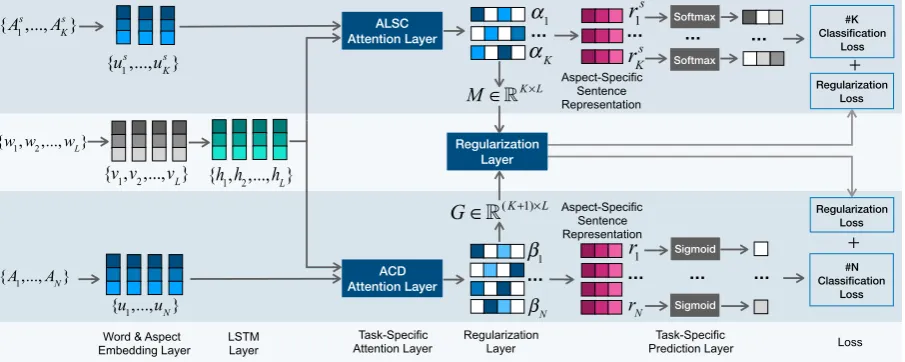
Figure 2: Network Architecture. The aspect categories are embedded as vectors. The model encodes the sentence using LSTM. Based on its hidden states, aspect-specific sentence representations for ALSC and ACD tasks are learned via constrained attention. Then aspect level sentiment prediction and aspect category detection are made.
sentence embedding that works well across do-mains for sentiment classification. In this paper, we adopt the multi-task learning approach by us-ing ACD as the auxiliary task to help the ALSC task.
3 Model
We first formulate the problem. There are to-tallyNpredefined aspect categories in the dataset,
A = {A1, ..., AN}. Given a sentence S =
{w1, w2, ..., wL}, which containsKaspectsAs=
{As
1, ..., AsK}, As ⊆ A, the multi-task learning is to simultaneously solve the ALSC and ACD tasks, namely, the ALSC task predicts the sentiment po-larity of each aspect As
k ∈ As, and the auxil-iary ACD task checks each aspectAn ∈Ato see whether the sentenceSmentions it. Note that we only focus on category instead of aspect-term (Xue and Li,2018) in this paper.
We propose CAN for multi-aspect sentiment analysis, supporting both ALSC and ACD tasks by a multi-task learning framework. The network ar-chitecture is shown in Figure2. We will introduce all components sequentially from left to right.
3.1 Embedding and LSTM Layers
Traditional single-aspect sentiment analysis han-dles each aspect separately, one at a time. In such settings, a sentence S with K aspects will be copied to form K instances. For example, a sentence S contains two aspects: As
1 with
polar-ity p1 and As2 with polarity p2. Two instances, hS, As
1, p1i and hS, As2, p2i, will be constructed.
Our multi-aspect sentiment analysis method han-dles multiple aspects together and takes the single instancehS,[As1, As2],[p1, p2]ias input.
The input sentence{w1, w2, ..., wL}is first con-verted to a sequence of vectors {v1, v2, ..., vL}, and the K aspects of the sentence are trans-formed to vectors {us
1, ..., usK}, which is a sub-set of{u1, ..., uN}, the vectors of all aspect cat-egories. The word embeddings of the sentence are then fed into an LSTM network (Hochreiter and Schmidhuber,1997), which outputs hidden states
H={h1, h2, ..., hL}. The sizes of the embedding and the hidden state are both set to bed.
3.2 Task-Specific Attention Layer
The ALSC and ACD tasks share the hidden states from the LSTM layer, while compute their own at-tention weights separately. The atat-tention weights are then used to compute aspect-specific sentence representations.
ALSC Attention LayerThe key idea of aspect
level sentiment classification is to learn different attention weights for different aspects, so that dif-ferent aspects can concentrate on difdif-ferent parts of the sentence. We follow the approach in the work (Bahdanau et al.,2015) to compute the attention. Particularly, given the sentenceSwithKaspects,
As ={As
1, ..., AsK}, for each aspectAsk, its atten-tion weights are calculated by:
αk =sof tmax(zaTtanh(W1aH+W2a(usk⊗eL))) (1) where usk is the embedding of the aspect Ask,
op-eration repeatedly concatenating usk for L times.
W1a ∈ Rd×d, W2a ∈ Rd×d andza ∈ Rd are the
weight matrices.
ACD Attention Layer We treat the ACD task
as multi-label classification problem for the set of
N aspect categories. For each aspect An ∈A, its attention weights are calculated by:
βn=sof tmax(zb
T
tanh(W1bH+W2b(un⊗eL))) (2) where un is the embedding of the aspect An.
W1b ∈ Rd×d, W2b ∈ Rd×d andzb ∈ Rd are the
weight matrices.
The ALSC and ACD tasks use the same atten-tion mechanism, but they do not share parameters. The reason to use separated parameters is that, for the same aspect, the attention of ALSC concen-trates more on opinion words, while ACD focuses more on aspect target terms (see the attention vi-sualizations in Section4.6).
3.3 Regularization Layer
We simultaneously handles multiple aspects by adding constraints to their attention weights.Note that this layer is only available in the
train-ing stage, in which the ground-truth aspects are
known for calculating the regularization loss, and then influence parameter updating in back propa-gation. While in the testing/inference stage, the true aspects are unknown and the regularization loss is not calculated so that this layer is omitted from the architecture.
In this paper, we introduce two types of regular-izations: the sparse regularization on each single aspect; the orthogonal regularization on multiple non-overlapping aspects.
Sparse Regularization For each aspect, the
sparse regularization constrains the distribution of the attention weights (αkorβn) to concentrate on less words. For simplicity, we use αk as an ex-ample, αk = {αk1, αk2, ..., αkL}. To make αk sparse, the sparse regularization term is defined as:
Rs=| L
X
l=1
α2kl−1| (3)
where L
P
l=1
αkl= 1andαkl>0. Sinceαkis
nor-malized as a probability distribution, L1 norm is
always equal to1(the sum of the probabilities) and does not work as sparse regularization as usual. Minimizing Equation 3will force the sparsity of
αk. It has the similar effect as minimizing the en-tropy ofαk, which leads to placing more probabil-ities on less words.
Orthogonal Regularization This
regulariza-tion term forces orthogonality among attenregulariza-tion weight vectors of multiple aspects, so that differ-ent aspects attend on differdiffer-ent parts of the sdiffer-entence with less overlap. Note that we only apply this reg-ularization to non-overlapping multi-aspect sen-tences. Assume that the sentence S containsK
non-overlapping aspects {As
1, ..., AsK} and their attention weight vectors are {α1, ..., αK}. We pack them together as a two-dimensional attention matrix M ∈ RK×L to calculate the orthogonal
regularization term.
Ro=kMTM−I k2 (4)
where I is an identity matrix. In the resulted matrix of MTM, each non-diagonal element is the dot product between two attention weight vec-tors, minimizing the non-diagonal elements will force orthogonality between corresponding atten-tion weight vectors. The diagonal elements of
MTM are subtracted by1, which are the same as
Rsdefined in Equation3. As a whole,Roincludes both sparse and orthogonal regularization terms.
Note that in the ACD task, we do not pack all theN attention vectors{β1, ..., βN} as a matrix. The sentenceS containsK aspects. For simplic-ity, let{β1, ..., βK}be the attention vectors of the
K aspects mentioned, while {βK+1, ..., βN} be the attention vectors of the N − K aspects not mentioned. We compute the average of theN−K
attention vectors, denoted byβavg. We then con-struct the attention matrixG={β1, ..., βK, βavg},
G ∈ R(K+1)×L. The reason why we calculate
βavgis that if an aspect is not mentioned in the sen-tence, its attention weights often attend to mean-ingless stop words, such as “to”, “the”, “was”, etc. We do not need to distinguish among the
N −K aspects not mentioned, therefore they can share stop words in the sentence by being averaged as a whole, which keeps theK aspects mentioned away from such stop words.
3.4 Task-Specific Prediction Layer
Given the attention weights of each aspect, we can generate aspect-specific sentence representa-tion, and then make prediction for the ALSC and ACD tasks respectively.
ALSC PredictionThe weighted hidden state is
final aspect-specific sentence representation.
rsk=tanh(W1rh¯k+W2rhL) (5)
where W1r ∈ Rd×d and Wr
2 ∈ Rd×d. ¯hk =
L
P
l=1
αklhl is the weighted hidden state for aspect
k. rskis then used to make sentiment polarity pre-diction.
ˆ
yk =sof tmax(Wparks+bap) (6)
whereWpa ∈ Rd×c andba
p ∈ Rc are the parame-ters of the projection layer, andcis the number of classes.
For the sentence S withK aspects mentioned, we make K predictions simultaneously. That is why we call our approach multi-aspect sentiment analysis.
ACD Prediction We directly use the weighted
hidden state as the sentence representation for ACD prediction.
rn= ¯hn= L
X
l=1
βnlhl (7)
We do not combine with the last hidden state hL since the aspect may not be mentioned by the sen-tence. We makeN predictions for all predefined aspect categories.
ˆ
yn=sigmoid(Wpbrn+bbp) (8)
whereWpb ∈Rd×1andbbpis a scalar.
3.5 Loss
For the task ALSC, the loss function for the K
aspects of the sentenceSis defined by:
La=− K
X
k=1 X
c
ykclog ˆykc
where c is the number of classes. For the task ACD, as each prediction is binary classification problem, the loss function for theN aspects of the sentenceSis defined by:
Lb =− N
X
n=1
[ynlog ˆyn+ (1−yn) log(1−yˆn)]
We jointly train our model for the two tasks. The parameters in our model are then trained by minimizing the combined loss function:
L=La+ 1
NLb+λR (9)
Dataset #Single #Multi #Total
OL NOL Total
Rest14 Train 2053 67 415 482 2535
Rest14 Val 412 19 75 94 506
Rest14 Test 611 27 162 189 800
Rest15 Train 622 47 262 309 931
Rest15 Val 137 13 39 52 189
[image:5.595.310.524.61.173.2]Rest15 Test 390 30 162 192 582
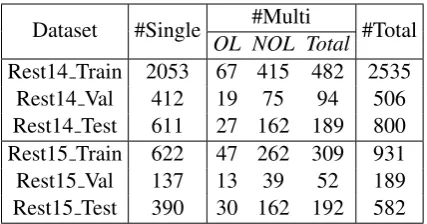
Table 1: The numbers of single- and multi-aspect sen-tences. OLandNOLdenote the overlapping and non-overlapping multi-aspect sentences, respectively.
whereRis the regularization term mentioned pre-viously, which can be Rs orRo. λis the hyper-parameter used for tuning the impact from reg-ularization loss to the overall loss. To avoid Lb overwhelming the overall loss, we divide it by the number of aspect categories.
4 Experiments
4.1 Datasets
We conduct experiments on two public datasets from SemEval 2014 task 4 (Pontiki et al., 2014) and SemEval 2015 task 12 (Pontiki et al., 2015) (denoted by Rest14 and Rest15 respectively). These two datasets consist of restaurant customer reviews with annotations identifying the men-tioned aspects and the sentiment polarity of each aspect. To apply orthogonal regularization, we manually annotate the multi-aspect sentences with overlapping or non-overlapping1. We randomly split the original training set into training, vali-dation sets in the ratio 5:1, where the valivali-dation set is used to select the best model. We count the sentences of single-aspect and multi-aspect sepa-rately. Detailed statistics are summarized in Table
1. Particularly,85.23%and83.73%of the multi-aspect sentences are non-overlapping in Rest14 and Rest15, respectively.
4.2 Comparison Methods
Since we focus on aspect-category sentiment anal-ysis, many works (Ma et al.,2017;Li et al.,2018;
Fan et al.,2018) which focus on aspect-term sen-timent analysis are excluded.
• LSTM: We implement the vanilla LSTM to model the sentence and use the average of all
Model Rest14 Rest15
3-way Binary 3-way Binary
Acc F1 Acc F1 Acc F1 Acc F1
LSTM 80.92 68.30 85.83 80.88 71.24 49.40 71.97 69.97
AT-LSTM 81.24 69.19 87.25 82.20 73.37 51.74 76.79 74.61
ATAE-LSTM 82.18 69.18 88.08 83.03 74.56 51.40 79.79 78.69
GCAE 82.08 70.20 87.72 83.84 76.69 53.00 79.66 77.96
AT-CAN-Rs 82.28 70.94 88.43 84.07 75.62 53.56 78.36 76.69
AT-CAN-Ro 82.81 71.32 89.37 85.66 76.92 55.67 79.92 78.77
ATAE-CAN-Rs 81.97 72.19 88.90 84.29 77.28 52.45 81.49 80.61
[image:6.595.113.484.61.214.2]ATAE-CAN-Ro 83.33 73.23 89.02 84.76 78.58 54.72 81.75 80.91
Table 2: Results of the ALSC task in single-task settings in terms of accuracy (%) and Macro-F1 (%).
hidden states as the sentence representation. In this model, aspect information is not used.
• AT-LSTM (Wang et al., 2016): It adopts the
attention mechanism in LSTM to generate a weighted representation of a sentence. The as-pect embedding is used to compute the attention weights as in Equation1. We do not concate-nate the aspect embedding to the hidden state as in the work (Wang et al.,2016) and gain small performance improvement. We use this modi-fied version in all experiments.
• ATAE-LSTM(Wang et al.,2016): This method
is an extension of AT-LSTM. In this model, the aspect embedding is concatenated to each word embedding of the sentence as the input to the LSTM layer.
• GCAE (Xue and Li, 2018): This state-of-the-art method is based on the convolutional neural network with gating mechanisms, which is for both aspect-category and aspect-term sentiment analysis. We compare with its aspect-category sentiment analysis task.
4.3 Our Methods
To verify the performance gain of introducing con-straints on attention weights, we first create several variants of our model for single-task settings.
• AT-CAN-Rs: Add sparse regularizationRs to
AT-LSTM to constrain the attention weights of each single aspect.
• AT-CAN-Ro: Add orthogonal regularization
Ro to AT-CAN-Rs to constrain the attention weights of multiple non-overlapping aspects.
• ATAE-CAN-Rs: AddRsto ATAE-LSTM.
• ATAE-CAN-Ro: AddRoto ATAE-CAN-Rs.
We then extend attention constraints to multi-task settings, creating variants by different op-tions: 1) no constraints, 2) adding regularizations only to the ALSC task, 3) adding regularizations to both tasks.
• M-AT-LSTM: This is the basic multi-task
model without regularizations.
• M-CAN-Rs: AddRs to the ALSC task in
M-AT-LSTM.
• M-CAN-Ro: AddRo to the ALSC task in
M-CAN-Rs.
• M-CAN-2Rs: AddRs to both tasks in
M-AT-LSTM.
• M-CAN-2Ro: Add Ro to both tasks in
M-CAN-2Rs.
4.4 Implementation Details
We set λ = 0.1 with the help of the validation set. All models are optimized by the Adagrad op-timizer (Duchi et al.,2011) with learning rate 0.01. Batch size is 25. We apply a dropout ofp = 0.7 after the embedding and LSTM layers. All words in the sentences are initialized with 300 dimension Glove Embeddings (Pennington et al.,2014). The aspect embedding matrix and parameters are ini-tialized by sampling from a uniform distribution
Model Rest14 Rest15
3-way Binary 3-way Binary
Acc F1 Acc F1 Acc F1 Acc F1
M-AT-LSTM 82.60 71.44 88.55 83.76 76.33 51.64 79.53 78.31
M-CAN-Rs 83.65 73.97 89.26 85.43 75.74 52.43 79.66 78.46
M-CAN-Ro 83.12 72.29 89.61 85.18 77.04 52.69 79.40 77.88
M-CAN-2Rs 83.23 72.81 89.37 85.42 78.22 55.80 80.44 80.01
[image:7.595.120.479.62.172.2]M-CAN-2Ro 84.28 74.45 89.96 86.16 77.51 52.78 82.14 81.58
Table 3: Results of the ALSC task in multi-task settings in terms of accuracy (%) and Macro-F1 (%).
Model Rest14 Rest15
Precision Recall F1 Precision Recall F1
M-AT-LSTM 0.8626 0.8553 0.8589 0.6691 0.4748 0.5555
M-CAN-2Rs 0.8698 0.8595 0.8645 0.6244 0.5019 0.5565
M-CAN-2Ro 0.8907 0.8627 0.8765 0.7127 0.4865 0.5782
Table 4: Results of the ACD task. Rest14 has5aspect categories while Rest15 has13ones.
4.5 Results
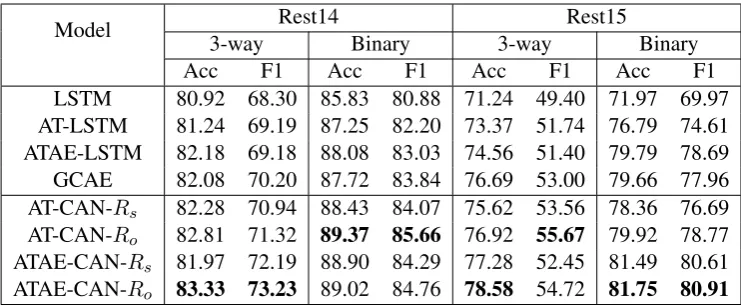
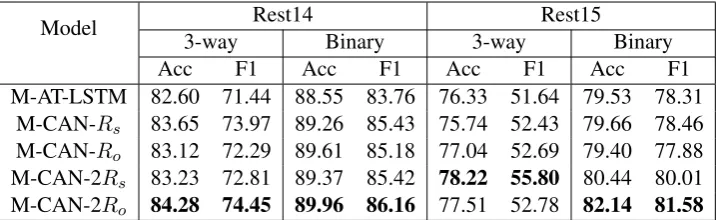
Table 2 and 3 show our experimental results on the two public datasets for single-task and multi-task settings respectively. In both tables, “3-way” stands for 3-class classification (positive, neutral, and negative), and “Binary” for binary classifica-tion (positive and negative). The best scores are marked in bold.
Single-task SettingsTable2 shows our
exper-imental results of ALSC in single-task settings. Firstly, we observe that by introducing attention regularizations (either Rs or Ro), most of our proposed methods outperform their counterparts. Particularly, AT-CAN-Rs and AT-CAN-Ro out-perform AT-LSTM in all results;
ATAE-CAN-Rs and ATAE-CAN-Ro also outperform ATAE-LSTM in 15 of 16 results. For example, in the Rest15 dataset, ATAE-CAN-Ro outperforms ATAE-LSTM by up to 5.39% of accuracy and 6.46% of the F1 score in the 3-way classifica-tion. Secondly, regularizationRo achieves better performance improvement than Rs in all results. This is becauseRo includes both orthogonal and sparse regularizations for non-overlapping multi-aspect sentences. Thirdly, our approaches, es-pecially ATAE-CAN-Ro, outperform the state-of-the-art baseline model GCAE. Finally, the LSTM method outputs the worst results in all cases, be-cause it can not distinguish different aspects.
Multi-task SettingsTable3shows
experimen-tal results of ALSC in multi-task settings. We first observe that the overall results in multi-task
set-tings outperform the ones in single-task setset-tings, which demonstrates the effectiveness of multi-task learning by introducing the auxiliary ACD task to help the ALSC task. Second, in almost all cases, applying attention regularizations to both tasks gains more performance improvement than only to the ALSC task, which shows that our at-tention regularization approach can be extended to different tasks which involving aspect level atten-tion weights, and works well in multi-task settings. For example, for the Binary classification in the Rest15 dataset, M-LASTM outperforms AT-LSTM by3.57%of accuracy and4.96%of the F1 score, and M-CAN-2Ro further outperforms M-AT-LSTM by3.28%of accuracy and4.0%of the F1 score.
Table 4 shows the results of the ACD task in multi-task settings. Our proposed regularization terms can also improve the performance of ACD. RegularizationRo achieves the best performance in almost all metrics.
4.6 Attention Visualizations
sub-food
service
the food was
outstanding and the
service
was tops . 0.0 0.35
0.175 0.0875 0.2625
(a) AT-LSTM
food
service
the food was
outstanding and the
service was tops
. 0.0
0.63
0.315 0.1575 0.4725
(b) M-AT-LSTM
food
service
the food was
outstanding and the
service was tops
. 0.0
0.5
0.25 0.125 0.375
[image:8.595.81.287.59.318.2](c) M-CAN-2Ro
Figure 3: Visualization of attention weights of different aspects in the ALSC task. Three different models are compared.
food
ambience
price
a/m
service
the food was
outstanding and the
service was tops .
0.0 0.6
[image:8.595.315.516.64.160.2]0.3 0.15 0.45
Figure 4: Visualization of attention weights of different aspects in the ACD task from M-CAN-2Ro. The a/m is short for anecdotes/miscellaneous.
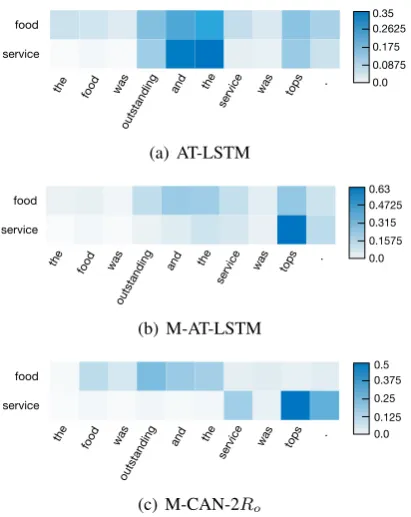
figure (a), the attention weights of aspect food
andserviceare both high in words“outstanding”,
“and”, and “the”, but actually, the word “out-standing”is used to describe the aspectfoodrather than service. The same situation occurs with the word“tops”, which should associate withservice
rather thanfood. The attention mechanism alone is not good enough to locate aspect-specific opinion words and generate aspect-specific sentence rep-resentations in the ALSC task.
As shown in subfigure (b), the issue is mitigated in M-AT-LSTM. Multi-task learning can learn bet-ter hidden states of the sentence, and betbet-ter aspect embeddings. However, it is still not good enough. For instance, the attention weights of the word
0 10 20 30 40 50 60 Epochs
0.880 0.885 0.890 0.895 0.900
Rs Loss
Rs Loss Ro Loss
1.34 1.35 1.36 1.37 1.38
Ro Loss
Figure 5: The regularization loss curves ofRsandRo during the training of AT-CAN-Ro.
“tops”are both high for the two aspects, and the weights are overlapped in the middle part of the sentence.
As shown in subfigure (c), M-CAN+2Ro gen-erates the best attention weights. The attention weights of the aspectfood are almost orthogonal to the weights ofservice. The aspectfood concen-trates on the first part of the sentence whileservice
on the second part. Meanwhile, the key opinion words “outstanding” and “tops” get highest at-tention weights in the corresponding aspects.
We also visualize the attention for the auxiliary task ACD. Figure4 depicts the attention weights from the method M-CAN-2Ro. There are five pre-defined aspect categories (food, ambience, price, anecdotes/miscellaneous, service) in the dataset, two of which are mentioned in the sentence. In the ACD task, we need to calculate the attention weights for all the five aspect categories, and then generate aspect-specific sentence representations to determine whether the sentence contains each aspect. As shown in Figure4, attention weights for aspectsfoodandserviceare pretty good. The as-pectfoodconcentrates on words“food”and “out-standing”, and the aspect service focuses on the word “service”. It is interesting that for aspects which are not mentioned in the sentence, their at-tention weights often attend to meaningless stop words, such as “the”, “was”, etc. We do not distinguish these aspects and just treat them as a whole.
We plot the regularization loss curves in Figure
5, which shows that bothRsandRodecrease dur-ing the traindur-ing of AT-CAN-Ro.
4.7 Case Studies
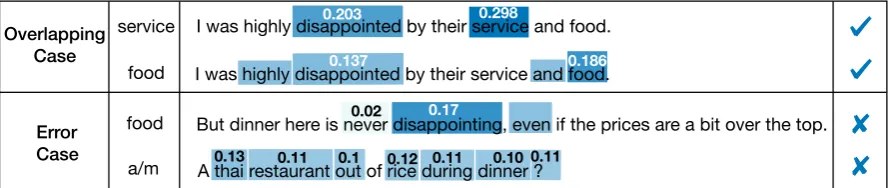
Overlapping CaseWe only add sparse
[image:8.595.79.285.387.486.2]0.13
0.17
service
food
0.203 0.298
0.137 0.186
food 0.02
Overlapping Case
Error Case
a/m 0.11 0.1 0.12 0.11 0.10 0.11
I was highly disappointed by their service and food.
I was highly disappointed by their service and food.
But dinner here is never disappointing, even if the prices are a bit over the top.
[image:9.595.76.521.63.157.2]A thai restaurant out of rice during dinner ?
Figure 6: Examples of overlapping case and error case. The a/m is short for anecdotes/miscellaneous.
andservice, both described by the opinion snippet
“highly disappointed”. Our method can locate the aspect terms and shared opinion words for both as-pects, and then classify the sentiment correctly.
Error CaseWith the help of attention
visualiza-tion, we can conduct error analysis of our model conveniently. As shown in Figure 6, for the first sentence in error case, the aspectfood attends on the right word “disappointing”, but fails to in-clude the negation word “never”. This may be caused by the inaccurate sentence representation or aspect embedding. We can not rebuild the con-nection between the aspect and the word by our regularizations. The second sentence is negative but classified as neutral. The attention weights dis-tribute evenly since the sentence does not contain any explicit opinion words. Since there is no ten-dency which words to concentrate, our model can not adjust the attention weights and help on such cases.
5 Conclusions
We propose constrained attention networks for multi-aspect sentiment analysis, which handles multiple aspects of a sentence simultaneously. Specifically, we introduce orthogonal and sparse regularizations on attention weights. Furthermore, we introduce an auxiliary task ACD for promoting the ALSC task, and apply CAN on both tasks. Ex-perimental results demonstrate that our approach outperforms the state-of-the-art methods.
6 Acknowledgement
This work is supported by National Science and Technology Major Project, China (Grant No. 2018YFB0204304).
References
Dzmitry Bahdanau, Kyunghyun Cho, and Yoshua Ben-gio. 2015. Neural machine translation by jointly
learning to align and translate. InICLR.
Konstantinos Bousmalis, George Trigeorgis, Nathan Silberman, Dilip Krishnan, and Dumitru Erhan. 2016. Domain separation networks. InNIPS.
Rich Caruana. 1997. Multitask learning. Machine Learning, 28(1):41–75.
Peng Chen, Zhongqian Sun, Lidong Bing, and Wei Yang. 2017. Recurrent attention network on mem-ory for aspect sentiment analysis. InEMNLP.
Jiajun Cheng, Shenglin Zhao, Jiani Zhang, Irwin King, Xin Zhang, and Hui Wang. 2017. Aspect-level sen-timent classification with heat (hierarchical atten-tion) network. InCIKM.
John Duchi, Elad Hazan, and Yoram Singer. 2011. Adaptive subgradient methods for online learning and stochastic optimization. Journal of Machine Learning Research, 12(Jul):2121–2159.
Feifan Fan, Yansong Feng, and Dongyan Zhao. 2018. Multi-grained attention network for aspect-level sentiment classification. InEMNLP.
Devamanyu Hazarika, Soujanya Poria, Prateek Vij, Gangeshwar Krishnamurthy, Erik Cambria, and Roger Zimmermann. 2018. Modeling inter-aspect dependencies for aspect-based sentiment analysis. InNAACL.
Sepp Hochreiter and Jrgen Schmidhuber. 1997. Long short-term memory. Neural Computation, 9(8):1735–1780.
Binxuan Huang, Yanglan Ou, and Kathleen M Car-ley. 2018. Aspect level sentiment classification with attention-over-attention neural networks. arXiv preprint arXiv:1804.06536.
Yanzhou Huang and Tao Zhong. 2018. Multitask learn-ing for neural generative question answerlearn-ing. Ma-chine Vision & Applications, pages 1–9.
Xin Li, Lidong Bing, Wai Lam, and Bei Shi. 2018. Transformation networks for target-oriented senti-ment classification. InACL.
Bing Liu. 2012. Sentiment analysis and opinion min-ing. Synthesis lectures on human language tech-nologies, 5(1):1–167.
Feifan Liu, Dong Wang, Bin Li, and Yang Liu. 2010. Improving blog polarity classification via topic anal-ysis and adaptive methods. InNAACL.
Dehong Ma, Sujian Li, Xiaodong Zhang, Houfeng Wang, Dehong Ma, Sujian Li, Xiaodong Zhang, and Houfeng Wang. 2017. Interactive attention net-works for aspect-level sentiment classification. In
IJCAI.
Yukun Ma, Haiyun Peng, and Erik Cambria. 2018. Targeted aspect-based sentiment analysis via em-bedding commonsense knowledge into an attentive lstm. InAAAI.
Navonil Majumder, Soujanya Poria, Alexander Gel-bukh, Md Shad Akhtar, Erik Cambria, and Asif Ek-bal. 2018. IARM: Inter-aspect relation modeling with memory networks in aspect-based sentiment analysis. InEMNLP.
Chaitanya Malaviya, Pedro Ferreira, and Andr´e F. T. Martins. 2018. Sparse and constrained attention for neural machine translation. InACL.
Tetsuya Nasukawa and Jeonghee Yi. 2003. Senti-ment analysis:capturing favorability using natural language processing. InK-CAP.
Jeffrey Pennington, Richard Socher, and Christopher Manning. 2014. Glove: Global vectors for word representation. InEMNLP.
Maria Pontiki, Dimitris Galanis, Haris Papageorgiou, Suresh Manandhar, and Ion Androutsopoulos. 2015. SemEval-2015 task 12: Aspect based sentiment analysis. InSemEval 2015.
Maria Pontiki, Dimitris Galanis, John Pavlopoulos, Harris Papageorgiou, Ion Androutsopoulos, and Suresh Manandhar. 2014. Semeval-2014 task 4: As-pect based sentiment analysis. InSemEval 2014.
Sebastian Ruder, Parsa Ghaffari, and John G. Breslin. 2016. A hierarchical model of reviews for aspect-based sentiment analysis. InEMNLP.
Kim Schouten, Onne Van Der Weijde, Flavius Frasin-car, and Rommert Dekker. 2018. Supervised and un-supervised aspect category detection for sentiment analysis with co-occurrence data. IEEE Transac-tions on Cybernetics, 48(4):1263–1275.
Yi Tay, Anh Tuan Luu, and Siu Cheung Hui. 2018. Learning to attend via word-aspect associative fu-sion for aspect-based sentiment analysis. InAAAI.
Yi Tay, Luu Anh Tuan, and Siu Cheung Hui. 2017. Dyadic memory networks for aspect-based senti-ment analysis. InCIKM.
Shubham Toshniwal, Hao Tang, Liang Lu, and Karen Livescu. 2017. Multitask learning with low-level auxiliary tasks for encoder-decoder based speech recognition.INTERSPEECH, pages 3532–3536.
Duy Tin Vo and Yue Zhang. 2015. Target-dependent twitter sentiment classification with rich automatic features. InIJCAI.
Bailin Wang and Wei Lu. 2018. Learning latent opin-ions for aspect-level sentiment classification. In
AAAI.
Jingjing Wang, Jie Li, Shoushan Li, Yangyang Kang, Min Zhang, Luo Si, and Guodong Zhou. 2018. As-pect sentiment classification with both word-level and clause-level attention networks. InIJCAI.
Yequan Wang, Minlie Huang, Xiaoyan Zhu, and Li Zhao. 2016. Attention-based lstm for aspect-level sentiment classification. InEMNLP.
Wei Xue and Tao Li. 2018. Aspect based sentiment analysis with gated convolutional networks. InACL.
Jianfei Yu and Jing Jiang. 2016. Learning sentence em-beddings with auxiliary tasks for cross-domain sen-timent classification. InEMNLP.