Conceptions of being a lecturer in nursing:
Variation of identities and how these are negotiated
during a tutorial
Susan Harness RGN, BSc (UCLan), BSc (Lancaster),
PGCE(HE), Queen’s Nurse
Learning, Education and Development (LED) Research Centre
Thesis submitted to the University of Lancaster for the degree of Doctor of Philosophy
January 2018
Susan Harness 2
Declaration
This thesis results entirely from my own work and has not been offered for any other degree or diploma.
Susan Harness 3
Acknowledgements
I would like to extend my sincere gratitude to all those who have helped me accomplish this
thesis and have given me a sustained source of encouragement throughout. This study would
not have been possible without the help and generous support of those who participated in
the research, who willingly shared their thoughts, experiences and views and were prepared
to have these video-recorded. The generosity of those who entrusted me to analyse this data
and publish these findings is humbly acknowledged.
Special thanks to my supervisory team Pete Boyd, Sue Bloxham and Linda McGhie who have
given me their time, professional knowledge and guidance, encouragement, motivation and
have steered me in the right direction when I have gone off course. I certainly couldn’t have
done this without you. Many thanks to Jan Bancroft for faithfully transcribing huge amounts of
data and to James Stephens for his expertise and guidance with the literature search.
I would like to give heartfelt thanks to my husband Paul for proof reading, helping when IT
problems occurred and for being understanding when I needed to write, often at weekends
and early mornings. Thank you to my children Elizabeth, Jacob, Ben and Amy who perhaps
now understand what I have been doing these last 6 years. Questions such as “Where’s
Mum?” and “What are you doing?” or “Why are you doing that?” have been answered with
“It’s my research!” and “Please don’t touch those papers” resulting in a lot of head shaking
and blowing out from both parties. I would also like to pay tribute to Meg and Mabel our
faithful Border Terriers, who have walked with me while I think and reflect on ideas and
theories swarming in my head. Their considered attempts to maintain a dignified silence as I
practiced explaining the rationale for every chapter of this study was duly appreciated.
Finally, I dedicate this thesis to my wonderful Dad who at 86 years of age and now suffering
from mixed Dementia and Alzheimer’s disease regularly tells me how proud he is and from
Susan Harness 4
Abstract
In the UK, lecturers in nursing normally have an extensive clinical background accumulated in
the National Health Service. They arrive in the Higher Education sector with little experience
of university cultures and practices. The transition into this new world can be traumatic as
experienced nurses strive to develop their educational capabilities.
This thesis focuses on conceptions of being a lecturer in nursing within higher education. Data
was collected for the study through video recorded interviews for each of ten lecturers in
nursing based at universities across England and Scotland. For each, a semi-structured
interview, a tutorial with a student, and a video stimulated recall and reflect interview took
place. The data collection design aimed to get beyond espoused identities by collecting rich
data including observation and reflection on practice.
A phenomenographic approach was used to analyse semi-structured interview data to identify
different ways of being a lecturer in nursing. This resulted in five categories of description of
identities in the outcome space: nurse; teacher; academic scholar; researcher; and academic
leader. Bourdieusian analysis of how identities are negotiated during tutorials indicated that
lecturers in nursing had developed new identities within the field of higher education whilst
maintaining their core identity as a nurse.
Currently, it appears that there is little provision to support lecturers in nursing during the
journey from transition to experienced lecturer in nursing. It is proposed that conceptions of
identity are discussed through induction, mentorship and in formal development structures. As
lecturers of nursing, the participants in this study occupy boundary-crossing roles on the
margins of higher education. The super-complex identities of the lecturers revealed in this
study provide useful insight into the life of a contemporary academic.
In addition to lecturers in nursing, this study and its findings may be relevant to those in other
health professions who move between the NHS and Higher Education. The findings may also
transfer to other professions where individuals move sectors, such as between public and
Susan Harness 5
Table of Contents
Declaration ... 2
Acknowledgements ... 3
Abstract ... 4
Chapter 1 – Introduction, Aim and Research Questions ... 9
1.1 Research Questions ... 11
1.2 Organisation of the thesis ... 12
Chapter 2 – Review of Literature ... 14
2.1 Introduction ... 14
2.2 Identity ... 20
2.2.1 Identity theory ... 20
2.2.1.1 Individualisation theories of identity ... 21
2.2.1.2 Biographical theories of identity ... 23
2.2.1.3 Fixed or fluid theories of identity ... 24
2.2.1.4 Discovered or Social Constructivist theories of identity ... 26
2.2.1.5 Relational theories of identity ... 32
2.2.2 Professional Image of Nursing ... 33
2.2.3 Identity when becoming a nurse ... 35
2.2.4 Professional identity ... 38
2.2.5 Identity and practice ... 40
2.2.6 Social identity ... 42
2.2.7 Academic identity ... 46
2.2.8 Nursing as an academic identity ... 47
2.2.9 Identity in becoming a lecturer in nursing ... 49
2.2.10 Identity of being a lecturer in nursing ... 54
2.3 Pedagogy ... 59
2.3.1 Teaching-Learning ... 59
2.3.2 Tutorials ... 64
2.4 Bourdieu’s Sociological Concepts ... 67
2.4.1 How Field contributes to identity ... 69
2.4.2 Macro level playing field ... 70
2.4.3 Meso level playing field ... 72
2.4.4 Micro level playing field ... 73
2.4.5 Capital ... 74
2.4.6 Habitus ... 76
2.4.7 Critique of Bourdieu’s concept of habitus ... 78
2.5 Summary ... 80
Chapter 3 – Phenomenographic and complementary approaches to analysis
... 83
3.1 Introduction ... 83
3.2 Qualitative research strategy ... 84
3.3 Rationale for using inductive and deductive reasoning ... 86
3.4 Positionality ... 87
3.5 The Philosophical Position ... 89
3.6 Historical Perspectives of Phenomenography ... 92
3.7 Phenomenography ... 93
3.8 Using a phenomenographic approach to analyse the data ... 94
Susan Harness 6
3.10 A critique of Phenomenography ... 97
3.11 Rationale for rejecting Phenomenology ... 100
3.12 Summary ... 101
Chapter 4 – Methods of collecting the data ... 102
4.1 Introduction ... 102
4.2 Strategy and Design of the Pilot Study ... 103
4.3 Reflections of the pilot study and lessons learned ... 104
4.4 Sampling ... 106
4.5 Participants ... 106
4.6 Interviews ... 109
4.7 The Phenomenographic Interview Approach ... 110
4.8 Video stimulated recall and reflection method ... 113
4.9 Collection of the data ... 114
4.10 Data collection process ... 117
4.11 Transcription ... 119
4.12 Data management ... 119
4.13 The Use of Computer Software in Phenomenographic Data Analysis
... 120
4.14 Outcomes of this phenomenographic study ... 121
4.15 Quality assurances to this study ... 124
4.16 Reliability of this study ... 124
4.17 Ethical considerations ... 126
4.18 Summary ... 127
Chapter 5 – Phenomenographic Analysis of Data ... 128
5.1 Introduction ... 128
5.2 Immersion into the data ... 129
5.3 Pool of meanings ... 130
5.4 Categories of description ... 131
5.5 Outcome Space ... 133
5.5.1 Conception I: Identity as a nurse reflecting on and sharing their
clinical knowledge and experiences with students ... 135
5.5.1.1 Summary of Conception I ... 146
5.5.2 Conception II: identity as a teacher who uses their knowledge to
develop student learning. ... 147
5.5.2.1 Summary of Conception II ... 149
5.5.3 Conception III: Identity as an academic engaged in scholarly activity
and guiding students to achieve in their academic studies ... 149
5.5.3.1 Summary of Conception III ... 150
5.5.4 Conception IV: Identity as a researcher to promote their research
and of others to inform their teaching. ... 151
5.5.4.1 Summary of Conception IV ... 153
5.5.5 Conception V: Identity as an academic leader to influence others
through their collective knowledge and skills ... 153
5.5.5.1 Summary of Conception V ... 155
5.6 Implications of the Phenomenographic Findings ... 155
5.7 Summary ... 158
Chapter 6 – Negotiation of identities under the lens of Bourdieu ... 160
6.1 Introduction ... 160
Susan Harness 7
6.3 Negotiation of identities within the Field ... 162
6.3.1 Summary of Negotiation of identities within the Field ... 167
6.4 How lecturers in nursing use Capital in the Field ... 168
6.4.1 Reticence of using Capital ... 171
6.4.2 Summary of Capital ... 173
6.5 What is the Habitus of lecturers in nursing in the Field? ... 174
6.6 Summary of Habitus ... 177
6.7 Relating Habitus and Capital in the Field ... 178
6.8 Summary ... 179
Chapter 7 – Discussion ... 180
7.1 Summary ... 188
7.2 Research questions answered ... 189
7.3 Limitations of the study ... 191
Chapter 8 Implications of the study, reflections and final words ... 194
8.1 Implications of this study and recommendations ... 194
8.2 Opportunities for further research ... 195
8.3 Reflection on the process ... 196
8.4 Reflection on the participants ... 197
8.5 Reflection on self ... 198
8.6 Final words ... 198
Appendices ... 199
Appendix 1 – Ethical Clearance ... 199
Appendix 2 – Letter to participants ... 200
Appendix 3 – Participant Information Sheet ... 202
Appendix 4 – Letter to students ... 205
Appendix 5 – Participant Consent Form ... 206
Appendix 6 – Letter/e-mail to participants (Lecturers in Nursing) ... 208
Appendix 7 – Letter/e-mail to student participants ... 209
Appendix 8 – Initial Interview Protocol ... 210
Appendix 9 – Observation of tutorial protocol ... 212
Appendix 10 – Video stimulated recall and reflection interview protocol .. 213
Appendix 11 – Erikson's Psychosocial Stages ... 215
Glossary of terms and abbreviations ... 216
Susan Harness 8
Figures
Figure 1 Concept Map ... 15
Figure 2 Tajfel and Turner (1979) Social Identity Theory ... 45
Figure 3 Representation of micro level habitus influenced by meso and macro
level field (adapted from Petit-dit-Dariel et al, 2014) ... 74
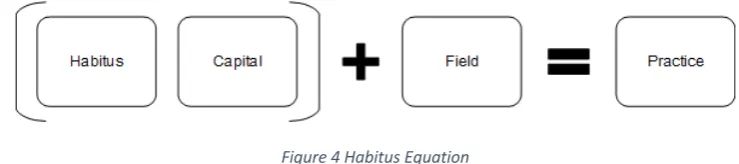
Figure 4 Habitus Equation ... 77
Figure 5 Points of Departure Between Phenomenography and Other
Research Approaches (Trigwell, 2006, p.369) ... 91
Figure 6 Relationship between objects with subjects and researcher (Based
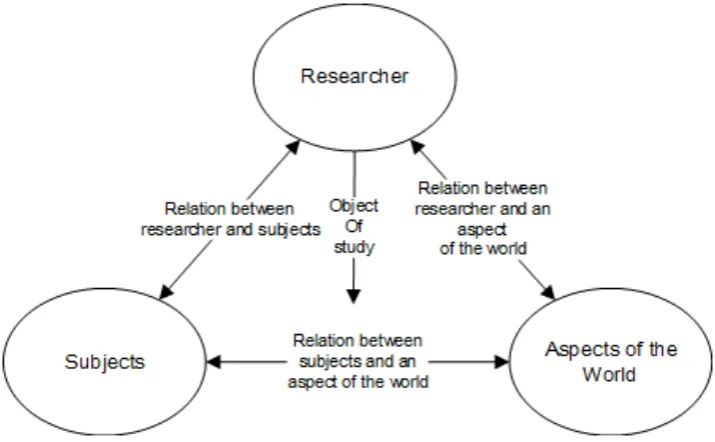
on Bowden 2005) ... 94
Figure 7 Illustration of phenomenographic process ... 129
Figure 8 Pool of meanings ... 131
Figure 9 Identity as a novice lecturer in nursing entering the field of higher
education ... 155
Figure 10 Develops credibility as a teacher leading towards academic scholar
identity and scholarship ... 156
Figure 11 Lecturers in nursing who have credible identities begin to engage in
research or academic leadership ... 157
Figure 12 Some lecturers in nursing are credible in all five categories in the
outcome space ... 157
Tables
Table 1 Search Concepts ... 17
Table 2 Search Detailed Analysis ... 18
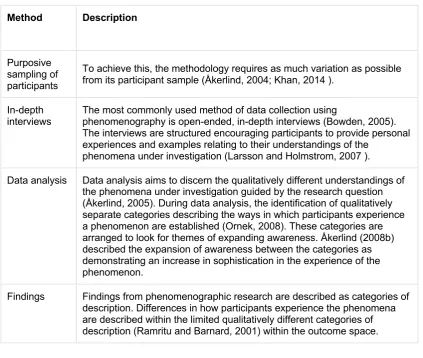
Table 3 Phenomenographical approaches to data ... 96
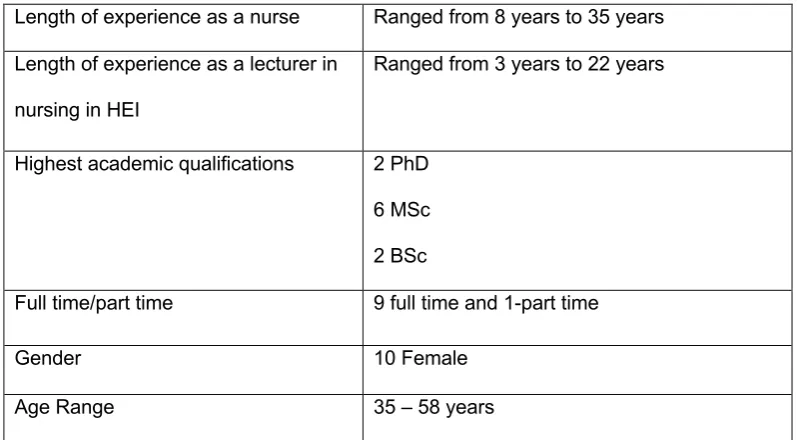
Table 4 Demographic variation within the sample ... 107
Table 5 Seven steps to analysis (Dahlgren 1991) ... 122
Table 6 Preliminary categories ... 132
Table 7 Initial dimensions of the collective variation ... 133
Table 8 Outcome space showing variation of being a lecturer in nursing .... 134
Susan Harness 9
Chapter 1
– Introduction, Aim and Research Questions
The aim of this study is to investigate how university-based lecturers in nursing perceive their
identity. I will argue that there is a need to understand identity and also to have an appreciation
of the values, beliefs and attitudes of lecturers that teach nurses. To develop this argument
further, my aim is to discover how variation of the perceived identities of lecturers in nursing are
negotiated during an individual tutorial with a student. This thesis challenges lecturers in nursing
to reflect and examine their identities which are often deeply embedded, and to determine how
and why they negotiate their identities with a student during a tutorial. This understanding could
provide insight into how they negotiate their identities and may improve teaching-learning
interactions with students.
To clarify a couple of terms: firstly, ‘lecturer in nursing’ refers to a qualified nurse who is
employed within higher education with the main function of delivering education and training to
pre-registration student nurses or qualified nurses accessing additional qualifications through
higher education. Secondly, throughout this study, I have chosen to adopt the term
teaching-learning rather than teaching and teaching-learning. I agree with Ashwin (2012, p. 2) who firmly believes
that teaching and learning are not two distinct and separate processes but, and as I consider,
are interwoven so that students and academics are engaging with these processes together.
Valuable work has been written about lecturers in nursing over the years, most recently
around nurses transferring from clinical settings to working within higher education (McAllister,
Oprescu and Jones, 2014; Duffy, 2012; Boyd and Lawley, 2009; Boyd et al., 2009; Anderson, 2008). Identity is also explored from the context of professional identity in nursing academics
(Andrew, 2012; Andrew et al., 2009) competing professional and academic identity in nurse education as a newly ‘academic’ discipline (Findlow, 2012) and the dual identity of nurses and
educators (Adams, 2011; Andrew and Robb, 2011). Although there have been studies
conducted on the conceptions of tutorials from a student perspective (Ashwin, 2005) and
academic perspective (Ashwin, 2006) there are no known studies identifying the conceptions
Susan Harness 10 The first part of the study involved using a phenomenographic approach to analysis of the
initial interviews based upon inductive reasoning. This analysis identified five conceptions of
being a lecturer in nursing. Additionally, as an extension of the phenomenographic analysis,
this study involved a thematic analysis based on the five conceptions using a Bourdieusian
theoretical framework as deductive reasoning to examine and code the data from the tutorial
and video stimulated recall interview around the three concepts of Field; Capital and Habitus
to consider how the different conceptions of being a lecturer in nursing are negotiated during
an individual tutorial with a student nurse.
The original contribution that this empirical research offers is to develop and enhance theories
of identity relating to the professional context of lecturers in nursing and how these perceived
identities are negotiated within an individual tutorial. I show that this distinctive study
contributes to this limited research area by providing rich and detailed qualitative data that
ultimately will provide insight into what I term, the super-complex identities of lecturers in
nursing. The term super-complex is significant here, to try and capture the multiple layered
identities of lecturers in nursing who have spanned two distinct professions and participated in
boundary crossing throughout their careers. This study will therefore examine identity theories
and how multiple contributing factors have influenced the identities of lecturers in nursing.
Furthermore, how identities are negotiated will be examined under the lens of Pierre
Bourdieu’s sociological concepts; field, capital and habitus.
Following a successful 25 years working in the NHS as a nurse, within many fields of practice
around the UK and latterly as a manager, I entered the world of teaching in higher education
11 years ago. As a lecturer in nursing, this study is interesting to me from a personal
perspective to develop a rich understanding of identity and how this may influence
pedagogical practice. This reflexive account will clarify the motivation for the study and offer
some insight into the background of my own professional careers within nursing and latterly
teaching. This is an opportunity to reflect and put into context where I have been working and
why this study is important to me. This study has grown from a passion and love of being a
nurse and a teacher and a desire to understand what it means to be ‘someone who teaches
Susan Harness 11 their own history, experiences and beliefs which although in sharp contrast to traditional
approaches justifies the use of writing in first person.
1.1 Research Questions
The core argument of this thesis is to understand the complex nature of how lecturers in
nursing identify themselves. I argue that their previous careers as a nurse, their transition into
teaching within higher education and the subsequent new roles may influence the formation of
their identities. I also argue that their perceived identities can be revealed to students within
an individual tutorial. The research around identity and lecturers in nursing is limited with no
known study of how the perceived identities of lecturers in nursing relates to their pedagogical
practices.
By undertaking this study there have been many things to take into account. Initially,
consideration was given to the personal values I hold in relation to the work, and secondly,
how these values aligned with deciding on the research design. Reflecting on the context of
this empirical study, I explored the philosophical underpinnings that would clarify the process
of inquiry and strengthen my rationale for the chosen methodology. Careful consideration was
given to defining the two research questions and crucially that the choice of methodology
afforded the possibility for these questions to be answered. On reflection, this involved a
lengthy iterative process of thinking around the research questions and different
methodological approaches that could justify the research process in order that outcomes are
credible.
This empirical research involved spending 16 months in the field undertaking qualitative
methods to conduct semi-structured interviews, video-recordings of tutorials and video
stimulated recall and reflection interviews with 10 participants in England and Scotland to
produce rich data to answer the following research questions:
• What are the conceptions of being a lecturer in nursing?
Susan Harness 12 The aim of this thesis is to answer the research questions by using a methodology and a
theoretical framework that will facilitate this process. In this case, I have used qualitative
methods to provide answers to both questions. For the first question, I have adopted
phenomenography to discover the conceptions of identity of lecturers in nursing. This
inductive approach to the rich and grounded data will ultimately reveal the variation of how
lecturers in nursing experience the ‘phenomena’ of identity. To provide an answer to the
second research question, deductive reasoning under the lens of Pierre Bourdieu’s reflexive
sociological theory of practice will be used as a theoretical framework of the data to discover
how lecturers in nursing negotiate their identities during a tutorial. This research is based on
the assumption that traditionally, lecturers in nursing have experienced the transfer from
working in clinical practice into academia which resonates with Pierre Bourdieu’s reflexive
sociological theory of practice, suggesting that there are pre-conscious, historical and social
influences on the practice of individuals (Bourdieu, 1977). The three concepts of field, capital
and habitus are explored and applied within the collection of data using this as a template to
be filtered and therefore interpreted. This provided the opportunity to relate the findings to the
theoretical philosophy of Pierre Bourdieu. In this way, the combination of adopting two
methodological approaches, firstly phenomenography using an inductive approach to the data
to reveal the variation of identities and deductive reasoning under the lens of Bourdieu’s
theoretical framework to discover how identities are negotiated during a tutorial have
complemented one another and produced findings that offer answers to the two research
questions.
1.2 Organisation of the thesis
Chapter 1 Within this introductory section, includes an overview of the study, setting out the
two research questions and providing some background for contextualising these questions.
Included is the theoretical framework and the methodological approach and reasoning that
have been taken.
Chapter 2 outlines the strategy to searching the literature and reviews key resources
including books, chapters, unpublished theses and research reports as well as journal papers
Susan Harness 13 sections. The first section focuses upon identity theory and how these are exhibited as a
nurse, academic, within a community of practice, as a lecturer in nursing and the presenting
challenges. The second section explores the literature around teaching-learning approaches
with a focus upon the tutorial. Furthermore, the literature of Bourdieu’s sociological theory of
practice has been examined.
Chapter 3 provides an explanation of the research methodologies including a rationale for the
adoption of a pilot study. This included using inductive approaches in the form of
phenomenography and deductive reasoning under the lens of Bourdieu’s concepts of field,
capital and habitus. It will set out the philosophical, ontological and epistemological
assumptions that provide the methodological underpinning for this study. There will be a focus
upon my location and position as the researcher within the study.
Chapter 4 explains the methods used to collect the data. Ethical issues are identified and
consideration given to ensuring the quality of this study.
Chapter 5 specifies the detail of the phenomenographic findings. The data from illustrative
accounts of the participants and interpretive commentary are constructed from the data to
form categories of description in the outcome space.
Chapter 6 examines the data from the tutorial and video stimulated recall and reflect interview
exercising deductive reasoning under the lens of Bourdieu’s sociological theoretical
framework of Field, Capital and Habitus to discover how identities are negotiated during a
tutorial.
Chapter 7 reflects upon the two research questions regarding the findings, culminating in a
synopsis of conclusions drawn from the study. The limitations of the study are also discussed.
Chapter 8 delivers a final exploration of personal thoughts leading to an indication of how the
study may have a practical application and implications for the intended audience. The
Susan Harness 14
Chapter 2
– Review of Literature
2.1 Introduction
There were three broad stages to preparing and undertaking a review of the literature. The first
stage establishes the context by exploring the broad issues of concepts and theories around
identity. The second stage was to direct and narrow down the focus of research into what was
directly related to this study. In addition, it was necessary to keep in touch with current research
that was being published during the time frame of this investigation. The final stage entailed
examining the findings of this investigation and relating these to the findings from other
researchers within the field during the writing of this thesis. This writing stage has been a
fundamental part of the research process in being able to write while collecting the literature
and to collect whilst continuing to write.
A systematic and rigorous approach was taken to search and select primary research for
analysis. This selection comprised of key concepts and theories around identity and
pedagogy that explain and justify how this study could provide answers to the two research
questions. The intentions of this literature review were twofold: firstly, to identify what is known
about the concepts within the literature and secondly, to develop meaning and understanding
of how these concepts are related. In this case, the purpose of the literature review was to
explore and examine extensive resources that could inform this study. From the literature
review, questions emerged that highlighted significant gaps in the current research, to which
this study aims to contribute. The two questions that underpins this study are:
• What are the conceptions of being a lecturer in nursing?
• How is the variation of being a lecturer in nursing negotiated during a tutorial?
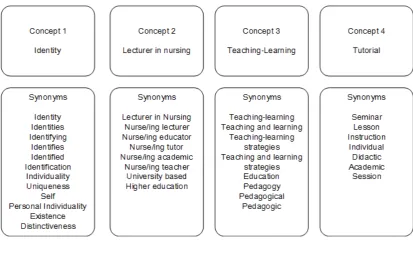
A concept map (see Figure 1) helped to visually represent different conceptions for further
Susan Harness 15
Figure 1 Concept Map
Following on from this process, boundaries needed to be in place to set the scope of this
literature review. The inclusion criteria comprised of searching the literature predominantly
from the UK that would reflect the situation where lecturers in nursing are in practice.
International studies have also been examined with the rationale being that there may be
similarities that can be drawn despite geographical variances that would contribute to this
study. The literature review has focused on lecturers in nursing within higher education or
being university based and has discounted literature relating to those studies that centred on
nurse educators working within clinical practice or outside of higher education. The exclusion
criteria omitted materials that were published before 1990, other than seminal papers of key
authors and theorists.
To provide an initial sense of the literature, this involved choosing ways of finding relevant
material of what is ‘out there’ in the world. Initially, a search was undertaken of the university library catalogue and One Search which retrieved some useful papers. Nevertheless, it was
necessary to undertake a systematic search to the most appropriate electronic databases in
relation to the subject of this study. Three databases chosen were: Education Source; Web of
Science and Academic Search Complete (EBSCO). These are all reputable and sophisticated
Susan Harness 16 articles with significant citations. The next step was to assemble the final list of key words,
phrases and synonyms using truncation and wildcards. International variations in terminology
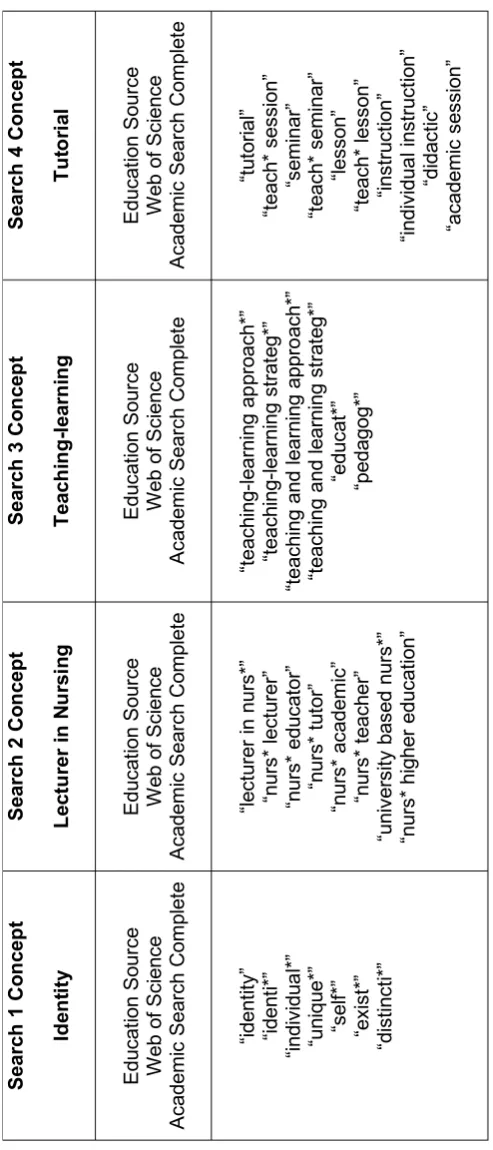
were considered to narrow the search fields in each of the four key concepts. This is shown in
Table 1.
Further limits involving Boolean logic in the form of AND, OR and NOT was applied to the
searching through the databases that communicated specific relationships between the key
words or phrases. Other strategies included ‘phrase searching’ by enclosing a key phrase
within quotation marks. In this case “identity of lecturers in nursing”, “lecturers in nursing
tutorial”, “lecturers in nursing teaching and learning approaches” and using parentheses to
group compound Boolean statements together as in (“identity” or “lecturers in nursing” or
“teaching and learning” or “tutorial”) and (“identity of lecturers in nursing” or “tutorial”).
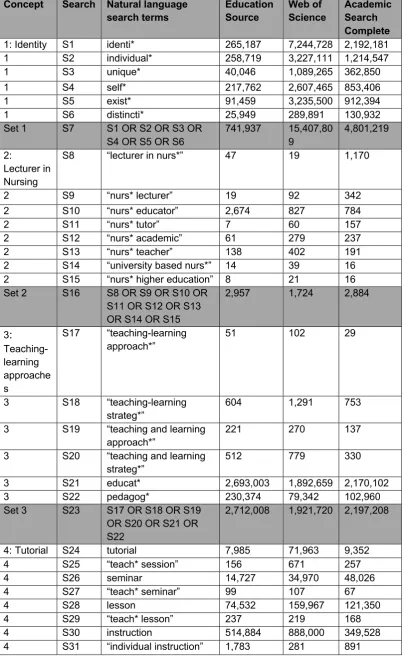
As demonstrated within Table 2 the search of the three electronic databases has produced a
huge number of hits. The clear majority of sources from initial searches are concerned with
professional identity of nurses from a clinical or practice-based perspective rather than nurses
who have moved to teaching within higher education so were discarded as they were outside
of my research boundaries. The 298 selected articles that were relevant to this study were
then examined further to systematically check they were specifically appropriate for this study
and that all the reference lists and bibliographies to capture other sources of information that
were not revealed through searching the electronic databases. Other sources of information
such as books and e-books have been gathered from accessing library catalogues through
the University of Cumbria and Lancaster University libraries. A small number of articles have
been obtained using inter-library loans and through directly contacting authors and requesting
information. To prevent printing out a large volume of papers all the electronic sources that
were relevant to this study were collected and stored within RefWorks in preparation for
Susan Harness 17 Se ar ch 1 C o n ce p t Ide nt it y Se ar ch 2 C o n ce p t L ec tu re r in N u rs in g Se ar ch 3 C o n ce p t Te ac hi ng -le ar ni ng Se ar ch 4 C o n ce p t Tut or ia l E du ca tio n S ou rce W eb o f S ci en ce A ca de m ic S ea rch C om pl et e E du ca tio n S ou rce W eb o f S ci en ce A ca de m ic S ea rch C om pl et e E du ca tio n S ou rce W eb o f S ci en ce A ca de m ic S ea rch C om pl et e E du ca tio n S ou rce W eb o f S ci en ce A ca de m ic S ea rch C om pl et e “id en tit y” “id en ti* ” “in di vi du a l* ” “u ni qu e* ” “se lf* ” “e xi st *” “d ist in ct i* ” “le ct ur er in n ur s* ” “n ur s* le ct ur er ” “n ur s* e du ca to r” “n ur s* t ut or ” “n ur s* a ca de m ic” “n ur s* t ea ch er ” “u ni ve rsi ty ba se d nu rs* ” “n ur s* h ig he r ed uca tio n” “t ea ch in g-le ar ni ng a p pr oa ch *” “t ea ch in g-le ar ni ng st ra te g* ” “t ea ch in g an d le ar ni ng a pp ro ac h*” “t ea ch in g an d le ar ni ng st ra te g* ” “e du ca t* ” “p ed ag og *” “t ut ori al ” “t ea ch * se ssi on ” “se m in ar ” “t ea ch * se m in ar ” “le sso n” “t ea ch * le sso n” “in st ru ct io n” “in di vi du a l i nst ru ct io n” “d id act ic” “a ca de m ic se ssi on ”
Susan Harness 18
Table 2 Search Detailed Analysis
Concept Search Natural language search terms Education Source Web of Science Academic Search Complete 1: Identity S1 identi* 265,187 7,244,728 2,192,181
1 S2 individual* 258,719 3,227,111 1,214,547
1 S3 unique* 40,046 1,089,265 362,850
1 S4 self* 217,762 2,607,465 853,406
1 S5 exist* 91,459 3,235,500 912,394
1 S6 distincti* 25,949 289,891 130,932
Set 1 S7 S1 OR S2 OR S3 OR S4 OR S5 OR S6
741,937 15,407,80 9
4,801,219
2:
Lecturer in Nursing
S8 “lecturer in nurs*” 47 19 1,170
2 S9 “nurs* lecturer” 19 92 342
2 S10 “nurs* educator” 2,674 827 784
2 S11 “nurs* tutor” 7 60 157
2 S12 “nurs* academic” 61 279 237
2 S13 “nurs* teacher” 138 402 191
2 S14 “university based nurs*” 14 39 16
2 S15 “nurs* higher education” 8 21 16
Set 2 S16 S8 OR S9 OR S10 OR S11 OR S12 OR S13 OR S14 OR S15
2,957 1,724 2,884
3: Teaching-learning approache s
S17 “teaching-learning approach*”
51 102 29
3 S18 “teaching-learning strateg*”
604 1,291 753
3 S19 “teaching and learning approach*”
221 270 137
3 S20 “teaching and learning strateg*”
512 779 330
3 S21 educat* 2,693,003 1,892,659 2,170,102
3 S22 pedagog* 230,374 79,342 102,960
Set 3 S23 S17 OR S18 OR S19 OR S20 OR S21 OR S22
2,712,008 1,921,720 2,197,208
4: Tutorial S24 tutorial 7,985 71,963 9,352
4 S25 “teach* session” 156 671 257
4 S26 seminar 14,727 34,970 48,026
4 S27 “teach* seminar” 99 107 67
4 S28 lesson 74,532 159,967 121,350
4 S29 “teach* lesson” 237 219 168
4 S30 instruction 514,884 888,000 349,528
Susan Harness 19
4 S32 didactic 66,271 18,731 37,392
4 S33 “academic session” 63 107 50
Set 4 S34 S24 OR S25 OR S26 OR S27 OR S28 OR S29 OR S30 OR S31 OR S32 OR S33
611,080 1,159,634 537,363
All concept sets combined with Boolean AND
S35 7 AND 16 AND 23 AND 34
191 48 70
Refined by publication date
S36 Limit to last 27 years 190 44 64
In section 2.2 , I review the relevant literature around why identity is a complex concept. To
place this into context, the literature had been narrowed down to focus on the key concepts of
identity within a number of theoretical frameworks of identity theory (2.2.1 ), including social
identity theory, professional and academic theories of identity. These theories are significant
to the study to understand how identity can be established and how they are exhibited within
the relevant context of lecturers in nursing (2.2.2 - 2.2.10 ). However, the search for empirical
studies on how identities are negotiated specifically as a lecturer in nursing is miserably scant.
This necessitated a search around how teacher identity is negotiated which proved useful in
understanding the similarities within both professions. As the chapter progresses, examination
and evaluation of significant evidence derived from the literature search was brought together
so that this phenomenon of identity could be comprehended. The literature review has been
structured around the key concepts that are fundamental to this study. Sections 2.2.9 and
2.2.10 conclude with a discussion on the tensions around identity in relation to transition,
credibility and dual identities which are relevant and have therefore been included within this
chapter. This study acknowledges that there are other significant factors that may influence
the identity of lecturers in nursing such as gender, feminism, ethnicity and class which
although could provide evidence for a second thesis have had to be discounted from this
literature review. Section 2.3 of the chapter has been structured around teaching-learning
Susan Harness 20 Bourdieu’s sociological concepts of field, capital and habitus that is used as a framework for
analysis in Chapter 6.
2.2 Identity
2.2.1 Identity theory
It is central to this study to understand and clarify the term ‘identity’ and why this is so
complex. To provide a sense of the dynamic nature of identity this chapter will explore, debate
and evaluate the divisive literature around the theories and methods used to try and answer
the questions on identity: Is identity viewed as being from a personal, relational or a collective
phenomenon? Is identity viewed as being relatively stable, or something that is fluid and
constantly changing? Is identity seen as something that is to be discovered, personally
constructed or socially constructed? Which research methods have been used to understand
identity? Although complex, this will provide a rich and valuable understanding of the powerful
construct of what identity is and by considering these core issues will offer some context to
this study. This chapter will attempt to provide a framework to answer the first of my research
questions on ‘what are the conceptions of being a lecturer in nursing’? This fundamental question involves participants reflecting and responding to the question: Who are you? This
simple question is a disguise for the enormous complexity in answering. Initially, by thinking
around ‘you’ this can be from an individual singular perspective (I am a British married
woman, mother to four children, academic and nurse) or plural as in pairs of individuals or
small groups (We are British, we are parents, we are academics and we are nurses).
Alternatively, participants may take a self-introspective position to consider: ‘Who am I’? or
make a connection to their fellow members within a group and contemplate on ‘Who are we’?
Thus, the seemingly simple question encompasses a wide range of diverse concepts that
involves not only ‘who you think you are’ but also ‘who you act as being’ in relation to
interpersonal and intergroup interactions.
The range of conceptions are important to consider in the context of this study in what
Baumeister and Leary (1986): Butler, (1990) and Reicher, (2000) introduce the idea that
identity is the social recognition from other individuals or groups. In the context of this study,
Susan Harness 21 individuals or groups they are with or belong to. I would argue as a group, lecturers in nursing
have strong professional principles that reflect the dominance of their discipline which has
been embedded during their nurse training. This resonates with Bourdieu’s concept of habitus
(Bourdieu, 1977) (see section 2.4.6 ) which suggests that agents (lecturers in nursing) have
developed certain characteristics, often subliminally over their careers that have contributed to
their identities. The following sections (2.2.1.1 - 2.2.1.5 ) will present the literature on identity
theory to demonstrate the relationship between the theory and how this may influence the
identities of lecturers in nursing.
2.2.1.1 Individualisation theories of identity
Identity theories that are centred around the individual are commonly understood to be ones
that are formed, maintained or changed over a period of years. Individual or personal identity
tends to focus upon individual-level processes in being an ‘agent’ to create or discover one’s
own identity (Côte and Levine, 2002; Waterman, 1984) that may refer to how as individuals
we are able to engage in self-definition. This could involve an individual considering what
goals, values or beliefs they have (Waterman, 1999) or religious and spiritual beliefs
(MacDonald, 2000), standards of behaviour and decision making (Hardy and Carlo, 2011;
Atkins, 2008), self-esteem and self-evaluation (Kernis et al., 2008; Sedikides and Gregg, 2008), a desire, fear and expected future for oneself (Markus and Nurius, 1986) and one’s
own life story (McAdams and Pals, 2006). This idea that individualisation merges into the
concept of identity and by asking the question ‘Who am I?’ acknowledges that individuals can
question themselves to clarify their own meaning of who they are which gives the opportunity
of having choice and control in making things happen.
This perspective of identity being individual was explored by Anthony Giddens, a sociologist
(1991) and his concept of ‘self-identity’. Giddens (1991, p. 53) defines his concept of identity
as ‘the self as reflexively understood by the person in terms of his or her biography’. This concept recognises that identity is about being a ‘person’ and what it means to be a ‘person’
to the self and others. Giddens acknowledges that identity spans time and space, placing
importance on the reflexive nature of personhood and the creation of self-identity. What is
Susan Harness 22 all the time and can change and adapt to new influences and experiences as they happen in
our lives which can shape our identity.
Further exploration of Giddens’s concepts reveals two other important facets to his central
concept of identity, namely ‘ontological security’ and ‘existential anxiety’. Firstly, the
ontological security refers to each person having a coherent existence whereby individuals
are the same in different situations and possess ‘unconscious and practical consciousness, ‘answers’ to fundamental existential questions which all human life in some way addresses’
(Giddens, 1991, p. 47). In this way, psychological perspectives relate very closely to a ‘core identity’ within everyone which resonates with how lecturers in nursing place huge
significance on their ‘core identity’ as a nurse. Secondly, in contrast to this idea, Giddens refers to existential anxiety when our identity is challenged by unpredictable conditions
making individuals unsure about themselves and their responses to others, which can impact
and undermine our ontological security. Again, a question here emerges of how individuals
are ‘agents’ of their own identity and what is interesting is this reflexive idea that our
self-identity needs to be continually checked to retain ontological security and maintain some
resilience to our self-identity. Giddens’s concepts are thought-provoking to consider, in this
case how nurses, who throughout their training and career are accustomed to being reflexive
and therefore a possible interpretation of Giddens’ idea is that lecturers in nursing may be
subconsciously checking and re-checking their core identity. This self-evaluation is sustained
throughout their clinical and academic careers in order to maintain their ontological security
against the constant challenges of how they negotiate their identity in different situations. This
perception of the individual as self can be seen as being reflective and experimental as the
‘mental centre’ (Illeris, 2014, p.37) with the understanding, confidence and realisation of self. Giddens’s concept of self-identity acknowledges that reflecting on the self is on the
background of the persons biography. This broad understanding on the concept of identity
views the orientation towards biography as a central feature of individual development and
Susan Harness 23
2.2.1.2 Biographical theories of identity
Several authors have considered the effects of the life course in how identity is personally
constructed (Erikson, 1950; Heron, 1992; Alheit, 1992; 2009). Early on, from a biographical
perspective Erikson (1950) introduced the epigenic model of human development whereby he theorised that there are eight stages of a life course that influence our identity (see Appendix
11 – Erikson's Psychosocial Stages). Erikson explains that by ‘development through
transformation’ (1968, p.94) through each stage of a life course, an individual may pass through their identity that is adapted and formed from childhood through to youth and then on
to adulthood. Interestingly, this theory considers the conception of identity with the acquisition
of learning through a life course. Erikson suggests that the development of the human brain
throughout childhood and youth corresponds with the social interactions and experiences that
an individual is exposed to in their life. Erikson’s theory offers some insight into the challenges
that may occur during an individual’s life which can affect their identity with Sikes et al., (1985, p.155) suggesting that identity ‘is never gained nor maintained once and for all’.
Erikson’s psychosocial viewpoint on the formation of identity is important in being able to draw
parallels with the many conceptions of learning theories (Ramsden, 1987; Marton and Säljö
1976). This relationship between how we live and learn and how our identity is developed and
embedded is relevant to understanding the psychosocial influences of lecturers in nursing.
Likewise, Alheit (1992; 2009) continues with the biographical perspective with his central
concept of ‘biographicity’ (2009 p.116) in which he attributes an individual’s life story to their self-identity. This is an important standpoint in relation to this study in appreciating the
biographical notion of identity where individuals, in this case, lecturers in nursing, perceive,
interpret and understand what has happened to them during their lives and is closely
connected with biographical learning. Alheit (2009) claims that by self-assessment of their
own life story, individuals can reflect and edit unfavourable occurrences or choose to interpret
and elaborate more favourable conditions in order to influence their preferred identity and
self-perception of themselves. What this interpretation reveals is the idea that by being a lecturer
in nursing, individuals can filter the good experiences from the bad in order to choose how
Susan Harness 24 Development theorists believe that changes to our identity occur over the life span (Kroger,
2007; Marcia and Kroger, 1993) and that most of the issues related to identity occur within
adolescence and early adulthood (Gestsdóttir and Lerner, 2007; Arnett, 2000, Erikson, 1968)
although Kroger and Haslett, (1988) and Stephen et al., (1992) argue that issues around identity may be re-visited during adulthood. In contrast to this theory, is the
social-psychological approaches that considers how identity is dependent in which group the
individual finds oneself (Spears et al., 2001; Turner and Onorato, 1999; Turner et al., 1987). Considering the developmental theory and social-psychological approach into the context of
identities of lecturers in nursing suggests that identity can be shaped over time and during
social interactions with other people or groups. Again, this interpretation resonates with the
idea that identity is biographical whereby lecturers in nursing have a history from childhood,
adulthood and their experiences from education and training to becoming a nurse. This
approach would suggest that identity from the perspective of being a lecturer in nursing is
developed over time throughout their early life, nursing career and then cultivated within their
teaching role working within higher education. In summary, these biographical perspectives of
identity and the dynamic interplay of life and learning throughout a career both in nursing and
teaching involve a negotiation of identities that may be selected within different contexts. In
this way, identity becomes reflexive, requiring a balance of being stable in being oneself to
being flexible and changing oneself. This suggests that identity is always open to change
requiring further exploration.
2.2.1.3 Fixed or fluid theories of identity
The question ‘is identity stable or fluid?’ has uncovered some debate around the fixed
possibility of being able to say, ‘this is who I am’ or whether it is constantly in flux and unstable
(Rattansi and Phoenix, 2005; Brubaker and Cooper, 2000). Kenneth Gergen, a psychologist
(1991) deduced that due to the modern world, individuals are saturated with choices and
information, so it is impossible to pin down one’s identity. An important aspect of Gergen’s
approach that can be considered in relation to this study, is as individuals we are exposed to
multiple influences which are difficult to contain. Gergen proposed that identity can take on
different dimensions depending on the role that we adopt and which situation we find
Susan Harness 25 having a ‘core identity with no steady anchor’ may threaten an individual’s accountability in themselves and their social environment. From the literature, it is apparent that a lecturer in
nursing needs to balance stability in being oneself with the opposing demand to be flexible
and adaptable with the ability to change. Zygmunt Bauman, a sociologist and philosopher
(2000) picks up this theme and pessimistically views identity as a ‘task’ (p.142), which he sees as being a project that individuals strive to achieve throughout the course of their lives.
Bauman (2000) argues that modern life is constantly challenging us and changing, and this
results in our identity being fragile, forever incomplete and out of reach. He rationalises this by
explaining that the world is ‘liquid’ and therefore our identity must also be ‘liquid’. Bauman (2000) explains identity as:
‘inhabiting a liquid-modern world is like living in a labyrinth, with no clear paths or directions, many options, and little ability to look forward or backward in time and space, since one’s own footprints are always disappearing’ (p. 28).
Bauman’s (2000) concept of identity being fluid has relevance to earlier work by Potter and
Wetherell (1987, p.187) suggesting that individuals ‘make up their identities as they go along during social interactions that help people achieve interactional goals’. Although the theories around stable and fluid identities appear opposed, there is the opportunity to consider that this
is a different emphasis rather than a different phenomenon. There are elements to identity
that are fixed over the long term [gender, race] (Kroger, 2007; Luyckx et al., 2006) with other elements able to fluctuate over the short term (Klimstra et al., 2010; Lichtwarck-Aschoff et al.,
2008). The position of both these contexts and that individuals have a choice provides a
middle ground from viewing identity being fixed or fluid.
Although this theory represents identity as fluid and a response to endless changes in modern
life there are some parallels to be drawn around lecturers in nursing. The demands of
exposure to an ever-changing climate both in health care and teaching within higher
education may necessitate that identity involves frequent or constant re-negotiation. In this
regard, a coherent formation of identity may be difficult to manage for lecturers in nursing with
the additional burden of carrying out a multitude of roles that involves ‘boundary crossing’ to
Susan Harness 26 contribute to the nature and re-negotiation of their identities. Considering these themes
requires some thought to changes in identity from a stable long term developmental
perspective to fluctuations within the moment and short term. These changes in identity
indicate that as individuals we live and relate with other people and that it is the social
relations that identity is constructed and deconstructed through language and social
interaction that needs to be understood.
2.2.1.4 Discovered or Social Constructivist theories of identity
The literature on identity being constructed [either personally or socially] or discovered is
contested. Alan Waterman (1984, p. 333) explains that a discovery perspective implies that:
‘one’s true self or potentials exist prior to their discovery and that one’s mission is to find and actualise self or set of potentials’. In contrast to Waterman’s (1984) discovery theory, Michael Berzonsky et al., (1990) self-theory assumes that a person will act with foresight and be able to manage problems or accomplish personal achievements. Berzonsky et al., (2011, p 57) proposed that: ‘people construct a theory about who they think they are and what they think they want’. This perspective of identity theory is significant to understanding that constructs can be acquired from parents, peers and others through modelling(Berzonsky, et al., 1990). From Berzonsky’s perspective, it appears that the socialisation of nurses through modelling
behaviour during nurse training and throughout their careers is significant in how their
identities are constructed. Role modelling is one of the most effective ways that nursing
students learn about professional behaviours that are outside the formal curriculum
(Thistlethwaite and McKimm, 2016; Perry, 2009; Spouse, 2008 and Donaldson and Carter,
2005).
Post-modern philosophers (Foucault and Derrida, cited in Edley, 2001) and Gergen (1991;
1994) claimed that social constructionism and the interaction between individuals, develops
identity with meaning, with understanding being constructed and deconstructed within
communities through language and social interaction. This interpretation suggests that
individuals can switch their identity and is dependent on which social group they belong to or
are connected to. Similarly, Williams (2000) proposed that issues around identity are dealt
Susan Harness 27 creating a new identity but rather as Blumer (1969) and Goffman (1983) believe, use their
established identity to negotiate a way to deal with other individuals. In this situation, Gergen
(1991; 1994) maintained that there is little space available for our personal identity and
prioritises our interactions with individuals. Gergen (1994) declared that the identity of
individuals has little consequence and places more significance on the social relations
between people that influence our personality and develop personal qualities. Reflecting on
Gergens’ perspective might indicate that the social interactions of students during nurse
training involves moving clinical placements every few months and meeting an array of other
individuals. The development of personality and personal qualities in nurses may be
influenced vicariously from having positive role models or negatively by individuals who offer a
poor experience to the student. These theories of social interaction are important to this study
by recognising that in this case, lecturers in nursing could interpret their established identities
from previous situations and interpret these within different contexts as in the transition from
working within a clinical area to higher education.
By examining sociological approaches to the meaning of identity it is possible to consider how
society may influence individuals. According to Berger and Luckmann (1966, p.194) ‘identity is formed by social processes’. They suggested that interaction between the individual and society forms our identity, which can impact on each other. A proposal by Henkel (2005)
suggested that identity is initially shaped by being within a strong community and the social
interactions within that community. However, Taylor (1989) indicated that identity is
constructed from individual choices although acknowledged that the community can define
the individual, specifically the language of the community that can construct and define
identity. The importance here with this interpretation is to understand the notion that the use
of a common language helps individuals to develop meaning within their world. Within this
perspective is the idea that values have a central role in identity. The view from Taylor (1989,
p.157) intimates that individuals need to know who they are in relation to 'moral space'. By recognising what is right and wrong, good or bad and what takes priority in life helps to embed
our identity within a moral framework. I would argue that the importance of examining the
concept of identity from a sociological perspective in relation to this study, is that lecturers in
Susan Harness 28 connections and solid moral values with both patients and students in how we communicate
and interact with others. These solid professional intrinsic values may strengthen and add
meaning to how lecturers in nursing identify and portray themselves as individuals.
An early example of social constructivism is presented by George Mead who understood that
identity ‘is not initially there, at birth, but arises in the process of social experience and activity’
(1934, p.135). According to Mead, ‘self’ could only be understood and given meaning in relation to other people, based upon the interactions with others and the meanings given to
those interactions. Mead, asserted that the ‘self’ did not exist without communication, as he
proposed that the self develops as part of the communicative process, suggesting that: ‘it is impossible to conceive of a self, arising outside of social experience’ (Mead, 1934, p140). Interestingly, Mead’s interpretation of the ‘self’ also allows for the possibility that the ‘self’ can
have multiple identities, so that in different social contexts we can, or are required to, ‘present different selves’ (Woodward 2004, p.33).
Expanding on Mead’s interpretation of the ‘self’ is the notion that identity is socially
constructed and has been evidenced in the work of two influential theorists: Erving Goffman
and Pierre Bourdieu. Both Goffman and Bourdieu ‘introduce agents as dynamic figures in the social order’ (Calhoun, 2000, p. 704). In preference to seeing individuals as simply rule-following, both theorists introduce an ‘element of improvisation and adaptation’ by expanding on the view that identity is autonomous and socially constructed by sensing that life is a
‘performance’ (Calhoun, 2000, p.704). The seminal work of the sociologist Erving Goffman in ‘The Presentation of Self in Everyday life’ (2002, p.53) presents us with an interesting idea
that we ‘socially construct our self’. Goffman expands on this by suggesting that we can reflect and manipulate our identity, choosing which identity to convey to others. Goffman refers to a
theatrical metaphor by describing this choice as adopting ‘frontstage and backstage’ (2002, p.53) behaviours. This analogy, he explains, is depending on the situation we can choose to
present our identity ‘frontstage’ then once ‘backstage’ we can reveal our true identity in being
ourselves if we choose to. Goffman argues this presentation of our identity involves giving a
‘performance’ to an audience whether this is to an individual or a group of people. How we
Susan Harness 29 this meaning is interesting. This idea that we can ‘act out’ our chosen identity and influence
others depending on the situation may be compared to how lecturers in nursing ‘perform’ on
stage, in a classroom or within their social group and being able to influence their audience, in
this case, students and peers.
Goffman (2002;1971) emphasised how as individuals we negotiate daily life and make
conscious decisions about how we present ourselves in the public arena within different
contexts or different institutions. Goffman's (2002;1971) notion of the creation of a 'front' or an image of oneself as an acceptable person makes it feasible to see how we may be less
malleable and more tactical. The individual, Goffman argues, is an actor possessing agency
to decide how they will present to their audience and therefore is a:
‘stance-taking entity, a something that takes up a position somewhere between identification with an organisation and opposition to it, and is ready at the slightest pressure to regain its balance by shifting its involvement in either direction. It is thus against something that the self can emerge’ (Goffman, 1961b, p. 280).
Although Goffman maintains that in this way individuals could 'work the system' he recognises that complete autonomy is not possible. Goffman (1961b, p.189) suggests that individuals
function in a 'contained' way and are therefore not disruptive but fit into existing structures and expectations’. Goffman's work on the presentation of self has inspired a growing interest in the notion of impression regulation that through this lens we may consider the identity of a
lecturer in nursing as being socially constructed. By reinforcing ideal impressions, which we
wish to convey, Goffman argues, ‘is a rhetoric of training' (2002, p. 46-47). Furthermore, ‘when an actor takes on an established social role, usually he finds that a particular 'front' has already been established for it’ (Goffman, 2002;1971, p. 24). Interestingly, this presents the idea that in this case, identities as a lecturer in nursing has been previously recognised and
fashioned, with novices having to contend with determining new identities of established
conventions.
Susan Harness 30
revolving around power relations’. He too emphasised individuals as agents and dynamic within the social order, who have the capacity to think and act strategically; although Bourdieu
recognised that individuals tend to reproduce the social order rather than challenge it to any
great extent. Bourdieu introduced the concept of 'the game' which is derived from the notion of 'fields' within which certain stakes and interests exist (Bourdieu,1993a, p. 72). Bourdieu proposed that:
‘for a field to function, there must be stakes and people prepared to play the game, endowed with the habitus that implies knowledge and recognition of the immanent laws of the field, the stakes and so on’ (1993a, p.73).
In the context of this study, the fields would be nursing and higher education with the habitus
being the sense of what it is to be a lecturer in nursing. This is based on ideas about
capabilities, beliefs and values, derived from the history of being a nurse and a teacher in
higher education. Goffman (2002) contributed to discussions on the interpretation of identity
by suggesting that the ‘self’ can be both presented and interpreted through a series of signs.
Using the metaphor of the stage to explain how people ‘perform’ or ‘act’ their ‘roles’ in a
variety of ‘settings’, Goffman suggested that:
‘A setting tends to stay put, geographically speaking, so that those who would use a particular setting as part of their performance cannot begin their act until they have brought themselves to the appropriate place and must terminate their performance when they leave it’. (2002, p.33)
By understanding this interpretation, it is possible for an individual to assume different
identities within different environments as in one’s personal life to within the workplace. Thus,
within the workplace individuals may assume different identities. For example, within higher
education the same individual, in this case a lecturer in nursing, may have different aspects to
their career such as nurse, academic, teacher, student, or researcher and within their
personal life being a wife, mother, daughter, friend or photographer. Like Mead, Goffman’s
work also claims that identity can be interpreted differently by the self and others within the
Susan Harness 31
a ‘performer’ to successfully ‘stage a character’ (Goffman, 2002, p.208), but he also acknowledges that under certain circumstances, ‘misrepresentation’ may be desired by the ‘performer[s]’ (Goffman 2002, p. 234) as for example when the performer wishes to display or conceal an aspect of their identity in front of the ‘audience’. Both Mead and Goffman theorise
that identity can have multiple identities depending on the situation and context rather than
viewing identity as static.
Thus, identity can have different meanings depending on an essentialist view where the mind
can determine the inner self or in contrast a postmodern constructionist view where identity is
built, performed and interpreted by others depending on the context, and can be dynamic and
changeable. Collectively, these aspects may provide a basis for defining identity that viewed
through a personal lens, combines their own characteristics, beliefs, roles and position in
relation to others as in being in a group within the wider context. It is clear from these aspects
that identity can be singular (personal) or multiple (social) and that an individual may
consciously and deliberately make reasoned choices to form and maintain their identity
(Kroger et al., 2010; Luyckx et al., 2006; Berzonsky, 1994a;). Alternatively, individuals may not be aware of the complexity around their identity as in defending one’s own self-esteem
against any threats (Gregg and Sedikides, 2010) or aspects of one’s own identity shifting
across different social contexts (Turner et al., 1987). Within this social constructionist
perspective, individuals may be unaware of their identity in categories of gender or nationality
(Segal, 2010; Anderson, 1983) as these are considered ‘real’ and ‘natural’. Other research
has confirmed that ‘impression regulation is a fundamental component of all social interaction and'performances' are stage-managed and embrace a wide range of human behaviours’ (Sedgwick and Parker, 1995, p. 46). As human beings, we usually seek to present ourselves
to others in the best possible light (Schlenker and Weigold, 1992, p.144), were we try to
present our 'ideal’ selves (Hamachek, 1992) or the person we would ideally like to be.
In summary, the social constructivist theory of identity is where meaning and understanding of
our identity is based upon the interactions with people. In taking this concept a stage further
Susan Harness 32
2.2.1.5 Relational theories of identity
The perspective of relational identity requires further exploration and how this is translated to
this study. This refers to how roles such as being a parent, spouse or colleague are defined
and interpreted by the individual who assumes them (Chen et al., 2008; Bamberg, 2004; Kerpelman et al., 1997) or within the family (Manzi et al., 2006; Grotevant, et al., 2000) or a role within a larger group as in the workplace (Thatcher and Zhu, 2006). Within this
perspective is the idea that individuals cannot establish their identity alone but need to be
recognised by a social group (Swann, 2005; Markova’, 1987). Theoretical approaches to
collective identity examine how developments within the group can influence a person’s
self-conception, where Turner et al., (1987) suggest may lead to a shift from viewing themselves as an individual, to being within a group. Individuals may identify with how the group share the
same beliefs, values and attitudes (van Zomeran et al., 2008; De Fina, 2007; Ashmore et al.,
2004 and Tajfel and Turner, 1986). This may include ethnicity (Taylor, 1989), religion (Cohen
et al., 2005) nationality (Schildkraut, 2005b; 2007) and gender (Bussey and Bandura, 1999) together with being part of a family and work group (Scabini and Manzi, 2011). In the case of
this study, a crucial issue raised from the perspective of relational identity is to question how
lecturers in nursing are recognised by their social group? This social group provides a
powerful arena where lecturers in nursing are able to see, think, discuss and socialise
themselves to vicariously reproduce professional morals and values and where these
interactions can contribute to the embedding of their identity. However, the opportunities
where lecturers in nursing can converge together to share feelings and beliefs and where
relational identity can be embedded are increasingly being challenged. The rise in lone
working, the potential feelings of isolation of teaching within a large department, on different
campuses or more commonly visiting students at clinical placements within a geographical
footprint are common practice. These challenges may threaten their ontological security and
could expose their struggles with self-identity from their previous clinical role and their
endeavour to strengthen their academic identity with students and others within their social
group.
In conclusion, the importance of understanding the general theories of identity are