Winter 2009, Volume 1, Number 2
Basic and Clinical
1. Introduction
ead has been known to be the most poison-ous metal and is widely distributed in the environment. Exposure to lead can occur via food, water and inhaled through the lungs (1). Toxic effects of lead are noted in the kidney, nervous, hematopoietic and gastrointestinal systems (2). Many biological alterations produced by
L
Evaluation of Nitric Oxide Involvement in Effect of Lead on
Dependency to Morphine in Mice
Mohammad-Reza Zarrindast1,2*, Bita Hamidi3, Mohammad Sharifzadeh3, Mousa Sahebgharani1,
Soheila Fazli-Tabaei4
1. Department of Pharmacology, Tehran University of Medical Sciences, Tehran, Iran
2. School of Cognitive Sciences, Institute for Studies in Theoretical Physics and Mathematics, Tehran, Iran 3. Department of Toxicology, Tehran University of Medical Sciences, Tehran, Iran
4. Department of Physiology, School of Medicine, Azad University, Tehran, Iran
lead appear related to the ability of the metal either to in-hibit or mimic the action of calcium. Lead ions (Pb2+) an-tagonize the action of Calcium ions at many sites and also mimic many of the biological effects of Calcium ions, for example it interacts with many Calcium binding sites, such as with calmodulin or the Ca2+-dependent K+ perme-ability in human blood cell (3). Various neurotransmitter systems including dopaminergic (4), noradrenergic (5-6), cholinergic (7-8) and GABAergic (9) may be affected by
* Corresponding Author:
Mohammad-Reza Zarrindast, PhD
Department of Pharmacology, School of Medicine, Tehran University of medical Sciences,Tehran, Iran. E-mail: [email protected]
In the present study, interactions between lead exposure with nitric oxide precursor (L-arginine) or nitric oxide synthase (NOS) inhibitor (L-NAME) on naloxone-induced jumping and diarrhea in morphine-dependent mice were examined. Chronic lead acetate (0.05%) exposure altered naloxone-induced jumping and diarrhea in mice. Jumping was decreased after 7 days and was unchanged 14 and 28 days after lead exposure. Diarrhea was only increased 28 days after lead exposure, which shows a difference between two signs of withdrawal syndrome. Since jumping is the most important sign, the animals were exposed to lead for 7 days in the rest of experiments. In a set of experiments, the nitric oxide agents (L-arginine) or L-NG-nitro arginine methyl ester (L-NAME) were used before naloxone injection to test their effects on the expression of jumping. The low dose of L-arginine, a precursor of nitric oxide (20 mg/kg) decreased jumping, but increased diarrhea. Higher dose of L-arginine (80 mg/kg) increased jumping, while decreased diarrhea. L-NAME decreased both jumping and diarrhea. On the other hand, L-arginine in combination with lead reversed lead-induced attenuation of naloxone-induced jumping, while decreased diarrhea. L-NANE in combination with lead decreased diarrhea, while did not alter jumping. In the second set of experiments, nitric oxide drugs were injected during development of morphine dependency. Data showed that jumping was increased or decreased by low or higher dose of L-arginine respectively. Diarrhea was also increased by the drug. L-NAME decreased both jumping and diarrhea in the development of morphine dependency. Both L-arginine and L-NAME in combination with lead decreased lead-induced jumping and diarrhea. It is concluded that nitric oxide may modulate morphine withdrawal signs and lead-induced attenuation of jumping.
A B S T R A C T
Key Words:
Nitric Oxide, Lead, Dependency, Mice Article info:
in morphine-seeking behavior in the adult offspring of these animals (12). Lead has been shown to alter nitric ox-ide production in rat brain leading to neuronal dysfunction (13). Nitric oxide has also been proposed to play a role in expression of morphine tolerance and dependence (14). In the present study, effects of lead acetate and/or nitric oxide agents (NO-agents) on the expression and development of dependency to morphine in mice were investigated.
2. Methods
2.1. Animals
Male NMRI mice (20-30 g) were housed in plastic cages in an animal room maintained at 22-25 °C on a 12/12-h light/dark cycle. Food and water was avail-able at all times except during the experiments. Each animal was used once and was killed immediately after the experiment. The protocol was approved by Ethical Committee of Faculty of Pharmacy, Tehran University of Medical Science (No 769; Aug 9, 1999).
2.2. Induction of Dependency
The mice were rendered dependent on morphine, based on the method we used previously (15). Morphine sul-fate was injected subcutaneously (s.c.) three times daily at 8 and 12 a.m. and 16 p.m. on the following dosage schedule. The first three doses were 50, 50 and 75 mg/kg respectively. The higher dose of the third daily injection was aimed to minimize any overnight withdrawal. A dose of 50 mg/ kg of morphine sulfate was also injected on 4th day (2 h before naloxone injection). Hyperactivity and the Straub tail effect were seen after morphine injections.
2.3. Naloxone-Induced Jumping
Groups of 7 mice each were tested for the occurrence of jumping after their tenth injection of morphine on day 4. Two hours after the last dose of morphine (50 mg/ kg), abstinence was precipitated by an intraperitoneal (i.p.) injection of naloxone (5 mg/ kg); then the animals were placed individually in a Perspex observation cyl-inder (15 cm diameter and 50 cm height). The number of jumps was recorded immediately after injection of naloxone over a 30-min period.
2.4. Drugs
The following drugs were used: morphine sulphate (Temad Co., Iran), L-arginine, L-NAME
(NG-nitro-2.5. Drug Treatment
The animals received 10 injections of morphine as de-scribed earlier, in order to develop dependence to mor-phine. The number of jumps induced by naloxone was compared to those that received 10 injections of saline instead of morphine. All animals in experiments 1-7 were morphine-dependent mice. The animals except those in experiments 2 and 6 were also exposed to lead (0.05%) or sodium acetate (0.025%) in drinking water. The drugs were injected either before naloxone admin-istration (effect of drugs on expression) or during devel-opment to morphine (effect of drugs on develdevel-opment). The results are mentioned in the results section.
2.6. Experiment 1
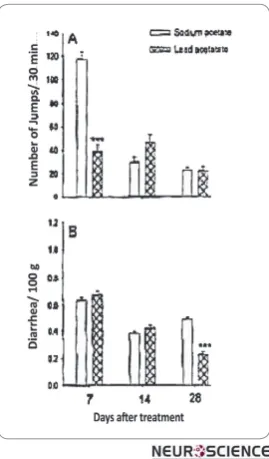
The morphine-dependent animals were exposed to lead acetate (0.05%) or sodium acetate (0.025%) in drinking water for 7, 14 and 28 days. The results are shown in Fig. 1.
Figure 1. Effects of lead on the development of dependency to morphine. The animals received lead acetate (0.05%) or sodium acetate (0.025%) for 7, 14 or 28 days as well as mor-phine (s.c.) 3 times daily for last 3 days of lead or sodium ac-etate exposure in order to induce dependency to morphine. All the dependent animals received naloxone (5 mg/kg, i.p.) to induce jumping and diarrhea. Jumping (Fig. 1A) and diarrhea (Fig. 1B) were recorded for 30 min immediately af-ter naloxone injection.
Winter 2009, Volume 1, Number 2
Basic and Clinical
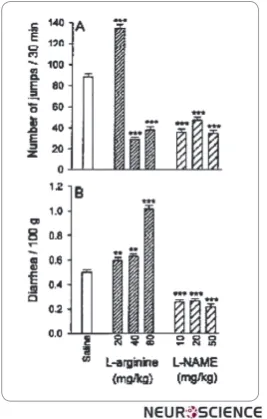
Figure 2. Effects of L-arginine (a precursor of nitric oxide) and L-NAME (nitric oxide synthase inhibitors) on the ex-pression of morphine dependency in mice. All animals received morphine (s.c.) 3 times daily for 3 days, in order to induce dependency to morphine. All the dependent animals received naloxone (5 mg/kg, i.p.) to induce jump-ing and diarrhea. arginine (20, 40, 80 mg/kg, i.p.) and L-NAME (10, 20, 50 mg/kg, i.p.) were injected 30 min before naloxone on the day 4, then jumping.
Data are means ± S.E.M.
*p<0.05, ** p<0.01, *** p<0.001 different from the saline con-trol group
Figure 3. Effects of L-arginine on the expression of mor-phine dependency in mice. All animals received mormor-phine (s.c.) 3 times daily for 3 days, in order to induce dependency to morphine .AII the dependent animals recei ved naloxone (5 mg/kg, i.p.) to induce jumping and diarrhea. L-argini ne (20, 40, 80 mg/kg, i.p.) was injected 30 min before nalox-one i n jection on the day 4.Jumping (Fig. 3A) and diarrhea (Fig. 3B) were recorded for 30 mi n. Each group comprised 7 mice. Data are means ± S.E.M.
*** p<0.0001 different from respective sodium acetate con-trol group.
+++ p<0.0001 different from respective L-arginine control group
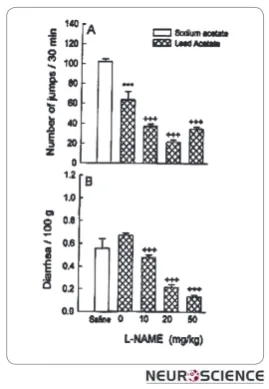
Figure 4. Effects of L-NAME on the expression of morphine dependency in mice. All animals received morphine (s .c .) 3 times daily for 3 days, in order to induce dependency to morphine. All the dependent animals received naloxone (5mg/kg, i.p.) to induce jumping and diarrhea. L-NAME (10, 20, 50 mg/kg,i.p.) was injected 30 min before naloxone injection on the day 4. Jumping (Fig. 4A) and diarrhea (Fig. 4B) were recorded for 30 min immediately after naloxone injection. Each group comprised 7 mice. Data are means ± S.E.M. *** p<0.001 different from respective sodium acetate control group. +++ p<0.001 different from respective L-NAME control group.
Figure 6. Effects of L-arginine on the development of mor-phine dependency in mice. All animals received mormor-phine (s.c.) 3 times daily for 3 days, in order to induce dependency to morphine. All the dependent animals received naloxone (5mg/kg, i.p.) to induce jumping and diarrhea. L-arginine (20, 40, 80 mg/kg, i.p.) was injected 30 min before morphine 3 days (during development of dependency). Jumping (Fig. 6A) and diarrhea (Fig. 6B) were recorded on the day 4 im-mediately after naloxone injection for period of 30 min . Each group comprised 7 mice. Data are means ± S.E.M. *** p<0.001 different from respective sodium acetate control group. ++ p<0.01, +++ p<0.001 different from respective L-arginine control group
Figure 7. Effects of L-NAME on the development of mor-phine dependency in mice. All animals received mormor-phine (s.c.) times daily for 3 days, in order to induce dependency to morphine. All the dependent animal s received naloxone (5mg/kg , i.p.) to induce jumping and diarrhea. L-NAME (10, 20, 50 mg/kg, i.p.) was injected 30 min before mor-phine 3 days (during development of dependency ) . Jump-ing (Fig. 7A) and diarrhea (Fig. 7B) were recorded on the day 4 immediately after naloxone injection for period of 30 min. Each group comprised 7 mice.
Data are means ± S .E .M.
*** p<0.001 different from respective sodium acetate con-trol group. +++ p<0.001 different from respective L-NAME control group.
NAME), before naloxone injection (before expression of jumping). The results are shown in Fig. 2.
2.8. Experiment 3
The morphine-dependent animals received saline (10 ml/kg) or different doses of L-arginine (20-80 mg/kg) 30 min before naloxone injection to test the response of the drug on expression of withdrawal signs. The animals were exposed to sodium acetate or lead acetate in drink-ing water. The results have been shown in Fig. 3.
2.9. Experiment 4
The morphine-dependent animals received saline (10 ml/kg) or different doses of L-NAME (10-50 mg/kg) 30 min before naloxone injection to test the response of the drug on expression of withdrawal signs. The animals were exposed to sodium acetate or lead acetate in drink-ing water. The data have been shown in Fig. 4.
2.10. Experiment 5
The morphine-dependent animals received saline, NO precursor arginine) or NO synthase inhibitor (L-NAME), 30 min before morphine, 3 times a day for 3 days during development of dependency (Fig. 5).
2.11. Experiment 6
The morphine-dependent animals received saline (10 ml/kg) or different doses of L-arginine (20-80 mg/kg) 30 min before morphine, 3 times a day for 3 days, dur-ing development of dependency, in order to test effect of L-arginine on development of dependency to morphine. The animals were exposed to sodium acetate or lead ac-etate in drinking water (Fig. 6).
2.12. Experiment 7
The morphine-dependent animals received saline (10 ml/kg) or different doses of L-NAME (10-50 mg/kg) 30 min before morphine, 3 times a day for 3 days.
2.13. Statistical analysis
Winter 2009, Volume 1, Number 2
Basic and Clinical
3. Results
3.1. Naloxone-Induced Withdrawal Jumping in Morphine-Dependent Mice
The mice were divided randomly into two groups. One group received morphine (as described in Methods) to induce dependency. The next group received saline (10 ml/kg, i.p.) instead of morphine (s.c.). Naloxone (5 mg/ kg, i.p.) increased the number of non-dependent mice. The results showed that naloxone could induce jumping in morphine-dependent mice. We considered jumping behavior as the signs of abstinence for further experi-ments in our study. Hyperactivity and Straub tail reac-tion were seen after morphine injecreac-tions.
3.2. Effects of Lead Exposure on Expression of Naloxone- Induced Jumping Behavior or Diar-rhea in Morphine Dependent Mice
Fig. 1 indicates effects of lead on development of de-pendency to morphine. The animals received i.p. injec-tion of lead acetate (0.05%) or sodium acetate (0.025%) for 7, 14 or 28 days, as well as morphine (s.c.) 3 times daily for last 3 days of lead or sodium acetate exposure, in order to induce dependency to morphine as described earlier in method section. Two-way ANOVA indicates that lead exposure altered naloxone-induced jumping [F(2,36)=47.0, p<0.0001] and diarrhea [F(2,36)=8.3, p<0.001]. Analysis shows that jumping was decreased 7 days, was not altered 14 days and 28 days after expo-sure to lead acetate. Diarrhea was increased 28 days af-ter lead exposure. The results may indicate that chronic lead exposure may disrupt opiate receptor mechanism.
3.3. Effects of No- Agents on Expression of Naloxone- Induced Jumping Behavior or Diar-rhea on Morphine-Dependent Mice
Fig. 2 indicates the effects of L-arginine, precursor of NO, L-NAME, NO synthase inhibitor on the expression of morphine dependency in mice. All animals received morphine (s.c.) 3times daily for 3 days, in order to in-duce dependency to morphine as described earlier. L-arginine and L-NAME were injected i.p. 30 min. before naloxone on the day 4, then the number of jumps and diarrhea were recorded immediately after naloxone in-jection for period of 30 min. One-way ANOVA shows a significant difference between jumps [F(9,60) =20.6, p<0.0001] and diarrhea [F(9, 60)=15.7, p<0.0001] in-duced by naloxone in the presence or absence of t he drugs. Further, analysis shows that jumping was de-creased by low dose (20 mg/kg, i.p.) and inde-creased by higher dose (80 mg/kg, i.p.) of L-arginine. L¬NAME decreased jumping in expression of jumping. Diarrhea
was increased by lower dose but decreased by higher dose of L-argnine, while decreased by L-NAME.
3.4. Effects of No-Agents on Expression of Naloxone-Induced Jumping Behavior or Diar-rhea in The Presence or Absence of Lead Acetate in Morphine-Dependent Mice
All the animals in the following groups (Fig.3 and 4) received i.p. injection of either lead acetate (0.05%) or sodium acetate (0.025%) for 7 days, as well as mor-phine (s.c.) 3 times daily for last 3 days of lead or so-dium acetate exposure, in order to induce dependency to morphine as described earlier in method section. The NO-agents were administered 30 min before naloxone injection on the day 4 of dependency. Jumps and diar-rhea were recorded for 30 min.
Fig. 3 shows the effects of L-arginine on the expression of morphine dependency in mice. Two-way ANOVA shows a significant difference between the effects of L-arginine on naloxone-induced jumping [F(3,48) =30.0, p<0.0001], and diarrhea [F (3,48)=22.7, p<0.0001] in the presence or absence of lead. Data show that lead de-creased jumping. L-arginine reversed lead-induced at-tenuation of jumping and increased diarrhea.
Fig. 4 shows the effects of L-NAME on the expression of morphine dependency in mice. Two-way ANOVA shows a significant difference between the effects of L-NAME on naloxone-induced jumping [F (3,48) =11.5, p<0.0001], and diarrhea [F(3,48) = 17.5, p<0.0001] in the presence or absence of lead. Data shows that lead decreased jumping, and L-NAME decreased diarrhea but not jumping.
3.5. Effects of No-Agents on Development of Naloxone- Induced Jumping Behavior or Diar-rhea in Morphine-Dependent Mice
All animals rendered dependent as described. L-argin-ine and L-NAME were injected 30 min before morphL-argin-ine 3 days (during development of dependency) the number of jumps and diarrhea were recorded on the day 4, imme-diately after naloxone injection for period of 30 min. Fig. 6 shows the effects of L-arginine on the development of morphine dependency in mice. Two-way ANOVA shows a significant difference between the effects of L-arginine on naloxone-induced jumping [F(3,48) =34.7, p<0.0001], and diarrhea (F (3,48)=5.5, p<0.0l] in the presence or ab-sence of lead. Data show that lead decreased jumping and L-arginine potentiated the response of lead. L-arginine in combination with lead decreased diarrhea.
Fig. 7 shows the effects of L-NAME on the development of morphine dependency in mice. Two-way ANOVA shows a significant difference between the effects of L-NAME on naloxone-induced jumping [F(3, 48) =5.3, p<0.0l], and diarrhea [F(3,48) =47.3, p<0.0001] in the presence or absence of lead. Data show that lead decreased jumping, which was potentiated in the presence of L-NAME. Diar-which was potentiated in the presence of L-NAME. Diar which was potentiated in the presence of L-NAME. Diar rhea was decreased by low dose of L-NAME.
4. Discussion
The several neurotransmitters including serotonin, dop-amine, GABA, adenosine, cholecystokinin and aspartate seem to be involved in morphine tolerance and dependence (16, 17). Mesolimbic dopaminergic neurons are thought to serve as a final common neural pathway for mediating rein-forcement processes. Long lasting neuroadaptive changes in mesolimbic dopamine-mediated transmission that develop during chronic drug used might contribute to compulsive drug-seeking behavior and relapse (18). It has also been shown that lead is capable of affecting dopamine recep-tor subtypes (4). Furthermore, lead exposure also has been found to produce functional dopaminergic supersensitivity, which involves both the dopamine Dl and D2 receptor sub-types (19). The present data show that chronic lead exposure for 7 days but not for 14 or 28 days decreased naloxone-induced jumping. It may be concluded that after first week of the lead exposure tolerance can be elicited. This is also in agreement with our previous results t hat lead exposure reduced jumping (20). Since dopaminergic mechanism has been implicated in naloxone-induced jumping in morphine -dependent mice (15), and lead exposure may disrupt dop-aminergic (4, 19), one site of interactions may be dopamine receptors . Furthermore, it has been shown t hat nitrite and nitrate increased after 7 days but not after 14 days of lead exposure (13). Since increase in NO level, during
develop-is the locus coeruleus and nucleus accumbens (21-23). How-ever, the role of locus coeruleus in the expression of opioid withdrawal is controversial (24). It has been suggested that chronic opiate administration induce different adaptations in the locus coeruleus, which some of these changes appear to be relevant in the behavioral consequences of opiate de-pendence and withdrawal (25). Opiate withdrawal might be mediated by nitric oxide acting as an intermediate messen-ger in the locus coeruleus (26). Our present study showed that pretreatment of animals with low dose (20 mg/kg) and higher dose (80 mg/kg) of L-arginine before naloxone ad-higher dose (80 mg/kg) of L-arginine before naloxone ad higher dose (80 mg/kg) of L-arginine before naloxone ad ministration (expression of jumping) decreased or increased expression of jumping respectively.
The present data have shown that L-arginine in com-bination with lead reversed lead-induced attenuation of naloxone-induced jumping and decreased diarrhea. Lead has also been shown to inhibit calcium-stimulated nitric oxide synthase activity in the rat cerebellum (27). There-fore opposite response of L-arginine in the presence or absence of lead may indicates that change in nitric oxide levels elicit a modulation of withdrawal jumping. NO in-duces release of neurotransmitters by calcium dependent and independent mechanisms, including acetylcholine, dopamine, norepinephrine, GABA, excitatory amino ac-ids, etc (28). Furthermore, NO exerts a dual effect on the neurotransmitter release. For example, low dose of the agent decrease release of dopamine while, high concen-tration of NO elevates the neurotransmitter (29). So, these controversial responses can be due to the dual effect of the agent. L-NAME decreased diarrhea. The similar respons-es of some dosrespons-es of L-arginine and L-NAME in exprrespons-es- expres-sion of naloxone-induced withdrawal signs, in this study may also further support the hypothesis of modulator role of nitric oxide in withdrawal.
Administration of lower dose and higher dose of L-argi-nine, during induction (development) of morphine depen-dency, in contrast to the effect of the drug when was used before expression, increased or decreased jumping respec-tively and increased diarrhea. Decrease in nitric oxide lev-els with L-NAME decreased both jumping and diarrhea. However, there is a report (14) indicating that increase or decrease in nitric oxide levels during development of opioid dependency elicited attenuation or acceleration of jumping respectively, our data may support the hypothesis that ni-tric oxide induces modulation of jumping withdrawal.
Winter 2009, Volume 1, Number 2
Basic and Clinical
with lead. Lead-induced attenuation of jumping also was potentiated in the presence of L-NAME, while diarrhea was decreased by the low dose of the drug. These data also s how that nitric oxide may involve in development of dependency and lead-induced attenuation of jumping.
Acknowledgement
The authors wish to thank Dr. T. Nayer-Nouri for his assistance in preparing this manuscript.
References
1-Kazantzis G. Lead sources, exposure and possible carcino-geni city. IARC Sci publ 1986;71 :
103-111.
2- Nolan CV.Shaikh ZA. Lead nephrotoxicity and associated disorders: biochemical mechanisms. Toxicology 1992;73:127-146
3-Simons TJB. Cellular interactions between lead and calcium. Br Med Bull 1986;42:432-434.
0RUHVFR50'DOOROLR5*DQGROÀ2*RYRQL6'L*LRYLQH
S. Trabucchi M. Lead neurotoxicity; a role for dopamine re-ceptors . Toxicology 1988;53:315-322 .
5-GoIter M. Michaelson IA. Growth, behavior and brain cat-echolamines in lead-exposed neonatal rats: a reappraisal . Sci. 1988;187 :359-361.
6-Silbergeld EK. Chisolm JJ Jr. Lead poisoning: altered urinary catecholamine met abolites as indicators of intoxication in mice and children. Science 1976;192:153 -155
7-Silbergeld EK. Interaction of lead and calcium on the syn-aptosomal uptake of dopamine and choline. Life Sci 1977; 20:309-318 .
8-Silbergeld EK. Goldberg AM. Pharmacological and neuro-chemical investigations of lead-induced hyperactivity. Neu-ropharmacology 1975;14:431-444.
9-Silbergeld EK. Hr uska RE. Miller LP. Eng N. Effects of lead in vivo and in vitro on GABAergic neurochemistry. J Neu-rochem 1980;34:1712-8.
10- Chapman DB. Way EL. Metal ion interaction with opiates. Ann Rev Pharmacol Toxicol 1980;20:553-579.
11- Sadee W. Pfeiffer A. Herz A. Opiate receptor: multiple ef-fects of metal ions. J Neurochem 1982;39: 659-667.
6FKZDUW]$60DUFKRN3/7KHLQÁXHQFHRIHDUO\OHDGH[ -posure on morphine reinforcement in the rat . Drug Alcohol Depend 1975;1:97-102 .
13- Chen SM. Swi lley S. Bell R. Rajanna S. Reddy SLN. Ra-janna B. Lead induced alterations in nitrite and nitrate levels in different regions of the rat brain. Comp Biochem Physiol 20 00;125 :315-323
14- Dambisya YM. Lee T. Role of nitric oxide in the induction and expression of morphine tolerance and dependence in mice. Br J Pharmacol 1996;117 : 914 -91 8 .
15- Zarrindast MR. Farzin D. Nicotine attenuates naloxone-induced jumping behavior in morphine-dependent mice. Eur J Pharmacol 1996;298:1-6 .
16- Bhargava HN. Diversity of agents that modify opioid tol-erance, physical dependence , abstinence syndrome, and self-administration behavior . Pharmacol Rev 1994;46 : 293 -324 .
17- Bourin M. Cholecystokinin receptor agonists block the jumping behavior precipitated in morphine-dependent mice by naloxone. Eur Neuropsychopharmacol 1999;9:37-43.
18- Spangel R. Weiss F. The dopamine hypothesis of reward: past and current status. Trends Neur osci 1999;22:521-527.
19- Cory-Sl etcha DA. Widzowski DV. Low level lead exposure increases sensitivity to the stimulus properties of dopamine D1 and D2 agonists. Brain Res . 1991;553:65-74 .
20- Ghazi-Khansari M. Delfan B. Abdollahi M. Zarri ndast MR. Effects of lead actate exposure on naloxone-induced jumping behavior in mice. Toxic Sub Mech 1999;18:39-47 .
21- Maldonado R. Stinus L. Koob GF. Role of different brain structures in the expression of the physical morphine with-drawal syndrome. J Pharmacol Exp Ther 1992;261:669-677
22- Redmond Jr DE. Krystal JH . Multiple mechanisms of with-drawal from opioid drugs. Annu Rev Neurosci.1984;7:443-478
23- Self DW. Nestler EJ. Molecular mechanisms of drug rein-forcement and addiction. Annu Rev Neurosci 1995;18 :463 -495 .
24- Christie MJ. Williams JT. Osborne PB. Bellchambers CE. Where is the locus in opioid withdrawal? Trends Pharmacol Sci 1997;18:134-140.
25- Nestler EJ. Alreja M. Aghajanian GK. Molecular and cellu-lar mechanisms of opiate action: studies in the locus coeru-leus. Brain Res Bull 1994 ;35:521-528.
26- Pineda J. Torrecilla M. Martin -Ruiz R. Ugedo L. Attenu-ation of withdrawal -induced hyperactivity of locus coeru-leus by inhibitors of nitric oxide synthase in morphine-de-pendent rats. Neuropharmacology 1998;37:759-767
27- Quinn MR. Harr is CL. Lead inhibits Ca2+-stimulated ni-tric oxide synthase activity from rat
cerebellum. Neurosci Lett 1995; 196:65-68.
28- Ohkuma S. Katsura M. Nitric oxide and peroxynitrite as factors to stimulate neurotransmi tter release in the CNS. Prog Neurobiol 2001,64:97-108.