based Wireless Sensor Network Energy
Optimization
Haider Ali
College of Engineering and Technology
University of Derby, Derby
United Kingdom
A thesis in fulfillment of the requirements for the degree of Ph.D in
Computer Science and Engineering
October 2020
Declaration
The study outlined in this dissertation were carried out in the Department of Engineering and Technology at University of Derby, under the supervision of Dr. John Panneerselvam and Professor Yong Xue. This is to declare that the work stated in this thesis was done by the author, and no part of the thesis has been submitted in a thesis form to any other university or similar institution. No human or animal participation have been included in this research and the research presented in this thesis has been ethically approved. The candidate confirms that appropriate credit has been given within the thesis where reference has been made to the work of others. Parts of this thesis have previously appeared in the papers listed in the list of publications.
Haider Ali
Department of Electronics, Computing and Mathematics University of Derby
Derby, United Kingdom January 2020
Acknowledgement
First of all, I thank Allah Almighty for His countless blessings. It was through His kindness that I was able to overcome all the challenges that I faced during my research.
I would like to thank my supervisorsDr. John Panneerselvam and Professor Yong Xue: it is difficult to express my gratitude to them for giving me the opportunity to join the research group at the University of Derby and supporting me in my research pursuits.
I express my deepest appreciation and gratitude to Professor Lu Liu. It would have never been possible for me to grow as a researcher without the continuous and extensive support of Professor Lu Liu.
I would also like to thank my dearest friend Dr. Umair Ullah Tariq for his help, valuable comments and constructive feedback on my research. I also appreciate the support from Dr. Xiaojun Zhai and Dr. Yongjun Zheng.
I would immensely thank to Dr. Muhammad Kazim who acted as a huge inspiration and spent quality time with me during my PhD. I also want to extend my gratitude to my friends specially Mr. Shahroz Nadeem and colleagues within the college of Engineering and Technology at the University of Derby.
I extend my profound gratitude to my parents Mr. Akbar Khan and Mrs. Zainab Bibi for their prayers, love and constant support throughout my PhD. Without their support, my dream of getting PhD was not possible.
Last but not least, I am indebted to my wife Jiya Haider and my three beautiful chil-dren Umer Haider, Ebad Haider,Arsh Haider, their continuous love and encouragement throughout my journey has been indispensable.
Abstract
Wireless Sensor Network (WSN) is an integrated part of the Internet-of-Things (IoT) used to monitor the physical or environmental conditions without human intervention. In WSN one of the major challenges is energy consumption reduction both at the sensor nodes and network levels. High energy consumption not only causes an increased carbon footprint but also limits the lifetime (LT) of the network. Network-on-Chip (NoC) based Multiprocessor System-on-Chips (MPSoCs) are becoming the de-facto computing platform for computationally extensive real-time applications in IoT due to their high performance and exceptional quality-of-service. In this thesis a task scheduling problem is investigated using MPSoCs architecture for tasks with precedence and deadline constraints in order to minimize the processing energy consumption while guaranteeing the timing constraints. Moreover, energy-aware nodes clustering is also performed to reduce the transmission energy consumption of the sensor nodes. Three distinct problems for energy optimization are investigated given as follows:
First, a contention-aware energy-efficient static scheduling using NoC based heterogeneous MP-SoC is performed for real-time tasks with an individual deadline and precedence constraints. An offline meta-heuristic based contention-aware energy-efficient task scheduling is developed that performs task ordering, mapping, and voltage assignment in an integrated manner. Com-pared to state-of-the-art scheduling our proposed algorithm significantly improves the energy-efficiency.
Second, an energy-aware scheduling is investigated for a set of tasks with precedence constraints deploying Voltage Frequency Island (VFI) based heterogeneous NoC-MPSoCs. A novel popu-lation based algorithm called ARSH-FATI is developed that can dynamically switch between explorative and exploitative search modes at run-time. ARSH-FATI performance is superior to the existing task schedulers developed for homogeneous VFI-NoC-MPSoCs.
Third, the transmission energy consumption of the sensor nodes in WSN is reduced by develop-ing ARSH-FATI based Cluster Head Selection (ARSH-FATI-CHS) algorithm integrated with a heuristic called Novel Ranked Based Clustering (NRC). In cluster formation parameters such as residual energy, distance parameters, and workload on CHs are considered to improve LT of the network. The results prove that ARSH-FATI-CHS outperforms other state-of-the-art clustering algorithms in terms of LT.
J = Journal Paper; C = Conference Proceeding; B = Book Chapter
J1: Haider Ali*, Umair Ullah Tariq*, Lu Liu, John Panneerselvam, and Xiaojun Zhai. “Energy-efficient Static Task Scheduling on VFI based NoC-HMPSoCs for Intelligent Edge Devices in Cyber-Physical Systems.” ACM Transactions on Intelligent Systems and Technology (TIST) 10, no. 6 (2019): 66. * Umair Ullah Tariq, Haider Ali contributed equally to this research.
J2: Haider Ali, Umair Ullah Tariq, Yongjun Zheng, Xiaojun Zhai, and Lu Liu.“Contention Energy-Aware Real-Time Task Mapping on NoC Based Heterogeneous MPSoCs.” IEEE Ac-cess 6 (2018): 75110-75123.
J3: Lei-Lei Shi, Lu Liu, Yan Wu, Liang Jiang, Muhammad Kazim, Haider Ali, and John Panneerselvam. “Human-Centric Cyber Social Computing Model for Hot-Event Detection and Propagation.”IEEE Transactions on Computational Social Systems (2019).
J4: Umair Ullah Tariq, Haider Ali, Lu Liu· John Panneerselvam , Xiaojun Zhai. “A Novel Meta-heuristic based Energy-aware Computing in Edge-devices using VFINoC-HMPSoC for Streaming Applications” Submitted to S.I. : IoT for Everyday Living: Ubiquitous Intelligence at Scale in Journal of Ambient Intelligence and Humanized Computing (AIHC). J5: Haider Ali,Umair Ullah Tariq, John Panneerselvam, Mubashir Hussain, Lu Liu. “ARSH-FATI a Novel Meta-heuristic for Cluster Head Selection in Wireless Sensor Networks” Accepted in IEEE Systems.
J6: Umair Ullah Tariq, Haider Ali, Muhammad Kazim, Waqar Ahmed. “Energy-aware Scheduling of Streaming Applications in IoT based Healthcare using VFI-NoC-HMPSoC as an Edge-device” Submitted inFuture Gen ration Computer Systems Journal.
C1: Haider Ali, Xiaojun Zhai, Umair Ullah Tariq, and Lu Liu. “Energy Efficient Heuristic Algorithm for Task Mapping on Shared-Memory Heterogeneous MPSoCs.” In 2018 IEEE 20th International Conference on High Performance Computing and Communications; IEEE 16th
International Conference on Smart City; IEEE 4th International Conference on Data Science and Systems (HPCC/SmartCity/DSS), pp. 1099-1104. IEEE, 2018.
C2: Haider Ali, Umair Ullah Tariq, Xiaojun Zhai, and Lu Liu. “Energy Efficient Task Mapping Scheduling on Heterogeneous NoC-MPSoCs in IoT Based Smart City.” In 2018 IEEE 20th International Conference on High Performance Computing and Communications; IEEE 16thInternational Conference on Smart City; IEEE 4th International Conference on Data Science and Systems (HPCC/SmartCity/DSS), pp. 1305-1313. IEEE, 2018.
C3: Hengjian Wang, John Pannereselvam, Lu Liu, Yao Lu, Xiaojun Zhai, and Haider Ali. “Cloud Workload Analytics for Real-Time Prediction of User Request Patterns.” In 2018 IEEE 20th International Conference on High Performance Computing and Communications; IEEE 16th International Conference on Smart City; IEEE 4th International Conference on Data Sci-ence and Systems (HPCC/SmartCity/DSS), pp. 1677-1684. IEEE, 2018.
C4: Haider Ali, Umair Ullah Tariq, Lu Liu, John Panneerselvam, and Xiaojun Zhai. “Energy Optimization of Streaming Applications in IoT on NoC Based Heterogeneous MPSoCs using Re-Timing and DVFS.” In 2019 IEEE SmartWorld, Ubiquitous Intelligence Computing, Advanced Trusted Computing, Scalable Computing Communications, Cloud Big Data Computing, Inter-net of People and Smart City Innovation (SmartWorld/SCALCOM/UIC/ATC/CBDCom/IOP/SCI), pp. 1297-1304. IEEE, 2019.
C5: Umair Ullah Tariq, Haider Ali, Lu Liu, and Xiaojun Zhai. “A Novel Meta-Heuristic for Green Computing on VFI-NoC-HMPSoCs.” In 2019 IEEE SmartWorld, Ubiquitous In-telligence Computing, Advanced Trusted Computing, Scalable Computing Communica-tions, Cloud Big Data Computing, Internet of People and Smart City Innovation (Smart-World/SCALCOM/UIC/ATC/CBDCom/IOP/SCI), pp. 1545-1552. IEEE, 2019.
B1: Yongjun Zheng, Haider Ali, and Umair Ullah Tariq. “Big Data Security in Internet of Things”. Pulished in Security and Privacy for Big Data, Cloud Computing and Applications (Computing and Networks), IET, UK.
ACO Ant Colony Optimization
ARSH-FATI Algorithm named after my daughter and niece
ARSH-FATI-CHS
ARSH- FATI based Cluster Head Selection
ATR Automatic Target Recognition
CATMES Contention and Energy-aware Task Mapping and Edge Scheduling
CH Cluster Head
CITM-VA Contention-aware Integrated Task Mapping and Voltage Assignment
CMOS Complementary Metal Oxide Semi-Conduction DAG Directed Acyclic Graph
DE Differential Evolution
DPM Dynamic Power Management
DR Dimensional Rate
DVFS Dynamic Voltage and Frequency Scaling EDF Earliest Deadline First
EECDF Edge Consistent Deadline First
EG Energy Gradient
ELFTF Earlier Latest Finish Time First E3S Embedded Systems Synthesis FFT Fast Fourier Transform
FND First Node Death
FoV Field-of-View
GA Genetic Algorithm
GALS Globally Asynchronous Locally Synchronous
IC Integrated Circuit
ICT Information and Communication Technology IDCT Inverse Discrete Cosine Transform
IFFT Inverse Fast Fourier Transform
ILP Integer Linear Programming IoT Internet-of-Things
IP Intellectual property
ISA Instruction Set Architecture
ITRS International Technology Road-map for Semiconductors LEACH Low-Energy Adaptive Clustering Hierarchy
LFT Latest Finish Time
LP Linear Program
LT Lifetime
MILP Mixed Integer Linear Programming MPSoC Multiprocessor System-on-Chip NLP Non-Linear Programming
NoC Network-on-Chip
NRC Novel Ranked based Clustering PEs Processing Elements
PSO Particle Swarm Optimization
PSO-ECHS PSO based Energy-efficient CH Selection QoS Quality-of-Service
SA Simulated Annealing
SC Smart City
SN Sensor Node
SoC System on Chip
VFI Voltage Frequency Island VCT Virtual cut-through VLCs Voltage Level Converters
WH Wormhole
Abstract i
1 Introduction 1
1.1 Internet-of-Things (IoT) . . . 1
1.2 Wireless Sensor Network (WSN) . . . 4
1.3 MPSoCs in IoT . . . 6
1.3.1 Multimedia Surveillance . . . 6
1.3.2 Healthcare and Automated Assistance . . . 8
1.3.3 Environment Monitoring . . . 8
1.3.4 Industrial Applications . . . 8
1.4 Challenges . . . 10
1.4.1 Research Approach . . . 10
1.5 Aim and Objectives . . . 13
1.6 Contributions . . . 13
1.7 Thesis Organization . . . 15
2 Background Study 17 2.1 Sensor Nodes Architectures . . . 17
2.1.1 Architecture . . . 19
2.1.1.1 Homogeneous MPSoCs . . . 20 ix
2.1.1.2 Heterogeneous MPSoCs . . . 20
2.1.2 Interconnect . . . 22
2.1.2.1 Bus . . . 22
2.1.2.2 NoC . . . 23
2.1.2.3 Bus based MPSoCs . . . 27
2.1.2.4 NoC based MPSoCs . . . 27
2.1.2.5 Voltage Frequency Islands based MPSoCs . . . 28
2.2 Task Scheduling . . . 29
2.2.1 System Level Energy Management Techniques . . . 34
2.2.2 Other Energy Reduction Techniques . . . 38
2.3 Summary . . . 43
3 Literature Review 44 3.1 Scheduling using NoC-MPSoCs . . . 44
3.1.1 Computational Energy Reduction . . . 44
3.1.2 Inter-processor Communication Energy Reduction . . . 46
3.1.3 Total Energy Savings . . . 47
3.2 Scheduling using VFI-NoC-MPSoC . . . 48
3.2.1 Independent Task Scheduling . . . 49
3.2.2 Single-processor Per VFI . . . 50
3.2.3 VFI based MPSoC . . . 50
3.3 Sensor Nodes Clustering . . . 52
4 Research Methodology 57
4.1 Preliminaries . . . 57
4.1.1 Extended Graph . . . 57
4.1.2 Multiprocessor Computing Platforms . . . 58
4.1.2.1 Non-VFI based NoC-MPSoC . . . 59
4.1.2.2 VFI based NoC-MPSoC . . . 62
4.1.3 Wireless Sensor Network . . . 65
4.2 Research Method . . . 67 4.2.1 Scheduling . . . 67 4.2.1.1 Task Mapping . . . 68 4.2.1.2 Task Ordering . . . 68 4.2.1.3 Voltage Scaling . . . 68 4.2.2 Clustering . . . 69
4.3 Experimental Setup and Data Collection . . . 69
4.3.1 Experimental Setup . . . 69
4.3.1.1 Node Level Experimental Setup . . . 70
4.3.1.2 Network Level Experimental Setup . . . 71
4.3.2 Data Collection . . . 71
4.4 Summary . . . 73
5 Energy-aware Static Task scheduling on Heterogeneous NoC-MPSoCs 74 5.1 Contention and Energy-aware Approach . . . 76
5.2 Results and Discussions . . . 83
5.2.1 CITM-VA Energy performance . . . 83
5.2.1.1 5×4 NoC . . . 84
5.2.1.3 7×4 NoC . . . 86
5.2.1.4 Robustness and QoS . . . 87
5.2.1.5 Energy and MM . . . 88
5.3 Summary . . . 89
6 Energy-aware Static Task Scheduling on Heterogeneous VFI-NoC-MPSoCs 90 6.1 Static Contention-aware Energy-efficient Scheduling . . . 92
6.1.1 Earliest Edge Consistent Deadline First (EECDF) Algorithm . . . 95
6.1.1.1 Energy gradient descent (EGD) . . . 99
6.2 Experimental Results and Discussions . . . 101
6.2.1 Scenario 1 . . . 103
6.2.2 Scenario 2 . . . 105
6.2.3 Scenario 3 . . . 106
6.2.4 Scenario 4 . . . 108
6.3 Summary . . . 109
7 Energy-aware Clustering for Enhancing Wireless Sensor Network Lifetime 111 7.1 ARSH-FATI based Cluster Head Selection . . . 112
7.1.1 ARSH-FATI-CHS . . . 114
7.1.2 Cluster Formation . . . 117
7.2 Experimental Results and Discussions . . . 119
7.2.1 Scenario 1(NoR) . . . 120
7.2.2 Scenario 2(NoANs) . . . 121
7.2.3 Scenario 3(IoBSL and IoNCHs) . . . 123
8.1 Conclusion . . . 127 8.2 Future Work . . . 132 8.3 Summary . . . 134
1.1 Smart city services . . . 4
2.1 MPSoCs architectures used in smart-phones . . . 21
2.2 Heterogeneous MPSoCs for IoT based applications . . . 22
2.3 Different DVFS-enabled NoC based MPSoCs from TileraTM . . . 28
2.4 Two different processors power consumption modes . . . 36
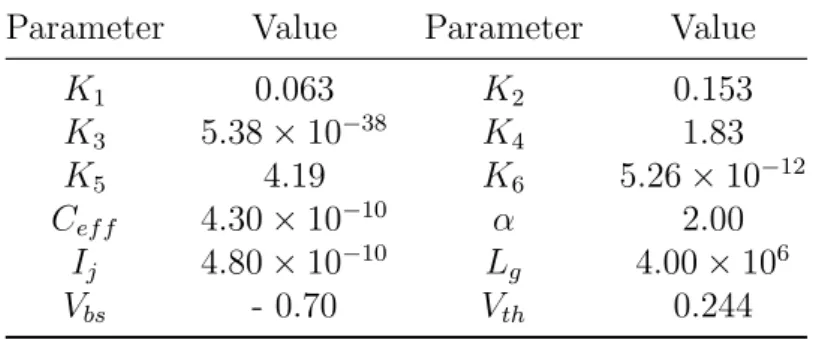
2.5 The 70 nm processor technology parameter values . . . 37
2.6 Transmeta crusoe processor power consumption at different supply voltage levels 37 4.1 Operating frequency and power consumption of type 1 and type 2 processors . . 70
4.2 Processors power consumption modes . . . 70
4.3 Various parameters used in simulation . . . 71
5.1 Terms and notations . . . 77
5.2 Real benchmarks description . . . 83
5.3 Real benchmarks dynamic energy consumption in Joule (J) . . . 84
5.4 Real benchmarks dynamic+static energy consumption in Joule (J) . . . 84
5.5 Real benchmarks dynamic+static energy in joule (J) at 0.9×(makespan)ECM . 85 5.6 Energy consumption (J) at different MM values using 28 tiles . . . 85
6.1 List of parameters used in results . . . 102 6.2 Real benchmarks energy consumption in joule (J) atN V F I = 4 andP P I = 2×2 103
7.1 List of abbreviations used in results . . . 120 7.2 ARSH-FATI-ECHS performance improvement comparison . . . 125
1.1 IoT connecting different devices and users for various applications . . . 2
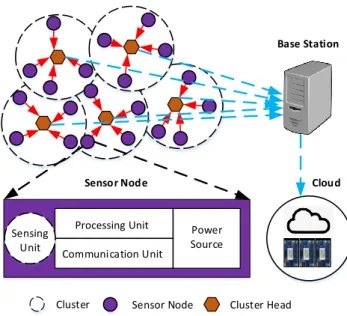
1.2 Wireless sensor network structure . . . 5
1.3 MPSoCs applications in IoT . . . 7
2.1 MPSoC systems categorization . . . 19
2.2 Homogeneous MPSoCs (a) shared memory (b) distributed memory . . . 20
2.3 Generic heterogeneous MPSoC architecture . . . 21
2.4 Bus communication architecture . . . 23
2.5 Bus matrix communication architecture . . . 23
2.6 A typical 2D-mesh NoC architecture . . . 24
2.7 Xilinx Zynq Ultrascale+MPSoC using ARM AMBA-AXI4 . . . 27
2.8 A typical representation of NoC based MPSoC architecture . . . 28
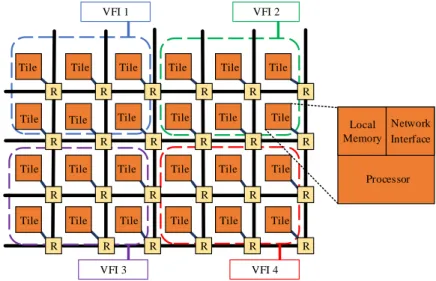
2.9 A generic representation of VFI based NoC-MPSoC architecture . . . 29
2.10 Directed acyclic graph . . . 32
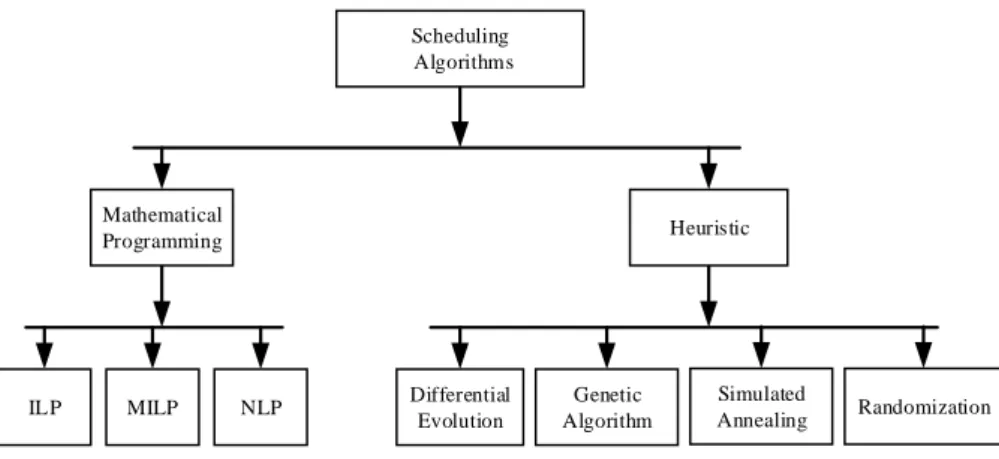
2.11 Task scheduling algorithms . . . 33
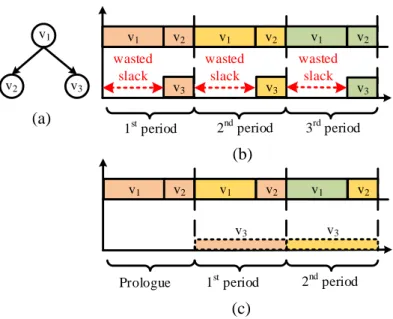
2.12 Coarse-grained software pipelining (a) a simple DAG with three task nodes rep-resenting a workload (b) tasks mapping without re-timing (c) task mapping with re-timing . . . 38
2.13 Sensor nodes clustering . . . 41
4.1 Directed acyclic graph . . . 58 xvii
4.3 2D-mesh topology based NoC-MPSoC . . . 60
4.4 VFI based heterogeneous NoC-MPSoC architecture . . . 63
4.5 2D-mesh topology NoC interconnect . . . 64
5.1 5×4 NoC containing 20 tiles . . . 85
5.2 6×4 NoC containing 24 tiles . . . 86
5.3 7×4 NoC containing 28 tiles . . . 87
5.4 Robustness . . . 88
5.5 Energy and makespan multiplier relation . . . 88
6.1 Dimensional rate parameter variations . . . 102
6.2 Energy consumption at N V F I = 4 andP P I = 2×2 . . . 104
6.3 Energy consumption usingN V F I = 4 at different PPI . . . 105
6.4 Set-1 energy consumption usingN V F I = 4 and P P I = 2×2 . . . 106
6.5 Set-2 energy consumption usingN V F I = 4 and P P I = 2×2 . . . 107
6.6 CCR impact on ARSH-FATI atV F I = 4 and P P I = 2×2 . . . 109
7.1 Performance analysis in terms of NoR after FND using different NSNs . . . 122
7.2 NoAN using different NSNs and NCHs = 25% at BS = (50, 50) . . . 123
7.3 Impact of base station and cluster heads on LT of the network . . . 125
Introduction
In this chapter we briefly introduce Internet-of-Things (IoT) and Wireless Sensor Network (WSN). We further explain the applications of Multiprocessor Systems-on-Chips (MPSoCs) in IoT and introduce the context of energy-efficiency in WSNs. We also list the objectives and contributions of this research. The organization of this thesis is presented at the end of this chapter.
1.1
Internet-of-Things (IoT)
IoT is a technological communication revolution that bridges a plethora of modern digital devices, users, and smart things to the Internet for numerous applications. Thus, IoT is transforming the Internet into a more pervasive and immersive model [1,2]. The literature demonstrates that the emergence of IoT has initiated Smart City (SC) concept, a paradigm that particularly concentrates on reconciling and enhancing both ecology and economy of city modernization [3,4]. An ultimate goal of the IoT technology for the SC is to optimize and efficiently control the city systems. More precisely the fundamental aim is to boost the effec-tiveness of city governance by establishing a communicating link between the human users and smart technology. IoT is gaining popularity for smart cities in order to develop efficient and low-cost applications for purposes such as monitoring, control and automation.
Figure 1.1: IoT connecting different devices and users for various applications
In IoT based services, the information is collected from the users and/or smart things via wearable devices, sensors, and cameras in Figure 1.1, these are represented by red, blue, and green colours respectively. These digital devices gathering information from a Field-of-View (FoV) are commonly known as Sensor Nodes (SNs). A process called clustering is performed on the SNs for achieving better energy efficiency, where several SNs are grouped into one cluster and one specific sensor node often referred as Cluster Head (CH) is selected. The CH gathers the data from each node within the cluster and performs further processing to compress the data and then transmits the aggregated data wirelessly to the Base Station (BS) [5,6]. The BS is usually a conventional computer with powerful processing capabilities and provides a platform where the data can be displayed to the professionals and/or other users through a user interface [6,7]. The data gathered in BS is transferred, processed, and stored in the cloud for further post processing to enable visualization and recommendations to be made, as shown in Figure 1.1 [8,9]. All the data from different CHs is accumulated in the cloud. The cloud provides a massive data/information storage and processing infrastructure [10,11]. The cloud promises high scalability, reliability, speed, performance, autonomy, and low-cost for the IoT applications. In simple words cloud delivers computing services, storage, networking, databases, software, intelligence, and analytics. The cloud is an essential part of the IoT system [12] and the collected data arrives in big amounts often reaches at real-time. Amazon EC2, Microsoft Azure, Google App Engine (GAE), Nimbus, IBM Blue Cloud, and 3Tera are some of the
examples of cloud computing systems [10].
There are three types of cloud (1) private, (2) public, and (3) hybrid explained as follows:
1. Private Cloud: The private cloud is defined as a computing service offered either over the Internet or a private internal network and to selected users only instead of the general public. The cloud infrastructure is operated solely for an organization. It may be managed by the organization or a third party and may exist on premise or off premise. Processes and data are managed within the same organization. Some of the benefits of a private cloud service include improved insurance, unlimited bandwidth, and low risk of security issues [13].
2. Public Cloud: A public cloud is a type of computing in which a service provider makes resources available to the public via the internet. Resources may include storage capa-bilities, applications or virtual machines. The cloud infrastructure is available to the general public and/or a large industry group and is owned by an organization providing cloud services. It provides services to each user using the same infrastructure. Basically the users pay for the resources they use. Some benefits of utilizing public cloud service include simple scalability, high reliability, and cost potency [13,14].
3. Hybrid Cloud:A hybrid cloud is a combination of a private cloud combined with the use of public cloud services where one or several touch points exist between the environments. The goal is to combine services and data from a variety of cloud models to create a unified, automated, and well-managed computing environment. Hybrid clouds are more complex than the other deployment models, since they involve a composition of two or more clouds (private, community, or public). By allowing workloads/jobs to move between the public and private clouds as computing costs and needs change subsequently, hybrid cloud can give businesses more data deployment options and greater flexibility [13,15].
Italy is one of the first countries to offer large scale smart services [16]. Recently in China, a boom in IoT based services occurred as listed in Table 1.1 to promote green, low-carbon, harmo-nious, and a sustainable development for 1.3 billion people [17]. IoT is opening new
opportuni-Table 1.1: Smart city services
Urban Function Smart Applications
Reproduction Public safety, environment, energy, healthcare, household, and urban management.
Economic
Development Manufacturing, industry, logistics, and city planning. Social
Interactions
Public transportation, online shopping, and general social management.
Culture
Enjoyment Education, tourism, and outdoor stream media.
ties to develop efficient, reliable, and low-cost applications that aim to enhance Quality-of-Life (QoL) in the cities [18]. As a result, various Information and Communication Technology (ICT) companies including Cisco, Samsung, IBM, HP, and Google are launching and promoting IoT based SC initiatives [19]. These initiatives encompass different domains such as environmental monitoring, utility monitoring, public transportation scheduling, advanced healthcare, incident reporting, and surveillance [16,20]. A report on the IoT Market (2011-2018) indicates that the global market exceeded US$ 1 trillion in 2017 and is anticipated to reach US$ 1,266 billion by 2019 [21].
1.2
Wireless Sensor Network (WSN)
WSN shown in Figure 1.2, is an integrated part of the IoT [22,23] and provides informa-tion about the physical world collected by dedicated sensors/cameras to the cloud from the Base Station (BS). Thus, WSN is a vital resource necessary to implement the vision of IoT paradigm [24–26]. In simple terms, WSN is an ad hoc network composed of resource-constrained digital devices known as SNs that are used to collect information from a FoV [27,28]. Advance-ments in modern technologies have had a significant positive impact on the availability of high-quality SN for numerous applications with superior technical features, low cost, minimal power consumption, and small physical size. The technological improvement in SN technology for multimedia data has enhanced the growth in WSN [29,30]. Multimedia content such as audio and video streams processing a promising technology utilized by numerous applications [31].
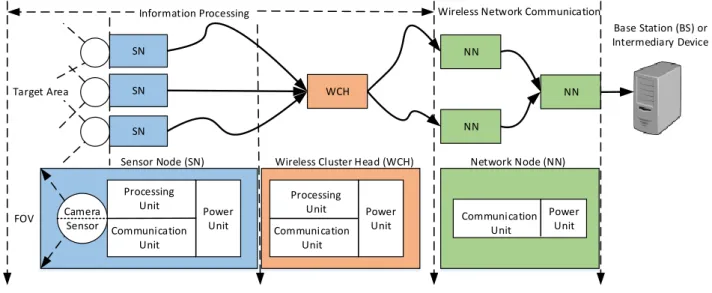
A typical SN indicated (highlighted by blue colour in Figure 1.2) used in a network contains four logical component blocks [6] each component is explained as follows:
1. Sensing Unit: Single or multiple sensors and Analogue to Digital Converters (ADC). The physical information is detected and captured in analogue form which the ADC converts to a digital format as required for the processing unit.
2. Processing Unit: Responsible for intelligent processing of the data received from the target area, this is a microprocessor and/or microcontroller with integrated memory. Digital Signal Processor (DSPr) and Application Specific Instruction-set Processor (ASIP) could also be component parts of the processing unit.
3. Communication Unit: Short-range transceiver system commonly based on standards such as IEEE 802.14.3, IEEE 802.15.4 or ZigBeeTM although other protocols e.g. IEEE 802.1 can also be utilised for specialised applications such as Industrial IoT (IIoT). 4. Power Source: Regulated supply for the data collection, processing, and transmission
subsystems. Batteries with limited residual energy are often deployed.
Processing Unit Communication Unit Power Unit Processing Unit Communication Unit Power
Unit Communication Unit Power
Unit Camera
Sensor FOV
Sensor Node (SN) Wireless Cluster Head (WCH) Network Node (NN) Target Area SN SN SN WCH NN NN NN
Information Processing Wireless Network Communication
Base Station (BS) or Intermediary Device Second Period First Period Prologue Third Period Second Period First Period Wasted Slack Wasted Slack Wasted Slack V2 V1 V2 V1 V2 V3 V3 V3 V2 V3 V1 V1 V2 V2 V3 V3 (a) (b) (c) V1 V1 V1
Figure 1.2: Wireless sensor network structure
The continuously expanding need for computationally extensive real-time applications has in-fluenced the growth in the usage of Multiprocessor-Syston-Chips (MPSoCs) in modern em-bedded systems [32]. MPSoCs provide high performance, exceptional Quality-of-Service (QoS),
and overwhelming reliability [33]. These qualities have contributed to the wide deployment of MPSoC as SNs for numerous real-time IoT applications. Some of the real-time applications in-volve multimedia content which is computationally extensive operations [34]. Subsequently, the number of processors are growing on the MPSoC for example Tilera Tile64 MPSoC contains 64 processors. According to International Technology Roadmap for Semiconductors (ITRS) there will be hundreds of processors in the MPSoC by 2025 [35] therefore, traditional bus based communications on chip architecture will become bottle neck due to the poor scalability and limited band width. NoC based communication has several advantages over hierarchical (STBus, Advance Microcontroller and Bus Architecture) as well as traditional bus architecture in terms of scalability, flexibility and performance [35].
The BS is responsible to collect the information from NNs. BS is usually a conventional computer with powerful processing capabilities i.e. multiprocessors. The BS provides WAN connectivity and data logging. The base station connects to database replicas across the in-ternet. Finally, the data is displayed to the professionals and/or other users through a user interface [6,7]. The BS has an unlimited power supply, while the SNs are mostly battery oper-ated digital devices with limited residual energy. In modern WSNs edge-computing is deployed before transferring all the data to BS to reduce load on the BS [36].
1.3
MPSoCs in IoT
The MPSoCs have become a de-facto computing platform and they can be used in various computationally extensive real-time applications as shown in Figure 1.3. Few examples are discussed as follows:
1.3.1
Multimedia Surveillance
MPSoCs integrated with video and audio sensors are used for target detection and track-ing, border protection, public event monitoring [37–39], video/image enhancement [40], person
Figure 1.3: MPSoCs applications in IoT
tracking [41], people and object identification [42,43]. These multimedia surveillance appli-cations involve compression/decompression, encoding/decoding and different conversions tech-niques which are computationally extensive operations. A few highly complex MPSoCs such as Xetal-I (128 processors) [34] and Xetal-II (320 processors) [44] are also used for surveillance.
Video surveillance to monitor on-road situation is a prime example of the multimedia applica-tion in IoT. In this video streaming of on-road situaapplica-tion, the informaapplica-tion is collected regarding vehicles positions, traffic jams and road accident severity. In the video streaming the multime-dia data content is streamed over the network in an encoded form while the video is displayed to the end user and/or professional either in a recorded or pre-recorded manner. In IoT based applications video streams are usually compressed to reduce the video size and achieve better load balancing in the video communications. The MPEG-encoder is executed numerous times for the whole video stream [45].
1.3.2
Healthcare and Automated Assistance
Multiprocessor systems are widely adopted by remote medical centres for various advanced healthcare related applications such as patient monitoring [46], drug administration, diagnostics [47,48], human gait analysis [49], care assistance, and motoring [50]. These servces using MPSoC help to reduce the frequency of patient’s visit to the hospitals while enhancing the Quality-of-Life (QoL). STMicroelectronics MPSoC is one of the popular multiprocessor platform that is widely adopted in advanced healthcare [46].
1.3.3
Environment Monitoring
MPSoCs are also used in applications such as animal and bird tracking as well as condition monitoring for irrigation, livestock, crops, and air pollution [44,51]. Monitoring systems are vital in time-critical applications, such as wild fire containment, flood detection, and disaster management [52,53]. High-performance computing platforms provided by MPSoC produce smart technology to monitor and detect natural and anthropogenic emergencies.
1.3.4
Industrial Applications
MPSoCs are deployed to extract and analyze information regarding civil structures e.g. nuclear power plants, pipelines, and large bridges especially during and after earthquakes, high winds, or environmental changes [54]. In industry MPSoCs are used for automation and manufacturing process control for example, Xilinx Zynq® UltraScaleTM are deployed in robots for operations such as supervision, control, and automation that increase repeatability while reducing human efforts while maintaining continuous operation [55,56].
Among the applications of MPSoCs in IoT, the most popular is surveillance where video ana-lytics is performed for different purposes. Video anaana-lytics also called Video Content Analysis (VCA), it involves different techniques to monitor, extract and analyze the information from video streams [57]. Closed-circuit television (CCTV) cameras are the main contributors of
com-puterized video analysis. In video analytics a key challenge is the size of the video data. In one second of high-definition video there is approximately equal to 2000 pages of text. Video analyt-ics in IoT is widely used in the recent years for surveillance and automated security. Automated surveillance systems are cost effective, cheaper, and remain focused as compared to labor-based surveillance systems. Video analytics can be used for human recognition, face recognition, ob-ject detection, recognizing suspicious activities, and detecting breach of restricted zones [58]. In terms of the IoT architecture two known approaches can be adopted for performing video ana-lytics, namely (1) server-based architecture and (2) edge-based architecture. Each architecture is explained as follows: [59].
Server-based Architecture: In this approach, captured video using cameras is transmitted to the centralized and dedicated server where video analytics is performed. The generated video is usually compressed to reduce the frame rates or the image resolution due to limited bandwidth availability. In this configuration the compressing may result the loss of information which can adversely affect analysis overall accuracy. However, the server-based approach facilitates easier maintenance.
Edge-based Architecture: In this configuration, analytics are applied at the SN level or ‘edge’ of the system. In other words video analytics is performed on the raw data gathered from the camera in the SNs. In this approach the entire content/data of the video stream remains available for the video analysis. Therefore, no loss of information occurs and enables efficient and effective content analysis. However, edge-based systems are more costly to maintain and posses lower processing power capability compared to server-based systems.
Briefly, server-based approach is easier to be implemented and maintained while edge-based system is costly though the entire video stream is available for performing video analytics on gathered data.
1.4
Challenges
One of the major technological challenges for IoT is energy consumption optimization at the SN and network level. High energy consumption of embedded systems at SN level not only reduces the lifetime of the network but also results in an increased carbon footprint. Approximately 4.7% of global electrical energy is consumed by Information and Communication Technology (ICT) and results in the releases of 2.0% of overall atmosphere carbon footprint [60]. Energy savings and green computing are therefore highly important. Moreover, SN mostly operates on embedded battery sources with limited residual energy, replacement of the batteries is usually challenging, difficult, and expensive. Consequently, there is high demand for energy-efficient techniques for reducing the energy consumption [61,62].
1.4.1
Research Approach
In this thesis we perform task scheduling to reduce the processing energy consumption con-sidering NoC-MPSoC and VFI-NoC-MPSoC architectures. Then we implement clustering to minimize the transmission energy consumption.
Scheduling used for real-time applications is an effective energy management mechanism when combined with Dynamic Voltage and Frequency Scaling (DVFS). This reduces the processing energy consumption of the MPSoC computing architectures. Task scheduling is a process of properly allocating an application containing a set of tasks on the processors such that specific obligations are fulfilled e.g. energy consumption optimization and/or execution time reduction. Proper task mapping and scheduling approach can drastically influence an embedded system’s performance and reliability [63]. DVFS is a useful technique whereby the processor supply voltage and clock frequency are dynamically reduced as a means to reduce overall power consumption without negatively impacting performance and deadline completion [64,65]. Modern MPSoCs includes DVFS-enabled processors. As an example, the Samsung Mongoose M2 has 4, DVFS-enabled homogeneous processors with an operating frequency range of 2.3 GHz to 2.8 GHz. Reducing the supply voltage can significantly decrease the energy consumption in
MPSoCs because voltage has a quadratic law relationship with energy consumption [66]. The DVFS not only reduces dynamic power,PD but also minimizes static power, PS, since it is also
dependent on Vdd. Thus DVFS is an efficient technique to reduce the total power ( dynamic
and static power) consumption.
Though DVFS is an effective technique to reduce the energy consumption of the tasks scheduled on MPSoCs however, there are other parameters that may affect the overall energy-efficiency. For example, task ordering plays significant role for achieving higher energy savings. If tasks with longer deadline are blocked by tasks with shorter deadline then DVFS may not have enough slack available to reduce the energy consumption. Similarly, in heterogeneous MPSoCs there are not only processors with different voltage scaling capabilities but also they contain processors with distinctive energy performance profiles. Therefore, mapping the tasks on heterogeneous influences the capability of DVFS to minimize the total energy consumption. If the tasks are not prioritized to be mapped on high energy-efficient processor such that the deadline is not missed then the overall energy-efficiency may be adversely affected. Moreover, energy consumption is also affected by the communication overhead due to the energy consumed on NoC links and router for inter-processor communications. Thus, our motivation for reducing the energy consumption of the MPSoC computing platform is to consider energy performance profiles of the processors, communication overhead, task ordering, and voltage scaling.
The total energy consumption of a network is the combination of sensing, processing and communication energy dissipation given as follows:
Enetwork =Esensing +Eprocessing+Ecommunication (1.1)
The sensing energy consumption reduction is performed at the fabrication level which is not within the scope of our thesis. However, the communication/transmission energy can be reduced by formulating it as a scheduling problem. The communication unit often consumes higher energy compared to the sensing and processing units [67,68]. Therefore, it is also important to minimize the communication energy consumption apart from reducing the processing energy.
ET X(l, d) = l×Eelec+l×ef s×d2 d≤do l×Eelec+l×emp×d4 d≥do (1.2)
whereEelec is the energy consumed per bit for running the transmitter circuit, ef s andempare
the amplification energy for free space model and multi-path model respectively whiledo shows
the threshold transmission distance.
Equation 1.2 shows that the transmission energy of the communication unit increases signifi-cantly when it transmits the data to the BS beyond its threshold transmission distance. Clus-tering is an effective technique deployed to increase the energy-efficiency of the network [69]. Clustering not only provides data aggregation, scalability, and bandwidth conservation but also prolongs the network Lifetime (LT) by decreasing the communication energy consumption of the SNs. In clustering process, the SNs are partitioned into groups called clusters. Where each cluster has its own leader known as CH. The CH collects the data within the cluster from its member SNs and transmits it to the BS.
Though, clustering increases energy-efficiency of the the network however there are other pa-rameters such as residual energy and workload on the CHs which must be observed. For instance if a CH with lower residual energy is selected then its energy would be depleted after few rounds. Subsequently it would adversely affect overall LT of the network. Similarly un-supervised workload on the CHs significantly can reduce the energy-efficiency of the network. Moreover higher the distance of a CH from BS can result an increased transmission energy con-sumption and subsequently may reduce the LT of the network. Therefore, we consider different distance parameters, residual energy, and workload on the CHs during our clustering approach in order to achieve maximum energy savings.
Briefly, in order to increase the energy-efficiency both task scheduling and clustering are the important mechanisms to be applied at the SN and network level respectively. Scheduling and clustering reduce the processing and transmission energy consumptions respectively which significantly increases the energy savings of the network while reducing the carbon footprint.
1.5
Aim and Objectives
This thesis aims to increase the lifetime of an MPSoC based wireless network by reducing the processing and transmission energy consumptions by performing proper task scheduling and nodes clustering respectively. In order to accomplish this aim, the following research objectives have been formalized.
1. To design an energy-efficient and contention-aware task scheduling algorithms deploying heterogeneous NoC-MPSoC computing architectures for real-time tasks with deadline and precedence constraints.
2. To design energy and contention-aware scheduling algorithms for a set of real-time tasks with precedence and deadline constraints targeting Voltage Frequency Island (VFI) based heterogeneous NoC-MPSoCs system.
3. To design algorithms for energy-efficient cluster heads selection in WSN to increase the overall LT of the network while efficiently reducing the transmission energy consumption of the sensor nodes distributed over a field.
1.6
Contributions
Contributions and innovations of this thesis are summarized as follows:
1. Contribution of Chapter 5: In this chapter, we investigate contention-aware and energy-efficient static scheduling using heterogeneous NoC-MPSoC for real-time tasks with an individual deadline and precedence constraints. Unlike other schedulers task or-dering, mapping, and voltage assignment are performed in an integrated manner to mini-mize the processing energy while explicitly reduce contention between the communications and communication energy. Furthermore, both dynamic voltage and frequency scaling and dynamic power management are used for energy consumption optimization. The de-veloped Contention-aware Integrated Task Mapping and Voltage Assignment (CITM-VA)
static scheduler performs tasks ordering using Earliest Latest Finish Time First (ELFTF) strategy that assigns priorities to the tasks having shorter Latest Finish Time (LFT) over the tasks with longer LFT. It remaps every task to a processor and/or discrete voltage level that reduces processing energy consumption. Similarly, the communication energy is minimized by assigning discrete voltage levels to the NoC links. Further, total en-ergy efficiency is achieved by putting the processor into a low-power state when feasible. Moreover, this algorithm resolves the contention between communications that traverse the same link by allocating links to communications with higher priority. The results obtained through extensive simulations of real benchmarks demonstrate that CITM-VA outperforms state-of-the-art scheduling algorithms and achieves an average ∼ 30% to-tal energy improvement. Additionally, it maintains high Quality-of-Service (QoS) and robustness for real-time applications.
2. Contribution of Chapter 6: In this chapter, we study energy-efficient and contention-aware static scheduling for tasks with precedence and deadline constraints on hetero-geneous VFI based NoC-MPSoCs (VFI-NoC-HMPSoC) with DVFS-enabled processors. Unlike the existing population-based optimization algorithms, we proposed a novel pop-ulation based algorithm called ARSH-FATI that can dynamically switch between ex-plorative and exploitative search modes at run-time. Our static scheduler ARHS-FATI collectively performs task mapping, task ordering, and voltage scaling. Consequently, its performance is superior to the existing state-of-the-art approach proposed for homoge-neous VFI based NoC-MPSoCs. We also developed a communication contention-aware Earliest Edge Consistent Deadline First (EECDF) task ordering algorithm and gradient descent inspired voltage scaling algorithm called Energy Gradient Decent (EGD). We introduced a notion of Energy Gradient (EG) that guides EGD in its search for islands voltage settings and minimize the total energy consumption. Conducted the experiments on 8 real benchmarks adopted from Embedded Systems Synthesis Benchmarks (E3S). Our static scheduling algorithm, ARSH-FATI outperformed state-of-the-art heuristics and achieved an average energy-efficiency of ∼ 24% and ∼ 30% over CA-TMES-Search and CA-TMES-Quick respectively.
3. Contribution of Chapter 7: Wireless Sensor Network (WSN) consists of a large num-ber of sensor nodes distributed over a certain target area. The WSN plays a vital role in surveillance, advanced healthcare, and commercialized industrial automation. Enhancing energy-efficiency of the WSN is a prime concern because higher energy consumption re-stricts LT of the network. Clustering is a powerful technique widely adopted to increase LT of the network and reduce the transmission energy consumption. In this chapter we develop a novel ARSH-FATI based Cluster Head Selection (ARSH-FATI-CHS) algo-rithm integrated with a heuristic called Novel Ranked based Clustering (NRC) in order to reduce the communication energy consumption of the sensor nodes while efficiently enhancing LT of the network. Unlike other population based algorithms ARSH-FATI-CHS dynamically switches between exploration and exploitation of the search process during run-time to achieve higher performance trade-off and maximally increase network LT. ARSH-FATI-CHS considers the residual energy, communication distance parameters, and workload during CHs selection. We simulate our proposed ARSH-FATI-CHS and generate various results to determine the performance of the WSN in terms of network LT. We compare our results with state-of-the-art Particle Swarm Optimization (PSO) based clustering and we prove that our developed ARSH-FATI-CHS energy-efficient sen-sor nodes clustering approach improves the network LT by∼25%. ARSH-FATI-CHS also outperforms LEACH and PSO-C while achieving an average LT improvements of ∼60% and ∼40% respectively.
1.7
Thesis Organization
The rest of the thesis is organized as follows: Chapter 2 discusses the background. Chapter 3 examines existing algorithms for task scheduling and nodes clustering. Chapter 4 presents our research methodology. Chapter 5 focuses on the development of contention-aware and energy-efficient scheduler for real-time tasks with precedence and deadline constraints on NoC-MPSoC system. Chapter 6 presents static algorithms for scheduling real-time tasks with precedence and deadline constraints on VFI based heterogeneous NoC-MPSoC architecture. Chapter 7
investigates the problem of energy-aware CHs selection in WSN for improving overall LT of the network. Finally, Chapter 8 concludes the thesis and discusses future research direction.
Background Study
In this chapter we present an overview of the MPSoCs considering different architectures and explain task mapping and scheduling in the viewpoint of energy-efficiency. We further discuss various energy management techniques applied at the SN level. Moreover we also explain SNs clustering process utilized to reduce the communication energy dissipation of the sensor network.
2.1
Sensor Nodes Architectures
In this section we discuss different architectures used in SNs for WSNs considering the energy-efficiency and performance requirements [70].
Recent advances in micro-electro-mechanical systems (MEMS) technology, wireless communi-cations, and digital electronics have enabled the development of high performance, low-cost, low-power, multi-functional SNs that are small in size and communicate untethered in short distances. They are the endpoints of the WSN and each SN comprises of sensor, processing unit and a communication unit [6,67]: Different architectures used as SNs in WSNs are discussed as follows:
Microcontroller: A microcontroller consisting of antenna (for wireless communication), pro-17
cessor, memory, sensor, and DC battery has been widely used as SN in the WSNs. Atmel ATMega 128L, MSP430, and Mica2 are the popular examples used as SNs. Though the energy-efficiency of these microcontroller based SNs was phenomenal however, the processing capability was limited and there was a latency issue because of the slower response. Thus, new archi-tectures have been developed to overcome the limitations of microcontrollers and one of the known example is Digital Signal Processors (DSPr).
Digital Signal Processors: Some applications in WSNs may require to perform digital filter-ing, Fourier analysis, and encoding. Microcontrollers are generally not optimized for such opera-tions therefore, DSPr are used to perform these data extensive mathematical operaopera-tions. Specif-ically DSPr optimizes handles and optimizes digital signal processing related tasks. Though DSP is a suitable solution for many applications but there are limitations such as lower speed and bandwidth. However DSPr can be an integrated part of the MPSoCs though some studies suggested ASIC (Application Specific Integrated Circuit).
ASIC: ASIC is an electronic circuit that integrates all components on a single chip required for performing a special tasks. ASIC has high performance, decreased circuit’s congestion, and low power consumption. These qualities make them ideal for being deployed in WSNs. Though ASIC provide an energy-efficient and robust computing platform for data extensive applications in WSNs however, time-to-market, price, lack of scalability and flexibility are the disadvantages of ASIC. Thus Field Programmable Gate Arrays (FPGAs) have replaced ASICs as an alternative.
FPGA:It is an integrated circuit that is designed to be configured by the customers or designers after manufacturing. FPGAs have higher adaptability and flexibility compared to ASIC. The FPGA architectures are re-configurable but complex to design though, they are useful for complex applications in WSNs. Xilinx Virtex-4 is an example of FPGA based architecture used in WSNs for video processing related applications (compression, decoding, image processing). FPGAs have gained drastic acceptance in WSNs to fulfill the requirements such as performance and flexibility.
19
developing high performance and energy-efficient systems such as green computing. MPSoC is set of independent and interconnected processors integrated on a silicon chip. These processors cooperate and communicate with each other to execute applications [71,72]. MPSoC is a single chip system that integrates all or most of the functions of an electronic system including I/O units with analog and mixed-signal components, memory, instruction-set processors, buses, spe-cialized logic, and digital signal processing functions [73,74]. MPSoC has set a new direction to the field of the embedded system. Modern MPSoC architectures also integrate Graphics Pro-cessor Unit (GPU), USB controller, Ethernet and/or wireless radios (3G, 4G, WiFi, 4G LTE), power management circuits, and multi-core functions [75–77]. MPSoCs have been pioneered by CPU manufacturing companies such as Xilinx, Tilera, IBM, Motorola, Intel, Samsung, and Apple [78,79].
MPSoC systems can broadly be categorized into three types as illustrated in Figure 2.1 based on their architecture, communication infrastructure, and number of processors deployed within each island of the MPSoC system. Each category of the MPSoC systems is explained with suitable examples given as follows:
Processing Unit Communication Unit Power Unit Processing Unit Communication Unit Power
Unit Communication Unit
Power Unit Camera
Sensor FOV
Sensor Node (SN) Wireless Cluster Head (WCH) Network Node (NN) Target Area SN SN SN WCH NN NN NN Second Period First Period Prologue Third Period Second Period First Period Wasted Slack Wasted Slack Wasted Slack V2 V1 V2 V1 V2 V3 V3 V3 V2 V3 V1 V1 V2 V2 V3 V3 (a) (b) (c) V1 V1 V1 MPSoCs MPSoCs Interconnect Architecture Voltage Frequency Island
Figure 2.1: MPSoC systems categorization
2.1.1
Architecture
In terms of the types of the processors used, MPSoCs can be divided into two general groups of homogeneous MPSoCs and heterogeneous MPSoCs. Each group of MPSoCs is explained as follows:
2.1.1.1 Homogeneous MPSoCs
Homogeneous MPSoCs are symmetric multiprocessing systems where identical processing el-ements with the same Instruction Set Architecture (ISA) are used [80]. Therefore, in homo-geneous MPSoC, a single thread task will have the same power consumption and complete in the same time irrespective of which processor is utilised. Examples of commercial homo-geneous MPSoC include Samsung Mongoose M2 with 4, Cortex-A53 processors and EZchip TILE-Mx100TM with one hundred Cortex-A53 processors. Homogeneous MPSoCs are suitable computing platforms for applications where communication to computation ratio is higher [81].
Homogeneous MPSoCs can be further classified into two categories based on memory organi-zation. Memory can be either shared shown in Figure 2.2(a) or distributed mirrored in Figure 2.2(b). Memory On-Chip Interconnect PE PE PE On-Chip Interconnect PE PE PE M M M (a) (b)
Figure 2.2: Homogeneous MPSoCs (a) shared memory (b) distributed memory
2.1.1.2 Heterogeneous MPSoCs
Heterogeneous MPSoC include multiple types of different processing elements. Heterogeneous MPSoCs can either be functional asymmetric or performance asymmetric.
1. Functional Asymmetric: They contain a set of architecturally different processing units, as a consequence with different ISA. Example architecture can include Specific Instruction-set Processor (ASIP), Field Programmable Gate Array (FPGA) fabric tiles, and dedicated microcontroller [82]. Figure 2.3 shows a generic functional asymmetric heterogeneous MPSoC consisting of architecturally different processing units i.e. general-purpose processor(CPU), video accelerator, and audio accelerator [83].
Power Management Interconnection Video Accelerator Audio Accelerator Memory CPU USB UART GPIO Wifi Bridge
Figure 2.3: Generic heterogeneous MPSoC architecture
2. Performance Asymmetric: The other type of heterogeneous MPSoCs is performance asymmetric where ISA remains the same but performance and power consumption of the processing units are different. In other words, some processing units may have higher performance capabilities but lower energy-efficiency compared to others [84]. Samsung Exynos 5 Octa (big.LITTLE) also known as Exynos 5410 used in Samsung Galaxy S4 is an example of performance asymmetric heterogeneous MPSoC. It has 4 Cortex-A15 proces-sors and 4 Cortex-A9 procesproces-sors. The Cortex-A15 procesproces-sors offer about 50% higher per-formance compared to Cortex-A9 [85]. Concisely, Cortex-A9 processor is energy-efficient but low performance while Cortex-A15 is low energy-efficient but high performance pro-cessor. Thus energy performance profile of the processors is different in heterogeneous MPSoCs.
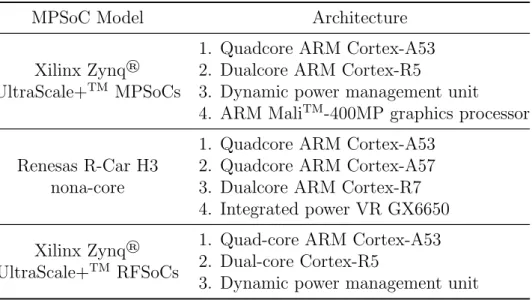
Heterogeneous MPSoCs are widely adopted for various processing extensive applications due to their superior performance and lower energy consumption compared to homogeneous MPSoCs [86,87]. Examples of heterogeneous MPSoC include, Samsung Exynos 9810 used in Samsung Galaxy S9+, S9++, and Note 9+. Few other heterogeneous MPSoCs are listed in Table 2.1 and Table 2.2.
Table 2.1: MPSoCs architectures used in smart-phones
Model Type Architecture
Samsung Exynos 9810 Heterogeneous 4 Mongoose 3 big cores and 4 Cortex-A55 little cores Apple A11 Bionic Heterogeneous 2 ARMv8-A monsoon and 4 ARMv8-A Mistral
Table 2.2: Heterogeneous MPSoCs for IoT based applications
MPSoC Model Architecture
Xilinx Zynq® UltraScale+TM MPSoCs
1. Quadcore ARM Cortex-A53 2. Dualcore ARM Cortex-R5
3. Dynamic power management unit
4. ARM MaliTM-400MP graphics processor
Renesas R-Car H3 nona-core
1. Quadcore ARM Cortex-A53 2. Quadcore ARM Cortex-A57 3. Dualcore ARM Cortex-R7 4. Integrated power VR GX6650 Xilinx Zynq®
UltraScale+TM RFSoCs
1. Quad-core ARM Cortex-A53 2. Dual-core Cortex-R5
3. Dynamic power management unit
2.1.2
Interconnect
The second broad categorization of MPSoC is based on the interconnect, the communication infrastructure used for inter-processor communication [88]. Subcategories are (1) Bus based MPSoC and (2) NoC based MPSoC. The type of inter-processor communication network plays a vital role in achieving energy-efficiency and avoiding communication congestion/contention. Loss of data in the communication network reduces the overall system performance and energy-efficiency [89].
2.1.2.1 Bus
The bus-based architecture is probably the oldest on-chip interconnect in the computer in-dustry and it is used in many MPSoCs [90]. The bus provides a communication mechanism which interconnects different components (processing units, memory, I/O units) of the MPSoC architecture. The bus interconnect shown in Figure 2.4 is an easier approach to integrating a small number of components due to its simple protocol design and silicon cost. However, it offers limited bandwidth and increased delays when used for a large number of components.
Matrix bus interconnect offers a solution for bandwidth as it offers multiple communication paths. Figure 2.5. demonstrates an example of 3 master and 5 slave Advanced Microcontroller
Processor Unit Communication Unit Power Source Processor Unit Communication Unit Power Source Communication Unit Power Source Sensor Camera FoV
Sensor Node (SN) Wireless Cluster Head (WCH) Network Node (Node) Target Area SN SN SN WCH NN NN NN Information Processing Wireless Network
Communication Base Station (BS) or Intermediary Device Input Stage Input Stage Input Stage ARM1 ARM2 DMA Arbiter1 Arbiter1 Arbiter1 Arbiter1 Arbiter1 MEM1 ROM MEM2 Timer MEM3 Matrix
Masters Decode Arbiters Slaves
Decode Decode A rb it e r
ARM1 ARM2 DMA MEM1 MEM2 ROM Timer
Figure 2.4: Bus communication architecture
Bus Architecture (AMBA) bus matrix communication subsystem architecture for dual ARM processor-based MPSoC. A bus matrix (crossbar switch) has several parallel wires (busses) which offer a suitable backbone to support concurrent data streams. The input stage handles interrupted bursts if receiving slaves are unable to accept them immediately. Decode generates a signal for proper slave selection. The component arbiter collects requests from all masters and allows only one module to have access to the slave at a time [91]. The evolution of bus interconnect is a progression started from AMBA, Advanced System Bus (ASB) to High-Performance Bus (AHB) then AMBA AHB-Lite and finally AMBA AXI (Advanced Extensible Bus). AXI4 is the latest example of MPSoC interconnect [92].
Processor Unit Communication Unit Power Source Processor Unit Communication Unit Power Source Communication Unit Power Source Sensor Camera FoV
Sensor Node (SN) Wireless Cluster Head (WCH) Network Node (Node) Target Area SN SN SN WCH NN NN NN Information Processing Wireless Network
Communication Base Station (BS) or Intermediary Device Input Stage Input Stage Input Stage ARM1 ARM2 DMA Arbiter1 Arbiter1 Arbiter1 Arbiter1 Arbiter1 MEM1 ROM MEM2 Timer MEM3 Matrix
Masters Decode Arbiters Slaves
Decode
Decode
Figure 2.5: Bus matrix communication architecture
2.1.2.2 NoC
NoC is a a typical example of network based communication subsystem on a chip. NoC technol-ogy applies the method of computer networking and improves the communication mechanism compared to conventional crossbar communication architectures. NoC increases the scalabil-ity, flexibilscalabil-ity, and power-efficiency of MPSoC. Figure 2.6 shows a typical 2D-mesh NoC that consists NR = 3 rows and NC = 3 columns i.e. a total of 9 routers. Each router in a NoC
has five ports associated with buffers, four ports are used to communicate with the neighbour routers and one dedicated for the purpose of communicating with the processing unit. NoC architecture basically consist of three major components explained as follows.
Router S west switch 0 (0,0) 1 (1,0) 2 (2,0) 3 (0,1) 4 (1,1) 5 (2,1) 6 (0,2) 7 (1,2) 8 (2,2) b u ff e r buffer b u ff e r Crossbar Switch buffer north switch south switch east switch processor
Figure 2.6: A typical 2D-mesh NoC architecture
Communication links: A communication link is used to connect two routers and a router with a processor. It contains one or more channels while each channel consists a set of wires. The links can be half duplex or full duplex and have a bandwidth, bw.
Router: NoC router consists a set of global output and input ports which are connected to other routers. A switching matrix connects input ports to output ports and the processor associated with the router. The buffers used in routers are to host the incoming data when immediate transfer to next processor and/or Intellectual Property (IP) is not possible because of the congestion.
Network Interface: It provides physical connections and logical connection between the processor and network.
In NoC communication is performed by transmitting message from the source processor to the associated router through network interface and the message is stored in the buffer temporarily for servicing. The router performs routing decision based on its policy regarding the path to be used for message delivery. The communication message is delivered to another router and this process continues until the communication message reaches to its destination i.e. the required processor. The communication latency depends on parameters such as message data size, network bandwidth, and buffer size [93]. Two major policies are used in NoC to deliver a
communication message (1) switching and (2) routing.
Switching: Switching determines when and how a data is transmitted in the NoC. The switch-ing mechanism can be divided into two subcategories i.e. circuit switchswitch-ing and packet switchswitch-ing. A routing algorithm is used in the circuit switching to determine the communication path and thus the a single communication message follows the same route [93]. In packet switching a communication message is often subdivided into several small fixed size packets called flits. Separate routing decisions are made for each packet or flit [94]. Some of the known packet switching strategies are (1) store-and-forward, (2) virtual cut-through, and (3) wormhole.
1. Store-and-forward: In store-and-forward strategy of data communication a complete message is stored by the router before sending it to the next router. Buffers of sufficient size are required in this mechanism to hold the whole packet otherwise it may cause the packet stalled.
2. Wormhole (WH): In the network when a flit traverses, the WH immediately deter-mines its next hop, forwards it and then the subsequent flits worm their way through the network. The disadvantage of this strategy is that in case of contention occurrence, a stalling packet may blocks all the communication links [33,95].
3. Virtual cut-through (VCT): In VCT routing the buffer size is large and the entire packet is sent to the next router. Thus, VCT has lower latency, higher link utilization, and lesser packet blocking probability. Though WH switching is simple and possesses higher efficiency of flow control over VCT but in case of congestion occurrence, the stalling packet can block all the links and result a low link utilization [96].
Routing: A routing algorithm determines the path of a communication message from source processor to the destination processor. Routing schemes can be either deterministic or adaptive.
1. Deterministic: In deterministic approach the packet always follows the same path be-tween source and destination. XY is the most popular and deterministic routing technique
used in NoC. In XY routing the packets are traversed in the X-direction first and then in the Y-direction to reach the target router.
2. Adaptive: Adaptive routing scheme dynamically performs link load evaluation and ap-plies a dynamic load balancing strategy. In other words, this scheme may use different path between source and destination if there is congestion on the original path.
There are also some other networks that are deployed as a interconnect for the inter-processors communications on chip. They are explained as follows:
Torus: Torus is the modified version of the basic mesh network. In this network the left sides of all the rows are connected to their right sides and the top of the columns are connected to the bottom of the columns. Torus performs better than mesh-network in terms of hop count but the wire length of mesh-network is significantly smaller than torus [97].
Star: In star network a central router in the middle of the star is responsible for inter-processor communications and the processors are on spikes of the network. There is always a higher chance of congestion occurrence as all the communication messages are going through the central router to reach the destination [98].
Polygon (Hexagon): It is basically a circular network in which the communication messages travel in loop from one router to another. One of the popular example for polygon network is hexagon topology. Hexagon network consist of six routers connected to five other routers while one link is associated for the computational resource [99].
Tree: It uses a tree structure in which the nodes show the routers while leaves represent the computational resources. The routers that are above the leaf are called leaf’s ancestors while the leaves below the ancestor are its children. In a fat tree topology for each node there are replicated ancestors thus many alternative routes are available between the nodes [99].
2.1.2.3 Bus based MPSoCs
Bus based MPSoCs use a bus as the medium of communication between processors and other components. Fig. 2.7 shows the architecture of Xilinx Zynq Ultrascale+MPSoC widely used for IoT applications. It deploys ARM AMBA-AXI4 bus to interconnect Quad-core ARM Cortex-A53, Dual-core ARM Cortex-R5 real-time processors, and other controls/peripherals [100,101]. ARM AMBA-AXI4 bus also establishes communication between a memory-mapped master device and a single or multiple memory-mapped slave devices [101]. The peripherals are inter-connected on a chip via the Security Policy Engine (SPE) to ensure security. Tightly Coupled Memory (TCM) segregates the untrusted applications. Traditional bus communication archi-tectures support only limited bandwidths and are not scalable for high-performance designs leading to the development of NoC based MPSoC. NoC based communication has several ad-vantages over hierarchical methods (STBus, Advance Micro-controller and Bus Architecture) as well as traditional bus architecture in terms of scalability, flexibility, power-efficiency, and performance [102,103]. L1 Cache 32 KB L1 Cache 32 KB L1 Cache 32 KB L1 Cache 32 KB AMBA-AXI4 TCM 64KB TCM 64KB SPE SPE ARM Cotex-R5 ARM Cotex-R5 I/O Sensor Interface ARM Cotex-A53 ARM Cotex-A53 ARM Cotex-A53 ARM Cotex-A53 L2 Cache 1MB
Figure 2.7: Xilinx Zynq Ultrascale+MPSoC using ARM AMBA-AXI4
2.1.2.4 NoC based MPSoCs
In NoC based MPSoC, the various modules such as processors (tiles), IP blocks, and mem-ory elements exchange the data through a network. In NoC data or messages can be relayed
from source to destination module over many links depending upon the routing decision at the switches [82,104,105]. NoC based MPSoCs can either be homogeneous or heterogeneous de-pending upon the nature of the processors used [82]. A generic NoC based MPSoC is illustrated in Figure 2.8. Tile Tile Tile Tile NI R M PE NI Network
Interface R Router M Memory PE
Processing Element NoC
DVFS
Figure 2.8: A typical representation of NoC based MPSoC architecture
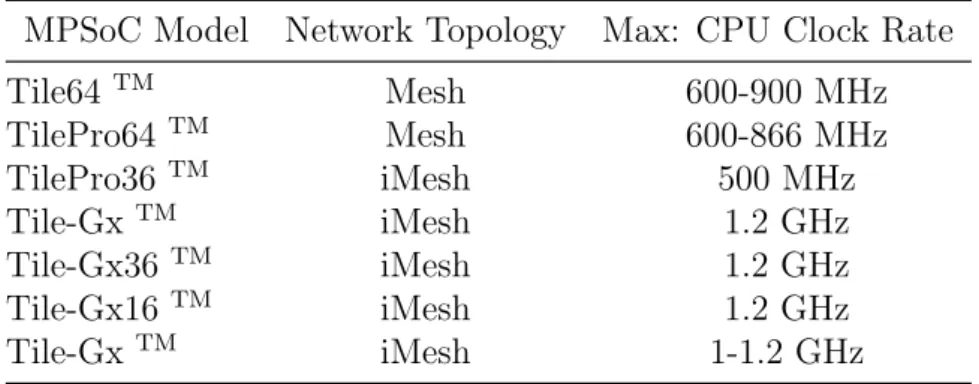
Samsung Exynos 7 Octa (7420) with 2.1 GHz Quad-Core Cortex®-A57 and 1.5GHz Quad-Core Cortex®-A53, HiSilicon Kirin 960 with 4× Cortex-A73, 4× Cortex-A53 are examples of NoC based MPSoC. The Tilera TILEPro64TM is an example that uses 64 identical processing units and iMesh NoC to interconnect tiles with each other and to the external resources. The iMesh NoC comprises of six 2D mesh-networks to support multi-hop routing. Various other NoC based MPSoCs by the Tilera corporation are listed in Table 2.3 [106,107].
Table 2.3: Different DVFS-enabled NoC based MPSoCs from TileraTM MPSoC Model Network Topology Max: CPU Clock Rate
Tile64TM Mesh 600-900 MHz TilePro64 TM Mesh 600-866 MHz TilePro36 TM iMesh 500 MHz Tile-Gx TM iMesh 1.2 GHz Tile-Gx36TM iMesh 1.2 GHz Tile-Gx16TM iMesh 1.2 GHz Tile-Gx TM iMesh 1-1.2 GHz
2.1.2.5 Voltage Frequency Islands based MPSoCs
More recently, Voltage Frequency Island (VFI), Globally Asynchronous Locally Synchronous (GALS) model is introduced to NoC interconnect, where the tiles are partitioned into islands
while each island is optimized with its own threshold voltage, operating frequency, and supply voltage. MPSoC systems implemented with GALS have a reduced number of voltage level converter and mixed-clock/mixed-voltage FIFO requirements [95,108,109]. However, the power consumption and complexity of the VFI based MPSoC systems increase when the number of VFIs are increased. Figure 2.9 shows a generalized VFI based NoC-MPSoC. It consists of four VFIs represented by different colours (yellow, green, violet, and blue) and six tiles per VFI. Each VFI contains an independent voltage supply and a local clock. Inter-VFI communication is established through mixed-voltage FIFO, mixed frequency clocks, and voltage converters. Moreover, each tile in every VFI has a local memory, network interface, and a processor [110]. It is worthy of note that state-of-the-art commercially available multiprocessor systems e.g. Intel Itanium i7 and IBM Power 7 series use VFI based MPSoC architectures [111,112].
VFI 2 VFI 3 VFI 4 VFI 1 R R R R R R R R R R R R R R R R R R R R R R R R Local Memory Processor Network Interface Tile Tile Tile
Tile Tile Tile
Tile Tile Tile
Tile Tile Tile
Tile Tile Tile
Tile Tile Tile
Tile Tile Tile
Tile Tile Tile
Figure 2.9: A generic representation of VFI based NoC-MPSoC architecture
2.2
Task Scheduling
Task scheduling is a process of properly allocating a set of tasks on the processors such that specific obligations are fulfilled e.g. power consumption optimization and/or execution time reduction. Scheduling real-time applications on a multi-processor system can be considered as solving two problems, 1) task mapping and (2) task ordering.
1. Task mapping: It specifies where each task is executed on the multiprocessor computing system.
2. Task ordering: This specifies the order and time in which each task or communication message would be executed on proces