ISSN(Online): 2320-9801
ISSN (Print): 2320-9798
I
nternational
J
ournal of
I
nnovative
R
esearch in
C
omputer
and
C
ommunication
E
ngineering
(An ISO 3297: 2007 Certified Organization)
Vol. 4, Issue 10, October 2016
Comparative Study of Various Segmentation
Techniques with their Effective Parameters
Savita Dubey, Yogesh Kumar Gupta, Diksha Soni
Research Scholar, Department of Computer Science, Banasthali Vidhyapith, Jaipur, Rajasthan, India
Assistant Professor, Department of Computer Science, Banasthali Vidhyapith, Jaipur, Rajasthan, India
Research Scholar, Department of Computer Science, Banasthali Vidhyapith, Jaipur, Rajasthan, India
ABSTRACT: To make the image more meaningful and easy to analyze, it is necessary to change its representation and simplify the image through the segmentation. Segmentation separates the digital image into multiple segments (set of pixels) and each segment possesses different features such as texture, color, intensity and many statistical properties. It is a way to interpret an image in detail. To visualize the ROI (Suspicious region) in any image segmentation is a prime function in image processing and computer vision. The goal of this study is to outlines some commonly used segmentation techniques in image processing like thresholding, edge based and region based with their merits and demerits. After that we present the comparison between segmentation techniques based on some specific parameters and find out suitable one.
KEYWORD: segmentation, thresholding, ROI, edge and region based.
I. INTRODUCTION
Segmentation of an image done to achieve mainly two objectives first is to construct an image into several parts to discover various image features and second is to extract meaningful information from an image and change the image representation into higher-level units that is much more meaningful for the future image analysis. Image segmentation involves separating a digital image into multiple meaningful regions (sometimes termed as region of interest (ROI)) and set of pixel regions that are strongly correlated with features and object of interest in the image. [3, 25] Region of interest used in image processing such as feature extraction, selection and disease classification. While segmentation, image is preprocessed which includes image enhancement, smoothening, filtering, restoration and pixel representation which is essential step to improve the segmentation process and noise filtering. [6, 2, 24] The segmented image is a set of contours that will rejoin to form the entire image and the level of segmentation is application dependent and also depends on the features that the image contained such as color, texture, shape, pixel intensity etc. [6, 7, and 24]
Image is a very successful source for information transmission. There is no universally available method for image segmentation so it is a challenge to develop an efficient method which will facilitate to understand an image and mine information from them to execute various jobs such as extracting harmful tissues from body scan, finding cancer cells, detection of airport from remote sensing data, robot navigation etc. [1] Segmentation is very primary and essential process in many image processing steps and also useful in image interpretation and analysis because object specific knowledge is require for the image interpretation, so image segmentation is a very important step in image analysis, visualization and object representation. Segmentation used to detect, recognize and measure the image objects. The segmentation process is used to differentiate between low and high level image processing. However it is very hard to get consistent and correct segmentation of an image by automatic means. Image segmentation turn into very popular area because there are many practical application areas of image segmentation such as in medical imaging (locate tumors, diagnosis, study of anatomical structures), satellite images to classify terrains, optical character recognition (OCR), image compression, watermarking, machine vision, brake light detection, traffic control and industrial inspection and so on where it is such a unpractical thing to process whole image directly. [1, 9]
ISSN(Online): 2320-9801
ISSN (Print): 2320-9798
I
nternational
J
ournal of
I
nnovative
R
esearch in
C
omputer
and
C
ommunication
E
ngineering
(An ISO 3297: 2007 Certified Organization)
Vol. 4, Issue 10, October 2016
extracts those features or parts of the image that need to be analyzed further. [2] Discontinuity and similarity are the two basic properties of intensity and the image segmentation techniques are based on these two.
II. SEGMENTATION TECHNIQUES
Image segmentation techniques are basically categorized into two categories: discontinuity approach (edge- based) and similarity approach (region- based) based on the two basic properties of the image. Segmentation method which is based on the discontinuity property of pixel, separate the image simply based on the sudden changes in intensity and it includes boundary or edge based techniques and the segmentation method based on similarity and homogeneity, partition the image by constructing the groups which are very analogous to each other and it uses methods like Thresholding, merging, region splitting and region growing. [4, 29, 25] The selection of image segmentation method is based on nature of the considered image and problem. There are numerous natures of images that need to be processed and analyze such as radiographic images, MRI images, color, grayscale images etc. Image segmentation techniques can be classified as:-
FIG. 1. VARIOUS TYPES OF SEGMENTATION TECHNIQUES [32]
A. THRESHOLDING BASED
ISSN(Online): 2320-9801
ISSN (Print): 2320-9798
I
nternational
J
ournal of
I
nnovative
R
esearch in
C
omputer
and
C
ommunication
E
ngineering
(An ISO 3297: 2007 Certified Organization)
Vol. 4, Issue 10, October 2016
threshold algorithm can automatically compute a value, known as automatic Thresholding, we can make a histogram of the image pixel intensities and with the help of mean and median one can choose a threshold. Thresholding techniques can be classified as: - [23]
Global Thresholding
When the intensity distribution among the background and foreground objects is different, a single threshold value can be used to differentiate both the objects. The threshold value purely depends on the pixels property and gray-level value of an image. This Thresholding is inappropriate for the complex documents and sometimes produce noise. There are some popular global methods as traditional, iterative and multistage. [22, 23]
Local Thresholding
To overcome the drawbacks of global Thresholding it comes into existence. When there is a use of different threshold value for each pixel in an image it is called as local or adaptive Thresholding. [22, 23]
B. EDGE BASED
Edge detection technique is based on the discontinuities in image values between different regions and highlights intensity changes. [25] Point, line and edges are the main types of discontinuity in the grey level. Edges generally composed with the pixels in the image where the gray value changes drastically from one pixel to another. Generally objects on boundaries have a tendency to produce abrupt intensity changes. Using edge detection operators this method used to find the edge information in the image and transform original image into edge images. Pixels between boundary of two regions form edge. Generally filtering, enhancement and detection of edge points are the three main steps to carry out edge detection process. [8, 13] Edges are the most essential part in the image because an image contains most important features such as corner, lines, curves etc on their edges. [10] Edge detection decreases the amount of data size to be processed and sort out the useless information and save essential structural properties in the image.[20, 12] Gradient based 1st order derivative (sobel operator, Prewit operator, Robert operator) and laplacian based 2nd order derivative (Laplacian of Gaussian, canny edge detection) are the two commonly used methods for edge detection. [10] Edge detection mainly used for object detection and image segmentation and serves wide variety of application such as security, image compression and enhancement, multimedia communication, computer vision etc and it gives poor performance in the presence of noise. [10]
C. REGION BASED
Region based technique is also known as “similarity based segmentation” used to find out region directly. [8, 28] It partition an image into uniform sub-regions based on some properties such as texture, color, intensity etc. Pixels belong to same intensity characteristics and closed to each other can be group together and assumed to be in same object. Region contains more information because it covers more pixels than edges. To detect regions we use texture and it is not simple to handle it with edges. In noisy images where edges are difficult to get, region growing technique is used. Watershed algorithm, region split and merge algorithm and region growing algorithm are the some commonly used methods of region based technique. It is a simple and robust method used to partition image into uniform regions correctly and give original image with clear edges using spatial information but it use high computation power. [20, 30]
III. REVIEW OF LITERATURE
Singh P, Chadha S.R. (2013). [1] The study suggested a novel approach to divide the image into multiple pieces to get more efficient vision of the image. They adopt one of the segmentation technique based on edge detection of the image present in the background and foreground. According to their suggested approach, after having the edge detection, dilation is applied over it from which is correctness is achieved for all type of images but stability is not achieved in the case of .png format.
ISSN(Online): 2320-9801
ISSN (Print): 2320-9798
I
nternational
J
ournal of
I
nnovative
R
esearch in
C
omputer
and
C
ommunication
E
ngineering
(An ISO 3297: 2007 Certified Organization)
Vol. 4, Issue 10, October 2016
images they found 96.5% increment in efficiency. As a future work they will try to implement an algorithm which is also suited for MRI, PET and SPET images.
Chandrakala M, Durgadevi P. (2016). [3] By comparing the existing algorithm with their proposed work they suggested threshold based segmentation technique using block processing for removal of non-uniform illumination background. In their proposed algorithm, image is segmented into M*N block on which global threshold as applied for each block. They concluded their technique as it has been proven by giving better and relevant results as compared with contemporary methods.
Sambasivarao Ch, Naganjaneyulu V. (2014). [4] Authors proposed a novel approach of boundary detection and image segmentation which is based on one of the common properties of image named as perceptual organization model. This work has to be proven for the outdoor images for their background recognition. The author’s aim is to recognize the strictly structured objects (combination of constituent parts) to get the accurate and efficient segmented image.
Singh P, Singh A. (2016). [5] Reviewed various segmentation techniques such as region based. Threshold based, cluster based and generic algorithm optimization based segmentation. They found region growing based segmentation well accurate as compared to other techniques except its limitation of having low intensity and complex background images. So by using fuzzy based modified shift and minimum spanning tree, they will probably improve multi spectral image segmentation.
R. Yogamangalam, B. Karthikkeyan. (2013). [8] Have studied the most commonly used segmentation techniques such as edge detection, model based, thresholding, clustering etc and discuss its advantages as well as disadvantages. Authors also mention the Markov Random Field (MRF) is the best method for denoisation of images and thresholding is the simplest and comparatively fast method for the image segmentation and segmentation techniques varies from application to application.
Jamil A. M. Saif, Al-Kubati A. A. M, Hazaa A. S, Al-Moraish M. (2012). [25] Authors compares two segmentation techniques first is Otsu thresholding (based on similarity approach) and second is Canny edge detection (based on discontinuity approach) and tests their correctness and stability on variety of medical and other types of images. For the segmentation purpose these two algorithms are best but for the endoscopic images canny algorithm is more suitable because in these images objects are not clearly separable from the background.
Abubakar F. M. (2013). [24] Author presents this paper on Global thresholding segmentation technique on the noisy images by using MATLAB software. With the help of this techniques images corrupted with noise such as Salt, Pepper and Gaussian firstly converted into grayscale and than by using this technique objects of these images will successfully removed from the background.
A. Manikannan, J. SenthilMurugan. (2015). [28] this paper firstly discuss on the some commonly used segmentation techniques as well as their advantages and drawbacks and proposed a technique based on the watershed algorithms to remove the limitation of the existing system. In existing system there is no proper way defined to process and alter an image in a desired manner. The proposed system provides image modification according the specification for the future accuracy.
Thakur A. K, Madhusudan. 2016. [15] Paper provides an overview on image segmentation techniques and principle of image segmentation with their major application areas. To achieve higher accuracy in result of image segmentation some methods with common attributes will combine because there is not any perfect image segmentation method.
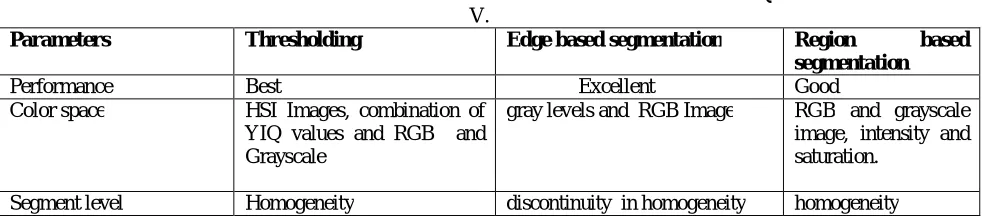
IV. TABLE 1. COMPARISON OF SEGMENTATION TECHNIQUES V.
Parameters Thresholding Edge based segmentation Region based
segmentation
Performance Best Excellent Good
Color space HSI Images, combination of YIQ values and RGB and Grayscale
gray levels and RGB Image RGB and grayscale image, intensity and saturation.
ISSN(Online): 2320-9801
ISSN (Print): 2320-9798
I
nternational
J
ournal of
I
nnovative
R
esearch in
C
omputer
and
C
ommunication
E
ngineering
(An ISO 3297: 2007 Certified Organization)
Vol. 4, Issue 10, October 2016
Segmentation effect Good Average Normal
Complexity Very low complexity Average complexity More complexity Quality measurement Depends on chosen threshold
value
Based on Intensity variation Based on similar pixel regions
VI. CONCLUSION
There is a need of image segmentation because the quality of images is directly affected by the temperature, noise and pressure. There are many factors on that segmentation depends such as pixel color, intensity, texture, similarity of images, image content and problem domain. According to the above comparison, the all segmentation algorithms do not guarantee same kind of result for all type of images so we can choose segmentation techniques that give efficient and accurate performance according to our problem area. Further research is immense required to produce a adaptive segmentation technique that will be applicable for all the images in any area of applications.
REFERENCES
1. Singh P, Chadha S.R. A Novel Approach to Image Segmentation. International Journal of Advanced Research in Computer Science and Software Engineering. 2013; Vol. 3, ISSN: 2277 128X.
2. Tamilselvan K. S, Murugesan G, Kandasamy K. A Novel Image Segmentation Algorithm for Clinical CT Images using Wavelet Transform, Curvelet Transform and Multiple Kernel FCM. Applied Mathematics Science, HIKARI Ltd. 2015. Vol. 9, no. 2351-2362.
3. Chandrakala M, Devi P. D. Threshold Based Segmentation Using Block Processing. International Journal of Innovative Research in Computer and Communication Engineering. 2016; Vol. 4, ISSN (ONLINE): 2320-9801, DOI: 10.15680/IJIRCC.2016.0401050.
4. Sambasivarao Ch, Naganjaneyulu V. An Efficient Boundary Detection and Image Segmentation Method Based on Perceptual Organization. International Journal of Computer Trends and technology (IJCTT). 2014; Vol. 7, ISSN: 2231-2803.
5. Singh P, Singh A. A Study on Image Segmentation Techniques. International Journal of Recent Trends in Engineering & Research (IJRTER). 2016; Vol. 02, ISSN: 2455-1457.
6. M. Ravi, B. Basavaprasad. A Comparative Study on Segmentation Methods for Medical Imaging. Proceeding of NCRIET & Indian J. Sci. Res. 2015; 12(1):302-306, ISSN (ONLINE): 2250-0138.
7. Usha, Kumar S. A Survey on Different Image Segmentation Techniques. International Conference on Technologies for Sustainability- Engineering, Information Technology, Management and the Environment. 2015; ISBN: 978-81-931039-7-5.
8. R. Yogamangalam, B. Karthikeyan. Segmentation Techniques Comparison in Image Processing. International Journal of Engineering and Technology (IJET). 2013; Vol. 5, ISSN: 0975-4024.
9. B. Poornima, Y. Ramadevi, T. Sridevi. Threshold Based Edge Detection Algorithm. International Journal of Engineering and Technology (IACSIT). 2011; Vol. 3, no. 4.
10. Kaur S, Singh I. Comparison between Edge Detection Techniques. International Journal of Computer Applications. 2016; Vol. 145-No. 15, ISSN: 0975-8887.
11. Saini B. S, Sethi G. Comparative Analysis of Edge Based and Region Based Active Contour using Level Sets and its Application on CT images. International Journal of Research in Engineering and Technology (IJRET). 2013; Vol. 02, Issue. 04, ISSN: 2319-1163.
12. Muthukrishnan R, M. Radha. Edge Detection Techniques for Image Segmentation. International Journal of Computer Science and Information Technology (IJCSIT). 2011; Vol. 3, No. 6.
13. S. Lakshmi, V. Sankaranarayanan. A Study of Edge Detection Techniques for Segmentation Computing Approaches. International Journal of Computer Applications. 2010.
14. Kandwal R, Kumar A, Bhargava S. Review: Existing Image Segmentation Techniques. International Journal of Advanced Research in Computer Science and Software Engineering. 2014; Vol. 4, Issue 4, ISSN: 2277 128X.
15. Thakur A. K, Madhusudan. Image Segmentation: A Comparative Study. International Journal of Advances in Computer Science and Technology. 2016; Vol. 5, No. 6, ISSN: 2320-2602.
16. Khan M. W. A Survey: Image Segmentation Techniques. International Journal of Future Computer and Communication. 2014; Vol. 3, No. 2, DOI:10.7753/IJFCC.2014.V3.274.
17. Dass R, Priyanka, Devi S. Image Segmentation Techniques. International Journal of Electronics and Communication Technology. 2012; Vol. 3, Issue. 1, ISSN (ONLINE): 2230-7109.
18. Kamdi S, R. K. Krishna. Image Segmentation and Region Growing Algorithm. International Journal of Computer Technology and Electronics Engineering (IJCTEE). Vol. 2, Issue. 1, ISSN: 2249-6343.
19. Matta S. Review: Various Image Segmentation Techniques. International Journal of Computer Science and Information Technologies (IJCSIT). 2014; Vol. 5 (6), ISSN: 0975-9646.
20. P. Elayaraja, M. Suganthi. Survey on Medical Image Segmentation Algorithms. International Journal of Advanced Research in Computer and Communication Engineering (IJARCCE). 2014; Vol. 3, Issue. 11, ISSN (ONLINE): 2278-1021.
21. P. Daniel Ratna Raju, G. Neelima. Image Segmentation by using Histogram Thresholding. International Journal of Computer Science Engineering and Technology (IJCSET). 2012; Vol. 2, Issue. 1, ISSN: 2231-0711.
ISSN(Online): 2320-9801
ISSN (Print): 2320-9798
I
nternational
J
ournal of
I
nnovative
R
esearch in
C
omputer
and
C
ommunication
E
ngineering
(An ISO 3297: 2007 Certified Organization)
Vol. 4, Issue 10, October 2016
23. Salem Saleh Al-amri, N. V. Kalyankar, Khamitkar S. D. Image Segmentation by using Threshold Techniques. Journal of Computing. 2010; Vol. 2, Issue. 5, ISSN: 2151-9617.
24. Abubakar F. M. Study of Image Segmentation using Thresholding Technique on a Noisy Image. International Journal of Science and Research (IJSR), India. 2013; Vol. 2, Issue. 1, ISSN (ONLINE): 2319-7064.
25. Jamil A. M. Saif, Al-Kubati A. A. M, Hazaa A. S, Al-Moraish M. Image segmentation using Edge Detection and Thresholding. The 13th International Arab Conference on Information Technology (ACIT). 2012; ISSN: 1812-0857.
26. H. S. Prasantha, Shashidhara H. L, K. N. B. Murthy, Madhavi Lata G. Medical Image Segmentation. International Journal on Computer Science and Engineering (IJCSE). 2010; Vol. 02, No. 04, ISSN: 1209-1218.
27. Ahirwar A. Study of Techniques used for Medical Image Segmentation and Computation of Statistical Test for Region Classification of Brain MRI. International Journal of Information Technology and Computer Science. 2013; 05, 44-53, DOI: 10.5815/ijitcs.2013.05.06.
28. A. Manikannan, J. SenthilMurugan. A Comparative Study about Region Based and Model Based using Segmentation Techniques. International Journal Innovative Research in Computer and Communication Engineering. 2015; Vol. 3, Issue. 3, ISSN (ONLINE): 2320-9801.
29. Chandel G. S, Kumar R, Khare D, Verma S. Analysis of Image Segmentation Algorithms using MATLAB. International Journal of Engineering Innovation & Research. 2012; Vol. 1, Issue. 1, ISSN: 2277-5668.
30. Banchpalliwar R. A, Salankar S. S. A Review on Brain MRI Image Segmentation Clustering Algorithm. IOSR Journal of Electronics and Communication Engineering (IOSR-JECE). 2016; Vol. 11, Issue. 1, ISSN (ONLINE): 2278-2834, DOI: 10.9790/2834-11128084.
31. Kumara R, Sharma N. A Study on the Different Image Segmentation Technique. International Journal of Engineering and Innovative Technology (IJEIT). 2014; Vol. 4, Issue. 1, ISSN: 2277-3754.
![FIG. 1. VARIOUS TYPES OF SEGMENTATION TECHNIQUES [32]](https://thumb-us.123doks.com/thumbv2/123dok_us/1427672.1175257/2.595.89.543.345.577/fig-various-types-of-segmentation-techniques.webp)