Available Online atwww.ijcsmc.com
International Journal of Computer Science and Mobile Computing
A Monthly Journal of Computer Science and Information Technology
ISSN 2320–088X
IMPACT FACTOR: 6.017
IJCSMC, Vol. 6, Issue. 5, May 2017, pg.308 – 315
Detail and Comparative Study on
Various Segmentation Techniques
Sneha Kumari
Banasthali University, India
1[email protected]
Abstract— As day by day new computer technologies are emerging in the area of image processing,
especially in the field of segmentation. Image Segmentation is a hotspot and important process of image
processing. Several algorithms and techniques are developed for image segmentation. It is a technique of
partitioning digital image into multiple regions called segments for further analysis. It is very useful in image
comprehension and in differentiating different objects in the image. As there is no general solution to the
image segmentation these algorithms are often combined for better interpretation. This paper presents a
comparative study of various basic image segmentation techniques.
Keywords— Image Processing; Segmentation; Thresholding; Image Analysis; Edge Detection; Clustering.
I.
I
NTRODUCTIONImage processing is the use of algorithms to analyse digital image. Image segmentation is
one of the most difficult processes of digital image processing. In this technique digital image
is partitioned in different segments depending on the similar features and properties. It is
done before denoising the image. The goal of performing segmentation is for better
understanding and interpretation of the digital image [4]. The extent of segmentation to which
the subdivision of the image is done depends on the problem being solved. In other words,
segmentation should stop when the object of interest is isolated. Image processing is a
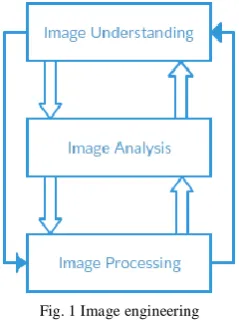
low-level operation in image engineering. It works on pixels. As operation is carried out on
pixel-level a modified version of image is produced [8]. Hence it improves the visual effects of the
image. Image processing follow 3 levels and each is subdivided into further different
categories.
A.
Reconstruction
1)
Restoration
Radiometric
Geometric
2)
Transformation
Contrast Stretching
Noise Filtering
Rotation
3)
Classification
Segmentation
Classification
Supervised
Unsupervised
The middle-level i.e. image analysis it deals with the measurement. A new set of images
are produced by Principal Component Analysis (PCA) from the given set. At the high level
image understanding, image is analysed and interpreted. Image segmentation is the main step
from image processing to image analysis. It makes feature measurement easier and gives
better interpretability [42].
Fig. 1 Image engineering
II.
CLASSIFICATION OFS
EGMENTATIONT
ECHNIQUESSegmentation techniques are mainly classified into two main categories i.e. Layer- Based
Segmentation and Block Based Segmentation Methods.
A.
Layer- Based Segmentation Methods
By the use of this segmentation method object is defined more clearly on the basis of shape,
appearance and depth. Hence evaluate class and instance segment.
B.
Block Based Segmentation Method
Block Based Segmentation methods are based on different features present in the image. It
could be colour information, information about pixels that helps in fencing off the edges or
boundaries. Further, block based segmentation method are divided into two categories i.e.
region based and edge or boundaries based. Fig.2
In this paper we have discussed the popular image segmentation techniques like
Thresholding Method, Edge Based Method, Region Based Method, Clustering Technique,
Partial Differential Equation Based Method, Watershed method and Fuzzy Theory based
Method [41]. All techniques use different approach for segmentation of a digital image.
III.
IMAGES
EGMENTATIONT
ECHNIQUESC.
Edge Based Segmentation Method
Edge detection techniques convert image to edge image by using the change of grey tone.
Edges in the image are significance of discontinuity in the image. It shows rapid change in
intensity value and form boundary between two regions. Edges are detected where either the
first derivative of intensity is greater than a particular threshold or second derivative has zero
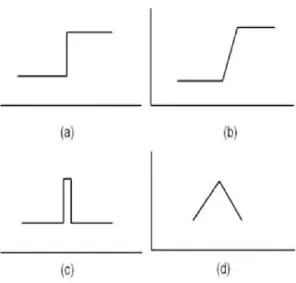
crossings. Few popular types of edges are as follows.
1)
Step Edge
Image intensity changes abruptly from one value to a different value which shows the
discontinuity.
2)
Ramp Edge
In real life it is very rare that a digital image has sharp edge. In reality ramp edges are the
actual form of step edge.
3)
Line Edge
In such edges intensity changes abruptly then returns to the initial value within short
distance.
4)
Roof Edge
The reality of line edges are roof edge.
Fig. 4 Types of edge detection
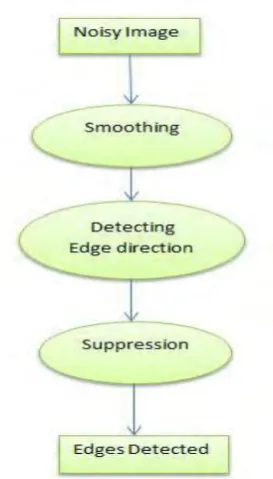
There are various techniques shown in Fig.4 used for edge detection. Edges are detected
on the basis of discontinuity in the intensity present in the digital image. Region are traced
and compared with the neighbouring pixel value, by using both fixed and adaptive feature of
Support Vector Machine (SVM).
The surface of the digital image is smoothened to reduce the effect of noise. This is
done by using Gaussian Convolution.
To measure edge strength and direction, sobel operator is used.
Pixels are not taken in account which is not related to the edge and minimized. For
non maximal suppression, the edge directions are taken into consideration.
In last step, threshold value of an image is calculated and pixel value is compared. If
the pixel value is higher than the threshold value then, it is considered as an edge else
discarded.
D.
Region Based Method
The entire image is divided into various regions having similar properties, also known as
“Similarity Based Segmentation”.
1)
Clustering: K- means
Dividing the image into k graphs by adding point p, to the cluster where the difference is
smallest between the points and the mean sharp boundaries between clusters produced by
hard clustering. Fuzzy clustering is shape-based segmentation algorithm.
2)
Split and Merge
At first the whole image is considered as a single region, repeatedly split until no more split
is possible. Two regions are merged together if they are similar and adjacent. Merging is
repeatedly done until no more merge is required.
3)
Normalized Cuts
It aims at optimal splitting by reducing number of regions based on graph theory. Each
pixel is considered as a vertex and edges link the adjacent pixels. On the basis of similarity,
colour, distance, grey level between two corresponding pixels [42].
4)
Region Growing
It is one of the most popular techniques. Combine the similar pixels based on properties and
repeat until all pixels belong to the same region.
5)
Thresholding
Algorithms come under Threshold Based Segmentation Technique divide the pixel
with respect to their intensity level. There are basically three types of thresholding:
Global Thresholding
An appropriate value for T is set and this value will be constant for whole image. On the
basis of T output image q(x, y) can be obtained from the original image p(x, y).
Variable Thresholding
In this type of thresholding, the value of the T can vary over the image and further grouped
into two categories:
a)
Local Threshold: In this the value of T depends upon neighbourhood of x and y.
b)
Adaptive Threshold: The value of is a function of x and y.
Multiple Thresholding
E.
Watershed Based Method
Topological interpretation is used in this method. In this method intensity shows the basin
having hole in its minima from where the water spills. Two adjacent basins are merged when
water reaches the border of the basin. Dams are required to maintain the separation, which
are made of dilation. Gradient of image is considered as topographic surface in this method
[17]. Those pixels which have more gradient depicts the edges
F.
Fuzzy Theory Based Method
Fuzzy sets are made by dividing pixels. Single pixel may belong to many sets and regions,
as shown in Fig.5. Fuzzy rules for neighbourhood and edge detection for central pixel is
clearly shown in the following diagram.
G.
Partial Differential Equation Based Segmentation Method
As partial differential equation methods are one of the fastest methods for segmentation
used in time critical application. Two basic methods partial differential equation are as
follows:
1)
Non-Linear Isotropic Diffusion filter(used for improve the edge)
2)
Convex Non-Quadratic Variation restoration(used in noise removal)
Hazy and blur edges are produced by applying partial Differential Equation Method, and
can be shifted by the use of close operator. For enhanced edge and boundary 2
ndOrder
Partial Differential Equation Method is used and 4
thOrder Partial Differential Equation
Method is used for noise removal [41].
IV.
C
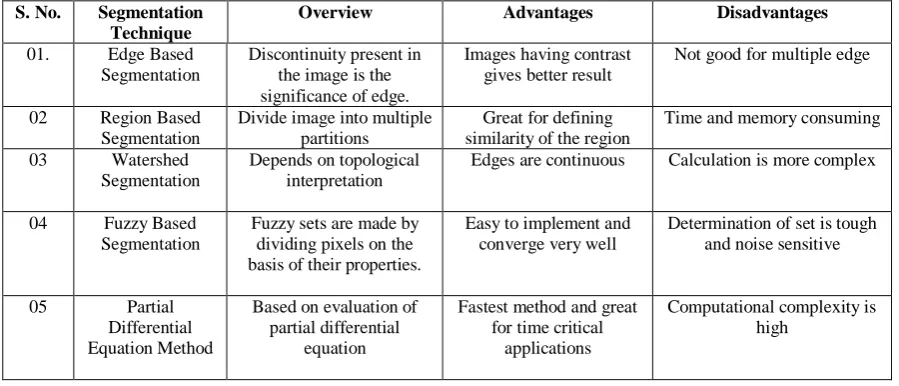
OMPARISONTable I shows the difference between different image segmentation techniques with their
advantages and disadvantages.
TABLEI
DIFFERENCE BETWEEN SEGMENTATION TECHNIQUES
S. No.
Segmentation
Technique
Overview
Advantages
Disadvantages
01.
Edge Based
Segmentation
Discontinuity present in
the image is the
significance of edge.
Images having contrast
gives better result
Not good for multiple edge
02
Region Based
Segmentation
Divide image into multiple
partitions
Great for defining
similarity of the region
Time and memory consuming
03
Watershed
Segmentation
Depends on topological
interpretation
Edges are continuous
Calculation is more complex
04
Fuzzy Based
Segmentation
Fuzzy sets are made by
dividing pixels on the
basis of their properties.
Easy to implement and
converge very well
Determination of set is tough
and noise sensitive
05
Partial
Differential
Equation Method
Based on evaluation of
partial differential
equation
Fastest method and great
for time critical
applications
V.
C
ONCLUSIONSIn this paper, a detail and comparative study is carried out on various image segmentation
techniques. From the study it is found that no single method is good enough for all kinds of
images. As segmentation result depends on various factors like pixel, colour, intensity, image
texture, content, similarity etc. Also an image can be segmented by using different
segmentation techniques. As segmentation techniques are required in many real life
applications, it has challenging future.
R
EFERENCES
[1] Y.W. Lim and S.U. Lee, “On the color image segmentation algorithm based on the thresholding and the fuzzy C-means techniques,” Pattern Recognition, vol. 23, no.9, pp. 935-952, 1990.
[2] Canny, J. F. (1986). A computation approach to edge detectors. IEEE Transactions on Pattern Analysis and Machine Intelligence, 8, 34–43.
[3] D Li, G Zhang, Z Wu, L Yi ,”An Edge Embedded Marker-Based Watershed Algorithm for High Spatial Resolution Remote Sensing Image Segmentation”,Vol:19,pp:2781-2787, IEEE Transactions on 2010
[4] SD Yanowitz, AM Bruckstein ,”A new method for image segmentation” on Computer Vision, Graphics, and Image, 1989 [5] M Celenk ,”A color clustering technique for image segmentation” on Computer Vision, Graphics, and Image Processing, 1990
[6] D Krstinic, AK Skelin, I Slapnicar,”Fast two-step histogram-based image segmentation”,on , IET, 2011
[7] Yu, Z., Wong, H.: „A rule based technique for extraction of visual attention regions based on real-time clustering‟, IEEE Trans.Multimedia, 2007, 9, (4), pp. 766–784
[8] M. M. S. J. Preetha, L. P. Suresh, and M. Bosco, "Image segmentation using seeded region growing," in Proc. International Conference onComputing, Electronics and Electrical Technologies (ICCEET), pp.576-583, 2012.
[9]
W. X. Kang, Q. Q. Yang, and R. P. Liang, "The comparative research on image segmentation algorithms," in Proc. First InternationalWorkshop on Education Technology and Computer Science, 2009. ETCS'09. pp. 703-707, 2009[10] T. Chen and Z. Shen, "An adaptive image segmentation method using region growing," in Proc. 2nd International Conference on ComputerEngineering and Technology (ICCET), vol. 7, pp. 78-80, 2010.
[11] H. Hedberg, "A survey of various image segmentation techniques," Dept. of Electroscience, Box, vol. 118, 2010.
[12] Z. Hua, Y. Li, and J. Li, "Image segmentation algorithm based on improved visual attention model and region growing," in Proc. 6th International Conference on Wireless Communications Networking and Mobile Computing (WiCOM), pp. 1-4, 2010.
[13] G. Chen, T. Hu, X. Guo, and X. Meng, "A fast region-based image segmentation based on least square method," in Proc. IEEE International Conference on Systems, Man and Cybernetics, SMC, pp.972-977, 2009.
[14] F. Jiang, M. R. Frater, and M. Pickering, "Threshold-based image segmentation through an improved particle swarm optimisation," in
Proc. International Conference on Digital Image Computing Techniques and Applications (DICTA), pp. 1-5, 2012.
[15] F. C. Monteiro and A. Campilho, "Watershed framework to region-based image segmentation," in Proc. International Conferenceon Pattern Recognition, ICPR 19th, pp. 1-4, 2008.
[16] W. Zhao, J. Zhang, P. Li, and Y. Li, "Study of image segmentation algorithm based on textural features and neural network," in
International Conference on Intelligent Computing and Cognitive Informatics (ICICCI), pp. 300-303, 2010.
[17] M. S. A. Shahzad, M. Raza, and K. Hussain, "Enhanced watershed image processing segmentation," Journal of Information & Communication Technology, vol. 2, pp. 1-9, 2008.
[18] Nikita Sharma, Mahendra Mishra, Manish Shrivastava. (2012, May). "Color Image Segmentation Techniques and Issues: An Approach". International Journal of Science & Technology Research. Volume 1 (issue 41), ISSN 2277-8616.
[19] Salem Saleh Al-amri, N.V. Kalyankar and Khamitkar S.D. (2010, May). "Image Segmentation by Using Threshold Techniques". Journal of Computing. Volume 2, ISSUE 5. [Online].
[20] Rajeshwar Dass, Priyanka, Swapna Devi. (2012, January-March). "Image Segmentation Techniques". IJECT. Volume 3 (issue 1), ISSN: 2230-7109 (Online) | ISSN: 2230-9543 (Print).
[21] Krishna Kant Singh, Akansha Singh. (2010, September). "A study of Image Segmentation Algorithms for Different Types of Images ". IJCSI International Journal of Computer Science Issues. Volume 7 (issue 5). ISSN (Online): 1694-0784. ISSN (Print): 1694-0814. [22] Muzamil Bhat. (2014, January). "Digital Image Processing". International Journal of Science & Technology Research. Volume 3
(issue 1), ISSN 2277-8616.
[23] Pushmeet Kohli, Stefanie Jegelka, (2013). "A Principled Deep Random Field Model for Image Segmentation".
[24] Hai Gao, Wan-Chi Siu and Chao-Huan Hou. (2001, December). "Improved Techniques for Automatic Image Segmentation". IEEE Transactions on Circuits and Systems for Video Technology. Volume 11 (issue 12).
[25] Kamiya Motwani, Nagesh Adluru, Chris Hinrichs, Andrew Alexander, Vikas Singh. "Epitome driven 3-D Diffusion Tensor image segmentation: on extracting specific structures". {kmotwani, hinrichs, vsingh} @cs.wisc.edu. {adluru, alalexander2}@wisc.edu. [26] Sara Vicente, Vladimir Kolmogorov, Carsten Rother. "Graph cut based image segmentation with connectivity priors Technical
report".
[27] Karthikeyan, B., Vaithiyanathan, V., Venkatraman, B., Menaka, M. ,‟ Analysis of image segmentation for radiographic images‟ in Indian Journal of Science and Technology 5 (11) , pp. 3660-3664
[28] Y Wang, Q Wang ,”Image Segmentation Based on Multi-scale Local Feature” on Image and Signal Processing (CISP),Vol :3,pp:1406-1409,2010
[29] J. Luo, R. T. Cray, and H.-C. Lee, “Incorporation of derivative priors in adaptive Bayesian color image segmentation‟‟, Proc. ICIP‟97, Vol. 3, pp. 58-61, Oct 26-29, 1997 Santa Barbara, CA.
[30] P Ganesan, V Rajini,” Segmentation and edge detection of color images using CIELAB color space and edge detectors”,in Emerging Trends in Robotics and Communication Technologies (INTERACT), pp:393-397 ,2010
[34] Yu, Z., Wong, H.: „A rule based technique for extraction of visual attention regions based on real-time clustering‟, IEEE Trans.Multimedia, 2007, 9, (4), pp. 766–784.
[33] Zhang, Z Wu, L Yi ,”Marker-Based Watershed Segmentation Embedded with Edge Information”,in Image Analysis and Signal Processing (IASP), pp:375-380 on 2010.
[34] Y. B. Chen and O. T. -C. Chen, “Image segmentation method using thresholds automatically determined from picture contents,”EURASIP Journal on Image and Video Processing, Article ID140492, 2009, doi:10.1155/2009/140492.
[35] W. T. Ma and B. S. Manjunath, “Edge flow: A framework of boundary detection and image segmentation,” IEEE Trans. Image Process., vol.9, no. 8, pp. 1375–1388, Aug. 2000.
[36] Fan, J., Zeng, G., Body, M., Hacid, M.: „Seeded region growing: an extensive and comparative study‟, Pattern Recognit. Lett., 2005, 26, (8), pp. 1139–1156
[37] HG Kaganami, Z Beiji , “Region based segmentation versus edge detection”, Intelligent Information Hiding and Multimedia Signal Processing, pp. 1217 - 1221 , 2009
[38] J. Gao and J. Zhang M. G. Fleming,”a novel multi resolution color image segmentation technique and its application to dermatoscopicimage segmentation”, Image Processing,vol.3,pp.408-411,2000
[39] D. Comaniciu and P. Meer, “Robust analysis of feature spaces: color image segmentation,” Proc. IEEE CVPRConf, San Juan, Puerto Rico, June 1997,750-755.
[40] JF Khan, SMA Bhuiyan ,”Image Segmentation and Shape Analysis for Road-Sign Detection” on Intelligent Transportation Systems, Vol:12,pp: 83-96, 2011
[41] Muhammad Waseem Khan, “ A Survey: Image Segmentation Techniques”, IJFCC, Vol. 3, No. 2, April 2014 .
[42] Nida M. Zaitoun and Musbah J. Aqel, “ Survey on image Segmentation Techniques”, ICCMT-2015, ELSEVIER, Procedia Computer Science 65 ( 2015) 767.