UNIVERSITI TEKNOLOGI MALAYSIA
UTM/RMC/F/0024 (1998)
BORANG PENGESAHAN LAPORAN AKHIR PENYELIDIKAN
TAJUK PROJEK :
Saya _______________________________________________________________________ (HURUF BESAR)
Mengaku membenarkan Laporan Akhir Penyelidikan ini disimpan di Perpustakaan Universiti Teknologi Malaysia dengan syarat-syarat kegunaan seperti berikut :
1. Laporan Akhir Penyelidikan ini adalah hakmilik Universiti Teknologi Malaysia.
2. Perpustakaan Universiti Teknologi Malaysia dibenarkan membuat salinan untuk tujuan rujukan sahaja.
3. Perpustakaan dibenarkan membuat penjualan salinan Laporan Akhir Penyelidikan ini bagi kategori TIDAK TERHAD.
4. * Sila tandakan ( / )
SULIT (Mengandungi maklumat yang berdarjah keselamatan atau
Kepentingan Malaysia seperti yang termaktub di dalam
AKTA RAHSIA RASMI 1972).
TERHAD (Mengandungi maklumat TERHAD yang telah ditentukan oleh
Organisasi/badan di mana penyelidikan dijalankan).
TIDAK
TERHAD
TANDATANGAN KETUA PENYELIDIK
Nama & Cop Ketua Penyelidik
Tarikh : _________________ THE DEVELOPMENT OF A COMMERCIALLY VIABLE DATABASE
ENCRYPTION TOOL FOR ORACLE8i RDBMS
MOHD NAZRI BIN KAMA
UNIVERSITI TEKNOLOGI MALAYSIA Research Management Centre
PRELIMINARY IP SCREENING & TECHNOLOGY ASSESSMENT FORM
(To be completed by Project Leader submission of Final Report to RMC or whenever IP protection arrangement is required)
1. PROJECT TITLE IDENTIFICATION :
_____________________________________________________________________________
______________________________________________________ _ Vote No:
2. PROJECT LEADER :
Name : ______________________________________________________________________
Address :
_____________________________________________________________________________
_____________________________________________________________________________
Tel : ___________________ Fax : ________________ e-mail : _______________________
3. DIRECT OUTPUT OF PROJECT(Please tick where applicable)
4. INTELLECTUAL PROPERTY(Please tick where applicable)
Not patentable Technology protected by patents
Patent search required Patent pending
Patent search completed and clean Monograph available
Invention remains confidential Inventor technology champion Secientific Research Applied Research Product/Process Development
Algorithm Method/Technique Product / Component
Structure Demonstration / Process
Prototype
Data Software
Other, please specify Other, please specify Other, please specify
___________________ __________________ ___________________________ ___________________ __________________ ___________________________ ___________________ __________________ ___________________________
74228 The Development of A Commercially Viable Database Encryption Tool for Oracle8i RDBMS
Mohd Nazri Bin Kama
Centre for Advanced Software Engineering (CASE), Fakulti Sains Komputer dan Sistem Maklumat,
Universiti Teknologi Malaysia, Jalan Semarak, 54100 Kuala Lumpur
5. LIST OF EQUIPMENT BOUGHT USING THIS VOT
_____________________________________________________________________________
_____________________________________________________________________________
_____________________________________________________________________________
_____________________________________________________________________________
6. STATEMENT OF ACCOUNT
a) APPROVED FUNDING RM : ………
b) TOTAL SPENDING RM : ………
c) BALANCE RM : ………
7. TECHNICAL DESCRIPTION AND PERSPECTIVE
Please tick an executive summary of the new technology product, process, etc., describing how it works. Include brief analysis that compares it with competitive technology and signals the one that it may replace. Identify potential technology user group and the strategic means for exploitation.
a) Technology Description
____________________________________________________________________________
____________________________________________________________________________
____________________________________________________________________________
____________________________________________________________________________
____________________________________________________________________________
____________________________________________________________________________
b) Market Potential
____________________________________________________________________________
____________________________________________________________________________
____________________________________________________________________________
Notebook – 2 Units
Desktop – 1 Unit
Printer – 1 Unit
Refer to Appendix A
Refer to Appendix B
70,500
c) Commercialization Strategies
____________________________________________________________________________
____________________________________________________________________________
____________________________________________________________________________
____________________________________________________________________________
8. RESEARCH PERFORMANCE EVALUATION
a) FACULTY RESEARCH COORDINATOR
Research Status ( ) ( ) ( ) ( ) ( ) ( )
Spending ( ) ( ) ( ) ( ) ( ) ( )
Overall Status ( ) ( ) ( ) ( ) ( ) ( ) Excellent Very Good Good Satisfactory Fair Weak
Comment/Recommendations:
_____________________________________________________________________________
_____________________________________________________________________________ _____________________________________________________________________________ _____________________________________________________________________________ _____________________________________________________________________________ _____________________________________________________________________________
……… Name : ………
Signature and stamp of Date : ………
JKPP Chairman
Refer to Appendix C
Mohd Nazri Bin Kama
RE b) RMC EVALUATION
Research Status ( ) ( ) ( ) ( ) ( ) ( )
Spending ( ) ( ) ( ) ( ) ( ) ( )
Overall Status ( ) ( ) ( ) ( ) ( ) ( ) Excellent Very Good Good Satisfactory Fair Weak
Comments :-
_____________________________________________________________________________
_____________________________________________________________________________
_____________________________________________________________________________
_____________________________________________________________________________
_____________________________________________________________________________
_____________________________________________________________________________
Recommendations :
Needs further research
Patent application recommended
Market without patent
No tangible product. Report to be filed as reference
……….. Name : ………
A. Purpose
The purpose of the Benefits Report is to allow the IRPA Panels and their supporting experts to assess the benefits derived from IRPA-funded research projects.
B. Information Required
The Project Leader is required to provide information on the results of the research project, specifically in the following areas:
• Direct outputs of the project;
• Organisational outcomes of the project; and
• Sectoral/national impacts of the project.
C. Responsibility
The Benefits Report should be completed by the Project Leader of the IRPA-funded project.
D. Timing
The Benefits Report is to be completed within three months of notification by the IRPA Secretariat. Only IRPA-funded projects identified by MPKSN are subject to this review. Generally, the Secretariat will notify Project Leaders of selected projects within 18 months of project completion.
E. Submissin Procedure
One copy of this report is to be mailed to :
IRPA Secretariat
Ministry of Science, Technology and the Environment 14th, Floor, Wisma Sime Darby
1. Description of the Project
A. Project identification: 04-02-06-0086-EA001
1. Project number : 74228
2. Project title : The Development of A Commercially Viable Database Encryption Tool for
Oracle8i RDBMS
3. Project leader : Mohd Nazri Bin Kama
B. Type of research
Indicate the type of research of the project (Please see definitions in the Guidelines for completing the Application Form)
Scientific research (fundamental research)
Technology development (applied research)
Product/process development (design and engineering)
Social/policy research
C. Objectives of the project
1. Socio-economic objectives
Which socio-economic objectives are adressed by the project? (Please indentify the sector, SEO Category and SEO Group under which the project falls. Refer to the Malaysian R&D Classification System brochure for the SEO Group code)
Sector : ___________________________________________________
SEO Category : ___________________________________________________
SEO Group and Code : ___________________________________________________
2. Fields of research
Which are the two main FOR Categories, FOR Groups, and FOR Areas of your project? (Please refer to the Malaysia R&D Classification System brochure for the FOR Group Code) a. Primary field of research
FOR Category : ___________________________________________________
FOR Group and Code : ___________________________________________________
FOR Area : ___________________________________________________
b. Secondary field of research
FOR Category : ___________________________________________________
FOR Group and Code : ___________________________________________________
X
Services and IT (04)
Information and Communication Services (S20900) Computer Software and Services (S20901)
F10500 Information, Computer and Communication Technology F10501 Information Systems
Cryptography, Encryption and Security Systems
What was the duration of the project ?
_______________________ Months
E. Project manpower
How many man-months did the project involve?
____________________________Man-months
F. Project costs
What were the total project expenses of the project?
RM______________________
G. Project funding
Which were the funding sources for the project?
Funding sources Total Allocation (RM)
_IRPA________________________ _____________________________
______________________________ _____________________________
______________________________ _____________________________
______________________________ _____________________________
Eighteen (18)
Fourty Four (44)
70,500
A. Technical contribution of the project
1. What was the achieved direct output of the project :
For scientific (fundamental) research projects?
Algorithm
Structure
Data
Other, please specify : ______________________________________________
For technology development (applied research) projects :
Method/technique
Demonstrator/prototype
Other, please specify : _______________________________________________
For product/process development (design and engineering) projects:
Product/component
Process
Software
Other, please specify : _______________________________________________
2. How would you characterise the quality of this output?
Significant breakthrough
Major improvement
Minor improvement
X
B. Contribution of the project to knowledge
1. How has the output of the project been documented?
Detailed project report
Product/process specification documents
Other, please specify : _______________________________________________
2. Did the project create an intellectual property stock?
Patent obtained
Patent pending
Patent application will be filed
Copyright
3. What publications are available?
Articles (s) in scientific publications How Many: ________________
Papers(s) delivered at conferences/seminars How Many: ________________
Book
Other, please specify : _______________________________________________
4. How significant are citations of the results?
Citations in national publications How Many: ________________
Citations in international publications How Many: ________________
None yet
Not known
X
X
1
1
X
lll. Organisational Outcomes of the Project
A. Contribution of the project to expertise development
1. How did the project contribute to expertise?
PhD degrees How Many: ________________
MSc degrees How Many: ________________
Research staff with new specialty How Many: ________________
Other, please specify: ________________________________________________
2. How significant is this expertise?
One of the key areas of priority for Malaysia
An important area, but not a priority one
B. Economic contribution of the project?
1. How has the economic contribution of the project materialised?
Sales of manufactured product/equipment
Royalties from licensing
Cost savings
Time savings
Other, please specify : _______________________________________________
2. How important is this economic contribution ?
High economic contribution Value: RM________________
Medium economic contribution Value: RM________________
Low economic contribution Value: RM________________
2
500,000
X
X
Already materialised
Within months of project completion
Within three years of project completion
Expected in three years or more
Unknown
C Infrastructural contribution of the project
1. What infrastructural contribution has the project had?
New equipment Value: RM __________________
New/improved facility Investment : RM __________________
New information networks
Other, please specify: _____________________________________________
2. How significant is this infrastructural contribution for the organisation?
Not significant/does not leverage other projects
Moderately significant
Very significant/significantly leverages other projects
D. Contribution of the project to the organisation’s reputation
1. How has the project contributed to increasing the reputation of the organisation
Recognition as a Centre of Excellence
National award
International award
Demand for advisory services
Invitations to give speeches on conferences
Visits from other organisations
Other, please specify: ______________________________________________
X
X New scheme for DB Encr and Decryr
X
X
X
X
Not significant
Moderately significant
Very significant
A. Contribution of the project to organisational linkages
1. Which kinds of linkages did the project create?
Domestic industry linkages
International industry linkages
Linkages with domestic research institutions, universities
Linkages with international research institutions, universities
2. What is the nature of the linkages?
Staff exchanges
Inter-organisational project team
Research contract with a commercial client
Informal consultation
Other, please specify: ________________________________________________
B. Social-economic contribution of the project
1. Who are the direct customer/beneficiaries of the project output?
Customers/beneficiaries: Number:
________________________________ ________________________________
________________________________ ________________________________
2. How has/will the socio-economic contribution of the project materialised ?
Improvements in health
Improvements in safety
Improvements in the environment
Improvements in energy consumption/supply
Improvements in international relations
Other, please specify: ________________________________________________
X X
X
X
X
Security of public databases like JPJ
Economic contribution in the locally developed Financial and banking databases
High social contribution
Medium social contribution
Low social contribution
4. When has/will this social contribution materialised?
Already materialised
Within three years of project completion
Expected in three years or more
Unknown
Date: 18 July 2005 Signature: X
THE DEVELOPMENT OF A COMMERCIALLY VIABLE DATABASE ENCRYPTION TOOL FOR ORACLE8i RDBMS
(PEMBANGUNAN ALATAN ENKRIPSI PANGKALAN DATA KOMERSIL BAGI ORACLE8i RDBMS)
MOHD NAZRI BIN KAMA
CENTRE FOR ADVANCED SOFTWARE ENGINEERING (CASE) FAKULTI SAINS KOMPUTER DAN SISTEM MAKLUMAT
THE DEVELOPMENT OF A COMMERCIALLY VIABLE DATABASE ENCRYPTION TOOL FOR ORACLE8i RDBMS
(PEMBANGUNAN ALATAN ENKRIPSI PANGKALAN DATA KOMERSIL BAGI ORACLE8i RDBMS)
MOHD NAZRI BIN KAMA
RESSEARCH VOTE NO: 74228
Centre For Advanced Software Engineering (Case) Fakulti Sains Komputer Dan Sistem Maklumat
Universiti Teknologi Malaysia
ABSTRACT
In database security, access control is a major research issue. Discretionary access controls have been handled well by many database management systems through user roles and privileges. Mandatory access controls, on the other hand, remains a big problem when users with lower security clearance accessing data of higher security class. Data with classifications and users have clearances developed multilevel access controls, thus the problem of multilevel security. Many researches have been conducted using methods like object labeling, trusted systems, security filters, database views and etc. Many a times the problem remains unsolved due to either too theoretical or not practical to be implemented. Recent developments in research showed cryptography to be the promising solution to the multilevel security problem. With appropriate key management and good multilevel security scheme design, the problem can be solved in both theory and implemented in practice. This research endeavor is one such effort. It presents an investigation into the applications of modern cryptography for the security of databases. The investigation yields a new multilevel security scheme based on
Key researchers:
Mr. Mohd Nazri Kama
Assc. Prof. Dr. Zailani Mohamed Sidek
E-mail : [email protected] Tel No : 03-26154344
ABSTRAK
Dalam keselamatan pangkalan data, kawalan capaian merupakan satu isu penyelidikan yang besar. Kawalan capaian “budi bicara” telah ditangani dengan baik oleh sistem pengurusan pangkalan data menggunakan peranan dan hak istimewa pengguna. Kawalan capaian mandatori pula masih memberi masalah besar apabila pengguna yang mempunyai kebenaran keselamatan lebih rendah cuba mencapai data yang mempunyai kelas keselamtan lebih tinggi. Data mempunyai kelas dan pengguna mempunyai kebenaran tertentu menyebabkan kawalan capaian menjadi berbilang aras dan masalah keselamatan berbilang aras. Banyak penyelidikan dijalankan untuk
menyelesaikan masalah seperti menggunakan kaedah melabel objek, sistem beramanah, penapis keselamatan, pandangan pangkalan data, dan lain-lain. Dalam banyak keadaan, masalah ini tidak dapat diselesaikan samada kerana terlalu teori atau tidak praktik untuk dilaksanakan. Perkembangan terkini penyelidikan menunjukkan kriptografi adalah satu penyelesaian yang baik kepada masalah ini. Dengan sistem pengurusan kunci yang sesuai dan skim keselamatan berbilang aras yang baik, masalah ini dapat diselesaikan secara teori dan praktik. Penyelidikan ini merupakan satu usaha ke arah ini
Penyelidik Utama:
Mr. Mohd Nazri Kama
Assc. Prof. Dr. Zailani Mohamed Sidek
E-mail : [email protected] Tel No : 03-26154344
TABLE OF CONTENTS
CHAPTER TITLE PAGE
ABSTRACT...i
ABSTRAK... iii
TABLE OF CONTENTS...vi
LIST OF TABLES...ix
LIST OF FIGURES ...x
LIST OF APPENDICES...xi
LIST OF ABBREVIATIONS...xii
LIST OF TERMINOLOGY...xiv
1.5 Problem Statement ...11
LITERATURE REVIEW ...13 2.1 Introduction...13 2.2 Cryptographic Application In Database Security ...13 2.3 Cryptographic Capabilities Of Commercial DBMS ...16 2.4 Smartcard Usage ...18 2.5 Research On Existing Product ...19 2.5.1 DBEncrypt ...19 2.5.1.1 Turn-Key Solution ...19 2.5.1.2 Low Level Application Programming Interface (API)...20 2.5.1.3 Features Of DBEncrypt...20 2.5.1.4 DBEncrypt Pros And Cons ...21 2.5.2 Protegrity Secure.DataTM...22
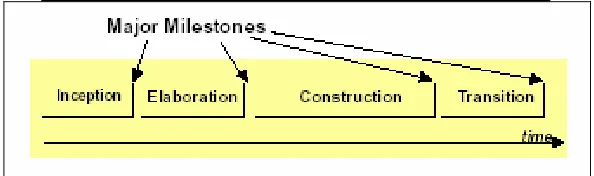
2.5.2.1 Unique Approach ...22 2.5.2.2 Data Item Protection ...23 2.5.2.3 Role Based Access...23 2.5.2.4 Encryption...24 2.5.2.5 Protegrity Secure.DataTM Pros And Cons...25 2.6 Existing Product Comparative Study...27 2.6.1 DBEncrypt vs. Secure.Data Features...27 2.6.2 Microsoft SQL Server 2000 vs. Secure.Data Features ...29 2.6.3 Oracle vs. Secure.Data Features ...30 2.7 Software ...31 2.8 Process ...31 2.9 Software Process...31 2.10 Rational Unified Process (RUP) ...32 2.10.1 RUP Definition ...33 2.10.2 Phases In RUP...34 2.10.2.1 Inception Phase ...35 2.10.2.2 Elaboration Phase...36 2.10.2.3 Construction Phase...37 2.10.2.4 Transition Phase...38
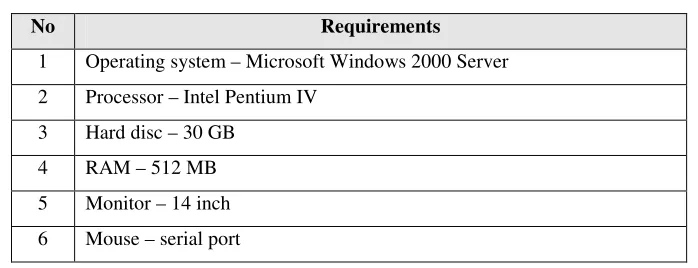
3.3.2.1 E1 Iteration (Develop Architectural Prototype)...51 3.3.3 Construction Phase...55 3.3.3.1 C1 Iteration ...60 3.3.3.2 C2 Iteration ...61 3.3.3.3 C3 Iteration ...64 3.3.4 Transition Phase...67 3.3.4.1 T1 Iteration...67 3.4 Software Technique ...71 3.5 Software Tools ...73 3.6 Problem Solving Methodology...74
PROJECT DISCUSSION ...97 4.1 Introduction...97 4.2 Output Analysis ...97 4.2.1 Project Phases And Milestones...98 4.2.2 Project Releases ...100 4.2.3 Project Deliverable(s) ...101 4.3 Project Constraint(s) ...102 4.4 Project Advantages / Uniqueness...103 4.5 Project Innovation...103 4.6 Project Potential ...104 4.7 Project Contribution...105 4.8 Future Work ...107
CONCLUSION...109 5.1 Introduction...109 5.2 Conclusion ...109
REFFERENCES ...112
LIST OF TABLES
TABLE NO TITLE PAGE
LIST OF FIGURES
FIGURE NO TITLE PAGE
LIST OF APPENDICES
APPENDIX NO TITLE PAGE
LIST OF ABBREVIATIONS
CASE - Center for Advanced Software Engineering
DBMS - Database Management Systems
DL - Digital Library
DLL - Dynamic Link Library
GUI - Graphical User Interface
HLIV - Hashed Left Data IV
HRIV - Hashed Right Data IV
HUIV - Hashed User IV
IRPA - Intensity Research and Priority Area
ITK - Institut Teknologi Kebangsaan
IV - Initialization Vector
I/O - Input/Output
LIV and RIV - Left and Right IVs
MINDEF - Ministry of Defense
OO - Object-Oriented
OS - Operating System
RDBMS - Relational Database Management System
RUP - Rational Unified Process
SAD - Software Architecture Document
SDK - Software Development Kit
SDP - Software Development Plan
SRS - Software Requirements Specification
TSBC - TS Block Cipher
TSSC - TS Stream Cipher
UML - Unified Modeling Language
LIST OF TERMINOLOGY
Actor Someone or something, outside the system that interacts
with the system.
Authentication The process of verifying the identity of a user, device, or
other entity in a computer system, often as a prerequisite to allowing access to resources in a system.
Authorization Permission given to a user, program, or process to access
an object or set of objects. In Oracle, authorization is done through the role mechanism. A single person or a group of people can be granted a role or a group of roles. A role, in turn, can be granted other roles.
Availability (of Systems) Preventing, detecting and/or deterring improper denial of access to services provided by the system.
Beta Testing Pre-release testing in which a sampling of the intended
customer base tries out the product.
Codes A system for hiding the meaning of a message by
replacing each word or phrase in the original message with another character or set of characters.
Computer Security Protection of information processed by a computer
against unauthorized observation, unauthorized or
improper modification, and denial of service (ensuring no authorized use of the information is denied).
Construction Phase The third phase of the Unified Process, in which the
software is brought from an executable architectural baseline to the point at which it is ready to be transitioned to the user community.
Cryptography Mathematical manipulation of data, which the purposes
Data Encryption The encoding of data so that it cannot be easily deciphered without the use of specialized decryption mechanisms or procedures.
Database A collection of data, arranged in some meaningful way.
Database Security (DB
Security) A set of measures, policies and mechanisms to provide secrecy, integrity and availability of data and to combat possible attacks on the system (threats) from insiders and outsiders, both malicious and accidental.
Database Management
System (DBMS) A software/program that organizes and operates on the database and auxiliary control information to implement the decisions of the access policy and gives users the means to retrieve information.
Decryption The process of converting the contents of an encrypted
message (ciphertext) back into its original readable format (plaintext).
Dynamic Link Library A file containing executable code and data bound to a program at run time rather than at link time. The C++ Access Builder generates beans and C++ wrappers that let your Java programs access C++ DLLs.
Elaboration Phase The second phase of the process where the product vision
and its architecture are defined.
Encryption The process of disguising a message rendering it
unreadable to anybody but the intended recipient.
Inception Phase The first phase of the Unified Process, in which the seed
idea, request for proposal, for the previous generation is brought to the point of being (at least internally) funded to enter the elaboration phase.
Phase The time between two major project milestones, during
which a well-defined set of objectives is met, artifacts are completed, and decisions are made to move or not move into the next phase.
Security Threats A hostile agent that, either casually or by using a
Smartcard A plastic card (like a credit card) with an embedded integrated circuit for storing information, including such information as user names and passwords. A smartcard is read by a hardware device at any client or server.
Transition Phase The fourth phase of the process in which the software is
turned over to the user community. A relationship between two states indicating that an object in the first state will perform certain specified actions and enters the second state when a specified event occurs and specified conditions are satisfied. On such a change of state, the transition is said to execute.
TS Block Cipher Block cipher can process data in blocks of 16 characters
at a time.
TS Stream Cipher Stream cipher can process 255 characters of data at a
time.
Unified Modeling Language A language for visualizing, specifying, constructing, and documenting the artifacts of a software-intensive system.
User Authentication The authorization mechanism that uniquely identify the
CHAPTER 1
INTRODUCTION
1.1 Introduction
This chapter describes the introduction of the project in which the researcher has been involved in order to fulfill the requirements for the new technology found for the Research Management Centre (RMC). The project has been operated in eighteen (18) months duration time starting from 14th December 2003 until 14th June 2005.
1.2 Company Background
This section describes the background of the institution that the researcher has involved during the project research and development.
1.2.1 Universiti Teknologi Malaysia
Universiti Teknologi Malaysia (UTM) was established on 14th March 1972 under
creative human resource and technology in line with the aspirations of the nation. It is one of Malaysia’s leading universities for engineering and technology, which has:
i. A reputation for innovative education and leading-edge research, educating the technologies and professional
ii. More than 25,000 students at campus in Johor, more than 4,500 students in Kuala Lumpur campus, and more than 5,000 students on distance learning/part-time programmes
iii. More then 2,500 postgraduates students in various fields of specialization
iv. More than 20 specialist institutes and centre, in addition to academic departments to service the technology, education and research needs.
UTM strives for academic excellence through creative learning and state-of-the-art technology. UTM has 2 campuses, the 1,222-hectare main campus in Skudai, Johor and 18-hectare branch campus situated at Jalan Semarak, Kuala Lumpur.
1.2.2 Centre For Advanced Software Engineering (CASE)
The Centre for Advanced Software Engineering (CASE) was established in 1996 as a joint-venture programme between Universiti Teknologi Malaysia (UTM) and Universite Thales, France for enabling the technology transfer into Malaysian industry, especially the software industry. CASE is committed in providing opportunities for advanced studies and professional development for the current and future needs of technology based industries. At CASE, the aim is to create opportunities for local industries or individuals to be trained in important aspects of Information Security and Software Development via the following programmes:
In meeting these goals, CASE promotes its expertise and technical capabilities in its effort to become a centre of excellent, majoring in the following specific areas:
i. Research and Development
ii. Software Consultancy and Mentoring
iii. Partnership in Software Development Software engineering project and software methodology
iv. Software engineering techniques and tools
1.2.3 Project Team
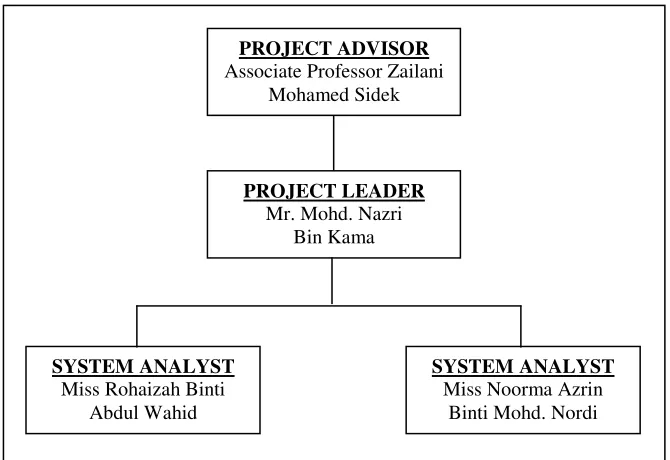
OraCryptTM project team consists of four (4) staff working closely with each
other in research and development activities at CASE. The project was funded by Intensification of Research Priority Areas (IRPA) and managed by the Research Management Centre (RMC). RMC is responsible to manage the research and
development activities conducted by UTM researchers that sometimes collaborate with the industries outside the UTM. It also regulates the grant for the research project conducted by UTM researchers.
Figure 1.1 OraCryptTM Project Organizations
Table 1.1 describes the role represented in the project organization diagram
above and their primary responsibilities.
Table 1.1 Lists Of Roles Respective Responsibilities
Role List of Responsibilities
Project Advisor Advise on the overall project contents and the products that should be delivered on a regular period of time.
Motivate the team members to perform their tasks. Help the team in allocating the tasks and resolving issues. Project Leader Plan and regulate the tasks.
Approve the process development.
Schedule and check the milestone for review and evaluation of the product, tasks and software process.
Maintain a project plan.
Lead the team in producing the development strategy.
Lead the team in producing the preliminary size and time estimates for the products to be produced.
Lead the team in producing the high-level design and design specification.
Motivate the team members to perform their tasks. PROJECT ADVISOR
Associate Professor Zailani Mohamed Sidek
PROJECT LEADER Mr. Mohd. Nazri
Bin Kama
SYSTEM ANALYST Miss Rohaizah Binti
Abdul Wahid
SYSTEM ANALYST Miss Noorma Azrin
Role List of Responsibilities
Help the team in allocating the tasks and resolving issues.
System Analyst Define the responsibilities, operations, attributes, and relationship of one or several classes, and determine how they will be adjusted to the implementation environment.
Devise a coding standard to be used during the implementation process. Implement the design defined in the SDD.
Strive to produce code that is readable and bug-free.
Develop and test components, in accordance with the projects adopted standards, for integration purposes.
Establish and maintain the team’s development standards.
1.3 Project Background
The project is being done under the Intensification of Research and Priority Area (IRPA) project at UTM. The project was initially a work of a doctorate student
Associate Professor Zailani Bin Mohamed Sidek of CASE. The research conducted is mainly on database security specifically in the area of cryptography. He argued that authentication, access control, and audit together provide the foundation for information and system security. The database security mechanism should be based on
cryptographic technology, which is independent, possibly developed locally, and is based on strong theoretic foundation. With this in mind, efforts are made to serve the purpose of being independent, secure and proactive. OraCryptTM product is one of the solutions. In this project, the researcher take the approach of building a prototype with highly secure, independent, and implementable database security mechanism for a commercially, widely-used relational database management system.
1.3.1 Project Overview
generation, management and distribution module allows the generation of Master and Shared keys. Master keys are for the hierarchical access control to encrypt data while Shared keys are useful for both direct access and hierarchical access controls. The encryption and decryption module is designed with no keys (Master or Shared keys) to be found or stored in the database Management System (DBMS) concern. Instead all keys are stored on smartcard. In this module, it allows users to encrypt and decrypt data at all levels (row, column, and data element). And in each level, users may provide condition for the selective encryption and decryption of data at those three levels.
1.3.2 Project Vision
OraCryptTM product is expected to become a commercial data encryption
software package within a Relational Database Management System (RDBMS). In this project, the implementation is focused on the Oracle Database Management System version 8i only.
1.3.3 Project Objective(s)
The objective of this effort is to develop a prototype software security system that:
i. Design and implement a database security mechanism using independent and local cryptographic technology that will enhance the security of the database for
Oracle8i RDBMS.
ii. Implement the new design for IV-based multilevel database encryption scheme in Oracle8i RDBMS environment.
iii. Develop and implement cryptographic key generation, management and distribution system.
1.3.4 Project Scope(s)
The scopes of this project are as follows:
i. Identify and examine locally developed cryptographic algorithms that are available and suitable in the proposed database security application.
ii. Analyze and implement the new IV-based multilevel database for encryption and decryption.
iii. Implement the cryptographic key generation, management and distribution scheme.
iv. Analyze, modify, and implement the cryptographic algorithms in column encryption-decryption module.
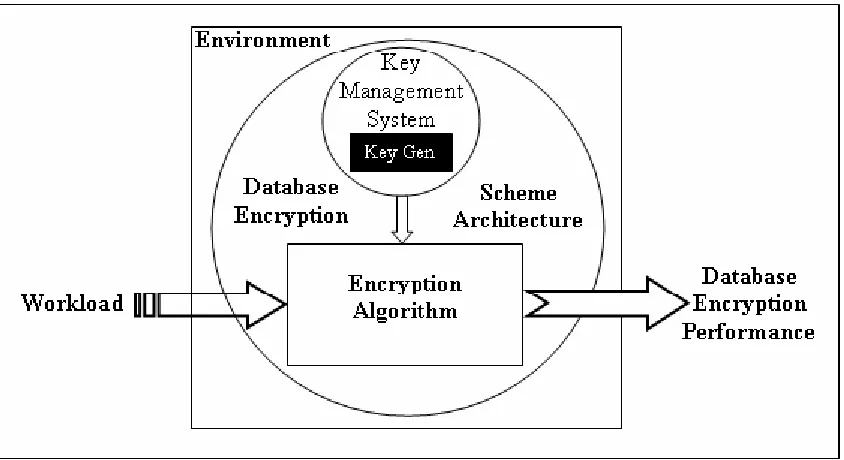
v. Analyze, design and formulate working models and solution procedures for database encryption and decryption. The working models and solution procedures are expected to be better in terms of its security and performance when compared to the existing schemes available.
1.3.5 Project Schedule
This project was scheduled for eighteen (18) months. Refer to Appendix A for
the details of the project’s schedule.
1.4 Problem Background
1.4.1 Computer Security Definition
Computer security [Schaefer (1993)] has come to a stage where its definition needs to be rethinking due to changes in the environment and the advancement of technologies. Blakley (1996) argues that the traditional model of computer security is no longer viable, and the new definitions of the security problem are needed before the industry can begin to work toward effective security in the new environment. In addition, Schaefer (1993) agrees that much of computer security has been reduced to practice but it is also important to understand that there are no general closed form solutions to computer security problems. This means there is no generally applicable technique that applies to securing arbitrary system environments.
They are few definitions of computer security for the sake of discussions. Castano, et. al. (1995), defines computer security as protection of information processed
by a computer against unauthorized observation, unauthorized or improper modification, and denial of service vis-à-vis ensuring no authorized use of the information is denied. Gollmann (1999) provides a simpler definition of computer security that deals with the prevention and detection of unauthorized actions by users of a computer system.
Schneier (1998) describes security as about risk management that detection and response are just as important as prevention, and that reducing the window of exposure for an
enterprise is security's real purpose.
1.4.2 Security Goals
The three goals of secure computing are confidentiality, integrity, and
availability [Pfleeger (2000), Gollmann (1999), Abrams et. al. (1995), Pernul (1994)].
Confidentiality means that assets of a computing system are accessible only by
assets are accessible to authorized parties. It is sometimes known by its opposite, denial of service. These three goals can overlap, and they can even be mutually exclusive.
1.4.3 Database Security Definition
Database security comprises a set of measures, policies, and mechanisms to provide secrecy, integrity and availability of data and to combat possible attacks on the system from insiders and outsiders, both malicious and accidental [Castano et. al. 1995),
Ciechanowicz (2001), Al-Salqan et. al. (1996)]. Database security encompasses
physical, logical and organizational issues. Physical database security focuses on tools, devices, and hardware or software techniques able to prevent or detect unauthorized physical accesses to data storage facilities, and to provide database backup and/or
recovery. Logical database security consists of control measures, models and techniques to prevent, detect, or deter unauthorized logical accesses to data. Organizational
database security concentrates on management constraints, operational procedures, and supplementary controls established to provide database protection.
Secrecy has the objective of keeping information unreadable for outsiders while making it available for authorized users. It also means preventing, detecting, or
deterring the improper disclosure of information and is very much relevant to protection of data in highly protected environments, such as the military and commercial
environments. Related to this is privacy and confidentiality. Privacy reflects
information about individuals or legal entities and is normally protected by laws and rules in many countries. Confidentiality is a service used to keep the content of information from all but those authorized to have it [Menezes et. al. (1997)]. Data
improper modification of information. Availability of data means to ensure authorized users can have access to data when they require.
1.4.4 Threats To Database Security
A threat can be defined as a hostile agent who intentionally or unintentionally gains an unauthorized access to the protected database resources and able to disclose or modify the information managed by a system [Castano et. al. (1995)]. Dastjerdi, et.al
(1996) classify threats into physical and logical threats. Physical threats are violations to databases in the form of a forced disclosure of passwords, a theft, a destruction of
physical storage devices to a power failure, and any form of natural disaster. The methods and techniques for this type of database protection include restriction of physical access to database storage facilities and the database backup and recovery. Logical threats involve unauthorized logical access to information in databases via software. They may result in information disclosure, integrity violation, and inaccessibility to an authorized individual.
These threats may occur intentionally or by accident. Accidental threats include natural disasters like earthquakes, flood and fire, or by human error, and hardware and software failures. Malicious attacks are always intentionally carried out by disgruntled employees or abused of privileges by authorized users. These hostile users execute their acts through some hidden codes within some legitimate functions in order to violate the security of the system. Examples of such codes are Trojan Horses, trapdoors, and viruses.
1.4.5 Security Requirements For Database System
on protected data. Security policies are policies, which outline an organization’s position on security issues [Theriault and Heney (1998)]. The security policy is made more concrete with the mechanism necessary to implement the requirements of the policy [Jajodia (1996)]. Security mechanisms define how the security system should achieve the security goals. Following is a list of requirements for security of database systems [Pfleeger (2000), Castano et. al. (1995)]:
Physical database integrity – the data in the database is immune to physical problems
such as power failures and it can be reconstructed if destroyed through a catastrophe.
Logical database integrity – the structure of the database is preserved. With logical
integrity of a database, a modification to the value of one field does not affect other fields.
Element integrity – the data contained in each element is accurate.
Auditability – able to track who has accessed the elements in the database.
Access control – a user is allowed to access only authorized data and different users
can be restricted to different modes of access (read or write).
User authentication – ensure that every user is positively identified, both for the
audit trail and for permission to access certain data.
Availability – users can access the database in general and all the data for which they
are authorized.
Encryption – ensures that only the intended user can decipher any data processed.
1.5 Problem Statement
resources. The Internet has brought a borderless world of today and the need for
adequate security mechanisms is becoming increasingly critical especially with the ever-rising rate of security breaches. Firewall seems to be a popular solution. However, firewalls are not immune to penetrations; once an outsider is successful in penetrating a system, they typically do not provide any protection to internal resources. We may only view Firewalls as our first line of defense since they do not protect against illegal actions by insiders, an organization’s authorized users. Many security experts are of the opinion that most of the computer related crimes are done by insiders.
Protection of internal resources, though not a trivial task, needs to be supported by appropriate tools and techniques. Though there are many security measures, better protection of computer information can be obtained if several of these measures are applied simultaneously whenever possible. Such an approach is especially necessary when protection of databases is concerned. We have been introduced to the kinds of threats to database security and the security requirements of database systems against these threats. This research then is an attempt to contribute to this effect. The main statement of the research problem is:
What is a “simple” cryptographic database security mechanism, with due respect to all security requirements and constraints, that is applicable and implemental in commercial database management products popularly in use today?
CHAPTER 2
LITERATURE REVIEW
2.1 Introduction
This literature review will focus on knowledge representation, research on existing product in the market, comparison between the existing product and the process modeling standards that was used during the development of OraCryptTM product.
2.2 Cryptographic Application In Database Security
Database management systems are a part of computer systems, as such protection of information in databases are very much dependent on the operating
systems and the DBMSs. Traditionally, physical security and operating system security have been used to provide security for the databases. Physical security has the
disadvantages of becoming very expensive, prevents remote access, and cannot address the requirement of a wide variety of legitimate users with disparate types of access privileges to information stored in the database. The operating system supervises user access to raw data in the operating memory. The DBMSs, though is the primary line of defense in controlling user access to databases have the weakness of not able to
enough of the current state of software certification, database vendor policies or governmental politics.
Using cryptographic controls in database security, results in data sets being stored in databases in the form of suitable cryptograms. Cryptograms are non-readable to anyone without the appropriate cryptographic key to apply. Illegal leaking of such data will not compromise protection of the database. As cryptographic operations are usually carried out under the supervision of the operating system, transmission of information between the computer and the auxiliary memory is also protected [Seberry and Pieprzyk (1989)]. Gudes et. al (1976) and Seberry and Pieprzyk (1989) introduced
cryptographic protection into a database system. They presented some basic cryptographic transformation techniques that preserve the database structure.
These are ten (10) characteristics of a database encryption system or ten (10) constraints imposed by typical database organizations and their application
environments.
i. The encryption system should either be theoretically secure or require an extremely high work factor to break.
ii. Encryption and decryption should be fast enough not to unacceptably degrade system performance.
iii. The encrypted data should not have significantly greater volume than the unencrypted data.
iv. The encipherment must be record oriented, thus most stream ciphers are effectively eliminated from consideration.
v. The encryption scheme should support the logical subschema approach to databases (each field should be accessible under a different key(s)).
vi. An encrypted record must not consist of a series of individually encrypted fields. Rather, an encrypted record should be a single encrypted value, which is a
vii. The encryption scheme should be as flexible as possible with regard to the
combinations of read and write privileges which can be granted and the conditions under which reads and writes must take place.
viii. The DBMS should be able to detect and reject records, which are created or updated under a false encryption key without being able to determine what the data are.
ix. The DBMS should not be forced by the encryption system to keep duplicate copies of data items in order to allow subschema to be represented.
x. Since records are likely to be built over a period, it must be possible to recover information from partially completed records in the same way it is recovered from full records.
Database encryption and authentication at the field level is not usually
recommended for security reasons. The reasons are using encryption to hide individual data elements is vulnerable to cipher text searching; and using cryptographic checksums to authenticate individual data elements is vulnerable to plaintext or cipher text
substitution. However, field based protection is advantageous as it allows projections to be performed and individual data elements decrypted or authenticated. To take
2.3 Cryptographic Capabilities Of Commercial DBMS
Research in the application of cryptography in databases has made some progress compared to its implementation in commercial database management systems. The current commercial database management systems have some form of cryptographic controls. The next paragraphs provide a brief preview of the cryptographic features pertaining to database encryption in commercial databases.
DB2 Universal Database is IBM’s proprietary DBMS. IBM® DB2 Version 7.2 has the capability for encryption and decryption of string data through user-defined functions. With the built-in encryption and decryption functions provided, users can encrypt data to add an additional layer of security. The ENCRYPT function encrypts data using a password-based encryption method. The encryption function also allows for a password hint to be stored and another function is provided to get the hint without using the password. The DECRYPT functions decrypt data using a password-based decryption method.
Microsoft® SQL Server™2000 does not have any direct capability to encrypt data in its database. However, it uses Kerberos to support mutual authentication
between the client and the server, as well as the ability to pass the security credentials of a client between computers. So that work on a remote server can proceed using the credentials of the impersonated client. Microsoft® SQL Server™ (Microsoft, 2001) has the capability to encrypt:
Login and application role passwords stored in SQL Server.
Any data sent between the client and the server as network packets.
Stored procedure definitions.
User-defined function definitions.
View definitions.
Trigger definitions.
Rule definitions.
Oracle™ Corporation is undoubtedly the largest database software vendor and the largest provider of software for e-business today [Oracle Press (2000)]. Being the leader in secure, highly available database software Oracle first introduced Trusted Oracle7 MLS RDBMS in 1992. The product supports strict multilevel security policy on trusted operating system. In 1998, the Secure Access Tier 3 product was merged to produce Oracle Label Security in 1999, which is built on the Oracle8i Virtual Private Database (VPD). Oracle8i has the integration capability with external services like Distributed Computing Environment (DCE). Early 2001, with the release of Oracle9i, the database software now provides a wide range of solution ranging from data
encryption across the network and within the database, consolidated user access across multiple applications, user authentication, server-defined access control policies, and extended auditing capabilities [Oracle (2001)].
Oracle has supported encryption of network data through Oracle Advanced Security, since Oracle7. Starting with Oracle8i release 2, Oracle has allowed selective data to be protected via encryption within the database as well. To address the need for selective data encryption, Oracle9i provides the DBMS_OBFUSCATION_TOOLKIT
PL/SQL package to encrypt and decrypt stored data. The package supports bulk data
2.4 Smartcard Usage
The main purpose of using smartcard in the OraCryptTM product is to store keys
of the database owners. The keys cannot be stored in the database itself because of security reason. Some techniques were proposed to solve this problem either by storing the keys in diskettes, CD-ROMs or a file to store all the owner’s keys. All the proposed ideas were not suitable due to the criteria of media size, storage space, processor needed and security features. Then the smartcard idea comes out. After doing some research, the project found that storing the keys in smartcard is more appropriate and secrecy than storing the keys in the database.
A smartcard is a portable, tamper-resistant computer with a programmable data store. Smartcards are different with magnetic stripe cards. The advantages of using smartcard are security, economical, convenience, customization and multi-functional. A smartcard has two (2) types of fundamental software; there are host software (runs on a computer connected to a smartcard and referred to as reader-side software) and card software (runs on the smartcard itself and referred to as card-side software). Host software is the most smartcard software used and will be written against existing smartcards, either commodity off-the-shelf smartcard available from manufacturers or created by major smartcard issuers such as bank associations, retailers, and national governments.
One of the first tasks of a host software programmer is to choose the smartcard that will be included in the system. There are a lot of smartcards developers and manufacturers in the market nowadays such as Atmel, EDS, Gemplus, IBM, NTRU Cryptosystems Inc, Philips Electronics, SC Solutions, SchlumbergerSema, SCM
Other industry standard groups are GSM, CEPS, EMV, Global Platform, and Open Platform.
2.5 Research On Existing Product
This section covers issues on several existing product that related to encryption and decryption process, and database security.
2.5.1 DBEncrypt
DBEncrypt is a flexible solution providing a means of encrypting rows and columns in a database. DBEncrypt provides a complete database encryption solution including a variety of strong encryption algorithms to pick from, templates to build own encryption procedures from, as well as a point-and-click user interface for installing and managing the encryption.
2.5.1.1Turn-Key Solution
2.5.1.2Low Level Application Programming Interface (API)
DBEncrypt provides a direct interface to encryption functions that allow database administrators and developers to design and build their own encryption features. From PL/SQL, developers can access a rich set of encryption features including hashing functions, public key ciphers, block and stream ciphers, ciphers to sign and verify data, and random numbers generators. This low- level API provides the developer the flexibility to choose details such as the padding mode or the key size. As a low- level interface, DBEncrypt provides developers with the ability to utilize
encryption as he sees fit. These developers are empowered with the ability to extend the current DBEncrypt features as well as design entirely independent solutions.
2.5.1.3Features Of DBEncrypt
DBEncrypt features are:
i. Database column and row level encryption
DBEncrypt provides database column and row-level encryption callable from SQL and PL/SQL. It was designed to be incredibly efficient for PL/SQL programmers and lucidly simple for the business user. Effective simplicity in design directly translates into the organization to saving time and money.
ii. Access to world class security resources that facilitate effective data protection DBEncrypt™ provides enterprise with strength protection for the database by giving user full access to a wide variety of block and stream ciphers, public key algorithms, message authentication codes, and one-way hash functions, as below:
Symmetric Algorithms (Block) - AES, DES, DESX, Triple DES (2 and 3
key), Blowfish, Twofish, RC2, Serpent, CAST128, CAST256 and Skipjack
Symmetric Algorithms (Stream) - RC4_compatible
Hashing Algorithms - SHA1, MD5
Message Authentication Code - HMAC_SHA1
iii. Mechanism in providing authentication, encryption and data integrity
Tools and templates are provided to create strong authentication, encryption, and data integrity of the information within the database. DBEncrypt™ provides an interface to a group of both low- level and high- level encryption functions. It is also provided an interface to generate secure random numbers, strong encryption keys, and initialization vectors.
2.5.1.4DBEncrypt Pros And Cons
DBEncrypt security solution provides a way to meet security and privacy in the database. This is because DBEncrypt is transparent to encrypt data on a per column basis. With DBEncrypt solution, it allows database administrators and developers to encrypt data without having to invent and develop an entire key management system themselves. In DBEncrypt, tools and templates are provided to create strong
authentication, encryption, and data integrity of the information within the database. It also provides an interface to generate secure random numbers, strong encryption keys, and initialization vectors.
2.5.2 Protegrity Secure.DataTM
Secure.Data is a granular privacy solution for sensitive information and records
in databases. It released by Protegrity, an information security company, specializing in the encryption of databases. The product includes Secure.Data Manager and
Secure.Data Server modules. Secure.Data Manager is the security official that defines user, controls data-access privileges, and specifies data to be encrypted and other security parameters. Secure.Data Server is the active component, performs real-time security processing of encryption and decryption. Secure.Data provides encryption
protection for information at a data item level. It allows organizations to manage and control all access to information. Secure.Data provides dynamic and real-time enterprise-wide database protection across major platforms and operating systems.
2.5.2.1Unique Approach
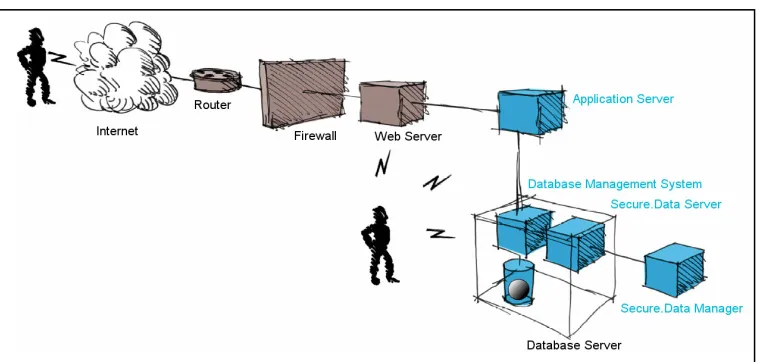
The Protegrity Secure.Data program suite takes a granular approach to information security. Instead of building walls around servers or hard drives, Secure.Data builds a protective layer of encryption around individual data items or objects. This concept protects the data wherever it is stored or processed instead of protecting the server that stores or protects the data (Figure 2.1).
The Protegrity solution adds a critical and final checkpoint for users accessing sensitive information. Secure.Data remains in place protecting the data at the closest and most effective point. This prevents outside attacks as well as infiltration from within the server itself.
2.5.2.2Data Item Protection
Secure.Data allows an organization manager to define which data stored in databases that is sensitive and which individuals or groups that should have the authority to access the information. This selection is done on a data item level, thereby focusing protection only on the sensitive data. The sensitive data is then encrypted and stored in the database. The selectivity of Protegrity’s data item protection technique not only prevents intruders from gaining access to sensitive data, but also minimizes the delays or burdens on the system that may occur from other bulk encryption methods. The
Protegrity approach is transparent to applications and does not affect non-sensitive data.
2.5.2.3Role Based Access
The role based access model is the cornerstone of the Secure.Data work-enabling design. This method allows managers to decide the levels of user access that are
2.5.2.4Encryption
Secure.Data utilizes encryption to transform sensitive data into a form that is unreadable to anyone who does not have proper authorization. To achieve maximum protection of data and maintain the best system performance, Protegrity offers its crypto-conductor process. This system allows implementation of encryption down to the column level within databases. While other security technologies encrypt whole files, tables or databases, Secure.Data lets users specify and secure only the sensitive data items that need protection. The crypto-conductor process supports encryption for up to 168 DES, strong (CBC block cipher) encryption with IV. Data encryption is the only way to absolutely protect sensitive data, eliminate potential data sharing issues, ensure that privacy is maintained, minimize the potential for identity theft, and ultimately meet data privacy compliance requirements. There are two (2) basic approaches to encryption of stored data:
i. The entire database can be encrypted. There are two (2) problems with this approach. First, it allows anyone with access to the database to decrypt all data stored therein. Second, it exacts a substantial performance penalty because all requests, whether for sensitive data or not, it requires data to be decrypted and re-encrypted.
2.5.2.5Protegrity Secure.DataTM Pros And Cons
Secure.Data provides a way to meet security and privacy requirements without having to alter the code in the applications. This is called application transparency. With the Protegrity solution, users can no longer bypass security policies embedded in applications because security policies are associated directly with data. This solution unifies access controls and protection of information into a central protected database repository, and at the same time closes the security loopholes that inevitably occur when adding, deleting, removing, and changing user access rights to sensitive information stored in a database.
The Protegrity solution allows the company to predetermine who is authorized to have access to sensitive information within corporate databases and to apply the
strongest mechanisms of encryption based security to this select information. Above this core functionality, the Protegrity solution then provides automatic encryption key management. The following are the benefits of the product that ensure protection of corporate information assets, protect its customers, and consumers.
Protection
Secure.Data Manager operates in its own self-secure encrypted environment,
protected by strong authentication that ensures the confidentiality and integrity of all Secure.Data security parameters. Secure.Data Manager runs on a workstation separate from both application and database servers.
Simple user interface
Secure.Data Manager’s graphical user interface incorporates the latest Windows techniques, such as drag and drop and browse and pick. The easy-to-use GUI
Separation of duties
It allows organizations to separate database security control from the duties of the database and system administrators. The database or system administrator can still perform his duties, but an appointed Security Manager maintains responsibility for the security of the sensitive information through the Secure.Data Manager module, which is operated separately from the database.
Advanced prevention of internal attacks
Secure.Data provides a sophisticated system of self-protection that protects the encryption mechanism in a way that it cannot be manipulated by a DBA or System Administrator. Through this self-protection mechanism, no user, even with
root/administrator rights, can undetected access the encrypted data.
High granularity
By using role-based access control and multilevel security, Secure.Data Manager allows operators to define user roles, workgroups, access rights and encryption requirements down to the data item level.
Single point of control
Secure.Data does not require security operators to update security parameters for various servers individually. Secure.Data Manager’s centralized administration allows operators to maintain the integrity of all Secure.Data policies and
configurations from a single location.
Auditing and reporting
Encrypted logs are produced to track both the Secure.Data Manager administrator’s activities and Secure.Data Server activities around protected data, such as records of changes to the security policy and unauthorized access attempts. Real-time auditing ensures non-repudiation of transactions on sensitive information and is independent of the DBMS audit mechanism. Secure.Data Manager also includes a report
Protocols and Database Managers in use. Secure.Data encrypts all logs and audits to ensure the fullest protection and security.
2.6 Existing Product Comparative Study
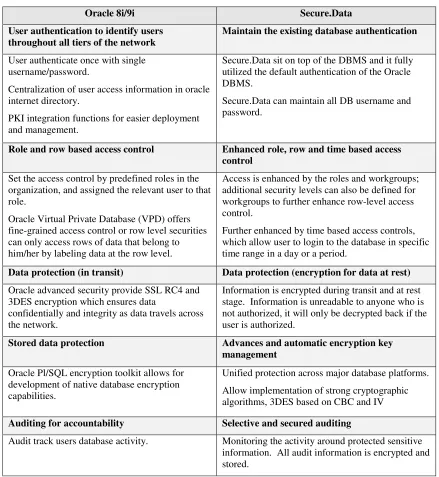
The comparative study was done on the security features and characteristics of four (4) existing database security systems, which uses cryptography to secure data in databases. The existing systems are DBEncryptTM, Secure.DataTM, Microsoft SQL
Server 2000, and Oracle Database Security.
2.6.1 DBEncrypt vs. Secure.Data Features
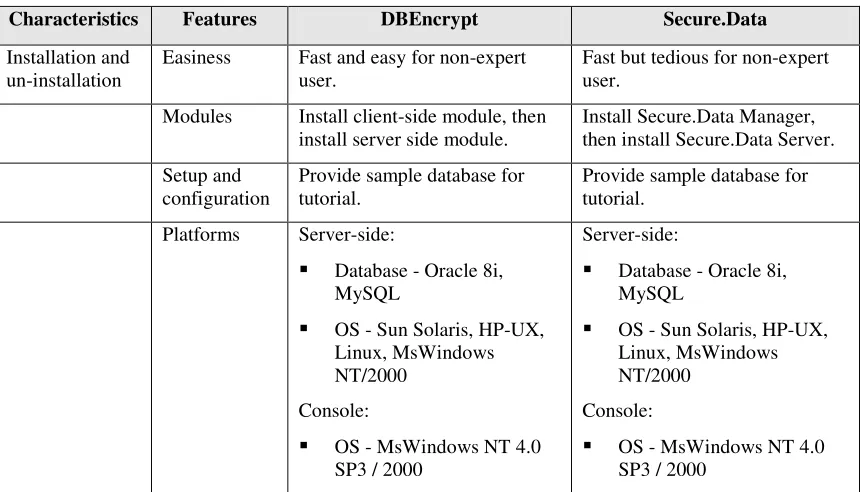
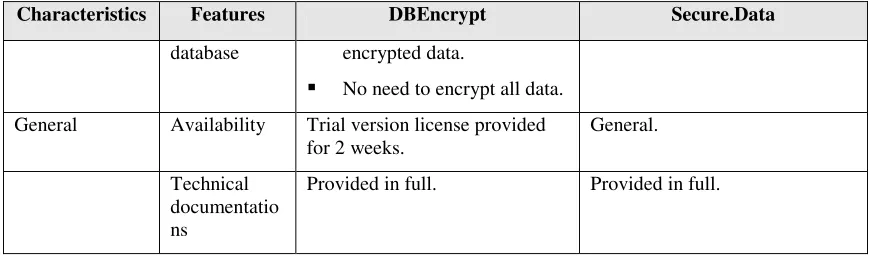
Table 2.1 shows the comparative studies on characteristics and features between
DBEncrypt and Secure.Data.
Table 2.1 DBEncrypt vs. Secure.Data
Characteristics Features DBEncrypt Secure.Data
Installation and
un-installation Easiness Fast and easy for non-expert user. Fast but tedious for non-expert user. Modules Install client-side module, then
install server side module. Install Secure.Data Manager, then install Secure.Data Server. Setup and
configuration Provide sample database for tutorial. Provide sample database for tutorial. Platforms Server-side:
Database - Oracle 8i, MySQL
OS - Sun Solaris, HP-UX, Linux, MsWindows NT/2000
Console:
OS - MsWindows NT 4.0
Server-side:
Database - Oracle 8i, MySQL
OS - Sun Solaris, HP-UX, Linux, MsWindows NT/2000
Console: