R E S E A R C H
Open Access
ARQ-based spectrum sharing with
multiple-access secondary system
Shu Fang
1*, See Ho Ting
2, Qiang Li
3, Ashish Pandharipande
4and Mehul Motani
5Abstract
We consider a cognitive radio network in which a multiple-access secondary system coexists with an automatic repeat request (ARQ)-based primary system under heavy primary traffic. To achieve spectrum sharing without degrading the performance of the primary system, the secondary transmitters alternate between cooperation and access modes based on a credit system. In the cooperation mode, the secondary transmitters serve as potential relays among which the best one is selected to help forward the primary packet, thus accumulating credits. These credits will then allow the secondary transmitters to gain spectrum access by exploiting the ARQ mechanism of the primary system.
Our results show that with a cluster of closely located secondary transmitters, the proposed spectrum sharing protocol achieves an equal average throughput for the primary system compared to the case without spectrum sharing, while providing access opportunities for the secondary system. Furthermore, by increasing the number of secondary transmitters or decreasing the distance between secondary transmitters and secondary receiver, an overall higher throughput can be achieved for the secondary system, without affecting the analytical results for the upper bounds of primary throughput under cooperation mode, and secondary throughput under access mode are also derived.
Keywords: Cognitive radios, Spectrum sharing, Automatic repeat request, Relay, Multiple-access
Introduction
Spectrum is a valuable resource in wireless communica-tion systems. Around the world, the frequency spectrum is tightly regulated by fixed spectrum assignment policies which partition the spectrum into a large number of fre-quency bands and legally limit the applications, users, and operators within each band [1]. This leads to an undesir-able situation where some systems may not fully utilize the allocated spectrum while others suffer from a lack of bandwidth. Over the past decades, these challenges and requirements have been extensively studied, giving birth to the notion of cognitive radios [2,3]. Cognitive radio is a technique that improves the utilization of the spectrum by intelligently sharing radio resources among different users, which is also considered in the framework of hier-archical spectrum sharing where the users with different priorities are allowed to operate over the same portion of spectrum.
*Correspondence: [email protected]
1Department of National key Laboratory on Communications, University of Electronic Science and Technology of China, Chengdu 611731, China Full list of author information is available at the end of the article
With the development of cognitive radio technologies, dynamic spectrum access [4-6] becomes a promising approach to increase the efficiency of spectrum usage. It allows unlicensed wireless users to dynamically access the licensed bands allocated to legacy spectrum holders on a negotiated or an opportunistic basis. The key component of dynamic spectrum access is dynamic spectrum sharing [7-10], which is able to provide efficient and fair spectrum allocation or scheduling solutions between the primary and secondary users.
Three approaches to spectrum sharing between primary and secondary users have been evaluated [11]: spectrum interweave, spectrum underlay, and spectrum overlay. Spectrum interweave is the original idea of utilizing the spectrum holes left by primary system to establish sec-ondary communication links. Spectrum underlay imposes strict constraints on the behavior of the secondary users so that the interference caused to the primary users is lim-ited below a predefined threshold [12]. Spectrum overlay does not necessarily impose restrictions on the trans-mission power of secondary users, but rather on when and where they may transmit opportunistically without degrading the primary performance [13].
According to spectrum utilization report of FCC [1], there is a large variation in spectrum usage intensity that some bands are heavily used, while others have light usage. When the traffic is light that results in spectrum holes within this band, it is better to use spectrum interweave to allow the secondary access. Conversely, when the traf-fic is very heavy in this band, where a spectrum hole can be hardly found, spectrum underlay and overlay are better choices.
Cooperative diversity brought about by relay transmis-sions can effectively combat channel fading and enhance the throughput. It also has a great potential to be adopted in cognitive radio networks [14-22]. Both theoretical and experimental results demonstrate that a relay-assisted cognitive spectrum sharing protocol [16,18] is able to assist the primary system to achieve a better performance and at the same time allows spectrum access for the sec-ondary system. In [17], multi-relay-based cognitive radio networks were considered to improve the performance of secondary users while ensuring the quality of service for primary users. Cooperative spectrum sharing proto-col with multiple secondary transmitters was studied in [18]. A two-phase spectrum sharing protocol with cooper-ative decode-and-forward relaying was proposed in [19], and a spectrum sharing protocol with two-way relaying was proposed in [20]. Cognitive relay networks with mul-tiple primary transceivers under spectrum sharing was considered in [21], where the impact of multiple primary transmitters and receivers on the outage performance of cognitive decode-and-forward relay networks was exam-ined. In [22], the outage probability of dual-hop cognitive amplify-and-forward relay networks subject to Nakagami-m fading is investigated under spectruNakagami-m sharing environ-ment. In [23], the author analyzed the performance of the secondary user in spectrum sharing cognitive relay networks with the primary user’s interference, where the performance loss of the secondary user due to the primary interference can compensate by increase in the number of relays for the secondary system.
Besides the above proposals for spectrum sharing with cognitive relays, the feedback mechanism of auto-matic repeat request (ARQ)-based primary system has also been exploited to gain secondary spectrum access [24-29]. In [24], the secondary user is able to eavesdrop on the handshaking signals of the ARQ-based primary system and adaptively adjust its input rate such that sec-ondary spectrum sharing is achieved, while maintaining the target rate for the primary user. The interference that the secondary user causes to the primary user and how this interference impacts the retransmission process of the latter were studied in [25]. In [26-29], the authors addressed the coexistence problem by taking advantage of the opportunities that arise during ARQ retransmis-sions of the primary system. In [26] and [27], the structure
of primary ARQ retransmissions is exploited to provide nontrivial rate for the secondary user while minimizing the impact on the primary user. In [28], the secondary user broadcasts a probing signal and listens to the cor-responding ACK/NACK sent from the primary receiver and then decides whether to access the spectrum. In [29], a cooperation-and-access spectrum sharing protocol with a single secondary user is proposed where the sec-ondary user alternates between cooperation and access modes by exploiting the ARQ ACK/NACK mechanism of the primary system. Although the basic idea of [29] is similar with our proposed spectrum sharing protocol, there are two major differences. One is that we extend the single secondary transmitter in [29] to multiple sec-ondary transmitters. The other is that they [29] focused on different retransmission times while our work focus on one retransmission. When the multiple secondary transmitters are served as potential relays to help for-ward the primary packet, the spectrum sharing protocol is much different from the case in [29] with single sec-ondary transmitter. We also derived the analytical upper bound of system throughput for primary and secondary system under cooperation and access mode with multi-ple secondary transmitters. Our results show that with a cluster of closely located secondary transmitter served as potential relay to help forward the primary packet, an overall higher throughput can be achieved for the sec-ondary system. The secsec-ondary throughput gap between the scheme in [29] and our proposed scheme is given in this paper. It was noted that even though ARQ retrans-missions may be relatively infrequent, it is still possi-ble to achieve a reasonably good performance for the secondary user.
PT
(Primary Transmitter) (Primary Receiver)
(Secondary Receiver) (Secondary Transmitter) h0
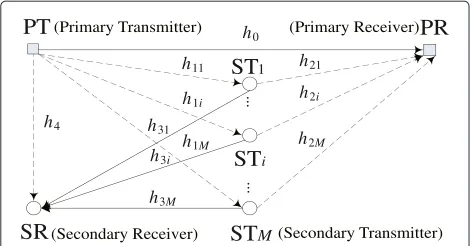
Figure 1System model for the proposed spectrum sharing protocol with multiple-access secondary system.
without relay and the proposed scheme with multiple sec-ondary transmitters serving as potential relay. With the proposed spectrum sharing protocol, it is shown that the secondary system is able to access the spectrum without degrading the primary system performance under heavy traffic and obtain considerable secondary system through-put. With a cluster of closely located secondary transmit-ters, the secondary system throughput increases with the number of STs and with decreasing distance between STs and SR.
System model and protocol description System model
Consider a cognitive radio system with a stop-and-wait ARQ-based primary system with relay functionality [30], as depicted in Figure 1. The primary system consists of a single PT and PR. The secondary system consists ofM secondary transmitters STiwherei ∈ M = {1, 2, ...,M}
and a single SR as shown in Figure 1. The channels
over links PT→PR, PT→STi, STi →PR, STi →SR, and
PT→SR are modeled as Rayleigh flat fading with channel coefficients denoted byh0,h1i,h2i,h3i, andh4respectively.
We have h0 ∼ CN(0,d−0v), hki ∼ CN(0,dki−v), k =
1, 2, 3, and h4 ∼ CN(0,d−4v), where v is the path-loss
exponent and d0, dki,k = 1, 2, 3, and d4 are the
dis-tances between the respective transmitters and receivers. In order to simplify the theoretical analysis, we assume that the secondary transmitters are closely located and
thus we have dki = dk,∀i ∈ M,k = 1, 2, 3. We
also denote the instantaneous channel gains for these links as γ0 = |h0|2, γki = |hki|2,k = 1, 2, 3, and
γ4 = |h4|2. The transmit power at PT and STi is
denoted as Pp and Ps ∀i, respectively. The target rates
for the primary and secondary systems are denoted by Rp and Rs, respectively. The variances of the additive
white Gaussian noise at all receivers are assumed to be identical and are denoted asσ2.
Protocol description
In cooperation mode, we quantify the improvement in primary performance due to cooperative relaying from the secondary system as credits accumulated by the sec-ondary system. Each complete transmission for a pri-mary packet in cooperation mode is associated with a credit which is tracked and collected by the secondary system. When enough credits are accumulated by the sec-ondary system to compensate the possible performance loss caused by secondary access, the secondary system turns into access mode.
During access mode, one of the secondary transmit-ters is allowed to access the spectrum along with the ARQ-based retransmission from PT. When the secondary access is completed, the system returns to cooperation mode again to collect more credits, so on and so forth.
We assume that the transmission of a primary packet is completed within at most two slots, i.e., the maximum number of retransmissions is 1. The secondary system transmits each secondary packet only once with a best-effort mechanism. Since the primary system has heavy traffic, PT is backlogged, i.e., it always has a packet to transmit. The secondary system is also assumed to be backlogged.
The details of the proposed spectrum sharing protocol are described below:
1. In cooperation mode. PT sends a packet to PR in the first time slot while PR, STi,∀i∈M, and SR attempt
to decode this packet. The achievable rate of link PT→PR is given by
corresponding outage probability of link PT→PR can be expressed as
If PR successfully decodes the packet, it sends back an ACK. Otherwise, a NACK is sent from PR. The decoding of the primary packet at STi,i∈Mis
successful ifR1i≥Rp, whereR1idenotes the
achievable rate of link PT→STiand is given by
R1i=log2
We defineA= {R1i≥Rp|i∈M}, whereA
represents the set of secondary transmitters that have successfully decoded the primary packet.
The secondary transmitters will listen to the ACK or NACK message sent from PR. By overhearing these messages, STi,i∈Ais able to estimate the channel
gainsγ2i,i∈A. If an ACK is overheard, STi,∀i∈A
discards the received primary packet, and PT proceeds to send a new packet. On the other hand, if a NACK is overheard, each secondary transmitter STi,∀i∈Astarts a count-down timer with initial
factor andt0is a predetermined initial time. The STi,
whose count-down timer reduces to zero first, i.e., STp,p=arg max
i∈A [
γ2i]will broadcast a relay
confirmation message (RCM) to identify its presence and then relay the primary packet to PR. In fact, it is the same as selection combining for the primary user. When NACK is heard by PT, it will not retransmit the packet immediately, but instead, it will wait for a predefined duration to see if a RCM is received from any potential relay. When the RCM is heard by PT and all other secondary users STi,∀i∈A\{p}, PT
will delegate the retransmission packet and STi,∀i∈A\{p}will withdraw themselves from the
Then the corresponding outage probability for link STi →PR can be expressed as
If STpsuccessfully relays the primary packet to PR,
then PR sends back an ACK. If the relayed packet is not successfully decoded by PR, PT will not retransmit this packet but a new packet will be transmitted as the number of retransmission is limited to one.
If a NACK is overheard by STi,∀i∈M, and PT after
the first transmission slot of primary packet, and none of the secondary transmitters has successfully decoded the primary packet, i.e., no RCM is heard by PT within a predefined duration, then PT will retransmit the primary packet in the second time slot. If the packet cannot be decoded at PR after two slots, an outage for primary transmission is declared.
At the same time, SR keeps track of the credits accumulated by secondary system asNC. Each
complete transmission for a primary packet in cooperation mode is recorded as a credit earned by the secondary system. The credits accumulated in cooperation mode are used to earn access opportunities for the secondary system in access mode. When enough creditsNCare collected by SR,
i.e.,NC≥ ¯NC, whereN¯Cis the threshold value, a
secondary access start message (SASM) is
broadcasted by SR and the system turns into access mode. Upon hearing that SASM is sent from SR, STi,∀i∈Mis able to estimate the channel gains
γ3i,∀i∈M.
2. In access mode. When PT transmits a new packet to PR, SR tries to decode the primary packet in anticipation for interference cancelation to be performed to retrieve the secondary packet. The achievable rateR4between link PT→SR is given by
R4=log2
The outage probability for link PT→SR is given by
O4=Pr{R4<Rp} =1−e−d
v 4
(2Rp−1)σ2
Pp . (9)
If SR fails to decode the primary packet in the first transmission slot, we presume that an outage is declared for the secondary transmission. Then the secondary system will operate in cooperation mode for anotherN¯Ctimes until it is allowed to access the
spectrum again.
After the first transmission, an interference signal (INF) is transmitted by SR to corrupt the
corresponding ACK/NACK sent from PR. Since the failure to receive an ACK/NACK is treated as an implicit NACK, PT retransmits the packet in the second transmission slot. At the same time, each secondary transmitter STi,∀i∈Mnow starts a
count-down timer with initial value
t3i=
factor. The STi, whose count-down timer reduces to
zero first, i.e., STq,q=arg max
i∈M [γ3i]will send a
secondary packet to SR together with a secondary access confirmation message (SACM) to identify its presence. All other secondary users STi,∀i∈M\{q},
the secondary packet. The achievable rateR3i
Then the outage probability for link STi→SR is
given by
In access mode, the secondary packet is transmitted along with the retransmission of the primary packet. Thus the secondary packet is successfully received at SR ifR3i>Rs. The secondary packet is successfully
decoded at SR ifR3i>RsandR4>Rp. Regardless
whether the secondary packet is successfully decoded at SR or not, the system turns into cooperation mode and SR resetsNCto zero.
In access mode, since the secondary system transmits along with the retransmission of primary packets to achieve spectrum access, the retransmission of the primary packets will always fail due to the strong interference from secondary access. Therefore, the successful transmission of primary packets in access mode is dependent only on the first primary transmission. As a result, the primary performance will be severely degraded in access mode.
Throughput and credit analysis
Throughput for conventional primary system without relay
For a conventional system based on ARQ mechanism, we consider the scenario where the packet can be transmitted at most by two transmission slots, i.e., only one retrans-mission. We have the following mutually exclusive events for the transmission of a packet:
Event 1:C1={primary packet is successfully received
at PR in the first transmission slot}.
Event 2:C2={primary packet is not successfully
received at PR in the first transmission slot, but the retransmission of the same packet from PT is successfully received at PR}.
Event 3:C3={primary packet transmission fails after
two transmission slots}.
From (2), the probability of the above events are respec-tively given by
Pr{C1} =1−O0, (13)
Pr{C2} =O0(1−O0), (14)
Pr{C3} =O20. (15)
Thus, the throughputηPbits is denoted as
ηPbits =RPηP, (16)
We defineηPas the average number of packets
success-fully delivered per time slot. That is the ratio between how much of each packet that can be successfully delivered and the number of time slots required.
ηP= Pr{C1} +Pr{C2} Pr{C1} +2 Pr{C2} +2 Pr{C3}
. (17)
The nominator denotes on average how much of each packet can be successfully delivered, and the denominator denotes the average time slots that are consumed. There-fore, ηP is the actual throughput normalized by the bit
rate. In this paper, we focus on analyzing the normalized throughput for convenience. Thus, the throughput for the conventional primary system is denoted as
ηP=1−O0. (18)
Throughput for the primary system in cooperation mode
In cooperation mode, the secondary system is always ready to serve as a relay for the primary system, for which we have the following mutually exclusive events:
Event 1:E1={primary packet is successfully received
at PR in the first transmission slot}.
Event 2:E2={primary packet is not successfully
received at PR and STi,∀i∈Min the first
transmission slot, PT retransmits the same packet in the subsequent slot and it is successfully received at PR}.
Event 3:E3={primary packet is not successfully
received at PR, but successfully received at one or more STi,i∈M; thus, one ST serves as relay to
forward this packet to PR in the subsequent slot and it is successfully received at PR}.
Event 4:E4={primary packet transmission fails after
two transmission slots}.
From (2) and (4), the probability forE1,E2, andE3are
given by
Pr{E1} =1−O0, (19)
Pr{E2} =O0O1M(1−O0), (20)
Pr{E3} =O0PSR, (21)
where the superscript SR denotes successful relaying, and PSR represents the joint probability that at least one of the STi,i ∈ Msuccessfully receives the primary packet
and successfully relays the packet to PR. In other words, PSRindicates the probability thatk ≥1 secondary
trans-mitters can successfully receive the primary packet from
PT. Among which, f ≥ 1 secondary transmitters can
successfully relay the primary packet to PR.
We denote B = {STi|i ∈ M,R1i > Rp,R2i > Rp},
whereBis the set of secondary transmitters STi,i ∈ M
to successfully forward the primary packet to PR in the
subsequent slot. Hence, B ⊆ A. When the first
trans-mission from PT to PR fails, the secondary system selects STp,p∈Awith the best channel gainp=arg max
i∈A [
γ2i] to relay the primary packet. The joint probabilityPSRcan be expressed as
ThenPSRis derived as
PSR=
E4represents the outage occurrence, and its probability is
given by
Pr{E4} =O0O1MO0 +O0PFR, (27)
where the first termO0O1MO0 denotes the first event that
the primary packet fails in the first transmission from PT to PR and all the secondary transmitters STi,∀i∈Malso
fail to decode the primary packet, and the retransmission of the packet from PT to PR fails again. The second term O0PFRdenotes the event that the primary packet fails at
the first transmission from PT to PR link and the super-script FR denotes failed relaying. SoPFRindicates the joint probability thatk≥1 secondary transmitters can success-fully receive the primary packet from PT. Among which, zero secondary transmitters can successfully relay the pri-mary packet to PR. However, at least one of the secondary transmitter STi,i ∈ Msuccessfully decodes the primary
packet but fails to relay it to PR, i.e.,A ∈∅andB ∈ ∅. Thus, PFR is also the joint probability that denotes the
secondary transmitters successfully receiving the primary packet but failing to relay, for which we have
PFR=
By substitutingf =0 into (25), we have from (28)
PFR=
The throughput for primary system under cooperation mode is thus
Proof. SincePSR +PFR represents the probability that
at least one of the secondary transmitters successfully decodes the primary packet,
PSR+PFR=1−O1M. (33)
From the binomial theorem, PFR in (29) can be
expressed as
Throughput for primary system in access mode
In access mode, SR transmits an INF signal to corrupt the primary ACK/NACK of the first transmission, and the failure to receive the ACK/NACK is treated as an implicit NACK. Since the secondary transmitter utilizes the retransmission of primary packets to achieve spec-trum access, the retransmission of the primary packets will fail due to the strong interference from secondary access. Thus, whether the primary packets can be success-fully transmitted or not in access mode is determined by the first transmission slot. There are two mutually exclu-sive events for primary system in access mode as shown in Figure 2:
Event 1:A1={the primary packet is successfully
received at PR in the first transmission, but the corresponding ACK is corrupted by SR; PT then retransmits this packet and an ACK is received from PR}.
Event 2:A2={the primary packet is not successfully
received at PR in the first transmission and the corresponding NACK is corrupted by SR; PT then retransmits this packet but still fails due to the strong interference from the secondary access and a NACK is received at PR, i.e., a packet loss}.
Thus, the probability of the above two events are respec-tively given by
Pr{A1} =1−O0. (36)
Pr{A2} =O0. (37)
The throughput for primary system under access mode thus given by
ηAP = Pr{A1} 2 Pr{A1} +2 Pr{A2}
= 1−O0
2 .
(38)
Credits and penalties
From the above analysis, it is apparent that the through-put for the primary system decreases severely under access mode, but improves significantly under coopera-tion mode. The performance loss in access mode incurred by the secondary system is regarded as penalties and the performance gain collected by the secondary system in cooperation mode is regarded as credits. Thus we propose an ARQ-based spectrum sharing protocol to regulate the credits and the penalties such that secondary spectrum access can be achieved without degrading the primary performance.
In cooperation mode, ‘credits’ is defined as
C= ηCP−ηP (credits/slot) (39)
In access mode, ‘penalties’ is denoted as
P=ηP−ηAP (penalties/slot) (40)
It is apparent that the throughput for the conventional sys-temηPis taken as a benchmark in the definition of credits
(a)
(b)
and penalties. For ease of exposition, we define the ratio between penalties and credits as
¯ NC=
P
C. (41)
To achieve spectrum sharing without degrading the performance of the primary system, every N¯C (or lN¯C)
complete transmission for a packet in cooperation mode allows one (or l) access opportunity for the secondary system, wherel ∈Z+. Thus, the overall average through-put for primary system in the proposed spectrum sharing protocol is given by
ηTP=ηCP N¯C
Throughput for secondary system in access mode
For the secondary system, if the primary packet is suc-cessfully received at SR in the first transmission, the interference from PT’s retransmission can be perfectly canceled out at SR. Otherwise, we assume that the sec-ondary packet fails to be received at SR due to the inter-ference from the primary retransmission. Thus in access mode, there are three mutually exclusive events for the secondary system:
Event 1:S1={the primary packet is successfully
received at SR in the first transmission slot, and the secondary packet is also successfully received at SR in the second transmission slot}
Event 2:S2={the primary packet is successfully
received at SR in the first transmission slot, but the secondary packet fails to be received at SR in the second transmission slot}
Event 3:S3={the primary packet failed to be received
at SR in the first transmission slot}
Thus, the probability of the above three events can be derived as
The throughput for the secondary system under access mode is thus given by
ηS= Pr{S1}
Lemma 2. An upper bound of the secondary throughput under access mode with an increasing M is given by
η∗S= lim
the upper bound is obtained.
Through the proposed credit system, the secondary system switches between cooperation and access modes, according to the accumulated credits, continuously. Thus, the overall average throughput for secondary system in the proposed spectrum sharing protocol is given by
ηTS = 1 ¯ NC+1
ηS. (48)
Lemma 3.An upper bound of the overall average throughput for secondary system with an increasing M is given by
In this section, we show the theoretical and simulation results for the throughput of the primary and secondary systems in the proposed spectrum sharing protocol. The theoretical results are according to the previous analysis, and the simulation results are according to the simu-lated transmission cases. For ease of exposition, as shown in Figure 1, we assume that the distance is the normal-ized distance, which is done with respect to the distance between PT and PR, i.e.,d0 = 1,dki = 0.5(k = 1, 2),
d4=0.5, and the path-loss exponentv=4. We let the
tar-get ratesRp =Rs = 1 and the transmit powersPp = Ps.
We use markers to denote the simulation results and lines to denote the analytical results.
Figure 3 shows the throughput for primary system in
cooperation mode under different valuesM. WhenM =
1, the results are identical with the spectrum sharing protocol in [29] with one retransmission of the primary system. The upper bound for primary throughput is also
plotted when M → ∞. It is apparent that the
theo-retical results agree well with the simulation results. We can see that the primary throughput in cooperation mode ηCP is always higher than that in the conventional
pri-mary system ηP; thus, credits can be accumulated by
the secondary system in cooperation mode. In the low SNR region, the primary throughput in cooperation mode
Figure 3Theoretical and simulation results for the primary throughput in cooperation modeηCPand access modeηTP.
of M due to the cooperation from the secondary
sys-tem. On the other hand, in high SNR region, since the outage probability of the direct primary link PT→PR is low, opportunities for cooperation from secondary system decreases, thus increasingMwill not improve the perfor-mance significantly in the high SNR region. We can also
observe that withM=10, the primary throughput under cooperation mode ηCP is very close to the upper bound η∗C
PwhenM→ ∞.
As shown in Figure 3, the primary system throughput in cooperation mode hits a plateau at about 0.5 in low SNR region and approaches 1 in the high SNR region. This is
Figure 5The ratio between penalties and creditslog10N¯Cunder different values ofPS/σ2.
because in the low SNR region, the direct link PT→PR is
weak and withM→ ∞secondary transmitters, the
prob-ability that the primary packet is successfully relayed by secondary users after two slots approaches 1. On the other hand, in the high SNR region, the direct link PT→PR is so
strong that the primary packet is always successfully deliv-ered after the first transmission. Thus, the improvement due to cooperation from secondary users is negligible. It is also observed that the primary throughput in access mode ηAP degrades severely because of the secondary access.
However, with the proposed ARQ-based spectrum shar-ing protocol, it is apparent that the same overall average throughput ηTP = ηP is achieved for the primary sys-tem compared to the case without relay, while providing secondary spectrum access.
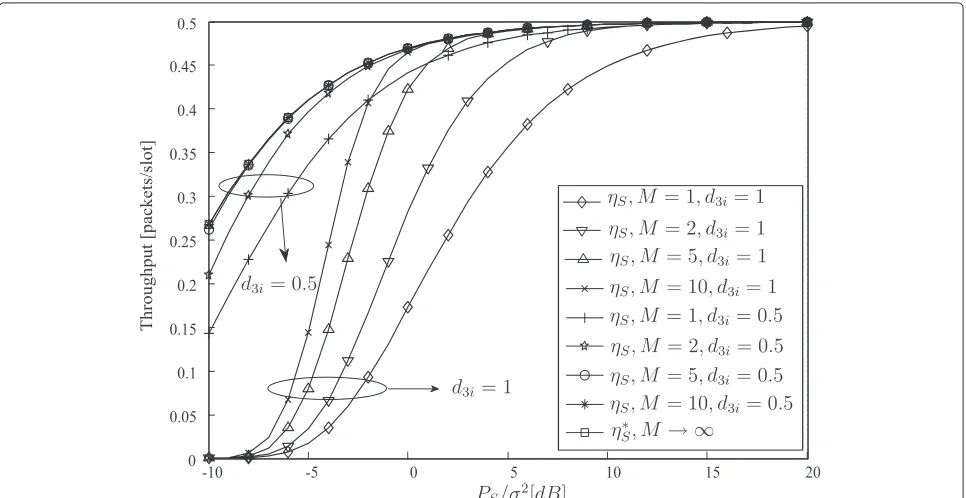
Figure 4 shows the throughput for secondary system in access modeηSunder different SNR valuesPS/σ2. We let M = 1, 2, 5, 10,∞and d3i = 1, 0.5 respectively. It can
be observed that the secondary throughput in the access
mode increases with an increasing Mand a decreasing
d3i. This is because on one hand, the probability of
suc-cessfully receiving the secondary packet at SR improves significantly with the increasingM. On the other hand, with the decrease of d3i, the probability of successful
transmission from secondary transmitter to secondary receiver also increases. It is also observed that the sec-ondary throughput in access mode approaches the upper boundη∗S, whend3iis decreased from 1 to 0.5 andM =
10. A throughput floor of 0.5 appears in the high SNR region for secondary system; this is because both the out-age probability of link PT→SR and STi →SR approach 0
in the high SNR region indicate that the probability of suc-cessfully decoding the secondary packet in access mode approaches 1. Therefore, in high SNR region, the through-put floor for secondary system in access mode is 0.5 due to the two transmissions.
Figure 5 shows the ratio log10(N¯C)under different SNR
valuesPS/σ2in the proposed spectrum sharing protocol.
When N¯C is lower, the access frequency for secondary
system, i.e., 1/(N¯C+1)is higher. From Figure 5 we can
observe that in low SNR region, where ratio N¯C → 0,
the secondary transmitters are able to operate in access mode for most of the time as 1/(N¯C+1) → 1, without
degrading the primary performance. On the other hand, in high SNR region whereN¯C 1, the secondary
trans-mitters have to operate in cooperation mode for most of the time, i.e.,N¯C/(N¯C+1) →1, before they are allowed
to switch to access mode. We also observe that an increase in M will cause a decrease in N¯C. This is because by
increasingM, the primary throughput gain in coopera-tion mode increases. Thus, in order to achieve the same primary throughput as in the case without relay, the oper-ating time in access mode can be increased by increasing
M. However, as shown in Figure 5, when the SNR is
high, increasingMwill not affect the value ofN¯C
signifi-cantly, which validates the observation in Figure 3 where the credits due to cooperation from secondary users are negligible in high SNR region.
In Figure 6, we show the overall average throughput for secondary systemηTS under differentPS/σ
2. We observe
thatηTS increases with an increasingM. This is because
with an increase in M, the secondary system collects
more credits and hence gains more chances to access the
spectrum. Furthermore, with an increasing M, a lower
outage probability for link STi →SR can be achieved. A
peak value of the overall average secondary throughput max(ηTS)for secondary system is achieved in modest SNR values, e.g., around 0 dB ford3i = 1 and around−5 dB
for d3i = 0.5. This is because in the low SNR region,
although ST is able to operate for a higher fraction of time 1/(N¯C+1)in access mode, the correspondingηSis small.
On the other hand, in high SNR region, although a higher secondary throughputηSis achieved in access mode, the secondary system has to spend most of the time in cooper-ation mode. When the distance of STi→SR decreases, the
corresponding max(ηTS)occurs in the lower SNR region. This is because with smaller d3i, the required SNR to
achieve the sameηSis lower. At the same time, the access
fraction 1/(N¯C+1)is larger in lower SNR region than that
in higher SNR.
Conclusions
We presented an ARQ-based spectrum sharing protocol to achieve spectrum access for multiple secondary trans-mitters coexisting with a primary system. Upon establish-ing a credit system, the secondary transmitters alternate between relaying for the primary system and accessing the spectrum for their own use. Credits can be accumulated by secondary transmitters in cooperation mode, which in return allow the secondary system to gain spectrum access in access mode. Our results show that the pro-posed protocol can achieve secondary spectrum access without degrading the performance of the primary system compared to the conventional system without relays. Fur-thermore, the throughput for secondary system improves as the number of secondary transmitters increases.
Competing interests
The authors declare that they have no competing interests.
Acknowledgements
This work is supported by the Singapore Ministry of Education Academic Research Fund Tier 2, MOE2009-T2-2-059 and the Fundamental Research Funds for the Central Universities of China, ZYGX2012Z004.
Author details
1Department of National key Laboratory on Communications, University of Electronic Science and Technology of China, Chengdu 611731, China.2School of Electrical and Electronic Engineering, Nanyang Technological University, 639801, Singapore.3Department of Electronics and Information Engineering Huazhong University of Science and Technology, 1037 Luoyu Road, Wuhan, China.4Philips Research, High Tech Campus, Eindhoven 5656 AE, The Netherlands.5Department of Electrical and Computer Engineering, National University of Singapore, 117576, Singapore.
Received: 2 December 2012 Accepted: 18 April 2013 Published: 13 May 2013
References
2. J Mitola, JGQ Maguire, Cognitive radio: making software radios more personal. IEEE Pers. Commun.6(4), 13–18 (1999)
3. S Haykin, Cognitive radio: brain-empowered wireless communications. IEEE J. Sel. Areas Commun.23(2), 201–220 (2005)
4. Q Zhao, B Sadler, A survey of dynamic spectrum access: signal processing, networking, and regulatory policy. IEEE Signal Process. Mag.24(3), 79–89 (2007)
5. KG Shin, H Kim, AW Min, Kumar: A, Cognitive radios for dynamic spectrum access: From concept to reality. IEEE Wireless Commun.17(6), 64–74 (2010)
6. S Srinivasa, SA Jafar, Cognitive radios for dynamic spectrum access - the throughput potential of cognitive radio: a theoretical perspective. IEEE Commun. Mag.45(5), 73–79 (2007)
7. JM Peha, Approachestospectrum sharing. IEEE Commun. Mag.42(2), 10–12 (2005)
8. Z Ji, KJR Liu, Cognitive radios for dynamic spectrum access-dynamic spectrum sharing: a game theoretical overview. IEEE Commun. Mag.
45(5), 88–94 (2007)
9. D Niyato, E Hossain, Market-equilibrium, competitive, and cooperative pricing for spectrum sharing in cognitive radio networks: analysis and comparison. IEEE Trans. Wireless Commun.7(11), 4273–4283 (2008) 10. D Niyato, E Hossain, Competitive pricing for spectrum sharing in
cognitive radio networks: dynamic game, inefficiency of Nash
equilibrium, and collusion. IEEE J. Sel. Areas Commun.26, 192–202 (2008) 11. SA A Goldsmith, I Jafar, S Maric, Srinivasa, Breaking spectrum gridlock with cognitive radios: an information theoretic perspective. Proc. IEEE.97(5), 894–914 (2009)
12. LP Luo, P Zhang, GC Zhang, JY Qin, Outage performance for cognitive relay networks with underlay spectrum sharing. IEEE Commun. Lett.
15(7), 710–712 (2011)
13. M Rashid, M Hossain, E Hossain, V Bhargava, Opportunistic spectrum scheduling for multiuser cognitive radio: a queueing analysis. IEEE Trans. Wireless Commun.8(10), 5259–5269 (2009)
14. S Yang, JC Belfiore, Towards the optimal amplify-and-forward cooperative diversity scheme. IEEE Trans. Inf. Theory.53(9), 3114–3126 (2007) 15. O Simeone, Y Bar-Ness, U Spagnolini, Stable throughput of cognitive
radios with and without relaying capability. IEEE Trans. Wireless Commun.
55(12), 2351–2360 (2007)
16. VA Bohara, SH Ting, Measurement results for cognitive spectrum sharing based on cooperative relaying. IEEE Trans. Wireless Commun.10(7), 2052–2057 (2011)
17. YL Zou, J Zhu, BY Zheng, YD Yao, An adaptive cooperative diversity scheme with best-relay selection in cognitive radio networks. IEEE Trans. Signal Process.58(10), 5438–5445 (2010)
18. Y Han, SH Ting, A Pandharipande, Cooperative spectrum sharing protocol with secondary user selection. IEEE Trans. Wireless Commun.9(9), 2914–2923 (2010)
19. Y Han, A Pandharipande, SH Ting, Cooperative decode-and-forward relaying for secondary spectrum access. IEEE Trans. Wireless Commun.
8(10), 4945–4950 (2009)
20. Q Li, SH Ting, A Pandharipande, Y Han, Cognitive spectrum sharing with two-way relaying systems. IEEE Trans. Vehicular Tech.60(3), 1233–1240 (2011)
21. TQ Duong, LY Phee, NQB Vo, M Elkashlan, Y Nan, Cognitive relay networks with multiple primary transceivers under spectrum-sharing. IEEE Signal Process. Lett.19(11), 741–744 (2012)
22. TQ Duong, DB da Costa, M Elkashlan, NQB Vo, Cognitive
amplify-and-forward relay networks over Nakagami-m fading. IEEE Signal Process. Lett.6(5), 741–744 (2012)
23. Z Li, HY Huang, JJ Chen, R Gao, Capacity analysis of cognitive relay networks with the PU’s interference. IEEE Commun. Lett.16(12), 2020–2023 (2012)
24. K Eswaran, M Gastpar, K Ramchandran, Cognitive radio through primary control feedback. IEEE J. Sel. Areas Commun.29(2), 384–393 (2011) 25. S Firouzabadi, M Levorato, D O’Neill, A Goldsmith, inIEEE Conference Global
Telecommunications (GLOBECOM 2010). Learning interference strategies in cognitive ARQ networks, (Miami, Florida, USA, 6–10 December 2010) 26. RA Tannious, A Nosratinia, Cognitive radio protocols based on exploiting
hybrid ARQ retransmissions. IEEE Trans. Wireless Commun.9(9), 2833–2841 (2010)
27. R Tannious, A Nosratinia, in2010 IEEE International Symposium on Information Theory Proceedings (ISIT). Coexistence through ARQ retransmissions in fading cognitive radio channels, (Austin, Texas, U.S.A, 13–18 June 2010), pp. 2078–2082
28. JCF Li, W Zhang, A Nosratinia, JH Yuan, inProceedings in IEEE Globecom 2010 Conference. Opportunistic spectrum sharing based on exploiting ARQ retransmission in cognitive radio networks, Miami, Florida, USA, 6–10 December 2010)
29. Q Li, SH Ting, A Pandharipande, M Motani, Cooperate-and-access spectrum sharing with ARQ-based primary system. IEEE Trans. Commun.
60(10), 2861–2871 (2012)
30. I Krikidis, JN Laneman, JS Thompson, S Mclaughlin, Protocol design and throughput analysis for multi-user cognitive cooperative systems. IEEE Trans. Wireless Commun.8(9), 4740–4751 (2009)
doi:10.1186/1687-1499-2013-129
Cite this article as:Fanget al.:ARQ-based spectrum sharing with multiple-access secondary system.EURASIP Journal on Wireless Communications and Networking20132013:129.
Submit your manuscript to a
journal and benefi t from:
7Convenient online submission 7Rigorous peer review
7Immediate publication on acceptance 7Open access: articles freely available online 7High visibility within the fi eld
7Retaining the copyright to your article