628 | P a g e
PERFORMANCE ANALYSIS OF PAPR REDUCTION IN
OFDM USING SLM & PTS TECHNIQUE
Farha Deeba
1, Mr. Amarjeet Kumar Ghosh
21
M.TECH Scholar Department of Electronics & Communication Engg, VITS, BHOPAL
2
Asst.Prof. Department of Electronics & Communication Engg, VITS, BHOPAL
ABSTRACT
OFDM (Orthogonal Frequency Division Multiplexing) has been raised a new modulation technique. Due to its
advantages in multipath fading channel e.g. robust against ISI, ICI and some other advantages like best QoS for
multiple users, efficient usage of bandwidth it is suggested to be the modulation technique for next generation
4G networks e.g. LTE. But along with all its advantages there are some disadvantages also e.g. High PAPR
(Peak to Average Power Ratio) at the transmitter end and BER (Bit Error Rate) at the receiving end. Since
OFDM is only used in the downlink of 4G networks. To reduce the problems of OFDM some techniques e.g.
SLM, PTS, Clipping, Coding, & Pre-coding etc are suggested but none of them is reduce the PAPR and BER to
an acceptable value. This Paper will discuss some techniques of PAPR & BER reduction, and their advantages
and disadvantages in detail.
KEYWORDS
:
PAPR, OFDM, SLM, DHT, DCTI INTRODUCTION
OFDM is a new and attractive modulation scheme with strongly efficient in bandwidth usage, immune to
multipath fading environment, less ICI and ISI, better spectral efficiency, and power efficiency [1] [2]. Due to
the recent advances in Digital Signal Processing, OFDM gain more popularity with its advantages. Most high
speed wireless communication standards adopt OFDM or adopting OFDM for transmission e.g. IEEE 802.11,
IEEE 802.16, IEEE 802.20, European Telecommunication Standards Institute, BRAN (Broadcast Radio Access
Networks) committee [3].
Amongst all attractive advantages of OFDM, there are some disadvantages of OFDM e.g. high PAPR (Peak to
Average Power Ratio) and BER (Bit Error Rate). The sensitivity of devices used in OFDM transmitter such as
DAC (Digital to Analogue Convertor) and HPA (High Power Amplifier) is very harsh to the signal processing
loop, which may impair system performance. To achieve high output power efficiency, most radio based system
operates HPA at or near its saturation region. The high PAPR may prevent HPA to used in its linear region and
may cause OOB (Out of Band radiation), and IB (In Band) distortion. Since this high PAPR may degrade
629 | P a g e
1.1 OFDM Basic
An OFDM the entire bandwidth is divided into sub channels or subcarriers, the se subcarriers are transmitted
parallel to achiev e high data rates, and to increase symbol duration and reduce ISI [5] [6]. An OFDM signal is
th e sum of all independent subcarriers, modulated onto the sub for receiver to detect the original symbol
correctly, this is also called the orthogonal constraints of OFDM symbol, since becomes orthogonal to each
others [7].
Figure 1: OFDM Block Diagram.
1.2 Subcarriers
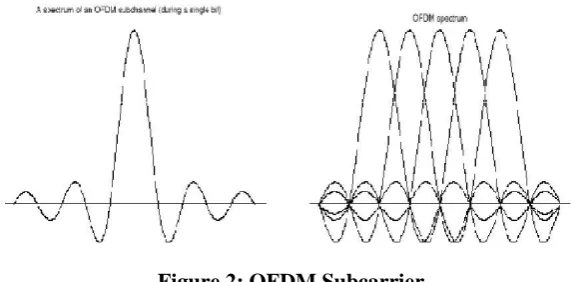
Two signals will be orthogonal if the integral of their products is zero at a specificc time period.
This is proven at the equation below for both continuous and discrete signals cases:
Figure 2: OFDM Subcarrier
Each sub-carrier in an OFDM system is a sinusoid with a frequency that is an integer multiple of a fundamental
frequency. Each sub-carrier is like a Fourier series component of the composite signal, an OFDM symbol. The
sub carrier’s waveform can be expressed as:
1.3 PAPR
Due to IFFT process at the transmitter end, this sums N sinusoids with superposition, some combination of these
630 | P a g e
of IFFT/ FFT, DAC, ADC, and mostly the HPA (which design to handle irregular occurrences of large peaks).Peaks created caused HPA to operate in the saturation region. Saturation creates both IB distortion which causes
BER increasing, and OB distortion which causes ACI. The PAPR of an OFDM system is derived as:
II PROBLEM
As discussed in the previous section as PAPR is the main problem of OFDM, it also increased the BER of
OFDM signal. A lot of work is done in the literature but still no one bring the PAPR and BER curve to an
acceptable level. This paper discusses some of PAPR reduction techniques described in the literature, there
advantages and disadvantages and results. Remaining paper is organized as: section iii) define the criteria for
PAPR reduction in OFDM, section iv) literature review, section v) discuss the conclusion, and section vi)
discuss a proposal for future work
3.2 Low Average Power
A technique must reduce PAPR as well as the average power of the signal not increased from an acceptable
region. If so it will require a large linear region for operation in HPA, which will increase the BER rate of the
OFDM system.
3.3 Low Complexity
The technique should also not increase the complexity of the overall system. Complexity includes both time and
hardware requirements for implementation of the system.
3.4 Less Bandwidth Expansion
Some techniques e.g. scrambling techniques needs side information, which increase the bandwidth usage. Some
coding techniques also expand the bandwidth due to code rate generation. A technique must not increase the
bandwidth to value which causes degradation in the throughput.
3.5 Less BER Performance Degradation
The main goal of the PAPR reduction technique is to gain better performance including BER as compared to
conventional OFDM system.
3.6
Less Additional Power Need
The technique must no need of additional power for PAPR reduction, as it will degrade BER performance of the
system plus power efficiency is the main goal of wireless based systems.
3.7 Good Spectral Efficiency
If a technique destroy the ICI, or, immunity to multipath fading or some other advantage related to spectrum
should not be considered a good PAPR reduction technique.
3.8 Other Factors
Some other factors like nonlinear devices such as ADC/ DAC convertors, and H PA should be kept into
consideration as PAPR reduction avoid nonlinear distortion due to these memories-less devices. Another factor
631 | P a g e
IV LITERATURE REVI EW
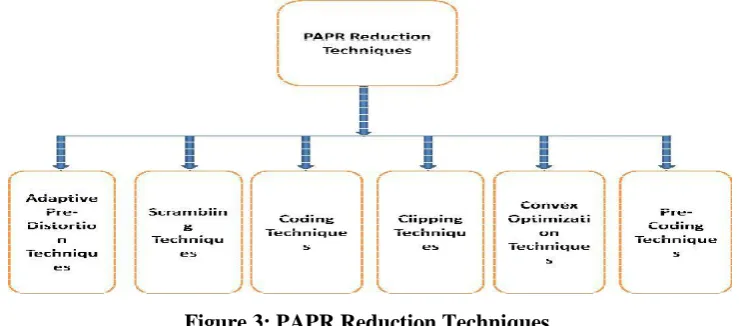
In the literature, a large number of PAPR Reduction Techniques have been prop osed. These techniques may be
divided in 6 major categories which are:
a) Clipping Techniques
b) Scrambling Techniques
c) Adaptive Pre Distortion Techniques
d) Convex Optimization Te chniques
e) Coding Techniques
f) Pre Coding Based Techn iques
The illustrations of these techniques are shown in Figure 3. All these techniques are relatively different and
impose different co nstraints e.g. bandwidth expansion, complex optimizations, OOB (out-of-band) radiation, IB
(in-b and) distortion, side-information, high transmitted p ower, spectral efficiency reduction, computati onal
complexity, BER (bit-error-rate) degradation and data-rate loss etc.
Figure 3: PAPR Reduction Techniques
4.1. Clipping Techniques
Papers [8] [9] described clipping techniques. A Clip or nonlinear saturation is empl oy around the peaks to
reduce the peaks before HPA to reduce PAPR. This technique is called Clipping Technique. This is simple techn
ique but introduce OOB Radiation and IB Distortion in OFDM Signal. It also destroys the O rthogonality of
OFDM subcarriers [10] [11]. Si mple clipping technique, joint clipping and filtering technique, peak windowing
technique, block-scaling technique, peak cancellation technique and nonlinear companding transform etc ar e
the types or variation of clipping technique. The signal parts which are above the allowed regio n are clipped in
a simple clipping technique. Joint clipping and filtering technique reduce OOB ra diation but IB distortion are
still there since this method degrades OFDM system performance e.g. spectral efficiency and BER. Another
PAPR reduction technique is Peak Windowing w ith improved spectral efficiency but it increas e OOB radiation
and BER [12]. For PSK (Phase Shift Keying) Modulation Envelop Scaling is u sed for PAPR reduction due to
632 | P a g e
subcarriers input [13]. For QAM (Quadrature Amplitude Modulation) based OFD M system this techniquesincreases the BER. Non Linear Companding transform is discussed in papers [14] [15] is a good PAPR due to
best perf ormance e.g. no bandwidth expansion, less BER deg radation, and less complexity. But this techni que
give worst performance due to boost in average power of transmit signal beyond the saturation region of HPA
(High Power Amplifier). Since this technique is not applicable for P APR reduction.
4.2. Scrambling Techniques
Scrambling Techniques uses th e concept of phase rotation. These techniques inncluded SLM (Selective
Mapping Technique) & PTS (Partial Transmit Technique), discussed i n papers [16] [17] [18] [19] [20] [21].
These t echniques are very popular technique for PAPR reduction but if number of phase rotation increa sed
these techniques increased complexity. Side information also needed for receiver to decode sig nal in these
techniques.
4.2.1. SLM (Selective Mapping)
A set of V dissimilar data blocks are created at the receiver side which con sist identical information and a block
with minimum PAPR is selected for transmission. This tech nique is used in SLM [16] [17] [18] which is shown
in figure 4. The figure shows that each data block is
multiplied with dissimilar phase sequence V of length N. v= 1,2…V), its result an altered data block. Lets an
altered data block for vth phase is,
v=1, 2… V.
Now each data block should be defined as:
.After SLM the OFDM Signal should be as:
, n=0, 1, 2... N-1
Where v = 1, 2… V with all data blocks v = 1, 2… V; the data block with mi nimum PAPR should be selected
for transmiss ion. Side information of the selected phase (vth ph ase) must be sent to receiver for decoding the
received signal.
633 | P a g e
4.1.2. PTS (Partial Transmit S equence)
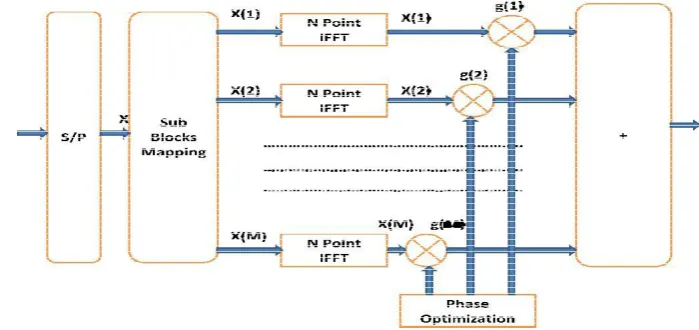
In the literature PTS is another popular PAPR reduction technique, it partitioned t he input data blocks into
dissimilar data blocks of N symbols then weighted these subcarriers diss imilar blocks with phase sequence. The
block diagram of PTS based OFDM system is shown in figure 5. PTS is described in papers [19] [2 0] [21] these
papers defined the PTS as it redu ces PAPR of combined (OFDM signal & dis similar data blocks) with proper
selection of phase factors. PTS system divides the X data blocks into dissimilar M sub data blocks as follow:
.
Figure 5: Block Diagram of PTS based OFDM system
4.1.3. TR (Tone Reservation)
A data block dependent time d omain signal is added to the original multi carrier signal at the transmitter end,
which reduces p eaks. In this technique transmitter does not send s mall subset of data for PAPR optimization
[22] [23]. The main goal is to find a proper time domain signal which
reduces PAPR. Lets a we have a frequency domain vector, and an original multi carrier signal, th en new time
domain signal will be the original signal and time domain signal must be disjoint, i.e. if then
This is good technique for PAPR reduction as not destroy Orthogonality but increase searching complexity of
time domain signal and band width wastage problem arises due to some unused subcarrier.
4.1.4. TI (Tone Insertion)
The main idea of this technique is to expand the constellation so that each point in the original constellation map
with several e quivalent points in the expanded constellation [22]. Thus we have some extra number of mapping
points which used for PAPR reduction. This techn ique increase complexity for finding the appropriate symbols
634 | P a g e
4.2. Adaptive Pre-distortion Technique
These techniques are described in papers [24] [25] [23] these techniques could reduce the high PAPR problem
of OFDM system or in other words compensates the non linear effects of HPA (High Power Amplifier).
Through automatic adjusting of the input constellation with the help of least hardware; the non linear HPA
deviation could be handled. The convergence time of pre-distorter and the MSE (Mean Square Error) can be
decreased through broadcasting techniques with the help of suitable training signal design.
4.3. Convex Optimization Technique
These techniques are described in papers [26] [27] [28]. These techniques the constellation errors and
constraints on permissible OOB (Out of Band) noise make a convex optimization problem. Some known
algorithms are used to achieve global optimal results with low complexity. With this technique first of all the
PAPR gain is defined then constraints are described for the transmitted OFDM symbol, which should be
detected by the receiver.
4.4. Coding Techniques
Coding techniques are popular techniques for PAPR reduction as these techniques does not initiate any OOB
radiation and IB distortion. These techniques are described in papers [29] [30] [31]. The disadvantages of
coding techniques are increased complexity in case subcarrier increased; and also if the code rate is reduced,
these techniques suffer from bandwidth efficiency.
4.5. Pre-Coding Techniques
The most popular and attractive techniques for PAPR reduction in OFDM and OFDMA based system. These
techniques are defined in papers [32] [33] [34] [35] [36] [37] [38] [39] [40]. Pre-coding based techniques
include: WHT (Walsh Hadamard Transform), DHT (Discrete Hartly Transform), DCT (Discrete Cosine
Transform), ZCT (Zadoff Cho Transform) etc. the description of these techniques are described in the below
section.
4.5.1. Walsh Hadamard Transform
This is an orthogonal linear transform and could be implemented as a butterfly structure of FFT. It means that
Hadamard Transform does not increase the system complexity. Mathematically Hadamard Transform [41] could
be written as:
are used in the pre-coding blo ck as a matrix A of dimensions. This matrix is multiplied with parallel data blo
cks before IFFT operation to reduce the correlatio n amongst all
sub carriers. IfTis a complex vector of size L after S/P bloc k, and a pre-
coder matrix A of size is multiplied with this matrix, the new vector o f size L could
be Y=AX= [Y0, Y1, Y2… YL-1] T, and Y is:, and
means mth row and lth column of matrix A. Now with N subcarriers complex base band signal is described as:
Pre-coding based techniques are merged with scrambling techniques, clipping tech niques, ACE etc to get best
635 | P a g e
V CONCLUSION
In this paper, a survey on PAP R reduction techniques has been discussed. Each technique of PAPR reduction in
OFDM bas ed system are different from each other and im pact different constraints e.g. bandwidth ex ansion,
OOB radiation, IB distortion, reductio n of spectral efficiency, BER reduction, high peak power, high average
power, and overall system complexity. This is concluded that Scram bling techniques give good performance
but it needs side information for receiver to recover original data block, also it increases complexity. Pre-coding
based techniques results good with no need of side information and works with less complexity. Hybrid
techniques Pre-coding plus other give best result for PAPR reduction.
VI FUTURE WORK
A survey paper on PAPR reduction in OFDM based system is presented in this paper. In future a Pre-coder will
be combined with any Scrambling technique and the system performance will be compared with already work
done for Next Generation Vehicular Ad-hoc Networks (NG-VANET).
REFERENCES
[1] Y.Wu and W. Y. Zou, "Orthogonal frequency division multiplexing: A multi-carrier modulation scheme,"
IEEE Trans. Consumer Electronics, vol. 42. no. 3, pp. 392-399, August 1995.
[2] W. Y. Zou and Y. Wu, "COFDM: An overview," IEEE Trans. Broadcasting, vol. 41 no.1, pp. 1-8, March
1995.
[3] JAE HONG LEE SEUNG HEE HAN, "AN OVERVIEW OF PEAK-TO-AVERAGE POWER RATIO
REDUCTION TECHNIQUES FOR MULTICARRIER TRANSMISSION," IEEE Wireless
Communications, pp. 56-65, April 2005.
[4] Yiyan Wu Tao Jiang, "An Overview: Peak-to-Average Power Ratio Reduction Techniques for OFDM
Signals," IEEE TRANSACTIONS ON BROADCASTING, VOL. 54, NO. 2, JUNE 2008, vol. 54, no.2,
pp. 257-268, June 2008.
[5] Jr L. J. Cimini, "Analysis and simulation of a digital mobile channel using orthogonal frequency division
multiplexing," IEEE Trans. Communication, vol. COM-33, no. 7, pp. 665-675, July 1985.
[6] Y. G. Li and G. Stüber, "Orthogonal Frequency Division Multiplexing for Wireless Communications,"
Boston, MA: Springer-Verlag, January 2006.
[7] Chenyang Yang,Gang Wu, Shaoqian Li, and Geoffrey Ye Li Taewon Hwang, "OFDM and Its Wireless
Applications: A Survey," IEEE TRANSACTIONS ON VEHICULAR TECHNOLOGY, vol. 58, NO. 4,
pp. 1673-1694, May 2009.
[8] R. O'Neill and L. B. Lopes, "Envelope Variations and Spectral Splatter in Clipped Multicarrier Signals ,"
IEEE Processing PIMRC 95 Toronto, Canada, pp. 71-75, September 1995.
[9] X. Li and Jr L. J. Cimini, "Effect of Clipping and Filtering on the Performance of OFDM," IEEE
636 | P a g e
[10] D. Kim and G. L. Stüber, "Clipping Noise Mitigation for OFDM by Decision–Aided Reconstruction,"IEEE Communication Letter, vol. 3, no. 1, pp. 4-6, January 1999.
[11] H. Saeedi, M. Sharif, and F. Marvasti, "Clipping Noise Cancellation in OFDM Systems Using
Oversampled Signal Reconstruction ," IEEE Communication Letter, vol. 6, no. 2, pp. 73-75, February
2002.
[12] Sungkeun Cha, Myonghee Park, Sungeun Lee, Keuk-Joon Bang, and Daesik Hong, "A new PAPR
reduction technique for OFDM systems using advanced peak windowing method," IEEE Transactions on
Consumer Electronics, , vol. 54, no. 2, pp. 405-410, May 2008.
[13] P. Foomooljareona nd W.A.C. Fernando, "PAPR Reduction in OFDM Systems," Thammasat Int. J. Sc.
Tech, vol. 7, no. 3, pp. 70-79, December 2002.
[14] Jiang Tao and Guangxi Zhu, "Nonlinear companding transform for reducing peak-to-average power ratio