Available online: http://internationaljournalofresearch.org/ P a g e | 1 0 9 9
On Characterization and Schedule Formation for
Transformative
tweet streams
M r. Y.M ADHU SEKHAR
Associat e Professor Dep art ment of CSE
M rs. P.SHIREESHA
M .T ech in Comp ut er Science Dep art ment of CSE M alla Reddy Institute of Technology, Maisammaguda, Dhulapally Post, Secunderabad and Telengana State, India.
Abstract:
Brief-textual content messages which include tweets are being created and shared at an unheard of charge. Tweets, in their uncooked form, whilst being informative, can also be overwhelming. For each give up-users and facts analysts, it's far a nightmare to plow through thousands and thousands of tweets which include great quantity of noise and redundancy. On this paper, we advocate a unique continuous summarization framework referred to as Sumblr to relieve the hassle. In contrast to the traditional file summarization methods which attention on static and small-scale records set, Sumblr is designed to cope with dynamic, rapid arriving, and massive-scale tweet streams. Our proposed framework includes three important additives. First, we advocate an online tweet move clustering algorithm to cluster tweets and hold distilled data in a information structure called tweet cluster vector (TCV). Second, we increase a TCV-Rank summarization technique for generating online summaries and historic summaries of arbitrary time periods. 1/3, we layout an effective subject matter evolution detection technique, which monitors summary-based totally/extent-based totally versions to provide timelines routinely from tweet streams. Ourexperiments on huge-scale real tweets exhibit the performance and effectiveness of our framework. In d ex terms —Tweet move, continuous summarization, summary, timeline
Available online: http://internationaljournalofresearch.org/ P a g e | 1 1 0 0
including numerous sentences. Intuitively, a terrific summary need to cowl the principle subjects (or subtopics) and feature variety a few of the sentences to reduce redundancy. Summarization is extensively utilized in content material presentation, specifically while customers surf the internet with their mobile devices that have tons smaller monitors than computers. conventional record summarization techniques, but, aren't as effective within the context of tweets given each the huge extent of tweets as well as the quick and non-stop nature of their arrival. Tweet summarization, therefore, calls for functionalities which appreciably differ from traditional summarization. In fashionable, tweet summarization has to take into consideration the temporal function of the arrival tweets. let us illustrate the desired houses of a tweet summarization device the use of an illustrative instance of a usage of such a machine. bear in mind a consumer interested by a subject-associated tweet stream, for example, tweets about “Apple”. A tweet summarization system will continuously monitor “Apple” associated tweets generating a real-time timeline of the tweet circulation. As illustrated in Fig. 1, a consumer might also discover tweets based on a timeline (e.g., “Apple” tweets posted among October 22nd, 2012 to November 11th, 2012). Given a timeline range, the summarization system may additionally produce a collection of timestamped summaries to highlight factors in which the subject/subtopics developed within the movement. any such machine will efficaciously enable the consumer to analyze fundamental news/ dialogue related to “Apple” while not having to study via the entire tweet circulate. Given the huge photograph approximately subject matter evolution approximately “Apple”, a consumer may additionally decide to zoom in to get a greater targeted
Available online: http://internationaljournalofresearch.org/ P a g e | 1 1 0 1
information sets and records streams. (2) to offer summaries of arbitrary intervals, they will must carry out iterative/recursive summarization for every viable time period, that's unacceptable. (3) their summary consequences are insensitive to time. for that reason it is hard for them to stumble on subject matter evolution . in this paper, we introduce a novel summarization framework referred to as sumblr (non-stop summarization by means of circulation clustering). to the first-rate of our expertise, our work is the first to study continuous tweet move summarization. the general framework is depicted in fig. 2. the framework includes 3 foremost additives, specifically the tweet flow clustering module, the high-level summarization module and the timeline technology module. within the tweet movement clustering module, we design an green tweet flow clustering algorithm, an online set of rules taking into account powerful clustering of tweets with only one skip over the records. this algorithm employs two information systems to keep critical tweet facts in clusters. the primary one is a novel compres sed shape referred to as the tweet cluster vector (tcv). tcvs are taken into consideration as potential sub-subject matter delegates and maintained dynamically in reminiscence at some stage in flow processing. the second one shape is the pyramidal time body (ptf), which is used to shop and organize cluster snapshots at distinctive moments, accordingly permitting ancient tweet facts to be retrieved by means of any arbitrary time intervals. the high-level summarization module helps era of forms of summaries: on-line and historic summaries. (1) to generate on-line summaries, we advise a tcv-rank summarization set of rules through regarding the cutting-edge clusters maintained in reminiscence. this set of rules first computes centrality rankings for tweets kept in tcvs, and
selects the top-ranked ones in terms of content material coverage and novelty. (2) to compute a historical summary in which the consumer specifies an arbitrary
Available online: http://internationaljournalofresearch.org/ P a g e | 1 1 0 2
snapshots, the tcv-rank summarization algorithm is carried out to generate summaries. the core of the timeline technology module is a topic evolution detection algorithm, which consumes on line/ancient summaries to provide real-time/variety timelines. The set of rules video display units quantified version all through the direction of circulation processing. a large variant at a selected second implies a sub-subject matter alternate, leading to the addition of a brand new node on the timeline. in our layout, we don't forget 3 various factors respectively within the set of rules. first, we don't forget variation inside the primary contents discussed in tweets (inside the shape of precis). to quantify the summarybased version (sum), we use the jensen-shannon divergence (jsd) to measure the gap between two word distributions in two successive summaries. 2nd, we reveal the volume-based totally variation (vol) which reflects the significance of sub-topic adjustments, to find out rapid will increase (or “spikes”) in the extent of tweets over the years. third, we define the sum-vol variant (sv) by way of combining each results of summary content material and significance, and come across topic evolution each time there is a burst in the unified variant. the main contributions of this work are as follows: we endorse a non-stop tweet circulation summarization framework, namely sumblr, to generate summaries and timelines inside the context of streams. we design a unique records structure referred to as tcv for flow processing, and advise the tcv-rank set of rules for on-line and historical summarization. we endorse a topic evolution detection set of rules which produces timelines by means of tracking three types of versions. Big experiments on actual twitter statistics sets show the efficiency and effectiveness of our framework.
2 RELATED WORK:
In this section, we review the related work including
stream data clustering, document/microblog
summarization, timeline detection, and other microblog mining tasks.
Circulate facts Clustering:
Available online: http://internationaljournalofresearch.org/ P a g e | 1 1 0 3
tweet stream clustering algorithm is an online procedure without greater offline clustering. And inside the context of tweet summarization, we adapt the web clustering segment by way of incorporating the brand new structure TCV, and proscribing the number of clusters to assure performance and the high-quality of TCVs.
File/Microblog Summarization:
filesummarization may be classified as extractive and
abstractive. the previous selects sentences from the files, even as the latter may also generate terms and sentences that don't appear in the unique files. in this
paper, we consciousness on extractive summarization.
Extractive record summarization has acquired a lot of current attention. maximum of them assign salient
scores to sentences of the documents, and pick the
top-ranked sentences. a few works attempt to extract
summaries without such salient scores. Wang et al.
used the symmetric non-bad matrix factorization to
cluster sentences and pick out sentences in each cluster
for summarization. He et al. proposed to summarize
documents from the attitude of data reconstruction, and
pick sentences that can excellent reconstruct the
authentic files. Xu et al. modeled documents (resort critiques) as multi-characteristic uncertain records and
optimized a probabilistic coverage trouble of the precis.
at the same time as record summarization has been studied for years, microblog summarization is still in its
infancy. Sharifi et al. proposed the phrase
Reinforcement algorithm to summarize tweet posts the
use of a single tweet. Later, Inouyeand Kalita proposed
a Hybrid TF-IDF algorithm and a Cluster- primarily
based set of rules to generate more than one post
summaries
.
Harabagiu and Hickl leveraged tworelevance models for microblog summarization: an
occasion structure version and a person behavior
version. Takamura et al. proposed a microblog
summarization method primarily based on the pmedian problem, which takes posted time of microblogs into
consideration. lamentably, nearly all current document/
microblog summarization methods specifically cope
with small and static records sets, and rarely pay
attention to performance and evolution issues.
There have additionally been researched on summarizing microblogs for a few specific kinds of activities, e.g., sports events. Shen et al. proposed to become aware of the members of occasions, and generate summaries based totally on sub-activities detected from every participant. Chakrabarti and Punera introduced a solution by learning the underlying hidden nation representation of the occasion, which wishes to examine from previous activities (football video games) with similar shape. Kubo et al. summarized activities by means of exploiting “excellent journalists”, depending on event-unique key phrases which want to take delivery of in enhance. In contrast, we intention to address fashionable subject matter-relevant tweet streams with out such earlier understanding. Furthermore, their technique shops all the tweets in every phase and selects a unmarried tweet as the precis, even as our technique maintains distilled data in TCVs to lessen garage/ computation value, and generates more than one tweet summaries in phrases of content coverage and novelty. further to on line summarization,
our method additionally supports ancient
summarization by way of retaining TCV snapshots.
Available online: http://internationaljournalofresearch.org/ P a g e | 1 1 0 4
The demand for studying massive contents in social medias fuels the trends in visualization strategies. Timeline is this type of techniques which can make analysis responsibilities less complicated and faster. Diakopoulos and Shamma made early efforts in this place, the usage of timelines to explore the 2008 Presidential Debates through Twitter sentiment. Dork et al. supplied a timeline-based totally backchannel for conversations around events.
Yan et al. proposed the evolutionary timeline summarization (ETS) to compute evolution timelines similar to ours, which includes a series of time-stamped summaries. However, the dates of summaries are decided through a pre-defined timestamp set. In contrast, our approach discovers the converting dates and generates timelines dynamically all through the process of non-stop summarization. Furthermore, ETS does not focus on efficiency and scalability problems, which are very essential in our streaming context. Several systems hit upon important moments when rapid increases or “spikes” in status update quantity show up. TwitInfo evolved an set of rules based on TCP congestion detection, even as Nichols et al. employed a slope-based totally approach to locate spikes. After that, tweets from each moment are recognized, and word clouds or summaries are decided on. Special from this two-step technique, our approach detects subject matter evolution and produces summaries/timelines in an on line style.
Different Microblog Mining
obligations:
The emergence of microblogs hasengendered researches on many different mining
obligations, together with topic modeling, storyline era
and occasion exploration. most of these researches
focus on static facts units alternatively of statistics
streams.For twitter move evaluation, Yang et al.
studied frequent pattern mining and compression. Van
Durme aimed at discourse contributors type and used
genderprediction as the example mission, which is also
a one-of-a-kind trouble from ours.To sum up, on this
work, we advocate a brand new problem referred to as
continuous tweet summarization. Exclusive from
precedingresearch, we aim to summarize
massive-scale and evolutionary tweet streams, generating
summaries and timelines in an online fashion.
3 PRELIMINARIES:
In this phase, we first present a statistics model for tweets, then introduce two crucial information structures: the tweet cluster vector and the pyramidal time body.
Tweet representation:
normally, a document isAvailable online: http://internationaljournalofresearch.org/ P a g e | 1 1 0 5
user have an impact on, we construct a matrix based on
social relationships among users, and compute the
UserRank. As a end result, we outline a tweet ti as a tuple: ðtvi; tsi; wiÞ, where tvi is the textual vector, tsi is
the published timestamp and wi is the UserRank price
of the tweet’s writer.
Tweet Cluster Vector:
All through tweetcirculation clustering, it's miles necessary to keep facts for tweets to facilitate summary generation. In this segment, we endorse a new statistics shape referred to as tweet cluster vector, which keeps information of tweet cluster.
From the definition, we can derive the vector of cluster centroid (denoted as cv)
Pyramidal Time Frame:
To support summarization over user-defined time durations, it is crucial to store the maintained TCVs at particular moments, which are called snapshots. While storing snapshots at every moment is impractical due to huge storage overhead, insufficient snapshots make it hard to recall historical information for different durations. This dilemma leads to the incorporation of the pyramidal time frame:
Available online: http://internationaljournalofresearch.org/ P a g e | 1 1 0 6
4 THE SUMBLR FRAMEWORK:
As proven in Fig. 2, our framework consists of 3 predominant modules: the tweet circulate clustering module, the high-level summarization module and the timeline era module. on this segment, we shall present every of them in detail.
Tweet Circulate Clustering:
The tweet move clustering module maintains the online statistical statistics. Given a subject-based totally tweet circulation, it is able to effectively cluster the tweets and maintain compact cluster statistics.
Initialization: O
n the begin of the movement, weaccumulate a small range of tweets and use a k-means
clustering algorithm to create the initial clusters. The
corresponding TCVs are initialized according to
Definition 1. subsequent, the movement clustering
manner starts to incrementally update the TCVs
whenever a new tweet arrives.
Incremental Clustering:
Suppose a tweet tarrives at time ts, and there are N energetic clusters at that point. the important thing trouble is to decide
whether or not to absorb t into one of the present day
clusters or improve t as a new cluster. We first locate
the cluster whose centroid is the closest to t.
particularly, we get the centroid of each cluster based totally on Equation (1), compute its cosine similarity to t, and locate the cluster Cp with the largest similarity (denoted as MaxSim (t). note that although Cp is the closest to t, it does not suggest t certainly belongs to
Cp. The purpose is that t may additionally still be very
distant from Cp. In such case, a brand new cluster need
to be created. The decision of whether to create a new
cluster can be made with the following heuristic.
During incremental clustering, assume there are N active clusters, the computational cost of finding the closest cluster for every new tweet is O(N2), where d is
Available online: http://internationaljournalofresearch.org/ P a g e | 1 1 0 7
Then the total cost is O(N2) m(d). Because m and d are
static, the computational cost depends on N. Similarly, the storage costs in disk (TCV snapshots) and memory (current TCVs) also depend on N.
Given the above analysis, we need to restrict the number of active clusters. We achieve this goal via two operations: deleting outdated clusters and merging similar clusters. Since the computational complexity of deletion is O(N) and that of merging is O(N2), we use
the former method for periodical examination and use the latter method only when memory limit is reached.
Deleting old Clusters:
For maximum occasions (such as information, soccer fits and live shows) in tweet streams, timeliness is critical due to the fact theytypically do no longer last for a long term. therefore it is safe to delete the clusters representing these sub-subjects after they
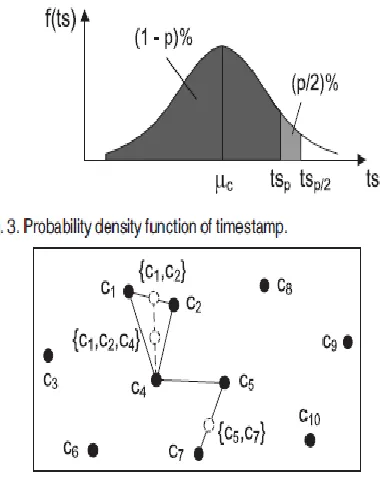
are rarely mentioned. To find out such clusters, an intuitive manner is to estimate the average arrival time (denoted as Avgp) of the closing p percentage of tweets
in a cluster. but, storing p percent of tweets for every
cluster will increase reminiscence fees, in particular while clusters develop big. for that reason, we appoint an approximate approach to get Avgp.
Merging Clusters:
If the number of clusters keeps increasing with few deletions, system memory will be exhausted. To avoid this, we specify an upper limit for the number of clusters as Nmax. When the limit is reached, a merging process starts.
Fig. 4 shows a running example of the process. For ease of presentation, we use cluster centroids (the black solid points) to represent clusters and use euclidean distance instead of cosine distance.
Available online: http://internationaljournalofresearch.org/ P a g e | 1 1 0 8
The high-level summarization module provides two types of summaries: online and historical summaries.
An online summary describes what is currently discussed among the public. Thus, the input for generating online summaries is retrieved directly from the current clusters maintained in memory.
TCV-Rank Summarization Algorithm:
Given an input cluster set, we denote its corresponding TCV set as D(c). A tweet set T consists of all the tweets in the ft sets in D(c). The tweet summarization problem is to extract k tweets from T, so that they can cover as many tweet contents as possible.From the geometric interpretation, our summarization tends to select tweets that span the intrinsic subspace of candidate tweet space, such that it can cover most information of the whole tweet set.
However, a potential problem of LexRank is that some top-ranked tweets may have similar contents. Fortunately, since the tweets are retrieved from TCVs, they have got inherent cluster information. Hence, we choose one tweet with the highest LexRank score from each TCV, and add tweet t into the summary (lines 4-9)
according to:
Timeline Generation:
The core of the timeline generation module is a topic
evolution detection algorithm which produces real-time and range timelines in a similar way. We shall only describe the real-time case here.
Available online: http://internationaljournalofresearch.org/ P a g e | 1 1 0 9
moment implies a sub-topic change, which is a new node on the timeline.
Precise-primarily based variant:
As tweets arrive from the move, online summaries are produced continuously by way of making use of online cluster information in tcvs. this permits for generation of a actual-time timeline. usually, while an apparent variant occurs within the main contents discussed in tweets (inside the shape of precis), we
can assume a change of sub-topic (i.e., a time node at the timeline).
In step with this summary-based totally variation, we determine whether or not the modern time is a sub-subject matter changing node by way of
that is, we hit upon sub-topic modifications every time there's a burst in distances between successive summaries.
Extent-primarily based version:
Though the summary-primarily based variant can reflect sub-topic modifications, a number of them may
not be influential enough. when you consider that many tweets are related to customers’ daily life or trivial activities, a sub-subject matter exchange detected from textual contents might not be sizable sufficient. to this cease, we consider using fast increases (or “spikes”) within the volume of tweets over time, that is a common method in current online event detection structures. A spike indicates that something crucial simply happened due to the fact many humans determined the want to comment on it.
in this element, we increase a spike-locating approach. As the enter, the binning method in algorithm three wishes to rely the tweet arrival quantity in each time unit. all through the flow generation, the main spike detection logic is:
then suggest and mean deviation are up to date with each new bin remember. to alter to changing tweet frequency traits in a streaming context, we preserve exponentially weighted shifting imply and mean deviation (we set g = zero:125 as in [25]):
Available online: http://internationaljournalofresearch.org/ P a g e | 1 1 1 0
The above spike-finding approach may match properly for short term events inclusive of football fits, but it might be difficult for them to handle lengthy-time period subject matter-associated streams, due to a
while-aware human behaviors in social media. For example, the quantity of tweet posts2 and public engagement rate3 will fluctuate in day of week or time of day. moreover, breaking news or rumors commonly draw huge interest and create big spikes in tweet volumes. these spikes will extensively growth the suggest and suggest deviation values, decreasing the chance for subsequent sub-topic adjustments being detected (equation (6)).
Now we are able to decide whether or not the modern-day time is a subtopic changing node by
DISCUSSION:
Coping with noises. the impact of clusters of noises may be dwindled by using manner in sumblr. first, in tweet stream clustering, noise clusters which are not updated regularly will be deleted as previous clusters. 2nd, inside the summarization step, tweets from noise clusters are a long way much less probably to be
decided on into summary, due to their small lexrank scores and cluster sizes.
5 EXPERIMENTS:
In this segment, we examine the overall performance of Sumblr. We gift the experiments for summarization and timeline generation respectively.
5.1 Experiments for Summarization:
Setup:
Information sets. We assemble fiveinformation sets to evaluate summarization. One is
obtained by engaging in keyword filtering on a massive
Twitter facts are set to be used. The alternative 4
include tweets obtained at some point of one month in
Available online: http://internationaljournalofresearch.org/ P a g e | 1 1 1 1
social networks for these 4, we set their weights of tweets wi to the default price of one. Information of the statistics units are indexed.
Ground facts for summaries:
As noprevious paintings has carried out comparable examine
on non-stop summarization, we need to build our very
own ground truth (reference summaries). but, guide
introduction of these summaries is seemingly
impractical due to the massive size of the information sets. For this reason, we appoint a -step method to acquire fair-first-rate reference summaries: 1) Given a time length, we first retrieve the corresponding tweet subset, and use the following three properly-recognized summarization algorithms to get three candidate
Summaries:
Cluster Sum clusters the tweets andalternatives the most weighted tweet from every cluster
to shape precis. LexRank first builds a sentence
similarity graph, and then selects crucial sentences
based on the concept of eigenvector centrality. DSDR
fashions the relationship among sentences using linear
reconstruction, and finds an foremost set of sentences to approximate the original documents, by minimizing the reconstruction error
To evaluate the metric on a continuous time period [T0; T], we need to calculate the indispensable of the metric over the length, that is given through
Available online: http://internationaljournalofresearch.org/ P a g e | 1 1 1 2
strategies. therefore, we will simplest report the F-score outcomes to shop area. The F-rating effects provided are averaged on all 5 data units.
Ordinary performance comparison:
In this segment, we compare the F-scores and runtime costs between Sumblr and three baseline algorithms (sliding window version). As tweets are often produced very fast and reach a massive extent in a quick whilst, it's far hardly ever meaningful to summarize a small number of tweets. Thus the window length ought to be a fantastically massive one. In this experiment, we set window length to 20,000 and sampling c programming language to 2,000. The step size varies from 4,000 to 20,000.
The metrics are averaged over the entire flow.
Scalability:
The scalability test evaluates theefficiency results of a single window, even as various the window size. It simulates the case of a massive burst of tweets in a quick period. Fig. eight presents the scalability outcomes for distinct methods.
Parameter Tuning:
On this segment, we songthe parameters in our technique. In every of the
following experiments, we range one parameter and
keep the others fixed.
Flexibility
One distinguishing characteristic of Sumblr is the power to summarize tweets over arbitrary time intervals. this option is supplied with the aid of incorporating the PTF. The effectiveness of PTF depends on a and l (segment 3.3). We restore a at 2 and display the outcomes varying l. For consistency, we extract a subset of 1-month duration from each facts set because the enter circulate. The c program languageperiod between two successive snapshots (timestamp unit) is one hour. For a timestamp ts , we evaluate the effects for exclusive periods with duration len varying from 1 to 10 days.
Fig. 10 gives the following observations:
Available online: http://internationaljournalofresearch.org/ P a g e | 1 1 1 3
intervals have higher precis nice. this is due to the fact PTF has finer granularity of snapshots for more recent moments. As a result, the queried periods can be higher approximated. A bigger l ends in higher standard first-class. Due to large capacity of each order, PTF with a larger l is able to hold extra snapshots, and for this reason produce greater correct approximation for the queried intervals.
lamentably, a larger l additionally requires more garage value (the numbers inside the parentheses represent the
amounts of snapshots in PTF). that is apparent on the grounds that it allows PTF to save more snapshots, which ends in heavier storage burden.
Results:
Our goal is to stumble on nodes within the reference timeline as the circulate proceeds. We compare performance of the topic evolution detection set of rules the usage of 3 one-of-a-kind versions in section 4.three, i.e., precis-primarily based variant, volume based variation and sum-vol version. We present precision, consider, and F-score of the timeline nodes detected by
means of these methods. on account that similar developments are discovered in all 4 facts sets, right
here we most effective show consequences for the largest data set Chelsea 2013 to save area. outcomes for other facts sets are also available.
Available online: http://internationaljournalofresearch.org/ P a g e | 1 1 1 4
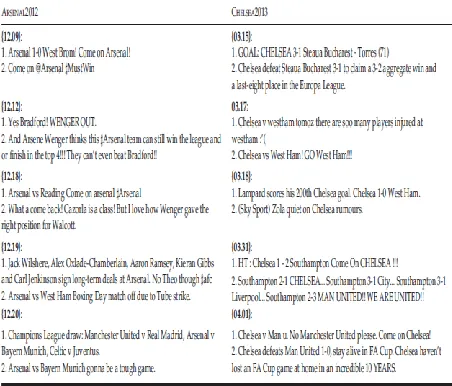
TABLE 5 Selected Part of Timelines for “Arsenal2012” (Left) and “Chelsea2013” (Right)
6. CONCLUSION:
We proposed a prototype called Sumblr which supported continuous tweet stream summarization. Sumblr employs a tweet stream clustering algorithm to compress tweets into TCVs and maintains them in an online fashion. Then, it uses a TCV-Rank
summarization algorithm for generating online
summaries and historical summaries with arbitrary time durations. The topic evolution can be detected automatically, allowing Sumblr to produce dynamic timelines for tweet streams. The experimental results demonstrate the efficiency and effectiveness of our method. For future work, we aim to develop a multi-topic version of Sumblr in a distributed system, and evaluate it on more complete and large-scale data sets.
REFERENCES:
[1] C. C. Aggarwal, J. Han, J. Wang, and P. S. Yu, “A framework for clustering evolving data streams,” in Proc. 29th Int. Conf. Very Large Data Bases, 2003, pp. 81–92.
[2] T. Zhang, R. Ramakrishnan, and M. Livny, “BIRCH: An efficient data clustering method for very large databases,” in Proc. ACM SIGMOD Int. Conf. Manage. Data, 1996, pp. 103–114.
[3] P. S. Bradley, U. M. Fayyad, and C. Reina, “Scaling clustering algorithms to large databases,” in Proc. Knowl. Discovery Data Mining, 1998, pp. 9–15.
[4] L. Gong, J. Zeng, and S. Zhang, “Text stream clustering algorithm based on adaptive feature selection,” Expert Syst. Appl., vol. 38, no. 3, pp. 1393– 1399, 2011.
[5] Q. He, K. Chang, E.-P. Lim, and J. Zhang, “Bursty feature representation for clustering text streams,” in Proc. SIAM Int. Conf. Data Mining, 2007, pp. 491– 496.
[6] J. Zhang, Z. Ghahramani, and Y. Yang, “A probabilistic model for online document clustering with application to novelty detection,” in Proc. Adv. Neural Inf. Process. Syst., 2004, pp. 1617–1624.
Available online: http://internationaljournalofresearch.org/ P a g e | 1 1 1 5
M r. Y.MADHU SEKHAR was born in India in t he y ear of
1982. He received B.Tech degree in the year of 2003 & ; M .Tech PG in the year of 2008 from JNTUH. He was exp ert in Principles of Programming Language, Design and analysis of Algorithms, Operating Systems, C Programming, Dat a St ructures and Cloud Computing subjects. He is current ly working as An
Associate Professor in the CSE Department in Malla Reddy Institute of Technology, Maisammaguda, Dhulap ally Post , Secunderabad, T elengana St at e, India.
M ail id : madhuy [email protected]
M rs. P.SHIREESHA was born in India . She p ursuing M .Tech degree in Computer Science & Engineering in CSE Department in Malla Reddy Institut e of T echnology , M aisammaguda, Dhulap ally Post , Secunderabad and T elengana St at e, India.