CSEIT1831473 | Received : 16 Feb 2018 | Accepted : 28 Feb 2018 | January-February-2018 [(3) 2 : 166-173 ]
International Journal of Scientific Research in Computer Science, Engineering and Information Technology © 2018 IJSRCSEIT | Volume 3 | Issue 2 | ISSN : 2456-3307
166
Evolutionary Multi-Objective Optimization Algorithm for
Software Modeling
1
P. Sireesha,
2M. Sarada
1PG Student, Department of MCA, St. Ann’s College of Engineering & Technology, Chirala, Andhra Pradesh, India 2Assistant Professor, Department of MCA, St. Ann’s College of Engineering & Technology, Chirala, Andhra
Pradesh, India
ABSTRACT
In this paper, we propose the use of preference-based evolutionary multi-objective optimization techniques (P-EMO) to address different software demonstrating challenges. P-EMO permits the fuse of decision maker (i.e., designer) preferences (e.g., quality, rightness, and so forth.) in multi-objective optimization methods by confining the Pareto front to a locale of intrigue facilitating the basic leadership errand. We examine the extraordinary difficulties and potential advantages of P-EMO in software modeling. We report investigates the utilization of P-EMO on an understood modeling issue where extremely encouraging outcomes are obtained. Keywords : Search-Based Software Engineering, User-Preferences, Multi-Objective Optimization, Evolutionary Computation, Modeling.
I.
INTRODUCTION
Software modeling considers models as top of the line ancient rarities amid the product lifecycle. The quantity of accessible devices, systems, and methodologies for demonstrating is expanding along with the developing significance of demonstrating in
software development. Software models,
characterized as code reflections, are iteratively refined, rebuilt and advanced for some reasons, for example, reflecting changes in prerequisites, adjusting errors in outline, and changing a plan to improve existing highlights. Hence, compelling strategies to configuration, develop, test and comprehend models are required. Search-based software engineering (SBSE) ponders the utilization of meta-heuristic improvement systems to software designing issues. The term SBSE was first utilized by Harman and Jones in 2001. Once a product designing undertaking is encircled as a query issue, by characterizing it regarding solution portrayal, objective work, and solution change administrators,
fashioners’ conclusions. Besides, because of this subjective nature of modeling issues, it is now and then hard to decide the relative significance of every objective, particularly if the number of objectives turns out to be high. For instance, to evaluate the
nature of an outline, distinctive quality
measurements can be utilized where everyone can be considered as a different goal.
II.
Preference-Based Multi-Objective
Optimization for Software Modeling:
Challenges and Benefits
In this section, we initially give the vital foundation on multi-objective procedures and talk about the significance of consolidating user preferences amid the optimization procedure. At that point, we show the difficulties and advantages of applying preference based multi-objective algorithms to software modeling issues.
Multi-Objective Optimization A multi-objective optimization issue (MOP) comprises of limiting or augmenting objective works under a few imperatives. The determination of a MOP yields a solution of exchange off solutions, called Pareto ideal solutions or non-commanded solutions, and the picture of this set in the objective space is called the Pareto front. Subsequently, the determination of a MOP comprises of approximating the entire Pareto front. The thing to ask at this stage is "the thing that completes a wonderful trade off solution mean?" at the end of the day, by what means can the Decision Maker (DM) be fulfilled? To be sure, the determinations of a specific MOP offers ascend to a solution of Pareto-equal solutions called the non-overwhelmed/exchange off/bargain solution set. As a rule, a great estimation of the Pareto front is made out of countless proportional solutions appropriated equitably finished the Pareto front and it is doing the DM to pick the last solution. The ordinary extensive cardinality of the non-commanded solution set makes the basic leadership assignment exceptionally troublesome. These issues are tended to in the following area.
Preference based Multi-Objective Optimization As of late, have commented that the objectives in MOPs generally are not similarly critical from the DM's perspective. Subsequently, the DM isn't such a great amount of inspired by approximating the whole Pareto front, yet rather the bit of the front that fulfills his/her preferences, called the Region Of Intrigue (ROI). Figure 1 outlines a subjective picked ROI for an exemplified front for a bi-objective issue; it is clearly not helpful to give the DM an estimation of the whole Pareto front when he/she is intrigued just in his/her ROI. Distinctive inspirations exist for joining DM preferences in multi-objective systems. Right off the bat, limiting the Pareto front to a ROI settles on the basic leadership undertaking less demanding. Besides, looking for a ROI is substantially less computationally costly than approximating the whole Pareto front. At long last, when the quantity of objectives surpasses three, the MOP is called many-target issue. This kind of issue is difficult to understand since the high dimensionality of the objective space significantly builds the issue trouble.
This perception can be clarified by the following reasons:
(1) the Pareto strength is not any more capable to separate between objective vectors, along these lines most Pareto-based algorithm practices debase into arbitrary search with the expansion of the quantity of destinations,
(2) the objective space dimensionality increments essentially which makes promising pursuit bearings elusive, and
(3) the number of solutions required to give an all around secured and all around differentiated estimation of the Pareto front increments drastically with the expansion of the objective space dimensionality.
non-overwhelmed solutions is around 62 500, 1 953 125, and 1 708 984 375, individually. A few basic leadership preferences demonstrating devices have been proposed in the Preference-based Evolutionary Multi- objective Optimization (P-EMO) writing, for example, Weighting coefficients: Each goal is doled out a weighting coefficient communicating its significance. The bigger the weight is, the more essential the goal is; Reference point (too called an objective or a yearning level vector): The DM supplies, for every goal, the coveted level that he/she wishes to accomplish. This coveted level is called yearning level; and Attractive quality limits: The DM supplies:
(1) a totally fulfilling objective esteem and
(2) an imperceptibly infeasible objective esteem. These edges speak to the parameters that characterize the Desirability Functions (DFs).
Fig. 1: Illustration of an example of a ROI on an optimal Pareto front.
The DM's preferences can be incorporated in three ways:
(1) a priori: where the preferences are infused before the start of the inquiry,
(2) a posteriori: where the preferences are utilized after the finish of the query to pick the last solution from the provided set of trade off solutions, and (3) intelligently: where the preferences are infused amid the search in an intelligent way.
A few P-EMO algorithms have been proposed in the EMO writing: The majority of these algorithms utilize the reference point as a preference demonstrating instrument, for example, r-NSGA-II. In reality, the reference point has a few benefits versus the other preference modeling instruments.
Initially, the outflow of a reference point on a specific multi-objective issue requires a constrained exertion from the DM. This favorable position applies likewise to the refresh task amid the intuitive run. Besides, when utilizing a reference point, the DM can undoubtedly confirm outwardly regardless of whether the acquired outcomes compare to his/her preferences (i.e., regardless of whether they got non-overwhelmed solutions are near his/her reference point. At last, the reference point is the one of a kind preference demonstrating device that can be pictured on the gotten solution plot in any case the quantity of objectives (e.g., for the bi-/tri-objective case, we utilize the 2D/3D plot and for higher number of goals, we utilize the parallel organize plot.). To whole up, the reference point is by all accounts a promising.
Advantages, Challenges and Problems in Preference based Software Modeling: As indicated by a current review by Harman et al.; most existing SBSE work regards SE issues as mono-objective. Be that as it may, since SE issues are ordinarily multi-objective by
nature, as of late unique multi-objective
about the hazardous of coordinating user preferences in multi-objective SBSE, but instead the hazardous of the many-objective determination of SE issues. Actually, the authors examine the significance of thinking about in excess of three objectives to illuminate SBSE issues. Such hazardous is called "many-objective optimization" and not "preference based multi-objective optimization" in the EMO people group. The authors said “we exhibit how prevalent algorithms, for example, NSGA-II and SPEA2 wind up futile as we increment the quantity of goals, an outcome that was appeared in different areas however never before in software designing". Therefore, the fundamental commitment of this paper is taking care of SE issues in the nearness of in excess of three objectives (that we can call many- objective SBSE issues) and not the fuse of user preferences in multi-objective SBSE. Without a doubt, the Pareto strength is inadequate in looking at between the distinctive objective capacities when the quantity of objectives surpasses four since it considers neither the number of changes nor the amount of every change between sets of objectives. Therefore, predominance based EMO algorithms act like irregular look for the many- objective case which isn't the situation for pointer based algorithms where the ecological determination depends on an execution metric, for example, SMS-EMO, IBEA, and so forth. We trust that P-EMO algorithms are extremely appropriate for most software modeling issues. Actually, modeling is an extremely subjective process and hard to completely computerize due to the requirement for connection with the user. What's more, a high number of destinations ought to be fulfilled for most modeling issues. We recognize in this paper some modeling issues that can profit from P-EMO algorithms. Model refactoring: demonstrate refactoring comprises of enhancing the plan nature of frameworks by recognizing and settling “awful stenches" utilizing refactoring activities, (for example, the move strategy, extricate class, and so forth.). Not at all like software bugs, there is no broad agreement on the best way to choose if a specific outline disregards a quality
heuristic. There is a contrast between distinguishing side effects and affirming that the recognized circumstance is a real awful stench. Terrible stenches are for the most part portrayed utilizing common dialect and their discovery depends on the understanding of the designers. Undoubtedly, unique specialists can have disparate feelings while recognizing indications for a similar terrible stench type. Generally speaking, assessing the nature of a plan is subjective. In this way, consolidating DM (fashioner/master) preferences can address distinctive quality change objectives amid the location process. These destinations can be detailed in wording of value measurements which implies that the quantity of objectives can be high. Numerous planners can indicate unique reference/perfect focuses relying upon their preferences. Another issue in show refactoring is that distinguishing many terrible stench events in a framework isn't generally useful, with the exception of if the rundown of imperfections is arranged by need. Notwithstanding the nearness of false positives that may make a dismissal response from development groups, the way toward utilizing the identified records, understanding the deformity hopefuls, choosing the genuine positives, and amending them, is long, costly, and not continuously beneficial. Be that as it may,
A. Model Transformation Challenges The
The source and objective models must comply with particular meta- models and, as a rule, moderately complex change rules are characterized to guarantee this. In this area, we underline the inspiration of joining user preferences and extraordinary goals while mechanizing model change. Characterizing change administers: The way toward characterizing administers physically for demonstrate change is intricate, time- expending and mistake inclined. In this manner, we have to characterize a robotized answer for create controls naturally rather than physically. One solution is to propose a semi-robotized approach for run age keeping in mind the end goal to help the architect. In the greater part of existing methodologies, the guidelines are created from traceability joins interrelating distinctive source and objective demonstrate cases. Be that as it may, characterizing follows is a critical errand since they are physically characterized. Creating change principles can be troublesome since the source and objective dialects may have components with various semantics; along these lines, 1-to-1 mappings are not frequently adequate to express the semantic equality between meta-show components. To be sure, what's more to guaranteeing auxiliary (static) intelligence, the change should ensure behavioral intelligence as far as time limitations and feeble sequencing. Furthermore, different run the show blend conceivable outcomes might be utilized to change between the same source and objective dialects, prompting the inquiry: how to pick between various conceivable run blends having a similar rightness? Another confinement is identified with the subjective nature of a few changes. Specialists may have unique feelings on the change of a few components. For instance, even in the outstanding instance of class graph to information bases change, a few planners propose to delineate speculation interface between two classes as two tables related by an outside key, while others recommend making a solitary table linking data from the two classes. In this manner, an approach is required to mull over disparate master preferences. Lessening change multifaceted nature: when all is said in done, the
dominant part of existing change approaches creates change rules without mulling over unpredictability (yet just accuracy). In such circumstances, applying these standards could create vast objective models, it is hard to test complex standards and identify/adjust change errors, and it is a particular assignment to advance complex standards (changing the change instrument) when the source or objective Meta- models are altered. Some change approaches propose
to refractor the principles subsequent to
Complexity: , where n(S) is the number of rules of S and m(S) is the number of meta- model elements that S contains.
Quality:
We take note of that we favor esteems that are as close as conceivable to one of the two limits, regardless of whether or not these qualities have a place with the interim characterized by the two edges. Proposes diverse measurements to evaluate the nature of social diagrams, for example, Depth of Relational Tree of a table T (DRT(T)) which is characterized as the longest referential way between tables, from the table T to some other table in the diagram database; Referential Degree of a table T (RD(T)) comprises of the quantity of outside keys in the table T; percentage of complex column PCC(T) metric of a table T; furthermore, Size of a Schema (SS) characterized as the entirety of the tables size (TS) in the composition. Every one of these measurements can be considered as a different goal. Correctnes: Experiments To evaluate the possibility of our approach, we directed an analysis on an outstanding change component between class outline and social diagram. The decision of Compact disc to-RS change is roused by the way that it has been explored by different means and is sensibly mind boggling. Along these lines, this enables us to center around portraying the specialized viewpoints of the approach and contrasting it and options. We begin by modeling our examination questions. At that point, we depict and examine the got comes about. Our investigation tends to two research questions, which are characterized here. We additionally clarify how our trials are intended to address them. The objective of the investigation is to evaluate the proficiency of our approach for producing right change rules while limiting the manage many-sided quality and boosting the nature of produced objective models.
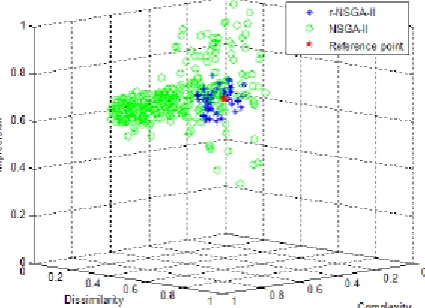
Fig 2. r-NSGA-II vs. NSGA results (imprecision = violated correctness constraints; Dissimilarity = deviation with good metric values; Complexity of the rules)
Figure 2 compresses our discoveries. We utilized as P-EMO algorithm the reference solution based NSGA-II (r-NSGA-II) what’s more, we contrasted it and the essential NSGA-II algorithm. To guarantee a reasonable examination, we utilized a similar populace and posterity sizes and a similar number of ages for both algorithms. These two parameters are separately 100, and 500. For r-NSGA-II, the reference point is set to (0.1=imprecision/abused
rightness imperatives, 0.1=complexity,
0.6=dissimilarity with great measurements esteem) and the parameter _, which controls the ROI spread, is settled to 0.35 tentatively. Figure 2 delineates the acquired outcomes for the two algorithms and
demonstrates the reference point, which
ones. In this way, we can presume that r-NSGA-II beats NSGA-II from a merging perspective since we have utilized a similar number of capacity assessments (100 x 500 = 50 000) for the two algorithms. The designer, obviously, can determine other reference focuses. The reference point utilized as a part of our analyze mirrors and preference of high accuracy (rules), low multifaceted nature (rules), and satisfactory quality (objective models). Another engineer can indicate different preferences relying upon his destinations/preferences and the specific circumstance. Notwithstanding taking into thought engineers' preferences, r-NSGA-II gives a lower number of solutions than NSGA-II which can enable the engineers to investigate the Pareto-to front containing once in a while in excess of 800 non-commanded solutions. Fig 2. r-NSGA-II versus NSGA comes about (imprecision = damaged rightness imperatives; Dissimilarity = deviation with great metric esteems; Complexity of the guidelines)
IV.
Conclusion
In this paper we presented another approach for show change in view of preference based evolutionary multi- objective optimization (P-EMO). The exploratory outcomes show that P-EMO performs much superior to the traditional multi-objective algorithm NSGA-II. The paper gives additionally a set of subjects for open issues in software demonstrating and a portrayal of a portion of the advantages that may collect through the utilization of P-EMO. As a feature of future work, we will chip away at adjusting P-EMO to various demonstrating issues and performing more near examinations.
V.
REFERENCES
[1]. Deb K (2001) Multi-objective optimization using evolutionary algorithms. John Wiley and Sons, Ltd, New York, USA.
[2]. Zhou A, Qu B-Y, Li H, Zhao S-Z, Suganthan P
N, Zhang Q (2011) C.Multiobjective
evolutionary algorithms: A survey of the state of the art. Swarm and Evolutionary Computation, 1(1)
[3]. M. Harman and B. F. Jones (2001), Search-based software engineering, Information & Software Technology, 43:833-839.
[4]. E. Zitzler and S. K¨unzli (2004) Indicator-Based Selection inMultiobjective Search. In Conference on Parallel Problem Solving from Nature (PPSN VIII), Vol 3242, 832- 842. [5]. M. Fowler, K. Beck, J. Brant, W. Opdyke, and
D. Roberts (1999), Refactoring - Improving the Design of Existing Code, 1st ed. Addison-Wesley, June 1999.
[6]. Fleurey, F., J. Steel and B. Baudry (2004), Validation in Model- Driven Engineering: Testing Model Transformations, In 15th IEEE
International Symposium on Software
Reliability Engineering.
[7]. France, R., Rumpe, B.(2007) Model-driven development of complex software: a research roadmap. In: Briand, L., Wolf, A. (eds.)
International Conference on Software
Engineering (ICSE 2007): Future of Software Engineering IEEE Computer Society Press, Los Alamitos.
[8]. Mark Harman, S. Afshin Mansouri, Yuanyuan
Zhang (2012) Search-based software
engineering: Trends, techniques and
applications. ACM Computing Surveys, 45(1): 11.
[9]. Lamjed Ben Said, Slim Bechikh, Khaled
Ghédira (2010) The r- Dominance: A new dominance relation for interactive evolutionary
multicriteria decision making. IEEE
Transactions on Evolutionary Computation, 14(5): 801-818.
[11]. Evan J. Hughes (2005) Evolutionary many-objective optimization: Many once or one many? In: Proceedings of IEEE Congress Evolutionary Computation (CEC’05), pp. 222-227.
[12]. Antonio López Jaimes (2011) Techniques to
deal with manyobjective optimization
problems using evolutionary algorithms. PhD thesis, the National Polytechnic Institute of Mexico.
[13]. Tobias Wagner, Heike Trautmann (2010)
Integration of preferences in hyper volume-based multi objective evolutionary algorithms by means of desirability functions. IEEE Transactions on Evolutionary Computation, 14(5): 688-701.
[14]. Upali K. Wickramasinghe, Xiaodong Li (2008)
Integrating user preferences with particle swarms for multi-objective optimization. In:
Proceedings Genetic and Evolutionary
Computation COnference (GECCO’08), pp. 745-752.
ABOUT AUTHORS:
Sireesha. P is currently pursuing her MCA Department, St.Ann’s College Of Engineering & Technology, Chirala. A.P. She received her B.Sc computer Science Degree from BCRM Degree College for women in Inkollu.
M. Sarada is currently working as an
Assistant Professor MCA