71:1 (2014) 49–54 | www.jurnalteknologi.utm.my | eISSN 2180–3722 |
Full paper
Jurnal
Teknologi
Integral Equation Approach for Computing Green’s Function on Doubly
Connected Regions via the Generalized Neumann Kernel
Siti Zulaiha Aspona*, Ali Hassan Mohamed Murida,b, Mohamed M. S. Nasserc, Hamisan Rahmata aDepartment of Mathematical Sciences, Faculty of Science, UTM, 81310 UTM Johor Bahru, Johor, Malaysia b
UTM Centre for Industrial and Applied Mathematics (UTM-CIAM), 81310 UTM Johor Bahru, Johor, Malaysia
c
Department of Mathematics, Faculty of Science, King Khalid University, P.O. Box 9004, Abha, Saudi Arabia
*Corresponding author: [email protected]
Article history
Received :2 February 2014 Received in revised form : 3 August 2014
Accepted :15 October 2014
Graphical abstract
Abstract
This research is about computing the Green’s function on doubly connected regions by using the method of boundary integral equation. The method depends on solving a Dirichlet problem. The Dirichlet problem is then solved using a uniquely solvable Fredholm integral equation on the boundary of the region. The kernel of this integral equation is the generalized Neumann kernel. The method for solving this integral equation is by using the Nystrӧm method with trapezoidal rule to discretize it to a linear system. The linear system is then solved by the Gauss elimination method. Mathematica plots of Green’s functions for several test regions are also presented.
Keywords Green’s Function; Dirichlet Problem; Integral Equation; Generalized Neumann Kernel
Abstrak
Kajian ini berkaitan dengan pengiraan fungsi Green pada rantau berkait ganda dua terbatas dengan menggunakan kaedah persamaan kamiran sempadan. Kaedah ini bergantung kepada penyelesaian masalah Dirichlet. Masalah Dirichlet kemudiannya diselesaikan menggunakan persamaan kamiran Fredholm berpenyelesaian unik pada sempadan rantau ini. Inti persamaan kamiran ini adalah inti Neumann teritlak. Kaedah untuk menyelesaikan persamaan kamiran ini ialah dengan menggunakan kaedah Nystrӧm dengan peraturan trapezoid untuk menghasilkan sebuah sistem linear. Sistem linear kemudian diselesaikan dengan kaedah penghapusan Gauss. Plot Mathematica bagi fungsi Green untuk beberapa rantau ujian juga dipersembahkan.
Kata kunci: Fungsi Green; Masalah Dirichlet; Persamaan Kamiran; Inti Neumann Teritlak
© 2014 Penerbit UTM Press. All rights reserved.
1.0 INTRODUCTION
Green’s functions are important since they provide a powerful tool in solving differential equations. They are very useful in several fields such as solid mechanics, applied physics, applied mathematics, mechanical engineering, materials science and quantum field theory.1
Henrici shows three different methods for computing Green’s function for doubly connected regions which leads to three different analytical representations for the Green’s function. The methods are the Fourier series method, infinite product method and Theta series method.2 Crowdy and Marshall have
presented an analytical formula for Green’s function for Laplace’s equation in multiply circular domains. The method is constructive and depends on Schottky-Klein prime function associated with multiply connected circular domain.3
Wegmann and Nasser have studied Fredholm integral equation associated with the linear Riemann-Hilbert problems on
multiply connected regions with smooth boundary curves. The kernel of these integral equations is the generalized Neumann kernel. They investigated the existence and uniqueness of solutions of the integral equations by determining the exact number of linear independent solutions and their adjoints.4 Based on Wegmann and Nasser, Nasser et al. have proposed a new boundary integral method for the solution of Laplace’s equation on multiply connected regions using either Dirichlet boundary condition or the Neumann boundary condition. The method is based on two uniquely solvable Fredholm integral equations of the second kind with the generalized Neumann kernel.5
Recently, Alagele has proposed a new method for computing the Green’s function on simply connected region by using the method of boundary integral equation which depends on the solution of a Dirichlet problem.6
paper wish to extend Alagele’s work to compute Green’s function for bounded doubly connected regions using integral equation with generalized Neumann kernel.6
2.0 AUXILIARY MATERIALS
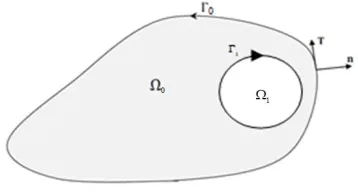
Let Ω be a bounded doubly connected region in the complex plane (Figure 1). The outer boundary
0 has a counter clockwise direction and surrounds the boundary
1 which has clockwise orientation. So we have
0
1.Figure 1 Bounded doubly connected region
We assume that each boundary
k has a parameterization( ),
,
0,1,
k
t
t
J
kk
which is a complex periodicfunction with period
2
, whereJ
k
[0, 2 ]
is theparametric interval for each
k.
The parameterization
k( )
t
also need to be twice continuously differentiable such that
( )
( ) 0.
k
d t
t dt
(2.1)
Therefore the parameterization
k of the whole boundary
can be written as0 0 0
1 1 1
:
( ),
[0, 2 ],
:
( ),
[0, 2 ].
t
t
J
t
t
J
(2.2)Let u be a real function defined in the region
and letz
x iy
. In our research, for simplicity, we write u(z) instead of u(x,y). LetH
be the space of all real Hölder continuous function with exponent
on the boundary Γ. The interior Dirichlet problem is defined as follows:Interior Dirichlet problem:
Let
k
H
be a given function. Find the function u harmonic in
, Holder continuous on
and satisfies the boundary condition(
k)
k,
u
k k,
(2.3)
where
0 0
1 1
( ),
,
( ),
.
t
t
J
t
t
J
The interior Dirichlet problem (2.3) is uniquely solvable and can be regarded as a real part of an analytic function
F
in
which is not necessary single-valued.2,5 The functionF
can be written as
1 1
( )
( )
ln
,
F z
f z
a
z
z
(2.4)where
f
is a single-valued analytic function in
,z
1is a fixedpoint in
1 anda
1is real constant uniquely determined byk
.5 We assume for bounded
thatIm ( )
f
0.
The constanta
1 is chosen to ensure that1
'(
k)
0.
f
d
In general the Green’s function for
can be expressed by8
( ,
0)
( )
1
ln
0, ,
0,
2
G z z
u z
z
z
z z
(2.5)where u is the unique solution of the interior Dirichlet problem
2
0
( )
0,
1
(
)
ln
,
.
2
k k k k
u z
z
u
z
(2.6)
By computing
F
given by (2.4) with0 0 0 1 0 1
1
ln
and
ln
,
,
2
z
z
k k
(2.7)the unique solution of the interior Dirichlet problem (2.6) is given in
by( )
Re ( ).
u z
F z
(2.8)3.0 INTEGRAL EQUATION FOR THE INTERIOR DIRICHLET PROBLEM
Let
A t
k( )
be continuously differentiable 2π-periodic functionsfor all
t
J
k,
k
0,1
. We consider two real functions9
,
( )
( )
1
( , )
Im
,
( )
( )
( )
l k
l k
k k l
A s
t
N
s t
A t
t
s
,
( )
( )
1
( , )
Re
.
( )
( )
( )
l k
l k
k k l
A s
t
M
s t
A t
t
s
(3.2)The kernel
, ( , )
l k
N s t is called the generalized Neumann
kernel formed with complex-valued function
A t
k( )
and
k( ).t 4 WhenA
k
1,
the kernelN
l k, is the classical Neumann kernel which arise frequently in the integral equations for potential theory and conformal mapping.2Theorem 3.14
a) The kernel
, ( , )
l k
N s t is continuous which takesonthe
diagonal the values
,
( )
( )
1
1
( , )
Im
.
2
( )
( )
k k
k k
k k
t
A t
N
t t
t
A t
(3.3)b) The kernel
M
l k,( , )
s t
is continuous forl
k
.
When,
l
k
the kernelM
k k,( , )
s t
has the representation, 1,
1
( , )
cot
( , ),
2
2
k k k
s t
M
s t
M
s t
(3.4)
with a continuous kernel
M
1,k which takes on the diagonal the values1,
( )
( )
1
1
( , )
Re
,
2
( )
( )
k k
k
k k
t
A t
M
t t
t
A t
(3.5)where
k
0,1.
To find the function
F z
( )
given by (2.4), we need to find the functionf z
( )
and the real constanta
1. We define real functions 0
k k
and
k[1]
ln
k
z
1 fork
0,1,
(3.6)where
ksatisfy (2.7). It follows that5[ ]
[ ] [ ] [ ]
( ( )) ( ) ( ) ( ), for , 0,1,
p
p p p
k k k k
f
t
t h t i
t p k (3.7)are boundary values of analytic function [ ]p
f in
where[ ]p k
is the unique solution of the integral equation
2 2
[ ] [ ] [ ]
,0 0 ,1 1
0 0
( ) ( , ) ( ) ( , ) ( )
p p p
l s Nl s t t dt Nl s t t dt
2 2
[ ] [ ]
,0 0 ,1 1 ,
0 0
( , ) p( ) ( , ) p( ) , , 0,1.
l l l
M s t t dt M s t t dt s J l p
(3.8)
and
2 2
1 1
[ ] [ ] [ ]
, ,
00 00
1
( , ) ( ) ( , ) ( ) ,
2
p p p
l l k k l l k k
k k
h M s t t dt N s t t dt
(3.9)with
[ ] [ ]
0
[ ] [ ] 1 1 0
0,
.
p
p p p
h
h h h
It follows from Nasser et al.5 that the unknown constant
1
a
is the solution of the equation
[0] [1]
1 0.
h a h (3.10)
Then
[0] [0] 1 0 1 [1] [1]
1 0 .
h h
a
h h
Hence, the boundary values of the function f is given by5
1 1
( k( )) k( ) ln | k( ) | k( ),
f
t
t a
t z i
t (3.11)where
[0] [1] 1 ( ) ( ) ( ).
k t k t a k t
By this result we can compute the interior values of
f z
( )
over the whole region
by using the Cauchy integral formula1 ( )
( ) .
2
f w
f z dw
i w z
(3.12)
We then compute the function
F z
( )
from (2.4) and( )
u z
from (2.8).4.0 NUMERICAL IMPLEMENTATION
Denoting the right-hand side of the Equation (3.8) by
l( )s , weget
2 2
[ ] [ ] [ ] [ ]
,0 0 ,1 1
0 0
( ) ( , ) ( ) ( , ) ( ) ( ).
p p p p
l s Nl s t t dt Nl s t t dt l s
Since the functions
A
k and
k are 2
- periodic, the integralsare discretized by the Nystrӧm method with trapezoidal rule.7 Let n be a given integer and define the n equidistant collocation points
t
jby2 ( 1) ,
j
t j
n
j1,2,...,n. (4.2)
Then, using the Nystrӧm method for (4.1) we obtain the linear system
[ ] [ ] [ ] [ ]
,0 0 ,1 1
1 1
2 2
( ) ( , ) ( ) ( , ) ( ) ( )
n n
p p p p
l i l i j j l i j j l i
j j
t N t t t N s t t s
n n
(4.3)where
kis an approximation to
, and,
( ) ( )
1
Im , , or ,
( ) ( ) ( ) ( , )
( ) ( )
1 1 , ,
Im Im ,
2 ( ) ( )
k j l i
i j k j k j l i
l k i j
k j k j
i j
k j k j
t A t
l k l k t t
A t t t
N t t
t A t l k t t
t A t
and 2 [ ] [ ] [ ] 1, 1 0 1 2
( ) cot ( ) ( , ) ( )
2 2
n
p i p p
l i k j k i j k j
j
t t
t t dt M t t t
n
[ ] , 1 2 ( , ) ( ), n p l k i j k j jM t t t
n
(4.4)where
l k p
, ,
0,1,
and,
( ) ( )
1
( , ) Re , ,
( ) ( ) ( )
k j l i
l k i j
k j k j l i
t A t
M t t l k
A t t t
1, ( ) ( ) 1 1
Re cot , t
( ) ( ) ( ) 2 2
( , )
( ) ( )
1 1 .
Re ,
2 ( ) ( )
k j i j
k i
i j k j k j k i
k i j
k j k j
i j k j k j
t t t
A t
t
A t t t
M t t
t A t t t
t A t
We use Wittich method to approximate the integral that contains cotangent function and obtain10
2
1 0
1
cot ( ) ( , ) ( )
2 2
n i
k k j
j
t t
t dt K i j t
(4.5)where , ) ( cot 2 , 0 ) , ( n j i n j i K
The left-hand side of (4.3) can also be calculated directly by using Mathematica. Define the matrices
[
i j],
[
i j],
[
i j],
[
i j]
P
P
Q
Q
R
R
S
S
and vectors,
[
]
l l i
x
x
andy
l
[
y
l i,]
by, 0 0
2
(
( ),
( )),
ij l k i j
P
N
t
t
n
, 0 12
(
( ),
( )),
ij l k i j
Q
N
t
t
n
, 1 0
2
( ( ),
( )),
ij l k i j
R
N
t
t
n
S
ij2
N
l k,( ( ),
1t
i 1( )),
t
jn
,
( ),
l i l i
x
t
y
l i,
l( ).
t
iHence, the Equation (4.3) can be written as an 2n by 2n system
0 1 0
(
I
P x
)
Qx
y
,
0
(
)
1 1.
Rx
I
S x
y
(4.6)To solve the system (4.6) we use the method of Gaussian elimination. Since (4.1) has a unique solution, then for a wide class of quadrature formula the system (4.6) also has a unique solution, as long as n is sufficiently large.7 After we get the unique solution
x
l i,
l( ) ,
t
i then we calculate0 and 1
(
( ))
j( ( ))
jf
t
f
t
by using the following formula:0 0 1 0 1 0
1 1 1 1 1 1
( ( )) ( ) ln ( ) ( ),
( ( )) ( ) ln ( ) ( ),
j j j j
j j j j
f t t a t z i t
f t t a t z i t
(4.7)
which represents the boundary values of
f
(
z
)
on
.
We can compute the interior values off
(
z
)
over the whole region
by using the Cauchy integral formula given in (3.12), i.e.,2 2 0 1 0 1 0 1 0 0 ( ( )) ( ( )) 1 1 ( ) ( ) ( )
2 ( ) 2 ( )
j j
j j
j j
f t f t
f z t dt t dt
i t z i t z
(4.8)To increase the accuracy of
f
(
z
)
we shall use the following formula. Based on the fact that 1 11 2 i
zd, we can write
)
(
z
f
as 2 2 0 1 0 1 0 1 0 0 2 2 0 1 0 1 0 0 ( ( )) ( ( )) 1 1 ( ) ( )2 ( ) 2 ( )
( ) .
( ) ( )
1 1
2 ( ) 2 ( )
j j
j j
j j
j j
j j
f t f t
t dt t dt
i t z i t z
f z
t t
dt dt
i t z i t z
(4.9)Then, using the Nyström method with the trapezoidal rule to discretize the integrals in (4.9), we obtain the approximation
0 1
0 1
1 0 1 1
0 1
1 0 1 1
( ( )) ( ( )) ( ) ( ) ( ) ( ) ( ) . ( ) ( ) ( ) ( ) n n j j j j
j j j j
n n
j j
j j j j
f t f t
t t
t z t z
f z
t t
t z t z
(4.10) if j-i is even,This has the advantage that the denominator in this formula compensates for the error in the numerator.11 Next, substitute
( )
f z
given in (4.10) into EquationF z
( )
in (2.4), and by taking the real part of (2.4) gives (2.8), i.e.( )
Re ( ).
u z
F z
Finally, by using
u
(
z
)
we can compute the Green’s function0
( ,
)
n
G z z
by the following formula (2.5), i.e.0 0
1
( ,
)
( )
ln
.
2
n
G z z
u z
z
z
5.0 NUMERICAL EXAMPLES
Example 1
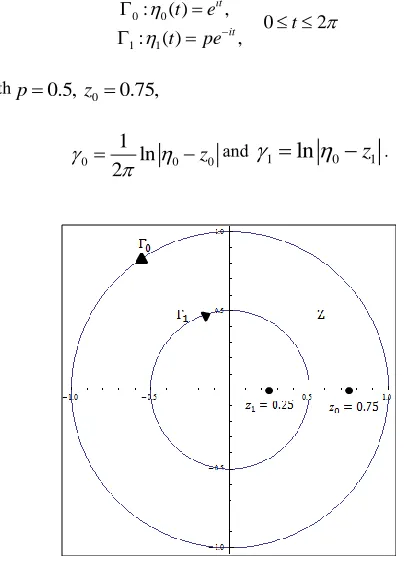
In Example 1, we consider an annulus as shown (Figure 2). The boundary of this region is parameterized by the function
0 0 1 1
: ( ) ,
0 2
: ( ) ,
it
it
t e
t
t pe
withp0.5, z00.75,
0 0 0
1
ln
2
z
and
1
ln
0
z
1 .Figure 2 The test region Ω for Example 1
The exact Green’s function of this region is given by2
1 0
Log 1
( , ) 1 Log Log
Log 1
i
i
e G z z
e
n n
n n n n
n n
n n
cos 1
where
z
e
i, and the infinite series converges, uniformly for1
z
and
1
at least like a geometric series with ratio
.We describe the error by maximum error norm
0 0
( , ) n( , )
G z z G z z , where n is the number of nodes and G z z( , 0)is the numerical approximation of G z z( , 0). We
choose some test points inside the region. The results are shown in Table 1.
Table 1 The error
0 0
( , ) n( , )
G z z G z z
n
z
32 64 128
0.6 0.7 0.8 0.9
4
10 72 .
1
5
10 77 .
9
5
10 58 .
1
4
10 88 .
1
6
10 13 .
1
7
10 86 .
7
7
10 72 .
4
8
10 29 .
2
11
10 81 .
5
11
10 05 .
4
11
10 54 .
2
11
10 15 .
1
0.74999999999 5
10 8 .
4 7
10 3 .
6 11
10 27 .
3
0.75000000001 5
10 8 .
4 7
10 3 .
6 11
10 27 .
3
0.5+0.5i 0.6+0.6i 0.7+0.7i
4
10 35 .
1
5
10 78 .
7
5
10 46 .
1
7
10 67 .
7
7
10 69 .
3
8
10 21 .
7
11
10 94 .
3
11
10 87 .
1
12
10 03 .
3
The 3D plot of the surface of
0 ( , )
n
G z z is shown (Figure 3).
Figure 3 The 3D plot of Green’s function for Example 1
Example 2
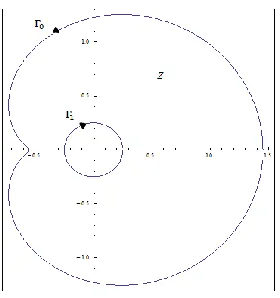
In Example 2, we consider an Epitrochoid as shown (Figure 4). The boundary of this region is parameterized by the function
0 0 1 1
: ( ) ,
0 2
: ( ) ,
it it
it
t e pe
t
t qe
with p0.3333, q0.1,
z
0
0.75,
z
1
0.01,
0 0 0
1
ln
2
z
Figure 4 The test region Ω for Example 2
The 3D plot of the surface of
0 ( , )
n
G z z is shown (Figure 5).
Figure 5 The 3D plot of Green’s function for Example 2
6.0 CONCLUSION
This study has presented a method for computing the Green’s function on doubly connected regions by using a new approach based on boundary integral equation with generalized Neumann kernel. The idea for computing the Green’s function on
is to solve the Dirichlet problem2
0
( )
0,
1
(
)
ln
,
.
2
k k k k
u z
z
u
z
(6.1)
on that region by means of solving an integral equation numerically using Nyström method with the trapezoidal rule. Once we got the solution
u z
( )
, the Green’s function of
can be computed by using the formula0 0
1
( ,
)
( )
ln
.
2
nG z z
u z
z
z
(6.2)The numerical example illustrates that the proposed method can be used to produce approximations of high accuracy.
Acknowledgement
This work was supported in part by the Malaysian Ministry of Higher Education (MOHE) through the Research Management Centre (RMC), Universiti Teknologi Malaysia (GUPQ.J130000.2526.04H62).
References
[1] Q.H. Qin. 2007. Green’s Function and Boundary Elements of Multifield Materials. Elsevier Science.
[2] P. Henrici. 1986. Applied and Computational Complex Analysis. New York: John Wiley. 3: 255–272.
[3] D. Crowdy, J. Marshall. 2007. IMA J. Appl. Math. 72: 278–301. [4] R Wegmann, M. M. S Nasser. 2008. J. Comput. Appl. Math. 214: 36–
57.
[5] M. M. S. Nasser, A. H. M Murid, M. Ismail, E. M. A Alejaily. 2011. J.
Appl. Math. and Comp. 217: 4710–4727.
[6] M. M. A. Alagele. 2012. Integral Equation Approach for Computing Green’s Function on Simply Connected Regions. M.Sc Dissertation, Universiti Teknologi Malaysia, Skudai.
[7] K. E. Atkinson. 1997. The Numerical Solution of Integral Equations of
the Second Kind. Cambridge: Cambridge University Press.
[8] L. V. Ahlfors. 1979. Complex Analysis, International Student Edition. Singapore: McGraw-Hill.