• No results found

High QScS beneath the Ontong Java Plateau

N/A
N/A
Protected

Academic year: 2020

Share "High QScS beneath the Ontong Java Plateau"

Copied!
9
0
0

Loading.... (view fulltext now)

Full text

(1)

EXPRESS LETTER

High

Q

ScS

beneath the Ontong Java Plateau

Daisuke Suetsugu

1*

, Hajime Shiobara

2

, Hiroko Sugioka

3

, Aki Ito

1

, Takehi Isse

2

, Yasushi Ishihara

1

,

Satoru Tanaka

1

, Masayuki Obayashi

1

, Takashi Tonegawa

1

, Junko Yoshimitsu

1

and Takumi Kobayashi

3

Abstract

The Ontong Java Plateau (OJP) in the southwest Pacific is the largest oceanic large igneous provinces (LIP) on Earth. Detailed seismic structure of the plateau has not been understood well because of sparse seismic stations. We inves-tigated seismic attenuation of the mantle beneath the plateau by analyzing data from temporary seismic stations on the seafloor and islands in and around the plateau. We analyzed the spectra of multiple ScS waves to determine the average attenuation of the mantle (QScS) beneath the plateau. We estimated the average QScS values for the paths with bounce points located in the plateau to be 309, which is significantly higher than the average (i.e., weaker attenuation than average) estimated in the western Pacific and is close to that of stable continents. We obtained positive residuals of 6 s for travel times of multiple ScS waves, which indicate that the average S velocity in the entire mantle beneath the OJP is low. While the positive residuals are at least partially attributable to the Pacific Large Low Shear Velocity Province (Pacific LLSVP), it is difficult to conclude whether low-velocity anomalies are required in the OJP upper man-tle to explain the residuals from the multiple ScS analysis.

Keywords: Seismic attenuation, Travel time, Multiple ScS phases, Ontong Java Plateau, Large igneous provinces, Broadband ocean-bottom seismograph

© The Author(s) 2019. This article is distributed under the terms of the Creative Commons Attribution 4.0 International License (http://creat iveco mmons .org/licen ses/by/4.0/), which permits unrestricted use, distribution, and reproduction in any medium, provided you give appropriate credit to the original author(s) and the source, provide a link to the Creative Commons license, and indicate if changes were made.

Introduction

The Ontong Java Plateau (OJP) is the most voluminous large igneous province (LIP) in the oceanic region of the Earth (Fig. 1), whose elevation is approximately 2000 m above the surrounding seafloor. The OJP is known to have been emplaced primarily at 120 and 90 Ma by mas-sive volcanism (e.g., Coffin and Eldholm 1994; Neal et al. 1997) based on petrological and geochemical studies, but the cause of this volcanism remains controversial. Previous studies of seismic tomography using seismo-logical data from islands in the region surrounding the OJP showed an anomalous mantle structure beneath the OJP, although the seismic images are not in agreement with each other. Richardson and Okal (2000) performed surface wave tomography using data from four tempo-rary stations on islands in the northern margin of the OJP, which showed a low-velocity zone of − 5% down to 300 km beneath the entire OJP region. Based on an SKS

splitting analysis, Klosko et al. (2001) interpreted the low-velocity zone obtained by Richardson and Okal (2000) as a rheologically strong and chemically distinct mantle root of the OJP. On the other hand, Covellone et  al. (2015) conducted surface wave tomography using earthquake and ambient noise data from permanent seismic stations in the western Pacific. Their model has a high-velocity anomaly in the center of the OJP down to 100 km. The contradictory results obtained in the previous studies suggest that even first-order images, such as the presence of the low-velocity zone, remain to be resolved.

The discrepancy in the previous seismic images is mainly due to a shortage of in  situ geophysical obser-vations. To improve the spatial resolution for the geo-physical structure beneath the OJP, we deployed a new temporary seismological and electromagnetic observa-tion network, referred to herein as the OJP array, in the OJP and its vicinity (Suetsugu et al. 2018). In the present study, we analyzed seismic attenuation in the mantle beneath the OJP using data from the OJP array, which could provide another constraint on the mantle structure beneath the OJP. Only one study has been performed on the seismic attenuation beneath the OJP (Gomer

Open Access

*Correspondence: [email protected]

1 Japan Agency for Marine-Earth Science and Technology, 2-15, Natsushima, Yokosuka, Kanagawa 237-0061, Japan

(2)

and Okal 2003) by analyzing multiple ScS waves (QScS),

which indicated that the attenuation in the OJP mantle was weak (high QScS). However, whether attenuation is

weak over the entire OJP region remains unclear, because attenuation could be analyzed for a single event–station pair because only one pair was available for the analysis of multiple ScS waves due to few seismological stations located in the OJP.

While spatial resolution in global three-dimensional attenuation models have been improved recently (see review by Romanowicz and Mitchell 2015), they show variable results for the OJP region. Bhattacharyya et  al. (1996) analyzed S and SS waves to determine the global distribution of Qs in the upper mantle. They showed that

Qs beneath the OJP region is similar to the global aver-age. Warren and Shearer (2002) analyzed spectra of P and PP waves to determine a global attenuation model, indi-cating that the OJP region has weaker attenuation. Atten-uation studies using Rayleigh waves showed that the OJP region has an attenuation that is weaker than or close to

the global average (Selby and Woodhouse 2002; Dalton et  al. 2008). At present, global attenuation tomography may still have difficulty in resolving the seismic attenua-tion of the OJP.

In the present study, we present QScS values estimated

from multiple ScS waves recorded at 12 stations, includ-ing six stations of the OJP array for a deep earthquake. We examine whether the high QScS obtained by Gomer

and Okal (2003) for a single event–station pair represents the seismic attenuation of the entire OJP region.

Data

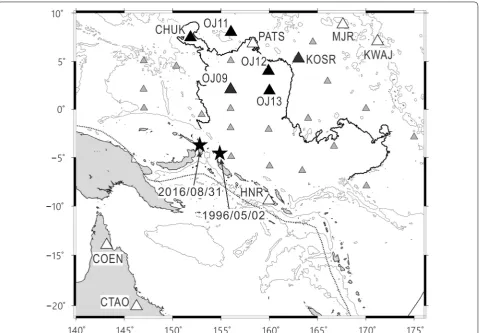
We analyzed waveform data recorded by a temporary broadband seismic network (OJP array) on the OJP and its vicinity along with six permanent stations operated by the IRIS/IDA, IRIS/USGS, Geoscience Australia, and Pacific21 seismic networks. The OJP array, which con-sisted of 23 broadband ocean-bottom seismic (BBOBS) stations and two land-based broadband stations on the Chuuk and Kosrae islands (Fig. 1), was operated from late

(3)

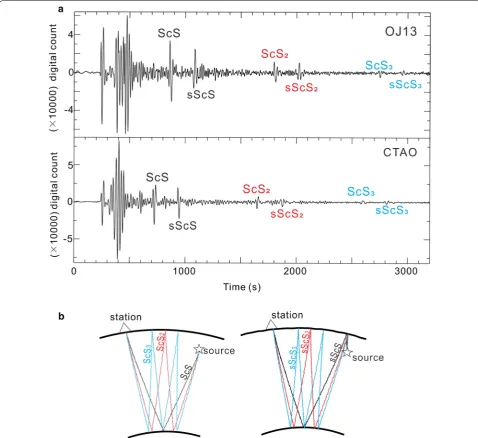
2014 to early 2017. We analyzed waveform data of a deep earthquake that occurred in the New Ireland region of Papua New Guinea on Aug. 31, 2016, which was nearly at the end of the observation period. The hypocenter parameters determined by USGS are 3.685° S, 152.792° E, 476 km, and 6.8 for latitude, longitude, focal depth, and moment magnitude, respectively (referred to as the 2016 event, Fig. 1). We also analyzed the data used in Gomer and Okal (2003) for comparison with the event that occurred beneath the Solomon Islands on May 2, 1996 (referred to as the 1996 event). Figure 2 shows examples of multiple ScS waves for the 2016 event, which is vis-ible up to ScS3 on the bandpass-filtered seismogram at

periods between 0.01 and 0.05 Hz. Note that the BBOBS data at OJ13 have a signal-to-noise ratio that is compara-ble to that at the continental station CTAO for this event.

Method

We analyzed a multiple ScS phase pair (ScSn+1 and ScSn,

sScSn+1 and sScSn) for each event–station pair to

meas-ure seismic attenuation and travel time, where n is the number of reflections at the core–mantle boundary. Multiple ScS waves are sensitive to structures near the source, station, and bounce points at the Earth’s surface and the core–mantle boundary (CMB) (e.g., Liu and Tromp 2008). Analyzing the phase pair, the effects of

(4)

structure near the source and station are substantially canceled, and the effects near the Earth’s surface and the CMB are likely to remain. The effect of the Earth’s surface is expected to be more enhanced than that near the CMB in measurements of seismic attenuation and travel time, because of much lower velocities near the Earth’s sur-face compared to those near the CMB. Even so, the CMB effect should be also taken into consideration in the pre-sent study, because the lower mantle beneath the OJP is known as the Pacific Large Low Shear Velocity Province (Pacific LLSVP) of low shear velocity and strong attenu-ation (e.g., Garnero and McNamara 2008; Ritsema et al. 2010; Konishi et al. 2017).

We used a spectral ratio method to measure QScS

along the propagation path in the mantle from an event to each station (e.g., Jordan and Sipkin 1977; Nakanishi 1979; Suetsugu 2001). We applied the stacking procedure for multiple ScS spectra developed by Jordan and Sipkin (1977) to the spectral ratio method. In this method, QScS

is estimated from the ratio of stacked spectra of a mul-tiple ScS pair (ScSn+1/ScSn and sScSn+1/sScSn) for each

event–station pair.

We used a time window of 180 s of the rotated trans-verse component seismograms to compute the multi-ple ScS spectra. The starting time of the first phase was placed 40 s prior to the theoretical IASP91 arrival time (Kennett and Engdahl 1991). We chose this starting time to avoid errors in QScS caused by crustal

reverbera-tions (Isse and Nakanishi 1997). A 30% cosine taper was applied to two phases when the spectra were computed. We calculated noise power spectra from a 180-s-long record preceding the first phase and smoothed with a running average of 0.01  Hz, from which we estimated the standard errors for the weighting factor of stacking (Jordan and Sipkin 1977). Geometrical spreading was corrected for the amplitude of multiple ScS waves. The logarithm of the stacked spectral ratio A(f) is related to

QScS by

where T is the travel time difference between the two phases, which is determined by cross-correlating the two phases, f is frequency, and ε is an error term. We dis-carded the phase pairs for which the cross-correlation was less than 0.6. The QScS value was computed from

Eq. (1) by applying a least-squares line fitting technique to ln A(f). The frequency range is basically from 0.01 to 0.05  Hz, whereas the highest and lowest limits of fre-quencies vary within 0.015 Hz based on the frequency-dependent signal-to-noise ratio at each event–station pair. Travel time residuals of ScSn+1–ScSn and sScSn+1–

sScSn were also obtained by cross-correlating waveforms

(1)

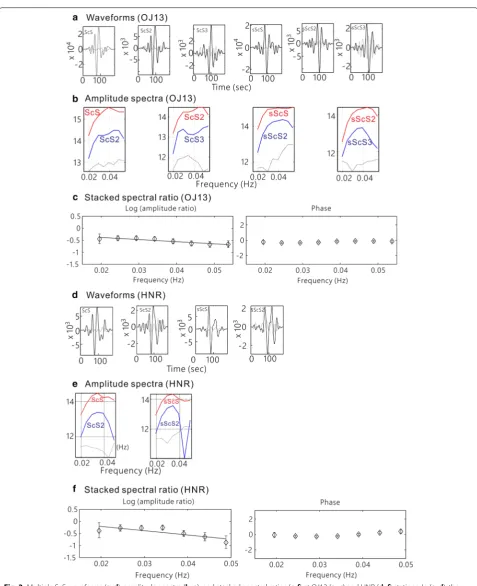
of a phase pair. The residuals were corrected for Earth’s ellipticity and water depths at surface bounce points. Figure 3 shows examples of QScS measurements at OJ13

and HNR stations. The slope of amplitude spectra with respect to the frequency is gentler at OJ13 than at HNR, indicating that QScS is higher (weaker attenuation) at

OJ13 than that at HNR.

Results

We obtained QScS from eight land-based stations and four

BBOBS stations in the northern part of the OJP array, as shown in Table 1. The operation of the BBOBS stations in the eastern part of the array had already been terminated at the time of the 2016 event. The BBOBS stations in the western and central parts of the array did not record mul-tiple ScS waves with a good S/N ratio. As a result, we could determine QScS with bounce points of multiple ScS waves

located only in the northern half of the OJP.

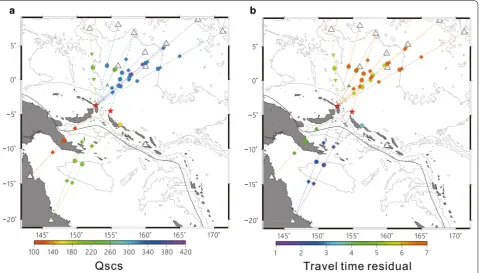
Figure 4a, b illustrates the QScS values and the travel time

residuals plotted at surface bounce points, respectively. The

QScS values with the bounce points located in the OJP range

from 213 to 413, whereas the standard errors are large (19–227) (Table 1), as estimated from the signal-to-noise ratio of the multiple ScS spectra at each station (Jordan and Sipkin 1977). The large standard errors are due to a large horizontal-component noise on the ocean-bottom seismo-graph (e.g., Suetsugu and Shiobara 2014). The average QScS

value beneath the OJP calculated from QScS at each station

is 309 ± 55, which is significantly higher than the average

QScS computed from global one-dimensional models, such

as the PREM (223, Dziewonski and Anderson 1981) or the QL6 model (233, Durek and Ekstrӧm 1996), or that for the western Pacific (156 ± 17) estimated by Sipkin and Jordan (1980), despite the significant variations of the observed

QScS values. Travel time residuals with the bounce points

located in the OJP range from 4.5 s to 6.9 s (6.0 s ± 0.8 s) with respect to those calculated from the IASP91 model, which is markedly larger than those with the bounce points outside the OJP (1.4–4.2  s). The large positive residuals beneath the OJP indicate that the average S velocity of the entire mantle is low beneath the OJP.

Discussion and conclusion

We estimated the QScS values to be 324 ± 34 and 218 ± 20

(5)
(6)

Table 1 QScS, standard errors, travel time residuals, and theoretical travel time residuals calculated from S40RTS (Ritsema et al. 2010), and pairs of multiple ScS used in the present study

δTScS is a travel time residual for a phase pair

Station ScS2/ScS1 ScS3/ScS2 sScS/sScS2 sScS2/sScS QScS δTScS δTScS(S40RTS)

Event on 2016/8/31

PATS 〇 〇 239 ± 59 6.5 2.8

CHUK 〇 〇 〇 213 ± 20 5.6 1.4

KOSR 〇 〇 〇 413 ± 227 5.4 3.9

OJ09 〇 290 ± 158 4.5 2.8

OJ11 〇 〇 334 ± 52 6.0 2.3

OJ12 〇 〇 333 ± 97 6.0 3.3

OJ13 〇 〇 331 ± 59 5.2 3.5

MJR 〇 〇 〇 309 ± 117 6.7 5.3

KWAJ 〇 〇 〇 307 ± 59 6.9 4.2

HNR 〇 〇 165 ± 54 3.7 2.2

CTAO 〇 〇 204 ± 60 2.7 2.5

COEN 〇 〇 〇 109 ± 26 4.2 0.4

Event on 1996/5/2

PATS 〇 〇 324 ± 34 6.3 3.2

CTAO 〇 〇 218 ± 20 1.4 3.0

(7)

Since there was no previous QScS study beneath the

OJP in the past, except for Gomer and Okal (2003), we compared QScS values obtained in previous studies with

those of the present study in broader regions, includ-ing the OJP. Sipkin and Jordan (1980) and Chan and Der (1988) estimated the QScS values from Fiji–Tonga events

to central Japan as 173 ± 37 and 214 ± 42, respectively, which are higher than the average QScS value of 156 in

the western Pacific (Sipkin and Jordan 1980). The QScS

values obtained by the present study (309 ± 55) are even higher than those obtained by previous studies, probably because multiple ScS waves analyzed by the two previous studies sampled a broader region from the Fiji–Tonga region to Japan, including the OJP, than the present study. The QScS beneath the OJP is close to those beneath the

stable continents of 280–333 (Chan and Der 1988; Reve-naugh and Jordan 1991; Sipkin and Revenaugh 1994). The

QScS values beneath the Solomon subduction zone and

the Coral Sea are 100–200, which is significantly lower than those of the OJP. Very low QScS (109) are observed at

the COEN station in the present study, probably because the multiple ScS phases travel long distances in the tec-tonically active region of the Papua New Guinea.

While it is difficult to estimate Qs of the upper and lower mantle separately from multiple ScS waves of nearly vertical paths, the spectral ratio and travel time difference of sScS and ScS waves bear information on the Qs and S velocity anomaly in the upper mantle above the 2016 event (Additional file 1: Table  S1, Figure S1). The average Qs in the upper 500 km above the source is estimated to be 98 ± 15, which is close to the Qs of 104 for the PREM. The travel time residual of sScS–ScS is 5.5 ± 0.6  s at stations located toward the OJP from the source, which corresponds to S velocity lower by 2.4% than that of the IASP91 model in the upper 500 km of the 2016 event. However, these values may not represent the upper mantle beneath the OJP, because the Qs and travel time residual from the sScS and ScS pairs are affected by the Papua New Guinea and Solomon Islands subduction zones with presumably strong lateral heterogeneities. Next, we referred to the existing Qs model of the lower mantle to estimate the Qs of the OJP upper mantle from the QScS value of 309 using a ray theory. Using the PREM

Qs value of 312 for the lower mantle, the Qs of the upper mantle is estimated to be 303. Since the LLSVP is seated in the OJP lower mantle, the effect of the LLSVP on atten-uation should be taken into consideration. Konishi et al. (2017) determined one-dimensional Vs and Qs models at depths greater than 2000 km using a waveform inversion technique beneath the western Pacific region, includ-ing the OJP. The Qs values beneath the OJP are approxi-mately 260 at depths from 2000  km to 2850  km and 216 at depths from 2850 to the core–mantle boundary.

Konishi et  al. (2017) attributed the low Qs values to thermo-chemical anomalies of the Pacific LLSVP. Using the Qs of 260 at depths from 2000 km to the core–mantle boundary and the Qs of PREM in the rest of the lower mantle, we obtained a Qs value of 367 for the OJP upper mantle. The Qs in the OJP upper mantle is higher than those computed from one-dimensional models, such as the PREM (134) and the laterally averaged SEMUCB-WM1 model (130, Karaoğlu and Romanowicz 2018). Considering the similarity of the QScS values beneath

the OJP by the present study and those of stable conti-nents reported in previous studies, as mentioned above, we estimated the upper mantle Qs values by a ray theory beneath the continents from the QScS values obtained in

the previous studies (Chan and Der 1988; Revenaugh and Jordan 1991; Sipkin and Revenaugh 1994) by assuming a lower mantle Qs to be that of PREM and compared these values with the Qs estimated for the OJP upper mantle. The QScS of 280–333 for the stable continents resulted in

an upper mantle Qs of 244–395, which is close to the Qs of the OJP upper mantle estimated above (303 and 367). The upper mantle Qs of the OJP is in the estimated range of those for stable continents.

The travel time residuals of multiple ScS waves are 6.0 ± 0.8 s, which indicates that the average velocity of the entire mantle beneath the OJP is low. The LLSVP is located in the lower mantle at depths from 1000 km to the core–mantle boundary, and the observed posi-tive residuals should be attributable, at least partially, to the low velocities of the LLSVP. We examined how large residuals can be explained by the LLSVP by cal-culating the theoretical residuals with the three-dimen-sional S velocity model S40RTS (Ritsema et  al. 2010) using a ray theory. Although a geographical pattern of the observed residuals is reproduced in the theoreti-cal residuals (largely positive residuals beneath the OJP and less positive residuals outside the OJP), the theo-retical residuals are 3.3 ± 1.1 s, which is approximately half of the observed residuals. While the upper mantle of the S40RTS model has strong high-velocity (1.5–3% in the shallowest 100  km) and low-velocity anomalies (− 1 to − 3% at depths from 200 km to 300 km), the net effects on multiple ScS waves are negligible, because the effects are canceled for nearly vertical paths of the multiple ScS waves. The theoretical residuals are there-fore mainly due to the broadly low-velocity anoma-lies of the LLSVP. Assuming that the remaining 2.7  s occurs in the entire upper mantle and the top 300 km depths, the velocity anomalies are − 0.9 ± 0.4% and

(8)

and the other is the positive residuals due to underes-timated correction of the LLSVP. Amplitudes of veloc-ity anomalies estimated by seismic tomography are well known to depend on the parameterization and regularization used in tomography. Some models have velocities as low as approximately − 2.5 to − 3% in the LLSVP (e.g., Lu and Grand 2016), whereas the S40RTS has velocities as low as approximately − 1.5 to − 2%. Determining the velocity structure in the upper mantle using multiple ScS studies is difficult. Seismic tomogra-phy using data from the OJP array is expected to pro-vide a tight constraint on the velocity structure beneath the OJP.

In summary, the QScS in the mantle beneath the

north-ern OJP is estimated to be 309 ± 55, which is consistent with the result of Gomer and Okal (2003). This is higher than the average QScS in the western Pacific and that

cal-culated from global one-dimensional Qs models and is close to the QScS beneath stable continents. Assuming

the lower mantle Qs based on existing Qs models with LLSVP effects accounted for, the seismic attenuation in the upper mantle is probably weak beneath the OJP, as is that of stable continents. The travel times of multiple ScS waves are as large as 6 s. While the positive residuals are at least partially explained by the effect of the Pacific LLSVP in the lower mantle, it is difficult to conclude whether the low-velocity zone in the upper mantle is required to explain the positive residuals, which remains to be concluded by seismic tomography using data from in situ stations such as the OJP array.

Supplementary information

Supplementary information accompanies this paper at https ://doi. org/10.1186/s4062 3-019-1077-8.

Additional file 1: Table A1.Qs and travel time residuals estimated from sScS-ScS pairs for the 2016 event. PATS, CHUK, KOSR, OJ09, OJ11, OJ12, OJ13 and MJR are located towards the OJP from the epicenter. Figure A1. Qs obtained from spectral ratio of sScS and ScS phases for the 2016 event (star). Surface bounce points of sScS phase are denoted by crosses. The dotted lines are surface projections of sScS ray paths in the upper 500 km of the mantle. The colors of the symbols and the dotted curves represent Qs values.

Abbreviations

OJP: Ontong Java Plateau; BBOBS: broadband ocean-bottom seismograph; PREM: Preliminary Reference Earth Model; IRIS: Incorporated Research Institu-tions for Seismology; IDA: International Deployment of Accelerometers; USGS: US Geological Survey.

Acknowledgements

The authors are grateful to the captains and crews of R/V MIRAI of JAMSTEC and R/V HAKUHO-MARU of JAMSTEC for the installation and recovery cruises, respectively. Their devoted efforts led to the success of the OJP array observa-tion. The authors thank IRIS Data Management Center for making their data available. We thank B. Romanowicz and an anonymous reviewer for their constructive comments, which substantially improved the present study.

The present study was supported by a Grant-in-Aid for Scientific Research (15H03720) from the Japan Society for the Promotion of Science.

Authors’ contributions

DA organized the seafloor observation, analyzed data, and wrote the manu-script. HSH, HSU, AI, TI, and TK performed the seafloor observation. YI, ST, MO, TT, and JY organized and performed the island observation. All authors read and approved the final manuscript.

Funding

The present study was supported by a Grant-in-Aid for Scientific Research (15H03720) from the Japan Society for the Promotion of Science and Grants for Operating Expenses of JAMSTEC and the University of Tokyo.

Availability of data and materials

Data supporting the results of the present article are available upon request to the authors.

Ethics approval and consent to participate

Not applicable.

Consent for publication

Not applicable.

Competing interests

The authors declare that they have no competing interests.

Author details

1 Japan Agency for Marine-Earth Science and Technology, 2-15, Natsushima, Yokosuka, Kanagawa 237-0061, Japan. 2 Earthquake Research Institute, The University of Tokyo, 1-1-1, Yayoi, Bunkyo, Tokyo 113-0032, Japan. 3 Department of Planetology, Graduate School of Science, Kobe University, 1-1 Rokkodai-cho, Nada-ku, Kobe, Hyogo 657-8501, Japan.

Received: 3 January 2019 Accepted: 26 August 2019

References

Bhattacharyya J, Masters G, Shearer PM (1996) Global lateral variations of shear wave attenuation in the upper mantle. J Geophys Res 101:22273–22289 Chan WW, Der ZA (1988) Attenuation of multiple ScS in various parts of the

world. Geophys J Int 92:303–314

Coffin MF, Eldholm O (1994) Large igneous provinces: crustal structure, dimen-sions, and external consequences. Rev Geophys 32:1–36

Covellone BM, Savage B, Shen Y (2015) Seismic wave speed structure of the Ontong Java Plateau. Earth Planets Sci Lett 420:140–150

Dalton CA, Ekstrӧm G, Dziewonski AM (2008) The global attenuation structure of the upper mantle. J Geophys Res. https ://doi.org/10.1029/2007J B0054 29

Durek JJ, Ekstrӧm G (1996) A radial model of anelasticity consistent with long-period surface-wave attenuation. Bull Seismol Soc Am 86:144–158 Dziewonski A, Anderson DL (1981) Preliminary reference Earth model. Phys

Earth Planet Inter 25:297–356

Garnero EJ, McNamara AK (2008) Structure and dynamics of Earth’s lower mantle. Science 320:626–628. https ://doi.org/10.1126/scien ce.11480 28 Gomer B, Okal EA (2003) Multiple-SCS probing of the Ontong-Java Plateau.

Phys Earth Planet Inter 138:317–331

Isse T, Nakanishi I (1997) The effect of the crust on the estimation of mantle Q from spectral ratios of multiple ScS phases. Bull Seismol Soc Am 87:778–781

Jordan TH, Sipkin SA (1977) Estimation of the attenuation operator for multiple ScS waves. Geophys Res Lett 4:167–170

Karaoğlu H, Romanowicz B (2018) Inferring global upper-mantle shear attenu-ation structure by waveform tomography using the spectral element method. Geophys J Int 213:1536–1558. https ://doi.org/10.1093/gji/ggy03 0

(9)

Klosko ER, Russo RM, Okal EA, Richardson WP (2001) Evidence for a rheologi-cally strong chemical mantle root beneath the Ontong-Java Plateau. Earth Planets Sci Lett 186:347–361

Konishi K, Fuji N, Deschamps F (2017) Elastic and anelastic structure of the lowermost mantle beneath the western Pacific from waveform inversion. Geophys J Int 208:1290–1304. https ://doi.org/10.1093/gji/ggw45 0 Liu Q, Tromp J (2008) Finite-frequency sensitivity kernels for global seismic

wave propagation based upon adjoint methods. Geophys J Int 174:265– 286. https ://doi.org/10.1111/j.1365-246X.2008.03798 .x

Lu C, Grand SP (2016) The effect of subducting slabs in global shear wave tomography. Geophys J Int 205:1074–1085. https ://doi.org/10.1093/gji/ ggw07 2

Nakanishi I (1979) Attenuation of multiple ScS waves in the Japanese arc. Phys Earth Planet Inter 19:337–347

Neal C, Mahoney JJ, Kroenke LW, Duncan RA, Petterson MG (1997) The Ontong Java Plateau. In: Mahoney JJ, Coffin MF (eds) Large igneous provinces: continental, oceanic, and planetary flood volcanism, 100th edn. American Geophysical Union, Washington, pp 183–216. https ://doi. org/10.1029/gm100 p0183

Revenaugh J, Jordan TH (1991) Mantle layering from ScS reverberations 1. Waveform inversion of zeroth-order reverberations. J Geophys Res 96:19749–19762

Richardson W, Okal EA, van der Lee S (2000) Rayleigh-wave tomography of the Ontong-Java Plateau. Phys Earth Planet Inter 118:29–51

Ritsema J, Deuss A, van Heijst HJ, Woodhouse JH (2010) S40RTS: a degree-40 shear-velocity model for the mantle from new Rayleigh wave dispersion, teleseismic traveltime and normal-mode splitting function measure-ments. Geophys J Int 184:1223–1236. https ://doi.org/10.1111/j.1365-246X.2010.04884 .x

Romanowicz, BA, Mitchell, BJ (2015) Deep earth structure: Q of the Earth from crust to core. In: Schubert G (ed). Treatise on geophysics. 2nd edn. pp 789–827

Selby ND, Woodhouse JH (2002) The Q structure of the upper mantle: constraints from Rayleigh wave amplitudes. J Geophys Res. https ://doi. org/10.1029/2001J B0002 57

Sipkin SA, Jordan TH (1980) Regional variation of QScS. Bull Seismol Soc Am 70:1071–1102

Sipkin SA, Revenaugh J (1994) Regional variation of attenuation and travel time in China from analysis of multiple-ScS phases. J Geophys Res 99:2687–2699

Suetsugu D (2001) A low QScS anomaly near the South Pacific Superswell. Geophys Res Lett 28:391–394

Suetsugu D, Shiobara H (2014) Broadband ocean bottom seismology. Ann Rev. Earth Planet Sci 42:27–43

Suetsugu D, Shiobara H, Sugioka H, Tada N, Ito A, Isse T, Baba K, Ichihara H, Ota T, Ishihara Y, Tanaka S, Obayashi M, Tonegawa T, Yoshimitsu J, Kobayashi T, Utada H (2018) The OJP array: seismological and electromagnetic obser-vation on seafloor and islands in the Ontong Java Plateau. JAMSTEC Rep Res Dev 26:54–64. https ://doi.org/10.5918/jamst ecr.26.54

Warren LM, Shearer PM (2002) Mapping lateral variations in upper mantle attenuation by stacking P and PP spectra. J Geophys Res. https ://doi. org/10.1029/2001J B0011 95

Publisher’s Note

Figure

Fig. 1 Map showing seismological stations of the OJP array and permanent stations around the OJP
Fig. 2 a Transverse component seismograms for the 2016 event at OJ13 (top) and CTAO (bottom)
Fig. 3 Multiple ScS waveforms (and those of  ScSa, d), amplitude spectra (b, e), and stacked spectral ratios (c, f) at OJ13 (a–c) and HNR (d–f) stations
Table 1 Qet al. ScS, standard errors, travel time residuals, and theoretical travel time residuals calculated from S40RTS (Ritsema 2010), and pairs of multiple ScS used in the present study

References

Related documents

Based on this, the problem to be solved is to let the system optimize the volume of the known coil, the width of the cutting and the corresponding number of cookies as the

[r]

The Diploma in Family Medicine (DFM) Examination Is a new certification offered by the College of Physicians and Surgeons of Pakistan, and its Department of Medical Education designed

230 cirrhotic patients (90% with alcoholism and 46% with Child’s grade C classification) with large esophageal varices without previous bleeding were randomly assigned to

A strict aseptic technique is used. Equipment for cardiopulmonary resuscitation is essential. Electrocar- diogram and pressure monitors should be set up. Pressure transducers are

Aforementioned invasive methods are being gradually superseded by extracorporeal lithotripsy, available in Pakistan since August 1988, in which externally produced shock waves

In this paper, a numerical internal wave tank is developed based on OpenFOAM by gravity collapse method. The wave profile is in good agreement with

The purpose of this report is to reemphasise the various clinical manifestations which a relatively rare tumour like gastric leiomyoma can produce in Nigerian patients since