Coded Modulation Assisted Iterative Parallel Interference Cancellation Aided CDMA
H.Wei, S.X.Ng and L.Hanzo
1Dept. of ECS, University of Southampton, SO17 1BJ, UK.
Tel: +44-23-8059-3125, Fax: +44-23-8059-4508
Email:lh
1@ecs.soton.ac.uk
,
http://www-mobile.ecs.soton.ac.uk
Abstract
In this contribution we investigate Trellis Coded Modulation (TCM) and Turbo Trellis Coded Mod-ulation (TTCM) assisted iterative parallel inter-ference cancellation aided CDMA schemes. The symbol-based Maximum a Posteriori (MAP) al-gorithm is invoked in both the TTCM and TCM decoder. In the context of the 8PSK TCM/TTCM CDMA schemes typically two iterations are nec-essary for approaching the best possible perfor-mance attained with the aid of an infinite number of iterations. By contrast, the number of itera-tions has to be increased to three or four in con-junction with 16QAM when the effective informa-tion throughput is increased from 2 to 3 bits per symbol.
1. INTRODUCTION
Following the philosophy of iterative turbo equalisation [1] in recent years iterative multiuser detection captured growing interest in the wireless communications commu-nity. In reference [2] an iterative decoding scheme de-signed for synchronous Code Division Multiple Access (CDMA) systems has been characterised. The algorithm proposed in [2] has a computational complexity propor-tional to the order of O(2Kv), where K is the number of users supported, andv is the channel codec’s memory length. This iterative multiuser detector exhibits near single-user performance. However, its excessive complity renders its real-time implementations unrealistic, ex-cept when the number of users supported is low.
In references [3] and [4] several schemes have been pro-posed for reducing the implementational complexity im-posed. In the set of these schemes, Interference Cancella-tion (IC) based iterative multiuser detecCancella-tion exhibits the lowest complexity, rendering the complexity proportional to the order ofO(K·2v).
In reference [5] an IC based iterative Multiuser De-tector (MUD) was developed, which exhibits a further reduced implementational complexity. The iterative
re-The financial support of the Mobile VCE, UK is gratefully ac-knowledged.
ceiver advocated in this treatise obeys a similar struc-ture to that proposed in [5], except for employing dif-ferent channel coding and modulation schemes. In [3] and [4] the proposed iterative multiuser detectors invoked soft estimation of the real-valued BPSK modulated sig-nal. In our approach, we propose a novel symbol proba-bility based iterative multiuser detection assisted receiver for employment in a Trellis Coded Modulation (TCM) and Turbo Trellis Coded Modulation (TTCM) aided sys-tem. Symbol-based Maximum APosteriori (MAP) algo-rithms [6] are employed for both the TCM and TTCM de-coder, which are capable of feeding back the symbol prob-abilities to the soft-symbol estimation and interference cancellation stages. More specifically, this algorithm re-lies on utilizing the probabilities of the channel-coded in-formation symbols for symbol estimation, rather than on employing the individual APP of the coded TCM/TTCM bits, which was justified both experimentally as well as from a heuristic perspective in [7], when employing a Rake receiver. A turbo MUD was analysed in detail from a unified theoretical perspective in the excellent treatise of Boutros and Caire [8] under the assumption of using ran-dom spreading.1
This contribution is organized as follows. In Section 2 we briefly introduce the concept of the PIC scheme , while in Section 3 we describe the soft estimation of the coded symbols. In Section 4 we discuss the TCM/TTCM aided PIC based iterative detector in detail, while in Section 5 we characterise its achievable performance. Finally, in Section 6 we offer our conclusions.
2. SOFT PARALLEL INTERFERENCE CANCELLATION
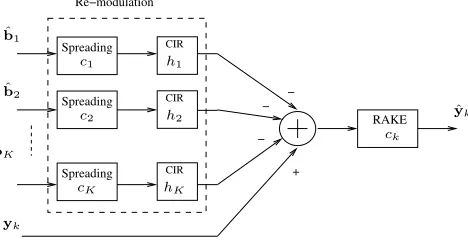
Figure 1 shows the structure of a parallel interference cancellation scheme, where the soft estimates ˆbk, k =
1, . . . , Kof the transmitted symbols, which are output by the channel decoder, are utilized for reconstructing esti-mates of the transmitted signal of all theK users. Then, for each user, the reconstructed estimated signals of all the interfering users are subtracted from the composite multiuser signal and the resultant decontaminated signal
1The authors are grateful to the anonymous reviewer for his in-sightful remarks in this context.
is processed by a Matched Filter (MF) or RAKE receiver, generating the soft output ˆyk. These modulated signal re-construction, interference cancellation and re-estimation steps are repeated, until the affordable number of itera-tions is exhausted.
Spreading Spreading
Spreading
CIR
RAKE −
−
−
+ Re−modulation
CIR
CIR c2
c1
cK
h2
ˆ
bK
ck
ˆ
b1
ˆ
b2
yk
ˆ
yk
h1
[image:2.612.48.282.172.293.2]hK
Figure 1: Schematic of a single PIC cancellation stage.
3. ESTIMATION OF THEM-ARY CODED
SYMBOL
We employed rate-m/(m+ 1)M = 2m+1-ary TTCM and TCM schemes, wheremis the number of original uncoded information bits per symbol. Again, the symbol-based MAP [6] algorithm was invoked.Thekth user’s TCM/TTCM decoder computes the soft symbol probabilitiesPr{bk =
xi|yˆk}, i = 1, . . . , M for each of the K users, from the
vector yˆk = [ˆyk,1, . . . ,yˆk,t, . . . ,yˆk,L]. More specifically, the indext,t = 1, . . . , T denotes the symbol index, T is the decoding block length and ˆyk,t is the kth user’s
es-timated soft output generated by the soft PIC block at time instantt. Explicitly, the probabilityPr{bk=xi|ˆyk}
is the A Posteriori Probability (APP) of the (m+1)-bit TCM/TTCM symbol. Let us drop the user indexk and describe the TCM/TTCM decoder’s operation in the con-text of a particular user. In the trellis decoding diagram, a branch leading from stateSt−1= `sto stateSt=sat time
instanttcan be labelled by the original uncoded informa-tion symbolat=uand the corresponding TCM/TTCM symbol bt =xi, i= 1, . . . , M. Let us first denote the output of the soft MAI canceller ˆy at timet by:
ηt(`s, s) = ˆyt. (1)
The metric of the trellis branch leading from stateSt−1= `
sto stateSt=scan be written as:
γt(`s, s) = Πt,u·ηt(`s, s), (2)
where the a priori probabilities Πt,uare either all equal to
1/2min the TCM scheme or are obtained from the other component decoder in the TTCM scheme. The above values are then used for recursively computing the forward
recursionαt−1(`s) as:
αt(s) =
all `s
γt(`s, s)·αt−1(`s), (3)
and the backward recursionβt(s) as:
βt−1(`s) =
alls
βt(s)·γt(`s, s). (4)
The APP of the (m+ 1)-bit coded symbol at time t can be obtained from:
Pr{bt=xi|yˆ}(t) =
(`s,s)⇒
bt=xi
βt(s)·αt−1(`s)·γt(`s, s), (5)
where (`s, s)⇒bt=xi indicates the specific set of
tran-sitions emerging from the previous state St−1= `s to the
present state St=s that can be encountered, when the
coded symbol isbt=xi.
The APPs of the coded symbols are then passed to the soft estimation block of Figure 2. Let us now drop the time index t and reinstate the user index k. The estimated symbol of user k at a particular time instant can be obtained from the soft estimation block of Figure 2 as:
ˆ
bk= M
i=1
Pr{bk=xi|ˆyk} ·xi, (6)
wherexiis the complex-valued TCM/TTCM symbol.
Fi-nally, ˆbk is fed to the soft MAI cancellation unit of
Fig-ure 1 and the TCM/TTCM assisted iterative multiuser detection continues iteratively until the last iteration.
4. ITERATIVE MULTIUSER DETECTION
Soft MAI Cancellation MF/RAKE
MF/RAKE MF/RAKE
Decoder Decoder Decoder
ˆ d1
ˆ d2
ˆ dK
ˆ y2
ˆ yK
y1
y2
yK
r(t)
ˆb1
ˆb2 ˆbK
ˆ y1
Π Π Π
Π−1 Π−1
[image:2.612.305.544.544.657.2]Π−1
Figure 2: Schematic of the iterative PIC-aided detector.
Figure 2 shows the schematic of the PIC assisted it-erative multiuser detector, where the Matched Filter’s (MF) output is given by: y = [y1, ...., yK]T. The
vec-tor bˆ = [ˆb1, ....,ˆbK]T contains the estimated symbol of
generated by Equation 6. Once we obtained the soft sym-bol estimates, soft MAI cancellation is performed, yield-ing the decontaminated soft output signal vector yˆ = [ˆy1, ....,yˆK]T, where the blocks Π and Π−1 in Figure 2
denote the channel interleaver and deinterleaver, respec-tively.
4.1. Synchronous System
Let us now consider the special case, when the synchronous DS-CDMA system communicates over a non-dispersive Additive White Gaussian Noise (AWGN) channel. Ac-cording to [9], we can express the received signal vectory
at the output of the MF seen in Figure 1 as:
y=RAb+n, (7)
whereRis the normalizedK×K-dimensional cross-corre-lation matrix of the K users’ spreading codes. The el-ement of the ith row and jth column of the matrix is denoted as ρij, and we have ρij = ρji. Furthermore,
the transmitted symbol vector b is expressed as: b = [b1, ...., bK]T, andn= [n1, ...., nK]T is the (K×1)-dimensional
noise sample vector at the output of the MF, while
A= diag{A1, ...., AK}is a diagonal matrix containing the energy-per-bit values for all theK users.
Let us define ˆbk as a vector, which equals ˆb except
that itskth element is zero. Then the vector ˆykcontaining
the desired signal of user k in its kth position can be written as:
ˆ
yk =RA(b−bˆk) +n, k= 1, ..., K. (8)
Explicitly, once a reliable soft estimateˆbbecomes avail-able, the vectoryˆbecomes free from MAI and hence it is contaminated only by the channel noise.
4.2. Asynchronous System
In an asynchronous system the symbols transmitted dur-ing theith signalling interval are also affected by all the asynchronous interfering signals transmitted during the intervals (i+ 1) and (i−1). Hence, according to [9], for an asynchronous DS-CDMA system communicating over a non-dispersive AWGN channel the received signal vector
ycan also be expressed as:
y[i] =RT[1]Ab[i+ 1] +R[0]Ab[i] +R[1]Ab[i−1] +n[i], (9) where i is the index of time instant and the zero-mean Gaussian channel noise processn[i] has the crosscorrela-tion matrix:
E[n[i]nT[j]] =
σ2RT[1], if j=i+ 1;
σ2R[0], if j=i;
σ2R[1], if j=i−1;
0, otherwise,
(10)
while the matrixR[1] andR[0] are defined as:
Rjk[0] =
1, if j = k;
ρjk, ifj < k;
ρkj, ifj > k,
(11)
Rjk[1] =
0, if j≥k;
ρkj, if j < k. (12)
Let us now define the vectors ˆbk[i+ 1],bˆk[i],bˆk[i−1] as
the soft estimates of the kth user during the signalling instants (i+ 1), i, and i−1, which have had their kth element set to zero. Therefore, after the soft MAI cancel-lation stage of Figure 2, the decontaminated signal vector
ˆ
yk[i] can be represented as:
ˆ
yk[i] = RT[1]A(b[i+ 1]−ˆbk[i+ 1])
+R[0](b[i]−bˆk[i])
+R[1](b[i−1]−ˆbk[i−1]). (13)
According to Equation 13, we can observe that the de-contaminated signal vectory[i] will be free from multiple access interference, provided that the symbol estimates
ˆ
bk[i+ 1],bˆk[i],bˆk[i−1] are reliable. In comparison to
the synchronous scenario of Equation 8 we can see that the iterative multiuser receiver communicating in an asyn-chronous scenario is more prone to error propagation than that of a synchronous scenario, because it requires three correctly estimated symbol vectors. Even if only one of the three vectors has errors, it will lead to increased resid-ual interference. Hence the PIC based iterative multiuser receiver exhibits a slower convergence in the asynchronous environments than in the synchronous scenario.
5. SIMULATION RESULTS
For the sake of fair comparison, initially all the systems studied were configured for maintaining the same com-plexity. Specifically, a code memory of v = 6 was in-voked by the TCM scheme [6]. To ensure that the TTCM scheme exhibited a similar decoding complexity in com-parison to the TCM scheme of memory v = 6 expressed in terms of the number of decoding trellis states [6], a component TCM code memory of v = 3 was used in the TTCM scheme. The number of decoding iterations was set to 4 for TTCM and there were 2 decoders, again, yielding a total of 64 trellis states. However, our initial in-vestigations indicated that no significant performance im-provements were achieved, when 4 TTCM iterations were invoked during all the PIC-based turbo iterations instead of 2. Hence the complexity of the TTCM channel decoder was reduced by using only 2 iterations in all channel de-coding processes apart from the last PIC-based turbo it-eration of the iterative PIC-aided detector. The family of
length was T = 120 bits. A random channel interleaver having a memory of 8 transmission bursts was employed in our system. We will demonstrate that the system was capable of supportingK= 15 users in a synchronous sce-nario, while attaining a single-user performance, which was reduced to K = 7 users in an asynchronous con-text. Furthermore, we also investigated the performance of the PIC-based iterative receiver when communicating over an asynchronous two-path uncorrelated Rayleigh fad-ing channel.
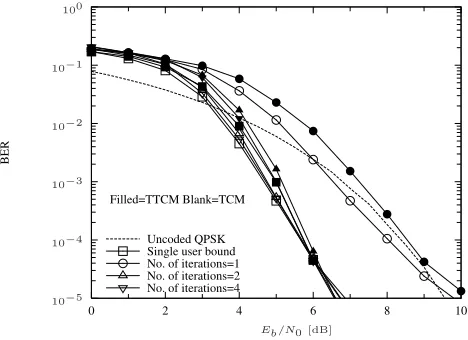
Figures 3 and 4 show the performance of the TTCM and TCM based8PSKmodulation scheme in both a syn-chronous and in an asynsyn-chronous scenario, respectively. We can observe that the iterative receiver is capable of approaching the single-user bound after two PIC-aided outer iterations, when communicating in a synchronous scenario, while four iterations are needed, when operat-ing in an asynchronous context.
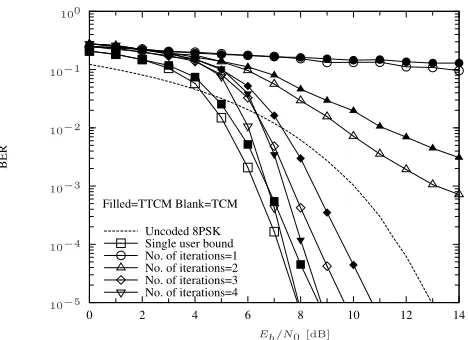
Furthermore, Figures 5 and 6 demonstrate that in a synchronous environment the PIC based iterative re-ceiver requires three iterations for approaching the single-user bound, when16QAMis employed. By contrast, the number of the outer iterations has to be increased to four in an asynchronous scenario for sake of achieving a near single-user performance.
Finally, Figure 7 characterises the PIC based iter-ative receiver’s performance, when communicating over an asynchronous two-path uncorrelated Rayleigh fading channel. As seen in Figure 7, the PIC based iterative re-ceiver requires 5 iterations for approaching the single user performance at a BER of 10−4, while supporting users
K= 10.
0 2 4 6 8 10
BER
Filled=TTCM Blank=TCM
Uncoded QPSK Single user bound No. of iterations=1 No. of iterations=2 No. of iterations=4
Eb/N0 [dB] 100
10−1
10−2
10−3
10−4
[image:4.612.310.545.132.304.2]10−5
Figure 3: The PIC and TCM/TTCM based iterative mul-tiuser detector’sBER versus Eb/N0 performance, when
communicating over a synchronous non-dispersive AWGN channel, while supporting K = 15 users. A
2
3-rate8PSKscheme having an effective throughput of 2
BPS was invoked.
0 2 4 6 8 10
BER
Filled=TTCM Blank=TCM
Uncoded QPSK Single user bound No. of iterations=1 No. of iterations=2 No. of iterations=4
Eb/N0 [dB] 100
10−1
10−2
10−3
10−4
10−5
Figure 4: The PIC and TCM/TTCM based iterative mul-tiuser detector’sBER versusEb/N0 performance, when
communicating over a asynchronous non-dispersive AWGN channel, while supporting K = 7 users. A 23 -rate 8PSK scheme having an effective throughput of 2 BPS was invoked.
0 2 4 6 8 10 12 14
BER
Filled=TTCM Blank=TCM
Uncoded 8PSK Single user bound No. of iterations=1 No. of iterations=2 No. of iterations=3 No. of iterations=4
Eb/N0 [dB] 100
10−1
10−2
10−3
10−4
[image:4.612.311.545.449.644.2]10−5
Figure 5: The PIC and TCM/TTCM based iterative mul-tiuser detector’sBER versusEb/N0 performance, when communicating over a synchronous non-dispersive AWGN channel, while supporting K = 15 users. A
3
4-rate 16QAM scheme having an effective throughput
of 3 BPS was invoked.
[image:4.612.48.282.495.665.2]0 2 4 6 8 10 12 14
BER
Filled=TTCM Blank=TCM
Uncoded 8PSK Single user bound No. of iterations=1 No. of iterations=2 No. of iterations=3 No. of iterations=4
Eb/N0 [dB] 100
10−1
10−2
10−3
10−4
[image:5.612.49.283.134.304.2]10−5
Figure 6: The PIC and TCM/TTCM based iterative mul-tiuser detector’sBER versus Eb/N0 performance, when
communicating over a asynchronous non-dispersive AWGN channel, while supportingK = 7 users. A 34 -rate16QAMscheme having an effective throughput of 3 BPS was invoked.
0 2 4 6 8 10 12 14
BER
Filled=TTCM Blank=TCM
Uncoded BPSK Single user bound No. of iterations=1 No. of iterations=3 No. of iterations=5
Eb/N0 [dB] 100
10−1
10−2
10−3
10−4
[image:5.612.48.284.454.644.2]10−5
Figure 7: The PIC and TCM/TTCM based iterative mul-tiuser detector’sBER versus Eb/N0 performance, when communicating over a asynchronous non-dispersive AWGN channel, while supportingK = 10 users. A 12 -rate codedQPSKscheme having an effective throughput of 1 BPS was invoked.
6. CONCLUSIONS
The PIC based iterative multiuser detector’s complexity per user bit is independent of the number of users sup-ported, which is an attractive property. In the context of TCM and TTCM aided8PSK modulation, the iterative receiver advocated is capable of approaching the single-user performance bound after two PIC turbo iterations, when communicating in a synchronous AWGN scenario. By contrast, four PIC turbo iterations are necessitated, when communicating in an asynchronous AWGN chan-nel. Furthermore, in the context of 16QAM the sys-tem approached the single-user bound after three iter-ations, when communicating in a synchronous environ-ment, while requiring an increased number of four iter-ations when communicating in an asynchronous AWGN channel. Finally, the system requires 5 PIC turbo itera-tions, when transmitting over an asynchronous two-path Rayleigh fading channel.
7. REFERENCES
[1] C. Douillard, A. Picart, M. Jezeuel, P. Didier, C. Berrou, and A. Glavieux, “Iterative correction of intersymbol in-terference: Turbo-equalization,” European Transactions on Telecommunications, vol. 6, pp. 507–511, September-October 1995.
[2] M. C. Reed, C. B. Schlegel, P. D. Alexander, and J. A. Asenstorfer, “Iterative Multiuser Detection for CDMA with FEC: Near single user performance,” IEEE Trans-actions on Communication, vol. 46, pp. 1693–1699, Dec. 1999.
[3] Y. Zhang, “Reduced complexity iterative multiuser detec-tion for DS/CDMA with FEC,” inInternational Confer-ence on Universal Personal Communications, no. 12, (San Diego, U.S.A), pp. 10–14, Oct. 1997.
[4] P. D. Alexander, A. J. Grant, and M. C. Reed, “Perfor-mance analysis of an iterative decoder for code-division mulitple-access,”European Transactions on Telecommuni-cation, vol. 9, pp. 419–426, Sept./Oct 1998.
[5] M. C. Reed,Iterative Receiver Techniques for Coded Mul-tiple Access Communication System. PhD thesis, The Uni-versity of South Australia, 1999.
[6] L. Hanzo, T. H. Liew, and B. L. Yeap, Turbo Coding, Turbo Equalisation and Space-Time Coding for Transmis-sion over Fading Channels. John Wiley-IEEE Press, 2002.
[7] A. Nordio, M. Hernandez, and G. Caire, “Design and per-formance of a low-complexity iterative multiuser joint de-coder based on viterbi decoding and parallel interference cancellation,”IEEE International Conference on Commu-nications, vol. 6, pp. 298–302, 28 April-2 May 2002.
[8] J. Boutros and G. Caire, “Iterative multi-user joint decod-ing: Unified framework and asymptotic analysis,” IEEE Transactions on Information Theory, vol. 48, pp. 1772– 1793, July 2002.
[9] S. Verdu,Multiuser Detection. Cambridge Press, 1998.