Study of Pushover Analysis and Column Removal
in Multi-Storey Building
Dr. S. G. Makarande1, S. P. Bezalwar2, Prof. G. D. Dhawale3, Prof. M. M. Lohe4
1, 2, 3,4
Department of Civil Engineering, Bapurao Deshmukh College of Engineering, Sewagram, India
Abstract: In this paper, a 3D finite element modelling is used to analysis the consecutive column removal scenario of multi storey steel building with composite steel frames. The nonlinear static analysis procedure was performed to check the behavior of structure under consecutive column removal scenarios. The analysis of the structure was detailed examined and displacement, base shear, plastic hinges are analysed in details.
Keywords: Finite element, Consecutive column removal, Modelling, Displacement, Base shear, Plastic hinges.
I. INTRODUCTION
The structural components in a typical multi-storey building, consists of a floor system which transfers the floor loads to a set of plane frames in one or both directions. The floor system also acts as a diaphragm to transfer lateral loads from wind or earthquakes. The frames consist of beams and columns and braces. As the height of the building increases beyond ten stories (tall building), it becomes necessary to reduce the weight of the structure for both functionality and economy. For example a 5% reduction in the floor and wall weight can lead to a 50% reduction in the weight at the ground storey. This means that the columns in the lower storeys will become smaller leading to more availability of space and further reduction in the foundation design.
II. LITERATURE REVIEW The earlier research carried out by various authors are studied in brief as follows,
Suraj B. Gaikwad, Prof. Mukund M. Pawar (2017)[1] present study is to analysis the progressive collapse of regular and irregular steel structure. For this G+15 regular as well as irregular building with missing column at different locations has been taken. For this linear static analysis, linear dynamic analysis, nonlinear static and nonlinear dynamic analysis of structure has been carried out. To compare the progressive collapse responses 2D and 3D models are prepared. Percentage change in the values of base shear, demand capacity ratio and roof displacement considering progressive collapse effect of structures has been carried out.
C. R. Chidambaram, Jainam Shah, A. Sai Kumar and K. Karthikeyan (2016) [2] paper has analyzed G+7 moment resisting steel frame residential building was analyzed using ETABS to predict the sensitivity of the structure to progressive collapse due to fire loads. Columns at different levels wereLekhraj Pandit, R. R. Shinde (2015) [3] given a temperature of 550̊ C with reduced material properties
and yield strength as per code IS 800. Progressive collapse load combination was adopted as per GSA guidelines. Corner, edge, intermediate and re-entrant columns were removed separately at alternate storeys. The lower storeys were found to be more susceptible than the upper storeys. Lekhraj Pandit, R. R. Shinde (2015) [3] paper aims to investigate the performance of steel bracing steel structure. In this project a steel building model is taken, this model is compared in different aspects such as axial force and bending moment in column and story displacement. Using different sections as bracing at critical storey Among these numbers of trials which type of bracing at critical section is more suitable from the observed results would be selected for the structure.
H. R. Tavakoli, F. Kiakojouri (2013) [5] present the study about progressive collapse capacity of steel moment frames was first investigated using alternate load path method, then a nonlinear dynamic analysis was carried out to examine the response of the steel moment frames in blast and sudden column loss scenario. The structural response of the building under sudden loss of column for different scenarios of column removal, with or without external blast loading was assessed in detail.
Feng Fu (2009) [8] paper presents a 3-dimensional finite element modelling technique developed by the author was used to analyse the progressive collapse of multi-storey buildings with composite steel frames. The nonlinear dynamic analysis procedure was performed to examine the behaviour of the building under consecutive column removal scenarios.
III. METHODOLOGY Analysis was done using ETABS 2016 software
A. Analysis was done assuming that the building is a Steel building.
B. Footing was idealized as fixed support.
C. The load cases adopted are dead load and live load, wind load and the seismic load.
D. Analysis was done for the load combinations given below:
1) Dead load + live load
2) Dead load + live load + wind load in (+ve) x – direction
3) Dead load + live load + wind load in (- ve) x – direction
4) Dead load + live load +earthquake load in (+ ve) x – direction
5) Dead load + live load +earthquake load in (- ve) x – direction
a) General details i) Total storey: 20
ii) Height per storey: 3m
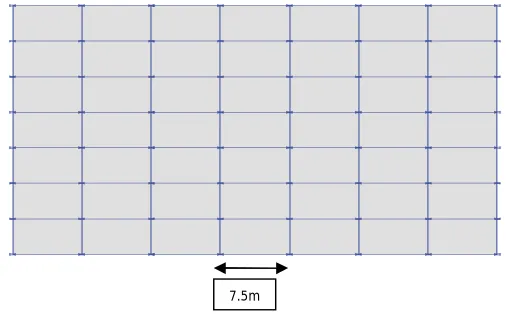
iii) Base plan area: 52.5 m x 52.5 m (7.5 m x 7.5 m bay)
b) Structural Details i) Column Size
1. For 1 to 7 storey: 2 ISMB 600 + 20mm Plate
2. For 8 to 20 storey: 2 ISMB 600
ii) Beam Size
1. For all storey: ISMB 500
iii) Loads on Structure 1. Live load: 1.5 kN/m2
2. Dead Load: 1.5 kN/m2
3. For Linear Static:
4. Zone factor = 0.24 (Zone IV)
5. For WIND LOAD:
6. Basic wind speed: 44 m/s
7. Terrain category : 2
8. Risk coefficient (K1) : 1
9. Topography factor (K2): 1
10. STEEL : Fe250
11. CONCRETE : M30
12. REBAR STEEL: HYSD415
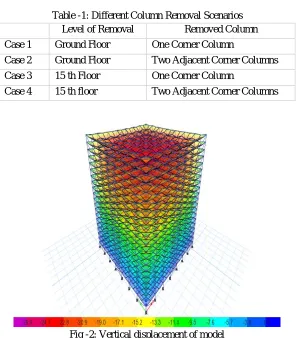
[image:2.612.178.431.550.707.2]Study of column removal scenario is mainly to get more occupancy. There are other more reason which are explained and sorted out in the United States, the Department of Defence (DoD) and the General Services Administration (GSA). Both employ the alternate path method (APM). The methodology is generally applied in the context of a ‘missing column’ scenario to assess the potential for progressive collapse and used to check if a building can successfully absorb loss of a critical member. FEMA 2002 and NIST 2005 also provide some general design recommendations, which require steel-framed structural systems to have enough redundancy and resilience, allow for alternative load paths and additional capacity redistributing gravity loads when structural damage occurs. Table 1 shows the list of analysis cases considered in this study.
Table -1: Different Column Removal Scenarios
Level of Removal Removed Column
Case 1 Ground Floor One Corner Column
Case 2 Ground Floor Two Adjacent Corner Columns
Case 3 15 th Floor One Corner Column
Case 4 15 th floor Two Adjacent Corner Columns
Fig -2: Vertical displacement of model
As shown in Fig. 2, as looking from top floor it shows top floor is in hogging condition and as going to the bottom it is becoming less hogging or in sagging condition.
[image:3.612.185.438.555.692.2]Chart -2: Storey Drift
Chart -3: Maximum Storey Displacement
In case 1, the column at ground floor was first removed. It is shown in Chart 3 that, node reached a peak vertical displacement of 54 mm. In case 2, with the 2nd column removal from ground level, the vertical defection started to increase again and reached a peak vertical displacement of 56 mm.
In case 3, the column at 15th floor was first removed. It is shown in Chart 3 that, node reached a peak vertical displacement of 51 mm. In case 4, with the 2nd column removal from 15th level, the vertical defection started to increase again and reached a peak vertical displacement of 52 mm.
Chart -4: Pushover Curve
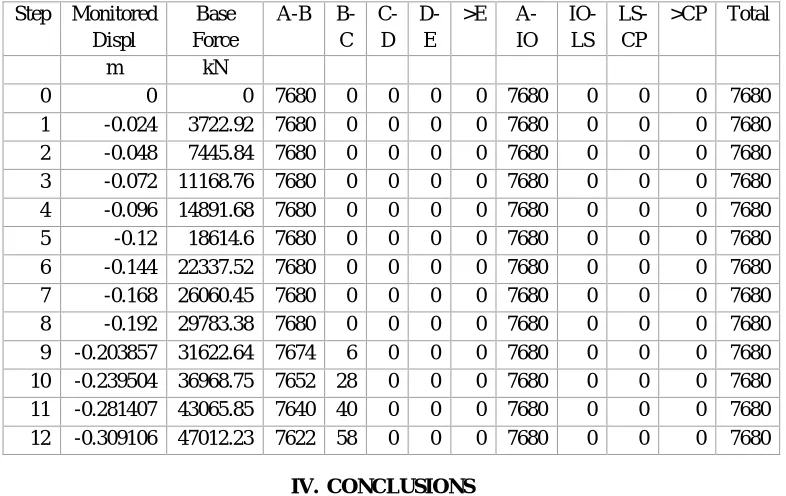
Table -2: Base shear vs. Monitored Displacement
IV. CONCLUSIONS
It may be concluded that optimally braced frames are stiff, strong, and an economical structural system. At the same time optimally braced one have least forces induced in the structure and produce maximum displacement but within prescribed limit.
Base shear force at performance point is 4986 kN which is checked with value of base shear force (7446 kN) of step no. 3 of pushover analysis. Hence it is required to see hinge formation at step no. 3. From fig. and pushover curve table it is clear that hinges formed in beams and columns are below immediate occupancy level. For a structure to be safe to use it requires no hinge formed above immediate occupancy level in governing step.
REFERENCES
[1] Suraj B. Gaikwad, Prof. Mukund M. Pawar, “Assessment of Progressive Collapse of Steel Structure”, International Journal of Engineering Science and Computing, Vol. 7, pp. 13697 – 13700, 2017.
[2] C. R. Chidambaram, Jainam Shah, A. Sai Kumar and K. Karthikeyan, “A Study on Progressive Collapse Behavior of Steel Structures Subjected to Fire Loads”, Indian Journal of Science and Technology, Vol. 9, pp. 1-7, 2016.
[3] Lekhraj Pandit, R. R. Shinde, “Study of Effect of Bracing on Critical Storey of High Rise Frame Structure”, International Journal of Engineering Research and General Science, Vol. 3, pp. 289–294, 2015.
[4] Seyyed Abdonnabi Razavi, Seyyed Afshin Mohebi, “Evaluation of the Destruction Procedure of Eccentric Braced Frames against Progressive Collapse using APM method”, Discovery, Vol. 22, pp. 7-13, 2014.
[5] H. R. Tavakoli, F. Kiakojouri, “Influence of Sudden Column Loss on Dynamic Response of Steel Moment Frames under Blast Loading”, International Journal of Engineering, Vol. 22, pp. 197-205, 2013.
[6] Behrouz Asgarian, Arezoo Sadrinezhad, Pejman Alanjari, “Seismic performance evaluation of steel moment resisting frames through incremental dynamic analysis”, Journal of Constructional Steel Research, Vol. 99, pp. 178-190, 2010.
[7] Kapil Khandelwal, Sherif El-Tawil, Fahim Sadek, “Progressive collapse analysis of seismically designed steel braced frames”, Journal of Constructional Steel Research, Vol. 65, pp. 699-708, 2009.
[8] Feng Fu, “3-D Nonlinear Dynamic progressive collapse Analysis of multi-storey steel composite frame buildings - parametric study”, Engineering structure December, Vol. 32, pp. 3974–3980, 2010.
[9] Feng Fu, “Progressive collapse analysis of high-rise building with 3-D finite element modelling method” J Constr Steel Res, Vol. 65, pp. 1269–1278, 2009. [10] H. S. Lew, “Analysis Procedures For Progressive Collapse of Buildings”, Building and Fire Research Laboratory, National Institute of Standards and
Technology, Gaithersburg, Maryland, U.S.A.
[11] Kaewkulchai Griengsak, Williamson Eric B, “Beam element formulation and solution procedure for dynamic progressive collapse analysis”, Comput Struct, Vol. 82, pp. 639–651, 2004.
[12] IS 456:2000, “Plain and Reinforced Concrete -Code of Practice”, 2000. [13] IS 800:2007, “General Construction in Steel- Code of Practice”, 2007.
[14] IS 1893 (Part 1) : 2002, “Criteria for Earthquake resistant Design of Structure”, 2002.
Step Monitored Displ
Base Force
A-B
B-C
C-D
D-E
>E A-IO
IO-LS
LS-CP
>CP Total
m kN
0 0 0 7680 0 0 0 0 7680 0 0 0 7680
1 -0.024 3722.92 7680 0 0 0 0 7680 0 0 0 7680
2 -0.048 7445.84 7680 0 0 0 0 7680 0 0 0 7680
3 -0.072 11168.76 7680 0 0 0 0 7680 0 0 0 7680
4 -0.096 14891.68 7680 0 0 0 0 7680 0 0 0 7680
5 -0.12 18614.6 7680 0 0 0 0 7680 0 0 0 7680
6 -0.144 22337.52 7680 0 0 0 0 7680 0 0 0 7680
7 -0.168 26060.45 7680 0 0 0 0 7680 0 0 0 7680
8 -0.192 29783.38 7680 0 0 0 0 7680 0 0 0 7680
9 -0.203857 31622.64 7674 6 0 0 0 7680 0 0 0 7680
10 -0.239504 36968.75 7652 28 0 0 0 7680 0 0 0 7680
11 -0.281407 43065.85 7640 40 0 0 0 7680 0 0 0 7680