Abstract— Energy Conservation and Balancing has been a
major issue in Wireless Sensor Networks in order to extend the lifetime of the network. This paper presents our model based on swarm Intelligence based Efficient Routing in which every node is associated with a Threshold Energy parameter which is introduced to control the Energy Conservation and Balancing in wireless sensor network. The performance evaluation of our proposed approach was conducted using NS-2 Simulator for variation of Threshold Energy of nodes in the networks reflecting different types of load or traffic patterns. Our simulation results show that optimal energy balancing and excellent energy conservation among nodes can be achieved by judiciously controlling the threshold energy associated with the nodes to prolong the network lifetime.
Index Terms— Wireless Sensor Network, Energy Balancing,
Energy Conservation, Threshold Energy, Network Lifetime, Swarm Intelligence, Ant colony based Efficient Routing
I. INTRODUCTION
rolonging lifetime of wireless sensor network becomes very essential for mission critical applications like battlefield surveillance where network nodes should continue to monitor and report for a longer period of time rather than becoming dead over a very short period or resulting in network disconnections or partitioning due to energy exhaustion or depletion. Due to the inherent constraints exhibited by wireless sensor network nodes such as limited non-chargeable battery energy, limited transmission range, low processor power and memory, it is required to devise novel techniques and approaches to achieve efficient utilization of energy and resources to extend the lifetime of the wireless sensor networks.
Several approaches have been proposed in the literature to mitigate the problem of energy balancing. In [1], a novel battery level aware clustering scheme (BLAC) is proposed for balancing energy consumption in clustered wireless sensor networks by considering the battery level combined with other metrics to elect the cluster-head. The cluster-head
Manuscript received July 19, 2016; revised August 10, 2016.
Dr. A. R. Naseer is Principal & Professor at the Department of Computer Science & Engineering, Jyothishmathi Institute of Technology &Science (JITS Karimnagar) affiliated to Jawaharlal Nehru Technological University (JNTU), Hyderabad, Telangana State, India (corresponding author phone: +91 9052430745; e-mail: [email protected]).
V. Neelima is Associate Professor at the Department of Computer Science & Engineering, Jyothishmathi Institute of Technology & Science (JITS Karimnagar) affiliated to JNTU Hyderabad, Telangana State, India (e-mail: [email protected]).
role is taken alternately by each node to balance energy consumption to improve network lifetime In [2], a mobile agent technology was introduced to investigate the problem of balancing the energy consumption during data collection in WSNs and proposed a method to mitigate the uneven energy dissipation problem by controlling the mobility of agents, which is achieved by an energy prediction strategy to find their positions. They proposed energy balancing cluster routing based on a mobile agent (EBMA) for WSNs wherein cluster structure is formed based on cellular topology by considering the energy balancing of inter-cluster and intra-cluster environments to achieve better performance. A balancing energy-aware sensor management protocol (BESM) for WSN based on PEAS (Probing Environment and Adaptive Sleeping) is proposed in [3]. BESM allots more sleep time to those nodes that have less energy by using negotiation strategy based on energy and energy saving method of nodes on the edge. In [4], the imbalanced energy consumption of hybrid clustering and routing (HCR) strategy used in cluster-based topology for multi-hop data collection in WSNs is evaluated and a new protocol is proposed which includes the adaptive relay selection and tunable cost functions to balance the energy consumption. [5] proposes two algorithms for balancing the energy dissipation in heterogeneous cluster-based WSNs - unequal width hybrid communication and equal width hybrid routing communication. Both algorithms use a hybrid data transmission mode which consists of a probability based energy balancing scheme that divides the network into K rings of unequal and equal widths respectively and find a set of probabilities for each ring to balance the energy consumption. It has been observed that the unequal width hybrid communication mode is better in extending the network lifetime as it tries its best to balance as well as minimize the energy consumption of the nodes. [6] proposed a load balancing technique distributing the traffic generated by each sensor node through multiple paths instead of using a single path to achieve significant energy savings and also proposed a new analytical model for load-balanced systems. In [7], the energy equilibrium problem was formulated as an optimal corona division, where data fusion and data slice are both considered in data gathering process. For a circular multi-hop sensor network with uniform node distribution and constant data reporting, the energy equilibrium of the whole network is unable to be realized. However, the maximum energy equilibrium for a given circular area can be achieved only if the area increases in geometric progression from the outer corona to the neighbor inner corona except for the outermost one. Moreover, a
Impact of Threshold Energy Control on Energy
Conservation and Balancing in Swarm
Intelligence Based Efficient Routing for
Wireless Sensor Networks
V. Neelima, Member IAENG and A. R. Naseer, Senior Member IEEE
zone-based allocation scheme is used to guarantee energy equilibrium of intra-corona. The approach for computing the optimal parameters is presented in terms of maximizing network lifetime. Based on the mathematical model, an energy equilibrium routing based on corona structure (EERCS) is proposed. The approach proposed in [8] discusses the problem of maximizing the network lifetime via energy balancing in the context of heterogeneous sensor deployment. It uses a distributed, adaptive data propagation algorithm that exploits limited, local density information for achieving energy-balanced propagation while at the same time keeping energy dissipation at low levels.
In [9], we proposed our model SIBER-XLP, Swarm Intelligence Based Efficient Routing protocol for WSN with Improved Pheromone Update Model and Optimal Forwarder Selection Function. There are two variants of the routing protocols named as SIBER-ELP (with Equal Link Probability) and SIBER-VLP (with Variable Link Probability) designed specifically to suit the environment where the WSN nodes are deployed. SIBER-ELP represents the routing protocol for WSN deployed in Normal Environment, i.e., in-house deployment for Environment, Health-care and Commercial applications, i.e., top of the buildings, hospitals, Commercial complexes where it is assumed that network nodes have stronger links with equal link probabilities. SIBER-VLP represents the routing protocol for WSN deployed in Harsh Environment - in the battlefield, forest, disaster prone areas where environment conditions keep changing drastically. In these zones, it is assumed that the network nodes will have links with varying link probabilities. These two variants are introduced in order to highlight the importance of link quality of the path in harsh environments or in environments where path link quality vary drastically due to environmental conditions which should also be taken into account in order to select the forwarder nodes with good quality links and to reinforce a good quality path with enough pheromone to make it to be selected as the optimal path to reach the sink from source. SIBER-VLP performs better when compared to SIBER-ELP in all respects by taking into consideration actual quality of links along the path in addition to all other metrics whereas SIBER-ELP does not take into account the actual link probabilities, instead assumes that all links have higher equal link probabilities which is only true in normal environments. It is observed that most of approaches reported in the literature for energy balancing consider a particular network topology with destination at the centre. Some approaches use Hierarchical network topology which is considered to be most suited for implementing energy balancing. It is to be noted here that network with random topology where nodes are distributed randomly, one will never always get optimal energy balancing among all the nodes in all the possible paths from source to sink. This is because all possible paths from source to sink will never have same number of hops or distance. This will always lead to suboptimal (uneven) energy balancing as shorter paths will be used most of the time when compared to longer paths even in multipath routing due to the node and path selection criteria used. Node and path selection criteria include node battery energy, link quality, shortest path between source & sink, low latency etc.
In order to achieve energy conservation along with energy balancing, our approach introduces a threshold energy
parameter Eth which is associated with every node. The threshold Energy Eth can be varied from a low value to a high value and each node or group of nodes in the network can have a different value of Eth. By keeping the Threshold Energy Eth at a higher value, more energy of the battery can be saved for future use. In situations where in suboptimal energy balancing among nodes is noticed, Eth plays an important Role by not allowing the nodes in the optimal path (mostly nodes in the shorter path with good energy and link quality) to consume energy below the specified Threshold Energy level thereby preventing them from participating in the packet forwarding. At the same time, neighbouring nodes of these nodes will be given a chance to forward the packets as long as their energy levels are above their associated Eth values. In this way, all nodes in the neighbourhood of a node of concern will participate in packet forwarding resulting in optimal energy balancing among nodes and excellent energy conservation among all the participating nodes, thereby extending the lifetime of the network. In other words, this energy conservation prolongs the lifetime of all the participating nodes thereby reducing the number of dead nodes in the network over a long period of time.
The rest of the paper is organized as follows. Section II presents the motivation and proposed work. The simulation setup, Results, performance evaluation of our approaches are presented in Section III, followed by concluding remarks in section IV.
II. MOTIVATION AND PROPOSED WORK
In this section, we illustrate the significance of Threshold Energy Eth which describes the motivation behind introducing this new parameter and then our proposed model SIBER-XLP [9] incorporating this new parameter will be presented briefly.
A. Threshold Energy – Eth
In this section, we highlight the significance of introducing Threshold Energy and discuss the impact of threshold energy control on the energy conservation and balancing among nodes in a wireless sensor network.
In our proposed model, every node in the network is associated with a Threshold Energy, Eth which is defined as the energy at which the node loses its right to participate in packet forwarding. In order to be considered for packet forwarding, available Energy of the neighboring node should be greater than the threshold Energy Eth. We also introduce another parameter, the least minimum threshold (Ethmin) at
which point node will stop participating in forwarding of packets due to energy depletion or disconnection from the network and is totally excluded from the path.
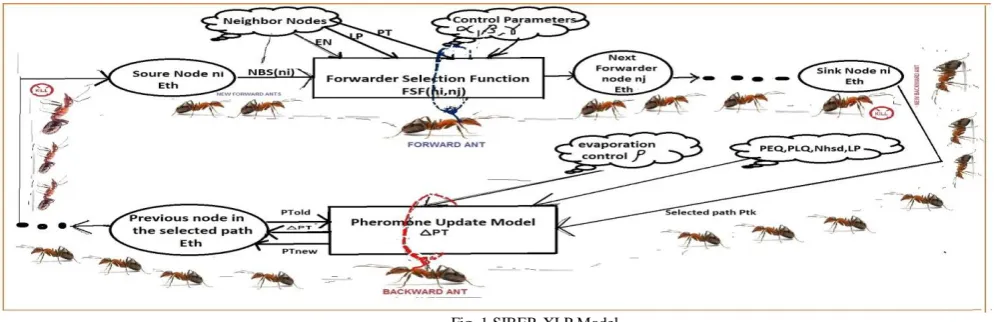
Fig. 1 SIBER-XLP Model conservation and balancing among neighboring nodes of a
node under consideration. When energy of all the neighboring nodes reach this threshold, then Eth can be lowered to an appropriate value, keeping in view that one of the quality neighbor nodes should always be available for packet forwarding. Or it can be set to the least minimum threshold (Ethmin) at which point node will stop participating
in forwarding of packets due to energy depletion or disconnection from the network. For example, to conserve energy for later use and to perform load balancing, initially Eth can be raised to 50% of the Initial Energy, EI so that most of the nodes will participate in packet forwarding/processing till the threshold energy is reached rather than some nodes getting depleted faster due to the prevailing higher importance attached to other parameters controlling the selection of good quality paths. Later depending on the traffic or type of processing, Eth can be lowered to a reasonable value in order to extend the lifetime of the network.
It is to be noted that the significance of Threshold Energy, Eth becomes more evident when the network has to handle varying type of load or traffic. Depending on the type of load and traffic patterns, the Eth of nodes can be varied to conserve energy of all the participating nodes and make these nodes to participate alternately to achieve proper energy balancing. For example, consider data applications dealing with three types of load or traffic, low, medium and high. In such situations, we can have three levels of Eth – for lower traffic, high value of Eth is associated with the participating nodes so that small portion of the battery energy is made available for utilization. For example, Eth can be set to a value between 70 or 80% of the battery energy so that only small amount energy 20 to 30% of the battery energy will be made available for processing and forwarding low traffic. In the case of medium traffic, Eth of the participating nodes can be set to a medium value say, for example, 50% of the available battery energy so that only 50% of the battery energy is made available for utilization. Similarly, for applications involving high traffic, a low value is assigned to Eth, say, for example, 20 to 30% of the battery available energy, so that the participating nodes will have high amount of energy, say, for example, 70 to 80% of the battery energy will be available to handle higher traffic. Further, in the case of heterogeneous network with nodes having different capabilities in terms of battery energy, bandwidth, communication links, processing power, etc., Eth becomes more important in order to put a cap on the amount of energy from nodes to be made available for utilization based on the capabilities of these nodes. This would help in
conserving the energy of lower capable nodes thereby making them participate in packet processing/forwarding only when they are required. Moreover, higher capability nodes will be made to participate in forwarding most of the time or until their available energy becomes equal to or less than Eth.
In multipath routing, one may not always get a balanced tree or paths to reach the destination with almost similar latency or hop count. Due to the preference given to the paths with shorter distance with higher energy, same shorter path or paths will be selected most of the time, thereby rapid decrease in energy of the nodes along these paths due to improper load/energy balancing. In such situations, Eth control plays an important role in making these neighbor nodes not to participate in packet forwarding, if their available energy becomes equal to or less than Eth. This feature of Eth control results in conservation of energy in these nodes for future use and provides opportunity for less dominant nodes in the neighborhood to participate in packet forwarding giving equal chance for all neighboring nodes to participate in packet forwarding until all their energy level reach Eth, thereby resulting in proper energy conservation and balancing among the neighboring nodes all the time.
B. SIBER – XLP MODEL
In this section, we briefly present our proposed Model SIBER-XLP, Swarm Intelligence Based Efficient Routing protocol for WSN with Improved Pheromone Update Model and Optimal Forwarder Selection Function. The detailed discussion on this model can be found in [9]. Figure 1 shows our proposed model SIBER-XLP which has two main components - Optimal Forwarder Selection Function and Improved Pheromone update model.
The Forwarder Selection Function, FSF is a probability function that is used to select the best forwarder node among the neighboring nodes of the current node, which is based on Pheromone Trail(PT) and heuristic function involving two parts representing Node Energy level(EN) and node link quality(LP) functions which is defined as
FSF(ni,nj)= {
[PT(ni,nj)]α[EN(nj)]β[LP(ni,nj)]γ
∑𝑛𝑗∊𝑁𝐵𝑆(𝑛𝑖)[PT(ni,nj)]α[EN(nj)]β[LP(ni,nj)]γ, 𝑖𝑓 𝑛𝑗 ∊ 𝑁𝐵𝑆(𝑛𝑖), 0 , 𝑜𝑡ℎ𝑒𝑟𝑤𝑖𝑠𝑒
} − (1)
deposited on the path between the nodes ni & nj. EN(nj) represents the energy level of the neighbor node nj. α,β,γ are the parameters to control the significance or importance of pheromone trail of the path, node energy level and link quality between nodes. The quality of the link between nodes ni and nj, i.e., link probability, LP(ni,nj) between nodes ni & nj is given by the expression :
LP(ni, nj) = 1
𝐸𝑇𝑋(𝑛𝑖,𝑛𝑗) -(2) where Expected Transmission Count, ETX is a measurement of the transmission link which is calculated based on the past events occurred on that link. The node energy level, EN(nj) is defined as
EN(nj)=𝐸𝑅(𝑛𝑗)
𝐸𝐼(𝑛𝑗) where ER(nj) > Eth -(3) where EI(nj) represents the initial energy of node nj and ER(nj), the Remaining (Actual) Energy of node nj and Eth represents the Threshold Energy.
The Pheromone update model has been designed considering the parameters that the forward ant has collected during its travel from source to the destination. The following parameters collected by the forward ant are used to compute the Pheromone trail once the forward ant reaches the destination - Eavg, Average energy of the nodes in the path traversed by forward ant, Emin, Minimum energy of the nodes in the path traversed by forward ant, Nhsd, Distance travelled by the forward ant from source to destination, i.e., number of hops, LPsd, Link quality of the path traversed by the forward ant from source to sink, Ptk path traversed by forward ant k from source to destination having Nhsd(Ptk) hops.
The Pheromone update or the concentration of additional pheromone to be deposited is computed as given by the following expression:
𝛥𝑃𝑇 = Path Energy Quality * Path Link Quality
= PEQ(Ptk) * PLQ(Ptk) = (𝐸𝑎𝑣𝑔
𝐸𝑖𝑛 − (1 −
𝐸𝑚𝑖𝑛 𝐸𝑎𝑣𝑔)) ∗
LPsd(Ptk)
𝑁ℎ𝑠𝑑(𝑃𝑡𝑘) -(4) The equation (4) captures the impact of Average Energy and Minimum energy of the nodes along the shortest path with better path link quality on the concentration of pheromone deposition. Higher average energy and higher Minimum Energy of nodes along the path would yield a good quality path in terms of Energy. In other words, good quality shorter path with high average energy and higher value of minimum energy will result in more amount of pheromone to be deposited on that path rather than the path with low minimum and average energy.
Once the forward ant reaches the destination, 𝛥𝑃𝑇 is computed using the parameter values provided by the forward ant and the forward ant gets killed. Next backward ant is created at the sink node with the computed
𝛥𝑃𝑇 𝑎𝑛𝑑 Nhsd. The Pheromone updation is done by the
backward ant in the reverse direction during its travel from destination node to source node as shown in figure 1. Whenever a node ni receives a backward ant coming from a neighboring node nj, it updates 𝑃𝑇(𝑛𝑖, 𝑛𝑗) in its routing table in the following manner:
𝑃𝑇(𝑛𝑖, 𝑛𝑗) = (1 − 𝜌)𝑃𝑇(𝑛𝑖, 𝑛𝑗) + 𝛥𝑃𝑇 -(5)
where 𝜌 is a decay coefficient and (1- 𝜌) represents the evaporation of Pheromone trail since the last time updating of 𝑃𝑇(𝑛𝑖, 𝑛𝑗).
III. RESULTS AND DISCUSSION
Our proposed system SIBER-XLP (SIBER-ELP & SIBER-VLP) with threshold energy, Eth associated with each node was simulated using open source NS-2 simulator. In this simulation, we have considered static network scenario with random topology and network with 25 nodes. The performance evaluation metrics used in this simulation are Energy Consumed by each node, Available Energy of each node, Energy Efficiency(Kb/J), Standard Deviation, Packet Delivery Ratio, Latency, which are defined as follows. Packet Delivery Ratio, PDR is defined as the ratio of total number of packets received at the sink node to the total number of packets generated at the source node. Energy Consumed is defined as the total energy consumed (in joules) by each node in the network during the period of simulation. Energy Efficiency is defined as the ratio of total packets delivered at the destination to total energy consumed by the sensor nodes in the network. Latency is defined as the difference in time when a packet is generated at the source node and when it eventually gets delivered at the sink node, that is nothing but the time delay of a packet sent from the source node to reach the destination node. Standard Deviation σ is defined as the average variation between energy levels of all nodes in the network (in joules)
σ = √∑𝑁𝑆−1𝑖=0 (𝐸𝑅𝑛𝑖− µ)2
[image:4.595.321.531.471.658.2]𝑁𝑆 -(6) where NS is the total number of nodes in the network, ERni is the remaining Energy of node ni in the network and µ is the mean of the energy levels of all the nodes in the network.
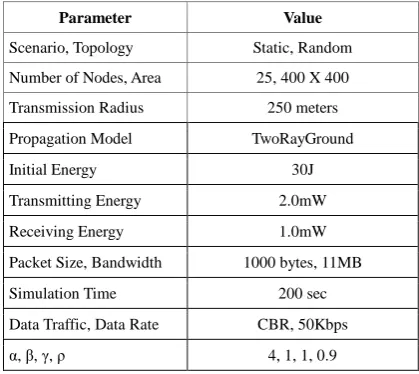
Table 1: Static Scenario - Simulation Parameters
Parameter Value
Scenario, Topology Static, Random
Number of Nodes, Area 25, 400 X 400
Transmission Radius 250 meters
Propagation Model TwoRayGround
Initial Energy 30J
Transmitting Energy 2.0mW
Receiving Energy 1.0mW
Packet Size, Bandwidth 1000 bytes, 11MB
Simulation Time 200 sec
Data Traffic, Data Rate CBR, 50Kbps
α, β, γ, ρ 4, 1, 1, 0.9
high. Accordingly, we have three levels of Eth values. For lower traffic, Eth is set to 2/3 of the initial or available energy. In our simulation, every node is associated with a initial battery energy of 30J. Hence, for low traffic, Eth is set to 20J so that small portion of the battery energy, in this case, 10J is made available for utilization for each node. For medium traffic, Eth is set to 50% of initial or available energy, i.e., in our simulation Eth is set to 50% of initial energy, i.e., 15J so that only 50% of the battery energy is made available for processing and packet forwarding. Similarly, for applications having high traffic, a low value is assigned to Eth, i.e., in our simulation, Eth is set to 1/3 of initial or available energy, i.e., Eth is set to 10J, so that participating nodes will have high amount of energy 20J to handle higher traffic. The simulation results for SIBER-ELP and SIBER-VLP are discussed next.
A. SIBER-ELP MODEL
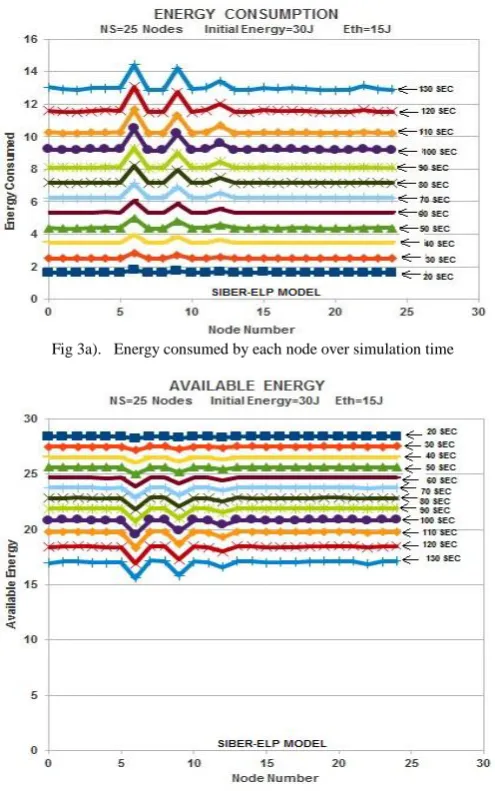
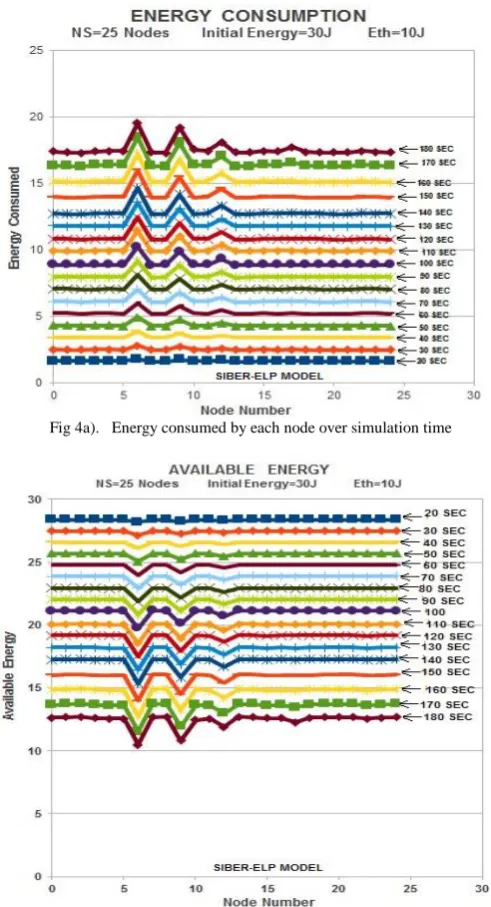
Fig 2a) and 2b) show the plots for energy consumption, and energy conservation over simulation time for Eth =20J (for lower traffic). For medium traffic, Eth = 15J, the plots for energy consumption and energy conservation over simulation time are depicted in 3a) and 3b). The plots for energy consumption and energy conservation over different simulation period for Eth=10J (high traffic) are given in fig 4a) and 4b).
Fig 2a). Energy consumed by each node over simulation time
It is clearly seen from energy consumption plots that as simulation time increases, more energy is consumed in the network as more and more nodes from different paths are involved in the packet transfer. At the same time, the consumed energy does not exceed the threshold energy. Also it is interesting to see that energy consumption is balanced among the participating nodes as nodes along both shorter and longer paths will participate in the packet forwarding due to the restriction put by the Eth control as only the specified amount of energy 10J/15J/30J is available for consumption at each node. At the end of the simulation, one could see that almost all participating nodes will have same amount of energy available resulting in optimal energy balancing and excellent energy conservation for future use, thereby extending the network lifetime. The energy conservation of the network is 66% of the initial energy for Eth=20J, 50% for Eth=15J and 33% for Eth= 10J.
As it is seen from Energy Consumption and Energy Available graphs, the approach balances the energy on the network and simultaneously conserves energy for all the three cases. With the increase in simulation time, available
energy decreases but does not go below the threshold energy in each case.
Fig 2b). Energy conserved at each node over simulation time
Fig 3a). Energy consumed by each node over simulation time
Fig 3b). Energy conserved at each node over simulation time
[image:5.595.307.547.79.271.2] [image:5.595.305.553.296.692.2] [image:5.595.47.293.376.527.2]energy Efficiency of the network increases with the increase in simulation time. The packet delivery ratio is almost 99.8% throughout the simulation, and most of the nodes are involved in the packet delivery achieving optimal energy balancing and the required energy conservation at each node.
Fig 4a). Energy consumed by each node over simulation time
Fig 4b). Energy conserved at each node over simulation time
B. SIBER – VLP MODEL
The plots for energy consumption and energy conservation over simulation time for Eth =20J (for lower traffic are shown in fig 5a) and 5b). For medium traffic, Eth = 15J, the plots for energy consumption and energy conservation over simulation time are depicted in 6a) and 6b). The plots for energy consumption and energy conservation over different simulation period for Eth=10J (high traffic) are given in fig 7a) and 7b). It is clearly seen from energy consumption plots that as simulation time increases, more energy is consumed in the network as more and more nodes from different paths are involved in the packet transfer. At the same time, the consumed energy does
not exceed the threshold energy. Also it is interesting to see that energy consumption is balanced among the participating nodes as nodes along both shorter and longer paths will participate in the packet forwarding due to the restriction put by the Eth control as only the specified amount of energy 10J/15J/30J is available for consumption at each node.
Fig 5a). Energy consumed by each node over simulation time
Fig 5b) Energy conserved at each node over simulation time
Fig 6a). Energy consumed by each node over simulation time
At the end of the simulation, one could see that almost all participating nodes will have same amount of energy available resulting in optimal energy balancing and excellent energy conservation for future use, thereby extending the network lifetime. The energy conservation of the network is 66% of the initial energy for Eth=20J, 50% for Eth=15J and 33% for Eth= 10J.
[image:6.595.48.294.119.573.2] [image:6.595.51.290.127.332.2] [image:6.595.306.552.128.471.2] [image:6.595.185.538.131.618.2] [image:6.595.308.545.481.673.2]network and simultaneously conserves energy for all the three cases. With the increase in simulation time, available energy decreases but does not go below the threshold energy in each case.
Fig 6b). Energy conserved at each node over simulation time
Fig 7a). Energy consumed by each node over simulation time
Fig 7b). Energy conserved at each node over simulation time
Latency increases slightly as the simulation time increases, but there is no much difference in latency till 60 seconds as less number of hops are involved. It increases slightly as the simulation time increases because of more number of nodes are involved in the packet forwarding
which balances energy on the nodes in the network. The energy efficiency of the network increases with the increase in simulation time. The packet delivery ratio is almost 100% throughout the simulation, and most of the nodes are involved in the packet delivery achieving optimal energy balancing and the required energy conservation at each node.
IV. CONCLUSION
In this paper, we have presented a novel way of achieving optimal energy balancing with high energy conservation to extend the lifetime of wireless sensor networks by associating every node in the network with a threshold energy parameter which can be controlled to suit the varying types of load and traffic patterns. Using NS-2 simulator, we have performed performance evaluation of our proposed system SIBER-XLP by controlling the threshold energy associated with each node in the network for different types of load and traffic patterns. Simulation results show that depending on the type of load and traffic patterns, threshold energy can be varied to conserve energy of all the participating nodes and make these nodes to participate alternately to achieve balanced energy consumption at the participating nodes. Our simulation results further indicate that both our proposed protocols ELP and SIBER-VLP perform extremely well under the control of threshold energy in achieving optimal energy balancing and excellent energy conservation with higher packet delivery ratio, energy efficiency and lower latency.
REFERENCES
[1] Tony Ducrocq, Michaël Hauspie and Nathalie Mitton, “Balancing Energy Consumption in Clustered Wireless Sensor Networks”, Hindawi Publishing Corporation, ISRN Sensor Networks, Volume 2013, Article ID 314732, 14 pages.
[2] Kai Lin, Min Chen, Sherali Zeadally, Joel J.P.C. Rodrigues, “Balancing energy consumption with mobile agents in wireless sensor networks”, K. Lin et al., Future Generation Computer Systems 28(2) : 446-456, February 2012.
[3] Wei Liang, Haibin Yu, Peng Zeng, and Chang Che , “BESM: A Balancing Energy-aware Sensor Management Protocol for Wireless Sensor Network”, International Journal of Information Technology, Vol. 12, No.4 2006.
[4] Zhezhuang Xu , Liquan Chen , Ting Liu , Lianyang Cao and Cailian Chen , “Balancing Energy Consumption with Hybrid Clustering and Routing Strategy in Wireless Sensor Networks”, Sensors 2015, 15(10), 26583-26605; doi:10.3390/s151026583.
[5] Kavi Kumar Khedo Bhama Imrith,, Reduit, “Hybrid Data Transmission Algorithms for Energy Balancing in Wireless Sensor Networks”, International Journal of Computer Applications (0975 – 8887) , Volume 2 – No.9, June 2010.
[6] Fatma Bouabdallah, Nizar Bouabdallah and Raouf Boutaba,“Load-Balanced Routing Scheme for Energy-Efficient Wireless Sensor Networks”, IEEE Communications Society, IEEE "GLOBECOM" 2008 proceedings..
[7] Kai Lin and Min Chen, “Energy equilibrium based on corona structure for wireless sensor networks”, Wireless Communications and Mobile Computing, Published online in Wiley Online Library (wileyonlinelibrary.com), 2010.
[image:7.595.47.298.92.729.2]