Proceedings of NAACL-HLT 2019, pages 3280–3290 3280
Relation Discovery with Out-of-Relation Knowledge Base as Supervision
Yan Liang1, Xin Liu1, Jianwen Zhang2, and Yangqiu Song1
1Department of CSE, Hong Kong University of Science and Technology, HK 2Microsoft, USA
1{
yliangav, xliucr, yqsong}@cse.ust.hk
2{
jiazhan}@microsoft.com
Abstract
Unsupervised relation discovery aims to dis-cover new relations from a given text cor-pus without annotated data. However, it does not consider existing human annotated knowl-edge bases even when they are relevant to the relations to be discovered. In this pa-per, we study the problem of how to use out-of-relation knowledge bases to supervise the discovery of unseen relations, where out-of-relation means that out-of-relations to discover from the text corpus and those in knowledge bases are not overlapped. We construct a set of constraints between entity pairs based on the knowledge base embedding and then incor-porate constraints into the relation discovery by a variational auto-encoder based algorithm. Experiments show that our new approach can improve the state-of-the-art relation discovery performance by a large margin.
1 Introduction
Relation extraction has been widely used for many applications, such as knowledge graph construc-tion (Dong et al.,2014), information retrieval (Liu et al., 2014), and question answering ( Ravichan-dran and Hovy,2002). Traditional supervised ap-proaches require direct annotation on sentences with a relatively small number of relations (Roth and Yih,2002;Kambhatla, 2004).1 With the de-velopment of large-scale knowledge bases (KBs) such as Freebase (Bollacker et al., 2008), rela-tion extracrela-tion has been extended to larger scales comparable to KBs using the distant supervi-sion (Mintz et al.,2009). However, when the train-ing corpus does not support the annotated relations showing in the KB, such approach could fail to find sufficient training examples. Distant super-vision assumption can be violated by up to 31%
1We distinguish a relation (e.g., a predicate in a knowl-edge base) from the relation expression (e.g., the text surface between entities in a sentence) throughout the paper.
for some relations when aligning to NYT corpus (Riedel et al., 2010). More importantly, either traditional supervised learning or distantly super-vised learning cannot discover new relations un-seen in the training phase.
Unsupervised relation discovery tries to over-come the shortcomings of supervised or distantly supervised learning approaches. Existing ap-proaches either extract surface or syntactic pat-terns from sentences and use relation expressions as predicates (which result in many noisy rela-tions) (Etzioni et al., 2004; Banko et al., 2007), or cluster the relation expressions based on the ex-tracted triplets to form relation clusters (Yao et al.,
2011,2012;Marcheggiani and Titov,2016). How-ever, these approaches do not use existing high-quality and large-scale KBs when they are relevant to the relations to be discovered.
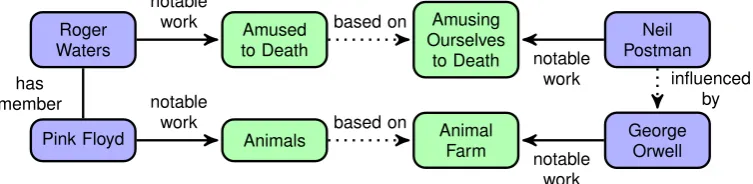
In this paper, we consider a new relation dis-covery problem where both the training corpus for relation clustering and a KB are available, but the relations in the training corpus and those in the KB are not overlapped. As shown inFigure 1, in the KB, we have entitiesPink Floyd, Animals, etc., with some existing relations notable work
and has member in the KB. However, when do-ing relation discovery, we can only get support-ing sentences that suggest new relationsbased on
andinfluenced by. This is a common and practical problem since predicates in KBs are limited to the annotator defined relations while the real relations in the world are always open and creative.
Pink Floyd Roger Waters
Animals Amused to Death
Amusing Ourselves
to Death
Animal Farm
George Orwell
Neil Postman
Amused to Deathwas inspried by Neil Postman’s bookAmusing Ourselves to Death.
Loosely based on George Orwell’sAnimal Farm,Animalsdescribe various classes in society as different kinds of animals
Postmandistinguishes theOrwellianvision of the future, from that offered by Aldous Huxley in Brave New World.
has
member notable work notable
work
notable work
notable work based on
based on
[image:2.595.106.483.71.163.2]influenced by
Figure 1: An illustration of our new relation discovery setting. The konwledge base contains relationsnotable work
andhas member. However, the training corpus to perform relation discovery only contains new relationsbased on
andinfluenced by.
KB. For example, inFigure 1, when we cluster the
based on relation, we can evaluate the similarity between the tuple (Animals, Animal Farm) and the tuple (Amused to Death, Amusing Ourselves to Death) based on the KB. If the KB tells us these two pairs of tuples are close to each other, then we put a constraint to force our relation clustering algorithm to group them to-gether.
We use the discrete-state variational autoen-coder (DVAE) framework (Marcheggiani and Titov,2016) as our base relation discovery model since this framework is flexible to incorporate dif-ferent features and currently the state-of-the-art. We use KB embedding (Bordes et al.,2013) to ob-tain entity embeddings in the KB and use entity embeddings to evaluate the similarity between a pair of tuples. Then constraints are constructed and incorporated into the DVAE framework in a way inspired by the must-link and cannot-link based constrained clustering (Basu et al., 2004). We show that with no overlapped relations be-tween the KB and the training corpus, we can im-prove the relation discovery by a large margin.
Our contributions are summarized as follows.
• We study a new prevalent but challenging task of relation discovery where the training corpus and the KB have no overlapped rela-tion.
• We propose a new kind of indirect supervi-sion to relation discovery which is built based
on pairwise constraints between two tuples.
• We show promising results using existing re-lation discovery datasets to demonstrate the effectiveness of our proposed learning algo-rithm for the new relation discovery task.
The code we used to train and evaluate our models is available athttps://github.com/ HKUST-KnowComp/RE-RegDVAE.
2 Problem Definition
We use X to denote the set of all training sen-tences. V is the set of named entities that are rec-ognized by an NER system inX, and(e1, e2) is the pair of first and second entities in a given sen-tencex ∈ X. RX is the set of relation labels for
X. In addition, there exists an external knowledge baseG(EG,TG), consisting of a set of entities EG
and relations RG and triplets TG where a triplet consists of two entities with their relation.
Our model is a relation extractor to predict the underlying semantic relationr ∈ RX given
sen-tences X, with the help of G(EG,TG). In
partic-ular, we focus on the challenging scenario where RX ∩ RG =∅.
3 Model
3.1 DVAE for Relation Discovery
Assuming that we perform generative modeling, where each latent relation r follows a uniform prior distributionpu(r), we follow (Marcheggiani and Titov,2016) to optimize a pseudo-likelihood:
L(θ) = log X r∈RX
p(ei, e−i|r, θ)pu(r) (1)
≈ 2
X
i=1
log X
r∈RX
p(ei|e−i, r, θ)pu(r), (2)
where ei and e−i are entities, i ∈ {1,2} and
e−i denotes the complement {e1, e2} \ {ei}.
p(ei|e−i, r, θ)is the probability of one entity given
another entity as well as the relation, whereθ de-notes the set of parameters. Note that this proba-bilitypis defined on the triplet(e1, r, e2)which is universal across different sentences containing the two entities.
The pseudo-likelihood L(θ) can be lower-bounded based on Jensen’s inequality through a variational posteriorq(r|x, ψ):
L(θ, ψ) =
2
X
i=1
X
r∈RT
q(r|x, ψ) logp(ei|e−i, r, θ)
+αH[q(r|x, ψ)],
(3)
whereq(r|x, ψ)predicts the relation based on the whole sentencexas an input andψas the set of pa-rameters.His the entropy to regularize the proba-bility distributionq, andαis the hyper-parameter to balance the regularization strength.
This model consists of two components, an encoder q(r|x, ψ) which encodes sentence fea-tures into a relation distribution, and a decoder p(ei|r, e−i, θ) which predicts an entity given the
relation cluster and another entity. Both are mod-eled by softmax functions:
q(r|x, ψ) = exp (w
|
rg(x)) P
r0∈R
X exp w
|
r0g(x)
, (4)
p(ei|e−i, r, θ) =
exp (φ(ei, e−i, r, θ)) P
e0i∈Vexp (φ(e0i, e−i, r, θ))
,
(5)
where ψ = {wr|r ∈ RX} and g(x) is a
vector representation of sentence x, which can be high-dimensional one-hot feature encodings or low-dimensional sentence embeddings encoded by deep neural networks. φ(e1, e2, r, θ) can be
a general scoring function defined over triplets. We use the instantiation with the best performance shown by (Marcheggiani and Titov,2016), which is a combination of bilinear model and selectional preference model:
φ(e1, e2, r, θ) =e|1Cre2+ [e1,e2]|r (6)
whereθ = {Cr,r,ei|r ∈ RT, ei ∈ V},Cr is a
matrix,ris a vector for the relationr,e1ande2are the vectors for head and tail entities respectively, and[e1,e2]is the concatenation of the vector rep-resentations of the two entities.
The DVAE model directly optimizes the vari-ational lower bound by doing gradient ascent for θ andψ jointly. Both encoder q(r|x, ψ) and de-coder p(ei|r, e−i, θ) are implemented as neural
networks. Standard training techniques and tricks can be applied.
3.2 Knowledge Base Constraint
Our KB constraint framework can be summarized as a two-step procedure: KB constraints construc-tion and regularizaconstruc-tion for the learning model. In the constraints construction step, a set of sentences is formed as a query to KB and retrieves a set of constraints back. Then in the regularization step, we apply the constraint to regularize posterior dis-tributions of the relation extractor.
Conceptually, given a set of sentences X, we want to bias the learning result: After the entities are linked to the KB, if KB inference indicates that some pairs should be in a relation based on a set of rulesΥ, then the extractor should be constrained to output it. This constraint can be encoded into a feature functionQ(X)= “entity pairs in the same relation based onΥ” and put into the posterior reg-ularization framework (Gillenwater et al., 2011). However, the computational complexity of the fea-ture function is exponential since we need to tra-verse the KB to findΥ. We instead consider the must-link and cannot-link constraints (Basu et al.,
2004), indicating respectively that a pair of sen-tences should be or should not be labeled as the same relation. For each pairwise constraint, the model assigns an associated cost of violating that constraint for the model regularization.
3.2.1 KB Constraints Construction
EuclideanL2distance dEuc(q1(r), q2(r)) = q
P
r|q1(r)−q2(r)|2
Kullback-Leibler (KL) divergence dKL(q1(r), q2(r)) =Prq1(r) log
q1(r)
q2(r)
Jensen-Shannon (JS) divergence dJ S(q1(r), q2(r)) = 12Prq1(r) log 2q
1(r)
q1(r)+q2(r)
+12P
rq2(r) log
2q
2(r)
q1(r)+q2(r)
Table 1: Cluster regularization with different distance or divergences.
belongs to sentence xi. This motivates us to
de-fine a similarity score for a pair of entity pairs. In-stead of modeling the common relation paths or logic rules, which is computationally infeasible, we compare them in the latent embedding space. In particular, we model the KB using the TransE (Bordes et al.,2013) model, where a relation is in-terpreted as a translation from the head entity to the tail entity, with a score function,e1+r= e2 for each gold triplet(e1, r, e2)in the KB. This op-eration is fast and the latent embeddings are ex-pressive in many cases. Then we can reason the latent relation representation of a particular pair in vector space by ri = ei,2 −ei,1, without the
need for extra parameters. Here ri is not
neces-sarily a real relation between two entities in the KB but just reflects the geometric property. The penalty for violating a must-link constraint be-tween a pair of sentences with a high KB score should be higher than those with low KB scores. This further inspires us to define a soft constraint penalty based on the similarity of latent KB rela-tions.
Here, we use the adjusted cosine similarity ( Sar-war et al.,2001) between two latent relations as a must-link confidence score
s+(x1, x2) = [cos(e1,2−e1,1,e2,2−e2,1)]+γ+
(7)
where [x]+γ+ = x ifx > γ+ otherwise 0,γ+ ∈ [0,1]is a threshold we defined to control the must-link scope,ei,j is named entity inxi andei,j is its
embedding. The similarity betweene1,2−e1,1and
e2,2−e2,1 evaluates whether two sentences indi-cate similar relations according to the KB embed-ding.
We also define the cannot-link in a similar way, where two sentences cannot be in the same cluster with a confidence
s−(x1, x2) = [cos(e1,2−e1,1,e2,2−e2,1)]−γ−
(8)
where [x]−γ− = x ifx < −γ− otherwise 0, and
γ−∈[0,1]is a threshold we defined to control the cannot-link scope. We simply setγ+=γ−=γ.
3.2.2 Clustering Regularization
For each pair of sentences (x1, x2), the rela-tion extractor will predict a clustering posterior qi(r|xi, ψ), i = 1,2, which can be computed
based on Eq. (4). We regularize the clustering result on the probability distance between sen-tence pairs, using either Euclidean L2 distance, Kullback-Leibler (KL) divergence, or Jensen-Shannon (JS) divergence. The computation of the distance or divergences can be found in Table1.
Then the soft constraints introduced in §3.2.1
are applied on the corresponding distance to cal-culate the regularization terms:
D+(x1, x2) =−d∗(q1(r), q2(r))s+(x1, x2),
(9)
D−(x1, x2) =d∗(q1(r), q2(r))|s−(x1, x2)|, (10)
for must and cannot links respectively, where d∗
can be dEuc, dKL, or dJ S. Taking must-link
constraint as an example, if the posterior distri-butions q1(r|x1, ψ) and q2(r|x2, ψ) are different from each other but KB suggests that these two sentences should be in the same cluster where s+(x1, x2) is large, then d∗(q1(r), q2(r)) being
large means there is a large cost whenq1andq2 be-ing different. Then in the trainbe-ing phase, we want to reduce this cost given the constraint.
The constraints above are defined in a|X | × |X | space. It is almost impossible to enumerate all of the constraints. To make it trainable, we instead gather the constraints within a mini-batch. Since in different training epochs we randomly permute the training samples, it is possible to touch many pairs of sentences in practice.
3.3 Learning
objective function withL2 regularization:
L(θ, ψ) =X x∈X
2
X
i=1
X
r∈RT
q(r|x, ψ) logp(ei|e−i, r, θ)
+X
x∈X
αH[q(r|x, ψ)]
+ X
Xi∼X
X
(x1,x2)∈Xi
βD(x1, x2)
+λk(ψ, θ)k2,
(11)
whereα,β,γ, andλare hyper-parameters to con-trol the regularization strength. D can beD+ or D− depending on the cosine similarity between pairs. In practice, we apply annealing method over αin an exponential way:
αt=α0exp(−ηt)andη=
log(α0/αT)
T ,
where α0 is the initial value, and αT is the final
value, t and T are the current and total training steps respectively. This method enables the extrac-tor to explore more possibilities first and finally converge to a stable distribution.
It is difficult to directly compute the partition function in Eq. (5), as it requires to sum over |V|. We use the same negative sampling method as (Marcheggiani and Titov, 2016) to substitute
logp(ei|e−i, r, θ)in Eq. (11) with:
logp(ei|e−i, r, θ)≈logσ(φ(ei, e−i, r, θ))
+ X
eneg∈N
logσ(−φ(eneg, ei, r, θ)),
whereN is the set of randomly sampled entities in Vandσis the sigmoid function.
4 Experiments
In this section, we show the experimental results.
4.1 Dataset and Preprocessing
We evaluate our model in the context of unsu-pervised relation discovery and compare to the baseline model, DVAE (Marcheggiani and Titov,
2016) which is the current state-of-the-art of rela-tion discovery. Distant supervision assumes that the relations should be aligned between the KB and the training text corpus, which is not available in our setting.
We tested our model on three different subsets of New York Times corpus (NYT) (Sandhaus and Evan,2008).
Data NYT122 NYT71 NYT27
Text
# sentences 67,123 14,210 87,144
# facts 9,207 2,274 8,559
# entity pairs 20,939 3,539 36,714
# entities 5,865 2,489 4,803
# relations 122 71 27
KB
# triplets 401,490 456,146 439,507 # entity pairs 331,008 373,875 354,960 # entities 14,907 14,933 14,911
[image:5.595.71.296.86.206.2]# relations 705 1,009 1,031
Table 2: Statistics of datasets. # facts in the text corpus is the number of sentences with relation labels.
• The first one is widely used in unsupervised settings, which was developed byYao et al.
(2011) and has also been used by Marcheg-giani and Titov(2016). This dataset contains articles 2000 to 2007, with named entities annotated and features processed (POS tag-ging, NER, and syntactic parsing). We use this dataset to compare with previous work directly (Marcheggiani and Titov,2016).
• The second and third ones are usually applied by supervised models. So when they gener-ated the data, they tended to focus on rela-tions with more supporting sentences. The second one was developed by Zeng et al.
(2017). The data is built by aligning Wikidata (Vrandeˇci´c, 2012) relations with NYT cor-pus, as a result of 99 possible relations. It is built to contain more updated facts and richer structures of relations, e.g., a larger number of relation/relation paths. We use this dataset to amplify the effects coming from relation paths in KB, as the data was used to train a path-based relation extraction model.
• The third one was developed byRiedel et al.
(2010) and has also been used byLin et al.
(2016). This dataset was generated by align-ing Freebase (Bollacker et al.,2008) relations with NYT in 2005-2007, and with 52 possi-ble relations. We use this data to test the clus-tering result with a narrow relation domain.
Model Metrics
Prediction based on encoder Prediction based on decoder
F1 NMI F1 NMI
Mean Std Mean Std Mean Std Mean Std
DVAE 0.417 0.011 0.339 0.009 0.419 0.011 0.337 0.014
RegDVAE (Euclidean at encoder) 0.469 0.014 0.430 0.020 0.448 0.020 0.384 0.020 RegDVAE (KL at encoder) 0.375 0.009 0.359 0.014 0.380 0.011 0.355 0.014 RegDVAE (JS at encoder) 0.435 0.038 0.370 0.042 0.409 0.012 0.336 0.005
[image:6.595.100.496.55.166.2]RegDVAE (Euclidean at decoder) 0.416 0.019 0.329 0.017 0.350 0.012 0.201 0.054
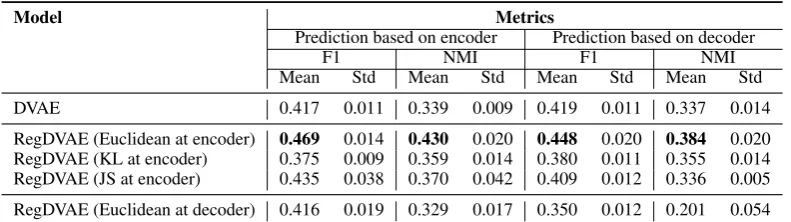
Table 3: Comparison results on NYT122 with different prediction and regularization strategies (using encoder or decoder).
entities in text corpus if they are not shown in KB, so that we can directly test the influence of our KB constraint model. Finally, we only keep a sin-gle label for each sentence, ande1,e2 follow the occurrence order in the sentence. The resulting datasets contain 122, 71, and 27 relation labels re-spectively, so we name them as NYT122, NYT71, and NYT27. The statistics of the three datasets are shown in Table2. For NYT71 and NYT27, we perform the same feature extraction as NYT122 shown in (Marcheggiani and Titov,2016).
4.2 Implementation Details
All the model parameters are initialized randomly. The number of negative samples is set to 5, mini-batch size is set to 100 with 80 epochs. We optimize all the models using AdaGrad (Duchi et al., 2011) with initial learning rate at 0.5. For NYT122, we induce 40 relations clusters, with α0 = 4, αT = 10−5, β = 0.6, and γ = 0.9.
For NYT71, we induce 30 relations clusters, with α0 = 2, αT = 10−4, β = 0.8, andγ = 0.95 .
For NYT27, we induce 20 relations clusters, with α0 = 2,αT = 10−4,β = 0.8, andγ = 0.3. We
train TransE as our KB embedding model with 50 dimensions and 1,000 epochs.
We report the average and standard deviation based on five different runs. We randomly split the data into validation:test=4:6. All the model se-lections were based on validation sets, and final evaluation results will be only based on test sets.
4.3 Evaluation and Discussion
As the scoring function, we use theB3F
1(Bagga
and Baldwin,1998) which has also been used by our baseline (Marcheggiani and Titov,2016), and Normalized Mutual Information (NMI) (Strehl and Ghosh,2002) metrics. Both are standard mea-sures for evaluating clustering tasks.
Regularization and Prediction Strategies. We first report our results on NYT122 using differ-ent regularization and prediction settings, as this dataset was used by our baseline model DVAE.
Note that both encoder and decoder components can make relation predictions. In fact, the way of using encoder q(r|x, ψ) for each sentence is straightforward. Then based on the encoder, we predict relation on the basis of single occurrence of entity pair. When using the decoder, we need to re-normalize p(ei|r, e−i, θ) asp(r|e1, e2, θ) to make predictions. Based on the decoder, we make predictions for each unique entity pair. As a con-sequence, our constraints can be imposed on both encoder and decoder. The way of computing de-coder probability distribution is the same as mak-ing predictions. So in this experiment, we report both results.
The results are shown in Table3. From the ta-ble, we can see that regularization with Euclidean distance performs the best compared to KL and JS. Moreover, the regularization over encoder is better than the regularization over decoder. This may be because the way that we put constraints only over sampled sentences in a batch may hurt the regu-larization of decoder, since sampled unique pairs may be less than sample sentences. If we look at results comparing original DVAE prediction based on the encoder and the decoder, both result in sim-ilar F1 and NMI numbers. Thus, we can only con-clude that currently in the way we do sampling, constraining over encoder is a better choice.
Model NYT122 NYT71 NYT27
F1 NMI F1 NMI F1 NMI
Mean Std Mean Std Mean Std Mean Std Mean Std Mean Std
Majority 0.355 - 0 - 0.121 - 0 - 0.549 - 0
[image:7.595.73.522.64.162.2]-DVAE 0.417 0.011 0.339 0.009 0.325 0.011 0.375 0.023 0.433 0.018 0.384 0.021 DVAE+E 0.385 0.021 0.341 0.043 0.339 0.021 0.418 0.022 0.396 0.034 0.381 0.039 DVAE+D 0.452 0.033 0.438 0.022 0.352 0.038 0.339 0.009 0.499 0.040 0.469 0.027 RegDVAE 0.469 0.014 0.430 0.020 0.377 0.020 0.466 0.036 0.587 0.005 0.451 0.005 RegDVAE+D 0.499 0.022 0.497 0.013 0.432 0.028 0.589 0.071 0.665 0.022 0.562 0.038
Table 4: Comparison of prediction results based on encoder using NYT122, NYT71, and NYT27 datasets with different KB regularization strategies.
0.01 0.10 0.50 1.00 2.00 4.00 β at regularization (logarithmic scale) 0.30
0.32 0.34 0.36 0.38 0.40 0.42 0.44 0.46
Metrics
encoder F1 encoder NMI decoder F1 decoder NMI
(a) Parameter sensitivity analysis atβ.
0.0 0.1 0.2 0.3 0.4 0.5 0.6 0.7 0.8 0.9 1.0 γ at cosine similarity
0.26 0.28 0.30 0.32 0.34 0.36 0.38 0.40 0.42 0.44 0.46 0.48
Metrics
encoder F1 encoder NMI decoder F1 decoder NMI
(b) Parameter sensitivity analysis atγ.
0.00 0.25 0.50 0.75 1.00 Overlap
0.44 0.45 0.46 0.47 0.48 0.49 0.50 0.51 0.52
F1
encoder F1 decoder F1
0.35 0.36 0.37 0.38 0.39 0.40 0.41 0.42 0.43 0.44 0.45 0.46 0.47
NMI
encoder NMI decoder NMI
(c) Relation overlap ratios.
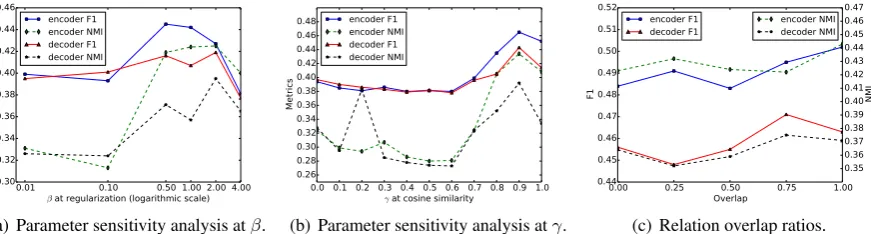
Figure 2: Comparison results on NYT122 with different parameters and relation overlaps. The predictions are based on either the encoder or the decoder.
with decoder entity vectors replaced by pre-trained KB embeddings (DVAE+D). For our method, we report RegDVAE with the best setting where we use Euclidean distance based constraints to regu-larize the encoder. Moreover, we report a setting with fixed embeddings in the decoder as the ones obtained from TransE (RegDVAE+D). This also makes sense since even though the TransE embed-dings are not trained with the observation of the same relations as the text corpus, the embeddings already contain much semantic information about entities. Then by fixing the embeddings of enti-ties in the decoder, we can significantly reduce the number of parameters that need to be trained. The results are shown in Table4. As we can see that, RegDVAE+D can outperform the original DVAE by 8∼23 points on F1. DVAE+D is also good but may fail when there are a lot of out-of-sample en-tities in the training corpus.
Hyper-parameter Sensitivity. We have three hyper-parameters in our algorithm:α0for the reg-ularization of encoder entropy, β for the regular-ization with our constraints, andγ for the thresh-old of KB based cosine similarities. Here, we test β and γ, since the sensitivity result of α0 is the same as the original DVAE work (Marcheggiani and Titov,2016). The sensitivity ofβ is shown in Figure2(a). The results are good in a wide range
fromβ = 0.5 to β = 2. The sensitivity ofγ is shown in Figure2(b). It reveals some interesting patterns. At the beginning whenγis small, it hurts the performance. Afterγ getting greater than 0.7, it improves the performance, which means that only very similar relations indicated by KB em-beddings are useful relations as constraints. In ad-dition,γ = 1(meaning only finding identical re-lations) is worse than γ = 0.9, which means we indeed find some relations in our KB so that dif-ferent triplets will be constrained.
KB Relation Overlap. Although we assume
[image:7.595.83.519.208.325.2]Contextual Sentence Cluster Similarity
. . .Spainwill become the third country inEurope. . .
12
0.926
Portugal, with all that talent, goes home toEurope. . .
12
Brazil, Latin America ’s largest economy . . .
12
0.916
. . .Argentina was perhaps the most expensive country in Latin Americafor tourists.. . .
[image:8.595.73.286.64.180.2]12
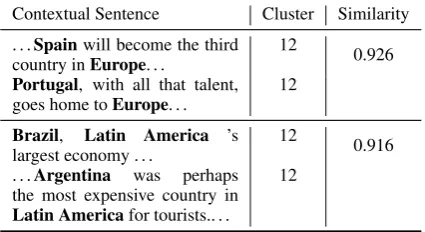
Table 5: Examples for relation: /location/contained by.
relations observed (Bordes et al.,2013).
Case Study. We also show some examples of entity pair similarities in Table 5. From the Table we can see that our target relation clus-ter is /location/contained by. In the first exam-ple, the similarity between entity pairs (Spain, Europe) and (Portugal, Europe) are high, which indicates the same cluster of pairs of sen-tences. The same constraint is applied in the sec-ond example, although there’s no direct connec-tion between (Brazil, Latin America), (Argentina, Latin America).
5 Related Work
Supervised and Distantly Supervised Relation Extraction. Traditional supervised relation ex-traction focuses on a limited number of rela-tions (Roth and Yih,2002;Kambhatla,2004;Chan and Roth,2010). Distant supervision uses KBs to obtain a lot of automatically annotated data (Mintz et al.,2009;Riedel et al., 2010;Hoffmann et al.,
2011; Surdeanu et al., 2012; Xu et al., 2013a;
Zhang et al.; Zeng et al., 2015;Lin et al., 2016;
Zeng et al., 2017). There are two important as-sumptions behind these models, namely multi-instance learning (Riedel et al., 2010) and multi-instance multi-label learning (Hoffmann et al.,
2011;Surdeanu et al.,2012). Our setting is simi-lar to multi-instance learning but we assume there is no overlapped relation between KB and training text corpus. Universal schema (Riedel et al.,2013;
Verga et al.,2016;Toutanova et al.,2015; McCal-lum et al.,2017) can also exploit KB to help ex-tract relations. It needs a lot of entity pairs in text to co-occur with KB triplets, which is under the same setting with distant supervision. Those sur-face patterns are pre-extracted and shown in the training phase, which makes it also a weakly su-pervised learning method.
Unsupervised Relation Extraction. Open Do-main Information Extraction (Open-IE) assumes
that every relation expression can represent a unique relation (Etzioni et al.,2004;Banko et al.,
2007; Fader et al., 2011; Mausam et al., 2012;
Xu et al., 2013b; Angeli et al., 2015). On the other hand, relation clustering approaches group all the related relation expressions to rep-resent a relation (Lin and Pantel,2001;Mohamed et al., 2011; Takamatsu et al., 2011; Yao et al.,
2011,2012;Nakashole et al., 2012a,b; Marcheg-giani and Titov, 2016). Our setting is based on (Marcheggiani and Titov,2016) but we also intro-duce KB as a different kind of weak and indirect supervision.
Knowledge Base Representation. Embedding based knowledge base representation learning methods (Bordes et al., 2013;Wang et al., 2014;
Lin et al., 2015;Trouillon et al., 2016) represent entities and relations as vectors, denoted aseand
Crrespectively such that for a distances function
f, the value f(e1,Cr,e2) is maximized for all
(e1, r, e2)facts. Among all these methods, TransE model has a favorable property that the translation operation can be easily recovered by entity vec-tors(r1,2 =e1−e2). With its simplicity and high performance, TransE is enough for demonstration. Though our method is not restricted to the repre-sentation form of KB, we leave it for future evalu-ation.
Constraints can be made more explainable by paths finding. For instance, the Path Ranking Al-gorithm (PRA) (Lao and Cohen,2010;Lao et al.,
2011) uses random walk to perform multi-hop rea-soning based on logic rules. Later on, reinforce-ment Learning (Toutanova et al., 2015; Xiong et al.,2017;Das et al.,2017;Chen et al.,2018) is used to search for paths more effectively. Though heuristics are used to further reduce the number of mined relations, it is still very costly to find the paths for KB with hundreds of relations, if not im-possible.
Constraint Modeling. Originated from semi-supervised learning (Chapelle et al.,2006), must-link and cannot-must-link modeling has been well stud-ied in machine learning community (Wagstaff et al., 2001; Basu et al., 2004, 2008). Such constraints were usually generated based on the ground truth labels of data. For document cluster-ing, word constraints constructed based on Word-Net similarities have been applied (Song et al.,
in an external KB have been used (Wang et al.,a,
2016), both being considered as a kind of indirect supervision based on side information. For triplet relation clustering, relation surface similarity and entity type constraints have been explored (Wang et al., b). However the above constraints are ap-plied to a particular form of models, co-clustering models. Compared to existing approaches, our constraints are constructed based on more recently developed KB embeddings, which is more flexible and easy to incorporate into different models.
In natural language processing community, con-straints based on background knowledge are also well studied. For example, constrained condi-tional models (CCM) (Chang et al., 2012) pro-vides a very flexible framework to decouple learn-ing and inference, where in the inference step, background knowledge can be incorporated as an ILP (integer linear programming) problem. Pos-terior regularization (PR) (Ganchev et al., 2010) generalizes this idea so that it uses a joint learn-ing and inference framework to incorporate the background knowledge. Both CCM and PR have many applications including the application to re-lation extraction (Chan and Roth, 2010; Chen et al., 2011). Compared to these existing ap-proaches, our constraints are derived from the general-purpose KB, which is quite different from their way of manually crafting some background knowledge as declarative rules.
It is very interesting that we are similar to the PR framework. Since we use a DVAE framework as the base algorithm, there is no traditional E-step and M-step in the variational inference. Instead, onlyqandpprobabilities parameterized by neural networks are updated. In our framework, we can add constraints to either q orp probabilities (ap-plying topneeds modification of normalization). It is the same that we draw a biased learning pro-cess when estimating the posteriors as PR does.
6 Conclusion
In this paper, we propose a new relation discov-ery setting where there is no overlapped relations between the training text corpus and the KB. We propose a new learning framework of KB regular-ization which uses must-link and cannot-link con-straints derived based on similarities in the KB embedding space. Our method improves the re-sults over all baseline models without harming the scalability. We believe this framework is as
flex-ible as other constraint models to be applied to many applications when we think the semantics of entities and relations provided by the KB is useful.
Acknowledgments
This paper was supported by the Early Career Scheme (ECS, No. 26206717) from Research Grants Council in Hong Kong. We thank In-tel Corporation for supporting our deep learn-ing related research. We also thank the anony-mous reviewers for their valuable comments and suggestions that help improve the quality of this manuscript.
References
Gabor Angeli, Melvin Jose Johnson Premkumar, and Christopher D. Manning. 2015. Leveraging linguis-tic structure for open domain information extraction. InACL, pages 344–354.
Amit Bagga and Breck Baldwin. 1998. Algorithms for scoring coreference chains. In LREC, pages 563– 566.
Michele Banko, Michael J. Cafarella, Stephen Soder-land, Matthew Broadhead, and Oren Etzioni. 2007. Open information extraction from the web. In IJ-CAI, pages 2670–2676.
Sugato Basu, Mikhail Bilenko, and Raymond J. Mooney. 2004. A probabilistic framework for semi-supervised clustering. InKDD, pages 59–68.
Sugato Basu, Ian Davidson, and Kiri Wagstaff. 2008.
Constrained Clustering: Advances in Algorithms, Theory, and Applications. Chapman & Hall/CRC.
Kurt D. Bollacker, Colin Evans, Praveen Paritosh, Tim Sturge, and Jamie Taylor. 2008. Freebase: a col-laboratively created graph database for structuring human knowledge. InSIGMOD, pages 1247–1250.
Antoine Bordes, Nicolas Usunier, Alberto Garc´ıa-Dur´an, Jason Weston, and Oksana Yakhnenko. 2013. Translating embeddings for modeling multi-relational data. InNIPS, pages 2787–2795.
Yee Seng Chan and Dan Roth. 2010. Exploiting back-ground knowledge for relation extraction. In COL-ING, pages 152–160.
Ming-Wei Chang, Lev-Arie Ratinov, and Dan Roth. 2012. Structured learning with constrained condi-tional models.Machine Learning, 88(3):399–431.
O. Chapelle, B. Sch¨olkopf, and A. Zien, editors. 2006.
Semi-Supervised Learning. MIT Press.
Wenhu Chen, Wenhan Xiong, Xifeng Yan, and William Yang Wang. 2018. Variational knowledge graph reasoning. In NAACL-HLT, pages 1823– 1832.
Rajarshi Das, Shehzaad Dhuliawala, Manzil Zaheer, Luke Vilnis, Ishan Durugkar, Akshay Krishna-murthy, Alexander J. Smola, and Andrew McCal-lum. 2017. Go for a walk and arrive at the answer: Reasoning over paths in knowledge bases using re-inforcement learning.CoRR, abs/1711.05851.
Xin Dong, Evgeniy Gabrilovich, Geremy Heitz, Wilko Horn, Ni Lao, Kevin Murphy, Thomas Strohmann, Shaohua Sun, and Wei Zhang. 2014. Knowledge vault: a web-scale approach to probabilistic knowl-edge fusion. InKDD, pages 601–610.
John C. Duchi, Elad Hazan, and Yoram Singer. 2011. Adaptive subgradient methods for online learning and stochastic optimization. Journal of Machine Learning Research, 12:2121–2159.
Oren Etzioni, Michael Cafarella, and Doug Downey. 2004. Webscale information extraction in knowitall (preliminary results). InWWW, pages 100–110.
Anthony Fader, Stephen Soderland, and Oren Etzioni. 2011. Identifying relations for open information ex-traction. InEMNLP, pages 1535–1545.
Kuzman Ganchev, Joao Grac¸a, Jennifer Gillenwater, and Ben Taskar. 2010. Posterior regularization for structured latent variable models. Journal of Ma-chine Learning Research, 11:2001–2049.
Jennifer Gillenwater, Kuzman Ganchev, Jo˜ao Grac¸a, Fernando Pereira, and Ben Taskar. 2011. Posterior sparsity in unsupervised dependency parsing. Jour-nal of Machine Learning Research, 12:455–490.
Raphael Hoffmann, Congle Zhang, Xiao Ling, Luke S. Zettlemoyer, and Daniel S. Weld. 2011. Knowledge-based weak supervision for information extraction of overlapping relations. In ACL, pages 541–550.
Nanda Kambhatla. 2004. Combining lexical, syntactic, and semantic features with maximum entropy mod-els for information extraction. InACL - Poster and Demonstration.
Ni Lao and William W. Cohen. 2010. Relational re-trieval using a combination of path-constrained ran-dom walks.Machine Learning, 81(1):53–67.
Ni Lao, Tom M. Mitchell, and William W. Cohen. 2011. Random walk inference and learning in A large scale knowledge base. InEMNLP, pages 529– 539.
Dekang Lin and Patrick Pantel. 2001. DIRT – dis-covery of inference rules from text. InKDD, pages 323–328.
Yankai Lin, Zhiyuan Liu, Huan-Bo Luan, Maosong Sun, Siwei Rao, and Song Liu. 2015. Modeling rela-tion paths for representarela-tion learning of knowledge bases. InEMNLP, pages 705–714.
Yankai Lin, Shiqi Shen, Zhiyuan Liu, Huanbo Luan, and Maosong Sun. 2016. Neural relation extrac-tion with selective attenextrac-tion over instances. InACL, pages 2124–2133.
Xitong Liu, Fei Chen, Hui Fang, and Min Wang. 2014. Exploiting entity relationship for query expansion in enterprise search.Inf. Retr., 17(3):265–294.
Diego Marcheggiani and Ivan Titov. 2016. Discrete-state variational autoencoders for joint discovery and factorization of relations. Transactions of the Asso-ciation for Computational Linguistic, 4:231–244.
Mausam, Michael Schmitz, Stephen Soderland, Robert Bart, and Oren Etzioni. 2012. Open language learn-ing for information extraction. InEMNLP-CoNLL, pages 523–534.
Andrew McCallum, Arvind Neelakantan, and Patrick Verga. 2017. Generalizing to unseen entities and en-tity pairs with row-less universal schema. InEACL, pages 613–622.
Mike Mintz, Steven Bills, Rion Snow, and Dan Juraf-sky. 2009. Distant supervision for relation extrac-tion without labeled data. In ACL/AFNLP, pages 1003–1011.
Thahir Mohamed, Estevam R. Hruschka Jr., and Tom M. Mitchell. 2011. Discovering relations be-tween noun categories. In EMNLP, pages 1447– 1455.
Ndapandula Nakashole, Gerhard Weikum, and Fabian M. Suchanek. 2012a. Discovering and exploring relations on the web. PVLDB, 5(12):1982–1985.
Ndapandula Nakashole, Gerhard Weikum, and Fabian M. Suchanek. 2012b. PATTY: A taxonomy of relational patterns with semantic types. In
EMNLP, pages 1135–1145.
Deepak Ravichandran and Eduard H. Hovy. 2002. Learning surface text patterns for a question answer-ing system. InACL, pages 41–47.
Sebastian Riedel, Limin Yao, and Andrew McCallum. 2010. Modeling relations and their mentions with-out labeled text. InECML PKDD, pages 148–163.
Sebastian Riedel, Limin Yao, Andrew McCallum, and Benjamin M. Marlin. 2013. Relation extraction with matrix factorization and universal schemas. In
NAACL-HLT, pages 74–84.
Sandhaus and Evan. 2008. The new york times anno-tated corpus. Linguistic Data Consortium, Philadel-phia.
Badrul Sarwar, George Karypis, Joseph Konstan, and John Riedl. 2001. Item-based collaborative filtering recommendation algorithms. InWWW, pages 285– 295.
Yangqiu Song, Shimei Pan, Shixia Liu, Furu Wei, Michelle X. Zhou, and Weihong Qian. 2013. Con-strained text coclustering with supervised and un-supervised constraints. IEEE Trans. Knowl. Data Eng., 25(6):1227–1239.
Alexander Strehl and Joydeep Ghosh. 2002. Clus-ter ensembles — A knowledge reuse framework for combining multiple partitions. Journal of Machine Learning Research, 3:583–617.
Mihai Surdeanu, Julie Tibshirani, Ramesh Nallap-ati, and Christopher D. Manning. 2012. Multi-instance multi-label learning for relation extraction. InEMNLP-CoNLL, pages 455–465.
Shingo Takamatsu, Issei Sato, and Hiroshi Nakagawa. 2011. Probabilistic matrix factorization leveraging contexts for unsupervised relation extraction. In
PAKDD, pages 87–99.
Kristina Toutanova, Danqi Chen, Patrick Pantel, Hoi-fung Poon, Pallavi Choudhury, and Michael Gamon. 2015. Representing text for joint embedding of text and knowledge bases. In EMNLP, pages 1499– 1509.
Th´eo Trouillon, Johannes Welbl, Sebastian Riedel, ´Eric Gaussier, and Guillaume Bouchard. 2016. Complex embeddings for simple link prediction. In ICML, pages 2071–2080.
Patrick Verga, David Belanger, Emma Strubell, Ben-jamin Roth, and Andrew McCallum. 2016. Multi-lingual relation extraction using compositional uni-versal schema. InNAACL-HLT, pages 886–896.
Denny Vrandeˇci´c. 2012. Wikidata: A new platform for collaborative data collection. InWWW, pages 1063– 1064.
Kiri Wagstaff, Claire Cardie, Seth Rogers, and Stefan Schr¨odl. 2001. Constrained k-means clustering with background knowledge. InICML, pages 577–584.
Chenguang Wang, Yangqiu Song, Ahmed El-Kishky, Dan Roth, Ming Zhang, and Jiawei Han. a. Incor-porating world knowledge to document clustering via heterogeneous information networks. InKDD, pages 1215–1224.
Chenguang Wang, Yangqiu Song, Dan Roth, Chi Wang, Jiawei Han, Heng Ji, and Ming Zhang. b. Constrained information-theoretic tripartite graph clustering to identify semantically similar relations. InIJCAI, pages 3882–3889.
Chenguang Wang, Yangqiu Song, Dan Roth, Ming Zhang, and Jiawei Han. 2016. World knowledge as indirect supervision for document clustering. ACM Transactions on Knowledge Discovery from Data, 11(2):13:1–13:36.
Zhen Wang, Jianwen Zhang, Jianlin Feng, and Zheng Chen. 2014.Knowledge graph embedding by trans-lating on hyperplanes. InAAAI, pages 1112–1119.
Wenhan Xiong, Thien Hoang, and William Yang Wang. 2017. Deeppath: A reinforcement learning method for knowledge graph reasoning. InEMNLP, pages 564–573.
Wei Xu, Raphael Hoffmann, Le Zhao, and Ralph Gr-ishman. 2013a. Filling knowledge base gaps for distant supervision of relation extraction. In ACL, pages 665–670.
Ying Xu, Mi-Young Kim, Kevin Quinn, Randy Goebel, and Denilson Barbosa. 2013b. Open information ex-traction with tree kernels. In NAACL-HLT, pages 868–877.
Limin Yao, Aria Haghighi, Sebastian Riedel, and An-drew McCallum. 2011. Structured relation discov-ery using generative models. In EMNLP, pages 1456–1466.
Limin Yao, Sebastian Riedel, and Andrew McCallum. 2012. Unsupervised relation discovery with sense disambiguation. InACL, pages 712–720.
Daojian Zeng, Kang Liu, Yubo Chen, and Jun Zhao. 2015. Distant supervision for relation extraction via piecewise convolutional neural networks. In
EMNLP, pages 1753–1762.
Wenyuan Zeng, Yankai Lin, Zhiyuan Liu, and Maosong Sun. 2017. Incorporating relation paths in neural relation extraction. InEMNLP, pages 1768– 1777.