Filling Knowledge Base Gaps for Distant Supervision
of Relation Extraction
Wei Xu+Raphael HoffmannˆLe Zhao#,*Ralph Grishman+
+New York University, New York, NY, USA
{xuwei, grishman}@cs.nyu.edu ˆUniversity of Washington, Seattle, WA, USA
[email protected] #Google Inc., Mountain View, CA, USA
Abstract
Distant supervision has attracted recent in-terest for training information extraction systems because it does not require any human annotation but rather employs ex-isting knowledge bases to heuristically la-bel a training corpus. However, previous work has failed to address the problem of false negative training examples misla-beled due to the incompleteness of knowl-edge bases. To tackle this problem, we propose a simple yet novel framework that combines a passage retrieval model using coarse features into a state-of-the-art rela-tion extractor using multi-instance learn-ing with fine features. We adapt the in-formation retrieval technique of pseudo-relevance feedback to expand knowledge bases, assuming entity pairs in top-ranked passages are more likely to express a rela-tion. Our proposed technique significantly improves the quality of distantly super-vised relation extraction, boosting recall from 47.7% to 61.2% with a consistently high level of precision of around 93% in the experiments.
1 Introduction
A recent approach for training information traction systems is distant supervision, which ex-ploits existing knowledge bases instead of anno-tated texts as the source of supervision (Craven and Kumlien, 1999; Mintz et al., 2009; Nguyen and Moschitti, 2011). To combat the noisy train-ing data produced by heuristic labeltrain-ing in distant supervision, researchers (Bunescu and Mooney, 2007; Riedel et al., 2010; Hoffmann et al., 2011; Surdeanu et al., 2012) exploited multi-instance
*This work was done while Le Zhao was at Carnegie Mellon University.
learning models. Only a few studies have directly examined the influence of the quality of the train-ing data and attempted to enhance it (Sun et al., 2011; Wang et al., 2011; Takamatsu et al., 2012). However, their methods are handicapped by the built-in assumption that a sentence does not ex-press a relation unless it mentions two entities which participate in the relation in the knowledge base, leading to false negatives.
aligned mentions
true mentions
5.5% 2.7% 1.7% false
negatives false
[image:1.595.326.509.340.396.2]positives
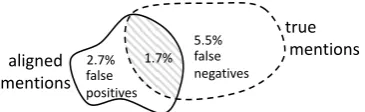
Figure 1: Noisy training data in distant supervi-sion
In reality, knowledge bases are often incom-plete, giving rise to numerous false negatives in the training data. We sampled 1834 sentences that contain two entities in the New York Times 2006 corpus and manually evaluated whether they
ex-press any of a set of 50 common Freebase1
rela-tions. As shown in Figure 1, of the 133 (7.3%) sentences that truly express one of these relations, only 32 (1.7%) are covered by Freebase, leaving 101 (5.5%) false negatives. Even for one of the
most complete relations in Freebase,Employee-of
(with more than 100,000 entity pairs), 6 out of 27 sentences with the pattern ‘PERSON executive of ORGANIZATION’ contain a fact that is not in-cluded in Freebase and are thus mislabeled as neg-ative. These mislabelings dilute the discriminative capability of useful features and confuse the mod-els. In this paper, we will show how reducing this source of noise can significantly improve the per-formance of distant supervision. In fact, our sys-tem corrects the relation labels of the above 6 sen-tences before training the relation extractor.
1http://www.freebase.com
Documents Knowledge Base
Relation Extractor
Passage Retriever
①
②
④
Pseudo-relevant Relation Instances
③ ⑤
[image:2.595.95.274.61.170.2]⑥
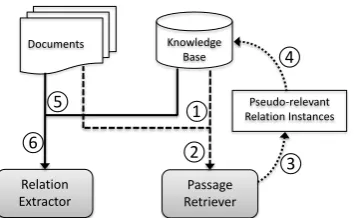
Figure 2: Overall system architecture: The system (1) matches relation instances to sentences and (2) learns a passage retrieval model to (3) provide rel-evance feedback on sentences; Relevant sentences (4) yield new relation instances which are added to the knowledge base; Finally, instances are again (5) matched to sentences to (6) create training data for relation extraction.
Encouraged by the recent success of simple methods for coreference resolution (Raghunathan et al., 2010) and inspired by pseudo-relevance feedback (Xu and Croft, 1996; Lavrenko and Croft, 2001; Matveeva et al., 2006; Cao et al., 2008) in the field of information retrieval, which expands or reformulates query terms based on the highest ranked documents of an initial query, we propose to increase the quality and quantity of training data generated by distant supervision for information extraction task using pseudo feed-back. As shown in Figure 2, we expand an orig-inal knowledge base with possibly missing rela-tion instances with informarela-tion from the highest ranked sentences returned by a passage retrieval model (Xu et al., 2011) trained on the same data. We use coarse features for our passage retrieval model to aggressively expand the knowledge base for maximum recall; at the same time, we exploit a multi-instance learning model with fine features for relation extraction to handle the newly intro-duced false positives and maintain high precision. Similar to iterative bootstrapping tech-niques (Yangarber, 2001), this mechanism uses the outputs of the first trained model to expand training data for the second model, but unlike bootstrapping it does not require iteration and avoids the problem of semantic drift. We further note that iterative bootstrapping over a single distant supervision system is difficult, because state-of-the-art systems (Surdeanu et al., 2012; Hoffmann et al., 2011; Riedel et al., 2010; Mintz et al., 2009), detect only few false negatives in the
training data due to their high-precision low-recall features, which were originally proposed by Mintz et al. (2009). We present a reliable and novel way to address these issues and achieve significant improvement over the MULTIR system (Hoff-mann et al., 2011), increasing recall from 47.7% to 61.2% at comparable precision. The key to this success is the combination of two different views as in co-training (Blum and Mitchell, 1998): an information extraction technique with fine features for high precision and an information retrieval technique with coarse features for high recall. Our work is developed in parallel with Min et al. (2013), who take a very different approach by adding additional latent variables to a multi-instance multi-label model (Surdeanu et al., 2012) to solve this same problem.
2 System Details
In this section, we first introduce some formal no-tations then describe in detail each component of the proposed system in Figure 2.
2.1 Definitions
A relation instance is an expression r(e1, e2)
where r is a binary relation, and e1 and e2 are
two entities having such a relation, for example
CEO-of(Tim Cook, Apple). The knowledge-based distant supervised learning problem takes as input (1) Σ, a training corpus, (2) E, a set of entities mentioned in that corpus, (3)R, a set of relation names, and (4)∆, a set of ground facts of relations
inR. To generate our training data, we further as-sume (5)T, a set of entity types, as well as type signaturer(E1, E2)for relations.
We define the positive data set P OS(r) to be
the set of sentences in which any related pair of entities of relation r (according to the knowl-edge base) is mentioned. The negative data set
RAW(r) is the rest of the training data, which
contain two entities of the required types in the knowledge base, e.g. one person and one
or-ganization for the CEO-of relation in Freebase.
Another negative data set with more conservative sense N EG(r) is defined as the set of sentences
which contain the primary entitye1 (e.g. person
in anyCEO-ofrelation in the knowledge base) and
any secondary entitye2of required type (e.g.
2.2 Distantly Supervised Passage Retrieval
We extend the learning-to-rank techniques (Liu, 2011) to distant supervision setting (Xu et al., 2011) to create a robust passage retrieval system. While relation extraction systems exploit rich and complex features that are necessary to extract the exact relation (Mintz et al., 2009; Riedel et al., 2010; Hoffmann et al., 2011), passage retrieval components use coarse features in order to provide different and complementary feedback to informa-tion extracinforma-tion models.
We exploit two types of lexical features: Bag-Of-Words and Word-Position. The two types of simple binary features are shown in the following example:
Sentence:Apple founder Steve Jobs died.
Target (Primary) entity:Steve Jobs
Bag-Of-Word features:‘apple’ ‘founder’ ‘died’ ‘.’
Word-Position features:‘apple:-2’ ‘founder:-1’ ‘died:+1’ ‘.:+2’
For each relation r, we assume each sentence
has a binary relevance label to form distantly su-pervised training data: sentences inP OS(r) are
relevantand sentences inN EG(r)areirrelevant.
As a pointwise learning-to-rank approach (Nallap-ati, 2004), the probabilities of relevance estimated by SVMs (Platt and others, 1999) are used for ranking all the sentences in the original training corpus for each relation respectively. We use
Lib-SVM2(Chang and Lin, 2011) in our
implementa-tion.
2.3 Psuedo-relevance Relation Feedback
In the field of information retrieval, pseudo-relevance feedback assumes that the top-ranked documents from an initial retrieval are likely rel-evant, and extracts relevant terms to expand the original query (Xu and Croft, 1996; Lavrenko and Croft, 2001; Cao et al., 2008). Analogously, our assumption is that entity pairs that appear in more relevant and more sentences are more likely to express the relation, and can be used to expand knowledge base and reduce false negative noise in the training data for information extraction. We identify the most likely relevant entity pairs as fol-lows:
2http://www.csie.ntu.edu.tw/˜cjlin/
libsvm
initialize∆0←−∆
foreach relation typer∈Rdo
learna passage (sentence) retrieval modelL(r)
using coarse features andP OS(r)∪N EG(r)
as training data
scorethe sentences in theRAW(r)byL(r)
scorethe entity pairs according to the scores of sentences they are involved in
selectthe top ranked pairs of entities, then add the relationrto their label in∆0
end for
We select the entity pairs whose average score of the sentences they are involved in is greater
thanp, where pis a parameter tuned on
develop-ment data.3 The relation extraction model is then
trained using(Σ, E, R,∆0)with a more complete
database than the original knowledge base∆.
2.4 Distantly Supervised Relation Extraction
We use a state-of-the-art open-source system, MULTIR (Hoffmann et al., 2011), as the rela-tion extracrela-tion component. MULTIR is based on multi-instance learning, which assumes that at least one sentence of those matching a given entity-pair contains the relation of interest (Riedel et al., 2010) in the given knowledge base to tol-erate false positive noise in the training data and superior than previous models (Riedel et al., 2010; Mintz et al., 2009) by allowing overlapping rela-tions. MULTIR uses features which are based on Mintz et al. (2009) and consist of conjunctions of named entity tags, syntactic dependency paths be-tween arguments, and lexical information.
3 Experiments
For evaluating extraction accuracy, we follow the experimental setup of Hoffmann et al. (2011), and
use their implementation of MULTIR4 with 50
training iterations as our baseline. Our complete system, which we call IRMIE, combines our pas-sage retrieval component with MULTIR. We use the same datasets as in Hoffmann et al. (2011) and Riedel et al. (2010), which include 3-years of New York Times articles aligned with Freebase. The
sentential extraction evaluation is performed on a small amount of manually annotated sentences, sampled from the union of matched sentences and
3We foundp= 0.5to work well in practice.
4http://homes.cs.washington.edu/
Test Data Set Original Test Set Corrected Test Set
˜P ˜R ˜F ∆˜F ˜P ˜R ˜F ∆˜F
MULTIR 80.0 44.6 62.3 92.7 47.7 70.2
[image:4.595.158.438.61.125.2]IRMIE 84.6 56.1 70.3 +8.0 92.6 61.2 76.9 +6.7 MULTIRLEX 91.8 43.0 67.4 79.6 57.0 68.3 IRMIELEX 89.2 52.5 70.9 +3.5 78.0 69.2 73.6 +5.3
Table 1: Overall sentential extraction performance evaluated on the original test set of Hoffmann et al. (2011) and our corrected test set: Our proposed relevance feedback technique yields a substantial increase in recall.
system predictions. We defineSeas the sentences
where some system extracted a relation and SF
as the sentences that match the arguments of a fact in ∆. The sentential precision and recall is
computed on a randomly sampled set of sentences fromSe∪SF, in which each sentence is manually
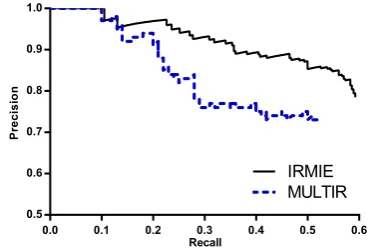
[image:4.595.322.509.189.315.2]labeled whether it expresses any relation inR. Figure 3 shows the precision/recall curves for MULTIR with and without pseudo-relevance feed-back computed on the test dataset of 1000 sen-tence used by Hoffmann et al. (2011). With the pseudo-relevance feedback from passage retrieval, IRMIE achieves significantly higher recall at a consistently high level of precision. At the highest recall point, IRMIE reaches 78.5% precision and 59.2% recall, for an F1 score of 68.9%.
Because the two types of lexical features used in our passage retrieval models are not used in MUL-TIR, we created another baseline MULTIRLEX by adding these features into MULTIR in order to rule out the improvement from additional infor-mation. Note that the sentences are sampled from the union of Freebase matches and sentences from which some systems in Hoffmann et al. (2011) ex-tracted a relation. It underestimates the improve-ments of the newly developed systems in this pa-per. We therefore also created a new test set of 1000 sentences by sampling from the union of Freebase matches and sentences where MULTIR-LEX or IRMIEMULTIR-LEX extracted a relation. Table 1 shows the overall precision and recall computed against these two test datasets, with and without adding lexical features into multi-instance learn-ing models. The performance improvement by us-ing pseudo-feedback is significant (p < 0.05) in
McNemar’s test for both datasets.
4 Conclusion and Perspectives
This paper proposes a novel approach to address an overlooked problem in distant supervision: the knowledge base is often incomplete causing
nu-Recall
P
re
c
is
io
n
0.0 0.1 0.2 0.3 0.4 0.5 0.6 0.5
0.6 0.7 0.8 0.9 1.0
IRMIE MULTIR
Figure 3: Sentential extraction: precision/recall curves using exact same training and test data, features and system settings as in Hoffmann et al. (2011).
merous false negatives in the training data. It greatly improves a state-of-the-art multi-instance learning model by correcting the most likely false negatives in the training data based on the ranking of a passage retrieval model.
In the future, we would like to more tightly inte-grate a coarser featured estimator of sentential rel-evance and a finer featured relation extractor, such that a single joint-model can be learned.
Acknowledgments
References
Avrim Blum and Tom M. Mitchell. 1998. Combin-ing labeled and unlabeled sata with co-trainCombin-ing. In Proceedings of the 11th Annual Conference on Com-putational Learning Theory (COLT), pages 92–100.
Razvan C. Bunescu and Raymond J. Mooney. 2007. Learning to extract relations from the web using minimal supervision. InProceedings of the 45th An-nual Meeting of the Association for Computational Linguistics (ACL).
Guihong Cao, Jian-Yun Nie, Jianfeng Gao, and Stephen Robertson. 2008. Selecting good expan-sion terms for pseudo-relevance feedback. In Pro-ceedigns of the 31st Annual International ACM SI-GIR Conference on Research and Development in Information Retrieval (SIGIR), pages 243–250.
Chih-Chung Chang and Chih-Jen Lin. 2011. Lib-svm: A library for support vector machines. ACM Transactions on Intelligent Systems and Technology, 2(3):27.
Mark Craven and Johan Kumlien. 1999. Constructing biological knowledge bases by extracting informa-tion from text sources. InProceedings of the Sev-enth International Conference on Intelligent Systems for Molecular Biology (ISMB), pages 77–86.
Raphael Hoffmann, Congle Zhang, Xiao Ling, Luke S. Zettlemoyer, and Daniel S. Weld. 2011. Knowledge-based weak supervision for information extraction of overlapping relations. InProceedings of the 49th Annual Meeting of the Association for Computational Linguistics (ACL), pages 541–550.
Victor Lavrenko and W. Bruce Croft. 2001. Relevance-based language models. InProceedings of the 24th Annual International ACM SIGIR Con-ference on Research and Development in Informa-tion Retrieval (SIGIR), pages 120–127.
Tie-Yan Liu. 2011. Learning to Rank for Information Retrieval. Springer-Verlag Berlin Heidelberg. Irina Matveeva, Chris Burges, Timo Burkard, Andy
Laucius, and Leon Wong. 2006. High accuracy re-trieval with multiple nested ranker. InProceedings of the 29th Annual International ACM SIGIR Con-ference on Research and Development in Informa-tion Retrieval (SIGIR), pages 437–444.
Bonan Min, Ralph Grishman, Li Wan, Chang Wang, and David Gondek. 2013. Distant supervision for relation extraction with an incomplete knowledge base. InProceedings of the Conference of the North American Chapter of the Association for Computa-tional Linguistics (NAACL 2013).
Mike Mintz, Steven Bills, Rion Snow, and Daniel Ju-rafsky. 2009. Distant supervision for relation ex-traction without labeled data. InProceedigns of the 47th Annual Meeting of the Association for Compu-tational Linguistics and the 4th International Joint
Conference on Natural Language Processing (ACL), pages 1003–1011.
Ramesh Nallapati. 2004. Discriminative models for information retrieval. InProceedigns of the 27th An-nual International ACM SIGIR Conference on Re-search and Development in Information Retrieval (SIGIR), pages 64–71.
Truc Vien T Nguyen and Alessandro Moschitti. 2011. End-to-end relation extraction using distant super-vision from external semantic repositories. In Pro-ceedings of the 49th Annual Meeting of the Associ-ation for ComputAssoci-ational Linguistics: Human Lan-guage Technologies, pages 277–282.
John Platt et al. 1999. Probabilistic outputs for sup-port vector machines and comparisons to regular-ized likelihood methods. Advances in Large Margin Classifiers, 10(3):61–74.
Karthik Raghunathan, Heeyoung Lee, Sudarshan Ran-garajan, Nathanael Chambers, Mihai Surdeanu, Dan Jurafsky, and Christopher Manning. 2010. A multi-pass sieve for coreference resolution. In Proceed-ings of the 2010 Conference on Empirical Methods in Natural Language Processing, pages 492–501. Association for Computational Linguistics.
Sebastian Riedel, Limin Yao, and Andrew McCallum. 2010. Modeling relations and their mentions with-out labeled text. In Proceedigns of the European Conference on Machine Learning and Principles and Practice of Knowledge Discovery in Databases (ECML/PKDD), pages 148–163.
Ang Sun, Ralph Grishman, Wei Xu, and Bonan Min. 2011. New york university 2011 system for kbp slot filling. InText Analysis Conference 2011 Workshop. Mihai Surdeanu, Julie Tibshirani, Ramesh Nallapati, and Christopher D. Manning. 2012. Multi-instance multi-label learning for relation extraction. In Pro-ceedings of the 50th Annual Meeting of the Asso-ciation for Computational Linguistics (ACL), pages 455–465.
Shingo Takamatsu, Issei Sato, and Hiroshi Nakagawa. 2012. Reducing wrong labels in distant supervi-sion for relation extraction. In Proceedings of the 50th Annual Meeting of the Association for Compu-tational Linguistics (ACL), pages 721–729.
Chang Wang, James Fan, Aditya Kalyanpur, and David Gondek. 2011. Relation extraction with relation topics. In Proceedings of the Conference on Em-pirical Methods in Natural Language Processing (EMNLP), pages 1426–1436.
Wei Xu, Ralph Grishman, and Le Zhao. 2011. Passage retrieval for information extraction using distant su-pervision. InProceedings of the International Joint Conference on Natural Language Processing (IJC-NLP), pages 1046–1054.