Memory-Based Shallow Parsing
W a l t e r D a e l e m a n s , S a b i n e B u c h h o l z , J o r n V e e n s t r a I L K , T i l b u r g U n i v e r s i t y , P O - b o x 90153, NL 5000 L E T i l b u r g
[ w a l t e r , b u c h h o l z , v e e n s t r a @ k u b , n l ]
A b s t r a c t
We present a memory-based learning (MBL) approach to shallow parsing in which POS tagging, chunking, and identification of syntactic relations are formulated as memory-based modules. The experiments reported in this paper show competitive results, the F~=l for the Wall Street Journal (WSJ) treebank is: 93.8% for NP chunking, 94.7% for VP chunking, 77.1% for subject detection and 79.0% for object detection.
I n t r o d u c t i o n
Recently, there has been an increased interest in ap- proaches to automatically learning to recognize shallow linguistic patterns in text [Ramshaw and Marcus, 1995, Vilain and Day, 1996, Argamon et al., 1998, Buchholz, 1998, Cardie and Pierce, 1998, Veenstra, 1998, Daelemans et aI., 1999a]. Shallow parsing is an important component of most text analysis systems in applications such as information extraction and summary generation. It includes discovering the main constituents of sentences (NPs, VPs, PPs) and their heads, and determining syntactic relationships like subject, object, adjunct relations between verbs and heads of other constituents.
Memory-Based Learning (MBL) shares with other statistical and learning techniques the advantages of avoiding the need for manual definition of patterns (common practice is to use hand-crafted regular expres- sions), and of being reusable for different corpora and sublanguages. The unique property of memory-based approaches which sets them apart from other learn- ing methods is the fact that they are lazy learners: they keep all training data available for extrapolation. All other statistical and machine learning methods are eager (or greedy) learners: They abstract knowledge structures or probability distributions from the train- ing data, forget the individual training instances, and extrapolate from the induced structures. Lazy learn- ing techniques have been shown to achieve higher ac- curacy than eager methods for many language pro-
cessing tasks. A reason for this is tile intricate in- teraction between regularities, subregularities and ex- ceptions in most language data. and the related prob- lem for learners of distinguishing noise from excep- tions. Eager learning techniques abstract from what they consider noise (hapaxes, low-frequency events, non-typical events) whereas lazy learning techniques keep all data available, including exceptions which may sometimes be productive. For a detailed analy- sis of this issue, see [Daelemans et al., 1999a]. More- over, the automatic feature weighting in the similar- ity metric of a memory-based learner makes the ap- proach well-suited for domains with large numbers of features from heterogeneous sources, as it embodies a smoothing-by-similarity method when data is sparse [Zavrel and Daelemans, 1997].
In this paper, we will provide a empirical evalua- tion of tile MBL approach to syntactic analysis on a number of shallow pattern learning tasks: NP chunk- ing, \ ' P clmnking, and the assignment of subject-verb and object-verb relations. The approach is evalu- ated by cross-validation on the WSJ treebank corpus [Marcus et al., 1993]. We compare the approach quali- tatively and as far as possible quantitatively with other approaches.
M e m o r y - B a s e d S h a l l o w S y n t a c t i c A n a l y s i s
Memory-Based Learning (MBL) is a classification- based, supervised learning approach: a nmmory-based learning algorithm constructs a classifier for a task by storing a set of examples. Each example associates a feature vector (the problem description) with one of a finite number of classes (the solution). Given a new feature vector, the classifier extrapolates its class from those of the most similar feature vectors in memory. The metric defining similarity can be automatically adapted to the task at hand.
In our approach to memory-based syntactic pat- tern recognition, we carve up the syntactic anal- 53
ysis process into a number of such classification tasks with input vectors representing 'a focus item and a dynamically selected surrounding context. As in Natural Language Processing problems in general [Daelemans, 1995], these classification tasks can be seg- mentation tasks (e.g. decide whether a focus word or tag is the s t a r t or end of an NP) or disambiguation tasks (e.g. decide whether a chunk is the subject NP, the object N P or neither). O u t p u t of some memory- based modules (e.g. a tagger or a chunker) is used as input by o t h e r memory-based modules (e.g. syntactic relation assignment).
Similar cascading ideas have been explored in other approaches to text analysis: e.g. finite state partial parsing [Abney, 1996, Grefenstette, 1996], statistical decision tree parsing [Magerman, 1994], maximum en- tropy parsing [Ratnaparkhi, 1997], and memory-based learning [Cardie, 1994, Daelemans et al., 1996]. A l g o r i t h m s a n d I m p l e m e n t a t i o n
For our experiments we have used T i M B L 1, an M B L software package developed in our group [Daelemans et al., 1999b]. We used the fol- lowing variants of MBL:
• IBI-IG: T h e distance between a test item and each m e m o r y item is defined as the number of features for which they have a different value (overlap metrid). Since in most cases not all features are equally rele- vant for solving the task, the algorithm uses informa- tion gain (an information-theoretic notion measuring the reduction of uncertainty about the class to be pre- dicted when knowing the value of a feature) to weight the cost of a feature value mismatch during compari- son. T h e n the class of the most similar training item is predicted to be the class of the test item. Clas- sification speed is linear to the number of training instances times the number of features.
• IGTREE: IBI-IG is expensive in basic memory aztd processing requirements. With IGTREE. an oblivious decision tree is created with features as tests, and or- dered according to information gain of features, as a heuristic approximation of the computationally more expensive pure MBL variants. Classification speed is linear to the number of features times the average branching factor in the tree, which is less than or equal to the average number of values per feature.
For more references and information about these algorithms we refer to [Daelemans et al., 1999b, Daelemans et al., 1999a]. In [Daelemans et al., 1996] b o t h algorithms are explained in detail in the context
ITiMBL is available from: http:[/ilk.kub.nl/
of MBT, a memory-based POS tagger, which we presuppose as an available module in this paper. In the remainder of this paper, we discuss results on the different tasks in section Experiments, and compare our approach to alternative learning methods in section Discussion and Related Research.
E x p e r i m e n t s
We carried out two series of experiments. In the first we evaluated a memory-based NP and VP chunker, in the second we used this chunker for memory-based sub- j e c t / o b j e c t detection.
To evaluate the performance of our trained memory- based classifiers, we will use four measures: ac- curacy (the percentage of correctly predicted out- put classes), precision (the percentage of predicted chunks or subject- or object-verb pairs that is cor- rect), recall (the percentage of chunks or subject- or object-verb pairs to be predicted that is found), and F,~ [C.J.van Rijsbergen. 1979], which is given by
(~2+1) v,.ec rec with ;3 = 1. See below for an example. 3 ~- p r e c q - r e c ' For the chunking tasks, we evaluated the algorithms by cross-validation on all 25 partitions of the WSJ tree- bank. Each partition in turn was selected as a test set, and the algorithms trained on the remaining partitions. Average precision and recall on the 25 partitions will be reported for both the IBI-IG and IGTREE variants of MBL. For the subject/object detection task, we used 10-fold cross-validation on treebank partitions 00-09. In section Related Research we will further evaluate our chunkers and s u b j e c t / o b j e c t detectors.
C h u n k i n g
Following [Ramshaw and Marcus. 1995] we defined chunking as a tagging task, each word in a sentence is assigned a tag which indicates whether this word is inside or outside a chunk. We used as tagset:
I _ N P inside a baseNP.
0 outside a baseNP or a baseVP.
B _ N P inside a baseNP, but the preceding word is in another baseNP.
I _ V P a n d B _ V P are used in a similar fashion.
Since baseNPs and baseVPs are non-overlapping and non-recursive these five tags suffice to unambiguously chunk a sentence. For example, the sentence:
[NP Pierre Vinken NP] , [NP 61 years NP] old , [vP will join vP] [NP the board NP] as [NP a nonexecutive director .~.p] [NP Nov. 29 .~'e] •
should be tagged as:
Methods
IGTree I B I - I G baseline words baseline POS
IGTree IBI-IG baseline words baseline POS
context accuracy precision I recall I Fa=I NPs
2-1 97.5 91.8
2-1 98.0 93.7
0 92.9 76.2
0 94.7 79.5
VPs 2-1
2-1 0 0
99.0 99.2 95.5 97.3
93.1 92.4 94.0 93.8 79.7 77.9 82.4 80.9
93.0 94.2 93.6 94.0 95.5 94.7 67.5 73.4 70.3 74.7 87.7 81.2
Table 1: Overview of the N P / V P chunking scores of 25-fold cross-validation on the of two words and POS right and one left, and of using IGTREE with the same computed with IGTrtEE using only the focus POS tag or the focus word
WSJ using I B I - I G with a context context. T h e baseline scores are
ature I 11
5
0
7
~Veight 39 40 4 3 2 10 12
Inst.1 -1 0 0 seen VBN -
Inst.2 1 0 0 seen VBN sisters PRP$ Inst.3 2 0 0 seen VNB seen VBN
8 9 10 11 12 13 [ Class
18 29 18 31 13 24
I
sisters PRP$ seen VBN S
seen VBN man NN lately RB O
man NN lately RB
Table 2: Some sample instances for the s u b j e c t / o b j e c t detection task. T h e second row shows the relative weight of the features (truncated and multiplied by 100; from one of the 10 cross-validation experiments). T h u s the order of importance of the features is: 2, 1, 11, 9, 13, 10, 8, 12, 7, 6, 3, 4, 5.
Pierret_Np Vinkent_NP ,o 61t_Np yearsLNp oldo ,o willt.vp joinz_vp the~_Ne boardl_NV aso a~_,ve nonexecutivet_Np directort_Np Nov.a_Np 29t.~, p -o
Suppose t h a t our classifier erroneously tagged di- rector as B _ N P instead of I_NP, but classified the rest correctly. Accuracy would then be 17 y~ = 0.94. T h e resulting chunks would be [NP a nonexecutive NP] [NP director NP] instead of [NP a nonexecutive direc- tor Nf'] (the other chunks being the same as above). T h e n out of the seven predicted chunks, five are correct (precision= ~ = 71.4%) and from the six chunks that were to be found, five were indeed found (recall= ~ = 83.3%). F3=~ is 76.9%.
T h e features for the experiments are the word form and the POS tag (as provided by the WSJ treebank) of the two words to the left, the focus word, and one word to the right. For the results see Table 1.
T h e baseline for these experiments is computed with I B I - I G , with as only feature: i) the focus word, and ii) the focus P O S tag.
T h e results of the chunking experiments show t h a t accurate chunking is possible, with Fz=t values around 94~c.
Subject/Object Detection
Finding a subject .or object (or any o t h e r relation of a constituent to a verb) is defined in our classification- based approach as a mapping from a pair of words (the verb and the head of the constituent) and a represen- tation of its context to a class describing the type of relation (e.g. subject, object, or neither). A verb can have a subject or object relation to more t h a n one word in case of N P coordination, and a word can be the sub- ject of more than one verb in case of V P coordination.
Data Format
In our representation, the tagged and chunked sentence
[ N P My/PRP$ sisters/NNS N P ] [ V P have/VBP not/RB seen/VBN V P ] [ N P the/DT old/JJ man/NN N P ] lately~liB ./.
will result in the instances in Table 2.
Classes are S(ubject), O(bject) or "-" (for anything else). Features are:
1 the distance from the verb to the head (a chunk just counts for one word; a negative distance means that the head is to the left of the verb),
[image:3.612.155.445.59.198.2] [image:3.612.62.537.255.313.2]# relations Method
Random baseline Heuristic baseline IGTree
IBI-IG
IGTree & IBI-IG unanimous 97.4
Together Subjects Objects
51629
acc-l p.rec" I rec. I
3.9 65.9 96.9 79.5 96.6 74.4 8 9 . 8
32755 18874
.
prec., 1 'reC': I
Fa=i'
prec. 1. rec.
I Fa=;
3.9 3.9 4.5 4.5 4.5 2.7 2.5 2.6
66.5 66.2 69.3 61.6 65.2 61.6 75.1
67.7
73.2
76:2
80.9 71.4 75.877.2
76.4
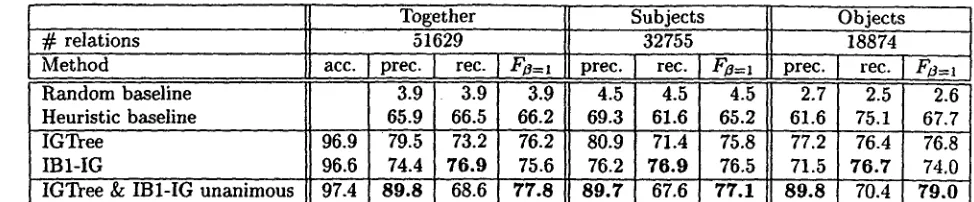
76.8 76.9 75.6 76•2 76.9 76.5 71.5 76.7 74.0 68.6 77.8 8 9 . 7 67.6 77.1 89.8 70.4 79.0Table 3: Results of the 10-fold cross validation experiment on the subject-verb/object-verb relations data• We trained one classifier to detect subjects as well as objects• Its performance can be found in the column
Together.
For expository reasons, we also mention how well this classifier performs when computing precision and recall for subjects and objects separately.
3 the number of commas between the verb and the head,
4 the verb, and
5 its POS tag,
6 - 9 the two left context words/chunks of the head, rep- resented by the word and its POS
1 0 - 1 1 the head itself, and
1 2 - 1 3 its right context word/chunk.
Features one to three are numeric features. This prop- erty can only be exploited by I B I - I G . IGTREE treats them as symbolic. We also tried four additional fea- tures that indicate the sort of chunk (NP, VP or none) of the head and the three context elements respectively These features did not improve performance, presum- ably because this information is mostly inferrable from the POS tag.
To find subjects and objects in a test sentence, the sentence is first POS tagged (with the Memory-Based Tagger MBT) and chunked (see section
Experiments:
Chunking).
Subsequently all chunks are reduced to their heads. 2Then an instance is constructed for every pair of a baseVP and another word/chunk head provided they are not too distant from each other in the sentence. A crucial point here is the definition of "not too distant". If our definition is too strict, we might exclude too many actual subject-verb or object-verb pairs, which will re- sult in low recall. If the definition is too broad, we will get very large training and test sets. This slows down learning and might even have a negative effect on pre- cision because the learner is confronted with too much "noise". Note further t h a t defining distance purely
2By definition, the head is the rightmost word of a baseNP or baseVP.
as the number of intervening words or chunks is not fully satisfactory as this does not take clause structure into account• As one clause normally contains one ba- seVP, we developped the idea of counting intervening baseVPs. Counts on the treebank showed that less than 1% of the subjects and objects are separated from their verbs by more than one other baseVP. We therefore constru! ! ct an instance for every pair of a baseVP and another word/chunk head if they have not more than one other baseVP in between them. s
These instances are classified by the memory-based learner. For the training material, the POS.tags "and chunks from the treebank are used directly. Also, subject-verb and object-verb relations are extracted to yield the class values.
R e s u l t s a n d d i s c u s s i o n Tile results in Table 3 show that finding (unrestricted) subjects and objects is a hard task. The baseline of classifying instances at random (using only the probability distribution of the classes) is about 4%. Using the simple heuristic of clas- sifying each (pro)noun directly in front of resp. after the verb as S resp. 0 yields a much higher baseline of about 66%. Obviously, these are the easy cases. IGTREE, which is the better overall MBL algorithm on this task, scores 10% above this baseline, i.e. 76.2°A. The differ- ence ill accuracy between IGTrtEE and I B I - I G is only
3The following sentence shows a subject-verb pair (in bold) with one intervening baseVP (in italics):
[,vP The plant .~p], [A'P which .~,-p] [l'P zs o~med l'P] by [:vP Hollingsworth & Vose Co. NP] , [vP was vP] under [^,p contract ,vp] with [.~p Lorillard .x-p] [vp to nmke vP] [,~p the cigarette filters .we] .
The next example illustrates the same for all object-verb
pair:
Along [,vp the way/vp] , [.~p he .~p]/re meets vP] [,vp a solicitous Christian chauffeur .vP] [.vp who .vp] [vP
of_
fers
re] [Ne the hero ~ve] [.~,-p God .re] [^-,~ "s phone num- ber .re/; and//re the Sheep M a n .x'e], [.vP a sweet, rough- hewn figure /v/,] [~vt, who .vP] [l'P wears t'P] - /.re what else ~,'t,] - [,vp a sheepskin ~,'t,] . [image:4.612.74.561.64.165.2]I. Method I A,D&K
R&M C&P IBI-IG IBI-IG IBI-IG
IBI-IG,POSonly
Table 4: Comparison of MBL aad MBSL on carried out with a context of five words and
Tagger
Iaccuracy
precision } recall l FZ=,Brill - 9i.6 91.6 91.6
Brill 97.4 92.3 91.8 92.0
Brill - 90.7 91.1 90.9
Brill 97.2 91.5 91.3 91A
MBT 97.3 91.6 91.5 91.6
WSJ 97.6 92.2 92.5 92.3
WSJ 96.9 90.3 90.1 90.2
same dataset of several classifiers, the experiments with I B I - I G are all POS left and three right
0.3%. In terms of F-values, I B I - I G is better for find- ing subjects, whereas IGTREE is better for objects. We also note that IGTRv.E always yields a higher precision than recall, whereas I B I - I G does the opposite.
IGTrtEv. is thus more "cautious" than I B I - I G . Pre- sumably, this is due to the word-valued features. Many test instances contain a word not occurring in the train- ing instances (in that feature). In that case, search in the IGTREV. is stopped and the default class for that node is used. As the "-" class is more than ten times more frequent than the other two classes, there is a high chance that this default is indeed the "-" class, which is always the "cautious" choice. I B I - I G , on the other hand, will not stop on encountering an unseen word, but will go on comparing the rest of the fea- tures, which might still opt for a non-"-" class. The differences in precision and recall surely are a topic for further research. So far, this observation led us to com- bine both algorithms by classifying an instance as S resp. O only if both algorithms agreed and as "-" oth- erwise. The combination yields higher precision at the cost of recall, but the overall effect is certainly positive (Fj=~ = 77.8%).
D i s c u s s i o n a n d R e l a t e d R e s e a r c h
In [Argamon
et al.,
1998], an alternative approach to memox3'-based learning of shallow patterns, memory- based sequence learning (MBSL), is proposed. In this approach, tasks such as base NP chunking and subject detection are formulated as separate bracketing tasks, with as input the POS tags of a sentence. For ev- ery input sentence, all possible bracketings in context (situated contexts) are hypothesised and the highest scoring ones m'e used for generating a bracketed out- put sentence. The score of a situated hypothesis de- pends on the scores of the tiles which are part of it and the degree to which they cover the hypothesis. A tile is defined as a substring of the situated hypoth- esis containing a bracket, and the score of a tile de- pends on the number of times it is found in the train-ing material divided by the total number of times the string of tags occurs (i.e. including occurrences with another or no bracket). The approach is memory- based because all training data is kept available. Sim- ilar algorithms have been proposed for grapheme~to- phoneme conversion by [Dedina and Nusbaum, 1991], and [Yvon, 1996], and the approach could be seen as a linear algorithmic simplification of the DOP memory- based approach for full parsing [Bod, 1995]. In the re- mainder of this section, we show that an empirical com- parison of our computationally simpler MBL approach to MBSL on their data for NP chunking, subject, and object detection reveals comparable accuracies.
C h u n k i n g
For NP chunking, [Argamon et
al.,
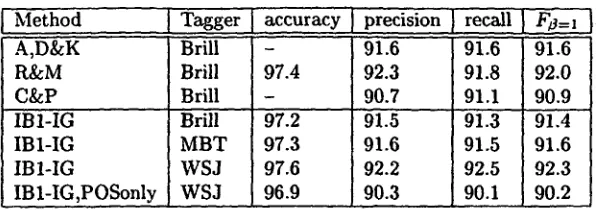
1998] used data ex- tracted from section 15-18 of the WS.J as a fixed train set and section 20 as a fixed test set, the same data as [Ramshaw and Marcus, 1995]. To find the opti- mal setting of learning algorithms and feature con- struction we used 10-fold cross validation on section 15; we found I B I - I G with a context of five words and POS-tags to the left and three to the right as a good parameter setting for the chunking task; we used this setting as the default setting for our ex- periments. For an overview of the results see Ta- ble 4. Since part of the chunking errors could be caused by POS errors, we also compared the same baseNP chunker on the santo corpus tagged with i) the Brill tagger as used in [Ramshaw and Marcus, 1995], ii) the Memory-Based Tagger (MBT) as described in [Daelemans etal.,
1996]. We also present the results of [Argamon etal.,
1998], [Ramshaw and Marcus: 1995] and [Cardie and Pierce, 1998] in Table 4. The latter two use a transformation-based error-driven learning method [Brill, 1992]. In [Ramshaw and Marcus, 1995], the method is used for NP chunking, and in [Cardie and Pierce, 1998] the approach is indirectly used to evaluate corpus-extracted NP chunking rules. [image:5.612.158.456.69.174.2]Subjects
#
subsequences • MethodA,D&K ... IGTcee IBI-IG
"IBI-IG POS only IBI-IG without chunks IBI-IG with treebank chunks
Objects
3044 1626
I prec. I rec. I
Fa=l
prec': I 'rec. [FO=x
88.6 84.5 86.5
77.1
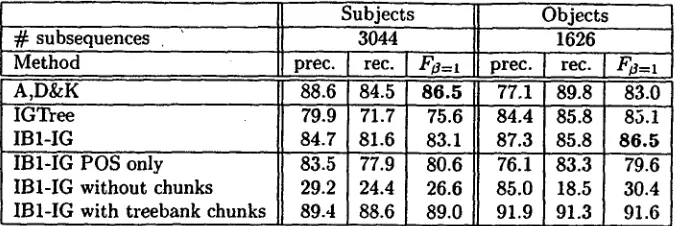
89.8 83.0 79.9 71.7 75.6 84.4 85.8 85.1 84.7 81.6 83.1 87.3 85.8 86.5 83.5 7 7 . 9 80.6 76.1 83.3 79.6 29.2 24.4 26.6 85.0 1 8 . 5 30.4 89.4 88.6 89.0 91.9 91.3 91.6Table 5: Comparison of MBL and MBSL on subject/object detection as formulated by Argamon et al.
tion for their MBSL chunker, we also experimented with that option (POSonly in the Table). Results show that adding words as information provides useful informa- tion for MBL (see Table 4).
S u b j e c t / o b j e c t d e t e c t i o n
For subject/object detection, we trained our algorithm on section 01-09 of the WSJ and tested on Argamon et al.'s test data (section 00). We also used the treebank POS tags instead of MBT. For comparability, we per- formed two separate learning experiments. The verb windows are defined as reaching only to the left (up to one intervening baseVP) in the subject experiment and only to the right (with no intervening baseVP) in the object experiment. The relational output of
MBL
is converted to the sequence format used by MBSL. The conversion program first selects one relation in case of coordinated or nested relations. For objects, the actual conversion is trivial: The V-O sequence extends from the verb up to the head(seen the old man
for the ex- ample sentence on page 55). In the case of subjects, the S-V sequence extends from the beginning of the baseNP of the head up to the first non-modal verb in the ba- seVP(My sisters have).
The program also uses filters to model some restrictions of the patterns that Arga- m o n e t al. used for data extraction. They extracted e.g. only objects that immediately follow the verb.The results in Table 5 show that highly comparable results can be obtained with MBL on the (impover- ished) definition of the subject-object task. I B I - I G as well as IGTREE are better than MBSL on the object data. They are however worse on the subject data. Two factors may have influenced this result. Firstly, more than 17% of the precision errors of I B I - I G con- cern cases in which the word proposed by the algorithm is indeed the subject according to the treebank, but the corresponding sequence is not included in Argamon et al.'s test data due to their restricted extraction pat- • terns. Secondly. there are cases for which MBL cor- rectly found the head of the subject, but the conversion results in an incorrect sequence. These are sentences
like
"All [NP the man NP] [NP 's friends NP] came."
in which
all
is part of the subject while not being part of an:)" baseNP.Apart from using a different algorithm, the MBL ex- periments also exploit more information ill the train- ing data than MBSL does. Ignoring lexical information in chunking and subject/object detection decreased the
Fa=I
value by 2.5% for subjects and 6.9% for objects. The bigger influence for objects may be due to verbs that take a predicative object instead of a direct one. Knowing the lexical form of the verb helps to make this distinction. In addition, time expressions like "(it rained) last week" can be distinguished from direct ob- jects on the basis of the head noun. Not chunking" the text before trying to find subjects and objects decreases F-values by more than 50%. Using the "perfect" chunks of the treebank, on the other hand. increases F by 5.9% for subjects and 5.1% for objects. These figures slmw how crucial the chunking step is for the succes of our method.G e n e r a l
Clear advantages of MBL are its efficiency (especially when using IGTREE), the ease with which information apart from POS tags can be added to the input (e.g. word information, morphological information, wor(lnet tags. chunk information for subject aIld object detec- tion), and the fact that NP and VP chunking and dif- ferent types of relation tagging can be achieved in one classification pass. It is uncleax how MBSL could be extended to incorporate other sources of information apart from POS tags, and what the effect would be on performance. More limitations of MBSL are that it cannot find nested sequences, which nevertheless occur frequently in tasks such as subject identification 4, and that it does not mark heads.
%.g. [SV John, who [SV I like SV]. Is SV] angry.
[image:6.612.158.496.61.174.2]C o n c l u s i o n
We have developed and empirically tested a memory- based learning (MBL) approach to shallow parsing in which POS tagging, chunking, and identification of syn- tactic relations are formulated as memory-based mod- ules. A learning approach to shallow parsing allows for fast development of modules with high coverage, robustness, and adaptability to different sublanguages. The memory-based algorithms we used (IBI-IG and IGTrtEE) are simple and efficient supervised learning algorithms. Our approach was evaluated on NP and VP chunking, and subject/object detection (using out- put from the clmnker).
Fa=l
scores are 93.8% for NP chunking, 94.7% for VP chunking,77.1%
for subject detection and 79.0% for object detection. The accu- racy and efficiency of the approach are encouraging (no optimisation or post-processing of any kind was used yet), and comparable to or better than state-of-the-art alternative learning methods.We also extensively compared our approach to a recently proposed new memory-based learning al- gorithm, memory-based sequence learning (MBSL, [Argamon
et al.,
1998] and showed that MBL, which is a computationally simpler algorithm than MBSL, is able to readl similar precision and recall when re- stricted to the MBSL definition of the NP chunking, subject detection and object detection tasks. More im- portantly, MBL is more flexible in the definition of the shallow parsingtasks: it allows nested relations to be detected; it allows the addition and integration into the task of various additional sources of information apart from POS tags; it can segment a tagged sentence into different types of constituent chunks in one pass; it can scan a chunked sentence for different relation types in one pass (though separating subject-verb detection from object-verb detection is surely an option that must be investigated).In current research we are extending the approach to other types of constituent chunks and other types of syntactic relations. Combined with previous results on PP-attachment [Zavrel
et al.,
1997], the results pre- sented here will be integrated into a complete shallow parser.A c k n o w l e d g e m e n t s
This research was carried out in the context of the "In- duction of Linguistic Knowledge" (ILK) research pro- gramme, supported partially by the Foundation of Lan- guage, Speech and Knowledge (TSL), which is funded by the Netherlands Organisation for Scientific Research (NWO). The authors would like to thank the other members of the ILK group for the fruitful discussions and comments.
R e f e r e n c e s
[Abney, 1996] S. Abney. Statistical methods and lin- guistics. In Judith L. Klavans and Philip Resnik, ed- itors,
The Balancing Act: Combining Symbolic and
Statistical Approaches to Language,
pages 1-26. MIT Press, Cambridge, MA, 1996.[Argamon
et al.,
1998] S. Argamon, I. Dagan, and Y. Krymolowski. A menmry-based approach to learn- ing shallow natural language patterns. InProc. o/
36th annual meeting o/the A CL,
pages67-73,
Mon- treal, 1998.[Bod~ 1995] R. Bod. Enriching linguistics with statis- tics: Performance models of natural language. Dis- sertation, ILLC, Universiteit van Amsterdam, 1995. [Brill, 1992] E. Brill. A simple rule-based part-of-
speech tagger. In
Proceedings of the Third ACL Ap-
plied NLP,
pages 152-155, Trento, Italy, 1992. [Buchholz, 1998] Sabine Buchholz. Distinguishingcomplements from adjuncts using memory-based learning. In
Proceedings o] the ESSLLI-98 Work-
shop on Automated Acquisition o/Syntax and Pars-
:ng,
1998.[Cardie and Pierce, 1998] C. Cardie and D. Pierce. Error-driven pruning of treebank grammars for base noun phrase identification. In
Proc. of 36th annual
meeting o/the ACL,
pages 218-224, Montreal, 1998. [Cardie, 1994] C. Cardie.Domain Specific Knowledge
Acquisition for Conceptual Sentence Analysis.
PhD thesis. University of Massachusets. Amherst. MA, 1994.[C.J.van Rijsbergen, 1979] C.J.van Rijsbergen.
Infor-
mation Retrieval.
Buttersworth, London, 1979. [Daelemanset al.,
1996] W. Daelemans, J. Zavrel.P. Berck, and S. Gillis. MBT: A memory-based part of speech tagger generator. In E. Ejerhed and I. Dagan. editors,
Proc. o] Fourth Workshop on Very LaTye
Co~l~ora,
pages 14-27. ACL SIGDAT. 1996.[Daelemans