International Journal of Mechanical & Mechatronics Engineering IJMME-IJENS Vol:16 No:03 88
Objective Effect on the Performance of a
Multi-Period Multi-Product Production Planning
Optimization Model
M. S. Al-Ashhab
1, 2, Nahid Afia
1and Lamia A. Shihata
11 Design & Production Engineering Dept. Faculty of Engineering, Ain-Shams University, Egypt 2Dept. of Mechanical Engineering Collage of Engineering and Islamic architecture, UQU, KSA
Abstract-- This paper introduces a multi objective optimization model to solve production planning problems for a multi products, multi period, and multi echelon manufacturing chain to minimize the total cost and maximize the overall service level of customers. The model is formulated using mixed integer linear programming optimization form.
The obtained results are compared with the results of a similar model which maximizes the total profit. It was proved that the configuration of the network and consequently its performance differs with the corresponding objectives and constraints taken into consideration when designing the network. Analysis of results prescribed that cost minimization is not always lead to maximizing profit.
Index Term-- Production planning; MILP; multi-products, multi echelon, multi-objective; multi-periods; cost minimization; and profit maximization.
1. INTRODUCTION
One of the most important supply chain decisions is how to design the network as its implication is significant and long lasting. The existing literature concerning SCN design problems are strongly dissimilar, different researchers include different objectives in their proposed models.
Most researches dealt with minimizing the sum of various cost components that depend on the set of decision modeled. Jayaraman and Ross (2003) provided a robust and practical approach for solving a multiple product, multi-echelon problem. The objective function minimizes fixed costs to open warehouses and cross-docks, costs to transport products from warehouses to cross-docks and costs to supply products from cross-docks to satisfy the demand of customers. This approach obtained optimal solution using the LINGO software for small datasets and near-optimal solutions. Bidhandi et al. (2009) reconsidered the mathematical formulation provided by Cordeau et al. for logistics network design. They developed a multi-commodity single-period integrated SCND model with two levels of strategic and tactical variables to minimize the sum of all fixed and variable costs.[
Similarly, Davoudpour and Sadjady (2012) approached the minimization of total variable and fixed costs of the network by designing a two-echelon supply chain network, which allows multiple levels of capacities for the facilities of both stages.
Successive research activities evolved accordingly dealing with minimizing the sum of various cost components
that depend on the set of decision modeled [Jeung Ko et al.- Wang et al.} while some others dealt with the objective of maximizing profit to determine the network [Costa et al.,- Melo et al.]. Akbari & Behrooz Karimi (2015) considered a multi-echelon, multi-product, multi-period supply chain including manufacturing plants, distribution centers, and retailers at customer zones with the objective to minimize the sum of location, allocation, transportation, and inventory carrying costs which can be formulated as a mixed integer linear programming problem.
Ryanb et al. (2016) formulated a novel profit maximization model using mixed-integer linear programming for a multi-period, single-product and capacitated CLSCN design problem to maximize the expected profit. Their major contribution is developing a hybrid robust-stochastic programming approach to model qualitatively different uncertainties. Historical data for transportation costs was assumed and used to generate probabilistic scenarios by a scenario generation and reduction algorithm.
One of the earliest researches that approached the multi-objective method for supply chain network was Weber and Current JR. in 1993. They proposed a multi-objective approach for vendor selection, considering three objectives including the purchases cost, number of late deliveries, and rejected units. (Sabria et al. 2000). Guillen et al. (2005) introduced three objectives in his research, maximizing net present value, maximizing demand satisfaction and minimizing financial risks in a stochastic supply chain setting to choose numbers, location and capacities of plants and warehouses. They mention that generating different configurations of SCN can help decision makers to determine the best design according to the chosen objectives. The authors stated that the main objective of the supply chain management is to achieve suitable economic results together with the desired consumer satisfaction levels.
International Journal of Mechanical & Mechatronics Engineering IJMME-IJENS Vol:16 No:03 89 demonstrated that single-cluster replenishment is generally
superior to joint cluster replenishment. However, based on transportation cost discounts, joint cluster replenishment may be superior to single cluster replenishment. The results showed that single-item replenishment is inferior to multi-item replenishment under volume (weight) discounts on transportation costs. Choudhary et al. (2016) introduced a multi-objective problem for supply chain network design by incorporating the issues of social relationship, carbon emissions, and supply chain risks such as disruption and opportunism. The proposed MOP included three conflicting objectives: maximization of total profit, minimization of supply disruption and opportunism risks, and minimization of carbon emission considering a number of supply chain constraints. An illustrative example was presented to manifest the capability of the model and the algorithm. The results obtained revealed the robust performance of the proposed MOP.
Pazhami et al. (2013) developed a bi-objective supply chain network design model. The objective of their research was minimizing the total supply chain network cost and maximizing the service level. In order to measure the service level they used Multiple Criteria Decision Making techniques and established an efficiency score for each warehouse and hybrid facility. As a second objective they have tried to maximize the total efficiency score.
Most of researches reduce their optimization models to single objective either to minimize the total cost of the supply chain or to maximize the total profit. However modeling may require more than single objective such as maximizing profit, maximizing service level, minimizing cost, maximize the utilization of resources. The multi objectives models represent reality more than the single objective ones. Usually, these objectives may cause conflicts. For example, in most cases; increasing service level usually causes a growth in costs while it may maximize profit. Similarly, minimizing the supply chain network total cost may lead to lower level of customer satisfaction due to usage of cheaper resources. The aim of a multi objective supply chain network design is to find trade off solutions in order to satisfy the conflicting objectives which must be optimized by the decision maker.
The above review of supply chain models shows the importance of assessing the impact of more than one objective while designing a SCN, but as far as the researchers of this paper went, there was no comparative study performed to support the tradeoff decision that should be reached by the decision maker. This research in addition to introducing a model with the objective of minimizing cost and maximizing the overall service level, it compares the results obtained those results when applying the same model after changing the model objective of profit maximization to a cost minimization one.
In general, the configuration of the supply chain depends
form of shortage cost as well as the non-utilized capacity cost if it is optimal not to produce with the full capacity.
Cost minimization is one of the necessary conditions for profit maximization. Revenues and costs are related, maximizing profit can be achieved by maximizing revenues and/or minimizing cost. In the domain of supply chain network design, minimizing costs may also minimize revenues and therefore will not maximize profit.
In this paper, a model is formulated using mixed integer linear programming optimization form. This model solves the production planning problem for a multi products, multi period, and multi echelon manufacturing chain. The proposed model attempts to simultaneously minimize total cost and maximize the overall service level of the customers. A case study is used to show the ability of the proposed model in solving the problem. The obtained results is compared with the results mentioned in Al-Ashhab et al.(2016)where the objective was maximizing profit and the overall service level of the customers.
The remainder of this paper is organized as follows: the model description is described in Section 2. The model assumptions and limitations are introduces in section 3. The detailed mathematical formulation is shown in Section 4. Section 5, presents and discusses the computational results of the model and the case study. Concluding remarks are made in Section 6. Finally, Future Work and Recommendations are presented in Section 7
2. MODEL DESCRIPTION
The proposed model assumes a set of customer locations with known and time varying demands and a set of candidate suppliers of known, limited and time varying capacity, and distributor’s locations of known, limited and time varying capacity. It optimizes locations of the suppliers, distributors and customers and allocates the shipment between them to minimize the total cost while maximizing the overall customer service level taking their capacities, inventory and shortage penalty and other costs into consideration.
Suppliers are responsible for supplying of raw materials to the facility. Facility is responsible for manufacturing of the three products and supplying some of them to the distributors and storing the rest for the next periods; if it is profitable. Distributors are responsible for the distribution of products to the customers and/or storing some of them for the next periods, and customers’ nodes may represent one customer, a retailer, or a group of customers and retailers. The model considers fixed costs for all nodes, materials costs, transportation costs, manufacturing costs, non-utilized capacity costs for the facility, holding costs for facility and distributors’ stores and shortage costs.
International Journal of Mechanical & Mechatronics Engineering IJMME-IJENS Vol:16 No:03 90
4. MODEL FORMULATION
The current model involves the same sets, parameters and variables where:
Sets:
S: potential number of suppliers, indexed by s. D: potential number of distributors, indexed by d. C: potential number of first customers, indexed by c.
T: number of periods, indexed by t. P: number of product, indexed by p. Parameters:
Fs, Ff, Fd: fixed cost of contracting supplier s, the facility, and distributor d
DEMANDcpt: demand of customer c from product p in period t,
Ppct: unit price of product p at customer c in period t,
Wp: product weight.
MHp: manufacturing hours for product. Dij: distance between location I and j. CAPst: capacity of supplier s in period t (kg), CAPMft: capacity of the facility Raw Material Store in period t.
CAPHft: capacity in manufacturing hours of the facility in period t,
CAPFSft: storing capacity of the facility in period t, CAPdt: capacity of distributor d in period t (kg), MatCostt: material cost per unit supplied by supplier s in period t,
MCft: manufacturing cost per hour for facility in period t,
MHp: Manufacturing hours for product (p)
NUCCf: non utilized manufacturing capacity cost per hour of the facility,
SCPUp: shortage cost per unit per period,
HFp: holding cost per unit per period at facility store (kg),
HDp: holding cost per unit per period at distributor d store (kg),
Bs: batch size from supplier s
Bfp& Bdp: batch size from the facility and distributor d for product p.
TCperkm: transportation cost per unit per kilometer.
Decision Variables:
Li: binary variable equal to 1 if a location i is opened and equal to 0 otherwise.
Qsft: number of batches transported from supplier s to the facility in period t,
Qfdpt: number of batches transported from the facility to distributor d for product p in period t, Ifpt: number of batches transported from the facility to its store for product p in period t,
Ifdpt: number of batches transported from store of the facility to distributor d for product p in period t,
Qdcpt: number of batches transported from distributor d to customer c for product p in period t,
Rfpt: residual inventory of the period t at store of the facility for product p.
Rdpt: residual inventory of the period t at distributor d for product p.
OSLc: Overall Service Level of customer c.
4.1. Objective Function
The objectives of the model are to minimize the total cost while maximizing the overall service levels of the four customers.
Total cost = fixed costs + material costs + manufacturing costs + non-utilized capacity costs + shortage costs + transportation costs + inventory holding costs.
P p cpt Dd pP dcpt
c Q / DEMAND
Level Service Overall T t T t (1) 4.1.1. Costs
(1)
Total cost = fixed costs + material costs + manufacturing costs + non-utilized capacity costs + shortage costs + transportation costs + inventory holding costs.
d D d d S s s
sL Ff F L
F
costsFixed (2)
(2)
S
s t T
st s
sft
B
M atCost
Q
cost
M aterial
(3)
(3)
Pp t T
D
d pPtT 2...
ft p fp fpt ft p fp
fdptB MH Mc I B MH Mc
Q costs ing Manufactur
(4)
P p f NUCC D d p fp fpt p fp fdpt D d T t fft)L (Q B MH) (I B MH)) )
((CAPH ( cost capacity Utilized -Non
(5)
p 1 dp dcpt T t t 1cpt
Q
B
)
))
SCPU
DEMAND
(
(
(
cost
Shortage
t D d C c P p(6)
)
D
T
W
B
Q
D
T
W
B
I
D
T
W
B
Q
(
DS
T
B
Q
costs
tion
Transporta
dc d p dp dcpt 2 fd f p fp fdpt fd f p fp fdpt T t sf s s sft
D d c Ct T Tt d D
T t d D P p S s
(7)
Dd tT
T t P p
)
HD
W
R
HF
W
R
(
costs
holding
International Journal of Mechanical & Mechatronics Engineering IJMME-IJENS Vol:16 No:03 91
4.1.2. Total Revenue
D d c Cp Ppct dp dcpt
B
P
Q
revenue
Total
T t(9)
Total Profit = Total revenue – Total cost
4.2. Constraints
Model constraints are categorized as follows: 4.2.1. Balance constraints:
P p p fp fpt p fp fdpt D d S s ssft
B
Q
B
W
I
B
W
t
T
Q
,
(10)
P
p
T
t
B
I
B
R
B
R
B
I
D d fp fdpt fp fpt fp t fp fpfpt
1)
,
,
(
(11)
D
d
T
t
B
Q
B
R
B
R
B
I
Q
Pp cC
dp dcpt dp dpt dp t dp P p fp fdpt
fdpt
,
2
,
)
(
( 1)(12)
P
p
C
c
T
t
B
Q
B
Q
t dp D d t dcp t cp D d cpt dpdcpt
,
,
,
DEMAND
DEMAND
1 ) 1 ( ) 1 ((13)
4.2.2. Capacity constraints:
S
s
T,
t
,
L
CAP
B
Q
sft s
st s
(14)T
t
,
L
CAPM
B
Q
sft s
ft f
S s (15)P
p
T,
t
,
L
CAPH
MH
)
B
I
B
Q
(
Dd d D
f ft p fp fpt fp
fdpt
(16)T
t
,
L
CAPFS
W
B
R
fpt fp p
ft f
P p (17)P
p
D,
d
T,
t
,
L
CAP
W
B
R
W
B
)
I
(Q
dt dT p fp 1 -dpt p fp fdpt
fdpt
t
(18)
5. RESULTS AND DISCUSSION
This section illustrates the behavior of the proposed model with the objective of minimizing cost and maximizing the overall service level. The obtained results are compared with the results obtained in M. S. Al-Ashhab, (2016) when applying the same model after changing the model objective of profit maximization to
International Journal of Mechanical & Mechatronics Engineering IJMME-IJENS Vol:16 No:03 92
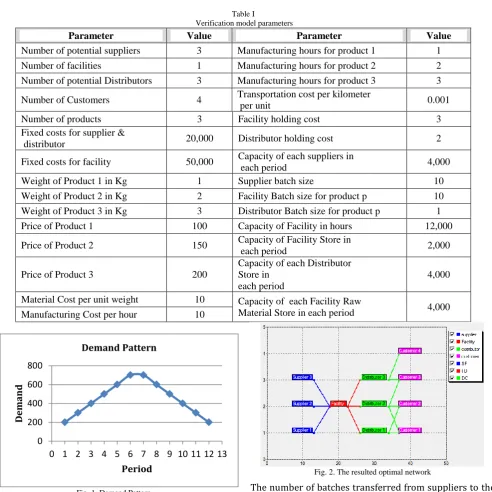
Table I
Verification model parameters
Parameter Value Parameter Value
Number of potential suppliers 3 Manufacturing hours for product 1 1
Number of facilities 1 Manufacturing hours for product 2 2
Number of potential Distributors 3 Manufacturing hours for product 3 3
Number of Customers 4 Transportation cost per kilometer
per unit 0.001
Number of products 3 Facility holding cost 3
Fixed costs for supplier &
distributor 20,000 Distributor holding cost 2
Fixed costs for facility 50,000 Capacity of each suppliers in
each period 4,000
Weight of Product 1 in Kg 1 Supplier batch size 10
Weight of Product 2 in Kg 2 Facility Batch size for product p 10
Weight of Product 3 in Kg 3 Distributor Batch size for product p 1
Price of Product 1 100 Capacity of Facility in hours 12,000
Price of Product 2 150 Capacity of Facility Store in
each period 2,000
Price of Product 3 200
Capacity of each Distributor Store in
each period
4,000
Material Cost per unit weight 10 Capacity of each Facility Raw
Material Store in each period 4,000
Manufacturing Cost per hour 10
Fig. 1. Demand Pattern
The behavior of the model under the condition of minimizing the cost is initially illustrated. Thereafter a comparison is carried out between the behaviors of the model with the other of maximizing profit.
5.1. Cost minimization model behavior
In this section, the results of applying the proposed model with the objective of minimizing cost are introduced. The results were discussed to show the optimal production plan in the design of manufacturing chain operating under a multi-product, multi-period with the objective of cost minimization and to select the partners as well. The resulted optimal network configuration that minimizes the total cost is as shown in Figure 2.
Fig. 2. The resulted optimal network
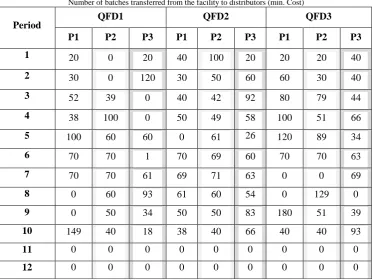
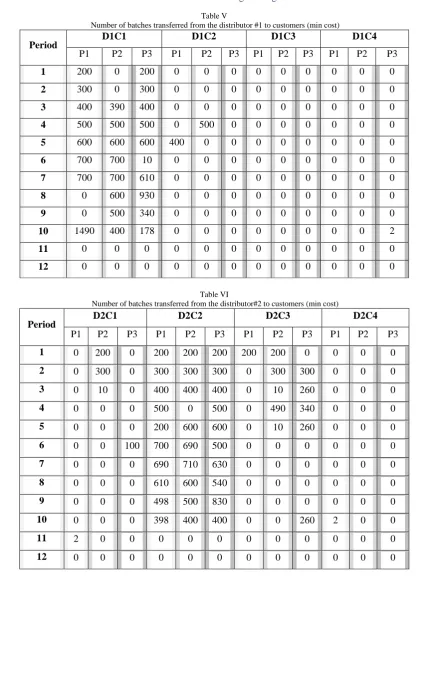
The number of batches transferred from suppliers to the facility is illustrated in Table 2 where it is noticed that while applying the model to design the network over 12 periods, the optimal production plan determined that the quantities transferred between the partners are just over only10 periods. This also can be easily shown in Tables 3a, 4a, 5, 6 and 7.
0 200 400 600 800
0 1 2 3 4 5 6 7 8 9 10 11 12 13
D
ema
nd
International Journal of Mechanical & Mechatronics Engineering IJMME-IJENS Vol:16 No:03 93
Table II
Number of batches transferred from suppliers to the facility
Cost minimization Profit maximization
Period S1F S2F S3F S1F S2F S3F
1 160 400 0 0 400 160
2 400 440044 200 200 400 400
3 400 400 200 400 400 200
4 400 400 200 200 400 400
5 400 400 200 400 400 200
6 200 400 400 200 400 400
7 400 400 200 200 400 400
8 400 400 200 200 400 400
9 400 400 200 200 400 400
10 399 399 202 400 400 200
11 0 0 0 400 400 200
12 0 0 0 400 400 200
Table IIIa
Number of batches transferred from the facility to distributors (min. Cost)
Period QFD1 QFD2 QFD3
P1 P2 P3 P1 P2 P3 P1 P2 P3
1 20 0 20 40 100 20 20 20 40
2 30 0 120 30 50 60 60 30 40
3 52 39 0 40 42 92 80 79 44
4 38 100 0 50 49 58 100 51 66
5 100 60 60 0 61 26 120 89 34
6 70 70 1 70 69 60 70 70 63
7 70 70 61 69 71 63 0 0 69
8 0 60 93 61 60 54 0 129 0
9 0 50 34 50 50 83 180 51 39
10 149 40 18 38 40 66 40 40 93
11 0 0 0 0 0 0 0 0 0
International Journal of Mechanical & Mechatronics Engineering IJMME-IJENS Vol:16 No:03 94
Table IIIb
Number of batches transferred from the facility to distributors (max. profit)
Period To distributor 1 To distributor 2 To distributor 3 P1 P2 P3 P1 P2 P3 P1 P2 P3 1 0 0 1 60 41 66 20 40 39
2 0 30 61 60 70 20 65 117 33
3 134 40 29 42 0 92 78 22 53
4 0 74 7 48 76 57 53 50 81
5 97 60 61 20 40 36 115 116 13
6 70 69 46 9 71 69 1 143 0
7 68 5 41 0 176 5 279 60 0
8 62 85 56 248 67 4 60 70 2
9 50 49 23 50 105 46 100 95 31
10 39 41 27 80 80 22 40 46 88
11 31 30 40 58 56 72 30 32 102
12 20 20 47 42 39 93 20 22 112
Table IVa
Number of batches transferred from facility store to distributors (min cost)
Period IFD1 IFD2 IFD3 P1 P2 P3 P1 P2 P3 P1 P2 P3 2 0 0 0 0 0 0 0 0 0 3
0 0 0 0 0 0 0 0 0
4 0 0 0 0 0 0 0 0 0 5 0 0 0 20 0 60 0 0 0 6 0 0 0 0 0 0 0 0 0 7 0 0 0 0 0 0 0 0 0
8 0 0 0 0 0 0 0 0 0
9 0 0 0 0 0 0 0 0 0 10 0 0 0 2 0 0 0 0 0 11 0 0 0 0 0 0 0 0 0
12 0 0 0 0 0 0 0 0 0
Table IVb
Number of batches transferred from the facility store to distributors. (max. profit)
Period
To distributor 1 To distributor 2 To distributor 3 Product 1 P2 P3 Product 1 P2 P3 Product 1 P2 P3 2 0 0 1 0 0 12 0 0 0
3 0 0 0 0 0 0 0 0 0
4 0 0 0 0 0 8 0 0 0
5 0 0 0 0 21 50 5 0 3
6 0 0 0 6 0 1 0 0 0
7 0 0 0 0 0 11 0 0 0
8 0 0 0 0 0 0 0 0 0
9 0 0 0 0 1 0 0 0 0
10 0 0 0 0 0 31 0 0 1
11 0 0 1 0 0 0 0 0 0
International Journal of Mechanical & Mechatronics Engineering IJMME-IJENS Vol:16 No:03 95
Table V
Number of batches transferred from the distributor #1 to customers (min cost)
Period
D1C1 D1C2 D1C3 D1C4
P1 P2 P3 P1 P2 P3 P1 P2 P3 P1 P2 P3
1 200 0 200 0 0 0 0 0 0 0 0 0
2 300 0 300 0 0 0 0 0 0 0 0 0
3 400 390 400 0 0 0 0 0 0 0 0 0
4 500 500 500 0 500 0 0 0 0 0 0 0
5 600 600 600 400 0 0 0 0 0 0 0 0
6 700 700 10 0 0 0 0 0 0 0 0 0
7 700 700 610 0 0 0 0 0 0 0 0 0
8 0 600 930 0 0 0 0 0 0 0 0 0
9 0 500 340 0 0 0 0 0 0 0 0 0
10 1490 400 178 0 0 0 0 0 0 0 0 2
11 0 0 0 0 0 0 0 0 0 0 0 0
12 0 0 0 0 0 0 0 0 0 0 0 0
Table VI
Number of batches transferred from the distributor#2 to customers (min cost)
Period
D2C1 D2C2 D2C3 D2C4
P1 P2 P3 P1 P2 P3 P1 P2 P3 P1 P2 P3
1 0 200 0 200 200 200 200 200 0 0 0 0
2 0 300 0 300 300 300 0 300 300 0 0 0
3 0 10 0 400 400 400 0 10 260 0 0 0
4 0 0 0 500 0 500 0 490 340 0 0 0
5 0 0 0 200 600 600 0 10 260 0 0 0
6 0 0 100 700 690 500 0 0 0 0 0 0
7 0 0 0 690 710 630 0 0 0 0 0 0
8 0 0 0 610 600 540 0 0 0 0 0 0
9 0 0 0 498 500 830 0 0 0 0 0 0
10 0 0 0 398 400 400 0 0 260 2 0 0
11 2 0 0 0 0 0 0 0 0 0 0 0
International Journal of Mechanical & Mechatronics Engineering IJMME-IJENS Vol:16 No:03 96
Table VII
Number of batches transferred from the distributor#3 to customers (min cost)
Period D3C1 D3C2 D3C3 D3C4
P1 P2 P3 P1 P2 P3 P1 P2 P3 P1 P2 P3
1 0 0 0 0 0 0 0 0 200 200 200 200
2 0 0 0 0 0 0 300 0 0 300 300 300
3 0 0 0 0 0 0 400 390 140 400 400 400
4 0 0 0 0 0 0 500 10 160 500 500 500
5 0 0 0 0 0 0 600 590 340 600 300 0
6 0 0 0 0 0 0 700 700 630 0 0 0
7
0 0 0 0 0 0 0 0 690 0 0 0
8
0 0 0 0 0 0 0 1290 0 0 0 0
9
0 0 0 0 0 0 1800 510 390 0 0 0
10
0 0 0 0 0 0 400 400 930 0 0 0
11
0 0 0 0 0 0 0 0 0 0 0 0
12
0 0 0 0 0 0 0 0 0 0 0 0
Table VIII
Number of batches transferred from distributors to customers. (max. profit)
Period 1 2 3 4 5 6 7 8 9 10 11 12
D1-C1
P1 0 0 395 500 600 700 680 620 500 390 310 200
P2 0 300 400 500 600 690 50 850 490 410 300 200
P3 0 300 165 500 600 460 410 560 230 270 410 470
D1-C2
P1 0 0 0 445 370 0 0 0 0 0 0 0
P2 0 0 0 240 0 0 0 0 0 0 0 0
P3 0 0 0 25 10 0 0 0 0 0 0 0
D1-C3
P1 0 0 0 0 0 0 0 0 0 0 0 0
P2 0 0 0 0 0 0 0 0 0 0 0 0
P3 0 0 0 0 0 0 0 0 0 0 0 0
D1-C4
P1 0 0 0 0 0 0 0 0 0 0 0 0
P2 0 0 0 0 0 0 0 0 0 0 0 0
P3 0 0 0 0 0 0 0 0 0 0 0 0
D2-C1
P1 200 300 5 0 0 0 0 0 0 0 0 0
P2 200 0 0 0 0 10 400 0 0 0 0 0
P3 200 0 235 0 0 0 0 0 0 1 0 0
D2-C2
P1 200 300 400 55 200 150 0 1880 500 400 300 200
P2 200 300 400 260 600 700 679 51 1060 410 280 220
P3 200 300 400 475 590 691 160 37 460 514 720 818
D2-C3
P1 200 0 1 439 0 0 0 600 0 400 280 220
P2 0 0 10 500 10 0 681 619 0 390 280 170
P3 12 268 273 187 270 9 0 3 0 15 0 112
D2-C4
P1 0 0 0 0 0 0 0 0 0 0 0 0
P2 0 0 0 0 0 0 0 0 0 0 0 0
P3 0 0 0 0 0 0 0 0 0 0 0 0
D3-C1
P1 0 0 0 0 0 0 0 0 0 0 0 0
P2 0 0 0 0 0 0 0 0 0 0 0 0
P3 0 0 0 0 0 0 0 0 0 0 0 0
D3-C2
P1 0 0 0 0 0 0 0 0 0 0 0 0
P2 0 0 0 0 0 0 0 0 0 0 0 0
P3 0 0 0 0 0 0 0 0 0 0 0 0
D3-C3
P1 0 300 399 61 600 0 1400 0 500 0 0 0
P2 200 300 390 0 590 700 0 0 500 10 20 30
P3 188 32 127 313 160 0 0 14 310 890 1020 1120
D3-C4
P1 200 300 400 500 600 10 1390 600 500 400 300 200
P2 200 300 400 500 570 730 600 700 450 450 300 190
International Journal of Mechanical & Mechatronics Engineering IJMME-IJENS Vol:16 No:03 97 It can be concluded from Figure 3 that the facility capacity
in hours are sufficient and exceeds the equivalent required hours both in the first four periods from T1 to T4 and the last four ones from T9 to T12. Moreover, it is not used for the last two periods T11 and T12. At the first four periods, the equivalent given hours is equal to the required hours and it is equal exactly to the facility capacity at period T4. This illustrates that all of the manufactured batches are delivered directly to the distributors without storing any inventory in the facility store. It is remarkable that the equivalent required hours exceed the facility hour’s capacity from T5 to T8, but it doesn’t matter as the optimal production plan is to manufacture equal or less than the facility capacity hours as shown in Figure 3.
Fig. 3. Relationship between the equivalents required manufacturing hours and the equivalent given hours
Considering capacity of material supply; Figure 4 illustrates the relationship between the equivalents required weight, supplying material and the equivalent given weight. The supplying capacity of the suppliers is 12,000 Kilograms as three suppliers were opened; the capacity of each is 4000 kilograms. This will exceed the raw material store capacity which is 10,000 kilograms. The required weights have not to be exceeded by both of them. It is evident that in the first three periods, the supplied material is more than the required; consequently the required weights are delivered to customers while the excess is stored in the distributor’s stores to be available as compensation in the following periods when needed.
It is notable that, the equivalent given weight exceeds the facility capacity as shown in periods T4 and T5. The difference can be compensated from the facility store as it is less than or equal 2000 kilograms which represent the maximum capacity of the facility store. The required material is more than the supplied from period T6 to period T9 and exceeds the facility capacity. Consequently, the facility cannot manufacture more than its capacity and customer demand cannot be satisfied. Shortage in demand is faced in the coming periods in the form of backorders. In spite of the supplied material is more than the required in period T10, but unfortunately the difference may not be sufficient to face or cover the shortage as no equivalent
Fig. 4. Relationship between the equivalents required weight, supplying material and the equivalent given weight
Fig. 5. The resulted Overall Service Level of the customers
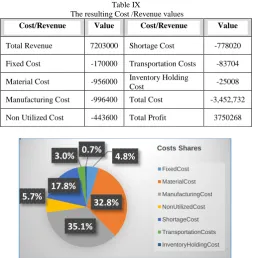
Table 9 represents the results obtained from applying the proposed model on the case study. The total revenue, cost elements, total cost and total profit can be seen. A pie chart, on which the cost shares percentages are mentioned, can be shown in Figure 6.
Table IX
The resulting Cost /Revenue values
Cost/Revenue Value Cost/Revenue Value
Total Revenue 7203000 Shortage Cost -778020
Fixed Cost -170000 Transportation Costs -83704
Material Cost -956000 Inventory Holding
Cost -25008
Manufacturing Cost -996400 Total Cost -3,452,732
Non Utilized Cost -443600 Total Profit 3750268
86.17% 90.72% 90.74%
31.51%
C 1 C 2 C 3 C 4
OSL
4.8%
32.8% 5.7%
17.8%
3.0% 0.7% Costs Shares
FixedCost
MaterialCost
ManufacturingCost
International Journal of Mechanical & Mechatronics Engineering IJMME-IJENS Vol:16 No:03 98
5.2. Comparison between the obtained results in both cases of minimizing the total cost and maximizing profit
This section introduces a comparison between the results mentioned in the above section concerning applying the proposed model on the case study with the objective of minimizing the total cost and the results mentioned in M. S. Al-Ashhab, (2016) when applying the model on the same case study but with the objective of maximizing profit.
5.2.1 The supply chain network design
The same resulted optimal network which is shown in Figure 2 is obtained in both cases, but with different number of batches to be transferred between partners. This explains why the fixed cost is equal as shown in Table 10.
Table X
The resulting Cost /Revenue values in both cases
Cost/Revenue Minimizing
total cost
Maximizi ng profit
Percentage of change%
Total Revenue 7,203,000 8,786,500 18 %
Fixed Cost -170,000 -170,000 0 %
Material Cost -956,000
-1,156,000 17.3 % Manufacturing
Cost -996,400
-1,238,400 19.5 % Non Utilized
Cost -443,600 -201,600 -120 %
Shortage Cost -778,020 -628,000 -23.9 %
Transportation
Costs -83,704 -106,002 21 %
Inventory
Holding Cost -25,008 -25, 000 0 %
Total Cost -3,452,732
-3,500,002 1.4 %
Total Profit 3,750,268 5,261,498 28.7 %
5.2.2 Cost/ Revenue values
Figure 7 depicts the total revenue, costs and profit for the both cases. The following can be concluded:
Fig. 7. Comparison between cost/ revenue values and total profit
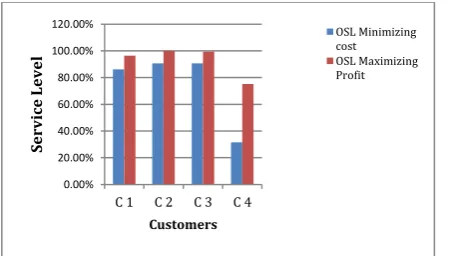
1) The first set of bars represents the total revenue. It is clear that, the total revenue with the objective of maximizing profit is greater than that of minimizing cost. It can be seen from Figure 8 that the resulting overall service level OSL at each customer with the
objective of maximizing profit is greater than that of minimizing cost. As a result this will lead the total revenue to be increased.
Fig. 8. The resulting Overall Service Level percentage in both cases
2) The set of bars in between represents the different cost elements in both cases
The following can be concluded from Figure 7 and Table 10: Replacing the objective of profit maximization by the other of cost minimization in this case resulted in:
a) No change in the fixed cost because the resulted networks are configuration similar
b) Decreasing in material cost. This is as a result that the supplying material weight is greater through the 12 periods as obtained in M. S. Al-Ashhab, (2016). Consequently, it is obvious that the manufacturing cost will be smaller in this case as well.
c) Decreasing in transportation cost as the transferred number of batches decreases.
d) Inventory holding cost is almost the same. The produced batches in most of the cases are transferred directly as it is less than or equal to the equivalent required weight in most of the periods.
e) Increasing in non-utilized capacity cost. The reason of that is clear when comparing the results in both tables 3a with 3b, Table 4a with 4b and Tables 5, 6 and 7 with Table8. Mainly, the last two periods are off which means greater non-utilized capacity cost. f) Increasing in shortage cost as well. This is because
the equivalent given weight is less than the required. 3) The set of bars before last represents the total cost. It is
evident that the total cost with the objective of minimizing cost is smaller than that of maximizing profit as it is the main objective in the second case. 4) The last set of bars represents the total profit. It is
evident that the total profit with the objective of maximizing profit is greater than that of minimizing cost as it is the main objective of the first case and equal to the difference between the total revenues and the sum of total mentioned costs.
5) It can be seen from Table 10 that, the revenue decreased by about 18% while the total cost increased by 1.35%. This will lead to a decrease in profit by 28.7%. This means that a relatively little percentage increase in total cost results in a reasonable greater increase in profit. From another point of view, the percentage increase in revenue is less than the percentage increase in profit. Consequently, the decision maker should not build the 0.E+00
1.E+06 2.E+06 3.E+06 4.E+06 5.E+06 6.E+06 7.E+06 8.E+06 9.E+06
Minimizing total cost Maximizing profit
0.00% 20.00% 40.00% 60.00% 80.00% 100.00% 120.00%
C 1 C 2 C 3 C 4
Se
rv
ic
e
Le
ve
l
Customers
International Journal of Mechanical & Mechatronics Engineering IJMME-IJENS Vol:16 No:03 99 decisions based on the traditional relations between
revenue, cost and profit.
6. CONCLUSIONS
The difference in the performance of the supply chain is studied under two different cases. The first case is to minimize the total costs of designing and managing the network beside the objective of maximizing the overall service level of customers. The second case is the same but with maximizing the profit instead of minimizing the total cost.
A case study is solved by the proposed model considering multi products, multi periods, and multi echelon to achieve optimal configuration network with optimal operation performance and detailed production planning for multiple planning horizons as well. There are many circumstances where the structures of the maximum profit and minimum cost solutions will be different, their facility number, locations, and quantities transferred between echelons which affect the overall service level of customers.
The comparison of the two models results revealed that the performance of the manufacturing chain affected drastically by the objective of the model. So, deciding the objective is a very critical decision. Although minimizing the total cost is an important performance metric in supply chain management but the overall service level of customers should be respected to certain reasonable levels in order to have profit. The decision of minimizing the total costs is accompanied by sacrificing some profit. Maximizing profit and minimizing costs are conflicting. The decision makers have to highlight the tradeoff between objectives. Conflicting may occur when a supply chain is supporting multiple products with capacity constraints and varying profit margins. Maximizing profit should be the objective of designing the profit organization where minimizing cost should be the objective of designing the non-profit or service organization with assigned minimum overall customer service level.
7.FUTURE WORK AND RECOMMENDATIONS
Further research can be done considering uncertain conditions to study the performance of the model under uncertainty. If product demands are highly variable, the minimum cost solution may not lead to the maximum profit.
From this research it can be recommended that, in all profit business networks; the objective of minimizing cost is not the good decision where it does not respect both revenue and profit.
REFERENCES
[1] Vaidyanathan Jayaraman, Anthony Ross, (2003), A simulated annealing methodology to distribution network design and management. European Journal of Operational Research, 144, 629–645.
[2] Hadi Mohammadi Bidhandi, Rosnah Mohd. Yusuff, Megat
selection, lead-times and inventory costs. Computers & Operations Research, 39, 1345–1354.
[4] Hyun Jeung Ko, Chang Seong Ko, Taioun Kim, (2006), A hybrid optimization/simulation approach for a distribution network design of 3PLS. Computers & Industrial Engineering, 50, 440–449
[5] Hyun Jeung Ko, Gerald W. Evans, (2007), A genetic algorithm-based heuristic for the dynamic integrated forward/reverse logistics network for 3PLs. Computers & Operations Research, 34, 346–366
[6] Hokey Min, Hyun-Jeung Ko, (2008), The dynamic design of a reverse logistics network from the perspective of third-party logistics service providers. Int. J. Production Economics, 113,176–192
[7] Phuong Nga Thanh, Nathalie Bostel, Olivier Peton, (2008), A dynamic model for facility location in the design of complex supply chains. Int. J. Production Economics, 113, 678–693. [8] Lin Lin, Mitsuo Gen, Xiaoguang Wang, (2009), Integrated
multistage logistics network design by using hybrid evolutionary algorithm. Computers & Industrial Engineering, 56, 854–873. [9] Elisa Gebennini, RitaGamberini, RiccardoManzini,(2009), An
integrated production–distribution model for the dynamic location and allocation problem with safety stock optimization. Int. J. Production Economics, 122, 286–304.
[10] D.H. Lee, M. Dong, (2008), A heuristic approach to logistics network design for end-of-lease computer products recovery. Transportation Research Part E: Logistics and Transportation Review, 44, 455–474.
[11] Fan Wang, Xiaofan Lai, Ning Shi, (2011), A multi-objective optimization for green supply chain network design. Decision Support Systems, 51, 262–269.
[12] Antonio Costa, Giovanni Celano, Sergio Fichera, Enrico Trovato, (2010), A new efficient encoding decoding procedure for the design of a supply chain network with genetic algorithms. Computers and Industrial Engineering, 59, 986–999.
[13] M. El-Sayed, N. Afia, A. El-Kharbotly, (2010), A stochastic model for forward–reverse logistics network design under risk. Computers & Industrial Engineering, 58, 423–431.
[14] Tiravat Assavapokee, Wuthichai Wongthatsanekorn, (2012). Reverse production system infrastructure design for electronic products in the state of Texas, Computers & Industrial Engineering, 62, 129–140.
[15] M.T. Melo, S. Nickel, F. Saldanha-da-Gama, (2009). Facility location and supply chain management – A review. European Journal of Operational Research, 196, 401–412.
[16] Ali Akbar Akbari & Behrooz Karimi, (2015), A new robust optimization approach for integrated echelon, multi-product, multi-period supply chain network design under process uncertainty, Int J Adv Manuf Technol, 79:229–244
[17] Esmaeil Keyvanshokooha , Sarah M. Ryanb, Elnaz Kabir, (2016), Hybrid robust and stochastic optimization for closed-loop supply chain network design using accelerated Benders decomposition, European Journal of Operational Research, 249, 76–92
[18] Ehap H. Sabria, Benita M. Beamon, (2000), A multi-objective approach to simultaneous strategic and operational planning in supply chain design. Omega, 28, 581-598.
International Journal of Mechanical & Mechatronics Engineering IJMME-IJENS Vol:16 No:03 100
[22] Mir Saman Pishvaee, Reza Zanjirani Farahani, Wout Dullaert, (2010), A memetic algorithm for bi-objective integrated forward/reverse logistics network design. Computers & Operations Research, 37, 1100–1112.
[23] M.S. Pishvaee, S.A. Torabi, (2010), A possibilistic programming approach for closed-loop supply chain network design under uncertainty. Fuzzy Sets and Systems, 161, 2668–2683.
[24] Turan Paksoy and Ching-Ter Chang, (2010), Revised multi-choice goal programming for multi-period, multi-stage inventory controlled supply chain model with popup stores in Guerrilla marketing. Applied Mathematical Modelling, 34, 3586–3598. [25] Hsiao-Fan Wang, Hsin-WeiHsu, (2010), A closed-loop logistic
model with a spanning-tree based genetic algorithm. Computers & Operations Research, 37, 376 – 389.
[26] M. S. Al-Ashhab, (2016), An optimization Model for Multi-period Multi-Product Multi-objective Production Planning. International Journal of Engineering & Technology IJET-IJENS Vol.: 16 No: 01
[27] Yu-Chung Tsao, Qinhong Zhang & Tsung-Hui Chen ,(2016), Multi-item distribution network design problems under volume discount on transportation cost, International Journal of Production Research, 54:2, 426-443
[28] Alok Choudhary · Soudagar A. K. Irfan Babu · Sri Krishna Kumar · A. Goswami ,M. K. Tiwari,(2016), Designing multi-period supply chain network considering risk and emission: a multi-objective approach Ravi Shankar Kumar1·, Annals of Operations Research pp 1-35