Ran Zhou, Huazhu Song
*and Jun Li
Abstract
In order to solve the problems of the laser scattering rate of settlement particles during sedimentation, such as polymerization, coverage, and disappearance, the grayscale characteristics, morphological features, and motion characteristics of the settlement particles are analyzed and studied in this paper. On the basis of these, the recursive idea is applied to the multi-threshold segmentation algorithm with fuzzy 3-partition entropy algorithm, and then, the fuzzy comprehensive evaluation method is used to identify the settlement particles. Finally, the proposed method is implemented in MATLAB 9 and compared with the traditional Kalman filtering and Otsu segmentation algorithm. The experimental results show that the proposed algorithm is better than other algorithms on the ROC curve, and the recognition rate of the settling particles is higher.
Keywords:Settlement particle recognition, Fuzzy partition entropy, Fuzzy comprehensive evaluation method
1 Introduction
The traditional methods of settlement particle size detec-tion include the sieving method and the laser method. The sieving method is easy to operate, which enables particles to detect particle size through different sieve holes. Al-though its operation is simple, but the precision is very poor. The accuracy of the laser method is much higher than that of the sieving method, but the laser method is costly, not conducive to the application of industrial level, and has high operation requirements for the inspectors.
In recent years, many scholars have studied the algorithm of particle recognition based on image ana-lysis, which improves not only the efficiency of recogni-tion but also the accuracy greatly. It has become a hot research focus in recent years [1–7]. Zhe et al. proposed a Hough-GVF segmentation method to segment cell im-ages [8]. Wen et al. realized the identification and classi-fication of different rice grains based on the technology of computer image processing technology [9]. Owing to this fact, the fuzzy set theory was adopted by several au-thors for image segmentation purpose.
Benabdelkader et al. proposed a recursive exhaustive fuzzy 2-partition algorithm. By preserving the instantan-eous recursive value calculated by the fuzzy entropy, the re-peated calculation of the follow-up population optimization is reduced [10]. However, the recursive algorithm is designed for the fuzzy 2-partition of the trapezoid member-ship function, and the segmentation accuracy is low.
Tang and others further improved the membership function as the S function, but when the number of fuzzy partitions changes, the dependence relation of the front and back terms in the fuzzy entropy formula is also changed [11]. It is difficult to apply to the fuzzy N division with higher segmentation precision and a more complex membership function, and the optimization strategy is the exhaustive algorithm to enumerate all possible solutions. Although the preexisting recursive re-sults can be used to reduce repeated computation, as the number of threshold increases, the running time also in-creases linearly. In addition, the threshold-based seg-mentation algorithm always has the influence by noise, and the optimization algorithm based on spatial correl-ation needs to be further implemented.
In our research, a multi-threshold segmentation method with recursive fuzzy 3-partition entropy is pro-posed, and the S membership function containing three
* Correspondence:[email protected]
School of Computer Science and Technology, Wuhan University of Technology, Wuhan 430070, People’s Republic of China
parameters is selected to replace the trapezoid member-ship function, and the fuzzy N division of the image is implemented to improve the segmentation precision. Then, the segmentation accuracy is improved. The fuzzy partition entropy is calculated by recursive algorithm, and the instantaneous recursive value is preserved for subsequent population optimization algorithm, so as to reduce repeated computation and improve the efficiency of optimization. Finally, the fuzzy comprehensive evalu-ation method is used to identify the settlement particles.
Section2 analyzes the characteristics of settlement par-ticles. In Section 3, the thresholding method based on fuzzy 3-partition entropy is proposed in detail, which improves the efficiency of optimization. Section 4 shows the steps for identify the settlement particles by the fuzzy
necessary to analyze the characteristics of the settlement particles. In this paper, the settlement particles are ana-lyzed from three aspects of the grayscale characteristics, the shape characteristics, and the motion characteristics.
2.1 Grayscale characteristics of settlement particles The most obvious and intuitionistic characteristic in the image of settlement particles is the grayscale characteristics.
1. Grayscale characteristics of settlement particles in single frame
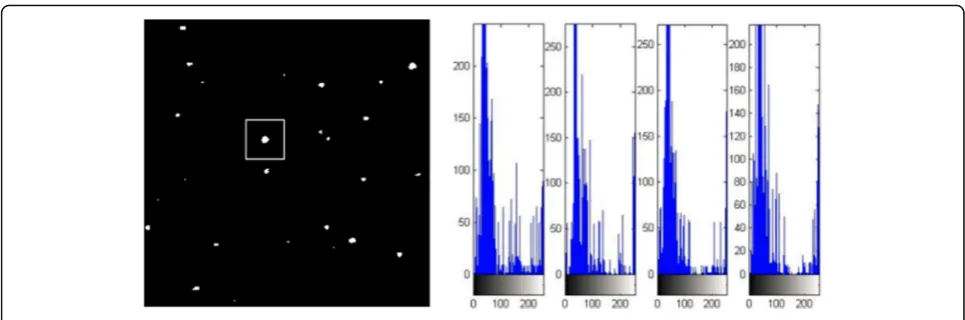
For individual settlement particles in single frame images, the grayscale distribution of settlement particles is different. As shown in Fig. 1, the upper part is the settlement particle and the corresponding grayscale dis-tribution below. It is obvious that the grayscale distribu-tion of the settlement particles is different.
2. Grayscale characteristics of settlement particles in different frames
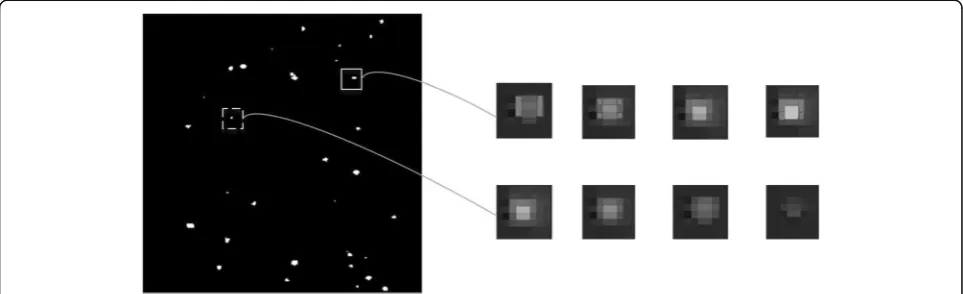
As in Fig. 2, the settlement particles are observed in the solid frame and the dotted line frame, and the right part of Fig. 2 is the grayscale change of the particles in the four frames. As can be seen from Fig.2, the change trend of the grayscale value of the two settlement particles is different.
In Fig.3, the grayscale changes of the settlement parti-cles in successive 40 frames are not intense and are basically visible.
Fig. 1Grayscale characteristics of different settlement particles
As shown in Fig.4, the grayscale changes of settlement particles between successive frames vary greatly. In the histogram, the high grayscale area (red area) gradually decreases. In this way, the particles will be difficult to distinguish in the next few frames.
From the above analysis, it can be seen that the grayscale value of the settlement particles has a dynamic change in the same frame, whether it is the different settling particles or the same settlement particle in different frames.
2.2 Shape characteristics of settlement particles
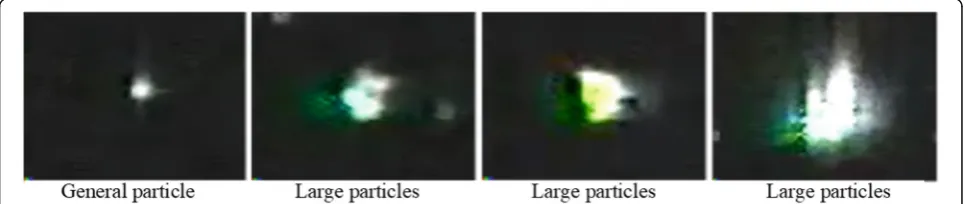
In the settlement particle image, most of the settlement particles are similar in size (shown in Fig. 5), but there are also a small portion of the particles due to physical reasons or shooting reasons, which mainly include large particles and long tail particles.
1. Large particles
As shown in Fig. 6, the settlement particles are aggre-gated in the settlement process, so the size of the entire particles will be larger than that of the general particles.
2. Long tail particles
Due to the physical causes of particles and camera shooting problems, the particles will have longer wakes. Figure7shows the long tail settlement particles.
2.3 Motion characteristics of settlement particles
In the settlement device, the settlement particles will be subjected to a lot of forces, such as gravity, Van der Waals force, and the attraction between particles. These forces are integrated into the settlement particles and lead to the operation of the settlement particles. For the same par-ticle, motion is different in different frames; for the same frame, different particles are moving differently.
1. The velocity of different particles in the same frame is different
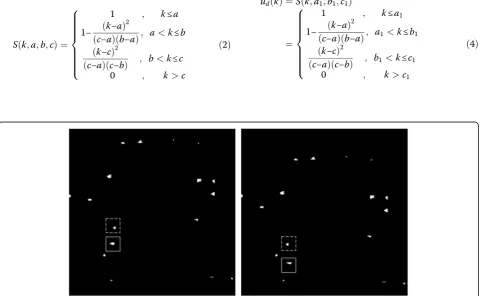
As seen from Fig. 8, two particles are moving not only in the vertical direction but also in horizontal direction, and the velocity of two settlement particles is also different.
Fig. 3Settlement particles with little change in grayscale
2. Settlement particles are uniformly moving
When the settlement granules have just been added to the settlement system, a large number of granules are piled up together, so that the settlement granules will ac-celerate settlement at the beginning. However, when the particles move in the device for a period of time, they will gradually stabilize and tend to uniform speed. Therefore, when there is no interference from external conditions, we believe that the movement of settlement particles is uniform.
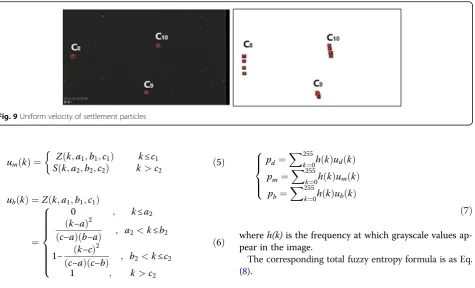
As shown in Fig.9, for particles C8, C9, and C10, their
settlement position is taken every 60 frames for a total of four times. The resulting settlement trajectory is shown on the right side of Fig. 9. As can be seen from the figure, the velocity of the settlement particles is rela-tively stable, so it can be considered that the movement of the settlement particles is uniform without external interference.
3. The coverage of settlement particles
The velocity of different settlement particles is differ-ent, so it is possible that the particles of fast motion will pass through the slow, that is, the covering of settlement particles.
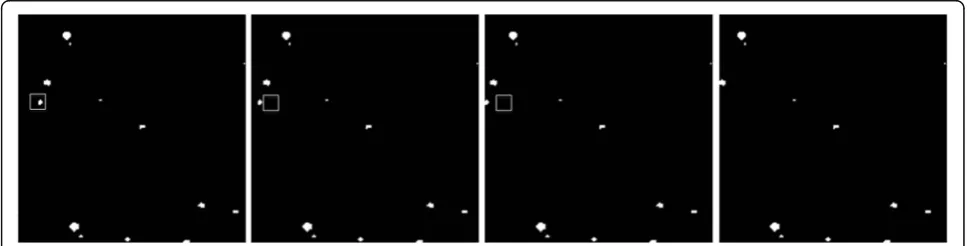
In Fig. 10, the particles in the round frame were cov-ered after a period of time, and then separated after a short covering.
4. The aggregation of settlement particles
Unlike the coverage of particles, the aggregation of the settlement particles is that the two particles remain at the same speed after polymerization, causing the parti-cles to cluster into a cluster and appear to be polymer-ized, shown in Fig.11.
5. The disappearance of settlement particles
The disappearance of the settlement particles is gener-ally divided into two cases: the first is that the settlement particles are free from the boundary, the disappearance of the particles is permanent, and the second is the tem-porary disappearance of the particles through the cover of other particles, shown in Fig.12.
In summary, this paper will identify and measure settle-ment particles from the above-settle-mentioned characteristics of settlement particles and combined with fuzzy set theory.
3 The multi-threshold segmentation method based on fuzzy 3-partition entropy
Fuzzy partitioned entropy segmentation algorithm takes into account the inherent fuzzy characteristics of the par-ticle and uses the membership function to describe the fuzzy information that traditional classical logic can hardly represent. The recursive fuzzy partition entropy threshold segmentation method was proposed to segment and optimize the settlement particles.
Fig. 5Different shape of settlement particles
3.1 Thresholding method based on fuzzy 3-partition entropy
Let I be a function which describes an image having 256 grayscale levels ranging from 0 to 255,I(x,y) is a value of this function in pixel with coordinates (x, y). The number of pixels with grayscale levelkis denoted asfk; then, the
prob-ability of the occurrence of the grayscale levelkin the image is calculated by Eq. (1), whereNis the total of the pixels.
p kð Þ ¼ fk=N ð1Þ
In this paper, we choose S-fuzzy function with three parameters, and its expression is calculated by Eq. (2), and its inverse Z-fuzzy function is calculated by Eq. (3).
S k;ð a;b;cÞ ¼
1 ; k≤a
1− ðk−aÞ
2
c−a
ð Þðb−aÞ; a<k≤b k−c
ð Þ2
c−a
ð Þðc−bÞ ; b<k≤c
0 ; k>c
8 > > > > > > < > > > > > > :
ð2Þ
Z kð ;a;b;cÞ ¼
0 ; k≤a
k−a ð Þ2
c−a
ð Þðb−aÞ ; a<k≤b
1− ðk−cÞ
2
c−a
ð Þðc−bÞ ; b<k≤c
1 ; k>c
8 > > > > > > < > > > > > > :
ð3Þ
The S-fuzzy function and the Z-fuzzy function classify the image into low, medium, and high grayscale fuzzy sets, denoted byEd,Em, andEb, respectively. The
expres-sion of membership functions of these three sets is shown in Eqs. (4) to (6).
udð Þ ¼k S k;ð a1;b1;c1Þ
¼
1 ; k≤a1
1− ðk−aÞ
2
c−a
ð Þðb−aÞ; a1<k≤b1 k−c
ð Þ2
c−a
ð Þðc−bÞ ; b1<k≤c1
0 ; k>c1
8 > > > > > > < > > > > > > :
ð4Þ
Fig. 7The Long tail settlement particles
umð Þ ¼k S k;Z kð ;a1;b1;c1Þ k≤c1
a2;b2;c2
ð Þ k>c2
ð5Þ
ubð Þ ¼k Z kð ;a1;b1;c1Þ
¼
0 ; k≤a2
k−a ð Þ2
c−a
ð Þðb−aÞ ; a2<k≤b2
1− ðk−cÞ
2
c−a
ð Þðc−bÞ ; b2<k≤c2
1 ; k>c2
8 > > > > > > < > > > > > > :
ð6Þ
where a1, b1, c1, a2, b2, and c2are parameters variables
of membership function, kis the pixel grayscale level of settling particle image, and it satisfies 0≤a1<b1<c1< a2<b2<c2≤255. Figure 13 is the curve of three
mem-bership functions. Under the optimal combination ofa1, b1, c1, a2, b2, and c2, the intersection ofud(k)and um(k)
and the intersection ofum(k)and ub(k)are the best
seg-mentation threshold.
3.2 The recursive algorithms imported to fasten the fuzzy entropy calculation
The corresponding probability ofEd,Em, andEbfuzzy sets
ispd,pm, andpband their expressions are as follows:
pd¼X255
k¼0h kð Þudð Þk
pm ¼X255
k¼0h kð Þumð Þk
pb¼X255
k¼0h kð Þubð Þk
8 > > < > > :
ð7Þ
whereh(k)is the frequency at which grayscale values ap-pear in the image.
The corresponding total fuzzy entropy formula is as Eq. (8).
H að 1;b1;c1;a2;b2;c2Þ ¼−pd logð Þpd −pm logð Þpm
−pb logð Þpb
ð8Þ
The basic idea of this paper is to divide the curves in Fig.1 into the upper and lower two layers, the um(k)as
the upper function, and the ud(k)+ub(k) as the lower
function, which is recorded as um’(k), and um(k)= 1−
um’(k).
It is known by Eq. (9).
pm0¼pbþpd¼1−pm ð9Þ
Then, Eq. (8) is simplified as Eq. (10).
Fig. 9Uniform velocity of settlement particles
H¼−pm0 logðpm0Þ−pm logð Þpm
¼−log 1ð −pmÞ þpmlog 1−pm
pm
ð10Þ
According to Eq. (10), the value of total fuzzy entropy is only related topmandpmcan be obtained by Eqs. (5)
and (7),
pm¼ 1
ðc1−a1Þðb1−a1Þ
Xb1
k¼a1þ1ðk−a1Þ 2hðkÞ
−ð 1
c1−a1Þðc1−b1Þ
Xc1
k¼b1þ1ðk−c1Þ 2
hðkÞ
−ðc 1 2−a2Þðb2−a2Þ
Xb2
k¼a2þ1ðk−a2Þ 2hðkÞ
þð 1
c2−a2Þðc2−b2Þ
Xc2
k¼b2þ1ðk−c2Þ 2
hðkÞ
þXb2
k¼b1þ1hðkÞ
ð11Þ
Equation (11) contains five parts of summation. In order to simplify the calculation, E(a, b), F(a, b), and
G(a,b) are used to simplify the summation calculation.
E a;ð bÞ ¼Xb
k¼aþ1ðk−aÞ 2
h kð Þ
F að ;bÞ ¼Xb
k¼aþ1ðk−bÞ 2
h kð Þ G a;ð bÞ ¼Xb
k¼aþ1h kð Þ
8 > > > < > > > :
ð12Þ
Bring Eq. (12) into Eq. (11),
pm¼
E að 1;b1Þ
c1−a1
ð Þðb1−a1Þ−
F bð 1;c1Þ
c1−a1
ð Þðc1−b1Þ−
E að 2;b2Þ
c2−a2
ð Þðb2−a2Þ
þ F bð 2;c2Þ
c2−a2
ð Þðc2−b2Þþ
G bð 1;b2Þ
ð13Þ
We use the recursive algorithms for Eq. (13), where
E(a,b),F(a,b), andG(a,b) in Eq. (12) can be calculated according to Eqs. (14) to (18) to improve efficiency.
Eða;bÞ ¼Xb
k¼aþ1ðk−aÞ 2
hðkÞ
¼ Xbk−¼1aþ1ðk−aÞ2hðkÞ þ ðb−aÞ2hðkÞ ¼ Eða;b−1Þ þ ðb−aÞ2hðkÞ
ð14Þ
Fig. 11The aggregation of settlement particles
E að ;bÞ ¼E að ;b−1Þ þðb−aÞ2h kð Þ E a;ð aþ1Þ ¼h að þ1Þ
ð15Þ
F að ;bÞ ¼Xb
k¼aþ1ðk−bÞ 2
h kð Þ
¼Xbk¼ðaþ1Þþ1ðk−bÞ2h kð Þ þðaþ1−bÞ2h kð Þ ¼ F að þ1;bÞ þðaþ1−bÞ2h kð Þ
ð16Þ
where F að ;bÞ ¼F að þ1;bÞ þðaþ1−bÞ
2
h kð Þ F bð −1;bÞ ¼0
ð17Þ
G að ;bÞ ¼Xb
k¼aþ1h kð Þ
¼Xbk−¼1aþ1h kð Þ þh bð Þ
¼G a;ð b−1Þ þh bð Þ ð18Þ
In the range of 0≤a<b≤255, the recursive values of
E(a,b),F(a,b), and G(a,b) are saved in order to reduce the duplication calculation and facilitate the subsequent optimization calculation.
it is necessary to calculate the yield of each honey source. Therefore, we need to use the income function to calcu-late the yield value many times, and the yield is calcucalcu-lated according to Eq. (10). Through the above description, we can know that in the calculation of Eq. (10), the recursive values ofE(a,b),F(a,b), andG(a,b) can be obtained by it-erative method, so a lot of calculation steps are reduced and the efficiency of the algorithm is improved. The im-proved artificial bee colony algorithm flowchart as shown in Algorithm 1.
3.4 The optimization of graph cut spatial correlation by the region-based label assignment
Considering that noises exist during the segmentation process, we used a graph cut algorithm to solve it. First, in order to maintain the edge information of the image, the settled particle image needs to be smoothed, then the pixels belonging to the same area are assigned the same label, and finally the image area with relatively small grayscale variance is used as the seed point, and the optimization of the graph cut is performed. This can reduce the time spent on graph cuts and can define data items for the graph cut algorithm. In the following, the fuzzy 3-partition algorithm is taken as an example to
Fig. 13The curve of three membership functions
Determine the factor set of the object evaluated
Determine the evaluation set
of the object evaluated
Determine the weights of the
factors evaluated Determine
the fuzzy relation
matrix
Fuzzy comprehensive
evaluation
End Start
illustrate the graph cut algorithm. For the corresponding low, medium, and high grayscale fuzzy sets in the settle-ment particle image, denoted by E_d, E_m, and E_b, re-spectively, the setting is as shown in formula (19).
Edata sR¼}Ed}
¼−logX
255
k¼0
hRð Þuk dð Þk
Edata sR¼}Em}
¼−logX
255
k¼0
hRð Þk umð Þk
Edata sR¼}Eb}
¼−logX
255
k¼0
hRð Þuk bð Þk
8 > > > > > > > > > < > > > > > > > > > :
ð19Þ
In Eq. (19),SRis the label of the region R andhR(k)is the
pixel normalized histogram. Meantime, in order to uni-formly label the adjacent areas, the smoothing term of the image Esmoothis defined as Eq. (20), where Rpand Rq are
the average grayscale values of the regionpand the region
q, anddist(p, q) is the distance between the region p and the region q, and the label of the image region of the settled particles is assigned by using theα-βexchange operator.
Esmooth¼ exp −
Rp−Rq
2
2σ2
!
1
dist p;ð qÞ
ð20Þ
In this paper, the region-based label assignment method is applied, which combines the advantages of threshold segmentation and region segmentation to im-prove the accuracy of image segmentation.
4 Particle target recognition based on fuzzy comprehensive evaluation
In the previous section, the recursive fuzzy partition entropy threshold segmentation algorithm was used to segment and optimize the settlement particles, which is in order to better identify the settlement particles. The settlement particles studied in this paper have many uncertain fuzzy information. The traditional identification methods (such as the Otsu threshold segmentation, Gaussian mixture model) cannot be effectively identified. This paper uses the method of settlement particle identification based on fuzzy comprehensive evaluation.
4.1 The fuzzy comprehensive evaluation method of settlement particles
Settlement particles containing fuzzy information are identified. Firstly, the image of reconstructed settlement particles optimized by recursive fuzzy partitioned en-tropy multi-threshold segmentation is preprocessed to
Fig. 15The original image of settlement particles in the video 1
eliminate some noise interferences. Then, according to the characteristics of settlement particles and some experts’ suggestions, the appropriate feature quantities are selected, and then the characteristics are established. The corre-sponding membership function and the weight matrix cor-respond to the settling particles. The steps of the fuzzy comprehensive evaluation method are shown in Fig.14.
Let the factor set U= {u1,u2, ...,un} be a set ofn
evalu-ation factors; the evaluevalu-ation set V= {v1,v2, ...,vm} is a set
composed ofmkinds of judgments; weightsw= {w1,w2, ...,
wn}, wherewiis the weight corresponding to theith factor
ui, represents the degree of influence of the evaluation
fac-tor on the evaluation result and satisfies the normalization
condition: P i¼1 n
wi¼1;0≤wi≤1 . The result of fuzzy com-prehensive evaluation is recorded as B= {b1, b2, ..., bm},
wherebjis the degree of importance of theith evaluationvj
throughout the evaluation process. Finally, the fuzzy com-prehensive evaluation result is obtained by combining the fuzzy relationR= (rij)n × mand the weight matrixw.
Step 1: Determine the factor setUfor the objects evaluated
Step 2: Determine the evaluation setV
Step 3: Establish the fuzzy relationship matrixR. Each elementuiinVis evaluated by a single element to obtain
a fuzzy membership degree vectorRi= (ri1, ...,rij, ...,rim) relative tovj(i= 1, 2,…,nandj= 1, 2,…,m).rijis the degree (0≤rij≤1), namely the factoruibelongs tovj, which is determined by the fuzzy membership function. After evaluating allnfactors in the factor setU, ann×m fuzzy relation matrixRcan be obtained
Step 4: Determine the weightswof the factors evaluated Step 5: Compute the fuzzy comprehensive evaluation and get its resultB=w Rwhich is calculated by Eq. (21), where
bi¼⋁ni¼1ðwi∧rijÞ;i¼1;2;…;m,∨represents the
additive operation and∧represents the multiplication
operation, thenbi¼ P k¼1
n
wkrk j;i¼1;2;…;m.
b1;b2;…;bm
ð Þ ¼ðw1;w2;…;wnÞ
r11;r12;…;r1m
r21;r22;…;r2m
… … ⋱ …
rn1;rn2;…;rnm 2
6 4
3 7 5
ð21Þ
4.2 Particle target recognition based on fuzzy comprehensive evaluation
In the settlement particle image, some particles will have adhesion and coverage, which will lead to many errors in the identification of particles. Therefore, we should
Fig. 17Settlement particle image based on region segmentation
deal with the problem. In order to separate adhered par-ticles, this paper combines distance conversion and watershed algorithms to treat settlement particles.
1. The establishment of evaluation set.
The size and shape distribution of the settlement particles are dependent on the size and shape distri-bution, and the different settlement particles can be used in different materials. Therefore, the particle size of the settlement particles has a great influence on the performance of the whole material. By analyzing the distribution of the particle size and area of the settlement particles, the settlement particles of these different shapes and granularity can be analyzed. Therefore, two aspects of granularity and area are considered in this paper. Qualitative index V= {large particle and long tail particle} is used as evaluation set of segmentation particles.
2. The establishment of membership function
The area and size membership of settlement particles are determined by linear analysis. In this paper, it is as-sumed that the particle size of the settling particles is d
and the membership function is u(d). The particle size of the evaluation set V= {large particles, long tail
particles} of the degree of membershipu1(d)andu2(d)is
respectively defined in Eqs. (22) and (23).
u1ð Þ ¼d
1 ; d≤d1
d2−d
ð Þ
d2−d1
ð Þ; d1<d<d2
0 ; d≥d2
8 > < > :
ð22Þ
u2ð Þ ¼d 1−
0 ; d≤d1
d2−d
ð Þ
d2−d1
ð Þ ; d1<d<d2
1 ; d≥d2
8 > < > :
ð23Þ
In Eqs. (22) and (23), d1 and d2 are the boundary
points of particle size.
Similarly, the membership function of the area char-acteristic quantity S of the settlement particle u1(S)
and u2(S) are described correspondingly to Eqs. (24)
and (25).
u1ð Þ ¼S
1 ; S≤S1
S2−S
ð Þ
S2−S1
ð Þ ; S1<S<S2
0 ; S≥S2
8 > < > :
ð24Þ
Fig. 19Settlement particle recognition based on fuzzy comprehensive evaluation
u2ðSÞ ¼
(
1−
0 ;S≤S1
ðS2−SÞ
ðS2−S1Þ ;
S1<S<S2
1 ;S≥S2
ð25Þ
In Eqs. (24) and (25),S1and S2are the dividing points
of the area.
3. Determination of weight coefficient
The weight coefficient reflects the degree of influence of the factor set U on the elements of the evaluation concentration. Therefore, the establishment of the weight coefficient should be objective and fair. There-fore, this paper decides to use Eq. (26) to establish the unknown weight values.
wi¼ f Xm
j¼1 gi−rij
=Xpi¼1Xmj¼1 gi−rij
ð26Þ
Among them, f(f≥1) indicates the number of known weights, p(p≥1) indicates the number of unknown weights, andgiis the factor ui in the factor set that
be-longs to the largest membership degree value in each factor in the evaluation set V.
The weight calculation method can find the corre-sponding weight of the evaluation factor by the evalu-ation matrix, and the request of the original data is not high. Therefore, when calculating the weight, it is
convenient to calculate, and it can also guarantee the fairness and rationality of the weight calculation. After solving the weight coefficient and the relation matrix, the membership degree of the characteristic quantity can be calculated, and then the evaluation result matrix is obtained by combining the fuzzy relation matrix and the weight coefficient. The maximum value of the evaluation result matrix is the result of the target recognition.
5 Experimental results and discussions
The experimental environment was as follows:
1. Hardware: the computer with CPU (i5 2.3 GHz or upward compatible CPU), memory (8 GB DDR3 or more than 8 GB), graphics card (2 GB or more than 2 GB).
2. Software: Windows 10 as the operation system and MATLAB 9 as the integrated development environment (IDE).
The experimental data in this paper are derived from the particle settlement experiment. The experiment has two videos in total, video 1 is 20 min long and video 2 is 27 min; the videos contains 25 frames per second, and the video resolution is 576 × 960.
Because video 2 has less settlement particles and its segmentation results are not very obvious, we chose
Fig. 21The recognized long tail particles in the video 1
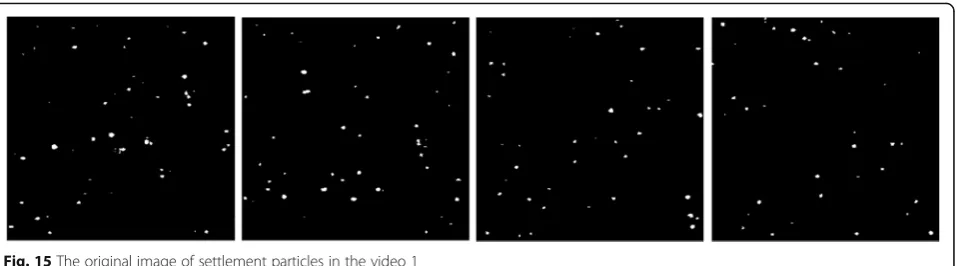
video 1 as the video for the all experiments, and video 2 for some. Here, Fig. 15 showed the original image of settlement in video 1.
1. Parameter determination
According to the weight calculation method in Sec-tion 4.2 and the relevant engineering data, the weights of the particle size and area of settling parti-cles are 0.6 and 0.4, respectively, namely [0.6, 0.4]. The parameters of settlement particle membership function are set to d1= 5 and d2= 10, and the
param-eters of area membership function are set to S1= 25
and S2= 100.
2. Experimental results
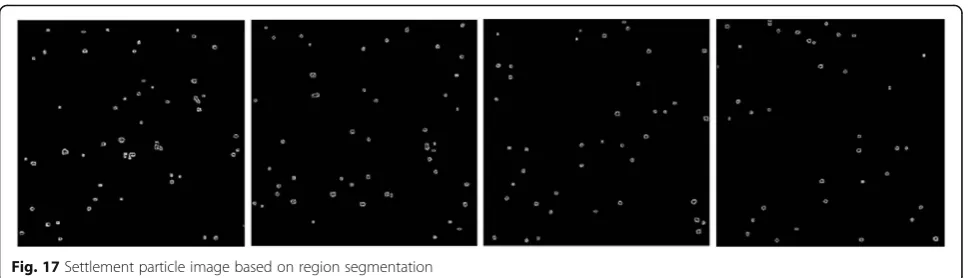
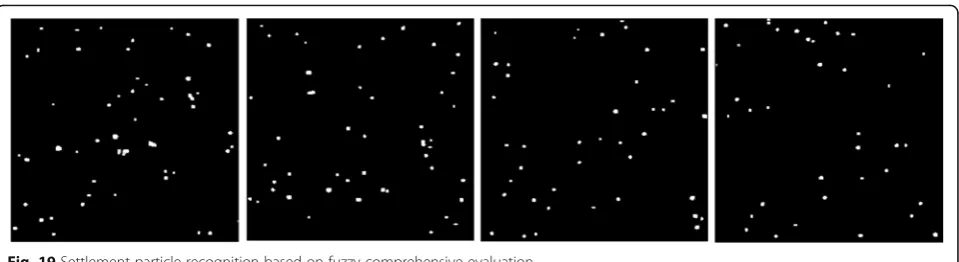
The segmentation of the particle image is key to recognize the settlement particle, so we had used the dif-ferent methods for the particle image segmentation by the Sobel operator, the normal region segmentation, and the proposed algorithm in video 1, whose results were respectively shown from Figs. 16, 17, and 18, respect-ively. Figure 18 shows the good segmentations prior to the other methods from the smoothness, sharpness, and brightness. Figure 19 is the settlement particle recogni-tion result based on fuzzy comprehensive evaluarecogni-tion.
Figures 20and 21 show the recognized large particles and the long tail particles in video 1, which were marked with a circle.
Figures 22and 23 show the recognized large particles and the long tail particles in video 2, which were marked with a circle.
Fig. 23Recognition results of long tail particles
OTSU threshold segmentation Gauss mixture model
a
b
3. Experimental comparison
For the comparison with the proposed methods, we did the experiments in video 1 by the classical Otsu threshold segmentation method, Gaussian mixture model, and Yang’s algorithm, and the results were shown in Figs.24and25.
4. Analysis of experimental results
The standard of settlement particle recognition algo-rithm is mainly measured by TPR and FPR, and its ex-pression is like Eq. (27).
T PR¼ T P
T PþFN; FPR¼
FP FPþT N
ð27Þ
In Eq. (27), TP is the prediction result and the actual result are the number of settlement particles, FP is the
prediction value is the settlement particle but the num-ber of noise in fact, FN is the prediction value is the noise but in fact the number of settlement particles, TN is the prediction result, and the actual result are the number of noise. Figure26describes the ROC curves of each method and Table 1 describes the average time of each method.
As can be seen from the above icons, the recognition accuracy of the proposed method is better than that of other algorithms, and from time, it is shorter than the Yang’s method, but it is a little longer than the Otsu al-gorithm and the Gauss mixture model. In summary, the algorithm in this paper has achieved good recognition results for settlement particles.
6 Conclusions
After the detail research on the settlement particle im-ages and settlement particle sequence images, a multi-threshold segmentation method with the fuzzy 3-partitioning entropy is proposed, where the improved artificial bee colony algorithm is used to optimize the threshold, the recursive idea is also used to reduce the large number of repeated calculations in the fuzzy parti-tioning entropy, and the region-based label assignment method is applied to improve the accuracy of image seg-mentation. The experiment results show that the pro-posed algorithm has better segmentation performance.
Table 1Average time of each method
Method Time (second)
Our method 1.4
Yang’s method 28.7
Otsu < 1
Gauss mixture model < 1
Fig. 25Experimental results of Yang’s algorithm
About the authors
Ran Zhou, software engineering, Master student in Wuhan University of Technology. His current research interests include data mining, artificial intelligence, image processing, and pattern recognition.
Huazhu Song, Doctor of Engineering, Associate Professor in Wuhan University of Technology. Her current research interests include data mining, artificial intelligence, machine learning, image processing, pattern recognition, semantic and ontology. Jun Li, software engineering, software engineering, Master student in Wuhan University of Technology. His current research interests include data mining, artificial intelligence, and image processing.
Author’s contributions
Three authors take part in the discussion of the work described in this paper. RZ researched on the topic of the paper and wrote the first version of the paper. HZS guided RZ’s research and modified the paper. JL helped to modify the figures in the paper and typeset the paper. All authors read and approved the final manuscript.
Competing interests
The authors declare that they have no competing interests.
Publisher’s Note
Springer Nature remains neutral with regard to jurisdictional claims in published maps and institutional affiliations.
Received: 13 July 2018 Accepted: 20 September 2018
References
1. J. Ma, H. Wen, X. Li, et al., Downy mildew diagnosis system for greenhouse cucumbers based on image processing. Nongye Jixie Xuebao/transactions of the Chinese Society of Agricultural Machinery48(2), 195–202 (2017). 2. S. BS, E. LM, Particle tracking in drug and gene delivery research:
state-of-the-art applications and methods. Adv. Drug Deliv. Rev.91, 70–91 (2015). 3. G. Borgefors, On digital distance transforms in three dimensions. Comput.
Vis. Image Underst.64(3), 368–376 (1996).
4. G. Corkidi, U.R. Diaz, M.J. Folch, et al., COVASIAM: an image analysis method that allows detection of confluent microbial colonies and colonies of various sizes for automated counting. Appl. Environ. Microbiol.64(4), 1400–1404 (1998). 5. P.K. Sethy, S. Panda, S.K. Behera, et al., On tree detection, counting & post-harvest
grading of fruits based on image processing and machine learning approach-a review. International Journal of Engineering & Technology9(2), 649–663 (2017). 6. Y. Tang, Y. Zhang, Y. Zhang, et al., A fast recursive algorithm based on fuzzy
2-partition entropy approach for threshold selection. Neurocomputing
74(17), 3072–3078 (2011).
7. H.C. Tsai, Y.H. Lin, Modification of the fish swarm algorithm with particle swarm optimization formulation and communication behavior. Appl. Soft Comput.11(8), 5367–5374 (2011).
8. Z. Zhe, Research on cell sequence tracking method based on image segmentation[D], Jilin University (2017).
9. W.T. Wen, Research on rice quality detection system based on image processing[D], Jilin University (2015).
10. S. Benabdelkader, M. Boulemden, Recursive algorithm based on fuzzy 2-partition entropy for 2-level image thresholding. Pattern Recogn.38(8), 1289–1294 (2005).
11. Y. Tang, W. Mu, Y. Zhang, et al., A fast recursive algorithm based on fuzzy 2-partition entropy approach for threshold selection. Neuro computing