IJSRSET1738235 | Received : 01 Dec 2017 | Accepted : 27 Dec 2017 | November-December-2017 [(3) 8 : 884-888]
© 2017 IJSRSET | Volume 3 | Issue 8 | Print ISSN: 2395-1990 | Online ISSN : 2394-4099 Themed Section : Engineering and Technology
884
Stability Improvement of Multimachine System by Application
of PSS : A Comparison Between Statcom and SVC
Prof. Nisheet Soni, Shri , Mohammad Abdul Sajid Khan
Shri Ram Institute of Technology, Jabalpur, Madhya Pradesh, India
ABSTRACT
Voltage stability analysis is essential for a secure power system operation. This study demonstrates the use of latest Power System Analysis Toolbox (PSAT) package for network analysis of alternative means of improving existing transmission system voltage stability. This project presents the investigation on steady state voltage stability improvement by determination of best location of Flexible ac transmission system (FACTS) controllers such as Static Compensator (STATCOM) device with minimum losses. The proposed method explains how voltage stability can be improved with the continuation power flow (CPF) method in case of increasing loading of contingency. Continuation power flow analysis which is currently used for evaluation of location of weak buses/areas of the power system sensitive to load increase. Voltage stability assessment on a 6-bus system has been simulated to test the effectiveness with increasing load. A comparative study of 6-bus test system between the base case and with Static Compensator is presented to demonstrate the effectiveness of Static Compensator. The proposed methodology found advantages because it is simple, faster and very convenient to apply for voltage stability analysis.
Keywords : STATCOM, PSAT, FACTS, CPF, UPFC, UPFC, PSO, SVC
I.
INTRODUCTION
The power system today is complicated networks with hundreds of generating stations and load centres being interconnected through power transmission lines. An electric power system can be subdivided into four stages:
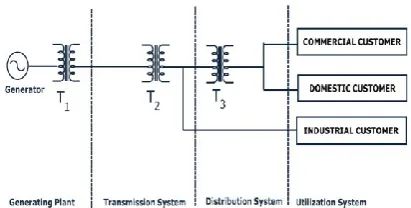
(i) Generation, (ii) Transmission (iii) Distribution and (iv) Utilization (load). The basic structure of a power system is as shown in figure1.1. It is composed of generating plants, a transmission system and distribution system. These subsystems are interconnected through transformers T1, T2 and T3.
Figure 1. Typical Power System
electronics technology, have been proposed in recent years for better utilization of existing transmission facilities. With the development of FACTS technique, it becomes possible to increase the power flow controllability and enhance power system’s stability. Recently, Flexible Alternative Current Transmission System (FACTS) controllers have been proposed to enhance the steady state and transient stability of power system [2]-[3].
The steady state stability of power systems has been and continues to be of major concern in system operation. Modern electrical power systems have grown to a large complexity due to increasing of interconnections, installation of large generating units, and extra-high voltage tie-lines etc. Many analysis methods of voltage stability determination have been developed on static analysis techniques based on the power flow model since they are simple, fast and convenient to use. It is known that voltage collapse leads to the reason for several blackouts that have occur throughout many areas. The major reasons for voltage collapse are based on increasing loading, large disturbance and line outage.
During the last decade, a number of control devices under the term FACTS technology have been proposed and implemented. Application of FACTS devices in power system, leads to better performance of system in many aspects. Voltage stability, voltage regulation and power system stability, damping can be improved by using these devices and their proper control [4].There are various forms of FACTS devices, some of which are connected in series with a line and the others are connected in shunt or a combination of series and shunt. The FACTS technology is not a single high power controller but rather a collection of controllers which can be applied individually or in coordination with other to control one or more of the inter related system parameters like voltage, current, impedance, phase angle and damping of oscillations at various frequencies below the rated frequency. Among all FACTS devices, static var compensator (SVC) plays much more important role in reactive power compensation and voltage support because of its attractive steady state performance and operating characteristics.
II.
METHODS AND MATERIAL
Related Work
1. Power flow model of static var compensator and Enhancement of voltage stability by H. B. Nagesh and P. S. Puttaswamy (May 2012)
Voltage stability analysis is the major concern in order to operate any power system as secured. In this context there are many research work has been carried out to improve the voltage stability. This study demonstrates the use of latest Power System Analysis Toolbox (PSAT) package for network analysis of alternative means of improving existing transmission system voltage stability. This paper presents the investigation on enhancement of voltage stability using FACTS controllers such as Static Var Compensator (SVC) device. The proposed method explains how voltage stability can be improved with the continuation power flow methods in case of increasing loading of contingency. Voltage stability assessment on standard IEEE-14 system has been simulated to test the effectiveness of increasing loadability. This paper presents the simple method for identifying the weak bus and also optimal value of reactive power support needed for that. A comparative study between the base case and SVC are presented to demonstrate the effectiveness of SVC. The propose methodology found advantages because it is simple, faster and very convenient to apply for voltage stability analysis.
2. Voltage instability and its prevention using facts controller by Richa, Sh. Vivek Kumar, Sh. Kumar Dhiraj (May 2012)
Voltage collapse, grid failure problem occurring frequently because of increasing demand in power sector. It is very important to analyse the power system with respect to voltage stability. In this paper an attempt has been made to investigate the voltage stability analysis of IEEE 9 bus system using SVC. The objective of this paper is to stabilize the voltage of the system when it experiences load change. Continuation power analysis is done with PSAT software.
collapsed .Overstressed system compels the transmission lines to work close to the limit n eventually a grid failure. Transmission lines operate at voltage levels from 69kV to 765 kV and are tightly connected for reliable operation. Factors like de regulated market environment, economics, right of way clearance and environmental requirements have pushed to operate transmission lines close to their operating limits any fault if not detected and isolated quickly will cascade into a system wide disturbance causing widespread outages for a tightly interconnected system operating close to its limits. Transmission protection systems are designed to identify the location of faults comprising the security of the system, the large interconnected transmission networks are prone to faults due to lightning discharges and reduced insulation strength. Changing loads and atmospheric conditions are unpredictable factors; this may cause overloading of line due to which voltage collapse takes place. The reason to it is massive demand, creaky infra-structure, and insufficient supply. This creates an overstretched, unstable system, prone to failures and disruption.
Recently several blackouts have been related to voltage collapses some of them are
• Srilanka power system disturbance, may 2, 1995 • Northern grid disturbance in Indian power
system, December 1996
• North American power system disturbance , Aug 14,2003
• National grid system of Pakistan disturbances of September 24,2006
Stability defined by American institution of electrical engineers are as follows Stability when used with reference to the power system is that attribute of the system or part of the system which enables it to develop restoring forces between the elements there of, equal to or greater than the disturbing forces so as to restore a state of equilibrium between the element.
Static voltage stability analysis of IEEE 9 Bus system is done. Continuation power flow techniques are used to identify weakest bus in the system. SVC facts devices are employed & voltage profile of the system is enhanced. Further reason will be focussed on dynamic voltage stability & optimal location of FACTS using artificial intelligence like PSO.
3. Performance of SVC and UPFC in Static Voltage Stability Margin Enhancement in Two Area Power System with Continuation Power Flow Method by Mohammad Sarvi , Haniyeh Marefatjou (2012)
Power systems operation becomes more important as the load demand increases all over the world. This rapid increasing of load demand forces power systems to operate near critical limits due to economic and environmental constraints. The objective in power systems operation is to serve energy with acceptable voltage and frequency to consumers at minimum cost. In this paper, voltage stability is studies by using continuation power flow method. Also steady state modeling of Static VAR Compensator (SVC) and Unified Power Flow Controller (UPFC) for continuation power flow studies has been represented and discussed in details. Comparison between performance of UPFC and SVC for improve voltage stability has been done. Case studies are carried on 11 bus network in two areas. Simulation is done with PSAT in MATLAB. Continuation Power Flow is was implemented using Newton Raphson method. Simulation results show the proper performance of UPFC and SVC to improve voltage control and power flows on the lines and significantly increase the loadability margin of power systems. In analyzing power system voltage stability, continuation power flow method is utilized which consists of successive load flows and load-voltage curves for several buses are obtained.
This paper presented the modeling and simulation of two types of FACTS devices, UPFC and SVC in the standard 11 bus power system for load flow studies. The results for the standard 11 bus network show SVC and UPFC can be used to increase system stability in practical power systems. The effects on static voltage collapse or maximum loading level are presented .The simulations results also show that SVC is more effectively than UPFC for improving of the steady state stability of the system.
III.
RESULTS AND DISCUSSION
Proposed Work and Result
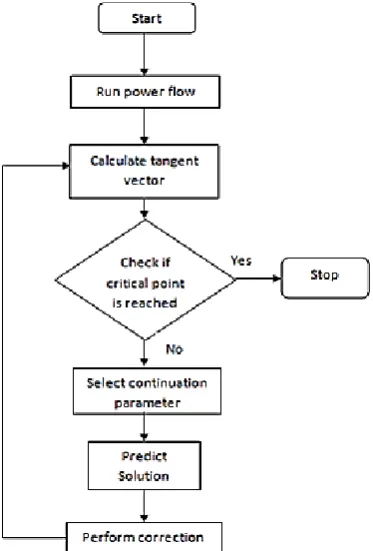
state variable with the greatest rate of change. Initially, λ is selected as continuation parameter since at first steps there are small changes in bus voltages and angles due to light load. When the load increases after a few steps the solution approaches the critical point and the rate of change of bus voltages and angles increase. Therefore, selection of continuation parameter is checked after each corrector step. The variable with the largest change is chosen as continuation parameter. If the parameter is increasing +1 is used, if it is decreasing -1 is used in the tangent vector in Equation 3.14.In order to summarize the whole continuation power flow process, a flow chart is presented in Figure 2.
step can be shown non-singular at the collapse point [19]. In this method, continuation power flow is applied without changing continuation parameter. Load parameter λ is selected as continuation parameter in all prediction and correction steps. The non-singularity of Jacobian in this method can be obtained by reducing step size σ as the solution approaches to critical point. In this study, continuation power flow method without parameterization is utilized so as to analyze the voltage stability of systems since it gives satisfactory results.
Network Statistics
Buses :- 6
Lines :- 11
Generators :- 3
Loads :- 3
Solution Statistics
Number of Iterations :- 3
Maximum P mismatch [p.u.] :- 0 Maximum Q mismatch [p.u.] :- 0
Power rate [MVA] :- 100
Figure 2 : Flow Chart for Continuation Power Flow [20]
The continuation power flow is stopped when critical point is reached as it is seen in the flow chart. Critical point is the point where the loading has maximum value. After this point it starts to decrease. The tangent component of λ is zero at the critical point and negative beyond this point. Therefore, the sign of dλ shows whether the critical point is reached or not.
Continuation Method without Parameterization
Although parameterization is necessary to guarantee the non-singularity of Jacobian matrix in power flow equations, the continuation equations of the corrector.
Figure 4. P-V Curves with STATCOM at Bus 6 Maximum Loading Value after CPF with
IV.
CONCLUSION
In this project, the current status of power system stability enhancement using static compensator (STATCOM) was discussed. The analysis of six bus system is done using power system analysis toolbox (PSAT) software. The stability of the 6-bus system is studied by using power flow (PF) and continuation power flow (CPF). First power flow then continuation power flow is performed in 6- bus system without static compensator, it is found that buses 4,5and 6 are critical buses which are more sensitive with the change in load, i.e. as load increases these buses has minimum operating voltage as given in table 4.24, with maximum loading value λ=3.3208. For stability improvement flexible ac transmission system (FACTS) device static compensator is used. First static compensator is connected at bus 4 than power flow and continuation power flow is performed, it is obtain that voltage of bus has improved and become 1 p.u. and maximum loading value increased to λ = 3.5772, with real power losses 0.07217 p.u. From p-v curve given in figure 4.13 it is obtain that voltage profile has improved it means that with static compensator connection voltage stability is improved.
V.
REFERENCES
[1] P. Kundur, "Power System Stability and
Control", McGraw-Hill, 2015.
[2] Y.H. Song and A.T. Johns, "Flexible ac
transmission systems (FACTS)", The Institute of Electrical Engineers, London, 2016.
[3] N.G. Hingorani and L. Gyugyi, "Understanding
FACTS: concepts and technology of flexible ac transmission systems", IEEE Press, NY, 2015.
[4] M.H. Haque, "Damping improvement using
facts devices". Electrical Power Syst. Res. Volume 76, Issues 9-10, June 2016.
[5] An Open Source Power System Analysis
Toolbox Federico Milano, Member, IEEEIEEE TRANSACTIONS ON POWER SYSTEMS, VOL. 20, NO. 3, AUGUST 2015
[6] Power System Analysis Toolbox
Documentation for PSAT version 1.3.4, July 14, 2015.
[7] Power System Analysis Toolbox version 2.1.6.
[8] H. Saadat, "Power System Analysis", McGraw-
Hill, 2016.
[9] "On-line Voltage Stability Assessment of Power
System- An Approach of Black-box Modelling" Sami Repo PhD Thesis "Power system voltage stability" Carson W. Taylor ISBN 10-0071137084
[10] M. Larsson, "Coordinated Voltage Control in
Electric Power Systems",Doctoral
Dissertation, Lund University, 2014.
[11] K.R.Padiyar "FACTS Controllers in power
transmission and distribution", New Age International Publishers, 2017.
[12] Brian Stott,"Review of Load-Flow Calculation
Methods", Proceedings of the IEEE , Vol.62, No. 7, July 2014. pp 916-929.
[13] E.Acha, C.R.Fuerte-Esquivel,
H.Ambriz-perez, C.Angeles-Camacho,"FACTS
Modelling and simulation in power
networks",John Willy & Sons, Ltd,2014.
[14] R. Mohan Mathur and Rajiv K.
Varma,"Thyristor- Based FACTS Controllers for Electrical Transmission Systems", IEEE Press, 2016.
[15] X. Duan, J. Chen, F. Peng ,Y. Luo and Y.
Huang, "Power Flow Control With FACTS Devices", Power Engineering Society Summer Meeting, 2015. IEEE, Vol. 3, pp. 1585-1589.
[16] E. Acha, V G Agelidis, O Anaya-Lara, and T J
E Miller "Power Electronic Control in Electrical Systems" ELSEVIER, 2016.
[17] W. D. Rosehart and C. A. Canizares,
"Bifurcation Analysis of Various Power System Models," International Journal of Electrical Power & Energy Systems, Vol. 21, No. 3, March 2015, pp. 171-182.
[18] C. A. Cañizares, "Voltage Collapse and
Transient Energy Function Analyses of AC/DC Systems", Doctoral Dissertation, University of Wisconsin- Madison, 2016.
[19] V. Ajjarapu and C. Christy, "The Continuation