TEST ON THE ROLES OF SINO-US INFLATION LEVELS TO
THE OTHER IN THEIR PREDICTIONS
QIZHI HE, HONGLING CHEN, TING YAO
School of Finance, Anhui University of Finance and Economics, Bengbu 233030, Anhui, china
ABSTRACT
The paper researches on the inflation level forecasting for China and the United States in one kind of univariate and three kinds of bivariate cases, using Vector Autoregressive and Bayesian Vector Autoregressive Models, based on the rolling-sample forecasts and the mean absolute percentage error standard. Empirical tests show that, both China and the United States’ inflation level series are stationary; China and the United States’ inflation level are both able to provide additional information besides itself to the other in the inflation level forecasting, but the effects of the United States’ inflation level to China’s inflation level is greater than that of China’s inflation level to the United States’ inflation level; In addition, the influence of the United States’ inflation level to China's inflation level maybe is mainly through the expectation gotten by its past values. Finally, some suggestions are given.
Keywords: Inflation Level, Rolling-Sample Forecasts, Mean Absolute Percentage Error, Vector Autoregression, Bayesian Vector Autoregression
1. INTRODUCTION
The inflation problem is not only a cores issue a country's monetary policy caring about, but also an important issue must be considered when public investors have an insight into economic trends. Since 2010, China's inflation level has continued to rise, which has been becoming one of the hottest issues the government and the people concern about. Though China’s inflation level has entered a downward path, after reaching a local maximum of 6.5% in July 2011, the public's inflation expectations remain strong and the inflation problem is still a core issue affecting the stable development of the economy. At the same time, with advancing and deepening constantly the openness to the outside world, China’s economy and the international economy become increasingly close. It has great significance to research the dynamic relationship between China’s inflation level and other developed countries’ inflation level, such as the United States’ inflation level, especially at a predicted angle.
The existing researches on the relationships among variables are often based on the fitting effect inside the sample, but, for the model, predictive capability outside the sample is more important. Considering the fact that one-time forecast often has certain chanciness, the paper applies rolling forecasts and uses the mean absolute percentage
error standard to evaluate the predicted effect. There are generally two major kinds of methods to forecast inflation. One is the structural approach, which is based on the economic theory. But under normal circumstances, economic theory cannot provide a rigorous description for the dynamic relationship between the variables (Gao, 2009) [1], and this kind of method often needs to know the values of other macroeconomic variables which can be more difficult to be predicted than the value of inflation level. The other is the VAR and the Bayesian VAR approach. As to the shortage of traditional macroeconomic models, Sims (1980) [2] put forward the VAR approach, in addition as for the deficiency of the VAR method, Doan, Litterman and Sims (1984) [3] recommended to use Bayesian prior information. Sims, Stock & Watson (1990) [4] believed that the application of the corresponding Bayesian Theory can be simpler and completely different in any case based on initial observations and Gaussian disturbance, in addition Bayesian method is completely based on the likelihood function, also regardless of the existence of non-stationarity or whether the same Gaussian
shape, and thus Bayesian inference on
nonstationarity need not to be given any special instructions.
methods, and it describes the methods of VAR and Bayesian VAR. The third part is about the empirical research, and it describes the data selection, stationary test and the forecasting test. The fourth part concludes the paper and gives policy implications.
2. INTRODUCTION TO THE METHODS
Vector Autoregression (VAR) and Bayesian Vector Autoregression (BVAR) are useful and efficient forecasting methods. VAR is a standard tool in macroeconomics, and is widely used in structural analysis and forecasting, and unlike structured model, it doesn't impose restrictions on the parameters, and thus it provides a very general
expressing form to capture the complex
relationships among data (Banbura, etc, 2010)[5]. As VAR model has many advantages, this paper uses VAR model to do forecasting tests. There are two main purposes of these tests: one is to select the suitable method for forecasting inflation level of China and the United States; the other is to test whether the United States’ inflation level can provide additional information in forecasting China’s inflation level and vice versa. As to the deficiency of the basic VAR model, such as the independent variable containing the lag value of the dependent variable, which will produce highly relevance and lead to the accuracy degradation in parameter estimation (LeSage,1999)[6]. In addition, the basic VAR also has the risk of over-parameterized (Banbura, etc, 2010) [5]. To overcome these problems, Doan, Litterman & Sims (1984) [3] recommended the use of Bayesian prior information. The main difference between BVAR and VAR is that BVAR regards the related parameters as a random variable, and gives prior
probability distribution assumptions. Many
scholars, such as Banbura,etc(2010) [5] and etc show that the BVAR can improve the prediction accuracy through empirical research. Therefore, this paper uses respectively VAR model and BVAR model to predict inflation level of China and the United States.
3. EMPIRICAL RESEARCH
3.1 Data Selection and Stationary Test
In the paper, we use the Consumer Price Index, CPI, as a measure of inflation level. The data come from statistical database of Intranet Business Express, macroeconomic data network of hexun, National Bureau of Statistics of China, and U.S. Department of Labor, and two kinds of software EViews6 and Matlab R2008a are used to process the data. Based on the following considerations, we
[image:2.612.317.519.365.449.2]apply year-over-year data. First, the public in China concern customarily the year-over-year data. Second, the year-over-year data can eliminate the seasonal factors, while the ring data are more vulnerable to the influence of the seasonal factors. In some countries, there are mature seasonal adjustment methods, but due to holidays in China and these countries are different, the seasonal adjustment methods may not be suitable for China. Third, due to the short time span, month on month data are usually too small, and may mask the long-term trend of inflation level. In addition, we have not transfer the Consumer Price Index to inflation rate, because if we do that inflation rate is 0 in some times and then we can not use the standard of mean absolute percentage error(MAPE). And thus we use the monthly year-over-year data of the Consumer Price Index to represent the inflation level in the paper. Except the special explain, the result for the inflation level in the paper is limited to this kind of data representation.
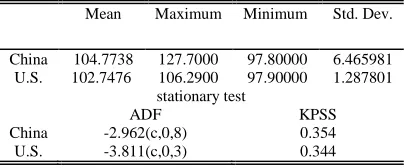
Table 1 Statistical Characteristics And The Stationary Test Of Sino-US Inflation Series
Mean Maximum Minimum Std. Dev.
China 104.7738 127.7000 97.80000 6.465981 U.S. 102.7476 106.2900 97.90000 1.287801
stationary test
ADF KPSS
China -2.962(c,0,8) 0.354
U.S. -3.811(c,0,3) 0.344
Note: the critical values for ADF and for KPSS at 5% significance level are respectively -2.87 and 0.463.
As to the stationary test, the traditional method is the ADF method, but its hypothesis is “the series has a unit” and it has low-efficiency and the test-efficiency is not ideal especially when the swatch is small and the data’ producing process has high self-correlation (Zhang and Bai, 2005; Gao,2009; Zhang and Zhang,2011)[ 7,1, 8].The KPSS method takes “the series is stationary” as the null hypothesis, and it can serve as a supplement to the ADF method. And thus the paper applies the two methods to test the stationarity of China and the United States’ inflation series. Seen from Table 1, both China’s inflation series and the United States’ inflation series are stationary whether according to the ADF method or according to the KPSS method.
3.2 The Forecasting Test
difference. In turn, we can indirectly verify the stationary character of a variable by judging whether the former transformation can improve the prediction accuracy. As we all know, stationary test is often judged by hypothesis testing, and thus it may have the possibility of making mistakes. Thus, the stationary problems of China and the United States’ inflation level series are studied from another angle in this paper, namely predicts are given respectively based on the level and differential items and which one is better is judged. That is to judge whether the difference can improve the forecasting effect based on the rolling prediction angle. If it can, that means the inflation level series maybe is non-stationary, otherwise, the inflation level series maybe is stationary, or at least we can get that even if the inflation level series is non-stationary, the harm of non-stationary is even smaller than the long-term information loss by the difference.
The paper intends to apply methods of the VAR-level, the VAR-difference, BVAR-level and BVAR- difference to forecast China and the United States’ inflation level. The method of VAR-level represents using directly the relative variables to build a VAR model to predict, and the method of VAR-difference represents differencing the variable firstly, then use the differential variable to build VAR model to predict, and then reverse the adjustment. The same are to the methods of BVAR-level and BVAR- difference. As to the forecasting inspection standard, we apply the standard of mean absolute percentage error (MAPE) (ADEBIYI, 2007) [9]. The formula of mean absolute percentage error (MAPE) is as follows.
^
1
/ n
t t
i t
CPI CPI
MAPE n
CPI =
−
=
∑
(1)Where: CPI is the actual consumer price t
index, CPI is the predicted consumer price ^ t
index, and
n
is the predicted number.In order to enhance the persuasion and avoid chanciness, the paper applies rolling sample forecasting, namely forecasting 12 months once, having 60 rolling forecasts, and thus totally carrying on 720 forecasting tests. Concrete details are as follows. First, we use the data from January 1990 to October 2005 to forecast the data from November 2005 to October 2006, and then use the data from January 1990 to November 2005 to forecast the data from December 2005 to November 2006, and so on, and finally we use the data from January 1990 to September 2010 to forecast the data from October 2010 to September 2011. As to
the variable selecting, we consider the four cases, and China's inflation level’s forecasting is given as an example as follows. In the first situation, we just take advantages of China's own historical data to forecast China's inflation trend in the future, and this kind of situation is noted by single variable model. In the second situation, we take the actual inflation level of the United States as the deterministic variable in the single variable VAR of China’s inflation level, and this situation is noted by double variable model 1. In the third situation, we use the United States’ inflation level to forecast its future value, and then take it as a deterministic variable in the single variable VAR of China’s inflation level, and this situation is noted by double variable model 2. In the fourth situation, we gather the inflation level of China and the United States together to build a bivariate VAR model, and this situation is noted by double variable model 3.
3.2.1 Rolling forecasts of China’s inflation level
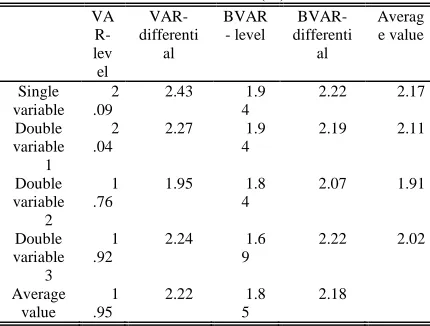
model 3, or the average forecasting value, the forecasting accuracy of VAR-level is higher than that of VAR-differential and the forecasting accuracy of BVAR-level is higher than that of BVAR-differential. This indirectly shows that inflation level series of China is stationary. Judging that China's inflation level series is non-stationary series, and transforming it to stationary series through the difference, and then forecasting the differential series, and then adjusting in turn can not improve the prediction accuracy. Third, the United States’ inflation level is able to provide additional information, other than China’s inflation level itself can provide, to China's inflation level forecasting, and no matter the way to include the United States’ inflation level, it can improve the accuracy of China's inflation level forecasting. Fourth, the influence of American inflation level to China’s inflation level may mainly in expected way. Although including the United States’ inflation level by different ways can all improve the prediction accuracy of China's inflation level forecasting, the effects of including fully the actual values of the United States’ inflation level are not good as including the partial actual values and the partial predictive values. This indirectly shows that the impact of the United States’ inflation level to China’s inflation level is not immediate, and it has a certain “time lag effect”, namely that the influence of the United States’ inflation level to China's inflation level maybe is through the expectation gotten by its past values. Fifth, the most suitable method to predict China’s inflation level is the BVAR-level method in the situation of double variable model 3. The prediction accuracy of this method is the highest, and the average value of the mean absolute percentage error (MAPE) forecasted by 720 times is 1.69%.
Table 2 The Rolling Forecasting Effect Of China’s Inflation Level (%)
VA R-lev el
VAR-differenti
al
BVAR - level
BVAR-differenti
al
Averag e value
Single variable
2 .09
2.43 1.9
4
2.22 2.17
Double variable
1 2 .04
2.27 1.9
4
2.19 2.11
Double variable
2 1 .76
1.95 1.8
4
2.07 1.91
Double variable
3 1 .92
2.24 1.6
9
2.22 2.02
Average value
1 .95
2.22 1.8
5
2.18
3.2.2 The rolling forecasts of the United States’ inflation level
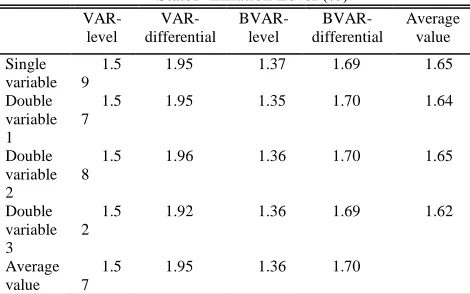
Table 3 reflects the contrasting effect of rolling forecast of the United States’ inflation level in
different prediction methods and different
Table 3 The Rolling Forecasting Effect Of The United States’ Inflation Level (%)
VAR-level
VAR-differential
BVAR- level
BVAR-differential
Average value
Single variable
1.5 9
1.95 1.37 1.69 1.65
Double variable 1
1.5 7
1.95 1.35 1.70 1.64
Double variable 2
1.5 8
1.96 1.36 1.70 1.65
Double variable 3
1.5 2
1.92 1.36 1.69 1.62
Average value
1.5 7
1.95 1.36 1.70
Consolidating the results of rolling forecasting of China’s and the United States’ inflation level, we can conclude as follows. The operation that gives the variable difference, then predicts, and then adjusts reversely would not improve the prediction accuracy. Both China’s and the United States’ inflation level are able to provide additional information to the other party beyond its own can provide, and the effect of the United States’ inflation level to China’s inflation level is greater than that of China’s inflation level to the United States’ inflation level.
4. CONCLUSIONS AND POLICY
IMPLICATIONS
Both China and the United States’ inflation level series are stationary. The forecasting method suitable for China's inflation level is the method of BVAR-level in the situation of double variable model 3, while the forecasting method suitable for the United States’ inflation level is the method of BVAR-level in the situation of double variable model 1. China and the United States’ inflation level have interactively dependent relationship, and they can provide additional information to each other besides they own can provide. But the effect of the United States’ inflation level to China’s inflation level is greater than that of China’s inflation level to the United States’ inflation level. The impact of the United States’ inflation level to China’s inflation is not instant, and it has certain delay effect, or we can say that the influence of the United States’ inflation level to China's inflation level maybe is mainly through expectation gotten by its past values. All these objectively require that China's monetary authorities and investors should pay close attention to the inflation level trends in the United States and other developed countries, and consider the inflation trends and expectations of those countries, and measures that might be
taken by those countries and the maybe influences to China’s inflation level when doing the macro decision-making and investment decision-making, and make measures in advance.
ACKNOWLEDGEMENTS
This work was supported by National Natural Science Foundation, project No.71103082.
REFERENCES:
[1] T.M. Gao, Econometric analysis method and
modeling, the second edition. Beijing: the Tsinghua University Press, 2009.
[2] C.A. Sims, “Macroeconomics and reality”,
Econometrica, Vol. 48, No.1, 1980, pp.1-48.
[3] T. Doan, R. Litterman, C. Sims, “Forecasting
and conditional projection using realistic prior distributions”, Econometric Reviews, Vol.3, No.1, 1984, pp.1-100.
[4] C.A. Sims, J.H. Stock, M.W. Watson,
“Inference in Linear Time Series Models with some Unit Roots”, Econometrica, Vol. 58, No.1, 1990, pp.113-144.
[5] M. Banbura, D. Giannone, L. Reichlin, “Large
Bayesian vector auto regressions”, Journal of
Applied Econometrics, Vol. 25, No.1, 2010,
pp. 71-92.
[6] J.P. LeSage, Applied Econometrics using
MATLAB. Department of Economics,
University of Toledo, October1999.
[7] X. Zhang, Z. Bai, “The Comparison of Small
Sample Properties for De-trending Unit Root Tests”, The Journal of Quantitative &
Technical Economics, No.5, 2005, pp.40-49.
[8] L. Zhang, X. Zhang, “Cyclical Fluctuations
and Nonlinear Dynamics of Inflation Rate”,
Economic Research Journal, No.5, 2011, pp.
17-31.
[9] M.A. ADEBIYI, “DOES MONEY TELL US
ANYTHING ABOUT INFLATION IN
NIGERIA?”, The Singapore Economic
Review, Vol.52, No.1, 2007, pp.117-134.
[10] Q. He, “Are International Factors Helpful for
the Prediction of Level of China’s Inflation?”,
MANAGEMENT WORLD, No.11, 2012,