© 2015, IRJET.NET- All Rights Reserved
Page 444
Development and Implementation of Algorithm for Speaker
recognition for Gujarati Language
Jigarkumar Patel
1, Arun Nandurbarkar
21
PG student, Electronics and Communication, L.D college of engg, Gujarat, India
2
Associate Professor, Electronics and Communication, L.D college of engg, Gujarat, India
---***---Abstract -
Modern speech understanding systemsmerge interdisciplinary technologies from Signal Processing, Pattern Recognition, Natural Language and Linguistics into a unified statistical framework. In this
paper weighted MFCC(Mel frequency cepstral
coefficients) and GMM(Gaussian Mixture Model) are implemented for Speaker Recognition in Gujarati Language. The experimental database consists of 30 speakers, 10 female and 20 male, collected in sound proof room. The result of this experiment certificates that this technique works better for speaker recognition for Gujarati language than only traditional MFCC with GMM.
Key Words: speaker recognition; Mel frequency
cepstral coefficients; feature extraction; weighted Mel
frequency cepstral coefficients; Gaussian Mixture
Model; maximum likelihood.
1. INTRODUCTION
Modern speech understanding systems merge interdisciplinary technologies from Signal Processing, Pattern Recognition, Natural Language and Linguistics into a unified statistical framework. These systems, which have applications in a wide range of signal processing problems, represent a revolution in Digital Signal Processing(DSP)[1][2]. Once a field dominated by vector-oriented processors and linear algebra bases mathematics, the current generation of DSP-based systems rely on sophisticated statistical models implemented using a complex software paradigm. Such systems now capable of understanding continuous speech input for vocabularies of several thousand words in operational environments.
Speech signal processing technology is an indispensable technology in the information society, and speaker recognition is an important research field of speech processing. Speaker recognition is also called the voiceprint recognition, which makes it possible to identify or verify the identity of the speaker using the speech feature. It combines the theories of various subjects, such as acoustics, phonetics, linguistics, physiology, digital signal processing, pattern recognition and artificial intelligence etc. Speaker recognition has a wide application prospect in the judicial identification, security
Monitoring, e-commerce and other fields. The extraction of the Mel frequency cepstral coefficients is one of the popular approaches of feature extraction.
Speaker modeling is the main part of a speaker recognition system. The Gaussian mixture model (GMM) is the most common approach for speaker modeling in text-independent speaker recognition[4][5]. A general speaker recognition system, shown in Figure 1, consists mainly, of three stages, each stages are explained in next sections.
Models
speech X
t Speakerwave ID
Figure 1. Speaker Recognition System[5].
2. The Feature Extraction
2.1 MFCC(Mel Frequency Cepstral Coefficients)
The purpose of feature extraction is to convert the speech waveform to a set of features for further analysis. Where appropriate information is estimated in a suitable form and size, from the speech signal to obtain a good representation of the speaker features, (Mel Frequency Cepstral Coefficients (MFCC features) are chosen in this paper because they are based on the perceptual characteristics of the human auditory system[4], figure 2 shows a block diagram of the steps in Mel feature extraction.
© 2015, IRJET.NET- All Rights Reserved
Page 445
The input to the system is speech sampled at 11025Hz andconverted to 16-bit digital format. The digital speech signal is then applied to a 256 samples (≈23ms) hamming window every 128 samples (≈12ms). Each individual frame is windowed so as to minimize the signal discontinuity at the beginning and end of each frame as shown in Figure 2. The Fast Fourier Transform (FFT) converts each frame of samples from the time domain into the frequency domain. The frequency scale is then converted from the hertz to the mel-scale using filter banks with frequency spaced linearly at low frequencies and logarithmically at high frequencies, and the logarithm is then taken. This stage is done in order to capture the phonetically important characteristics of speech in a manner that reflects the human perceptual system. The Discrete Cosine Transform (DCT) is then applied to the output to produce a cepstrum[4][5]. Therefore if we denote those mel power spectrum coefficients that are the result of the last step are
S
~
0,
k
0
,
2
,...,
K
1
, we cancalculate the MFCC's,
~
c
n,
asThe first component m= 0 is excluded from the DCT since it represents the mean value of the input signal which carried little speaker specific information.
2.2 Weighted MFCC
The static characteristics of the voice are described by the Mel frequency cepstral coefficients. Changing voice signals are an important feature of speech signal, so we introduce the first order differential MFCC[3] parameters
where k is a constant, usually take k =2 . Noise to some extent can be eliminated by the differential MFCC, so we can achieve the better performance.
3. Implementation based on Gaussian Mixture
Model(GMM)
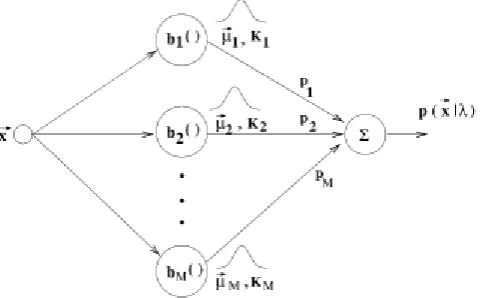
component densities as shown in figure 3.Figure 3. M probability densities forming a GMM
In the GMM model, the features distributions of the speech signal are modeled for each speaker as follows
P(x| λ)= number of GMM components, each density component is a D-variants Gaussian distribution given eq. below.
A statistical model for each speaker in the set is developed and denoted by λ. For instance, speaker s in the set of size
S can be written as follows:
, where i={1,...M} & s={1,...S}
3.1 ML Parameter Estimation
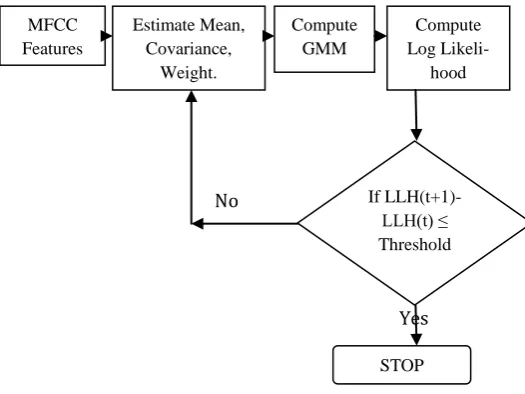
The ML(Maximum Likelihood) algorithm for GMM estimation[5] is shown in Figure 4.
© 2015, IRJET.NET- All Rights Reserved
Page 446
Since the GMM likelihood of the nonlinear function isimpossible that maximizes directly, the ML estimations can be possible by using the EM algorithm iteratively.
No
Yes
Figure 4. EM algorithm for GMM
The training phase consists of two steps, namely
initialization and expectation maximization (EM). The initialization step provides initial estimates of the means for each Gaussian component in the GMM model. The EM algorithm recomputed the means, covariances, and weights of each component in the GMM iteratively[5]. Each iteration of the algorithm provides increased accuracy in the estimates of all three parameters. The EM algorithm formulas are the following:
weight
mean
covariance matrix
the likelihood of the posteriori of the ith class is
given by posterior probability
This process is repeated until convergence is achieved.
3.2 Classification based on GMM
In this stage, after the GMM models for each speaker are estimated, the target is to find the model with the maximum likelihood a posteriori for an observation sequence. The input to the classification system is denoted as
X = {x1, x2, x3, . . . ,xT}
The rule to determine if X has come from speaker s can be stated as
p(λs | X) > p(λr | X) r = 1, 2, . . . , S (r / = s).
Therefore, for each speaker s in the speaker set, the classification system needs to compute and find the value of s that maximizes p(λs | X) according to
The classification is based on a comparison between the probabilities for each speaker. If it can be assumed that the prior probability of each speaker is equal, then the term of p(λs) can be ignored. The term p(X) can also be ignored as this value is the same for each speaker, so p(λs | X) = p(X | λs),
where,
Practically, the individual probabilities, p(xt|λs), are typically in the range 10−3 to 10−8, the result p(x
t|λs),will underflow probability for all speakers will be calculated as zero. Thus, p(X | λs) is computed in the log domain in order to avoid this problem[2]. The likelihood of any speaker having spoken the test data is then referred to as the log likelihood.
The speaker of the test data is statistically chosen by
MFCC Features
Estimate Mean, Covariance,
Weight.
Compute GMM
Compute Log
Likeli-hood
If LLH(t+1)-LLH(t) ≤ Threshold
© 2015, IRJET.NET- All Rights Reserved
Page 447
4. RESULTS AND ANALYSIS
4.1 speech signal
Figure 5. recorded speech signal of Gujarati Language
4.2 weighted MFCC of one frame
Figure 6. weighted MFCC of one frame
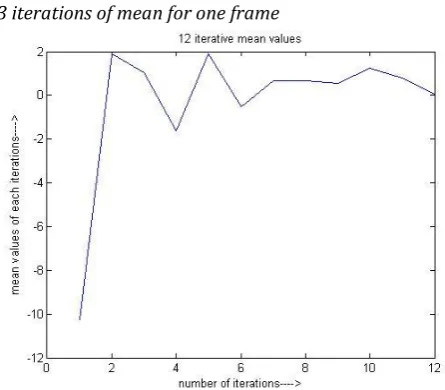
4.3 iterations of mean for one frame
Figure 7. 12 iterative values of mean
4.4 iterations of covariance
Figure 8. 12 iterative values of covariance
4.5 Gaussian Mixture Model of one speaker
Figure 9. Gaussian Mixture Model pdf of one speaker
4.6 Analysis of results
Experimental results showing that with implementation of weighted MFCC for extraction of features from the speech signal of Gujarati Language, GMM gives the better results for speaker recognition. In this GMM model 12 iterations are used for achieving the approximate suitable Gaussian model with the help of 128 MFCC frames.
5. CONCLUSIONS
After analyzing the results, the experiment concludes that Weighted MFCC+GMM gives better efficiency of speaker recognition than the Traditional MFCC+GMM for Gujarati Language. The recognition rate is approximately 1% higher compared to the Tradition MFCC+GMM.
© 2015, IRJET.NET- All Rights Reserved
Page 448
REFERENCES
[1] L.R. Rabiner and R.W. Schafer, " Digital Processing of Speech Signals", Printice Hall Signal Processing Series, Second Edition.
[2] Thomas F. Quatieri, " Discrete-Time Speech Signal Processing Principle and Practics", Pearson Education Signal Processing Series, First Indian Reprint.
[3] Zhang Wanli and Li Guoxin " The Research of Feature Extraction Based on MFCC for Speaker Recognition" published in 3rd International Conference on
Computer Science and Network Technology in 2013. [4] Douglas A. Reynolds and Richard C. Rose "Robust
Text-Independent Speaker Identification Using Gaussian Mixture Model" published in IEEE
TRANSACTIONS ON SPEECH AND AUDIO
PROCESSING, VOL. 3, NO. 1, JANUARY 1995.
[5] Snani Cherifa and Ramdani Messaoud "New Technique to Use the GMM in Speaker Recognition System(SRS)" published in 978-1-4673-5285-7/13/$31.00 ©2013 IEEE.
[6] T. Kinnunen and H. Li, “An Overview of Text-Independent SpeakerRecognition: From Features to Supervectors," Speech Commun., vol. 52, no. 1, Jan. 2010, pp. 12-40.
[7] Zhang Wanli, Li Guoxin,“Speech Recognition Using Improved MFCC”, 2012 International Conference on Electrical and Computer Engineering, Volume 11, pp.99-104, July, 2012
[8] Z.J.Wu and Z.G.Cao, “Improved MFCC-Based Feature for Robust Speaker Identification”, TSINGHUA Science and Technology, vol.10,pp. 158-161, Apr. 2005.
[9] M. Hassan, M. Jamil, M. Rabbani, and M. Rahman, “Speaker identification using Mel frequency cepstral coefficients,” in Proceedings of the 3rd International Conference on Electrical &Computer Engineering, pp. 565–568, 2004).
[10]Hassen Seddik, “text independent speaker recognition using the mel frequency cepstral coefficients and a neural network classifier”,2004
BIOGRAPHIES
Jigarkumar Patel was born in Bayad, Gujarat, India in 1992. He
received B.E(EC) from
Vishwakarma Govt. Engg. college, Chandkheda in 2013 and pursuing M.E in Communication System Engg. from L.D College of Engg, Ahmedabad in 2015.
![Figure 1. Speaker Recognition System[5].](https://thumb-us.123doks.com/thumbv2/123dok_us/977636.1120352/1.595.312.558.669.757/figure-speaker-recognition-system.webp)