Small Scale Technologies:
Directions for Victoria
Final Report
Centre for Strategic Economic Studies
Victoria University
Melbourne
Executive Summary
Small scale technologies are already having a significant economic and social impact. Over the next two decades they will have profound effects on industrial products and processes, on the lives of individuals and on the nature of human society. As the next major wave of global technological change, they offer vast potential benefits but carry serious economic, social and ethical risks. It is important that Victoria acts now to share in the potential benefits of small scale technologies and to understand and respond to the risks involved.
We use the phrase ‘small scale technologies’ to refer to technologies with feature sizes less than 1000 nanometers, where a nanometer is one millionth of a millimetre. In other words, they are technologies with feature sizes less than one thousandth of a millimetre. The term thus covers both micro technologies, operating down to about 100 nanometers, and nano technologies, operating at or about the nanometer scale. Technologies at both levels are already being used in industry, often in combination with one another. Micro technologies are currently much more important in industrial applications. But those at the nano scale will become increasingly dominant in a wide variety of industries over the next two decades. They will also have the most dramatic implications, as new properties of matter emerge at the very small scale.
These facts have been recognised by governments around the world, and support programs amounting to some US$3 billion are in place in 2003. Substantial commitments have been made by a number of countries in East Asia as well as in North America and Europe, and this is the first technological revolution in which Asian countries have been participants at a foundational stage. Much of this support has been in terms of basic science, and in particular in the scientific foundations of nano technologies.
The State has some important scientific capabilities in relevant areas, and valuable nodes of expertise in the development and application of small scale technologies for commercial use. But there is still only limited awareness of the potentially revolutionary role of these technologies in the business sector and in the community at large. Victoria can be only a niche player in terms of scientific excellence, but it can play a significant role in the application of small scale technologies in many areas of human life.
In our view, the central challenge is to use emerging small scale technologies to protect and enhance the competitiveness of existing industries, to encourage new and growing local and overseas firms and to generate broader social benefits for the Victorian community. Comprehensive leadership by the Government in helping Victorians to address this challenge is appropriate at this time, before the opportunity to establish a leading position in the technologies and their applications is lost.
The central objective of Victorian policy in this area should be to make the State a leading centre for the commercial development and application of small scale technologies by firms, public agencies and other organisations, in the context of sustained and shared reflection on the social and ethical issues involved. Activities to achieve this objective should be directed at small scale technologies generally, and not just at nano technologies, and at the commercial and social application of these technologies.
What is needed is a coordinated program of action - involving industry, academia and government - that is sustained over the long term. For this reason it is proposed that the Government establish, in conjunction with industry and academia, a new peak body – Small Scale Technologies Victoria – to provide the leadership necessary to make Victoria a leading centre for the commercial development and application of small scale technologies. Coordinated action in six areas is necessary:
• Facilitating Infrastructure: working with firms and research groups, and international experts, to plan and implement the basic infrastructure required for the application of small scale technologies, and to review that infrastructure on a regular basis.
• Raising Awareness and Demonstrating Applications: implementing programs to raise awareness in firms and in the community about the implications of small scale technologies, for example by funding demonstration projects.
• Encouraging Commercial Applications: encouraging commercial applications of small scale technologies, through creation of Applications Development Consortia and in other ways.
• Facilitating Alliances and Networks: assisting local firms and research institutions to enter into alliances and networks with firms and institutions operating elsewhere in Australia, and in the USA, Europe and East Asia.
• Strengthening Social and Ethical Reflection: strengthening the capacity of the Victorian community to address, in a sustained and considered fashion, the social and ethical issues raised by small scale technologies.
Much is already being done to build the necessary infrastructure in Victoria, through the creation of MiniFAB, NanoVic and Bio21, the construction of the Australian Synchrotron and the activities of the universities, CSIRO and the Cooperative Research Centres. However, much remains to be done to build adequate commercialisation infrastructure, for example in terms of facilities for the rapid design, development and prototyping of micro-devices and for measurement and testing at the micro and nano levels.
A detailed review of immediate infrastructure needs, drawing on both local and international expertise, should be an immediate priority. Our initial assessment is that an allocation of about $30 million over the next 2-3 years from the STI program should prove sufficient to meet those immediate needs, if the funds are carefully used to leverage matching funds from industry, the universities and the Australian Government.
The leadership and coordination role of Small Scale Technologies Victoria will be crucial to achieving the objective proposed here. Various legal structures are available for such a body, but four points are crucial. First, it must have a real tripartite presence, with high level and committed leaders from each of industry, academia and government actively involved. Second, it must have a long- term focus and role, with the stability of membership, public acceptance and assured funding necessary to pursue its objectives over a decade or more. Third, it must have continuing access to the best available expertise, both from within Australia and from other countries.
1. Introduction
1.1 Understanding Small Scale Technologies
For many years scientists have been studying the properties of matter and living organisms at the molecular and atomic level, and firms have made use of knowledge of these properties to create commercial products and processes. Over the past two decades, however, it has become possible to manipulate atoms and molecules to create new materials, devices and processes, designed at the atomic level. At this very small scale, the characteristics of traditional materials change, as quantum effects and surface and other properties become dominant, so that quite new possibilities emerge. In the not too distant future, the growing application of new materials, devices and processes engineered at the very small scale will have a major impact on economic and social life, comparable to the present impact of information and communication technologies.
This report is about the likely impact of small scale technologies on Victoria, the opportunities and challenges that they present and the appropriate policy responses. Small scale technologies are defin ed simply as the application of knowledge about the small scale structure of matter and of living organisms to make new products and to develop new or improved processes. It is common to measure the scale of such technologies in terms of the nanometer, which is one millionth of a millimeter or 10-9 metres. Thus this definition is intended to cover, through the use of the term ‘small scale’, both micro technologies, operating at 100-1000 nanometers or 10-7 to 10-6 metres, and nano technologies, operating at the nano scale or below (10-8 to 10-10 metres). In practice, technologies at both the micro and the nano scale are already important, and many applications will involve a combination of both types of technology.
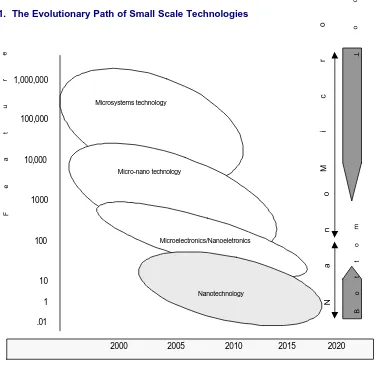
While this report covers both micro and na no technologies, over time there will be increasing use of applications at the very small scale. Nevertheless, it is important to focus on the broader concept of small scale technologies, to emphasise two key facts. One is that both micro and nano technologies are already being used in industry, often in combination with one another. The other is that, while micro technologies currently have wider use, technologies operating at the nano scale will become increasingly dominant in a wide variety of industries over the next two decades. This will not happen suddenly, but will occur steadily as the special properties of nano scale technologies are proven and as their costs of use fall. The evolutionary path of small scale technologies, including the increasing interlinking of micro and nano technologies and the imminent emergence of ‘bottom up’ nanotechnologies, is illustrated in Figure 1.
macro products and processes is at the heart of the structural changes that small scale technologies will bring about, and highlights the need to respond to them.
In the Victorian Government’s statement Biotechnology: Strategic Development Plan for Victoria, biotechnology is defined as the application of knowledge about living organisms and their components to make new products and to develop new industrial processes (DSRD 2001, p. 7). To the extent that biotechnology involves applications of small scale technologies, as it increasingly does, it is included in the coverage of this report. Our focus is on the use of micro and nano technologies to develop new products and processes, irrespective of the field of science from which they derive or the industry to which they are relevant. As in other areas, micro technologies are currently very important in biotechnology, but the field will be increasingly driven to the nano scale in the near future.
Figure 1. The Evolutionary Path of Small Scale Technologies
Source: Adapted from MANCEF (2002).
In addressing small scale technologies, we are concerned with the application of knowledge to create and exploit useful materials, devices and processes. Small scale technologies, while heavily reliant on the advance of scientific knowledge, are all about
.01 1 10 100 1000 10,000 100,000 1,000,000
Microelectronics/Nanoeletronics Microsystems technology
Micro-nano technology
Top down
Bottom up Feature size (nanometers)
2000 2005 2010 2015 2020
Nanotechnology
Micro domain
applying that knowledge for economic and social benefit. Australia in general, and Victoria in particular, has a high level of public expenditure on science, and major public institutions such as CSIRO and the universities have built up considerable excellence in many areas over a long period of time. The increasing application of small scale technologies will provide a way of leveraging this substantial investment for greater economic and social benefit. For this and other reasons it is vital to assess what these technologies mean for Victoria and to explore how we, as a community, should respond to the opportunities and challenges they present.
1.2 The Central Challenge
If Victoria is to prosper in the coming era of small scale technologies, a high quality scientific base in the underlying scientific disciplines will be vital. The Victorian Government has done much in recent years to help strengthen and modernise that base, through such measures as Bio21, the establishment of the National Synchrotron and through a range of STI initiatives, including the establishment of NanoVic. While scientific excellence is vital, it is not now the central challenge that we face. Rather, the central challenge is to use emerging small scale technologies to protect and enhance the competitiveness of existing industries, to encourage new and growing local firms and to
generate broader social benefits. This is the challenge that we seek to address in this
report.
There are many parallels between emerging small scale technologies and the information and communications techno logies that have changed the world over the past two decades, and these parallels provide a salutary warning. Australia has become a sophisticated user of information and communications technologies over the past two decades. But, in spite of some relevant intellectual and business capabilities, Australia has not become a significant producer of new products in these areas, whether goods or services, nor has it been a creative force in the development of these technologies and of the industries that they ha ve spawned. Thus output of information industry products in Australia is low and has recently been declining, overall employment in the information industries in low by world standards and Australia’s deficit on information industries trade is high and ris ing (Houghton 2002, 2003).
Recent studies (Edquist et al. 2001) have argued that new product technologies create jobs, while new process technologies tend to be job destroying, with their benefits accruing through increases in productivity rather than thr ough new employment opportunities. By failing to gain any serious position as a creator and producer of product technologies in the information industries, and becoming only a defensive adopter of process technologies to enhance efficiency, Australia has missed the creation of new streams of high value employment that have been associated with the information industries in some other countries.
employment creating aspects of this next technological revolution. This project is directed to providing some of the knowledge to assist firms and governments to address this challenge, and to make some recommendations to the Victorian Government about strategies. These policy recommendations are contained in Section 4, after we have reviewed global trends and issues in relation to small scale technologies (Section 2) and attempted a preliminary assessment Victorian capabilities and of the impact of these technologies on major Victorian industries (Section 3).
1.3 Small Scale Technologies and Industrial Change
Before proceeding on this path, however, it is important to situate small scale technologies within the broader range of factors driving change within key industries. These drivers include both factors common to most industries, related to global processes often referred to as the rise of the knowledge economy, and factors specific to individual industries.
Many industries face common drivers of change in the knowledge economy. Globalisation and the reduction of formal and informal barriers to trade are reducing the extent of protected markets. Excess capacity is sharpening competition, in many cases accentuated by the rise of developing countries such as China as real competitors. Consumer awareness is intensifying competition on price, performance and product quality. New technologies and increasing knowledge intensity are also driving increased competition in terms of the functionality and quality of existing products and the creation of new products. Growing environmental awareness is creating greater demands in terms of both environmentally sustainable products and production technologies. In short, firms in many industries face rapid change driven by increased global competition, technological change, increased consumer awareness and greater environmental requirements and regulation.
Within this broad context, there are of course many industry specific variants. For example, in a number of industries such as motor vehicles, pharmaceuticals and aerospace, the structure of the global industry is moving to a small number of ‘prime’ producers, which function in part as system integrators and product marketers, with a wide range of supplier firms distributed around the world. In such a case the requirements of the ‘primes’ and of the activities that they undertake (creating, producing and marketing new motor vehicle or aircraft models or discovering, testing, producing and marketing new drugs) become important drivers of change for other firms within the industry.
2. The Global Framework
The development and application of small scale technologies is a case study of globalisation at work, and any discussion of their impact on Victoria must be placed in this broader context. In this section we review very briefly the underlying scientific and technological trends, the emerging applications of these technologies, the response of governments around the world and some of social and ethical issues that arise.
Figure 2. Small Scale Technologies and the Convergence of Sciences
Functional
m o l e c u l e d e s i g n
Supramolecular
chemistry Material
design
Quantum effects
1960 1980 today 2020 2040 Year
Macro
Micro
Nano
Electronics
C o m p l e x
chemistry
Structure size
Electronic devices
Photonic devices
Sensors
Biochips
…
Applications of
small scale technologies
Integrated
exploitation of
biological principles
physical laws
chemical properties
0 . 1 m m
100 nm
0.1 nm
Chemistry Biology
Micro
-electronics
Physics
Molecular
b i o l o g y Cell biology Electro technology
Source: Adapted from Bachmann (2001).
2.1 Underlying Scientific Trends
Further, quantum effects are showing the way to alternatives to existing silicon technology for operation at nanometer scales. In chemistry, improved knowledge of complex systems has led to new catalyst, membrane, sensor and coating technologies which rely on the ability to tailor structures at atomic and molecular levels. In biology, living systems have sub-units with sizes between micron and nanometer scales and these can be combined with non-living materials to create new devices or can be used to create complex structures with desired properties.
More generally, a variety of disciplines are converging at the atomic or molecular level. This convergence of disciplines, and the development of technologies operating at a very small scale, has a range of synergistic effects. For example, scientific work becomes increasingly interdisciplinary, with knowledge and techniques from one area ‘amplifying’ work in other, overlapping areas. New research technologies operating at the micro or nano scale, such as scanning probe microscopes and micro-arrays, contribute significantly to further scientific progress, which in turn generates new technologies. This iterative process – the convergence of scientific research at the nano scale and the creation of new research technologies at that scale – seems certain to provide the central dynamic for scientific progress in the early decades of the 21st century.
In a scientific and technological sense this convergence at the nano scale is more than just a linear progression to a smaller scale, for at the nano scale quite new properties of materials and processes emerge. These new properties emerge from two main factors. The first is the dominance of quantum effects over Newtonian effects at the nano scale. The second arises from the fact that the ratio of surface area to volume rises as scale falls, so that surface properties and effects become much more important at the nano scale.
2.2 Some Current and Emerging Technologies
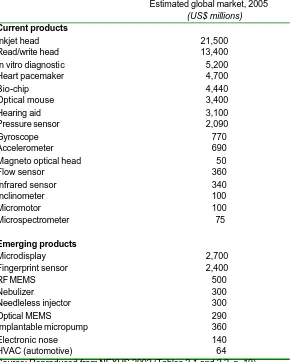
Table 1. World Market for Current and Emerging MEMS Products
Estimated global market, 2005
(US$ millions) Current products
Inkjet head 21,500
Read/write head 13,400
In vitro diagnostic 5,200
Heart pacemaker 4,700
Bio-chip 4,440
Optical mouse 3,400
Hearing aid 3,100
Pressure sensor 2,090
Gyroscope 770
Accelerometer 690
Magneto optical head 50
Flow sensor 360
Infrared sensor 340
Inclinometer 100
Micromotor 100
Microspectrometer 75
Emerging products
Microdisplay 2,700
Fingerprint sensor 2,400
RF MEMS 500
Nebulizer 300
Needleless injector 300
Optical MEMS 290
Implantable micropump 360
Electronic nose 140
HVAC (automotive) 64
Source: Reproduced from NEXUS 2002 (Tables 2.1 and 2.2, p. 10).
Box 1. Some Key Nano Technologies
Nanotubes. Carbon nanotubes (layers of carbon atoms making up a tube) are among the key building blocks of nanotechnology. They have very high tensile strength, and high thermal electrical conductivity, and are semiconducting. They come in a wide variety of types, with different properties and applications, and will play a significant role in super-strong composites, electronics, sensors, super-strong textiles and filtration devices.
Fullerenes. Fullerenes are collections of carbon molecules, roughly spherical in shape. They have possible uses as lubricants and contrast agents, and in composite materials.
Nanoparticles: They can be made from a wide variety of materials, are already applied in some areas and are likely to have a wide variety of applications, from composite materials and surface coatings to UV creams and drug delivery systems.
Quantum dots and nanowires. These are tiny structures that confine electrons and can be made to emit light at different frequencies. If attached to particular molecules of interest, they offer possible applications in analysis and detection, in both medicine and electronics, even to the extent of detecting the presence of a single molecule of a substance.
Dendrimers. Dendrimers are complex designer molecules (polymers), and can be built up step by step to produce different configurations with different chemical properties. Given these capabilities, dendrimers are seen as having potential applications in drug design and delivery, and also in new composite materials.
Soft lithography. Various forms of this technology use a mold to imprint materials or to create new components at the nano level. It has important potential, and some actual applications, in medical systems and electronics.
Self -assembly. Self-assembling monolayers, where a substance forms a layer one molecule thick on a surface, offer many applications, as they allow the surface properties of materials to be readily modified. In the long run, designing nano systems that self-assemble into more complex structures is seen as having great potential in many applications.
Molecular nanotechnology. The goal of molecular nanotechnology is to make robotic machines or assemblers on a molecular basis, with the capability of constructing new materials an atom at a time, and of reproducing themselves. Such machines could have enormous ramifications, in terms of new materials, health, industrial processes and other areas. But such possibilities are very long term, are far from proven and are not the subject of significant commercial investment at this time.
Source: Harper and Hollister (2002) and CMP Científica (2002, 2003).
2.3 The Scale of Present and Future Applications
Many estimates are available, on different bases, about the likely future markets for products employing small scale technologies. But, as Cientifica (2003) has argued, the concept of a ‘market for small scale technology’ is close to meaningless, because small scale technologies will impact on virtually every industry and on many products, at different ways and at different times. The total value of the sales of products incorporating these technologies will be enormous, but this is not an estimate of the value of small scale technologies sales. The impact of small scale technologies will, over the next two decades, be massive, but it makes no sense to try to quantify this impact in a single market size figure.
nanobiotechnology. Here we focus as far as possible on products that directly and centrally depend on small scale technologies, rather than products that use these technologies in one way or another. Consider first nanomaterials, which currently make up a substantial proportion of the total market for such products (roughly 25 to 30 per cent). Catalysts, the market for which is currently around US$30 billion, are expected to rise to US $100 billion by 2015. Nanoparticles and nanocomposites in manufacturing, currently around US$13 billion, are expected to rise to US$30 billion by 2006. One analysis indicates that nanomaterials could be a much larger proportion of the total spending on small scale technology products, say two thirds, by 2015.
In the area of nanoelectronics, coatings, particularly for hard magnetic disc drives, are currently around US$24 billion and this could grow substantially in the future. Much depends on the technology developed for sub-100 nanometre scale feature sizes for semiconductors. Current devices are approaching the limit for existing technologies, which will probably be reached around 2004 to 2006. The market for semiconductors, currently about US$140 billion, is anticipated to reach US$300 billion by 2006. Light and particle beams are being developed for production down to 10 nanometres but a paradigm shift to quantum computing could change markets dramatically. Nanotechnology is anticipated to contribute about US$300 billion to the electronics industry by 2010 to 2015.
In nanobiotechnology, about half of all pharmaceutical production (about US$180 billion) in 2010 to 2015 is expected to depend on nanotechnology e.g. microfluidics for drug assay and nanoparticles for targeted drug delivery. The market for medical devices and biomedical materials based on small scale technologies is expected to double in the next three years to about US$1 billion and thereafter to grow even more rapidly.
2.4 Government Responses
The long run potential of these technologies has led to major programs for government support for R&D in nanotechnology in recent years, especially in basic sciences. While there was activity in this area in the 1990s, the endorsement of a National Nanotechnology Initiative in the US in early 2000, covering a large number of departments and agencies and with a significant increase in funding on a continuing basis, sparked worldwide attention. At about the same time, Japan upgraded its already substantial activities in nanotechnology, and a number of other countries have put in place major programs. Japan, Korea and China have initiated national coordinating offices for nanotechnology.
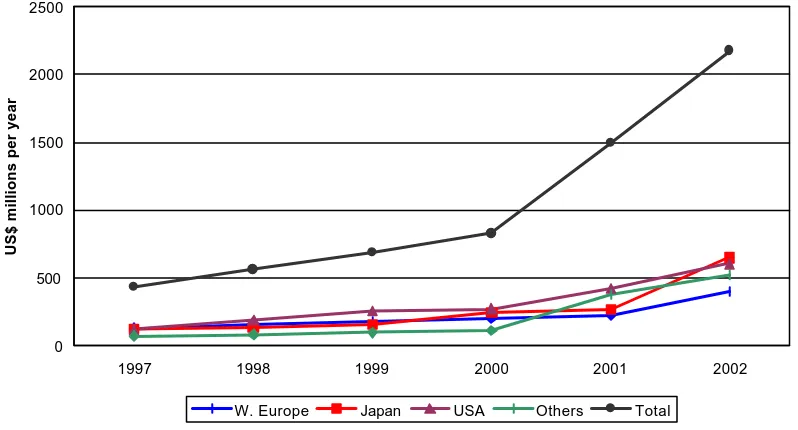
One estimate of total government support for nanotechnology programs is that of Roco, from the US National Nanotechnology Initiative, shown in Figure 3 (Roco 2002). This estimate puts total support for these programs at US$2,174 million in 2002, an increase of 164% on that for 2000. Total support in 2002 was five times that in 1997. For most countries, signs of continued rapid growth in support for nanotechnology are evident, and the President Bush’s 2004 Budget contains funding of US$847 million for 2004, an increase of 40% on the figure for 2002.
nanotechnology R&D across many programs. For example, the European Commission has nominally allocated some ∈1.3 billion (US$1.42 billion) for a programme on nanotechnology as a thematic priority (1.1.3), in the Sixth Framework Programme over the period 2002 to 2006. A careful analysis by the European NanoBusiness Association (Roman 2002) concludes that nanotechnology is embedded in most of the thematic priorities and that a more realistic figure for nanotechnology is around ∈850 million (US$900 million) per annum, rather than the US$400 million included in the Figure 3 estimates.
Figure 3. Government Support for Nanotechnology Programs, NNI Estimates, 1996 -2002
0 500 1000 1500 2000 2500
1997 1998 1999 2000 2001 2002
US$ millions per year
W. Europe Japan USA Others Total
Source: Roco (2002).
Indeed, it is widely accepted that the NNI figures understate the level of government support for small scale technologies, and that in 2003 the total level of support is in excess of US3 billion (Cientifica 2003). Whatever the difficulties with the precise estimates, the overall picture is clear – there has been a dramatic upsurge in government support for nanotechnology programs since 2000, which is set to continue into 2004 and beyond.
of small scale technologies, but on supporting fundamental research in a context of close relationships between research institutions and companies.
Another important feature of investment on nanotechnology is that this is the first major technology in which Asian countries have a central position at an early stage. Thus nearly half of the US$2.2 million identified government support in 2002 (Figure 3) is in countries in East Asia (Japan, China, Korea, Taiwan and Singapore), with spending in Japan comparable to that in the US. China was the first country in the region to officially launch a national nanotechnology initiative in October 2001. The Chinese NNI has a budget of about US$240 million over five years. Korea is planning a ten-year nanotechnology development program with a total budget of 1.4 trillion won (about US$1.1 billion) over the ten-year period. Taiwan is planning its five-year science and technology programs, which include a national nanotechnology program with a total expected budget of US$450 million over five years. Singapore has also launched its national nanotechnology initiative, although the budget is yet to be made public. There have been indications and activities in the region showing increasing desire for enhancing regional collaboration and coordination in Asia Pacific nanotechnology development (see, for example, Asia Technology Information Program Reports, www.atip.org/NANO).
2.5 Social and Ethical Issues
The growth of modern science, and the power that it has provided to the human community to control the natural world for human use, has generated deep-seated social and ethical dilemmas. Increased power over the material world has given us many products that enhance human life, but has also led to global warming and nuclear weapons. Medical research has contributed greatly, both through new drugs and medical procedures and through preventative programs, to a longer and healthier span of life for many people, but has also raised deep ethical and social issues.
In the longer term, nanotechnology is likely to involve much more fundamental knowledge of matter, and of the material foundation of human life, than has been available to date, together with a commensurate power to intervene in physical and human processes. As Roco and Bainbridge (2001) point out, the envisioned breakthroughs include ‘orders of magnitude increases in computer efficiency, human organ restoration using engineered tissue, ‘designer’ materials created directly from atoms and molecules, as well as emergence of entirely new phenomena in chemistry and physics’ (p. 1). Given the increased technological power that it is likely to deliver, nanotechnology will raise to a new level the social and ethical dilemmas emerging from modern science.
In general terms, the main issues are familiar if not at all easy to resolve. They include:
• the environmental and human health issues raised by the increasing use of nanoparticles and the creation of new forms of matter;
• issues about the nature, identity and preservation of human life arising from new generations of medical technologies based on individual genetic structures;
• questions about the human/machine interface, with increasing capability to incorporate artificial components into human beings and to build ‘intelligent’ machines; and
• the equity issues, across both individuals and countries, about access to the benefits of small scale technologies.
Fundamental as these issues are, it is necessary to keep the development and application of small scale technologies in perspective. Micro technologies, many of which raise less dramatic issues, are likely to remain the main game for some time to come, although increasingly wedded to nano scale probes, instruments or components. Many of the more revolutionary nano developments – such as complex, self replicating robotics machines with extensive functionality – are several decades off, and are yet to be scientifically proven.
Nevertheless, it is important that, as the scientific and technical community pursues the development of small scale technologies, the broader community becomes aware of the issues they raise and develops the capability to think seriously about these issues. As Mnyusiwalla, Daar and Singer (2003) point out, this is not just a matter of increased funding for social and ethical research in these areas. Indeed, they note that in the US less than half of the funds allocated in the National Nanotechnology Initiative for the study of societal implications have been spent, in part because of the lack of meritorious research proposals. A broader process of awareness raising and capability strengthening is necessary, including the development of substantial inter-disciplinary research platforms.
2.6 Education and Training
The discussion of the previous section raises issues of community awareness of nanotechnology and the need for provision of education programs reaching into the public arena. An important starting point is the role of the media in reaching the general populace through newspapers, television and radio. Information needs to be provided to ensure that there is a balanced consideration of all the various issues involved in the development and use of small scale technologies. The issue has already attracted the attention of groups overseas such as Greenpeace and a Canadian group called ETC (Erosion, Technology and Concentration). ETC early this year issued a manifesto calling for a moratorium on nanoparticle research (particularly aimed at nanobiotechnology) until the issues of the use of nanoparticles have been considered by all the relevant UN bodies.
A looming problem is the education and training of a new generation of researchers and skilled workers with the interdisciplinary perspectives necessary for rapid progress in small technologies. A recent estimate quoted by Roco (2001) of the people needed for nanotechnology in 2010-2015 is 800-900,000 in the US, 500-600,000 in Japan, 300-400,000 in Europe, and 100-200,000 in the Asia-Pacific region excluding Japan. These numbers can only be taken as broadly indicative of emerging demand, but countries are reacting to these anticipated needs by encouraging the development of new undergraduate courses and expanded post-graduate programs. In this area Australia has taken a leading role with the establishment of the first undergraduate course in nanotechnology in the world at Flinders University over three years ago. Several other courses will be commencing in the near future, so that up to 100 grad uates a year could be produced within five years. There needs to be networking within Australia and with overseas institutions in the area of nanotechnology undergraduate education.
The role of TAFE institutions is vital in building up skills in the workforce in nanotechnology to enable research to be translated into commercialization; some of these TAFE institutions are linked to universities and can provide routes for interchange in learning modules and experiments. Given the potential for widespread change in industry as a result of developments in small technologies a critical component of an education system for the future is the introduction of the concepts of small technologies into management courses with appropriate case studies to alert them to the changing technology environment. These and other issues concerning the crucial role of education and training are taken up further in Section 4.5 of this report.
2.7 Small Scale Technologies in Australia 2.7.1 The National Scene
One leading international observer of nanotechnology has assessed the situation in Australia in unflattering terms:
In the past there has been little effort to understand the potential of nanotechnology, and most decision makers are uncertain about the value of investing funds in nanotechnology R&D. … this has led to a climate of very little government support for nanotechnology and a distinct disinterest on the part of the commercial sector. One reason for this is the country’s dependence on primary production in the form of minerals and agricultural products, where the applications of nanotechnology have not been obvious. (Cientifica 2003, p. 52)
Priorities have been developed after extensive consultation in late 2002. The National Research Priorities are:
• an environmentally sustainable Australia;
• promoting and maintaining good health;
• frontier technologies for building and transforming Australian industries; and
• safeguarding Australia.
Each has a number of associated priority goals and nanotechnology is specifically mentioned in three of the four under Frontier Technologies, namely:
• Breakthrough science - nanoassembly and quantum computing
• Frontier technologies - nanotechnology
• Advanced materials - biomaterials, smart materials and composites.
However, examination of all the priority goals suggests that nanotechnology could play a significant role in many areas, e.g. through improved sensor technologies in environmental applications, through improved diagnosis and drug delivery systems and point-of-care treatment in health applications and in sensor technologies for bio-terrorism.
Given identification of these priorities, there is clearly a need to ensure that Victorian activities and strategies complement and build upon the national thrusts, since Australian Government funding will be directed to these in the future. In the recent ARC round,for example, some 50 nanotechnology-related research projects received funding of A$15 million over three years to 2005.
While precise figures are not available, it seems that Australia spent about A$50 million on nanotechnology R&D in 2002 and that this may approximately double in 2003. This is comparable to spending levels at the government level in Korea and Taiwan. However, unlike these two countries, there is currently limited interest in commercializing nanotechnology in Australia. This may in part reflect the limited capability in the microelectronics industry in Australia, with major Australian areas such as agri- food and minerals resources are relatively low in research intensity compared to the electronics industry.
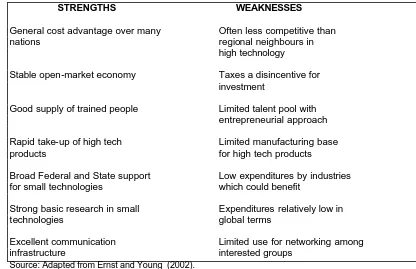
In the scoping study by Ernst and Young in 2002, a SWOT analysis was made of technology drivers and constraints in regard to Australia’s position in nanotechnology.
The results are summarised in Table 2.
has only been able to expand through a joint venture with Samsung Corning of South Korea. A major plant is being set up in Korea to service the large electronics market in that region.
Table 2. Analysis of Australia’s Capabilities and Relative Deficiencies in Nanotechnology
STRENGTHS WEAKNESSES
General cost advantage over many Often less competitive than nations regional neighbours in high technology
Stable open-market economy Taxes a disincentive for investment
Good supply of trained people Limited talent pool with entrepreneurial approach
Rapid take-up of high tech Limited manufacturing base products for high tech products
Broad Federal and State support Low expenditures by industries for small technologies which could benefit
Strong basic research in small Expenditures relatively low in
technologies global terms
Excellent communication Limited use for networking among infrastructure interested groups
Source: Adapted from Ernst and Young (2002).
The strategies of the major Australian Government research organizations are important since their activities cover several States and their priorities may not always coincide with those of the Victorian Government. Thus in CSIRO 17 Divisions across Australia have indicated that they have some activity in nanotechnology and CSIRO is currently making a detailed audit. In Victoria CSIRO has strong representation in nanotechnology through Divisions in the Clayton complex and others in Preston, Highett, Parkville and Geelong. It is a major participant in NanoVic with some of these activities.
Similar considerations apply to DSTO, which has a strong presence at Fisherman’s Bend and at Maribyr nong but also has major facilities in South Australia in the electronics area. While DSTO is not a core participant in NanoVic there is a strong interest in using the equipment of the participants and also Mini FAB for device fabrication.
2.7.2 The State Scene
While a major component of funding for nanotechnology is provided by the Australian Government, the State governments are also funding activities within their States. The degree of support reflects the social, economic and industrial structures together with the aspirations of each State. The two States that give the strongest support are Queensland and Victoria- a similar situation to that which prevails in biotechnology. New South Wales has more limited activity in the area.
Queensland in 2001/2002 earmarked A$ 63 mill ion for stimulating innovation, particularly in advanced technology areas. Of the six projects that were funded, two were on nanotechnology. The University of Queensland, with the support of the State Government, has established the A$50 million Australian Institute of Bioengineering and Nanotechnology. This is complemented by strong university groups in these areas, notably the Nanomaterials Centre at the University of Queensland. CSIRO has interests in applications of nanotechnology through its strong grouping of biotechnology, primary industry and resource Divisions in Queensland.
The University of New South Wales has an ARC Special Research Centre for Quantum Computer Technology which expanded in 2000 from a Semiconductor Nanofabrication Facility with an A$9 million from ARC plus a matching amount from four Australian Government departments over three years. This Centre has links to universities in Queensland and the University of Melbourne . Further the University of Technology Sydney has a developing Institute for Nanoscale Technology.
Victoria has centres of expertise in nanotechnology in its universities and in CSIRO divisions. The strong medical and biotechnology research and commercialization activities provide the opportunity for significant interaction in the nanobiotechnology area. The Victorian Government has awarded A$12 million over three years from its Infrastructure Development Program to support the setting- up of Nano Vic, which draws together most of the major R&D groups of universities and of CSIRO in Victoria in a unified approach. The participants will provide cash and in-kind support approaching A$30 million over three years. Through a company structure, NanoVic will support four fundamental platforms – design and processing at the nanoscale, characterization of the performance of nanoscale systems, nanoscale structural characteristics, and modelling of nanosystems. These will be focused into three research programs - nanofabrication and characterization, chemical and biomolecular nanotechnology, and nanostructured materials. An aim is to create an Australian Centre for Molecular Nanotechnology and thus exploit opportunities in the health and pharmaceutical sector, and in the advanced manufacturing sector in Victoria.
exists to stimulate industry participation to provide advanced problem-solving capability such as exists overseas and to encourage spin-off high tech companies through an incubator program.
The Cooperative Research Centre for Microtechnology is headquartered in Victoria at Swinburne University with links to institutions and industries in Queensland, Western Australia and New South Wales. It has strong research programs with international links in fabrication technology, microdevice packaging and systems integration, safety and health microsystems, and microfluidics. Furthermore, it has nearly 50 post-graduate students working in its programs. It is a significant resource for Victoria in small scale technologies.
3. Industry Implications and Victorian Capabilities
This section of the report reviews, for a range of industries important to the Victorian economy, the major commercial applications of small scale technologies that can be foreseen with reasonable assurance, and summarise some of the implications for these industries. For each industry an assessment is made of which part of the industry is most likely to benefit from the utilisation of small scale technologies. In addition, the extent of knowledge about and adoption of these technologies is described where this is known as is the main scientific and technological capabilities in Victoria in these sectors.
3.1 Human Health
Health can be looked at from two perspectives: as the sector of the economy using knowledge and technologies, and the devices and products in which they are embodied, to provide services to individuals, and as the industry creating, marketing and distributing those knowledge intensive products. While realizing the close links between these two perspectives, we use this dichotomy to discuss the impact of small scale technologies on health.
3.1.1 Health Services
It is widely believed that the convergence of low cost communications and information technology, and the development of nanotechnology based disease detection devices and other biosensors, has the potential to revolutionise the delivery of he alth services. In particular these technologies have the capacity to enable customised and specialised health care for both diagnosis and treatment to be delivered outside large centralised health institutions. This could involve individual delivery of medical services at the local clinic or even at home through communications networks and small scale devices.
One of the enabling factors in this possible revolution is the likelihood of being able to provide highly personalised treatment regimes based on the characteristics of each individual patient’s specific genome. The mapping of the human genome has opened up the possibility of designing programs of treatment specifically in response to identified individual genetic disease dispositions. In particular it has introduced the possibility of personalised drugs to suit each patient’s genetic makeup. As the CEO of one leading biotech firm has been quoted as saying:
One day, everyone will have their own genomes mapped out and stored in memory chips, and doctors will look at the information in those chips, and prescribe accordingly.1
Personalised medicine could, for example, have far reaching implications for the pharmaceutical industry. The industry is dominated by a small number of global companies each with a high level of dependency on selling blockbuster drugs – those with sales in excess of US$1 billion. In 2001 almost half (45.6%) of the total sales of the top 10
pharmaceutical companies were due to sales of only 35 drugs, each with sales of over US$1 billion. Personalised medicine could change that business model radically, by requiring the distribution of small quantities of a much larger range of personalised drugs. In these circumstances pharmaceutical companies could seek to have a direct relationship with the patient, for example via the Internet or through the patient’s virtual physician.
The impact of information and communications technologies – with low cost comprehensive data bases of patient records, remote delivery of medical services, so called telemedicine and increasing use of the Web by consumers for health information - has been with us for some time and its implications have been discussed in the literature. Hospitals and health management organisations have grappled with the challenges of implementing these databases. The first US patent for a computerised system for the delivery of patient specific drug information was awarded to Multum Information Systems in 1999. The system has the capacity to generate dosage recommendations based on specific patient medical condition data (Health Management Technology 1999) Increasingly physicians have been persuaded to make their prescriptions legible by using pocket PC’s that record and display patient drug interactions, run allergy and other checks at the point of care and can transmit the scrip directly to the preferred pharmacy.
Delivery of medical services to remote areas has been much improved at a lower cost by telemedicine and even remote surgery is now possible. The design of certain therapeutic and diagnostic devices has been facilitated the shift of point of care to the domestic environment. For instance, a Chicago based company InterCure introduced a prescription medical device that helps monitor and lower blood pressure in the home.
A range of microtechnology-based devices have been developed which address particular medical conditions. The earliest of these were disposable blood pressure devices that cost about US$10. More recently micropumps that can deliver insulin drugs in dosage sizes measured in nanolitres have been developed, and implantable pace makers that control irregular heart rates and implantable hearing aids are available. These devices have some distance to go before they offer the comprehensive diagnostic care being envisaged in some models. Not only do they need to cover a broader range of medical conditions but the integration between the devices and the available communication and information systems is necessary to transform prospective prototypes into fully fledged products.
Nanotechnology offers the potential for a plethora of relatively non-intrusive but powerful and comprehensive diagnostic devices that could provide the basis for increased domestic applications. For example, the Australian company Ambri is developing a diagnostic device that will undertake blood analysis in an emergency ward context that takes minutes rather than 12-24 hours through the pathology lab. Its impact will initially be in the hospital ward but it may be a precursor to the types of devices necessary to provide comprehensive diagnostic services in the domestic environment.
3.1.2 Health Products
While much biomedical research and produc t development draws upon molecular biology and biotechnology, which work with nanoscale biological molecules, international applications of nanotechnology in the life sciences area have focussed on three main areas (Malsch 2002; Saxl 2002).
Diagnostic devices. This includes biosensors and ‘lab-on-a-chip’ devices that test for
particular substances or drugs, analyse blood or test for the presence of other chemicals. They rely on advances in nanotechnology such as the ability to attach very thin layers of biological material to various types of sensor substrates, or control the flow of miniscule amounts of fluids through nano sized channels to provide almost instantaneous analysis. The applications typically require sophisticated monitoring and detection devices to receive and process the information from the sensors.
CSIRO (2003) has defined three target markets for diagnostics. The first is in intensive care requiring continuous monitoring of drugs and analytes. The second is pathology labs demanding high through put screening and the third is point of care where rapid diagnosis is required. While in its early stages the application of biosensor technology could be quite revolutionary in changing the delivery of health services. As noted earlier, automated diagnosis by biosensors could shift point of care from institutionalised to decentralised locations for more personalised delivery.
Drug discovery and delivery. Drug discovery productivity has been massively improved by
high through put screening of potential drug candidates. Nano technology develops this further in a number of ways. Uniform nano sized particles can be used to provide more sophisticated optical detection of reactions between drugs and their targets. The ability to detect molecules attached to uniform nano sized particles can significantly improve the productivity of high through put screening technologies. The engineering of proteins by the manipulation of the constituent amino acids can optimise the function of drugs, significantly improving their efficacy by many times their original formulation.
A large amount of research and development is being done on improved methods of delivering drugs in the appropriate amounts to the correct sites within the body. Dendrimers and other scaffolds such as liposomes are being used to ensure that drugs are able to navigate the digestive tract and immune system and to reach their targets. These small scale technologies will enable lesser amounts of toxic drugs to be used, and will make it easier to deliver multiple drugs to the one target.
Prostheses, implants and other applications of biomaterials. The ability to gain greater
While this has the potential to improve current applications such as catheters, coronary stents, pacemakers, insulin delivery systems, cochlear implants and the cultivation of replacement skin and other body parts, further utilisation could see the development of retinal implants to restore sight and the ability to replace or restore most body systems.
3.1.3 Victorian Capabilities
An analysis by CSES of worldwide biotech and pharmaceutical alliances involving nanotechnology shows that of those formed since 2000, 58% are concerned with drug delivery and design. Of the remainder most are concerned determination of protein structures and with various applications using nanoparticles or in the manufacture of biochips. Most applications falls within the wider ‘drug discovery and delivery’ category, while nano particle applications include the use of very small, magnetised particles in imaging, improving the productivity of assays, and in the development of biostructures in tissue engineering products.
While many applications are being suggested, the study of the properties of nano sized materials and particles is at such an early stage that defining its potential applications remains to some extent a matter of conjecture. For instance, nanotechnology could have application to most areas of the drug production value chain – from discovery and development to manufacturing and delivery.
Victorian capabilities mirror these international trends. The most prominent commercial application of nanotechnology is the work on drug delivery and design by Starpharma Pooled Development Fund (PDF), a listed PDF, which is developing drugs using a dendrimer platform, a nano scale structure, to which drugs are ‘attached’. Its most advanced application is due to begin human trials this year. Starpharma has a dominant position in world patents in dendrimers and is seeking alliances with leading global pharmaceutical firms. Some indication of its potential commercial value is the US$545m alliance formed by Glaxo with a private biotech developing similar drug delivery and design technologies (ReCap 2003).
Eiffel Technologies is also pursuing nano based drug delivery technologies. The company uses super critical fluids (SCFs) to improve the delivery of existing drugs in aerosol form. For asthma sufferers the smaller particle size means better absorption of inhaled drugs. The company is also working on inhaled delivery of otherwise injectable drugs. Eiffel has formed alliances with overseas partners including Sheffield Pharmaceuticals and Batelle Pulmonary Therapeutics to use its SCF technology to improve the effectiveness of reformulated drugs. Interestingly Batelle, which is itself a private, unlisted pharmaceutical company has formed an alliance with GlaxoSmithKline to promote its own Mystic drug delivery system.
be some distance away. In addition to the technical challenges involved in the production of sensors, much is required in order to transform biosensor components into fully functioning products.
Led by Prof Peter Hudson, at its Parkville campus, CSIRO has an active research program focussing on quantitative assays of proteins and nucleic acids based on biosensors. This research is likely to contribute to applications that include high through put clinical analysis. Biochips are to be developed using various nanotechnologies such as artificial membrane bilayer assemblies.
At RMIT, Professor David Mainwaring is leading a team working on the design of biosensors and similar diagnostic devices. He receives biological material from CSIRO, other parts of RMIT and Latrobe University which he attaches to appropriate substrate. Professor Dan Nicolau at Swinburne is also working on biosensors substantially funded by the US government agency, DRPA. His work on bio information systems is at this stage still basic research, with possible commercial application some way off.
One local application of nano particles, which has had some commercial application, is Prof Paul Mulvaney’s work at the University of Melbourne on quantum dots, which, in collaboration with the US Quantum Dot Corporation, is being used as an input into a new drug screening technology.
The Centre for Green Chemistry at Monash University has developed new biocatalysts based on molecular recognition and molecularly imprinted polymers to achieve major efficiency gains in the production of pharmaceuticals. These nano scale techniques have the potential for wide application in industrial processes.
These research initiatives should give Victoria good capabilities in biosensors and other diagnostic products for which there is considerable market potential. It is intended that NanoVic will have a commercialisation capability. However at this stage, the most likely vehicles to promote the commercial application of this work is the CRC for Microtechnology and the CRC for Diagnostics.
Both CRCs have industry partners relevant to the commercialisation of diagnostics and biosensors. Motorola, a participant in the Victorian based CRC for Microtechnology has an interest in developing the associated detection and information management systems for biosensors. The Queensland focussed CRC for Diagnostics, which would be the likely vehicle for commercialising diagnostics originating from Peter Hudson’s group at CSIRO, has a number of potential industry partners including PanBio.
3.1.4 Demonstration Project
the delivery of health services. Placing small inexpensive diagnostic devices in the hands of GPs and paramedics that undertake blood or other tests for particular pathogens or diseases could radically shift the point of service from hospitals to GPs surgeries or even to the home for self administered drug treatment regimes.
Indeed these possible changes in favour of decentralised point of care are consistent with the potential trends towards the development of personalised medicine arising from the decoding of the human genome. This work offers the prospect of drugs designed to match personal genetic defects, or susceptibility to particular diseases, supported by comprehensive personalised information systems. In a futuristic article, PriceWaterhouseCoopers envisioned a world in which a personalised ‘health check’ device provided a daily disease diagnosis and a computer linked to a comprehensive personalised health information system prescribed appropriate doses of individualised medicines (1999).
For this vision to be realised however requires the development of a series of completely different business models for the delivery of health services. This in turn requires a much better understanding of the capability of the technology to deliver useful products, the cost of manufacturing such products and likely demand. Prototype products need to be designed and used in a controlled environment where their impact can be observed.
To demonstrate the possible effectiveness of these devices, how they might be used, and how they the ir use might be integrated to deliver health care, a demonstration ‘clinic’ could be established where the devices could be displayed, tested or demonstrated. Clearly there would be restrictions on the use of untested devices on humans, but equally such a demonstration site could help stimulate the imagination of industry and help bridge the ‘commercialisation gap’. Amongst the various nanotechnology players in Victoria, MiniFAB would be best placed to establish such a project. It has fabrication facilities that could be harnessed to manufacture prototypes and has a significant incentive to interest companies in the benefits of nanotechnology.
In designing such a demonstration project, it will be necessary to involve a range of health professionals so tha t whatever system is developed meets their needs and hence facilitates its uptake.
3.2 Food and Agriculture
Victoria’s agricultural and food processing industries are major contributors to the State’s economy supplying both the Australian and overseas markets. Agriculture employs 90,000 people while food processing has a workforce of 47,000. Food processing is the largest sector within Victorian manufacturing and is responsible for about 34% of manufactured exports. These sectors are also important markets for suppliers of agricultural chemicals and fertilisers, veterinary products, farm equipment suppliers and a large part of the packaging industry.
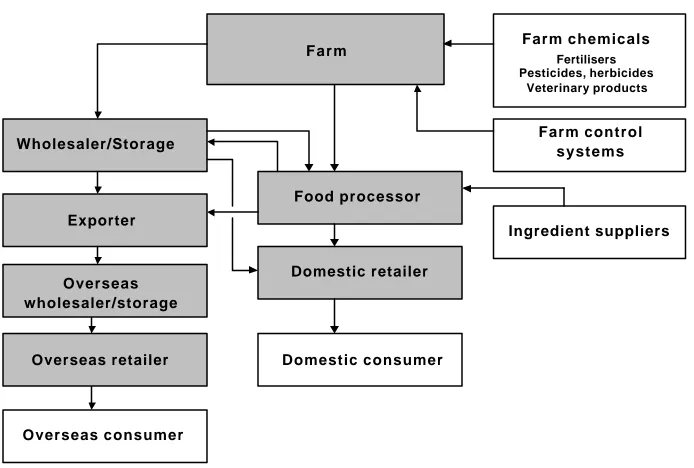
retailer directly or through a wholesaler. For overseas sale there are usually more links in the supply chain to the final customer, involving export agents, overseas wholesalers and retailers. Transport will usually be needed to move the product from one link to the next in the supply chain and there is likely to be a need for further storage on site.
A key feature of Victoria’s strategy for the development of the food industry is the ‘clean, green’ image associated with the State’s food products. This means that it is important to demonstrate that food products are free from residual chemicals used in growing, processing and storing food, and from pathogens that may be introduced along the supply chain. In addition it is important, especially for fresh or lightly processed food, that deterioration through the supply chain be minimised to ensure maximum shelf life.
Figure 4. Food Value Chain
Small scale technologies have the potential to contribute to achieving these goals and to giving farmers and food processors greater control over product characteristics, as well as helping to achieve higher levels of productivity. In particular, cheap sensors can play an important role in systems that control production and distribution to maintain desired product characteristics, such as freshness and freedom from contamination.
3.2.1 Food Production
Growing plants with the desired characteristics relies on the right combination of a number of different factors. They usually need the application of pesticides and herbicides to control insects and weeds respectively, and fertilisers and other nutrients to promote growth. The cost to the farmer of using these chemicals can be minimised if the correct amount can be applied at the optimum time.
Farm
Farm control systems Farm chemicals
Fertilisers Pesticides, herbicides
Veterinary products
Wholesaler/Storage
Overseas consumer
Food processor
Domestic retailer
Domestic consumer
Ingredient suppliers Exporter
Overseas wholesaler/storage
Heavy rain and over- irrigation can result in traditional chemicals being dissolved and removed from the soil into groundwater or streams. Not only is this wasteful economically but it has serious environmental repercussions in its impact on the ecology of waterways and the quality of drinking water derived from these sources.
CSIRO and other research organisations are working on methods to encapsulate agricultural chemicals in nanostructures, in such a way that their release in the field can be better controlled. This means that less of the chemical is needed to achieve optimum results and that the release of these chemicals to the environment can be minimised. In addition, if the particle size of agricultural chemicals can be controlled at the nano scale, their efficacy can be enhanced, with more of the active ingredient being available for its intended application.
Raising livestock requires pasture and hence the same range of chemicals. In addition veterinary pharmaceuticals and other chemicals are need to control pests, disease and parasites. Nanotechnology can be used to produce cheap, disposable diagnostic tests to detect the presence of these conditions and enable more targeted intervention to control them.
In a good year, Australian farmers spend about $3.5 billion per year on fertiliser, agricultural chemicals and veterinary supplies and services to support sales of around $25 billion. If nanotechnology could improve the usage of these farm inputs by 10% this would mean savings of $350 million in farm costs. In addition if nanotechnology could deliver a 1% expansion of sales through higher productivity and improved quality of farm produce this would provide a benefit of $250 million. In total therefore nanotechnology could contribute $600 million to gross profits.
The largest Australian supplier of crop protection chemicals is Nufarm, which is based in Victoria. The company is actively engaged in research to develop mechanisms at the nano scale to deliver their products more efficiently and to make them more efficacious. Their research program is partly motivated by the desire to provide their customers with ways of using smaller applications of chemicals while still ensuring the same or better levels of efficacy. The approach is to control particle characteristics and to ensure controlled release of chemicals while minimising environmental impact.
A similar approach could be adopted for improving the efficacy of veterinary pharmaceuticals. In the same way as is being proposed for human drugs, nanotechnology could be used to design and manufacture scaffolds such as liposomes and dendrimers and similar compounds, to ensure better animal drug delivery with controlled release of active ingredients at targeted sites. Improving the delivery and efficacy of animal drugs would lead to cost savings and healthier animals.
interventions more effectively not only in the application of chemicals but in the use of water, the timing of planting and harvesting.
Nanotechnology has the potential to enable cheap, disposable sensors to be used on farms to provide data on variables such as air temperature and humidity, air speed and direction, soil composition, amount and type of nutrients, presence of plant pathogens, amount of pollen, and composition of crops at various stages of development.
Information from large numbers of sensors spread across fields wo uld enable the farmer to allow for variations in conditions and apply interventions, such as irrigation water, in a targeted, more selective manner. The use of a system of sensors like this would contribute to improved crop and animal yields, higher and more consistent quality for produce and reduced costs, as fewer inputs are used. As farm chemicals would be used selectively and only as needed, it would also reduce the environmental burden of these chemicals.
The Cooperative Research Centre for Microtechnology, based at Swinburne University, has been developing a project in the application of cheap, disposable environmental sensors with one of its commercial partners, Motorola. One application for these sensors could be within vineyards (Figure 5), where they would be mounted within a stake that could be driven into the ground at various locations to report on the kinds of environmental and other characteristics outlined above.
Figure 5. Sensor Control System for a Vineyard
Other uses for sensors in agriculture include detection of pathogens and parasites and other diseases in animals and monitoring waste from intensive animal production such as piggeries The CRC for Microtechnology has research projects in both controlled release of
Information on environment, crops, soil etc
vaccines in food animals and microsensors for pathogen detection in the intensive animal production industry.
3.2.2 Food Processing
Victoria has a large and diverse food processing industry. It is particularly strong in diary products, but has a substantial presence in meat and seafood products, fruit and vegetable processing, cereals based manufacturing, pet foods, and confectionery. It has major facilities in malt and beer making and its wine industry has shown strong and sustained growth over recent times.
Much of the industry has a strong export orientation and faces the constant challenge of developing new products and adapting existing products to meet the needs of consumers in a variety of different countries.
A key competitive advantage of Victorian food products is the perception among consumers that they are produced within a clean and healthy environment. It is important therefore that products are free from chemical and pathogen contamination and that they are either fresh or in good condition when presented to consumers. This creates significant logistical challenges for the distribution chain in terms of timely delivery, and monitoring and control of the product and environmental conditions while in storage and transit. This in turn requires significant innovation in packaging.
Food processing often uses processes that operate at the nano scale. Making food products involves combining raw materials from a variety of sources with other ingredients, such as flavours, preservatives and extenders, under different atmospheric and temperature conditions. In many food products, the materials that go into them are either nanoparticles or they combine to form particles and structures at the nano scale, for instance through the interaction of carbohydrates and proteins.
Greater control of particle size and characteristics will enable food producers to design and manufacture products with improved flavour, colour and nutrient content. New techniques for encapsulating food ingredients at the micro and nano scale will mean that oils in foods such as sauces, mayonnaises, margarines and other products can be more readily stabilised. This will ensure longer shelf life and prevent separation of ingredients. It should also reduce the need for antioxidants, stabilisers and emulsifiers to be added to food.
This encapsulation technology is also important in the development of so-called nutriceuticals, i.e. foods that contains ingredients that provide health benefits in a fashion similar to traditional pharmaceuticals. Encapsulation enables these desirable ingredients to be delivered to the appropriate part of the digestive system and be released as required.
Again as a parallel to human drug delivery, liposomes and dendrimers can act as suitable transport mechanisms for the active ingredients within nutriceuticals.