ISSN(Online): 2320-9801
ISSN (Print): 2320-9798
I
nternational
J
ournal of
I
nnovative
R
esearch in
C
omputer
and
C
ommunication
E
ngineering
(An ISO 3297: 2007 Certified Organization)
Vol. 3, Issue 7, July 2015
Efficient and Secure Data Storage in Cloud
Computing RSA and DSE Function
V.
Yamuna
1, A. Anusha Priya
2Research Scholar, Dept. of CS, Muthayammal College of Arts & Science, Rasipuram, Namakkal, India1 Associate Professor, Department of PG, Muthayammal College of Arts & Science, Rasipuram, Namakkal, India2
ABSTRACT: Cloud computing is the way of providing computing resources in the form of services over internet. The
cloud computing allows storing the user’s data and to measure the applications and services provided by cloud server. There is an ample data stored at cloud storage server. Security is one of the major issues which reduce the growth of cloud computing So Cloud computing entails encyclopedic security solutions .This paper presented secure file exchanging on Cloud using Blowfish, RSA algorithms which is capable of solving data security, authentication, and integrity problems of files on the cloud. Data security is improved by cryptography algorithms. The rightness of data is verified by introducing techniques. Enhanced system (RSA value) compares with simple RSA and Blowfish on basis of some performance parameters like:- throughput, encryption time ,cipher text and delay time . In our enhanced system we integrate symmetric, asymmetric and algorithms which provide better results for performance parameters .TPA(Third party Auditor) which has to match the code for the integrity of user data in cloud on behalf of Data Owners. Data Owner can get notification from TPA when the data integrity is lost. If any unauthorized people access the data in cloud, they will be blocked.
KEYWORDS: cloud storage server, cloud computing, TPA.
I. INTRODUCTION
Cloud storage becomes an increasing attraction in cloud computing paradigm, which enables users to store their data and access them wherever and whenever they need using any device in a pay-as-you-go manner. Moving data into cloud offers great conveniences to the users since they do not have to care about the large capital investment in both the maintenance and management of the hardware infrastructures. Amazon’s Elastic Compute Cloud (EC2) and Amazon Simple Storage Service (S3) and apple icloud are well known examples of cloud data storage. However, once data goes into cloud, the users lose the control over the data. This lack of control raises new formidable and challenging issues related to confidentiality and integrity of data stored in cloud. The confidentiality and integrity of the out sourced data in clouds are of paramount importance for their functionality. The reasons are listed as follows:
1) The CSP, whose purpose is mainly to make a profit and maintains a reputation, has intentionally hide data loss an incident which is rarely accessed by the users.
2) The malicious CSP might delete some of data or is able to easily obtain all the information and sell it to the biggest rival of Company.
3) An attacker who intercepts and captures the communications is able to know the user’s sensitive information as well as some important business secrets.
4) Cloud infrastructures are subject to wide range of internal and external threats. The examples of security breaches of cloud service providers appear from time to time.
ISSN(Online): 2320-9801
ISSN (Print): 2320-9798
I
nternational
J
ournal of
I
nnovative
R
esearch in
C
omputer
and
C
ommunication
E
ngineering
(An ISO 3297: 2007 Certified Organization)
Vol. 3, Issue 7, July 2015
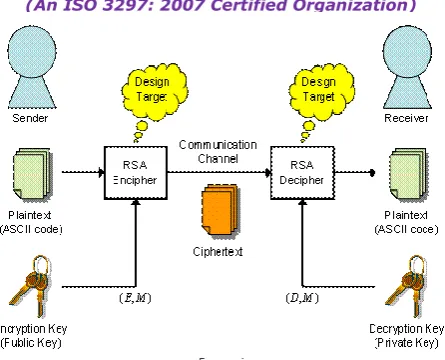
Fig 1.System Architecture
II. LITERATURE SURVEY
Under The security of remote storage applications has been increasingly addressed in the recent years, which has resulted in various approaches to the design of storage verification primitives. The literature distinguishes two main categories of verification schemes. Deterministic verification schemes check the conservation of a remote data in a single, although potentially more expensive operation and probabilistic verification schemes rely on the random checking of portions of outsourced data.
Deterministic Secure Storage
Deterministic solutions are verifying the storage of the entire data at each server. Deswarte et al. and Filho et al. are firstly proposed a solution to remote data integrity. Both use RSA-based functions to the whole data file for every verification challenge. They require pre-computed results of challenges to be stored at verifier, where a challenge corresponds to the hashing of the data concatenated with a random number. However, both of them are inefficient for the large data files, which need more time to compute and transfer their values. Carmoni et al. described a simple deterministic approach with unlimited number of challenges is proposed, where the verifier like the server is storing the data. In this approach, the server has to send MAC of data as the response to the challenge message. The verifier sends a fresh unique random value as the key for the message authentication code to prevent the server from storing only the result of the previous ing of the data. Golle et al. proposed a SEC (Storage Enforcing Commitment) deterministic verification approach.
Probabilistically Secure Storage
In their system, the client pre-computes the tags for each block of a file using homomorphic verifiable tags and stores the file and it tags with the server. Then, the client can verify that server integrity of the file by generating a random challenge, which specifies the selected positions of file blocks. Using the queried blocks and their corresponding tags and the server generates a proof of integrity. Juels et al. proposed a formal definition of POR
(Proof of Retrievability) and its security model. In this model, the encrypted data is being divided into small data blocks, which are encoded with Reed-Solomon codes. The “sentinels” are embedded among encrypted data blocks to detect whether it is intact.
III. EXISTING SYSTEM
ISSN(Online): 2320-9801
ISSN (Print): 2320-9798
I
nternational
J
ournal of
I
nnovative
R
esearch in
C
omputer
and
C
ommunication
E
ngineering
(An ISO 3297: 2007 Certified Organization)
Vol. 3, Issue 7, July 2015
to the users, because these schemes verifying integrity of outsourced data based on pseudorandom sequence, which does not cover the whole data while computing the integrity proof.
Disadvantages of existing system:
Disadvantage occurs in this method that is unable to provide strong security assurance to the users.
IV. PROPOSED SYSTEM
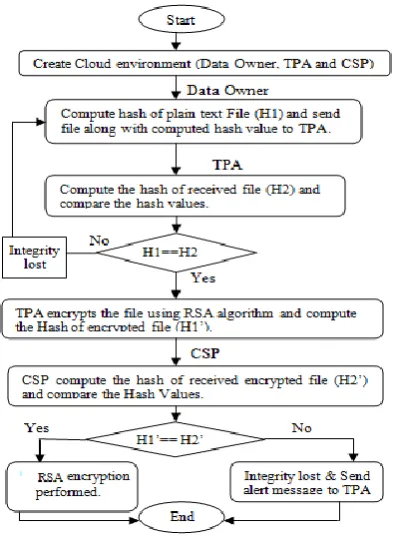
Our proposed work used the concept of hash function along with several cryptographic tools to provide better security to the data stored on the cloud. TPA checks the integrity of the data stored on cloud on behalf of the data owner. TPA checks the of the message to verify the integrity of the data. The Integrity Verification is provided by the TPA which reduces a lot of work of the data owner. In our proposed system Blowfish and RSA cryptography algorithms are used to integrate the features from both and make it a better system than existing system. . In our proposed system we focus on integrity detection and integrity prevention mechanism implemented using some locking techniques.
ADVANTAGES OF PROPOSED SYSTEM:
Our scheme achieves the confidentiality of data It is efficient in terms of computation, storage, because its key size is low compared to RSA based solutions.
V. RSA (RIVEST SHAMMIR ADLEMAN) ALGORITHM
RSA (Rivest Shammir Adleman) is public key cryptography algorithm involves two different keys. Public key for encryption and private key for decryption.RSA also provide authentication. RSA Algorithm RSA is a commonly adopted public key cryptography algorithm. RSA can be used for key exchange, digital signatures, or encryption of small blocks of data. RSA uses a variable size encryption block and a variable size key.RSA has been widely used for establishing secure communication channels and for authentication and the identity of service provider over insecure communication medium. file. The RSA algorithm involves three steps:
1) Key Generation, 2) Encryption and 3) Decryption.
Key Generation
RSA involves a public key and a private key. The public key can be known by everyone and is used for encrypting messages. Messages encrypted with the public key can only be decrypted in a reasonable amount of time using the private key.
Encryption
Alice transmits her public key (n, e) to Bob and keeps the private key secret. Bob then wishes to send message M to Alice. He then computes the ciphertext c corresponding to: C≡memod(n) Bob then transmits c to Alice.
Decryption
Alice can recover m from c by using her private key exponent d via computing: m≡cd(mod n) Given m, she can recover the original message M by reversing the padding scheme.
VI. IMPLEMENTATION
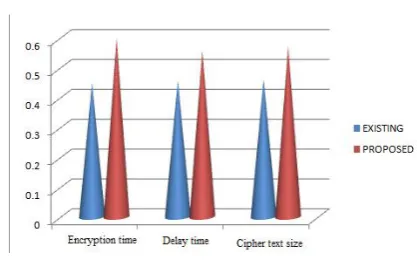
In our proposed work we compare Blowfish, RSA and integrate system (Blowfish+RSA) based on the performance parameters like:- throughput, cipher text, encryption text and delay time. Formulas for these parameters as following:
1) Throughput:
It is number of bits transferred per unit time. Its unit is byte/sec.
ISSN(Online): 2320-9801
ISSN (Print): 2320-9798
I
nternational
J
ournal of
I
nnovative
R
esearch in
C
omputer
and
C
ommunication
E
ngineering
(An ISO 3297: 2007 Certified Organization)
Vol. 3, Issue 7, July 2015
2) Ciphertext size:
It is length of encrypted data. Its unit is in bytes.
Formula: Ciphertext size = Length of encrypted data
Fig 2: Proposed System flow chart
3) Encryption time:
Time taken by server to encrypt any file. Its unit is nano seconds.
Formula : Encryption time = Encryption End Time - Encryption Start Time.
4) Delay Time:
Delay time is time difference between start uploading time and end uploading time. Its unit is in nano seconds. formula : Delay Time = End Uploading Time-Start Uploading Time .
VII. RESULT ANALYSIS
ISSN(Online): 2320-9801
ISSN (Print): 2320-9798
I
nternational
J
ournal of
I
nnovative
R
esearch in
C
omputer
and
C
ommunication
E
ngineering
(An ISO 3297: 2007 Certified Organization)
Vol. 3, Issue 7, July 2015
Fig 3.Result Analysis Graph
VIII.CONCLUSION AND FUTURE WORK
When a client stores its data on the cloud, there is always a big concern of whether the cloud service provider stores the file correctly or not. Security is the main concern in cloud computing. The proposed mechanism provides a security mechanism for securing the data in cloud computing with the help of Blowfish & RSA algorithms. This research paper has proposed a system to provide integrity, authentication and confidentiality to the data stored in cloud computing. Authentication is achieved because only registered client upload and download the files on the cloud. The proposed scheme used the combination of blowfish and RSA to secure the data in such a way that no leakage of data on cloud could be performed. Always encrypted file stored on the cloud.Value matches at TPA server to check the integrity of file. There is always a scope for improvement in every field of work, so here also. We take one of the assumption made in all the models of security are that the TPA is neutral. So there is some need to do some work for making TPA more secure.
REFERENCES
1. R. Buyya, C. S. Yeo, S. Venugopal, J. Broberg, and I. Brandic.“Cloud Computing and Emerging IT Platforms: Vision, Hype, and Reality for
Delivering Computing as the 5th Utility,” Future Generation Computer Systems, vol. 25, no. 6, June 2009, pp 599–616.
2. Amazon.com, “Amazon Web Services (AWS),” Online at http://aws.amazon.com, 2008.
3. Apple “ICloud” Online at http://www.apple.com/icloud/what-is.html 2010.
4. T Mather, S Kumaraswamy, and S Latif “Cloud Security and Privacy”, O’REILLY Publication, first edition, sep- 2009.
5. H. Takabi, J.B.D. Joshi, and G. Ahn, “Security and Privacy Challenges in Cloud Computing Environments”, Article in IEEE Security and
Privacy, vol. 8, no.6, Nov- Dec. 2010, pp. 24-31.
6. N. Gohring, “Amazon’s S3 down for several hours,” Online at http://www.pcworld.com/businesscenter/ articl/
142549/amasons_down_for_sever_hours.html”, 2008 .
7. J. Kincaid, “MediaMax/TheLinkup Closes Its Doors”,Online at http://www.techcrunch.com/2008/07/10/mediamaxthelink
up-closes-its-doors/, July 2008.
8. Y. Deswarte, J.-J. Quisquater, and A. Saidane. “Remote integrity checking”. In Proc. of Conference on Integrity and Internal Control in Information Systems (IICIS’03), November 2003. lausanne, Switzerland.
9. D. L. G. Filho and P. S. L. M. Barreto, “Demonstrating Data Possession and Uncheatable Data Transfer,” cryptology ePrint Archive, Report
2006/150, 2006, http://eprint.iacr.org/.
10. G. Caronni and M. Waldvogel, “Establishing Trust in Distributed Storage Providers”, In Third IEEE P2P Conference, Linkoping 03, 2003.
11. P. Golle, S. Jarecki and I. Mironov, “Cryptographic Primitives Enforcing Communication and Storage Complexity”, In proc. of Financial
Crypto 2002. Southampton, Bermuda.
12. F. Sebe. J. Domingo-Ferrer, and A. Martinez-Balleste, Y. Deswarte, and J.-J. Quisquater, “Efficient Remote Data Possession Checking in
Critical Information Infrastucures”, IEEE Trans. Knowledge and Data Engineering, vol. 20, no. 8, aug-2008, pp. 1034-1038
13. G. Ateniese, R. Burns, R. Curtmola, J. Herring, L. Kissner, Z. Peterson,and D. Song, “Remote Data Checking using Provable Data Possession,” ACM Trans. ACM Transactions on Information and System Security, Vol. 14, No. 1, Article 12, may 2011, pp. 12.1–12.34.
14. A. Juels and J. Burton S. Kaliski, “PORs: Proofs of Retrievability for Large Files,” Proc. of CCS ’07, pp. 584– 597, 2007.Alexandria, Va,
USA.
15. G Ateniese, S. Kamara, J. Katz, “Proofs of Storage from homomorphic identification protocols”. In Proc. of ASIACRYPT '09, 2009, pp.
ISSN(Online): 2320-9801
ISSN (Print): 2320-9798
I
nternational
J
ournal of
I
nnovative
R
esearch in
C
omputer
and
C
ommunication
E
ngineering
(An ISO 3297: 2007 Certified Organization)
Vol. 3, Issue 7, July 2015
BIOGRAPHY
Ms.V.YAMUNA received BCA from Muthayammalcollege of Arts and Science Affiliated to Periyar University in 2011. She received MCA from Muthayammal college of Arts & Science in 2013 Affiliated to Periyar University. Currently pursuing M.Phil(cs) from Muthayammal college of Arts & Science Rasipuram Affiliated to Periyar University...Her area of interest is cloud computing and mobile computing.