IJEDR1604010
International Journal of Engineering Development and Research (www.ijedr.org)58
Result Analysis of Authority to Control of Variable
Pitch and Variable Speed of Wind Turbines in Fragile
Grid Structure With Active Power Balance
1
Shikha Chaturvedi,
2Nisheet Soni,
1 M.tech. Scholar, 2Head of Department, 1,2 Electrical Engineering Department, 1,2 Shri Ram Institute of Technology, Jabalpur, India
________________________________________________________________________________________________________
Abstract—In the case of operating in a very weak grid system, when wind generation becomes a significant portion of the
power system or maybe the only energy supply, the wind power generators and converters are expected to help maintain the grid voltage. The terminal (grid) region convertor desires to vocation as an electrical energy source to assist control the terminal (grid) voltage amplitude and rate of recurrence by regulate the reactive control and active power flow, severally. For a direct-drive magnet synchronous generator through a full power convertor, the active power must be provided by the captured wind generation. The active power flow between the supply (captured wind power) and therefore the grid (load) should be balanced by actively controlling the generator speed and turbine pitch angle. In the study, the coordinated control of generator speed and blade pitch angle is planned along with a dc-link voltage controller. A model of the grid-side tool prepared as a voltage give for design and also the strategy relating to voltage and frequency regulation is given. Simulation is administered with totally different wind and cargo profile. The results show the wind energy will facilitate support the weak grid and power the native grid in complete mode still.
IndexTerms—SCIG (squirrel cage induction generator), PCC (point of common coupling), DFIG (doubly-fed induction generator).
________________________________________________________________________________________________________
I. INTRODUCTION
In the present day, for the most part distributed generation (DG) from wind property in medium voltage (MV) and low voltage (LV) distribution networks accounts for a comparatively little share of the power provided by the networks. The grid is typically perceived as a perfect voltage supply (strong grid) and also the generator and power device operates as a current supply, wherever the most wind generation is transferred to the robust grid, following MPPT (maximum electrical outlet tracking) mode. This case is probably going to vary within the close to future, as an outsized installation of wind generation is inspired in several countries due to the distinct advantages they will offer: property, emission-free. The space between the power station and cargo centre is typically terribly long; the drop due to the state of the conductor can vary for various wind generation and cargo conditions. Similarly, the grid frequency additionally varies with power; within the case wherever the bus isn't infinite (e.g. the generators connected to the grid are droop controlled). Therefore, the power station is after all facing a weak grid, wherever the voltage of the purpose of common coupling (PCC) isn't a perfect voltage supply. During this case, once wind generation becomes a big portion of the facility system or maybe the only real energy supply, the wind generation generator and its device are expected to assist maintain the grid voltage and frequency, operational sort of a standard giant synchronous generator (SG). The weak grid condition may be a result of intended disjointing or is landing from the grid or grid faults (unintentional islanding). It applies still to the complete operational mode. The structure of a typical weak grid system with wind turbines and native load still because the transmission network. The bus that the system is connected to is assumed to own restricted capability with frequency droop characteristics. Every turbine adopts the topology of a full power device and a direct-drive permanent magnet generator (PMG).
Several papers have studied the device complete mode operation and power sharing between the load-side converters exploitation droop management, forward the device dc-link voltage is constant with active power balance, while not considering the supply (wind) characteristics. The authors mentioned the turbine active power management by dynamic the generator speed and don't embrace pitch management for adjusting the input power. In adopt the auxiliary load (damping resistor) to dissipate the excessive wind energy for power equalization purpose that isn't sensible for big wind turbines.
II. METHOD
Active Power Control
IJEDR1604010
International Journal of Engineering Development and Research (www.ijedr.org)59
is totally electronic systems that change the electrical operating purpose of the modules so the modules are able to deliver most accessible power. Additional power harvested from the modules is then created offered as increased battery charge current. MPPT may be used at the same time with a automatic following system, however the 2 systems are fully completely different. to acknowledge however MPPT works, let’s initial decide the operation of a standard (non MPPT) charge controller. Once a standard controller is charge a discharged battery, it essentially connects the modules on to the battery. This forces the modules to control at battery voltage, sometimes not the perfect operating voltage at that the modules are able to manufacture their most offered power output. MPPT or most electric receptacle following is algorithmic rule that enclosed responsible controllers used for extracting most offered power from wind module below bound conditions. The voltage at that wind module will generate most power is termed ‘maximum power point’ (or peak power voltage). Most power varies with wind module produces power with most power voltage. A MPPT or maximum electric receptacle hunter is associate electronic DC to DC device that optimizes the equivalent between the star vary (PV panels), and also the battery bank or utility grid. to place it merely, they modify a better voltage DC output beginning star panels (and some wind generators) right down to the lower voltage required to charge batteries.III. SIMULATION RESULTS
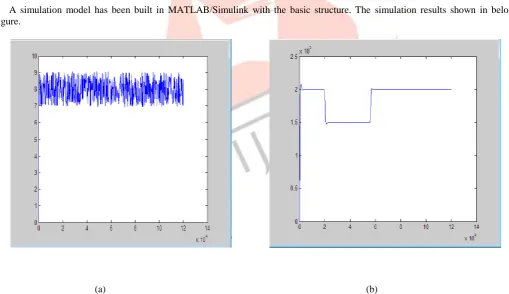
A simulation model has been built in MATLAB/Simulink with the basic structure. The simulation results shown in below figure.
IJEDR1604010
International Journal of Engineering Development and Research (www.ijedr.org)60
(c) (d)
IJEDR1604010
International Journal of Engineering Development and Research (www.ijedr.org)61
(g) (h) Fig .1 Simulation results for active power balancing
(a)Wind speed profile (b) Load power
(c) Wind turbine pitch angle (d) PMG speed
(e) PMG output power (f) PMG output power (g)Dc-link voltage
IJEDR1604010
International Journal of Engineering Development and Research (www.ijedr.org)62
(c) (c)
(c)
Fig. 2 System performance during load increase
(a) Generator speed
(b) Wind generator power reference
(c) Load power, wind generator output power and grid power
IJEDR1604010
International Journal of Engineering Development and Research (www.ijedr.org)63
(c) (d)
Fig. 3 Simulation results with a wind farm connected to a weak grid system
(a) Reference load power and real load power with/without wind power support (b) Voltage amplitude and frequency at PCC point with/without wind power support (c) Grid power and wind power
IJEDR1604010
International Journal of Engineering Development and Research (www.ijedr.org)64
(b) (b)
Fig.3 Simulation results for two wind turbines in a stand-alone system
(a) Voltage at the PCC and converter output current during load change (b) Active power output of converter I and converter II
IV. CONCLUSION
In this paper in a very weak-grid system or complete system, the captured alternative energy ought to be balanced with the load power, which may be achieved by the generator speed and rotary engine pitch management. By dynamic the generator speed, the captured wind generation will be adjusted and therefore the K.E. is keep or free consequently, that is useful for damping the load power modification. The pitch management is coordinated with the generator speed management and is employed for limiting the generator speed varies. A well-designed dc-link voltage controller will maintain the active power flow balance between the supply and cargo. The droop management is adopted for power sharing between multiple winds converters and additionally for control the grid voltage amplitude and frequency via reactive power and active power management. Simulations results have shown that the planned system will facilitate maintain the weak grid voltage and additionally power the native grid in complete mode operation. The planned theme with active power management can even be used for wind generation smoothing and different active power management applications.
.
REFERENCES
[1] Kanellos, F.D., Hatziargyriou, N.D.: ‘Control of variable speed wind turbines in islanded mode of operation’, IEEE Trans. Energy Convers., 2008, 23, (2), pp. 535–543
[2] Muljadi, E., Butterfield, C.P., Parsons, B., Ellis, A.: ‘Effect of variable speed wind turbine generator on stability of a weak grid’, IEEE Trans. Energy Convers., 2007, 22, (1), pp. 29–36
[3] Bindner, H.: ‘Power control for wind turbines in weak grids: concept development’. Riso national laboratory report, March 1999
[4] Liserre, M., Cardenas, R., Molinas, M., Rodriguez, J.: ‘Overview of multi-MW wind turbines and wind parks’, IEEE Trans. Ind. Electron., 2011, 58, (4), pp. 1081–1095
[5] Kanellos, F.D., Hatziargyriou, N.D.: ‘The effect of variable-speed wind turbines on the operation of weak distribution networks’, IEEE Trans. Energy Convers., 2002, 17, (4), pp. 543–548
[6] Zhong, Q., Weiss, G.: ‘Static synchronous generators for distributed generation and renewable energy’. Proc. IEEE PSCE’09 Conf., March 2009, pp. 1–6
[7] Morren, J., Haan, S., Kling, W., Ferreira, J.: ‘Wind turbines emulating inertia and supporting primary frequency control’, IEEE Trans. Power Syst., 2006, 21, (1), pp. 433–434
[8] Van Thong, V., Woyte, A., Albu, M.: ‘Virtual synchronous generator: laboratory scale results and field demonstration’, IEEE Bucharest Power Tech. Conference, 2009, June 2009, pp. 1–6
[9] Yuan, X., Wang, F., Borojevich, D.: ‘DC-link voltage control of full power converter for wind generator operating in weak grid systems’, IEEE Trans. Power Electron., 2009, 24, (9), pp. 2178–2192
[10] Luo, C., Banakar, H., Shen, B.: ‘Strategies to smooth wind power fluctuations of wind turbine generator’, IEEE Trans. Energy Convers., 2007, 22, (2), pp. 341–349
IJEDR1604010
International Journal of Engineering Development and Research (www.ijedr.org)65
[18] Senjyu, T., Sakamoto, R., Urasaki, N., Funabashi, T.: ‘Output power leveling of wind turbine generator for all operatingregions by pitch angle control’, IEEE Trans. Energy Convers., 2006, 21, (2), pp. 467–475
[19] Yamazaki, T., Takahashi, R., Murata, T., Tamura, J.: ‘Smoothing control of wind generator output fluctuations by new pitch controller’. Proc. ICEM’08 Conf., September 2008, pp. 1–6
[20] Zhang, J., Cheng, M.Z., Chen, and X.F.: ‘Pitch angle control for variable speed wind turbines’. Proc. IEEE DRPT’08 Conf., April 2008, pp. 2691–2696
[21] Conroy, J.F., Watson, R.: ‘Low-voltage ride-through of a full converter wind turbine with permanent magnet generator’, IET Renew. Power Gener. 2007, 1, (3), pp. 182–189