Volume 01, No.7, July, 2015
P
age
8
Effect of Fine Aggregate Particles on Compressive Strength of
Cement Mortar
Chandra Prakash Bastani* & R. Kansal**
*M..E.IV Sem.(CTM) Student
**Professor & Head, Department Of Civil Engineering, MITS Gwalior
ABSTRACT:
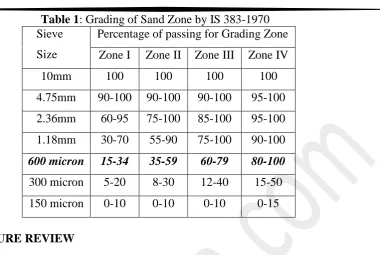
The Cement Sand mortar 1:6 is commonly used in the masonry work. The sand is an important ingredient of mortar. Various studies on mortar properties have been done with correlating its Fineness Modulus to various parameters. It is a fact that the same fineness modulus may have different particle size distribution patterns. Sand is composed of different sized particles e.g. ranging from 4.75mm to 150 micron in varying proportions, These gradation of particles affect the performance of mortar by improving the workability ,compressive strength etc. and vice versa. The presence of fine particles in sand is of a paramount importance. An attempt has been made to study the effect of fine particles i.e. passing 600 micron sieve in different percentages as specified by IS code; on cement sand mortar 1:6 .The main objective is to identify a particle size distribution which requires less water for better workability of mortar without sacrificing the strength of mortar.
KEY WORDS: Compressive strength, workability, cement mortar, water cement ratio, sand, flow test.
I. INTRODUCTION
Volume 01, No.7, July, 2015
P
age
9
Table 1: Grading of Sand Zone by IS 383-1970 Sieve
Size
Percentage of passing for Grading Zone
Zone I Zone II Zone III Zone IV
10mm 100 100 100 100
4.75mm 90-100 90-100 90-100 95-100
2.36mm 60-95 75-100 85-100 95-100
1.18mm 30-70 55-90 75-100 90-100
600 micron 15-34 35-59 60-79 80-100
300 micron 5-20 8-30 12-40 15-50
150 micron 0-10 0-10 0-10 0-15
II LITERATURE REVIEW
B.V. Venkataram Reddy, (2012) reported that C.M.1:4 achieved 100 % flow on water cement ratio of 1.2 while C.M. 1:6 attained 100% flow value on 1.75 water cement ratio. Compressive strength for these mortar cubes was assessed as per the guide lines of IS 2250 and was found 15.50 MPa for C.M.1:4 and 8.19 MPa for C.M.1:6 at the flow value of 100 %.
Vladimir G. Haach, (2011) suggests that the mortar mix prepared with fine sand required more amount of water than the mortar mix made with coarse sand. This also resulted in low flow value for fine sand mortar and vice versa.
Reddy and Gupta (2005) observed that fine sands require 25-30 % more water to achieve a certain consistency than coarse sands.
III METHODOLOGY
The sand collected from nearby Sindh river was sieved through designated IS sieves i.e.4.75, 2.36, 1.18 mm & 600, 300 and 150 micron sieves. Different sized particles were collected and blended in required proportions in order to prepare the samples of sand with fine particles 35, 43,51 & 59 % passing 600 micron sieve. Cement and sand mortar was mixed in 1:6 ratio. The water cement ratio was varied from 1.0 to 2.00 in order to achieve a flow value of 110-115 percent. Each sand sample was tested for its workability on Flow Table as per IS 2250-1981 for each water cement ratio. The mortar cubes were casted and cured in water tanks. After 28 days of curing period cubes were tested. The details are given in table 2.
Table 2:Gradation of prepared sand samples
S.No. IS Sieve Percentage Passing for
S1 S2 S3 S4
Volume 01, No.7, July, 2015
P
age
10
0 50 100 150
Cumulative % Passing
Sieve Size
S1 S2 S3 S4
Fig.1
IV RESULTS AND DISCUSSION
The flow values for different mortar cubes with different sand samples for each water cement ratio have been tabulated –
Table 3
S.No. W/C
Ratio
Flow value percentage
S1 S2 S3 S4
1. 1.0 52.50 45.75 43.75 38.00
2. 1.1 57.50 49.25 46.00 43.00
3 1.2 67.75 55.00 51.00 44.75
4. 1.3 70.75 61.00 55.75 47.25
5. 1.4 77.50 68.75 62.75 53.50
6. 1.5 85.50 74.50 68.00 56.25
7. 1.6 92.25 78.50 78.75 67.50
8. 1.7 111.50 86.50 88.25 75.75
9. 1.8 122.00 110.50 112.25 86.25
10. 1.9 - - - 110.00
2 2.36mm 75 83 92 100
3 1.18mm 55 67 78 90
4 600 micron 35 43 51 59
5 300 micron 8 15 23 30
6 150 micron 0 0 0 0
Volume 01, No.7, July, 2015
P
age
11
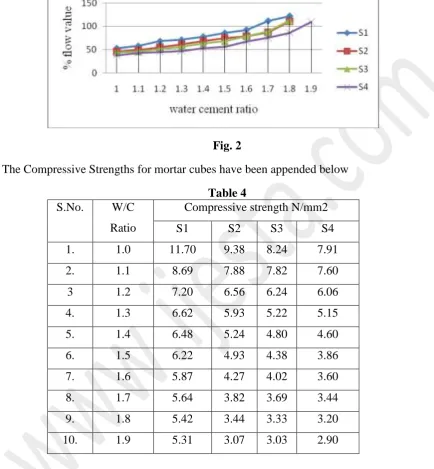
Fig. 2
The Compressive Strengths for mortar cubes have been appended below
Table 4
S.No. W/C
Ratio
Compressive strength N/mm2
S1 S2 S3 S4
1. 1.0 11.70 9.38 8.24 7.91
2. 1.1 8.69 7.88 7.82 7.60
3 1.2 7.20 6.56 6.24 6.06
4. 1.3 6.62 5.93 5.22 5.15
5. 1.4 6.48 5.24 4.80 4.60
6. 1.5 6.22 4.93 4.38 3.86
7. 1.6 5.87 4.27 4.02 3.60
8. 1.7 5.64 3.82 3.69 3.44
9. 1.8 5.42 3.44 3.33 3.20
10. 1.9 5.31 3.07 3.03 2.90
Volume 01, No.7, July, 2015
P
age
12
V CONCLUSION
The results show that the sand sample containing 35% finer particles i.e. passing 600 micron sieve attained the desired flow value of 110-115% at the lowest W/C ratio 1.70 and gained the compressive strength of 5.64 N/mm2 which can be compared with the permissible compressive strength prescribed in IS 2250-1981 i.e.3 to 5 N/mm2 which is even more than its higher limit of 5 N/mm2. As the percentage of fine particles passing 600 micron sieve increased in the sand samples S2, S3, S4; the water needed for same consistency increased. The increase in water /cement ratio resulted a decrease in the compressive strength of mortar for prescribed flow value of 100- 110 %. Although the compressive strength values were found near to the lower limits of 3.0 N/mm2. It can be concluded that the fine particles are more thirsty hence require more water resulting in lower compressive strength. As it supports this concept that due to the presence of fine particles, the surface area increases resulting in the increased amount of water.
VI RECOMMENDATIONS
The sand is an important ingredient of mortar and its properties need to be carefully addressed. The sand before dispatching to the site should be examined for its particle size distribution and it should be blended accordingly so that its maximum strength contribution can be utilized.
REFERENCES
i. Satish Chandra.Gyanen.Takhelmayum,Deepa.T (2013) “Study on Flow and
Compressive Strength Properties of Mortars Using Fly Ash and Lime.IS 2250-1981:
Code of Practice for Preparation and Use of Masonry Mortars.
ii. IS 5512-1983: Specification for Flow Table for use in tests.
iii. IS:383-1970 Specification for Coarse and Fine Aggregates from Natural Sources for
Concrete (Second Revision).
iv. Prof. B.V. Venkataram Reddy, Department of Civil Engineering, Indian Institute of
Science, Bangalore Report on “Suitability of Manufactured Sand as Fine Aggregate in Mortars and Concrete”.(2012)
v. Valdimir G.Haach (2011) “Influence of Aggregates Grading and Water Cement Ratio
in the Workability and Hardened Properties of Mortars.”
vi. Reddy and Gupta (2005) “Influence of Sand Grading on the Characteristics of