http://dx.doi.org/10.4236/jamp.2014.213138
Euler-Lagrange Elasticity with Dynamics
H. H. Hardy
Math and Physics Department, Piedmont College, Demorest, GA, USA Email: [email protected]
Received 10October 2014; revised 12November 2014; accepted 19November 2014
Copyright © 2014 by author and Scientific Research Publishing Inc.
This work is licensed under the Creative Commons Attribution International License (CC BY).
http://creativecommons.org/licenses/by/4.0/
Abstract
The equations of Euler-Lagrange elasticity describe elastic deformations without reference to stress or strain. These equations as previously published are applicable only to quasi-static de-formations. This paper extends these equations to include time dependent dede-formations. To ac-complish this, an appropriate Lagrangian is defined and an extrema of the integral of this Lagran-gian over the original material volume and time is found. The result is a set of Euler equations for the dynamics of elastic materials without stress or strain, which are appropriate for both finite and infinitesimal deformations of both isotropic and anisotropic materials. Finally, the resulting equations are shown to be no more than Newton's Laws applied to each infinitesimal volume of the material.
Keywords
Elasticity, Stress, Strain, Infinitesimal Deformations, Finite Deformations, Discrete Region Model
1. Background
Virtually all modern theories of elasticity [1]-[4] build the equations to describe elasticity using stress and/or strain. Hardy [5] proposed to return to the approach of Euler, Lagrange, and Poisson [6] to build the equations of elasticity using point locations and forces instead of stress and strain. Hardy called these equations the equations of Euler-Lagrange elasticity. The equations of Euler-Lagrange elasticity are appropriate for quasi-static defor- mations, but do not include dynamics. Dynamics will be added in this paper.
Hardy defined an elastic material as one which when deformed, stores energy; and when it is returned to its original state, the stored energy is returned to its surroundings. This is known as hyper-elasticity [7]. Hardy followed the notation of Spencer [8] by defining the initial position of each point in an elastic material to be X1,
2
X , and X3 corresponding to the x, y, and z coordinates of that point. The parameters, x1, x2, x3 were
and X3. The energy of the material is a function of the final positions of each point xi (i = 1, 2, 3) and the
relative change in distances between points, i j
x X
∂
∂ (i and j = 1, 2, 3). This energy is expressed in terms of the
energy per unit original volume, , i i j x E x X ∂ ∂
, which can be divided into the energy associated with body forces,
( )
body i
E x , plus the energy associated with the deformation of the body, i def j x E X ∂ ∂ ,
( )
body . i i def j xE E x E
X
∂
= +
∂
(1)
To obtain the Euler-Lagrange differential equations, Hardy minimized the total energy, tot,
1 1 3
, i d d d 0
tot i
j
x
E x X X X
X
δ =δ ∂ =
∂
∫∫∫
, (2)
which resulted in three Euler equations,
(
)
d
0 for 1, 2, 3. d
i j i j
E E
i
x X x X
∂ ∂
− = =
∂ ∂ ∂ ∂ (3)
The advantage of Hardy’s approach is that Equation (3) is applicable to both infinitesimal and finite defor- mations as well as being appropriate for both anisotropic and isotropic materials. The disadvantage of this approach is that it is only appropriate for quasi-static deformations, since time dependence is not included. In this paper, I will extend this approach to include dynamics.
2. Adding Dynamics
To add dynamics to the Euler-Lagrange elasticity equations several changes are needed to the quasi-static approach. First define each xi as a function of time as well as X1, X2, and X3. Second define an appro-
priate Lagrangian. Third minimize the integral of the Lagrangian over both space and time. Lagrangians for particle dynamics are defined as the kinetic energy minus the potential energy of the particle. To extend this to a distributed material, our “particle” will be an infinitesimal volume of the elastic material. Define the kinetic energy per original volume of the material as
2
1 2
T= ρv , (4)
with ρ the mass per original volume of the material and the velocity of any point in the material, v, is
2
2 2
2 x1 x2 x3 .
v
t t t
∂
∂ ∂
= + +
∂ ∂ ∂
(5)
Define the potential energy per unit original volume as E in Equation (1) and the Lagrangian, as .
T E
= −
(6) Substitute Equation (1) into Equation (6) with Ebody=ρgx3 and T from Equation (4) to express as
2 2 2 3 1 2 3 1 . 2 i def j x x x x gx E
t t t X
ρ∂ ∂ ∂ ρ ∂
= + + − −
∂ ∂ ∂ ∂
(7)
Now find the extrema of
1 2 3
dX Xd dX d .t
=
∫∫∫∫
Since , i , i i j x x f x X t ∂ ∂ = ∂ ∂
, the following three Euler equations result from setting δ=0:
(
)
(
)
d d
0.
d d
i j i j i
x X x X t x t
∂ ∂ ∂
− − =
∂ ∂ ∂ ∂ ∂ ∂ ∂
(9)
Substituting from Equation (7) gives
(
)
3 d d 0 d d def i ij i j
E x
g
X x X t t
ρ δ ∂ ρ∂
− + − =
∂ ∂ ∂ ∂
, (10)
or
(
)
3 d d . d d def i ij i j
E x
g
t ρ t ρ δ X x X
∂
∂
= − +
∂ ∂ ∂ ∂
(11)
Equation (11) are the equations of dynamics for deformation of elastic materials. All that is required is to define Edef of the material experimentally. The Edef must be invariant under coordinate rotations and transla- tions. One method is to define Edef in terms of invariants of the i
j
x X
∂
∂ matrix (e.g. Ogden [9], Hardy [10]).
Note that no assumptions of infinitesimal deformation or isotropy have been made to derive Equation (11), so they are applicable for both infinitesimal and finite deformations of both isotropic and anisotropic materials. The most surprising thing about Equation (11) is that each term in Equation (11) can be given a simple physical interpretation.
3. Physical Interpretation of the Terms in Equation (11)
In order to give a physical interpretation to the individual terms in Equation (11) consider a small cuboid defined
as ∆ ∆ ∆X1 X2 X3. The term on the left hand side of Equation (11),
d d
i
x t ρ t
∂
∂
, is the change in momentum per
unit original volume of this cuboid with respect to time in the limit as ∆X1, ∆X2 and ∆X3 approach 0. The
first term on the right hand side, −ρ δg i3, is the force of gravity per unit original volume of this cuboid in the
same limit. The second term on the right hand side,
(
)
d d
def
j i j
E
X x X
∂
∂ ∂ ∂
, is shown below to be the net surface
force per unit original volume applied to all the surfaces of the cuboid as the volume of the cuboid shrinks to
zero. In other words, Equation (11) is just an expression of Newton’s laws d dt
=
∑
p
F for each infinitesimal
volume of the material.
To see that
(
)
d d
def
j i j
E
X x X
∂
∂ ∂ ∂
is indeed the net surface force per unit original volume acting on the cuboid,
recall that Hardy [5] found that the external force acting on a surface can be written as
(
)
d i def d j.
i j E F A x X ∂ =
∂ ∂ ∂ (12)
be dA1, dA2, and dA3 in the X1, X2, and X3 directions respectively. The three components of the force
exerted on the da plane at any time during the deformation are then calculated from Equation (12) as
(
)
1(
)
2(
)
31 2 3
d i def d def d def d .
i i i
E E E
F A A A
x X x X x X
∂ ∂ ∂
= + +
∂ ∂ ∂ ∂ ∂ ∂ ∂ ∂ ∂ (13)
For our cuboid, defined as ∆ ∆ ∆X1 X2 X3, the
th
i component of the force on a plane of the cuboid originally perpendicular to Xj is Fij, where
(
def)
d(
not summed over)
ij j
i j
E
F A j
x X
∂ =
∂ ∂ ∂ . (14)
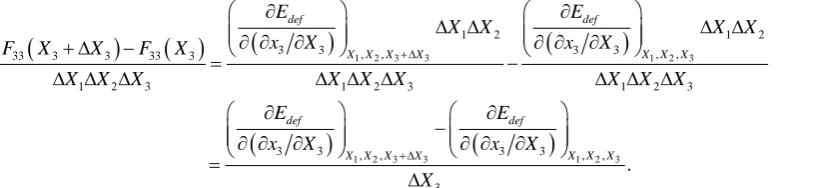
For example, F33 is the X3 component of the force on plane dA3 =dX X1d 2. Divide the body into cuboids
along the X3 direction as shown in Figure 1(a). As shown in this figure, F33
( )
X3 is the component of forceon region a from region b in the X3 direction. F33
(
X3+ ∆X3)
is the component of force on region b fromregion c. If we wish to express the net force on region b alone, this would be F33
(
X3+ ∆X3)
−F33( )
X3 asshown in Figure 1(b). The net force in the X3 direction on region b along the X3 direction when divided by
the cuboid’s original volume is
(
)
( )
(
)
(
)
(
)
(
)
1 2 3 3 1 2 3
1 2 3 3 1 2 3
1 2 1 2
3 3 , , 3 3 , ,
33 3 3 33 3
1 2 3 1 2 3 1 2 3
3 3 , , 3 3 , ,
3
.
def def
X X X X X X X
def def
X X X X X X X
E E
X X X X
x X x X
F X X F X
X X X X X X X X X
E E
x X x X
X +∆ +∆ ∂ ∂ ∆ ∆ ∆ ∆ ∂ ∂ ∂ ∂ ∂ ∂ + ∆ − = − ∆ ∆ ∆ ∆ ∆ ∆ ∆ ∆ ∆ ∂ ∂ − ∂ ∂ ∂ ∂ ∂ ∂ = ∆ (15)
Taking the limit as the dimensions of the cube go to zero gives the net force per unit original volume on region b in the X3 direction on the dA3 faces of the cube, 33
net
F , to be
(
)
( )
(
)
(
)
(
)
1 2 3
1 2 3 3 1 2 3
3
33 3 3 33 3
33
, , 0
1 2 3
3 3 , , 3 3 , ,
0
3
3 3 3
lim lim d . d net
X X X
def def
X X X X X X X
X
def
F X X F X
F
X X X
E E
x X x X
X E
X x X
∆ ∆ ∆ → +∆ ∆ → + ∆ − = ∆ ∆ ∆ ∂ ∂ − ∂ ∂ ∂ ∂ ∂ ∂ = ∆ ∂ = ∂ ∂ ∂ (16)
A similar argument using F11 and F22 yields the net forces normal to the dA1 and dA2 faces, 11
net
F and
22
net
F , to be
[image:4.595.105.521.291.385.2]
(a) (b)
Figure 1. Force within the material in the X3 direction on the dA3 surfaces (a) internal forces from Equation (14) (b)
(
)
11
1 1 1
d d
def
net E
F
X x X
∂ =
∂ ∂ ∂ , (17)
and
(
)
22
2 2 2
d
. d
def
net E
F
X x X
∂ =
∂ ∂ ∂ (18)
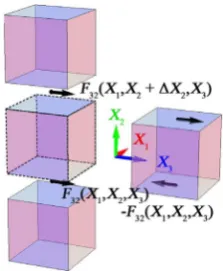
Next consider 32
net
F . Using Figure 2and an argument similar to the one used in Figure 1gives
(
)
32
2 3 2
d d
def
net E
F
X x X
∂ =
∂ ∂ ∂ , (19)
and in general
(
)
(
)
d
not summed over . d
def net
ij
j i j
E
F j
X x X
∂ =
∂ ∂ ∂ (20)
Combining these results, we have the total force in the Xi direction to be
(
)
d d
def net
i
j i j
E F
X x X
∂
=
∂ ∂ ∂
, (21)
for i = 1, 2, 3, and summed over j = 1, 2, 3, which is the third term in Equation (11). Thus
(
)
d d
def
j i j
E
X x X
∂
∂ ∂ ∂
is the net surface force per unit original volume in the ith direction on any cuboid in the limit as the cuboid dimensions shrink to zero.
[image:5.595.83.541.85.366.2]Figure 3 summarizes this result by illustrating the forces summed in each direction to calculate the net surface force on a cuboid of material. Note that in Figure 3only the forces on the “front” faces of the cuboid are
Figure 2. Forces in the X3 direction on the two dA2 faces within the material
and on a region.
[image:5.595.242.354.427.563.2](a) (b) (c)
[image:5.595.156.443.600.697.2]shown. There are forces on the rear surfaces that also contribute to each Finet term.
4. Some Details
The procedure outlined in the last section to calculate the force on a plane after a deformation seems a bit convoluted in that the location of the plane before any deformation must be found in order to find the force on the plane after deformation. However, Equation (12) are excellent for applying Neumann boundary conditions to Equation (11). As an example, consider the case of deforming a rectangular body as shown in Figure 1(a) by applying some force on the X3 face of the cuboid. If we know the components of the applied force from
boundary conditions as a function of time, we can write
(
)
33
d . def i
i
E
F A
x X
∂ =
∂ ∂ ∂
∫
(22)If the force is applied uniformly over the area, dFi dA3 is simply the applied force divided by a constant, the
origial area. Therefore the Neumann boundary condition using Equation (12) is defined using just a rescaled version of the applied force on the surface of the material.
Finite deformations may displace and distorted planes in the cuboid from their original positions, but as long as inversions are not allowed, the same bounding surfaces of the cuboid are found regardless of how the material
is deformed. The values of
(
idef j)
E
x X
∂
∂ ∂ ∂ change from point to point as the material is deformed, but the dAj vectors are unchanged by the deformation. Thus the forces shown in Figures 1-3may be displaced due to the finite deformation, but the orientation of each component of each force from each surface is the same and the
form of the sum of the forces,
(
)
d d
def
j i j
E
X x X
∂
∂ ∂ ∂ , is unchanged by the displacement.
Lastly, it is tempting to consider the second order tensor quantity
(
idef j)
E
x X
∂
∂ ∂ ∂ to be stress, but it is only
stress for infinitesimal deformations. This is because
(
idef j)
E
x X
∂
∂ ∂ ∂ must be multiplied by the ORIGINAL
surface vector, not the current one to get the force at the current location.
5. Conclusion
The equations for dynamics in Euler-Lagrange elasticity have been derived. These equations are shown to be a
simple statement of Newton’s Law d dt
=
∑
p
F for each infinitesimal volume of the material. The derived
equations, Equation (11), are applicable to infinitesimal and finite deformations for both isotropic and anisotropic materials.
References
[1] Maugin, G.A. (2013) Continuum Mechanics through the Twentieth Century. Springer, London. http://dx.doi.org/10.1007/978-94-007-6353-1
[2] Truesdell, C. and Noll, W. (2009) The Non-Linear Field Theories of Mechanics. Springer, London. [3] Srinivasa, A.R. and Srinivasan, S.M. (2004) Inelasticity of Materials. World Springer, New York. [4] Pedregal, P. (2000) Variational Methods in Nonlinear Elasticity. Siam, Philadelphia.
[5] Hardy, H.H. (2013) Euler-Lagrange Elasticity: Differential Equations for Elasticity without Stress or Strain. Journal of Applied Mathematics and Physics, 1, 26-30.
[6] Todhunter, I. (1886) A History of the Theory of Elasticity and of the Strength of Materials from Galileo to the Present Time. Vol. 1, Cambridge University Press, New York.
[8] Spencer, A.J. (1980) Continuum Mechanics. Dover, Mineola, New York.
[9] Ogden, R.W. (1984) Non-Linear Elastic Deformations. Dover, Mineola, New York.