S T U D Y P R O T O C O L
Open Access
Collaborative care for depression in general
practice: study protocol for a randomised
controlled trial
Ursula Ødum Brinck-Claussen
1*, Nadja Kehler Curth
1, Annette Sofie Davidsen
2, John Hagel Mikkelsen
1,5,
Marianne Engelbrecht Lau
1,6, Merete Lundsteen
3, Claudio Csillag
1,7, Kaj Sparle Christensen
4,8, Carsten Hjorthøj
1,
Merete Nordentoft
1,9and Lene Falgaard Eplov
1Abstract
Background:Depression is a common illness with great human costs and a significant burden on the public economy. Previous studies have indicated that collaborative care (CC) has a positive effect on symptoms when provided to people with depression, but CC has not yet been applied in a Danish context. We therefore developed a model for CC (the Collabri model) to treat people with depression in general practice in Denmark. Since systematic identification of patients is an“active ingredient”in CC and some literature suggests case finding as the best alternative to standard detection, the two detection methods are examined as part of the study. The aim is to investigate if treatment according to the Collabri model has an effect on depression symptoms when provided to people with depression in general practice in Denmark, and to examine if case finding is a better method to detect depression in general practice than standard detection.
Methods/Design:The trial is a cluster-randomised, clinical superiority trial investigating the effect of treatment according to the Collabri model for CC, compared to treatment as usual for 480 participants diagnosed with depression in general practice in the Capital Region of Denmark. The primary outcome is depression symptoms (Beck’s Depression Inventory (BDI-II)) after 6 months. Secondary outcomes include depression symptoms (BDI-II) after 15 months, anxiety symptoms (Beck’s Anxiety Inventory (BAI)), level of functioning (Global Assessment of Function (GAF)) and psychological stress (Symptom Checklist-90-Revised (SCL-90-R)). In addition, case finding (with the recommended screening tool Major Depression Inventory (MDI)) and standard detection of depression is examined in a cluster-randomized controlled design. Here, the primary outcome is the positive predictive value of referral diagnosis.
Discussion:If the Collabri model is shown to be superior to treatment as usual, the study will contribute with important knowledge on how to improve treatment of depression in general practice, with major benefit to patients and society. If case finding is shown to be superior to standard detection, it will be recommended as the detection method in future treatment according to the Collabri model.
Trial registration:ClinicalTrials.gov. NCT02678845. Retrospectively registered on 7 February 2016.
Keywords:Mood disorders, Depression, Collaborative care, Shared care, Detection of depression, General practice, Illness recognition, Cluster randomised trial
* Correspondence:[email protected]
1Mental Health Center Copenhagen, Mental Health Services, Kildegårdsvej 28,
DK- 2900 Hellerup, Capital Region of Denmark, Denmark Full list of author information is available at the end of the article
Background
The treatment outcome study
Depression is a common disorder with a lifetime risk of 17–18% [1]. A Danish survey found a point prevalence of major depression of 3.3% [2]. Based on the Danish National Patient Register [3], including information on all patients in Danish hospitals, the annual number of new cases of depression admitted to a psychiatric hos-pital is 11,000. It is estimated that 32,000 men and 59,000 women are living with depression [4]. The human cost relating to depression is great, but the illness also places a significant burden on the public economy. It is estimated that the cost related to loss of production due to depression in Denmark is approximately 0.5 billion US dollars per annum [4]. The majority of people with depression are treated in general practice [5], but studies show that many patients with depression go unrecognised or do not receive evidence-based treatment in general practice [2, 5–7]. Some of the obstacles in the current management and organisation of treatment of depression that have been identified are as follows. First, there is a lack of coordination of the management of depression, as there is no organised, coherent treatment regime between general practice and psychiatry. Second, there is a lack of treatment opportunities, as most general practitioners (GPs) are not trained to offer psychotherapy. It is esti-mated that only around one third of GPs in Denmark are qualified to offer cognitive behavioural therapy (CBT) [6]. However, GPs can refer patients with mild and moderate depression to a psychologist, but part of the treatment is paid for by the patient (with the other part being publi-cally funded if the patient meets specific criteria). Third, there is a shortage of independent psychiatrists and chologists trained in CBT or other evidence-based psy-chotherapies targeting depression, delaying the specialised treatment of patients referred from general practice [6].
National guidelines recommend that optimising depres-sion treatment in general practice could be done through introducing shared-care interventions, such as collabora-tive care (CC) programmes [1]. CC stems from the recog-nition, that patients with depression in general practice may profit from an organisation of care corresponding to the model introduced for other chronic diseases [7]. Health economics studies indicate that, in spite of extra initial costs when introducing CC, the costs tend to have recovered after 3–4 years and with substantial long-term savings, because of reduction in sick leave and disability pensions [8].
A Cochrane review from 2012, investigating the effects of CC for depression, concluded that CC is associated with significant improvements in treatment outcomes for up to 2 years, compared with usual care [9]. There-fore, CC represents a useful addition to clinical pathways for adult patients with depression. The evidence is based
on research primarily conducted in the USA and England. Until now, no studies have been conducted in Scandinavia. The current evidence is therefore based on an organisa-tional framework not directly applicable in a Danish con-text, and it is not possible to know whether CC will have the same effect in a Danish context [10]. Thus, it is neces-sary to adjust the model to Danish conditions. The devel-opment of a Danish model for CC (the Collabri model) for depression was completed in 2014 in cooperation between Danish GPs, psychiatrists and researchers. A protocol for a cluster-randomised trial in patients with depression treated according to the Collabri model, are presented in this art-icle. At the same time models for CC for panic disorder, generalized anxiety and social phobia were developed. The trial protocol for the investigation of CC vs. treatment as usual for these three anxiety disorders are presented in a separate paper.
The detection of depression study
Bower et al. reports that systematic identification of pa-tients is an“active ingredient”in CC [11], so we want to include systematic identification in the Collabri depres-sion study, and to use a method that can be carried out by GPs. Studies indicate that GPs fail to diagnose about half of patients with depression in general practice [12, 13]. There is substantial evidence that routine screening will lead to too many false positives [12], because of the modest prevalence of depression in primary care. However, the US Preventive Task Force reports evidence supporting screening for depression [14]. One factor for the opposing conclusions is that the latter includes research where screening is supported by subsequent treatment [15].
To sum up, screening for depression is recommended in the USA, but not in the UK and in Denmark, where screening is only recommended in high-risk groups [1]. Nevertheless, screening of high-risk groups is not sup-ported by subsequent literature. A randomised controlled trial on high-risk screening found no difference in recogni-tion rates between the intervenrecogni-tion group and the control group [16]. In a prospective cohort study, as a final result of screening, only 1% (17/1687) started treatment for major depressive disorder [17]. Finally, in a Danish observational study investigating high-risk screening for depression with the Major Depression Inventory (MDI), compared with screening with MDI on clinical suspicion (called case-finding) and a combination of the two methods, investigators found that screening of patients in high-risk groups had limited effect in addition to the cheaper and less invasive method of case-finding [18].
depression scale (HADS), but we planned to use the MDI, a self-assessment questionnaire that uses the diagnostic cri-teria from International Classification of Diseases edition 10 (ICD-10) [19] and is recommended for screening and diagnostics of depression in Denmark [1]. It has shown good agreement with standard methods such as Schedules for Clinical Assessment in Neuropsychiatry (SCAN), [20] for both diagnosis and severity [1, 21]. Based on the afore-mentioned literature and the available techniques, case-finding is tested against standard detection of depression in a randomised controlled design as part of the Collabri study. Since the study on detection of depression (the de-tection study) is incorporated with the Collabri studies and shares much of their methods, this article presents both the protocol (version 2) for a cluster randomised trial on treat-ment according to the Collabri model for patients with de-pression (the treatment outcome study) and for the study on detection of depression (the detection of depression study).
Methods
Aim and design
The aim of the study is to test the null hypothesis that treatment according to the Collabri model (intervention group) and treatment as usual (control group) has the same effect on depression symptoms in people with de-pression in primary care and to test the null hypothesis that the performance of case-finding and standard detec-tion of depression in primary care is the same. The treat-ment outcome study is a cluster-randomised, clinical superiority trial in 480 patients diagnosed with depres-sion in general practice. The detection of depresdepres-sion study is a cluster-randomised trial within the Collabri study setting.
Eligibility of study participants Cluster level
GPs with a registered provider number in the Capital Region of Denmark, except for Bornholm, are eligible to participate in the Collabri study of depression. The local branch of the Organisation of General Practitioners in Denmark and the Capital Region of Health Care have negotiated and signed an agreement that allows the GPs to participate in the study and sets out the terms and conditions for it, including financial reimbursement.
Individual level
Patients are eligible for the outcome study and the de-tection of depression study if their GP participates in the study and the patient complies with the following inclu-sion and excluinclu-sion criteria, assessed either by the GP at recruitment and/or by a research assistant at a baseline eligibility interview. Patients are eligible for the outcome study if they are diagnosed with depression according to
the ICD-10. Patients are eligible for the detection of de-pression study if they are referred to the study either by their GP in the standard detection group with a depres-sion diagnosis or by their GP in the case-finding group with a (positive or negative) MDI score. In both studies, patients must be 18 years of age, Danish speaking and give her/his written informed consent to participate in the trial on the terms described.
Patients cannot participate in the Collabri studies and are excluded at baseline if they have a high risk of suicide, a current psychotic condition, obsessive compulsory dis-order (OCD), post-traumatic stress disdis-order (PTSD), bipo-lar affective disorder, or alcohol or substance misuse that prevents the person from participating in the Collabri intervention. Patients are also excluded at baseline if they are in current therapeutic or medical treatment for anxiety or depression, have a pending disability pension case, or have been treated for anxiety or depression within the last 6 months. Additionally, patients diagnosed with dementia and patients assessed by the GP to be medically unstable, making it impossible to adhere to treatment, cannot partici-pate. Further, patients cannot participate if they are referred to treatment in the secondary psychiatric caresystem not later than at first contact with the GP after inclusion by a research assistant is referred to treatment in the secondary psychiatric care system. Patients in the intervention group are excluded if they want treatment cf. the psychologist scheme and do not want referral to the psychologist to be preceded by treatment according to the Collabri model.
Recruitment and randomisation Cluster level
Recruitment of GPs ran from May 2014 to July 2015. GPs in the catchment areas of the Capital Region in Denmark were invited to join the study through letters with information about the project and dates for a total of four information meetings. Additionally, the GPs were recruited through articles in professional newsletters and forums. Information visits and telephone calls to GPs were made on request.
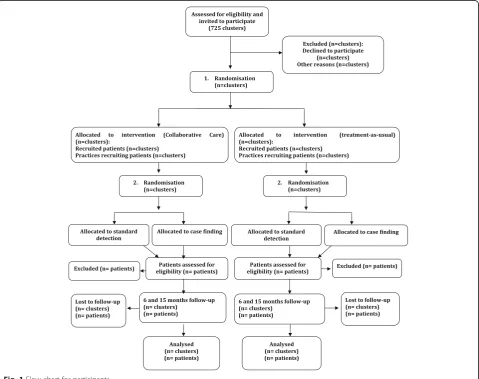
they usually did. In case-finding the GPs were asked to systematically use the MDI as a screening tool if they suspected depression. See Fig. 1 for an illustration of the randomisation process.
Individual level
Patients within the clusters are allocated to the same group as their GP. The GPs enrolled in the study detect patients with depression according to randomisation al-location. Only patients who meet the criteria for depres-sion at baseline are included in the depresdepres-sion study. Patients who have not initially been diagnosed with de-pression by the GP and have only been referred to the detection of depression study, and are subsequently di-agnosed with depression through the Mini International Neuropsychiatric Interview (MINI), are asked to partici-pate in the treatment outcome study if the GP agrees with the diagnosis.
The GP obtains verbal consent from the patient that a research assistant can make contact by telephone in
order to conduct a diagnostic interview (MINI interview). If the diagnosis according to the MINI interview is incon-sistent with the GP’s diagnosis, the research assistant con-sults a psychiatrist in the Collabri group, who contacts the GP to confirm which diagnosis is correct. Patient recruit-ment was initiated in November 2014 and ended on 31 December 2016.
Blinding
It is not possible to ensure blinding of the patient and GP, but the blinding of GP allocation to intervention group is maintained for researchers in the data collec-tion phase and in the analysis phase. The intervencollec-tion groups are coded and anonymised (e.g. X and Y) so that researchers are blinded in the entire phase of the ana-lysis and when writing the conclusion. In the detection of depression study, blinding of the patient diagnosis and the MDI result is maintained for the researchers during the MINI interview, in order to ensure that the
[image:4.595.59.539.343.722.2]evaluation of diagnosis is not affected by the GP’s refer-ral diagnosis.
Care managers, GPs, psychiatrists, and patients are no-tified that they cannot reveal to the researchers to which group the patients are allocated. If the blinding is broken and referral diagnosis, or baseline or outcome measures are revealed at the baseline interview or at the follow-up interview, the patient is referred to another blinded researcher.
The experimental intervention - treatment according to the Collabri model
Four criteria for CC are listed in the Cochrane review [9]: a multi-professional approach to treatment, sched-uled monitoring and review, enhanced inter-professional communication, and a structured treatment plan. Partic-ipants in the intervention group are treated according to the Collabri model, based on the four criteria listed in the Cochrane review [9] and on the recommendations from a systematic literature reveiw by Eplov et al. [8], and adapted to the Danish health care system by includ-ing collaboration with relevant social worker(s) in the municipality and integrating the existing psychologist scheme. On the basis of these and on current guidelines [1, 22–25], the following elements were integrated into the Collabri model: recruitment of staff with mental health care experience, training of GP and care manager, use of instruments for detection and follow up, educa-tion and treatment of the patient, supervision from a psychiatric specialist, and a stepped-care approach to treatment where treatment is always commenced on the least invasive and least resource-demanding level. These elements will be described in detail.
The Collabri model is based on a multi-professional approach to treatment. Treatment is provided by care managers, GPs and psychiatrists, all of whom receive a short training following their recruitment. The care manager has a medium-long health professional educa-tion, is often a nurse, and has experience in working in mental health together with a certified CBT course (of minimum 1 year). The care manager provides assessment of side effects due to medical treatment, CBT, supportive conversations, diagnosis-specific treatment, psychoeduca-tion and regular contact with social worker(s). The GP has overall responsibility for treatment and takes care of the diagnostic procedure, initiation of treatment, coordination of the treatment intervention with the care manager, supervision of the care manager, and collaboration with the care manager on contact with social caseworker(s). The psychiatrist guides and supervises the care manager and GP and participates in joint consultations with the GP.
According to the Collabri model, the patient is regularly monitored and assessed at scheduled patient follow-up
visits. Monitoring consists of assessments at intervals de-termined by the severity of depression or anxiety - at least every 2 weeks, more frequently on signs of significant change in the condition and at least once per week when stepping up medication. Review will take place at least once a month and always at the end of a treatment component.
The Collabri model includes enhanced inter-professional communication where the care manager and the GP meet at minimum weekly and discuss patients. In addition, the psychiatrist supervises the care managers in groups twice a month, and the GPs in groups once a month. Furthermore, the psychiatrist supervises the care managers and GPs individually when needed.
The psychiatrist, GP, and care manager may have joint consultations if needed. Communication between pro-fessionals can take place via video conferences if it is not possible to meet in person; however, the weekly commu-nication between the care manager and GP must be face to face.
The CC treatment for depression and anxiety takes place according to treatment guidelines established on the basis of the Danish Health Authority’s reference programme for unipolar depression in adults [1], The Danish College of General Practitioners’ guideline for unipolar depression [22], the Danish Health Authority’s reference programme for anxiety disorders [24] and The Danish College of General Practitioners’clinical guide-line for anxiety disorders [25].
The Collabri model also focuses on the principles of a stepped-care approach to treatment, active and planned follow up, patient involvement and influence on treat-ment, involvement of carers, and self-management.
The specific treatment modalities in the Collabri model are medical treatment in accordance with treat-ment plans in Collabri, psychotherapy in the form of CBT by a care manager in accordance with treatment plans in Collabri, psychoeducation in groups in the form of the course “Lær at takle angst og depression” (“Learn to cope with anxiety and depression”), based on the Chronic Disease Management Program (http:// patienteducation.stanford.edu/programs/cdsmp.html) or individual psychoeducation carried out by the care manager or psychoeducation as a part of CBT. All pa-tients and carers are offered written psychoeducational material.
Fidelity
plan is developed if needed in order to improve the im-plementation. The fidelity scale is available through the corresponding author.
The control intervention - treatment as usual group
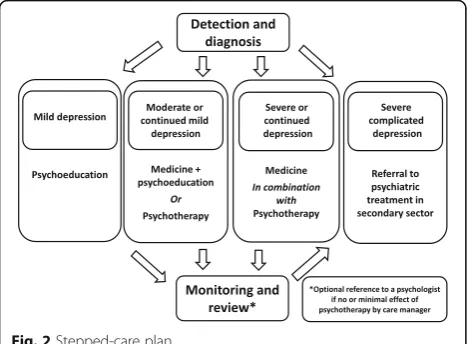
GPs in the treatment as usual group treat the participat-ing patients as they normally do. The treatment is based on clinical guidelines from The National Board of Health and The Danish College of General Practice, including recommendations on detection, diagnosis, treatment, and referral [23]. The guidelines recommend screening for depression in risk groups, use of screening tools, e.g. the World Health Organization (WHO)-5 Well-being Index (WHO-5) or use of two screening questions, diag-nosis according to the ICD-10, and treatment according to a stepped-care model with the following treatment el-ements: psychotherapy (for mild to moderate depres-sion) and medical treatment (for moderate depression not responding to therapy and for severe depression) (see Fig. 2). The guidelines also recommend, in some cases, admission to an inpatient ward or referral to or advice from a psychiatrist, community mental health centre, or a psychologist.
Assessments and outcome measures Baseline eligibility interview
The GP assesses referral diagnosis and comorbidity at recruitment and refers the participant to the study. At baseline, the participants are interviewed by telephone in order to assess the inclusion and exclusion criteria and confirm the diagnosis on the basis of a modified version of the MINI [26], including ICD-10-specific questions for the inclusion diagnosis.
Outcome measures in the treatment outcome study
The primary outcome for the treatment outcome study is self-reported degree of depression measured by the Beck Depression Inventory (BDI-II) [27] at 6 months.
BDI-II is a 21-item multiple-choice questionnaire asses-sing degree of depression and changes in depression mode by measuring symptoms of depression during the last 14 days. Each item has four statements reflecting in-crease in symptom severity from scores 0 to 3. The total score ranges from 0 to 63.
Secondary outcomes for the treatment outcome study are self-reported degree of depression measured by the BDI-II [27] at 15 months, self-reported degree of anxiety measured by the Beck Anxiety Inventory (BAI) [28] at 6 months, functional impairment measured with the Global Assessment of Functioning (GAF-F, split version) [29] obtained through a semi-structured interview with a research assistant, and self-reported psychological stress measured with the Symptom Checklist (SCL-90-R) [30] at 6 and 15 months.
The BAI is a 21-item multiple-choice questionnaire assessing physiological anxiety symptoms. Each item has four statements scoring 0 to 3, reflecting increase in the degree to which the participant has been bothered with the symptom over the last week. The total score ranges from 0 to 63. The GAF-F measures the participants’ level of functioning over the past month on a continu-ous scale ranging from 0 to 100. The SCL-90-R is a multi-dimensional questionnaire assessing mental health problems and psychopathological symptoms on a con-tinuous scale from the lowest functional level of 0 to the highest functional level of 100. It consists of 90 items, each item graded on a scale of 0–4, based on the extent to which the participant has experienced the symptom within the past week. The questionnaire measures nine primary dimensions of symptoms and can be summed in the global severity index (GSI), measuring overall psy-chological distress.
Explorative outcomes for the treatment outcome study are self-reported degree of anxiety measured by the BAI [28] at 15 months, self-reported quality of life measured with the WHO-5 [31], psychosocial functioning mea-sured with the Personal and Social Performance Scale (PSP) [32], obtained through semi-structured interview with a research assistant, self-reported side effects mea-sured by the Patient-Rated Inventory of Side Effects (PRISE) [33], self-reported health-related quality of life measured with the EuroQol Five Dimensions Question-naire with Three Levels (EQ-5D-3 L) [34], self-reported functional impairment measured with the Sheehan Disabil-ity Scale (SDS) [35], self-reported self-efficacy measured with the Illness Perception Questionnaire Revised (IPQ-R) [36] and two subscale questions from the Chronic Disease Self-efficacy Scales (SECD-32) [37], self-reported recovery measured with INSPIRE [38], self-reported general satisfac-tion with the treatment measured with the Client Satisfac-tion QuesSatisfac-tionnaire-8 (CSQ-8) [39], and apathia measured by a research assistant with the Diagnostic Apathia Scale
[image:6.595.57.291.552.724.2][40], a 6-item rating scale covering neuropsychological symptoms. The number of sick leave days, and information on employment and the use of social services will be ob-tained from the Danish Register for Evaluation of Marginalization (DREAM) database [41]. The DREAM database contains information on all Danish transfer pay-ments on a weekly basis. Medication use will be obtained from the Danish National Prescription Registry [42], con-taining detailed information on prescriptions dispensed in Denmark. Demographic data will be obtained from Statis-tics Denmark [43], covering statisStatis-tics on Danish society, and the National Prescription Registry [42].
The WHO-5 is a 5-item questionnaire measuring mental health within the last 2 weeks. Each item is rated on a Likert scale from 0 (not present) to 5 (constantly present). The score from 0 to 25 is transformed into a scale from 0 to 100, where higher scores mean better well-being. The PSP is a 100-item scale measuring per-sonal and social functional level within the last month. The score is based on the assessment of performance within 4 domains: (1) socially useful activities, (2) per-sonal and social relationships, (3) self-care, and (4) dis-turbing and aggressive behaviours. Higher scores mean better functional level. PRISE is a questionnaire used to identify and evaluate the tolerability of side effects within 9 domains. The EQ-5D-3 L measures health sta-tus within 5 domains: (1) mobility, (2) self-care, (3) usual activities, (4) pain and discomfort, and (5) anxiety and depression. The participants self-rate their level of sever-ity on a 3-level scale and mark their health status on a visual analogue scale from 0 (worst imaginable health status) to 100 (best imaginable health status). The SDS is a self-report tool measuring functional impairment in 3 domains: (1) work and school, (2) social life, and (3) family life. Symptoms are rated on a visual analogue scale and can be translated into a single dimensional measure of global functional impairment, ranging from 0 (unimpaired) to 30 (highly impaired). The subscales from the SECD-32 measure self-efficacy. The partici-pants rate how confident they are in doing certain activ-ities. Each item is rated on a 10-point Likert scale from 1 (not at all confident) to 10 (very confident). The IN-SPIRE questionnaire assesses the participant’s feeling of being supported in their recovery by their health care provider (the GP and possibly the care manager). The first 20-item part covers support from the therapist and the second 7-item part covers the relationship with the therapist. The IPQ-R subscale on personal control mea-sures confidence in one’s own ability to influence dis-ease. Each of the 6 items is self-rated on a 5-point Likert scale from 1 (very disagree) to 5 (strongly agree). The CSQ-8 is an 8-item questionnaire that measures general satisfaction with the treatment. Each item is rated on a scale from 0 to 4.
At baseline the following will also be registered: somatic comorbidity reported by the GP at the point of referral, and personality disorder measured by the Standardized Assessment of Personality: Abbreviated Scale (SAPAS) [44], an 8-item screening interview.
Safety measures
Self-reported anxiety and depression symptoms are mea-sured by the BAI and BDI-II. Suicidal ideation is evalu-ated in the MINI interview. Data on death are obtained from the Danish Cause of Death Register [45]. The num-ber of outpatient services, admissions, inpatient days, and life-threatening conditions for reasons other than suicide attempts are obtained from the Danish National Patient Registry (Landspatientregistret) [3] containing data on Danish patients’ contacts with hospitals in Denmark. Numbers of sick leave days are obtained from the DREAM database.
Outcome measures in the detection of depression study The primary outcome for the detection of depression study is the positive predictive value of referral diagnosis in two randomised detection settings: case-finding and standard detection. In the standard detection group, based on results from the referral diagnosis performed by the GP and the MINI carried out by the research assistant, the positive predictive value of the GP’s diagnosis is calcu-lated. In the case-finding group, based on results from the MDI and MINI, the positive predictive value of the diag-nosis and the sensitivity, specificit, and negative predictive value of the diagnosis are calculated.
Data collection
Training and inter-rater reliability
All assessors have received the necessary training in the relevant instruments and receive ongoing support and supervision. All assessors have participated in regular joint ratings for PSP and GAF, in order to ensure inter-rater reliability. All cases of discrepancy between the re-ferral diagnosis and a diagnosis made at the inclusion
interview via the MINI interview will be discussed with the psychiatrist and the referring GP.
Power and sample size
[image:8.595.56.540.101.597.2]We made two sample size calculations, one for the depres-sion treatment outcome study and one for the detection of depression study to see how many people to include in the
Table 1Schedule of enrolment, interventions and assessments Study period
Recruitment Baseline Post-baseline Source of data collection
Timepoint Treatment
period
Follow up, 6 months
Follow up, 15 months Enrolment Referral diagnosis, information and
informed consent
x GP
Assessment of somatic comorbidity x GP
Eligibility interview (including MINI) x Interview
Standardized Assessment of Personality, Abbreviated Scale
x Interview
Suicidal ideation x Interview
Interventions Collaborative care x
Treatment as usual x
Assessments Beck Depression Inventory-II x x x Self-report
Beck Anxiety Inventory x x x Self-report
Global Assessment of Functioning x x x Self-report
Symptom Checklist-90-Revised x x x Interview
World Health Organization-5 x x x Self-report
Personal and Social Performance Scale x x x Interview
Patient-Rated Inventory of Side Effects x x x Self-report
EuroQol Five-Dimension Questionnaire with Three Levels
x x x Self-report
Sheehan Disability Scale x x x Self-report
Subscale from Illness Perception Questionnaire Revised scale
x x x Self-report
Chronic Disease Self-efficacy Scales-32 x x x Self-report
INSPIRE x Self-report
Client Satisfaction Questionnaire-8 + project-specific questions
x Self-report
The Diagnostic Apathia Scale x x x Interview
Sick leave x x x Register
Medication use x x x Register
Death x x x Register
Life-threatening conditions x x x Register
Outpatient services, admissions and inpatient days
x x x Register
Use of social services x x x Register
Intervention-specific services and treatment x Care managers and
psychiatrists
depression treatment outcome study with the embedded detection of depression study
Sample-size calculation for the depression treatment outcome study
The primary outcome is a change in the BDI-II summary score. Clinical relevant treatment response at group level is defined as a difference in the degree of depression by 4 points measured by the BDI-II [46, 47]. No surveys have been carried out in Denmark that can contribute to the estimation of the standard deviation (SD) for BDI-II. However, according to international surveys, the SD for BDI-II can be set at 11 [46, 48–50]. There is no knowledge of the size of the intra-class correlation (ICC) in a Danish context; however a review of ICCs in depression in pri-mary care suggests that the ICC can be set at 0.04 [51].
The sample-size calculation for the depression study based on the aforementioned figures shows that 328 par-ticipants with depression should be included in order to be able to reject the null hypothesis in the depression study. According to the null hypothesis, participants in the intervention group and the control group improve similarly in terms of symptoms with a power of 0.8 and a significance level of 0.05.
Sample size calculation for the detection of depression study On the basis of a study carried out by Michell et al. [13], the positive predictive value of standard detection is esti-mated to be 45%. A clinical meaningful and possible [52] increase in the number is estimated to be up to detection of 60%. With the detection of depression study embedded in the depression study, the sample size calculation shows that 480 individuals should be included in order to be able to reject the null hypothesis in the depression study. Ac-cording to the null hypothesis, participants in the inter-vention group and the control group improve similarly in terms of symptoms, with a power of 0.8 and a significance level of 0.05.
Summary
In all, 480 individuals should be included in the Collabri treatment for depression outcome study with the em-bedded detection of depression study in order to reject the null hypothesis.
Secondary outcomes
[image:9.595.61.538.659.714.2]The power for the secondary outcomes for depression is estimated to be over 0.8 for all analyses [53–55]. See Table 2.
Feasibility
By including 48 GPs, the GPs must each include 10-11 people with depression in the depression treatment out-come study with the embedded detection of depression study over a 15-month period. This is possible as 12 months prevalence rates indicate that a GP with 1600 registered patients on average will see 140 patients with depression per year [2].
Eight full-time care managers and one and a half psy-chiatrists (one full-time and one part-time) are employed in the Collabri project. Each care manager has a maximum caseload of 100 participants per year. Thus, it is realistic in terms of the capacity of care managers to complete the intervention in 240 participants with depression.
Statistical analysis
The Collabri study will be conducted according to the statistical principle “intention-to-treat”[56], which means that once a person is included in the project, he or she stays in the study population and is followed, regardless of whether the person is later excluded. In the detection of depression study the positive predictive value will be cal-culated and compared for both groups. Subgroup analysis will be performed in patients with a medical comorbidity and a personality disorder.
Linear mixed-effects regression models will be used to compensate for the cluster randomisation and potential confounders. To account for repeated measures, multi-level regression models with random effects will be used, estimated using an unstructured covariance matrix if possible. If not possible, other covariance matrices such as independent, interchangeable, auto-regressive, and Toeplitz will be estimated, and the best-fitting structure selected based on Bayes’ information criterion. This makes it possible to take “missing at follow up” into ac-count under the assumption of “missing at random” by including covariates that are associated with missing values at follow up. The analysis levels are by GP, pa-tients, and time. This method introduces less bias than the method whereby the last observation is used instead of the missing values, and the method whereby only
Table 2Power calculation for the secondary outcomes
Secondary outcome Mean difference (MD) Standard deviation (SD) of the pooled mean Type 1 error Calculated power
BAI 4 (57) 12 (57) 5% 99%
GAF-F 5 (*) 10 (56) 5% 99%
SCL-90-R 23 (55) 50 (55) 5% 99%
cases with complete follow-up information are eligible for the analysis.
Project organisation
The project is led by a steering group. The aim of the steering group is to ensure the progress of the research project. A lead project manager ensures the general management of the project together with a project man-ager in charge of implementation of the intervention and a project manager in charge of the research project. Administrative staff support the project managers. Data collection and analysis are carried out by Ph.D. students and research assistants.
Discussion
The Collabri model is based on the evidence supporting CC in other countries. To our knowledge this is the first randomised trial investigating the effect of a CC model for depression in a Scandinavian context. The strength of the outcome study is the centralised computer-based cluster randomization, which ensures adequate generation of the allocation sequence and adequate allocation con-cealment. The use of blinded outcome assessors for the secondary outcome, the fact that it is a register-based out-come, and the use of intention-to-treat analysis decreases the risk of biased effect estimates. The strength of the detection of depression study is also the centralised computer-based cluster randomisation and the use of blinded assessors of the outcomes. The trial is registered at http://www.clinicaltrials.gov, which helps prevent se-lective and incomplete outcome reporting. The fact that we monitor fidelity to the Collabri model after 6 months is also a strength of the trial. This is intended to ensure that care managers, psychiatrists, and GPs are true to the model. A limitation of this trial is that we are not able to blind participants, care managers, psychiatrists, or GPs to the allocation. Another limitation is that the primary out-come is self-reported and therefore not blinded, which may well lead to overestimation of treatment effects. Some might argue that it is difficult to sustain the blinding of the assessor during follow up, and this certainly leads to risk of bias. Should blinding be broken, a second assessor will complete the follow-up interview.
Although participants are recruited from general prac-tices throughout the Capital Region of Denmark, and should be fairly representative of the population in the region, there may be reduced external validity. As it is the GP who identifies eligible participants, not every-body with depression who is eligible may be asked to participate, as patients are not systematically screened for eligibility. Due to differences in healthcare systems, the results may not be directly comparable with other countries, but together with other trials in the area, it
will give a more complete picture of the effects of collab-orative care in people with depression.
The results of this trial will add to the knowledge of col-laborative care for depression in a Scandinavian context. If the Collabri model is shown to be more effective than treat-ment as usual in general practice, the results can contribute to improving the care and treatment for patients with de-pression in general practice with benefits to both patients and society. The results of the detection of depression study add to the knowledge of detection of depression in primary care. If case-finding is shown to be superior to standard de-tection, it will be recommended as a detection method in future treatment according to the Collabri model.
Trial status
Recruitment of participants within the clusters is ongoing and continued until the 31 December 2016.
Additional file
Additional file 1:SPIRIT 2013 checklist: recommended items to address in a clinical trial protocol and related documents*. (DOC 124 kb)
Abbreviations
BAI:Beck Anxiety Inventory; BDI-II: Beck Depression Inventory; CBT: Cognitive behavioural therapy; CC: Collaborative care; CSQ-8: Client Satisfaction Questionnaire; DREAM: Danish Register for Evaluation of Marginalisation; EQ-5D-3L: EuroQol Five Dimensions Questionnaire with Three Levels; GAF-F: Global Assessment of Functioning; GP: General practitioner; HADS: Hospital anxiety and depression scale; ICC: intra-class correlation; IPQ-R: Illness Perception Questionnaire Revised; MINI: Mini International Neuropsychiatric Interview; PRISE: Patient Rated Inventory of Side Effects; PSP: Personal and Social Performance Scale; RCT: Randomised controlled trial; SAPAS: Standardized Assessment of Personality, Abbreviated Scale; SCL-90-R: Symptom Checklist-90-Revised; SDS: Sheehan Disability Scale; SECD-32: Chronic Disease Self-efficacy Scales; SPS: Personal and Social Performance Scale; WHO-5: World Health Organization-5 Well-being Index
Acknowledgements
We acknowledge Rie Poulsen for excellent assistance in planning and design and Lone Tonsgaard for English revision of the manuscript.
Funding
The Collabri project is financed by a grant from the Danish Ministry of Health “Pulje til styrket samarbejde mellem behandlingspsykiatrien og almen praksis (shared care)”, reference number 65401. No sponsors will have any role in the trial design or on the collection, analysis, interpretation or publication of data from the study.
Availability of data and materials Not applicable.
Authors’contributions
Ethical approval and consent to participate
The trial will be conducted in compliance with the Helsinki Declarations, the Collabri study protocol, and good clinical practice and guidelines, and will follow the rules for informed consent. No substantial deviation from the protocol will be implemented without prior review and approval of the regulatory authorities. Personally identifiable information collected in the study is treated according to the Danish Law on Personal Information (Lov om behandling af personoplysninger). Data are stored and kept confidential in secure cupboards and electronic data are stored in entry-restricted files. The study is also carried out in accordance with the applicable guidelines for social science research ethics. When communicating the results, participants and clinics will be anonymised. For every patient there is a case record form (CRF) marked with an identification number. Data on each patient are kept there. An identification list with the civil registration number (cpr. number) and case record numbers is stored in an entry-restricted folder on an internal electronic drive, separately from other patient-related material. The participants’ consent is voluntary and informed, and given both verbally and in writing. Previous international experience does not indicate that the intervention provided by the Collabri model is associated with side effects for the patients. In order to minimize the possible risks of discomfort, the research interviews are conducted in a flexible manner and interspersed with breaks if necessary. The extent of the interviews is a maximum of 2 hours and questionnaires take a maximum of an hour to complete. It is possible to fill out questionnaires in stages. If the participants experience the interview as stressful or uncomfortable, the interview can be conducted in stages or the participants can without further ado leave the trial, without it affecting their possibility of receiving current or future treatment. Prior to commencement, the project has been approved by the Regional Ethics Committees of the Capital Region of Denmark (identification no: H-3-2013-203) and approved by the Danish Data Protection Agency (ID number: 2007-58-0015, local journal no: RHP-2014-012) and by DSAMs Multi Practices Committee (ID number MPU 29-2013) and registered on ClinicalTrials.gov., identifier: NCT02678845. Results will be published in international journals. A Standard Protocol Items: Recommendations for Interventional Trials (SPIRIT) checklist is available in Additional file 1.
Consent for publication Not applicable.
Competing interests
The authors declare that they have no competing interests.
Publisher’s Note
Springer Nature remains neutral with regard to jurisdictional claims in published maps and institutional affiliations.
Author details
1Mental Health Center Copenhagen, Mental Health Services, Kildegårdsvej 28,
DK- 2900 Hellerup, Capital Region of Denmark, Denmark.2The Research Unit for General Practice and Section of General Practice, University of
Copenhagen, Øster Farimagsgade 5, Postboks 2099, 1014 Copenhagen K, Denmark.3General Practitioner in Copenhagen, Copenhagen, Denmark. 4
Department of Public Health, Aarhus University, Aarhus, Denmark.5Mental Health Center Frederiksberg, Mental Health Services, Nordre Fasanvej 57-59, 2000 Frederiksberg, Capital Region of Denmark, Denmark.6Stolpegård Psychotherapy Center, Mental Health Services, Stolpegårdsvej 20, 2820 Gentofte, Capital Region of Denmark, Denmark.7Mental Health Center North Zealand, Mental Health Services, Dyrehavevej 48, 3400 Hillerød, Capital Region of Denmark, Denmark.8Research Unit for General Practice, Institute of Public Health, Aarhus University, Bartholins Allé 2, 8000 Aarhus C, Denmark.
9
Institute for Clinical Medicine, University of Copenhagen, Mental Health Center Copenhagen, Mental Health Services, Kildegårdsvej 28, DK-2900 Hellerup, Capital Region of Denmark, Denmark.
Received: 26 December 2016 Accepted: 24 June 2017
References
1. Sundhedsstyrelsen. Referenceprogram for unipolar depression hos voksne. (The Danish Health Authority. Reference program for unipolar depression in adults 2007). Copenhagen: Sundhedsstyrelsen; 2007. Danish.
2. Olsen LR, Mortensen EL, Bech P. Prevalence of major depression and stress indicators in the Danish general population. Acta Psychiatr Scand. 2004;109:96–103. Danish.
3. Lynge E, Sandegaard JL, Rebolj M. The Danish National Patient Register. Scand J Public Health. 2011;39(7 Suppl):30–3. Danish.
4. Flachs E, Eriksen L, Koch M, Ryd J, Dibba E, Skov-Ettrup L, Juel K. The Disease Burden in Denmark - Diseases [Sygdomsbyrden I Danmark - Sygdomme]. National Institute of Public Health, University of Southern Denmark [Statens Institut for Folkesundhed, Syddansk Universitet]. 2015. https://
sundhedsstyrelsen.dk/da/sygdom-og-behandling/~/media/ 00C6825B11BD46F9B064536C6E7DFBA0.ashx. Accessed 31 Oct 2016. 5. Improved patient courses for patients with non-psychotic psychiatric disorders
[Bedre patientforløb for patienter med psykiske lidelser af ikke- psykotisk karakter]. The Danish College of Psychiatrists and The Danish College of General Practitioners [Dansk Psykiatrisk Selskab og Dansk Selskab for Almen Medicin]. 2004. http://dpsnet.dk/wp-content/uploads/2015/01/2004-11-10-rapport_ bedreptforlob.pdf. Accessed 31 Oct 2016.
6. Hauge-Helgestad A, Schlepern Johansen K, Hansen J. Behandling af mennesker med angst og depression. Kortlægning af behandlingsfelt og diskussion af perspektiverne ved indførelse af collaborative care. (Treatment of people with anxiety and depression. Mapping of efficacy and the discussion of the prospects of introducing collaborative care). København: Dansk Sundhedsinstitut; 2012. Danish
7. Søgaard J. Prevention of mental disorders - an economic perspective [Forebyggelse af psykiske sygdomme–et økonomisk perspektiv]. In: Jørgensen P, Nordentoft M, Videbech P, editors. Prevention of Mental Disorders [Forebyggelse af psykiske sygdomme]. Copenhagen: Munksgaard; 2010. p. 173–86.
8. Eplov LF, Lundsteen M, Birket-Smith M. Shared Care for ikke-psykotiske sygdomme. Anbefalinger på baggrund af en systematisk litteraturundersøgelse. (Shared Care for non-psychotic diseases. Recommendations based on a systematic literature review). Copenhagen: Danske Regioner; 2009. Danish. 9. Archer J, Bower P, Gilbody S, Lovell K, Richards D, Gask L, Dickens C,
Coventry P. Collaborative care for depression and anxiety problems. Cochrane Database Syst Rev. 2012;14, CD006525. doi:10.1002/14651858.CD006525.pub2. 10. Rotwell P. External validity of randomised controlled trials:“To whom do the
results of this trial apply?”. Lancet. 2005;365:82–93.
11. Bower P, Gilbody S, Richards D, Fletcher J, Sutton A. Collaborative care for depression in primary care. Making sense of a complex intervention: systematic review and meta-regression. Br J Psychiatry. 2006;189:484–93. 12. Gilbody S, House A, Sheldon T. Screening and case finding instruments for
depression. Cochrane Database Syst Rev. 2005;4, CD002792. doi:10.1002/ 14651858.CD002792.pub2.
13. Mitchell AJ, Vaze A, Rao S. Clinical diagnosis of depression in primary care: a meta-analysis. Lancet. 2009;374:609–19.
14. Siu AL, the US Preventive Services Task Force (USPSTF). Screening for depression in adults. US Preventive Services Task Force recommendation statement. JAMA. 2016;315(4):380–7.
15. Goodyear-Smith F, Van Driel M, Arroll B, Del Mar C. Analysis of decisions made in meta-analyses of depression screening and the risk of confirmation bias: a case study. BMC Med Res Methodol. 2012;12:76.
16. Romera I, Montejo ÁL, Aragonés E, Arbesú JÁ, Iglesias-García C, López S, Lozano JA, Pamulapati S, Yruretagoyena B, Gilaberte I. Systematic depression screening in high-risk patients attending primary care: a pragmatic cluster-randomized trial. BMC Psychiatry. 2013;13:83.
17. Baas KD, Wittkampf KA, van Weert HC, Lucassen P, Huyser J, van den Hoogen H, van de Lisdonk E, Bindels PE, Bockting CL, Ruhé HG, Schene H. Screening for depression in high-risk groups: prospective cohort study in general practice. BJP. 2009;194:399–403.
18. Christensen KS, Sokolowski I, Olesen F. Case-finding and risk-group screening for depression in primary care. Scand J Prim Health Care. 2011;29:80–4. 19. Bertelsen A. WHO ICD-10 - Mental and Behavioural Disorders - Classification
and Diagnostic Criteria [WHO ICD-10 - Psykiske Lidelser Og
Adfærdsmæssige Forstyrrelser - Klassifikation Og Diagnostiske Kriterier]. 1st edition. Gyldendal Akademisk; 2000.
20. Wing JK, Babor T, Brugha T, Burke J, Cooper JE, Giel R, et al. SCAN. Schedules for clinical assessment in neuropsychiatry. Arch Gen Psychiatry. 1990;47:589–93. 21. Bech P, Rasmussen NA, Olsen LR, Noerholm V, Abildgaard W. The sensitivity
and specificity of the major depression inventory, using the present state examination as the index of diagnostic validity. J Affect Disord. 2001;66:159–64. 22. Dansk Selskab for Almen Medicin. Unipolar depression. Diagnostik og
Practitioners. Unipolar depression. Diagnosis and treatment. Clinical guidelines for general practice). København: Dansk Selskab for Almen Medicin; 2010. Danish.
23. National Institute for Health and Clinical Excellence. Depression. The treatment and management of depression in adults. NICE clinical guideline 90. London: National Institute for Health and Clinical Excellence; 2009. 24. Sundhedsstyrelsen. Referenceprogram for angstlidelser hos voksne. (The
Danish Health Authority. Reference program for anxiety disorders in adults). Copenhagen: Sundhedsstyrelsen; 2007. Danish.
25. Dansk Selskab for Almen Medicin. Angsttilstande. Diagnostik og behandling. Klinisk vejledning for almen praksis. København: Dansk Selskab for Almen Medicin; 2010. Danish.
26. Sheehan DV, Lecrubier Y, Harnett-Sheehan K, Janavs J, Weiler E, Bonora LI, Keskinen A, Schinka J, Knapp E, Sheehan MF, Dunbar GC. Reliability and validity of the MINI International Neuropsychiatric Interview (MINI): according to the SCID-P. Eur Psychiatr. 1997;12:232–41.
27. Beck AT, Ward CH, Mendelson M, Mock J, Erbaugh J. An inventory for measuring depression. Arch Gen Psychiatry. 1961;4:561–71.
28. Osman A, Hoffman J, Barrios FX, Kopper BA, Breitenstein JL, Hahn SK. Factor structure, reliability, and validity of the Beck Anxiety Inventory in adolescent psychiatric inpatients. J Clin Psychol. 2002;58:443–56.
29. Pedersen G, Hagtvet KA, Karterud S. Generalizability studies of the Global Assessment of Functioning-Split version. Compr Psychiatry. 2007;48:88–94. 30. Olsen LR, Mortensen EL, Bech P. The SCL-90 and SCL-90R versions validated
by item response models in a Danish community sample. Acta Psychiatr Scand. 2004;110(3):225–9.
31. Bech P. Measuring the dimensions of psychological general well-being by the WHO-5. QoL Newsletter. 2004;32:15–6.
32. Morosini PL, Magliano L, Brambilla L, Ugolini S, Pioli R. Development, reliability and acceptability of a new version of the DSM-IV Social and Occupational Functioning Assessment Scale (SOFAS) to assess routine social functioning. Acta Psychiatr Scand. 2000;101:323–9.
33. Katz AJ, Dusetzina SB, Farley JF, Ellis AR, Gaynes BN, Castillo WC, Stürmer T, Hansen RA. Distressing adverse events after antidepressant switch in the Sequenced Treatment Alternatives to Relieve Depression (STAR*D) trial: influence of adverse events during initial treatment with citalopram on development of subsequent adverse events with an alternative antidepressant. Pharmacotherapy. 2012;32:234–43.
34. Rabin R, De Charro F. EQ-5D: a measure of health status from the EuroQol Group. Ann Med. 2001;33:337–43.
35. Sheehan DV, Harnett-Sheehan K, Raj BA. The measurement of disability. Int Clin Psy-chopharmacology. 1996;11 suppl 3:89–95.
36. Moss-Morris R, Weinman J, Petrie K, Horne R, Cameron L, Buick D. The Revised Illness Perception Questionnaire (IPQ-R). Psychol Health. 2002;17:1–16. 37. Lorig K, Stewart A, Ritter P, González V, Laurent D, Lynch J. Outcome
measures for health education and other health care interventions. Thousand Oaks CA: Sage Publications; 1996.
38. Williams J, Leamy M, Bird V, Le C, Sam B, Francesca N. Development and evaluation of the 851 INSPIRE measure of staff support for personal recovery. Soc Psychiatry Psychiatr Epidemiol. 852 2014; doi:10.1007/s00127-014-0983-0.
39. Larsen DL, Attkisson CC, Hargreaves WA, Nguyen TD. Assessment of client/ patient satisfaction: development of a general scale. Eval Program Plann. 1979;2:197–207.
40. Hellström L, Eplov LF, Nordentoft M, Ostergaard SD, Bech P. The Diagnostic Apathia Scale predicts the ability to return to work following depression or anxiety. Acta Neuropsychiatr. 2014;26:364–71.
41. The National Labour Market Authority in Denmark. The DREAM database. http://www.dst.dk/da/TilSalg/Forskningsservice/Data/Andre_Styrelser.aspx . Accessed 31 Oct 2016.
42. Kildemoes HW, Sorensen HT, Hallas J. The Danish National Prescription Registry. Scand J Public Heal. 2011;39(7 Suppl):38–41.
43. Statistics Denmark (www.dst.dk/en).
44. Hesse M, Moran P. Screening for personality disorder with the Standardised Assessment of Personality: Abbreviated Scale (SAPAS): further evidence of concurrent validity. BMC Psychiatry. 2010;10:10.
45. Helweg-Larsen K. The Danish Register of Causes of Death. Scand J Public Health. 2011;39(7 Suppl):26–9.
46. Swindle RW, Rao JK, Helmy A, et al. Integrating clinical nurse specialists into the treatment of primary care patients with depression. Int J Psychiatry Med. 2003;33:17–37.
47. Buszewicz M, Griffin M, McMahon EM, Beecham J, King M. Evaluation of a system of structured, pro-active care for chronic depression in primary care: a randomised controlled trial. BMC Psychiatry. 2010;10:61.
48. Mann AH, Blizard R, Murray J, et al. An evaluation of practice nurses working with general practitioners to treat people with depression. Br J Gen Pract. 1998;48:875–9.
49. McMahon L, Foran KM, Forrest SD, et al. Graduate mental health worker case management of depression in UK primary care: a pilot study. Br J Gen Pract. 2007;57:880–5.
50. König H-H, Born A, Heider D, et al. Cost-effectiveness of a primary care model for anxiety disorders. Br J Psychiatry. 2009;195:308–17. 51. Adams G, Gulliford M, Ukoumunne O, Eldridge S, Chinn S, Campbell M.
Patterns of intracluster correlation from primary care research to inform study design and analysis. J Clin Epidemiol. 2004;57:785–94.
52. Von Korff M, Goldberg D. Improving outcomes in depression. Br Med J. 2001;323:948–9.
53. Stant D, Ten Vergert EM, den Boer PCAM, Wiersma D. Cost-effectiveness of cognitive self-therapy in patients with depression and anxiety disorders. Acta Psychiatr Scand. 2008;117(1):57–66.
54. Lorentzen S, Ruud T, Fjeldstad A, Høglend P. Comparison of short- and long-term dynamic group psychotherapy: randomised clinical trial. Br J Psychiatry. 2013;203(3):280–7.
55. Muntingh ADT, van der Feltz-Cornelis CM, van Marwijk HWJ, et al. Collaborative stepped care for anxiety disorders in primary care: aims and design of a randomized controlled trial. BMC Health Serv Res. 2009;9:159. 56. Porta N, Bonet C, Cobo E. Discordance between reported intention-to-treat
and per protocol analyses. J Clin Epidemiol. 2007;60:663–9.
• We accept pre-submission inquiries
• Our selector tool helps you to find the most relevant journal
• We provide round the clock customer support
• Convenient online submission
• Thorough peer review
• Inclusion in PubMed and all major indexing services • Maximum visibility for your research
Submit your manuscript at www.biomedcentral.com/submit