ISSN: 1992-8645 www.jatit.org E-ISSN: 1817-3195
ON A METHOD OF FORMATION OF SIGNALS WITH HIGH
SPECTRAL EFFICIENCY FOR COGNITIVE RADIO
COMMUNICATION SYSTEM
DMITRY IGOREVICH USHAKOV
Belgorod National Research University Pobeda Str. 85, Belgorod, 308015, Russia
IVAN ALEKSANDROVICH STAROVOIT
Belgorod National Research University Pobeda Str. 85, Belgorod, 308015, Russia
ABSTRACT
The paper presents results of the studies aimed at development of new method for formation of signals for cognitive radio communication systems, which would allow to increase spectral efficiency of systems for data transmission as compared to the existing approaches. Signals which are used in cognitive radio communication systems nowadays (signals with Orthogonal Frequency Division Multiplex (OFDM)) have a number of disadvantages, one of which is high level of side lobe of some subcarrier, and that fact doesn't allow to provide potential spectral efficiency of cognitive radio communication system. The developed method is based on implementation of special forming functions, which provide good level of energy localization in frequency part and rapid decrease of side lobes in spectrum of formed signal for a specified duration of signal. Implementation of that method allows to generate signal not only with holes of signal spectrum with specified width for adaptation in complicated electromagnetic environment, but also with low level of interference in that domains, which is impossible to achieve using OFDM channels. The paper presents studies on evaluation of possibility of signal formation with minimally acceptable holes in spectrum and provision of a specified level of interference in that interval; also, the study demonstrates advantages of the developed method as compared to OFDM. In addition, feature of rapid decrease of side lobes in spectrum allows to use a part of protective intervals in spectrum between adjacent channels for data transmission, and, thus, increase spectral efficiency of the system by 20% as compared to systems operating on traditional methods of signal processing.
Keywords:Cognitive Radio Communication System, OFDM, Spectral Efficiency, Spectral Mask, Dynamic Spectrum, Subcarrier, Forming Function, Orthogonality.
1. INTRODUCTION
Intensive development of wireless information access technologies nowadays led to the situation, when radio frequency spectrum resources for them is almost depleted. That's why the further increase of wireless information access speed in communication networks is a quite complicated problem, even though demand for high-speed access to modern communication services from users of mobile platforms is continuously increasing. In this regard, a topical problems appears, which is related with increase of spectral efficiency of modern wireless communication technologies for high-speed access to information and media services. That problem is of system nature, because, from one point of view, it is related with a need for increase of spectral efficiency of wireless data transmission systems, but from
another point of view, it requires provision of a certain level of reliability of transfered information [1].
The problem of efficient use of radio frequency spectrum can be in part solved by technology of cognitive radio communication, which provides dynamic access to spectrum for users of that system [2]. Features of such systems are ability to extract and analyze information from surrounding space, predict change of communication of channel and optimally adjust their internal parameters adapting to changes of transmission media [3].
There are the following requirements for cognitive radio communication system:
ISSN: 1992-8645 www.jatit.org E-ISSN: 1817-3195 parameters [4]. Also, the system must be capable to
identify signals of various users in spectrum and detect the following characteristics: whether they worked in licensed or unlicensed range;
- subscriber units must be capable to flexibly form transferred spectrum of signal. At that it must be capable to control signal parameters, such as: range of occupied frequencies, level of power, band center and, first of all, dynamic spectral mask;
- adaptivity of a system is one of requirements for cognitive radio technology [5]. By combining measured information with knowledge of current capabilities and limitations of a system, cognitive radio systems can adjust forms of signals for interaction with other telecommunication systems, select the most suitable communication channel or network for transmission, specify corresponding frequency for transmission in open part of spectrum adjust signal form for compensation of instability of channel and minimization of interference [3];
- compatibility of telecommunication systems of different standards (IEEE 802.11a/b/g/n/ac, IEEE 802.16g/e/m, IEEE 802.15.3a, IEEE 802.22, etc.) is also one of the main properties of cognitive radio. Compatibility is capability of two or more systems and components of data exchange to transfer information to each other independently from technology and standard, which are they based on [2].
At the present time, meeting of the aforementioned requirements for cognitive radio communication system is provided by means of implementation of spectrum-efficient channels on basis of OFDM, which are practically applied in modern wireless systems of data transmission, such as Wi-Fi, WiMAX, LTE [16].
That approach essentially consists of resulting signal being, in fact, sum of harmonic oscillation of the same length (T), which frequency differs for value multiple to certain frequency step (Δω), which, in turn, directly connected with duration of harmonic oscillation and resulting signal in a whole [14]:
( )
∑
−[
(
( )
)
]
=
+
=
10
0
cos
N
k
k
k
t
t
A
t
s
ω
ϕ
, (1)where
ω
0 – circular frequency of carrier,( )
kk
t
ω
kt
ϕ
ϕ
=
∆
+
,A
k – amplitude of k harmonics,k
=
0
,
1
,
...,
N
−
1
– number of harmonics, which are called sub-carrier,T
/
2
π
ω
=
∆
.The equation (1) can be formulated as follows by using trigonometric identities:
( )
∑
−[
( ) ( )
( ) ( )
]
=−
=
10
0
0
sin
cos
N
k
i k r
k
t
t
G
t
t
G
t
s
ω
ω
,where envelopes
G
r( )
t
k and
G
( )
t
ik has the
following form:
( )
t
C
kt
C
kt
G
kir k r
k
=
cos
∆
ω
−
sin
∆
ω
,( )
t
C
kt
C
kt
G
kri k i
k
=
cos
∆
ω
+
sin
∆
ω
, ik r k
C
C
,
– information symbols. AmplitudesA
kand
ϕ
k phase of each subcarrier are connected with information symbols via expressions:( ) ( )
2 i 2k r
k
k
C
C
A
=
+
,(
i)
k r k k
=
arctg
C
/
C
ϕ
.One of the advantages of such method of signal formation is that every subcarrier is orthogonal with others, and the resulting signal is easily realized via inverse Fourier transform [13].
∑
− =∆
−
=
10 1
)
,
(
N
k
kt i k
e
X
t
X
F
ω ,( )
t(
F(
X t)
)
( )
t(
F(
X t)
)
( )
ts 0
1 0
1
sin , Im cos
,
Re − ω + − ω
= ,
where
X
=
[
X
0,
X
1,...,
X
N−1]
, in turni k r k k
C
iC
X
=
+
,i
=
−
1
.
As it known [16] method of formation of OFDM signals is one of the most widely used approaches in modern systems of wireless communication and has potential for meeting the aforementioned requirement for cognitive radio systems. Due to possibility of divide spectrum into subranges, which are modulated by orthogonal subcarriers (Figure 1), a possibility exists for adjust for complicated radio frequency situation in channel by means of zeroing of corresponding components
X
k, and applicationISSN: 1992-8645 www.jatit.org E-ISSN: 1817-3195
Fig. 1. Analysis And Formation Of Spectrum By Means Of OFDM Signals
2. REVIEW OF PREVIOUS STUDIES AND PROBLEM STATEMENT
However, as it known from many previous works, one of the major disadvantage of OFDM signals is high level of side lobes of an independent subcarrier due to use of rectangular envelope of forming pulse [16], [9]. It can be said that envelope of every subcarrier
h
k(
t
)
is of rectangular form:( )
k( )
(
(
)
k)
k
t
A
t
k
t
h
=
cos
ω
0+
∆
ω
+
ϕ
, (9)where
A
k( )
t
– envelope of k subcarrier, at that:( )
( ) ( )
[
]
[
]
−
∉
−
∈
+
=
.
2
/
,
2
/
,
0
2
/
,
2
/
,
2 2
T
T
t
T
T
t
C
C
t
A
i k r
k
k (10)
Energy spectrum of subcarrier
h
k(
t
)
will havethe following form (Figure 2):
Fig. 2. Frequency Spectrum Of Subcarrier In OFDM Channel
That feature leads to occurrence of high mutual interference between adjacent subcarriers and leak
of power from a range, where data is being transferred [12]. That disadvantage significantly decrease spectrum efficiency of a system, and for compensation of that disadvantage in frequency range, where digital data is being transferred, protective intervals are implemented, which are several subcarriers with zero components
X
k, onwhich data is not transferred; they are situated from both sides of a main spectrum [20]. That approach allows to decrease level of out-of-band emissions and, thus, minimize influence of interference on adjacent channels; however, it leads to 25% decrease of use of a specified frequency resource and possible speed of data transfer [6].
[image:3.612.91.295.504.668.2]ISSN: 1992-8645 www.jatit.org E-ISSN: 1817-3195
Fig. 3. Power Spectrum Density Of OFDM Signal With Holes In Spectrum.
From the figure it can be seen that in holes of frequency spectrum, in which information is not transferred , interference level significantly exceed minimally permitted level of interference, which is -35 dB. That fact indicates that implementation of OFDM signal in order to form narrow holes in spectrum for cognitive radio systems is impossible, because in that case operation of a third party radio system in that narrow spectral ranges will become impossible [21].
In the previous works in the topic various other methods had been proposed for solution of the problem of high level of side lobes in spectrum, and, in general, they are based on use of special smoothed functions [15], [11], [16]. However, these kinds of functions haven't been widely applied, because in that case orthogonality between subcarriers of OFDM signal is decreasing or duration Т of signal is increasing and level of intersymbol interference is increasing [17].
The mentioned disadvantages of OFDM signals during its application in cognitive radio communication system don't allow to provide satisfactory solution to the problem of effective use of available frequency resource by radio communication systems for provision of information and communication services with high speed and required quality to customers.
That's why the presented work proposes the new method of formation of signals for information transmission with high spectral efficiency and capability of dynamic change of frequency band width, in which data transmission is carried out depending on electromagnetic environment in airwaves. The developed method will allow to provide high speed anti-interference information transmission with high spectral efficiency for
cognitive wireless communication systems with software-configured core.
3. METHODOLOGY
3.1 Mathematical Basis Of The Methodology
The proposed methodology is based on use of subcarriers with low levels of out-of-band emissions, i.e. their energy is localized in narrow range of frequencies. One of types of that kind of signals are following signals:
( )
k( ) (
k k)
kt
A
g
t
t
t
v
=
cos
ω
0+
ω
+
ϕ
,where
g
( )
t
– envelope of form:( )
=
t
T
t
T
t
g
π
π
2
2
sin
,
and
ω
k=
∆
ω
k
– analogous to subcarriers of OFDM signal,t
– time, T – duration of main pulse of the function (12).However, signals from envelope of form (12) have features, which consist in provision of full localization of their energy in a specified frequency domain, and duration of such signals must be infinite
t
∈
(
−
∞
,
∞
)
, which is impossible from engineering point of view. In this regard, signals of form (11) are necessary to be limited by time via special window functionr
( )
t
:( )
[
]
[
]
−
∉
−
∈
=
2
/
,
2
/
,
0
2
/
,
2
/
,
2
2
sin
aT
aT
t
aT
aT
t
t
aT
t
aT
t
r
b
π
π
, where
a
– coefficient adjusting duration of envelope, andb
– coefficient providing elimination of side lobes of the function (12). Thus, signal of form (11) will take the following form:( )
k( ) ( ) (
k k)
kt
A
r
t
g
t
t
t
v
=
cos
ω
0+
ω
+
ϕ
.ISSN: 1992-8645 www.jatit.org E-ISSN: 1817-3195 Figure 4 shows comparison of subcarrier energy
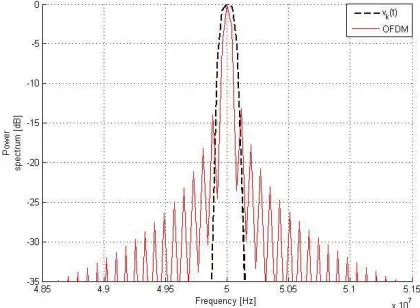
[image:5.612.91.301.148.302.2]spectra of OFDM signal and subcarriers of the form (14).
Fig. 4. Type Of Subcarrier Energy Spectra Of OFDM And Of Type (14)
In sum, it can be concluded that subcarriers of the form (14) has higher energy concentration in frequency domain as compared to subcarriers used in OFDM signals.
By analogy with OFDM subcarriers signals of the form (14) can be presented in a form of sum of quadrature and in-phase components:
( )
t
Q
( ) ( )
t
t
Q
( ) ( )
t
t
v
k=
krcos
ω
0−
kisin
ω
0 , (15)( )
t
C
r
( ) ( )
t
g
t
t
C
r
( ) ( )
t
g
t
t
Q
kr=
krcos
ω
k−
kisin
ω
k, (16)
( )
t
C
r
( ) ( )
t
g
t
t
C
r
( ) ( )
t
g
t
t
Q
kr k k i
k i
k
=
cos
ω
+
sin
ω
. (17)
Let's presume that complex function
q
k( )
t
hasthe following form:
( ) ( ) ( )(
t
r
t
g
t
t
i
t
)
q
k=
cos
ω
k+
sin
ω
k , (18)Then, the expression (15) can be formulated as follows:
( )
t(
X q( )
t) ( )
t(
X q( )
t) ( )
tvk =Re k k cos
ω
0 −Im k k sinω
0 . (19)The resulting signal based on subcarriers (15) is as follows:
( )
t X q( )
t( )
t X q( )
t( )
t sN k
k k N
k k k
v 0
1
0 0
1
0
sin Im
cos
Re ω ω
+
=
∑
∑
−= −
=
, (20)
The methodology proposed in the presented paper allows to easily form signal with specified frequency characteristics for adjustment with a specified spectral mask by means of assignment of
zero values to complex symbols
X
k correspondingto specified subcarrier frequencies. That approach allows formation of holes in spectrum of transmitted signal for adjustment to complicated electromagnetic environment. Figure 5 presents comparison of energy spectra of OFDM signal and signal
s
v( )
t
formed using the developed method.As it can be seen from the figure, value of energy of frequency components of signal
s
v( )
t
in specified [image:5.612.316.521.304.462.2]holes is by far lower as compared to signals based on OFDM. Signals were simulated in Matlab software in frequency band of 20 MHz width and duration of 12.8 µs. Modulation at subcarriers QAM-16.
Fig. 5. Energy Spectra Of OFDM Signals And Signals Of Form (20) With Holes In Frequency Domain
It is worth noting that signal
s
v( )
t
has suchfeatures as time localization and duration. As compared to OFDM signals for same values of width of occupied frequency band and number of subcarrier frequencies, duration of signal of form (20) for coefficient
a
>
1
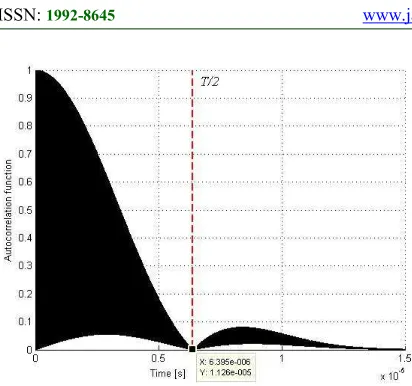
exceeds duration of OFDM signal, which directly influences speed of data transmission and energy efficiency in a whole by decreasing it. However, that effect can be compensated by applying signals on each other along time axis in a process of transmission. Discussion of autocorrelation function independently from taken subcarrierv
k( )
t
showsISSN: 1992-8645 www.jatit.org E-ISSN: 1817-3195
Fig. 6. Autocorrelation Function Of Signal Of Form (20)
That fact allows to provide transfer of information by signals of form (20) with the same speed as in communication systems based on OFDM with the same values of width of frequency band occupied by signal and number of used subcarrier frequencies.
3.2 Formation Of Orthogonal Set Of Signal Components
Another important feature of signals based on subcarriers
v
k( )
t
is that adjacent subcarriersv
k( )
t
are not orthogonal and values of autocorrelation functions for adjacent subcarriers with k, k+1 and k+2 indexes are significantly large and are from 0.1÷0.2.
For provision of a specified level of interference immunity of data transfer and process of demodulation at a receiver's side, it is necessary to carry out procedure of orthogonalization of complex functions
q
k( )
t
using the followingprocedure [18]:
( )
t
q
( )
t
q
( )
t
q
omk
m m k
o
k
∑
−
=
−
=
10
α
, (21)where
α
m coefficient is calculated using the equation:( ) ( )
( ) ( )
∫
∫
− −
=
/22 /
2 /
2 /
aT
aT
o m o m aT
aT
o m k
m
dt
t
q
t
q
dt
t
q
t
q
α
. (22)However, orthogonalization is necessary to carry out not for all
q
k( )
t
. It is related with the fact thatsubcarriers, which will correspond to domains of spectrum, in which it is necessary to form hole , will not be used during transmission of information. Thus, in a process of signal formation in a certain range of frequencies
[
ω
1,
ω
2] [
⊂
ω
0,
ω
0+
N
∆
ω
]
there must be no spectral components of signal, but in[
ω
1,
ω
2]
subcarriersv
k( )
t
are concentratedwith numbers k with
n
1 byn
2, at that1
0
<
n
1<
n
2<
N
−
, then orthogonalizationprocess is carried out for
q
k( )
t
with k indexesequal to 0 from
n
1 and fromn
2 toN
−
1
.The obtained set of complex functions will be used for signal formation:
( )t Xq( )t Xq( )t ( )t Xq( )t Xq( )t ( )t s
N n k
o k k n
k o k k N
n k
o k k n
k o k k o
v 0
1
0 0 1
0
sin Im
cos Re
2 1
2 1
ω
ω
+ +
+
= ∑ ∑ ∑ ∑−
= = −
= =
. (23)
Figure 7 presents comparison of energy spectra of OFDM signal and signal
s
( )
t
o
v formed after
[image:6.612.288.524.528.690.2]orthogonalization procedure. From the figure it can be seen that after orthogonalization procedure level of interference in holes of spectrum is higher than, approximately, 30 dB, however, that level is still lower than in OFDM signals and difference is about 40 dB. Spectra are obtained as a result of simulation in Matlab software in frequency band of 20 MHz width and duration of 12.8 µs. Modulation at subcarriers QAM-16.
ISSN: 1992-8645 www.jatit.org E-ISSN: 1817-3195 As it was mentioned before cognitive radio
communication system must be capable to form transferred signal with a specified frequency spectrum. It is necessary to control the following parameters of signal: frequency band in which signal is formed, power level, band center and, first of all, flexible spectral mask [1-4, 22]. Method of formation proposed in the presented study can provide that kind of flexibility due to structure, which consists of subcarrier of a special form (15). As it was mentioned before, switching off of corresponding subcarriers allows to adjust form of spectra of transmitted signal in order to conform to a required spectral mask [19].
Also, it is worth mentioning that during formation of OFDM signal with narrow domains, in which there are no frequency components, principle of zeroing of adjacent subcarriers is used for provision of a specified level of interference. That approach significantly decrease spectral efficiency of a system, because subcarriers, which could transfer useful information are not used. The proposed methodology of signal formation doesn't have that kind of disadvantage and for formation of narrow domains of spectrum, in which there are no frequency components, there is no need for zeroing of adjacent and neighboring subcarriers, because energy of each subcarrier of (15) type is completely localized in a specified frequency domain and doesn't have any influence on other ranges, which allows to increase spectral efficiency of system for a given level of interference immunity.
3.3 Adaptation Of The Methodology For Implementation In Elements Of Microprocessor Technology
For realization of signal of (23) type at software-configured communication devices it's necessary to present a set of complex functions (18) in a form of matrix
( )
tl
q
q
k,l=
k∆
, (24)where
∆
t
– sampling period,L
L
L
l
=
−
,
1
−
,
...,
,L
in turn is integer part of ratioaT
/(
2
∆
t
)
. The expression (24) can be formulated in discreet form as follows: + = L kl a i L kl a L l a L l a L l L l q b l k π π π π π π sin cos sin sin , . In further, it is necessary to define, which of subcarriers
v
k( )
t
will not be used for formation ofresulting signals and carry out orthogonalization procedure for rows of matrix
k
q
q
q
, 1 0 , ,∑
− =−
=
α
,where
q
ko,l – elements of matrixα
m will be equal:∑
∑
− = − ==
L L l o l m o l m L L l o l m l k mq
q
q
q
, , , ,α
.Thus, procedure of formation of discreet complex envelope will take the following form:
o
X
S
=
⋅
.At that, vector of complex symbols
X
is formed basing on information bit sequence depending on selected modulation (QPSK, QAM-16 etc.). Operations (24-28) can be easily used for digital signal processor or programmable logic integrated circuit. The final stage of formation of signal of form (23), the same as in a case of OFDM signal, is digital-to-analog transformation of real and imaginary part of complex vectorS
in a form of quadrature and in-phase components with consequent processing of them in quadrature modulator, which is implemented in front-end of transmitter.4. RESULTS OF COMPUTER SIMULATION
ISSN: 1992-8645 www.jatit.org E-ISSN: 1817-3195 For evaluation of spectral efficiency γ the
following equation was used:
,
F
R
∆
=
γ
(29) where: R – speed of data transfer; ΔF – width of
frequency band occupied by signal (20 MHz). Formation of signals was carried out in Matlab software: The simulation was carried out as follows:
Binary random sequence was generated, which was source data. From the obtained binary sequence modulation symbols
X
k of QAM-16 type wereformed. In further signals for two adjacent channels with bandwidth of 20 MHz and durations of 12,8 µs were formed using classical OFDM and signal of (23) type. Values of carrier frequencies were as follows: channel 1 – 2.48 GHz; channel 2 – 2.5 GHz.
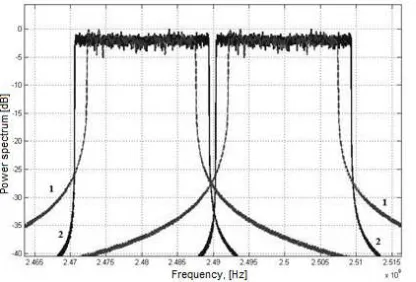
Figure 8 shows average values of spectral density of OFDM (#1) signals and spectral densities of signals of (23) (#2) type obtained as a result of computer simulation.
[image:8.612.91.299.555.696.2]Value of drop of frequency spectra beyond a specified frequency range defines level of interchannel interference. Because value of drop of spectral density of signal of (23) type is significantly higher than in OFDM, taking into account that width of channels window is fixed (in the discussed case 20 MHz), there is possibility to decrease value of introduced protective intervals between adjacent communication channels, which, in turn, will allow to increase spectral efficiency γ because of it (Fig. 8), at that level of interference will remain lesser than in OFDM signal.
Fig. 8. Spectral Densities Of Signals.
1) OFDM signal; 2) Signal of (23) type There is a need to evaluate capability of the proposed approach to form signals with specified characteristics for various combinations of ΔF and Тс. In order to do that we carried out an experiment, in which we changed values of width of frequency range ΔF for various levels of signal's duration and calculated number of possible subcarriers for information transfer. Table 1 presents results of experiments for comparative evaluation of number of subcarriers in specified frequency and time resources of communication channel for use of OFDM signal and signal of (23) type. In cells of the table there are ratios of number of signal subcarriers of (23) type acceptable for use and number of OFDM signal subcarriers.
Table 1. Relative Number Of Formed Subcarriers
Тс, µs
Bandwidth, MHz
1.25 2.5 5 10 20
25.6 1.24 1.24 1.24 1.23 1.23 12.8 1.25 1.24 1.24 1.24 1.23 6.4 1.16 1.25 1.24 1.24 1.24 3.2 1 1.16 1.25 1.24 1.24
1.6 1 1 1.16 1.25 1.24
From the results presented in Table 1 it can be concluded that there is clear advantage (about 20%) of the proposed approach of signal formation of (23) type as compared to classical OFDM, from the point of view of used basis functions with specified characteristics is observed with Тс·ΔF ≥8. The results of evaluation of spectral efficiency γ of the studied signals are presented in Table 2.
Table 2. Spectral Efficiency Of The Studied Signals
Type of modulation OFDM signal
Signal of (23) type
QAM-4 1.57 1.96
QAM-16 3.14 3.9
QAM-64 6.28 7.78
[image:8.612.315.521.571.651.2]ISSN: 1992-8645 www.jatit.org E-ISSN: 1817-3195 The following experiment was carried out to
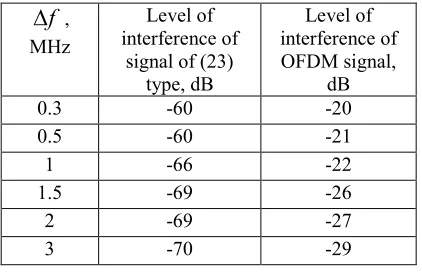
[image:9.612.90.301.234.370.2]evaluate capability of the proposed method to form minimally acceptable holes in signal spectrum and to provide specified level of interference in it Evaluation of level of interference was carried out in holes of spectrum for OFDM signal and signal of (23) form, and obtained results are presented in Table 3.
Table 3. Characteristic Of Level Of Interference In Holes Of Spectrum
f
∆
, MHzLevel of interference of
signal of (23) type, dB
Level of interference of OFDM signal,
dB
0.3 -60 -20
0.5 -60 -21
1 -66 -22
1.5 -69 -26
2 -69 -27
3 -70 -29
The experiment shows that the proposed method allows to form signals with narrower holes during provision of a specified levels of interference and, thus, provide higher spectral efficiency as compared to OFDM signals.
5. CONCLUSION
As the result of the carried out studies the new methodology of signal formation was developed for cognitive radio communication system, in which it is required to provide dynamic access to radio frequency spectrum to users of such systems. The methodology proposed in the paper is compared with the known OFDM method, which nowadays is actively applied in modern systems of wireless data transfer. The results of comparison show that the new method for signal formation has 20% higher spectral efficiency, because it uses for data transfer part of additionally introduced protective intervals for data transfer together with main spectrum. Moreover, the proposed approach allows to form narrow domains of spectrum, in which it is necessary to provide absence of any frequency components, while maintaining a specified level of interference, which is impossible to do in a case of OFDM signals. Those facts allows to state that application of that kind of signals in high-speed broadband systems of cognitive communication will allow to increase spectral efficiency of
operation of communication systems, as well as to provide higher speed of data transfer between users. In the further studies we plan to develop effective method of processing and demodulation of signals proposed in the presented paper, comparative evaluation of peak-facto and stability to fading in communication channel, as well as immunity to interference of Gauss noise type.
6. ACKNOWLEDGMENTS
The study was carried out in framework of grant of the President of the Russia Federation for support of young Russian scientists, project No. MK-7092.2015.9 "Development of new methods and algorithms of transmission of data with high spectral efficiency for software-configurable radio communication systems".
REFERENCES:
[1] Mitola, J. and G.Q. Maquire Jr., 1999. Cognitive radio: making software radios more personal. IEEE Personal Commun., 4(6): 13-18.
[2] Kwang-Cheng, C. and R. Prasad, 2009. Cognitive radio networks. Wiley.
[3] Arslan, H., 2007. Cognitive Radio, Software Defined Radio, and Adaptive Wireless Systems. Springer.
[4] Zhang, Y., J. Zheng and C. Hsiao-Hwa, 2010. Cognitive radio networks. Architectures, Protocols, and Standards. CRC Press Taylor & Francis Group.
[5] Zhang, Y., 2008. WiMAX network planning and optimization. CRC Press.
[6] Van Nee, R., 2000. OFDM for wireless multimedia communication. Artech House universal personal communications library. [7] Molisch, A.F., 2011. Wireless communications;
2nd ed.p. cm. Library of Congress Cataloguing-in-Publication Data.
[8] Arslan, H. and T. Y¨ucek, 2006. Adaptation of Wireless Mobile Multi-carrier Systems. Adaptation Techniques in Wireless Multimedia Networks. Nova Science Publishers.
[9] Andrews, J.G., 2005. Fundamentals of WiMAX. Understand Broadband Wireless Networking. Prentice Hall.
ISSN: 1992-8645 www.jatit.org E-ISSN: 1817-3195 [11] Khan, F., 2009. LTE for 4G Mobile
Broadband. Air interface Technologies and Performance. Cambridge University Press. [12] Schulze, H. and C. Luders, 2005. Theory end
Application of OFDM and CDMA. Wideband Wireless Communications. British library Cataloguing in Publication Data: John Wiley & Sons, Ltd.
[13] Shinsuke, H., 2003. Milticarrier techniques for 4G mobile communication. Artech House universal personal communication series. [14] Hanzo, L., W.T. Webb and T. Keller, 1999.
Single- and Multi-carrier Quadrature Amplitude Modulation: Principles and Applications for Personal Communications. WLANs and Broadcasting.
[15] Gray, D., 2009. Comparing Mobile WiMAX with HSPA+, LTE, and Meeting the Goals of IMT-Advanced. WiMAX Forum.
[16] Andreas, Ed. and F. Molish, 2001. Wideband wireless digital communications. Prentice Hall PTR.
[17] Bahai, A.R.S. and B.R. Salzberg, 2007. Multi-Carrier Digital Communication. Theory and Application of OFDM. New York: Kluwer Academic/Plenum Publishers.
[18] Arfken, G., 1985. Gram-Schmidt Orthogonalization. §9.3 in Mathematical Methods for Physicists, 3rd ed. Orlando, FL: Academic Press, pp: 516-520.
[19] Y¨ucek, T. and H. Arslan, 2006. MMSE noise power and SNR estimation for OFDM systems. Proc. IEEE Sarnoff Symposium, Princeton, New Jersey.
[20] Mobile WiMAX – Part I: A Technical Overview and Performance Evaluation, 2006. [21] Rajbanshi, R., A.M. Wyglinski and G.J.