Kent Academic Repository
Full text document (pdf)
Copyright & reuse
Content in the Kent Academic Repository is made available for research purposes. Unless otherwise stated all content is protected by copyright and in the absence of an open licence (eg Creative Commons), permissions for further reuse of content should be sought from the publisher, author or other copyright holder.
Versions of research
The version in the Kent Academic Repository may differ from the final published version.
Users are advised to check http://kar.kent.ac.uk for the status of the paper. Users should always cite the published version of record.
Enquiries
For any further enquiries regarding the licence status of this document, please contact: [email protected]
If you believe this document infringes copyright then please contact the KAR admin team with the take-down information provided at http://kar.kent.ac.uk/contact.html
Citation for published version
Modi, Bala (2015) FPGA-based High Throughput Regular Expression Pattern Matching for Network
Intrusion Detection Systems. Doctor of Philosophy (PhD) thesis, University of Kent,.
DOI
Link to record in KAR
https://kar.kent.ac.uk/56664/
Document Version
FPGA-based High Throughput Regular Expression Pattern Matching for
Network Intrusion Detection Systems
A thesis submitted to the University of Kent,
in the subject of Computer Science
for the degree of Doctor of Philosophy (PhD)
by
Bala Modi
February, 2015
To my wife Tina & children
ii
iii
Abstract
Network speeds and bandwidths have improved over time. However, the frequency of network attacks and illegal accesses have also increased as the network speeds and bandwidths improved over time. Such attacks are capable of compromising the privacy and confidentiality of network resources belonging to even the most secure networks. Currently, general-purpose processor based software solutions used for detecting network attacks have become inadequate in coping with the current network speeds. Hardware-based platforms are designed to cope with the rising network speeds measured in several gigabits per seconds (Gbps). Such hardware-based platforms are capable of detecting several attacks at once, and a good candidate is the Field-programmable Gate Array (FPGA). The FPGA is a hardware platform that can be used to perform deep packet inspection of network packet contents at high speed. As such, this thesis focused on studying designs that were implemented with Field-programmable Gate Arrays (FPGAs). Furthermore, all the FPGA-based designs studied in this thesis have attempted to sustain a more steady growth in throughput and throughput efficiency. Throughput efficiency is defined as the concurrent throughput of a regular expression matching engine circuit divided by the average number of look up tables (LUTs) utilised by each state of the engine‟s automata. The implemented FPGA-based design was built upon the concept of equivalence classification. The concept helped to reduce the overall table size of the inputs needed to drive the various Nondeterministic Finite Automata (NFA) matching engines. Compared with other approaches, the design sustained a throughput of up to 11.48 Gbps, and recorded an overall reduction in the number of pattern matching engines required by up to 75%. Also, the overall memory required by the design was reduced by about 90% when synthesised on the target FPGA platform.
iv
Acknowledgements
I am highly appreciative of my supervisor Gerald Tripp, for his professional assistance and guidance throughout the period of my research. I also wish to appreciate the effort of the entire School of Computing staff for their administrative assistance. I also thank the school for the technical and financial support I received during my study period. I thank all the members of my review panel. I also appreciate the support of my colleagues Keith Greenhow and Neil Brown for their support.
I wish to acknowledge the use of the Xilinx ISE Proprietary Project Navigator application version P.49d, volume 14.4 (nt64) Software. The software is bundled with the Xilinx Synthesis Tool (XST) used for synthesising and implementing the various circuit descriptions contained in the design that was constructed in this thesis. I acknowledge the use the Microsoft Excel 2010 spread sheet application for generating all the graphs and related figures and tables used for analysing the results of the experiments performed in this thesis. I also wish to acknowledge the use of the tool used for performing a one-way analysis of variance (One-way ANOVA). The ANOVA tool is bundled with the International Business Machines Statistical Package for the Social Sciences (SPSS) version 21 which was used for testing the statistical research hypothesis of the thesis.
Lastly, I wish to thank God almighty for his infinite love, protection, provision, wisdom and strength, as well as my wife Tina, and my children Yusuf, Stephen and Salim for their love and patience. I also extend the same appreciation to my aunty Esther, and my grandmother Jebu for their patience, financial, moral and spiritual support throughout my study period.
v
Table of Contents
Abstract ... iii
Acknowledgements ... iv
Table of Contents ... v
List of Figures ... vii
List of Tables ... ix
List of Algorithms ... xi
List of Abbreviations ... xii
Glossary ... xiii
1. Introduction ... 1
Introduction to Computer Network Security and Management ... 1
1.1 Fundamentals ... 2 1.2 Motivation ... 3 1.3 Thesis Statement ... 4 1.4 Research Objective ... 5 1.5 Statistical Research Hypothesis ... 6
1.6 Contributions ... 6 1.7 Outline ... 7 1.8 2. Background ... 9 Introduction ... 9 2.1 Regular Expression ... 9 2.2 2.2.1 Snort Rule Description ... 11
Finite Automata ... 14
2.3 Network Intrusion Detection System ... 18
2.4 2.4.1 Network Security Issues ... 19
Hardware Description Language ... 21
2.5 Field Programmable Gate Array ... 23
2.6 Synthesis Process ... 27
2.7 Chapter Summary ... 29
2.8 3. Approaches to Regular Expression Pattern Matching ... 30
Introduction ... 30
3.1 Pattern Matching Design and Implementations ... 30
3.2 3.2.1 General-purpose and Processor-based Approaches ... 30
3.2.2 FPGA-Based Approaches ... 48
Chapter Summary ... 71
3.3 4. Analysis of Related Approaches ... 73
Tables of Results for Related Approaches ... 73
4.1 4.1.1 Multi-Character Regexp Matching Designs Table ... 73
4.1.2 Common Prefix Sharing Design Table ... 74
4.1.3 Shared Character Decoding Design Table ... 74
4.1.4 Regexp Matching Engine Designs Table ... 74
vi
Analysis of Related Designs ... 76
4.2 4.2.1 Data Analysis of Results ... 76
Chapter Summary ... 81
4.3 5. Design and Implementation ... 82
Motivation ... 82
5.1 Design Concerns ... 83
5.2 The Hardware Design Phase ... 85
5.3 5.3.1 The Modular Block Module: First Phase ... 85
5.3.2 The Hardware Module: Second Phase... 87
5.3.3 The ECDRTS-NFA Design ... 88
The Implementation Phase... 89
5.4 5.4.1 Implementation of the First Phase ... 89
5.4.2 Implementation of the Second Phase... 94
Chapter Summary ... 102 5.5 6. Evaluation of Results ... 103 Design Description ... 103 6.1 Design Results ... 103 6.2 6.2.1 ECDRTS-NFA and Related Approaches Result ... 103
6.2.2 Data Analysis of All Designs ... 104
6.2.3 Analysis of the Synthesised ECDRTS-NFA REME Designs ... 115
Test of Statistical Hypothesis ... 119
6.3 6.3.1 Testing the Throughput ... 120
6.3.2 Testing the Ratio of LUTs/States ... 121
Chapter Summary ... 121
6.4 7. Conclusions ... 123
Contributions and Conclusions ... 123
7.1 Future Work ... 126 7.2 7.2.1 Proposed Improvements ... 126 Chapter Summary ... 129 7.3 Concluding Thoughts... 130 7.4 BIBLIOGRAPHY ... 132
APPENDIX 1.1: Simulated 4-byte Matching BG2RE sub-REME. ... 139
APPENDIX 1.2: RTL Diagram for BG2RE sub-REME. ... 140
APPENDIX 1.3: Results for the Ten BG5RE sub-REMEs. ... 141
APPENDIX 1.4: Results for the Ten BG4RE sub-REMEs. ... 141
APPENDIX 1.5: Results for the Ten BG3RE sub-REMEs. ... 142
APPENDIX 1.6: Results for the Ten BG2RE engines. ... 142
APPENDIX 1.7: Summary of the Average Throughput per REME Design. ... 143
vii
List of Figures
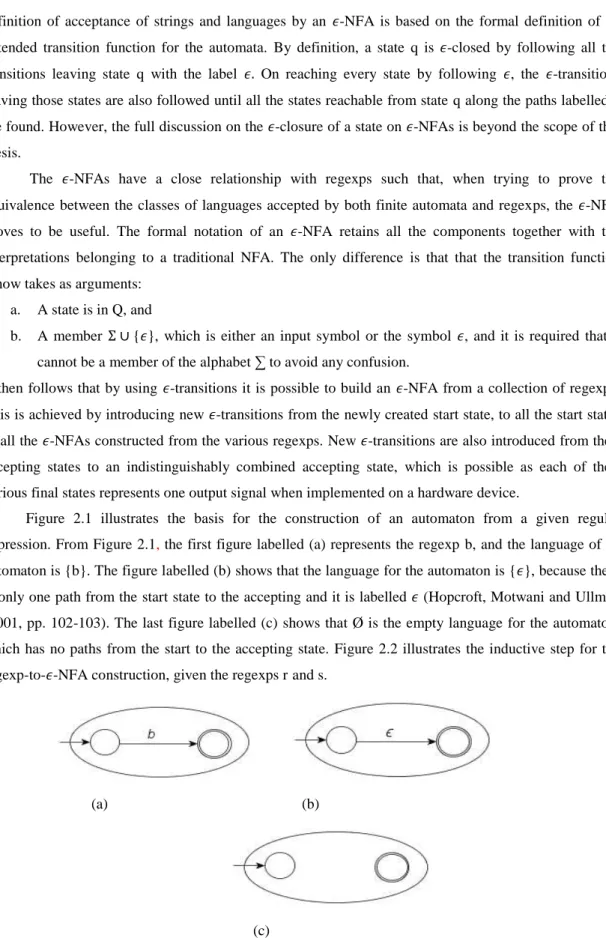
Figure 2.1: Figure (a), (b) and (c), show the basis for the construction of an automaton from a regexp. .. 16
Figure 2.2: The inductive steps in the construction of regexp-to- -NFA construction. ... 17
Figure 2.3: NFA for the regexp (a|b)*(cd). ... 17
Figure 2.4: Arrangement of slices within the CLB. ... 25
Figure 2.5: Row and Column relationship between CLBs and Slices. ... 26
Figure 2.6: Diagram of a SLICEM. ... 27
Figure 3.1: Merge_FSM formed by merging non-equivalent states. ... 33
Figure 3.2: New state diagram of merge_FSM from Figure 3.1. ... 33
Figure 3.3: Construction of pathVec and ifFinal. ... 34
Figure 3.4: State diagram of the state traversal machine created from Figure 3.3. ... 34
Figure 3.5: AC state machine for the two patterns “abcdef” and “wdebcg”. ... 35
Figure 3.6: Merging two disorder sections of pseudo-equivalent states of an AC machine. ... 35
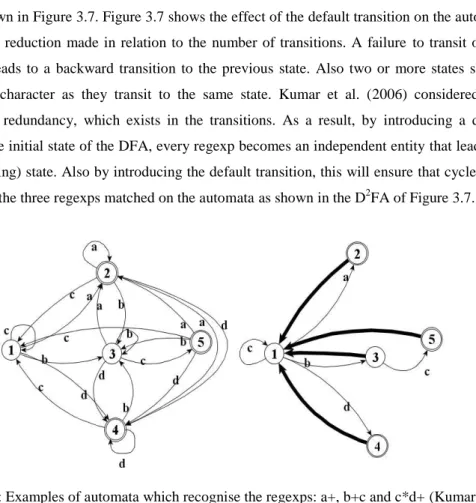
Figure 3.7: Examples of automata which recognise the regexps: a+, b+c and c*d+. ... 36
Figure 3.8: Automata recognising (a+), (b+c) and (c*d+). ... 39
Figure 3.9: FA internals: a lookup example. ... 41
Figure 3.10: (a) Rudimentary bitmap-based data structure, (b) More compact bitmap-based data structure using pointer indirection... 43
Figure 3.11: DFA for regexp (a[b-e][g-i]|f[g-h]j)k+.. ... 43
Figure 3.12: DFA after merging states 3 and 4. ... 44
Figure 3.13: DFA after merging states 1 and 2 from the example of Figure 3.12. ... 45
Figure 3.14: Merged data structure for the state 1_2 of Figure 3.13 ... 45
Figure 3.15: Logic structures for the regexps (a) single character, (b) r1|r2, (c) r1r2, (d) r1*.. ... 49
Figure 3.16: (a) Matching interleaved substrings. ... 53
Figure 3.17: Run-length coded transition table ... 55
Figure 3.18:Top-level diagram of regexp matching system. ... 56
Figure 3.19: The new infix sharing architecture. ... 57
Figure 3.20: Pattern matching module using a multi-character decoder NFA. ... 59
Figure 3.21: A modular NFA for “\x2F(fn|s)\x3F[^\r\n]*si” constructed using the MMY rules. ... 60
Figure 3.22: Structure of a 2-D staged pipeline. ... 62
Figure 3.23: (a) An NFA, (b) The NFAs reduced version using , (c) The NFAs reduced version using both and . ... 63
Figure 3.24: An NFA, and its reduced versions using and . ... 63
Figure 3.25: The packet flow RFC ... 65
Figure 3.26: The ECD-NFA two-phased toolchain design Block diagram. ... 67
Figure 4.1: Graph of the input (n-bytes, n = 1, 2, 4, and 16). ... 77
Figure 4.2: Graph of the number of characters matched (ranging from 652-120000)... 77
Figure 4.3: Graph of the throughput (ranging from 0.24-10.65 Gbps). ... 78
Figure 4.4: Graph of the speed (ranging from 30.90MHz – 340.63). ... 79
viii
Figure 4.6: Distribution of speed and the throughput of matching. ... 80
Figure 5.1: A 4-byte ECD-NFA for an n-regexp engine, where n = 2, 3, 4, and 5. ... 86
Figure 5.2: Software/hardware ECD-NFA/ECDRTS-NFA model. ... 87
Figure 5.3: Block diagram of parallel 4-byte ECD-NFA REMEs. ... 88
Figure 5.4: NFA for the regexp (a|b)*(cd). ... 90
Figure 5.5: Minimised classified ECDRTS-NFA. ... 90
Figure 5.6: ECD-NFA with assigned ECDs. ... 90
Figure 5.7: 2x36kBRAM block interface. ... 95
Figure 5.8: (a) Four 256x8-bit table of ECDs for Mem(0-3)(0) memory blocks. ... 96
Figure 5.9: (a) An expanded REME diagram as shown in Figure 5.7. ... 98
Figure 5.10: Two-phased process for each sub-NFA block. ... 100
Figure 6.1: Graph of the speed (ranging from 30.90MHz - 367.34MHz). ... 105
Figure 6.2: Graph of the throughput (ranging from 0.24-11.44 Gbps). ... 106
Figure 6.3: Graph of the total number of characters matched (ranging from 652-120,000). ... 107
Figure 6.4: Distribution of the Input (n-bytes, n = 1, 2, 4, and 16). ... 108
Figure 6.5: Distribution of BG2RE average ECDs for the 10 BG2RE engines. ... 111
Figure 6.6: Distribution of BG3RE average ECDs for the 10 BG3RE engines. ... 111
Figure 6.7: Distribution of BG4RE average ECDs against the 10 BG4RE Engines. ... 112
Figure 6.8: Distribution of BG5RE average ECDs against the 10 BG5RE engines. ... 112
Figure 6.9: Graph for the ECDs and the total number of characters matched by the BG2RE engines. ... 113
Figure 6.10: Graph for the ECDs and the total number of characters matched by the BG3RE engines. . 113
Figure 6.11: Graph for the ECDs and the total number of characters matched by the BG4RE engines. . 114
Figure 6.12: Graph for the ECDs and the total number of characters matched by BG5RE engines. ... 114
Figure 6.13: Graph for the throughput efficiency. ... 117
Figure 6.14: Graph for the throughput (Gbps). ... 118
Figure 6.15: Graph for the number of LUTs per number of states utilised. ... 118
ix
List of Tables
Table 2.1: The general structure of a Snort rule. ... 12
Table 2.2: A typical Snort community service rule. ... 12
Table 2.3: Table of Snort rule header. ... 12
Table 2.4: Table of Snort rule options. ... 13
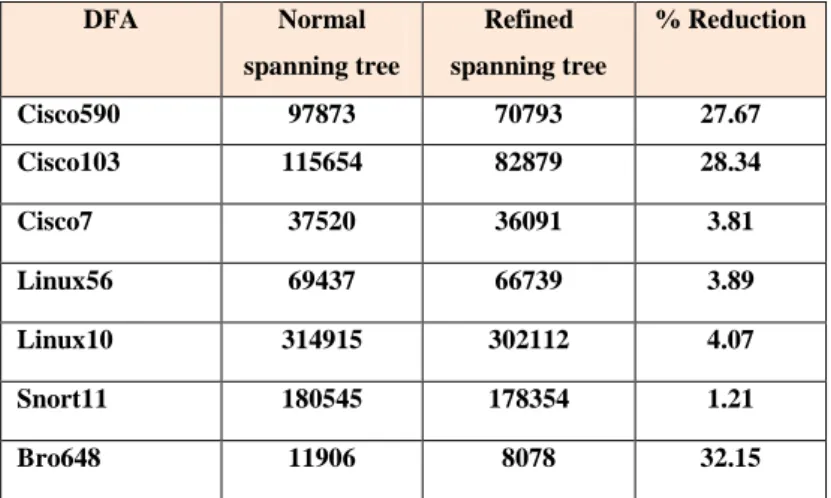
Table 3.1: Number of transitions in D2FA with default path length bounded to 4. ... 37
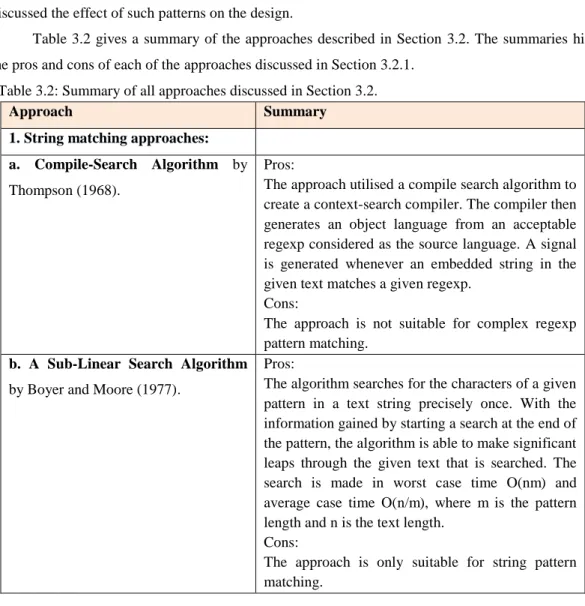
Table 3.2: Summary of all approaches discussed in Section 3.2. ... 46
Table 3.4: Summary of FPGA-based approaches discussed in Section 3.2.2. ... 68
Table 4.1: Compared results for multi-character regexp matching designs. ... 74
Table 4.2: Compared results for common prefix sharing designs. ... 74
Table 4.3: Compared shared/partial decoding designs. ... 74
Table 4.4: Compared results for regexp matching engine designs. ... 75
Table 4.5: Design result for an ECI-based design. ... 75
Table 4.6: Combined table results for the various FPGA-based approaches. ... 76
Table 5.1: ECD table of the state vectors for the regexp “/(a|b)*cd/”. ... 90
Table 5.2: (a) ECD 0 cross product of itself and those of ECD (1, 2 and 3). ... 91
Table 5.3: (a) Table of the 2-byte state vectors merged to form 6 new ECD columns. ... 93
Table 6.1: The design approach compared with other related approaches as seen in Table 4.6. ... 104
Table 6.2: Table of 4 x n-regexp ECDs and their averages. ... 109
Table 6.3: 4 x n-regexp total number of characters matched with their sums per engine. ... 110
Table 6.4: Compared results for related 4-byte LUT-based REME designs. ... 116
Table 6.5: One-way ANOVA Analysis for the average throughputs of REMEs. ... 120
x
List of Algorithms
Algorithm 3.1:Pseudo-code for the creation of the transition table tc of a FA from the transition table t of
a DFA. ... 40
Algorithm 3.2: Pseudo-code for the lookup in a FA. The current state is s and the input character is c .. 40
Algorithm 3.3: Basic naïve data structure representing a state in a DFA ... 42
Algorithm 3.4: NFA construction algorithm using Self-Reconfiguration. ... 50
Algorithm 5.1: Construction of n-ECD class vectors. ... 93
Algorithm 5.2: Hardware synthesis process for the compressed n-byte ECDs. ... 99
xi
List of Abbreviations
ABS IDS Anomaly-Based Intrusion Detection System. AC-DFA Aho-Corasick Deterministic Finite Automata. ANOVA Analysis of Variance.
ASCII American Standard Code for Information Interchange. BRAM Block Random Access Memory.
CLB Control Logic Block.
DFA Deterministic Finite Automata. ECD Equivalence Class Descriptor.
ECD-NFA Equivalence Class Descriptor Nondeterministic Finite Automata. ECDRTS-NFA Equivalence Class Direct Synthesis Nondeterministic Finite Automata. ECI Equivalence Class Index.
FPGA Field Programmable Gate Array. FF Flip-Flop.
FSM Finite State Automata.
HDL Hardware Description Language. IBM International Business Machines. IDS Intrusion Detection System. LUT Look up Tables.
MHz Megahertz.
NIDS Network Intrusion Detection System. NFA Nondeterministic Finite Automata. OS Operating System.
PCRE Perl Compatible Regular Expression. RE Regular Expression.
RE-NFA Regular Expression Nondeterministic Finite Automata. RFC Recursive Flow Classification.
REME Regular Expression Matching Engine. SBS IDS Signature-Based Intrusion Detection System. SPSS Statistical Package for the Social Sciences. UUT Unit Under Test.
VHDL VHSIC Hardware Description Language. WWW World Wide Web.
xii
Glossary
Term Definition
BGnRE Block-Engine Group of n Regular Expressions, where n = 2, 3, 4 and 5. BGnRE average
ECDs
The average number of ECDs for each BGnRE REME.
BGnRE 4-byte CH The sum of the characters matched per clock cycle by each 4-byte BGnRE REME, with n = 2, 3, 4, and 5.
Input Number of characters consumed at once in bytes. NOCH Total number of characters matched.
NoL Number of LUTs. NoS Number of NFA states. Regexp Regular Expression
T/Char Total number of characters matched. Tp Throughput.
Tpe Throughput Efficiency. It is the concurrent throughput of a regular expression matching engine circuit divided by the average number of look up tables (LUTs) utilised by each state of the engine‟s automata.
1
Introduction
1.
This chapter briefly introduces the concept of computer networks and the related security issues involved. This is closely followed by the fundamentals, problem statement, thesis statement, contributions and finally the outline of the research work.
Introduction to Computer Network Security and Management
1.1
A computer network is defined to be a set of autonomous, independent computer systems which are interconnected so as to permit interactive resource sharing between any pair of systems” (Roberts and Wessler 1970). As such, there is a need to monitor how the various interconnected computer systems are secured on any given network.
Computer network security (Rufi 2006, p. 4) refers to the various processes involved in protecting computers on a network. The protection is against malicious (dangerous) attacks or intrusions by both external and internal users. Also, computer-mediated communication networks have succeeded in linking people together, spreading knowledge and connecting institutions together from all over the world. Networked societies regard such a network as a computer-supported social network (Wellman 2001, pp. 2031-2034). The printed media and publications such as newspapers, books, magazines, and posters to mention but a few have adapted to website technology. The technology uses a system of interlinked hypertext documents referred to as the World Wide Web (WWW or W3).
Furthermore, network management became necessary. The management process involves a broad range of functions that involve the use of tools to administrate, operate, and reliably maintain computer network systems. The deployment of security measures have to work in line with organisational measures and policies in order to be effective (Gollmann 2011). Also, network management requires the use of a variety of software and hardware devices, which aid in the network administration process. The management process is concerned with the reliability, efficiency, capacity and capabilities of data transfer channels. The process also covers a broad range of research components such as: security, performance and reliability. The security component deals with the protection and authorisation of eligible users on the network. Although, there may not be a clear distinction between the security-relevant components of a given system, the use of specific rules and regulations to check the excesses of legitimate users on the network should be encouraged.
The performance component deals with the ways to identify and fix bottlenecks in the network such as network connection and speed. The reliability component ensures an uninterrupted availability of
CHAPTER 1
INTRODUCTION
2
network service, and also ensures that the problems relating to hardware and software malfunctions (or crashes) are easily restored.
To capture the essence of computer security, the process of information asset compromise need to be understood as described by Gollmann (2011, p. 34) based on the following:
a. Confidentiality: This involves the prevention of unauthorised disclosure of information. b. Integrity: This involves the prevention of unauthorised modification of information.
c. Availability: This involves the prevention unauthorised withholding of information or resources. Most network security systems rely on layers of protection. The layers are made up of multiple components including network monitoring and security applications. The components are usually managed by a trained network or system administrator, who implements the security and policy requirements. The administrator is normally required to protect the confidentiality and integrity of secured information, while ensuring that only legitimate employees are granted adequate access to the network resources.
Fundamentals
1.2
This thesis is primarily concerned with developing a novel approach that is capable of effectively detecting attacks or intrusions flowing into a computer network. Such attacks usually appear in a given pattern within a data packet, and require to be stopped in real-time. The design described in this thesis is suitable for matching multiple characters and patterns at once. The process of performing the matching activity is known as pattern matching. Pattern matching as described by Komendantsky (2012, p. 150), involves the problem of deciding whether or not given a word defined over a finite alphabet of characters, and a given regular expression belongs to the language expressed by the regular expression. As such, given any T* representing the set of all strings defined over an alphabet T, then any „regular expression defined over T always describes a regular language‟ (Rayward-Smith 1991). Refer to Section 2.2 for more background details on regular expressions.
Furthermore, any pattern that can be matched by a regular expression can also be matched by an automaton. Unlike pattern recognition which performs a likelihood of matching inputs, pattern matching is expected to generate an exact match. Parallel pattern matching involves the process of scanning multiple flows of characters with the aim of finding exact elements of a given pattern. Issues concerning network intrusions are security concerns that require urgent and proper attention. Intrusions are more commonly referred to as attacks or anomalies. Such attacks are actions or attempts aimed at compromising the confidentiality, integrity and availability of network resources.
Also, intrusions are more difficult to define in terms of their behaviour or actions, but could be easily expressed in terms of their effect on a given automaton. As such, intrusion detection can be regarded as a method by which intrusions from outside or misuse from within an organisation‟s network are gathered and analysed using an intrusion detection system (IDS). The detection system is aimed at stopping any possible security breaches from incoming or existing attacks. The primary objective of this thesis is to create a design that frames the intrusion detection problem as a pattern matching problem. The problem is solved using efficient algorithms to implement the matching processes (refer to Section 2.3 for more on IDSs). Furthermore, the entire research is aimed at developing a fast, more efficient and less complex design for performing pattern matching.
CHAPTER 1
INTRODUCTION
3
The choice of automata for the implementation of the pattern matching design depends on the appropriate choice of polynomial ( ) algorithm for deciding the basic problem. A polynomial time algorithm is any algorithm that runs in polynomial time O( ), where k some constant independent of the problem size n(Mount 2003, p. 57). Consequently, problems could be solved using a deterministic or nondeterministic Turing Machine (TM) (Hopcroft, Motwani and Ullman 2001, p. 414) respectively. Such problems are set of all decision problems (problems with Boolean outputs e.g. „yes‟ or „no‟) that can be verified in polynomial time (Mount 2003, p. 59). The design automata in this thesis runs in polynomial time O( m), with k being any positive integer, and n being the length of the regular expression. The value m is the number of regular expressions combined together to create the compound automata. Also, the memory requirement of the design runs in time O(nm). The choice of automata used in this thesis is based on the class of problems under consideration. The class of such problems can best be solved using nondeterministic TMs as opposed to the deterministic TMs (Hopcroft, Motwani and Ullman 2001, p. 414).
A number of optimisation strategies are employed in this thesis in order to generate a more efficient automata-based design. Such strategies are usually implemented as separate approaches, but this thesis combined multiple strategies into a single design. The design is then used for creating compact and efficient pattern matching systems that operate in a parallel configuration. Such optimisation strategies are discussed in Section 3.2. The idea is to generate a memory efficient and fast nondeterministic finite automata (NFA) based matching engines. The automata are finally implemented in a target Field Programmable Gate Arrays (FPGA) platform to perform hardware-based regular expression matching. Section 3.2.2f dwells more specifically on the concept of equivalence classification used to develop the approach in this thesis.
An analysis of the various related approaches is performed in Chapter 4 to measure how each approach compares to the other. After introducing the thesis approach in Chapter 3, the analysed results in Chapter 4 was collated and combined with the results of experiments obtained in the thesis in Chapter 6. Afterwards, a comprehensive analysis was performed again and further results were obtained.
Motivation
1.3
As network bandwidth has continued to steadily and rapidly increase, so have the frequency of network attacks. Network bandwidth is considered to be a measurement of the bit rate that a network interface supports, and is usually expressed in Bits/sec, Kilobits/sec (Kbps), Megabits/sec (Mbps), and Gigabits/sec (Gbps) etc.
Data packets need to be processed and as such packet processing has become necessary. Furthermore, most patterns contained in data packets now appear in form of complex regular expression patterns which are increasingly difficult to define and detect. Also, string matching is no longer efficient in defining and detecting such complex patterns. Such patterns are mostly contained in packets of data that flow through a network system. Furthermore, the required processing flexibility and fast processing power could best be attained by utilising reconfigurable hardware devices such as FPGAs. Current FPGAs exploit specialised circuitry and parallelism, and have the ability to process multiple bytes or characters per clock cycle.
CHAPTER 1
INTRODUCTION
4
Currently, many approaches have been developed and implemented to deal with the problem of network intrusions using Network Intrusion Detection Systems (NIDS). The use of regular expression pattern matching as a viable alternative and solution to string pattern matching has become necessary. This is because regular expression matching systems have the ability to effectively scan a packet payload in order to detect suspicious contents. A packet payload is the data in the body of the packet block during a data transmission process. However, regular expressions are often a computational burden in applications such as NIDS, which rely heavily on the regular expressions. The computational burden is high, because matching against regular expression consumes a lot of computation time, which is in O( m), with k being any positive integer, and n being the length of the regular expression. The value m is the number of regular expressions combined together to create the compound automata.
The key challenge facing the development of an efficient regular expression pattern matching design lies in the ability to take full advantage of the processing speed and fine-grained parallelism provided by current reconfigurable hardware platforms such as FPGAs. The speed and parallelism is the fundamental advantage of FPGAs over microprocessor-based regular expression matching designs. Almost all the previous approaches have been trying to deal with issues such as: the increased clock operating frequency (or simply the design speed of matching measured in MHz) at a much reduced logic circuit cost. The logic circuit cost relates to the resources utilised within a confined FPGA logic space. Other issues include reduction in the latency and the number of logic elements utilised by the states of a given automata. Latency can be described as the delay experienced during a certain processing stage, such as the latency experienced in a parallel input/output (I/O) system during disk access operations. The issue of power consumption could also be efficiently dealt with by applying various optimisation strategies used for the effective hardware implementation.
However, the primary concern in this thesis is to provide a good balance between obtaining a higher throughput, which is the continuous rate at which an input data stream is processed (Brodie, Taylor and Cytron 2006), and a higher throughput efficiency (Yang, Jiang and Prasanna 2008). The throughput efficiency determines the efficient use of logic resources by every state of a given FPGA-based automata such as the use of look up tables (LUTs) (refer to Section 2.6 for more details on LUTs). Furthermore, computing the throughput efficiency is important. This is because the throughput of a regular expression matching circuit alone is not enough to justify the length and complexity of the regular expressions implemented (Yang and Prasanna 2012). Also, the LUT efficiency alone does not account for the clock frequency of the matching circuit. This explains why computing the throughput efficiency is important in determining the efficiency of the designs implemented in this thesis. Refer to Section 6.2.3 for more on the computation of the throughput efficiency.
Thesis Statement
1.4
This thesis implemented a design that performs regular expression pattern matching using FPGAs. The approach addresses the problem of creating more compact and efficient VHSIC Hardware Description Language (VHDL) designs files. The files contain the memory and table-synthesis modules, which are attached to the Equivalence Class Descriptor (ECD) NFA-based automata simply referred to as ECD-NFA. The ECD-NFA design was further improved by developing the optimised version of it called an Equivalence Class Direct Table-Synthesis NFA referred to as ECDRTS-NFA. The ECDRTS-NFA
CHAPTER 1
INTRODUCTION
5
completely discards the need for decoder circuits, together with the associated shift registers, multiplexers and other related logic circuit components. Chapter 5 discusses the full design and implementation of the approach. Furthermore, theapproach implemented in this thesis incorporated the basic functionalities of a typical Snort NIDS. Snort was originally released in 1998 by Sourcefire founder, Martin Roesch (Roesch 1999, p. 229). Typically, a Snort NIDS is based on rules and those rules are also based on intruder signatures. Section 2.2.1 discusses more about the structure of a Snort rule.
Perhaps one of the most important aspects of this thesis which required attention was how to potentially reduce the large state transition table size of the ECDs. Problem of large input table size is an issue with most Deterministic Finite Automata (DFA) and other poorly designed NFA approaches. This thesis succeeded in reducing the hardware input table size by synthesising the table into a piece of logic using the Xilinx Synthesis Technology (XST) tool (Xilinx ISE 2012). The XST VHDL synthesis tool is bundled in the Xilinx Integrated Synthesis Environment (ISE) FPGA Project Navigator, version 14.4 design suites. The synthesised table is then used to perform the necessary table lookup operations, which could be inefficient if not carefully designed. To improve the design, the table lookup operation function avoided the use of complex nested loop operations (refer to Section 5.3.3 for more details). This is simply because complex nested lookup operations are not supported by FPGAs.
The design also addresses the current trend in pattern matching called parallel multi-character (Singapura et al. 2015) and multi-pattern matching. These types of pattern matching systems involve the creation of many blocks of NFA-based automata that perform regular expression matching in parallel. These blocks are called regular expression matching engines (or simply referred to as REMEs throughout this thesis). REMEs are usually built for a single pattern matching engine (Lin et al. 2006; Hieu et al. 2011) in most related approaches. The design implemented in this thesis combined several patterns of varying degrees of complexity together within the same REME block. More importantly, the concept placed four sub-REMEs within every REME block, which were then arranged them in a parallel configuration. The design approach is fully explained Chapter 5.
Lastly, the approach described in this thesis ensures that the throughput of the design only decreases steadily with every increase in the REME design complexity. The efficiency of the throughput decreases steadily too, especially in terms of the how much memory it consumes. The time it takes to synthesise, place and route the entire design on hardware is also reduced to the barest minimal. The performance of the overall throughput and throughput efficiency of the various REME designs in this thesis forms the basis for the statistical research hypothesis stated in Section 1.6.
Research Objective
1.5
The summary of the research objective is to determine whether or not the objective of creating scalable REME designs is achievable. The idea is to ensure that the REME designs only steadily decline in throughput and throughput efficiency. The rate at which this happens is to be established based on the result of experiments. Each of the studied approaches in this thesis that tried to scale up their REME designs also reported declines in their design throughput and throughput efficiency. Also, only a few of the directly related LUT-based approaches reported the number of LUTs utilised by their designs. A LUT is a collection of logic gates (National Instruments 2011) hard-wired on the FPGA. LUTs are used to implement function generators in CLBs (Xilinx 2012a). However, the number of LUTs utilised by each state of automata in a given sub-REME design automata is central to the computation of the throughput
CHAPTER 1
INTRODUCTION
6
efficiency of the design. Four sub-REME matching blocks make up a REME in this thesis. Lastly, the focus in this thesis is mainly on the LUT-based REME design approaches as discussed in Chapter 6.
Statistical Research Hypothesis
1.6
The experimental hypothesis of this thesis seeks to address the objective mentioned in Section 1.5. The hypothesis was then tested for significance in Section 6.3 of Chapter 6 and is stated thus:
a. Null Hypothesis (HO): Increasing the number of patterns matched by each sub-REME has no effect on the throughput and the number of LUTs utilised by each sub-REME in the overall REME.
b. Alternative Hypothesis (HA): Increasing the number of patterns matched by each sub-REME has an effect on the throughput and the number of LUTs utilised by each sub-REME in the overall REME.
Contributions
1.7
The details of the contributions made by this thesis are as discussed in Section 7. However, this section highlights the summaries of the contributions made as follows:
i. The thesis introduced a novel ECD-NFA two-phased approach (refer to Section 5.4 for more details) with its optimised version called the ECDRTS-NFA. The approach is used to generate efficient NFAs for the various REMEs.
ii. The process involved in performing (i) uniquely applies to NFAs only. This is because with NFAs, there is not necessarily a single current state that is reached anymore. Furthermore, a single ECD input can activate several transitions and states which is not applicable to DFAs. iii. All the inputs that do not trigger transitions were properly classified. This was achieved by
grouping the inputs as a single ECD descriptor to be looked up. Also, all self and empty string transitions were also eliminated in the process, thereby further reducing memory requirement. iv. A minimised and compressed n-dimensional table of compressed ECDs (Gupta and McKeown
1999, p. 150) was created. The table is suitable for a 4-byte input match.
v. A simple algorithm was implemented to synthesise the table of ECDs generated in (iv) into a simple piece of logic for look up operations. This helped to cut down a lot of logic resources required such as: shift registers and decoders.
vi. A very simple and less complex toolchain for implementing simple, fast and area efficient NFA-based REMEs was implemented. The process was divided into the first phase, which is the software implementation phase, and the second phase which is the hardware implementation. vii. The design comprehensively combines multiple optimisation strategies discussed in Chapter 3.
The design uses equivalence classification concept to create compact, memory efficient and fast NFAs for the hardware implementation in the second phase. The design also matches multiple characters by consuming four characters at once. The approach is designed to increase the speed of matching characters.
viii. An algorithm was implemented to build nested sub-REME (Yang and Prasanna 2008; Yang and Prasanna 2012) blocks into each REME mentioned in (vi). The blocks are then arranged in parallel to execute multiple patterns in a single clock cycle.
CHAPTER 1
INTRODUCTION
7
ix. Using optimised the ECDRTS-NFA, a unique form of block RAM (BRAM) compression was utilised for the ECDs generated in the software design phase. The BRAMs supply 7-bit ECDs to the various matching units. This is in contrast to the BRAM centralised character matching approach (Xilinx 2011; Yang, Jiang and Prasanna 2008; Yang and Prasanna 2009; Ganegedara, Yang and Prasanna 2010; Hieu et al. 2011; Long et al. 2011) implemented for character matching.
The main purpose of this thesis was to create an all-round design that combined numerous design strategies into a single approach. The design utilised the concept of equivalence classification for an NFA-based design, previously known to work with DFAs only as described by Brodie, Taylor and Cytron (2006, p. 194) and Tripp (2006). The concept was used to implement a variation of the DFA-based approach that now works with NFAs only. The detailed design process is found in Chapter 5, while the detailed analysis of the design performance is found in Chapter 6.
Outline
1.8
Chapter 1 briefly discusses the concept of computer network security and management. It also highlights some of the reasons that prompted research in the area of regular expression pattern matching for implementation in current NIDSs. The reasons leading to the novel approach described in the chapter is briefly introduced, while the various contributions made in thesis is highlighted. The chapter concludes with the statement of the research hypothesis.
Chapter 2 gives brief background knowledge behind regular expression, and examines the issues relating to security breaches in current NIDS. The security threats and weaknesses used to exploit most computer networks are discussed. The chapter further elaborates on the basic concepts concerning Finite Automata (FAs). Some existing hardware platforms are briefly introduced, with a major focus on FPGAs. Hardware description languages (HDLs) were also briefly introduced, with a primary focus on VHDL, which is the HDL of choice in this thesis.
Chapter 3 discusses the related approaches used in designing efficient regular expression pattern matching engines. The approaches are explained and closely examined in order to understand the strategies used in their implementation. The idea is to explore and relate them to the initial novel ECD-NFA approach, which is later optimised as ECDRTS-ECD-NFA as described in Section 1.4.
Chapter 4 relates to Chapter 3, but mainly analyses the various results obtained from all the related approaches discussed in Chapter 3. The analysis centres on the way each approach compares to the rest. The comparison is mainly concerned with the number of bytes consumed per clock cycle, as well as the density of the design. The density reflects the amount of logic resources utilised per state of a given automata. The throughput generated by the separate approaches and the number of patterns matched also forms another basis for comparison.
Chapter 5 describes in detail the FPGA-based approach described in this thesis. The approach in the chapter describes the novel two-phased design and toolchain approach. In the toolchain, the first phase describes the software based modular block module that is used to automatically generate the ECDR TS-NFA VHDL codes necessary for interfacing with the second phase. The second phase of the approach describes the hardware-based modular block module, which is made ready for hardware synthesis, mapping, placement, and routing.
CHAPTER 1
INTRODUCTION
8
Chapter 6 analyses and explains the results obtained from the design described in Chapter 5. An evaluation of the various results obtained for the 4-byte input matching REME engines is presented. The chapter analyses the results obtained in this thesis against those obtained in Chapter 4. The analysis aims to establish the performance of the thesis design, while identifying its limitations too.
Chapter 7 outlines the summary of the various contributions made by this thesis approach, and the conclusions drawn from it. The chapter also outlines the possible future work required to build upon the current design. A recommendation for improving some of the related approaches is highlighted. The chapter ends with a brief evaluation and concluding thoughts concerning the future of high-speed NIDs.
A brief background of the study in this thesis is discussed in Chapter 2. Emphasis is on the basic concepts relating to regular expressions and how each relates to the design automata which are NFAs. The hardware platform of choice in this thesis, as well as the hardware description language used for implementing the various REMEs is further discussed in Chapter 2.
9
Background
2.
Chapter 2 discusses the background knowledge of strings, regular expression and pattern matching. It also discusses the issues affecting network security and its accompanied threats and weaknesses. This chapter also discusses the hardware technologies used for pattern matching and the associated finite state machines. The hardware description language used to implement the various REMEs is also discussed in this chapter.
Introduction
2.1
The regular expression pattern matching engines described in this thesis are designed and implemented for FPGA platforms. This chapter starts by explaining the basic concepts relating to regular expressions. Section 2.2.1 illustrates the format in which regular expressions exist within a given Snort rule, which are usually in form of Perl compatible regular expressions (PCREs). Afterwards, using some basic operations, a description of simple NFAs constructed from regular expressions is discussed. The basic operations allow for the construction of more complex NFAs. The regular expressions described in this chapter appear in most of the rules found in several NIDS. The rules constitute the patterns of attacks present in most computer networks. The chapter further discusses what constitutes an NIDS and the security issues involved. The Hardware Description Language (HDL), basic FPGA logic circuits and the synthesis process involved is also discussed.
Regular Expression
2.2
To fully understand the concept behind regular expression pattern matching and the various approaches that implement them, there is a need to first understand what constitutes regular expressions. This Section summarises the concepts of alphabets, strings, and regular languages which constitutes regular expressions.
An alphabet is a finite non-empty set of symbols. Conventionally, the symbol is often used to represent an alphabet (Hopcroft, Motwani and Ullman 2001, pp. 28-29). Examples of an alphabet include:
i. = {0,1}, which is a binary alphabet.
ii. = {a,b,….,z}, which is a set of all lower-case letters.
iii. A set of all American Standard Code for Information Interchange (ASCII) characters, which are printable.
CHAPTER 2
BACKGROUND
10
A string (or word) is a finite sequence of symbols chosen from some alphabet . In a binary alphabet such as = {0,1}, a string of binary numbers could be formed, such as 1110001. An empty string is denoted by [which] may be chosen from any alphabet whatsoever. A standard notation for determining the length of a given string x is given by . For instance: = 3, = 1, and = 0. Furthermore, the notation defined as t is normally defined to be the set of all strings of length t, with each having its symbol in the alphabet. Thus, 0 = { }, regardless of what represents. If = {a,b} then 1 = {a,b} and
2 = {aa, ab, ba, bb}.While and 1 may contain the same elements, is an alphabet while 1 is a set of strings with length of 1 each. The set of all strings defined over an alphabet is denoted by *. Thus, given that = {x,y}, * = { , x, y, xy, yx, xx, yy, ….} was obtained. * could still be expressed further as: * =
0 1 2 ...
A language is a finite set of all strings chosen from some *. For the sake of clarity, if is an alphabet, and L *, then L is considered to be a language over . It is also important to note that:
i. * is a language for any alphabet .
ii. Ø is the empty language over any alphabet . iii. { } is the language composed only of empty strings.
However, while Ø have no strings at all, { } stands for a single string of length 0. Thus, Ø ≠ { }, Ø* = { and Ø0 = { , Øi , i 1 is empty because no strings can be selected form an empty set (Hopcroft, Motwani and Ullman 2001, p. 85). There are three basic operations that could be performed on a language, namely: union, concatenation and Kleene closure. The closure of a given language L is denoted L*, represents a set of strings that can be formed by taking any possible number of strings from L. The
term “Kleene closure” is attributed to S.C Kleene who is the originator of the regular expression notation and the closure operator (*). Given any two languages L and M, such that L = {aab, ba, bbb}, and M = { aab}, then Hopcroft, Motwani and Ullman (2001, pp. 85-86) describe the following operations as:
i. L M = { ba, aab, bbb}, which represents the union of L and M.
ii. LM = {aab, ba, bbb, aabaab, baaab, bbbaab}, which represents the concatenation of L and M. iii. M* = { aab, aabaab, aabaabaab…}, which represents the Kleene closure of M.
A finite language is considered to be a regular language, and the following definitions hold for a regular language:
i. If a language is empty, it is considered to be a regular language. Thus, Ø is a regular language. ii. If a ∑, then the language { is a regular language.
iii. If L and M are regular languages, then L M (union), LM (concatenation), and M* (Kleene closure) are all regular languages too.
A regular expression [can be used to] define exactly the same regular languages that various forms of the automata describe (Hopcroft, Motwani and Ullman 2001, p. 83). Section 2.2 discusses more on such automata. Furthermore, given that any T* represents the set of all strings defined over the alphabet T,
„then any regular expression defined over T always describes a regular language‟ (Rayward-Smith 1991). Also, a regular expression (which is more commonly referred to as a „regexp‟) is a regular language constructed with character classes over a fixed alphabet (Yang, Jiang and Prasanna 2008). Regexps are commonly used to serve as the input language for a lot of systems concerned with string processing. In addition to the three basic operations carried out on a regular language, namely: union, concatenation, and Kleene closure; there are other common operations. Algebra allows for the construction of some form of
CHAPTER 2
BACKGROUND
11
simple expressions, by repeatedly applying a set of arithmetic operators such as: + (plus) and * (multiplication) to previously constructed expressions. Hopcroft, Motwani and Ullman (2001, pp. 86-87) discussed the inductive steps involved in regexps operations as follows:
1. If a and b are regexps, then a + b is also a regexp that denotes the union of L( ) and L( ), expressed as L( + ) = L( ) L( ).
2. If a and b are regexps, then ab is also a regexp that denotes the concatenation of L( ) and L( ), expressed as L( ) = L( )L( ).
3. If a is a regexps, then a* is also a regexp that denotes the Kleene closure of L(a) expressed as L(a*) = (L( ))*.
4. If a is a regexps, then (a) which is a parenthesised a, is also a regexp that denotes the same language as a, expressed as (L( )) = L( ).
In terms of operator precedence, the Kleene closure operator has the highest precedence, followed by the concatenation operator and finally the union operator. A good example of a regular expression is given thus: “/(m|n)*(pq)/”. The character “|” is called a pipe. When it is grouped in a regexp, it allows alternation of either parts of the regexp. For instance in (m|n), either “m” or “n” can be matched at a time. The Kleene closure operator in (m|n)* means that zero or more strings of either m or n is matched. Lastly
from the regexp example “/(m|n)*(pq)/”, zero or more strings of either m or n is matched, before a single p followed by a single q is matched.
It is importance to understand the general concepts behind regexps, before looking at how it applies to automata such as DFAs and NFAs. However, since the rules used for inspecting data packets flowing through a network contain harmful contents usually in form of regexps, there is a need to examine such rules. Section 2.2.1 discusses more on the structure of a typical Snort rule.
2.2.1
Snort Rule Description
Data is constantly flowing through a computer network in form of packets at any given time, creating traffic. Network traffic refers to the amount of data passing through such a network in a particular period of time. Contained in each of the data packets trafficking through the network are packet payloads. Each packet payload contains contents that may be harmful to a network system. The design in this thesis examines the packet payloads for suspicious contents that appear in the form of regexp patterns. The patterns are extracted from the Snort rules databases and closely examined.
Most intruder activities on a given network have similar signatures to those of viruses (refer to Section 2.4.1 for more on viruses). Also, the Snort rules considered in this thesis were extracted from the Sourcefire community rules v.2.0 (Rehman 2003; Snort 2013). The rules are created based on the captured information regarding the signatures of the intrusions. Furthermore, the existing databases of known vulnerabilities are constantly exploited by intruders. However, the attack signatures that are already known are used to determine when an intruder is attempting to exploit the databases of the known signatures.
Typically, Snort rules are composed of two logical parts namely: the rule headers and the rule options. The rule header and its options make up the structure of any given Snort rule as seen in Table 2.1.The rule header determines the action to be taken by a rule, as well as the criteria used to match a rule against a data packet. Alert messages and other information pertaining to that part of a packet used to
CHAPTER 2
BACKGROUND
12
generate alert messages are contained in the options part of the Snort rule. The focus of Section 2.2.1 is to describe the PCRE patterns contained in the content part of the rule options. This is because this thesis is more concerned with automating the regular expressions found within each packet payload. The automaton is then used to perform a packet inspection of harmful data packets flowing through a network. Table 2.1 shows the general structure of a Snort rule, which is further described with an illustration of the Snort rule presented in Table 2.3. Afterwards, the keyword “pcre”, which is the focus of this section, is explained separately in more detail.
Table 2.1: The general structure of a Snort rule (Rehman 2003, p. 79).
Rule Header Rule Options
For illustrative purpose, consider the rule header and its options in Table 2.2. The rule was selected from the community service rule database provided by Sourcefire Inc. (Snort 2013).
Table 2.2: A typical Snort community service rule (Snort 2013).
A typical Snort Rule Sample
Rule
alert tcp $EXTERNAL_NET any -> $HOME_NET 21 (msg:"PROTOCOL-FTP SITE EXEC attempt";flow:to_server, established; content: "SITE"; nocase; content: "EXEC"; distance: 0; nocase; pcre:"/^SITE\s+EXEC/smi"; metadata: ruleset community, service ftp; reference: bugtraq,2241; reference: cve, 1999-0080; reference: cve,1999-0955; classtype: bad-unknown; sid: 361; rev: 22;)
Furthermore, the summary of the keywords found in the rule header of the Snort rule in Table 2.2 is presented in Table 2.3.
Table 2.3: Table of Snort rule header (Snort 2013; Sourcefire 2013).
Rule Header Keywords
Description
Alert An alert is the first part of the Snort rule and it is generated and sent to a file or console whenever a rule condition is met. The alert rule action is one of the predefined actions within the Snort rules, and can be user-defined
Protocol: tcp The Transfer Control Protocol (TCP) is one of the protocols found in the rule header. The TCP keyword checks to ensure that the receiving host is prepared to receive TCP-type data packets.
Source address: $EXTERNAL_NET
The source address variable is the $EXTERNAL_NET, and it defines the external and untrusted network addresses that connects to the home network.
Destination address: $HOME_NET
$HOME_NET is the destination address variable. It defines the home network addresses to be protected against.
Any The keyword “any” following the $EXTERNAL_NET or $HOME_NET variable applies the rule on all packets irrespective of the port number.
21 The port number 21 after the $HOME_NET variable represents the port for all FTP-type packets.
CHAPTER 2
BACKGROUND
13
Table 2.4: Table of Snort rule options (Snort 2013; Sourcefire 2013).
Rule Options Keywords
Description
msg The “msg” keyword is used to add text string to logs or alerts, and the messages that follow the keyword are placed within double quotation marks. In the message “PROTOCOL-FTP SITE EXEC attempt” for instance, the File Transfer Protocol (FTP) server command executes commands on an FTP server. “EXEC” is the
argument to the FTP command name “SITE”.
Direction operator: -> or <-
The direction operator “->” shows that the address variable $EXTERNAL_NET and the port number “any” on the left hand side are the source, while the address variable $HOME_NET and the FTP port number 21 on the right hand side are the destination. flow Options can be used with the “flow” keyword to determine the
direction of packet flow. The option “to_server, established;”
establishes a TCP session. The keyword signifies a response when applying a rule during a TCP session.
content This is a significant keyword, because of its ability to locate a data pattern within a data packet. The keyword is used to identify intrusive signature similar to malware such as viruses. For
instance, the Snort rule detects the pattern “SITE” in the TCP packets leaving the address variable $EXTERNAL_NET and entering the home network address variable $HOME_NET to port 21 the port for FTP-type packets.
nocase Is a keyword that is used in conjunction with the keyword
“content”. For instance. nocase; content: "EXEC", allows for a case insensitive search of the content pattern “EXEC” . The
keyword “nocase” has no argument of its own.
distance The keyword “distance” means that the next match starts relative to the end of a previously searched pattern when searching for a specific pattern. For instance in the command “SITE EXEC”, the
number of spaces to be ignored between “SITE” and “EXEC” is
determined by the distance keyword of value 0. The distance of value 0 means start immediately after the previous pattern is matched. The allowable values for the keyword ranges from - 65535 to 65535.
metadata The “metadata” tag allows extra information concerning a rule to be embedded by rule writer based on a key-value format. For
instance, “metadata: ruleset community, service ftp;” is a free -form metadata having multiple keys: ruleset and service, as well having multiple values: community and FTP.
reference The keyword “reference” allows references to external attack identification systems to be included within the given Snort rule, including unique Universal Resource Locators (URLs). For instance, “reference: cve,1999-0955;” has a reference id system of
type “cve” which is a URL prefix to the URL:
http://cve.mitre.org/cgi-bin/cvename.cgi?name=, and reference id is given as: 1999-0955.
classtype Snort rules use the “classtype” keyword for classifying attacks as part of a general attack class. This helps to organise the event data
which Snort provides. For instance, “classtype: bad-unknown;” is a potentially bad traffic with medium priority.
CHAPTER 2 BACKGROUND 14 Table 2.4: (cont’d). Rule Options Keywords Description
sid and rev The keyword “sid” is a rule option that is usually used with the
“rev” keyword. The “sid” keyword provides information that is
used to uniquely identify Snort rules, while the “rev” keyword
identifies the revisions of unique Snort rules. For instance, “sid: 361; rev: 22;” indicates that 361 is the unique id of the Snort rule
and the revision is number 22.
The only rule option that was left out of the sample Snort rule shown in Table 2.2 is the “pcre” keyword. All the other Snort rule options have been discussed in Table 2.3 and continued in Table 2.4. The “pcre” allows PCRE rules to be written more efficiently. The PCRE has a library of functions suitable for implementing regexps pattern matching. As such, considering the sample Snort rule option pcre: "/^SITE\s+EXEC/smi", it can be clearly seen that its argument is a regexp. The description of the regexp
simply means: match the command pattern “SITE” at the very beginning of the match string, followed by
a single or multiple spaces before the “EXEC” command is matched. The pattern modifiers “smi” imply the following:
a. „i‟: The modifier will make all the matched characters in the pattern case-insensitive, whenever it is set.
b. „s‟: If set, will make a dot metacharacter to match all the characters present in the pattern including newlines.
c. „m‟: When set, ^ (caret) and $ (dollar) matches at the beginning and ending of the string. By default, the string is treated as a big line of characters.
Furthermore, pcre evaluation can be a computational burden especially when every data packet flowing through the network has to be evaluated (Sourcefire 2013). Handing over such a computational burden to a separate pattern matching system such as the one implemented in this thesis is helpful. However, there is still a need to understand how the regexps extracted from the various Snort rules discussed in Section 2.2.1 are converted to automata. Section 2.3 discusses more on what constitutes the Finite Automata (FA) as well as the basis and inductive steps involved in a regexp-to-NFA conversion, particularly an -NFA.
Finite Automata
2.3
A Finite Automaton (FA) is considered to be an abstract machine, which can be in one or several states at any given time. Hopcroft, Motwani and Ullman (2001) describe a finite automaton as one that comprises of a set of states, having a control which moves from one state to another in response to external inputs. Such a control could be “deterministic”, meaning that a machine can only be in one state at any given time. If the machine has to be in several states at a given time, then the machine‟s control is
“nondeterministic”. There two basic types of FAs are DFAs and NFAs.
A DFA is a Finite State Machine (FSM) that accepts or rejects a finite string of characters or symbols. A DFA can be implemented in both hardware and software. Hopcroft, Motwani and Ullman (2001) describe the formulation for a given DFA say A as follows:
CHAPTER 2
BACKGROUND
15
Given that A = (X, , q0, F) a 5-tuple, then:
1. X is a finite set of states.
2. ∑ is a finite set of input symbols.
3. A transition function given as: X.
4. Start state q0 X.
5. A set F X of accepting states.
Given that a DFA “A = (Q, , q0, F), the language is denoted by L(A) and is defined by L(A) = {w | (qo, w) is in F}” (Hopcroft, Motwani and Ullman 2001, p.52). The language of the DFA A consists of the set of strings w which take the start state qo to one of the accepting states in F. The symbol is the transition function. Furthermore, “if L is L(A) for some DFA A, then…[we could say that] L is a regular language” (Hopcroft, Motwani and Ullman 2001, p. 52).
The DFA can be described using a directed graph. Each vertex of the graph represents a state, and edges represent possible transitions. The DFA is an FA which accepts or rejects finite strings of symbols. For each given input, there is one and only one state to which the DFA can make a transition from its current.
The NFA like the DFA is also described using a directed graph, and is considered to be a special kind of FA that accepts or rejects finite strings of symbols too. From each state and given input, the NFA can jump into several possible next states, when an input string of finite length is read by it. However, despite the added flexibility of an NFA over a DFA, an NFA cannot recognise a language that is not already recognised by a DFA. The proof that a DFA can do what an NFA does involves a special process of construction called the subset construction. The subset construction process constructs all subsets of the states of the NFA. Generally, most of the proofs concerning automata require constructing one automaton from another.
The smallest DFA in worst case can have up to 2n states, while the smallest NFA has just n states for the same language recognised by the DFA (Hopcroft, Motwani and Ullman (2001, p. 61). The initial state of the NFA is designated by a start state that has an inward arrow attached to it. Without a source vertex, the machine begins to process strings from the state called the initial state, by reading the first symbol of the input string. Based on its value, it makes the appropriate transitions to the next states. States shown with a double boundary are called accepting states, and there can be many of these in an NFA. The remaining states that are neither the start nor accepting states are the intermediary states.
The formulation for a given NFA A is the same as that of a DFA, except for the transition function definition. The transition function for a given NFA A = (X, , q0, F) is a 5-tuple such that its transition function is: { } pow(X). Note that pow (X) denotes the power set of X, which contains the set of all subsets of X, including the empty set Ø, and X itself. Also, if an NFA A = (Q, , q0, F), then L(A) = {w| (qo, w) F Ø. It then follows that the L(A) is the set of strings w in * such that (qo, w) contains at least one accepting (Hopcroft, Motwani and Ullman 2001, p. 59).
Moreover, to successfully convert regexps to automata, NFAs with -transitions which Hopcroft, Motwani and Ullman (2001, p. 72) calls an -NFA, were implemented in this thesis. The idea behind the -transition is that it allows an automaton to make transitions on the empty string . However, the
CHAPTER 2
BACKGROUND
16
definition of acceptance of strings and languages by an -NFA is based on the formal definition of an extended transition function for the automata. By definition, a state q is -closed by following all the transitions leaving state q with the label On reaching every state by following , the -transitions leaving those states are also followed until all the states reachable from state q along the paths labelled are found. However, the full discussion on the -closure of a state on -NFAs is beyond the scope of this thesis.
The -NFAs have a close relationship with regexps such that, when trying to prove the equivalence between the classes of languages accepted by both finite automata and regexps, the -NFA proves to be useful. The formal notation of an -NFA retains all the components together with the interpretations belonging to a traditional NFA. The only difference is that that the transition function
now takes as arguments: a. A state is in Q, and
b. A member { }, which is either an input symbol or the symbol , and it is required that cannot be a member of the alphabet ∑ to avoid any confusion.
It then follows that by using -transitions it is possible to build an -NFA from a collection of regexps. This is achieved by introducing new -transitions from the newly created start state, to all the start states of all the -NFAs constructed from the various regexps. New -transitions are also introduced from their accepting states to an indistinguishably combined accepting state, which is possible as each of their various final states represents one output signal when implemented on a hardware device.
Figure 2.1 illustrates the basis for the construction of an automaton from a given regular expression. From Figure 2.1, the first figure labelled (a) represents the regexp b, and the language of its automaton is {b}. The figure labelled (b) shows that the language for the automaton is { }, because there is only one path from the start state to the accepting and it is labelled (Hopcroft, Motwani and Ullman (2001, pp. 102-103). The last figure labelled (c) shows that Ø is the empty language for the automaton, which has no paths from the start to the accepting state. Figure 2.2 illustrates the inductive step for the regexp-to- -NFA construction, given the regexps r and s.
(a) (b)
(c)
Figure 2.1: Figure (a), (b) and (c), show the basis for the construction of an automaton from a regexp (Hopcroft, Motwani and Ullman 2001).