Licensed under Creative Common Page 634
http://ijecm.co.uk/
ISSN 2348 0386
INFLUENCE OF HUMAN RESOURCE MANAGEMENT
PROFESSIONAL ACT ON PERFORMANCE OF THE HUMAN
RESOURCE FUNCTION IN NAKURU COUNTY, KENYA
Q. M. Apwoka
School of Human Resource Development
Jomo Kenyatta University of Agriculture and Technology, Kenya [email protected]
J. Kwasira
School of Human Resource Development
Jomo Kenyatta University of Agriculture and Technology, Kenya [email protected]
Abstract
Human Resources Management Professionals Act was enacted in January 2013 which was
expected to govern the entry and conduct of professionals in the human resource management.
Performance of the human resource function and the organization as a whole is expected to
improve with the implementation of the HRMP Act. The purpose of this study was to analyze the
influence of Human Resource Management Professionals Act on the Human Resource Function
in Kenya. In particular the study sought to establish the relationship between training strategies
as stipulated by the HRMP Act on human resource function in Nakuru County, Kenya. The
study will be conducted in selected sub-counties in the County Government of Nakuru. The
research study adopted descriptive research design, specifically survey study. Data was
collected using a structured questionnaire. The target population constituted 100 employees
working in the aforementioned sub-Counties. A census study was conducted. Data was
analyzed using Statistical Package for Social Sciences software. The collected data was
analyzed using frequencies, percentages, means, standard deviations and Pearson’s
correlation coefficient. At the end, study findings and implications were presented.
Licensed under Creative Common Page 635 INTRODUCTION
Historically, the human resource (HR) function in the public sector has lacked credibility and has been regarded as peripheral and relatively powerless compared with other more powerful groups vying for resources (Horton, 2003). Resource dependence theory might suggest that unless HR functions can gain and maintain control over valued resources, then their position will be further weakened (Jackson & Schuler, 1995). However, Oswick and Grant (1996) go so far as to argue that ongoing public sector reforms are actually challenging the power of personnel specialists rather than strengthening it through a focus on cost control that reframes the HR function as an overhead to be cut. Cole (2002) reflects that HR‟s traditional role in the public sector of balancing the competing values of efficiency and responsiveness with individual rights and social equity is shifting towards a primary focus on cost and accountability under strategic HRM. However, it has also been argued that traditional public sector values continue to impact on the role and activities of the HR function, and that demonstrable fairness in the treatment of employees and the notion of the good employer remain critical, alongside strategic pressures (Farnham et al., 2003). The presence of these competing demands, set alongside the crosscutting stakeholder relationships and public accountability, creates a complex and contradictory setting in which HR functional roles are enacted.
Human Resource Management therefore deals with formal system for the management of the people within the organization. Many well known companies, report that they are trying to transform their workforce into a source of competitive advantage. This definitely gives the HRM department in an organization an uphill task. The great significance of HRM in organizations prompted the government to enact a law that would govern the Human Resource Management profession in Kenya. Human resource professionals in Kenya are expected to acquire certification after President Kibaki assented to a Bill that made it mandatory for HR practitioners to be licensed. It provided for a one-year window within which all those in the profession must apply for a practicing certificate after attaining the necessary knowledge, skills and experience (HRMP Act, 2012). The Human Resource Management Professionals Act 2012 was enacted in January, 2013 and it required that all human resource practitioners in Kenya be certified for them to practice.
Licensed under Creative Common Page 636 required to register HR professionals and maintain high governance standards within the profession.
The law also establishes the Human Resource Management Professionals Examinations Board, which is tasked with drawing-up a curriculum, and setting and administering examinations for HR practitioners. The Board will thereafter issue professional qualifying certificates and other awards to candidates who satisfy examination requirements, as well as make and enforce rules pertaining to the examinations. The study aims at finding whether organizations and Human Resource practitioners are aware of the act and whether they have adopted it. This is more so because that would mean changing the recruitment and selection criteria, and have training tailor made to fit the people working in organizations and do not have the mentioned requirements as stated in the act. According to the Institute of Human Resource Management (IHRM), a professional members‟ organisation, it is estimated that about half of Kenya‟s practicing HR officers do not have the relevant academic training. The government since has embarked on facilitating the additional training necessary for certification for civil servants currently working as human resource officers. This is being done by awarding scholarships and setting up of the training revolving fund where study loans can be accessed.
Devolution empowered county governments to run their own operations including the human resource function which includes human resource planning, performance management, rewards management, employee relations, training and development. In order to perform these functions the human resource officers in these counties must comply with the HRMP act requirements. The law therefore is meant to mainstream and recognize the function of human resource management in the county governments and the same time an objective to weed out quacks in the human resource profession. Thus the need to carry out this study on the analysis of implementation of the act on Human resource function in the public sector, selected sub-counties in Nakuru County, Kenya.
Statement of the Problem
Licensed under Creative Common Page 637 represented. The government thus enacted a new act on the Human Resource professionals which was signed into law by the former president in 2012.
The current constitution has also paved way for the devolution which meant that governance was to be brought down to the counties thus setting up the current county governments system in Kenya. Since the formation of the county governance systems and the enactment of the new HRMP law about two years ago, it is felt that there is need to carry out a study that would analyse the situation before and after the implementation of the new Human Resource Management Professional Act on performance of the Human Resource function. The Act also came in at a time when there was a sharp increase in industrial unrest in Kenya, evidence that there is disconnect between employers and employees; a function of human resource management. There has also been lack of appreciation of the profession which is evidenced by human resource managers sitting out of company boards. From the foregoing there are possibilities that the law could just be existing on paper and may be yet to trickle down to the counties. There is need therefore to address the gap that exists by analysing the situation after the enactment of the Human Resource Management Professional Act.
Research Objective
1. To analyze how the training strategies as outlined in the HRM Act enhances performance of the HR function in the County Government of Nakuru.
Research Hypothesis
H01:µ1=µ1: The training strategies as outlined in the new HRMP Act do not significantly enhance
performance of the HR function in the County Government of Nakuru.
THEORETICAL FRAMEWORK
The focus of this section is on the Kantian theory which is reviewed in relation to the HRM implications.
Kantian Theory
Licensed under Creative Common Page 638 first introduced this idea as something accepted by our common moral consciousness and only then tried to show that it is an essential element of any rational morality.
Kantian‟s ethics are based on his distinction between hypothetical and categorical imperatives. He called any action based on desires a hypothetical imperative, meaning by this that it is a command of reason that applies only if we desire the goal. For example, "Be honest, so that people will think well of you!" is an imperative that applies only if you want people to think well of you. Because nothing else but reason is left to determine the content of the moral law, the only form this law can take is the universal principle of reason.
Thus the supreme formal principle of Kant's ethics is: "Act only on that maxim through which you can at the same time will that it should become a universal law." His ethics is a deontology. In other words, the rightness of an action depends on whether it accords with a rule irrespective of its consequences. From the discussion on the Kantian Theory, considered as a right based framework for HRM it can be inferred that there are two principles: What is right for one person is right for everyone, so it is necessary to do onto other as you would be done by (law of universality and reversibility) and the principle of respect for people, in which they have to be treated as ends in themselves and not as means to an end.
This is a deontological ethical approach to business ethics due to its focus on duty, and this is a perspective that links ethics to things that are good in themselves. At the present time, the rights-based models still continue to be relevant to HRM in some areas that has to do with personnel selection, occupational testing, equality, working schedules, employee development, etc. However, in general at the HRM level these approaches are not being completely applied because they are identified as not practical and not profitable for the organization (Apel, 1989).
Conceptual Review
Here, existing literatures on HR practices that contribute to performance of an organization, in particular, literature on training strategies and human resource function are reviewed.
Training and HRMP Act
Licensed under Creative Common Page 639 They should acquire additional capabilities for more responsibilities in their current and future positions.
It was also pointed out that because of data information and technology, the need to update the workers to adjust to a very fast changing environment is critical in order for the organization to compete, survive, and excel. Moreover, gaps in knowledge, skills and attitudes can be filled in even with the minutest reference book in an office of factory bookshelf or by a professional helping in training, pathing and counseling programs. Scholars and practitioners agree that although training can positively impact commitment, simply providing training to employees is not enough. The benefits of training will be achieved only to the extent that the employees accept it and contribute to it. As a result, an organization needs to seriously determine what it is looking to achieve within the training program as well as the impact it will have on employee effort, commitment, and turnover (Glance et al., 1997). Within this context, training becomes most effective in enhancing commitment when it is used in conjunction with other commitment-based human resource policies and strategies.
Training that coincides with other commitment generating human resource policies is typically associated with a greater level of employee retention. Many scholars have found that regardless of whether companies pay entirely for general or purely specific training, when other commitment policies are in place there tends to be a downward impact on mobility. A human resource approach that seeks to “bundle” commitment policies, such as linking training to employee appraisal and compensation plans, have shown to further enhance employee commitment (Green et al., 2000).
In Human Resource Management, there is a need to consider human capital. “Human capital theory suggests that individuals and society derive economic benefits from investments in people” (Zula & Chermack, 2007). Without dealing into the complicated method of calculating for return-on investment (ROI) on human capital, the prime principle of this effort is to simply look into human resource investments for the business organization, much in the same way as infrastructure investment, machinery, software, etc.
Licensed under Creative Common Page 640 He further indicates that organizations that train their employees consistently have better outcomes than those that do not. When business environments change quickly and abruptly, it is typically the companies with the best trained employees that adapt and adjust most efficiently. Glance et al (1997) determined these statements to be accurate in their study that looked at training and turnover from the perspective of evolving organizations. The researchers affirmed that training encourages “spontaneous cooperation” in many large companies. Even in fast moving and ever evolving industries, the cooperation that can be achieved through training could lessen the need for complicated company policies. From a reciprocity perspective, one can ascertain that this “spontaneous cooperation” which results from training is due to the training participant‟s sense of debt to the company. These fast paced, ever-changing industries need to retain employees in order to achieve company goals and gain a competitive advantage. Training is a tool that can assist organizations in building a more committed and productive workforce. By helping to establish employee investment, reciprocity, identification, and by limiting alternative employment options, an effective training program can lead to greater commitment and less employee turnover. The result is an organization that is more productive and professional. Although training can play a major role in this process, organizations need to look at additional work force strategies and practices that can enhance commitment. Training alone may offer many benefits but a much greater impact will be found when using a strategy to human resources that entails many different organizational commitment practices and policies. Organizations need to strategically and methodically develop human resource practices that are designed to fully achieve commitment (Heyes et al., 1996).
Conceptual Framework
Conceptual framework is a set of broad ideas and principles taken from relevant fields of enquiry and used to structure a subsequent presentation. It is a research tool intended to assist a Researcher in developing an understanding of the situation under investigation. The performance of human resource function is conceptualized as being dependent on the training strategies as stipulated in the Human Resource Management Professionals Act.
Figure 1: Conceptual Framework
Performance of HR Function Training Strategies
Dependent Variable Independent Variable
Licensed under Creative Common Page 641 RESEARCH METHODOLOGY
Research Design
The study adopted a descriptive research design; more specifically survey. The descriptive study is considered as the most appropriate strategy for answering research questions which ask „how‟ and „what‟ and which do not require control over the events (Yin, 1994). It will thus be the most appropriate in analyzing the situation before and after implementation of the HRMP Act on the performance of HR function in county government. A survey is used to gain information about many individuals. According to Ngechu (2004) the purpose of survey, is for research to describe attitudes, opinions, behaviours or characteristics of the population based on data collected.
Target Population
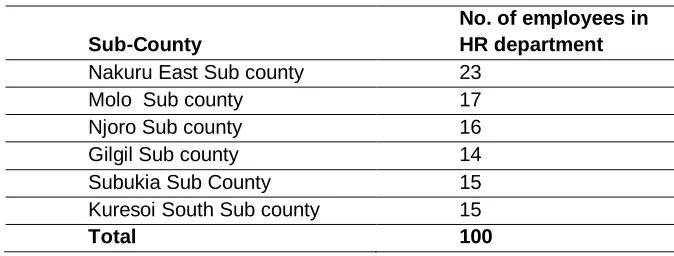
The target population for the study constituted employees attached to the HR department in Nakuru East, Njoro, Molo, Gilgil, Subukia and Kuresoi sub-County Governments. According to the Nakuru County structure the HR department is under the ministry of public service management. The target population comprised of 100 employees as shown in Table 1.
Table 1: Distribution of the Target Population
Sub-County
No. of employees in HR department
Nakuru East Sub county 23
Molo Sub county 17
Njoro Sub county 16
Gilgil Sub county 14
Subukia Sub County 15 Kuresoi South Sub county 15
Total 100
Sample and Sampling Technique
Licensed under Creative Common Page 642 Data Collection Instrument
A self-administered structured questionnaire was used to collect data from the respondents. The tool was effective since the target population mainly comprised literate individuals (Kothari, 1990). According to Orodho and Kombo (2002), the instrument is advantageous when collecting data whose confidentiality is essential. It also saved time and since the questions were presented in paper format there was no opportunity for bias in data collection from the respondents. The questionnaires also gave the respondent a clear comprehension of the questions, induced them to cooperate.
Pilot Testing
A pilot study was conducted in order to determine both the validity and reliability of the questionnaire. According to Somekh and Cathy (2005) validity is the degree by which the sample of test items represents the content the test is designed to measure. Content validity which employed in this study is a measure of the degree to which data collected using the research questionnaire represented a specific domain or content of a particular concept. Mugenda and Mugenda (2003) contend that the usual procedure in assessing the content validity of a measure is to use a professional or expert in a particular field. Hence in establishing the validity of the research instrument the opinion of the university‟s supervisor was sought. This facilitated the necessary revision and modification of the research instrument thereby enhancing validity. According to Walliman (2001), reliability refers to the consistency of measurement. The Cronbach alpha coefficient was used to test the instrument‟s reliability where the threshold was α ≥ 0.7.
Data Analysis Approach
The collected data was edited for completeness and consistency before analysis. The Statistical Package for Social Sciences (SPSS) tool was used to generate the relevant statistics for analysis.
Licensed under Creative Common Page 643 ANALYSIS & FINDINGS
Descriptive Findings
Training Strategies
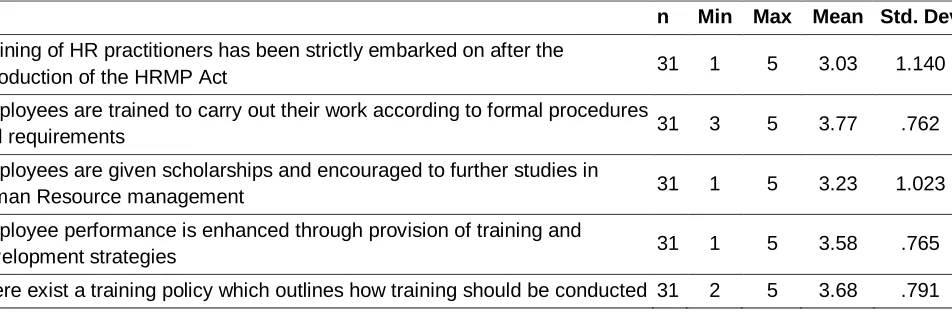
Table 2 outlines the views of the respondents regarding training strategies employed by the Nakuru County Government.
.
Table 2: Descriptive Statistics for Training Strategies
n Min Max Mean Std. Dev
Training of HR practitioners has been strictly embarked on after the
introduction of the HRMP Act 31 1 5 3.03 1.140
Employees are trained to carry out their work according to formal procedures
and requirements 31 3 5 3.77 .762
Employees are given scholarships and encouraged to further studies in
human Resource management 31 1 5 3.23 1.023
Employee performance is enhanced through provision of training and
development strategies 31 1 5 3.58 .765
There exist a training policy which outlines how training should be conducted 31 2 5 3.68 .791
The respondents agreed (mean ≈ 4.00) that employees are trained to carry out their work according to formal procedures and requirements; employee performance is enhanced through provision of training and development strategies; and there exists a training policy which outlines how training should be conducted. However, the respondents were non-committal (mean ≈ 3.00) that training of HR practitioners has been strictly embarked on after the introduction of the HRMP Act; and that employees are given scholarships and encouraged to further studies in human resource management.
Performance of Human Resource Function
The opinions of the sampled respondents regarding issues touching on the performance of HR function are outlined in Table 3.
Table 3: Descriptive Statistics for Performance of Human Resource Function
n Min Max Mean Std. Dev
Licensed under Creative Common Page 644 The findings indicated that respondents agreed (mean ≈ 4.00) that there is fully-fledged HR department in the county office; the HR department plays a key role in the County Government; all employees of the HR department understand the nature of their work; and that most employees appreciate services offered by the HR department. Yet, the respondents were not sure (mean = 3.26) whether the HR department has started implementing the HRMP Act.
Inferential Findings
The inferential findings were obtained after conducting correlation analysis between training strategies and the performance of HR function. Table 4 shows the results of the correlation between training strategies and the performance of HR function.
Table 4: Correlation between Training Strategies and Performance of HR Function
Performance of HR Function
Training Strategies Pearson Correlation .713**
Sig. (2-tailed) .000
n 31
**. Correlation is significant at the 0.01 level (2-tailed).
The relationship between training strategies and the performance of HR function was established to be positive, strong and statistically significant (r = 0.713; p < 0.01). This was interpreted to mean that training strategies play a fundamental role in the performance of HR function in Nakuru County Government. The correlation findings further led to the rejection of the second null hypothesis „The current training strategies as outlined in the new HRMP Act does not significantly enhance performance of the HR function in the County Government of Nakuru‟.
SUMMARY
Licensed under Creative Common Page 645 second null hypothesis that stated that, “current training strategies as outlined in the new HRMP Act does not significantly enhance performance of the HR function in the County Government of Nakuru”.
The findings indicated that respondents agreed that there is fully-fledged HR department in the county office; the HR department plays a key role in the County Government; all employees of the HR department understand the nature of their work; and that most employees appreciate services offered by the HR department. Yet, the respondents were not sure whether the HR department has started implementing the HRMP Act.
CONCLUSION & RECOMMENDATIONS
The Nakuru County Government employees are trained to to execute their responsibilities and tasks in accordance to a formal procedure. The study further concluded that the Government has a training policy that outlines how the staff ought to be trained. It remains unclear how the HRMP Act has been implemented in respect of training HR practitioners. Against this backdrop, the training strategies as enshrined in the Act are fundamental to the performance of the HR function in the County Government.
As part of enhancing the competence of County Government employees, there should be encouragement to staff to advance their studies by, for example, giving them paid study leaves or interest-free study loans.
REFERENCES
Apel, K-O. (1989). Normative ethics and strategic rationality. The Philosophical Problem Of Political Ethics' in The Public Realm. New York: State of New York Press.
Cole, G.A. (2002). Personnel and human resource management (5thEd). Unite Kingdom: Thomas Rennie. Farnham, D., Horton, S. & White, G. (2003). Organisational change and staff participation and involvement in britain‟s public services. International Journal of Public Sector Management, 16(6): 434-445.
Glance, N.S., Hogg, T. & Huberman, B.A. (1997). Training and turnover in the evolution of organizations. Organization Science, 8(1): 84-96.
Green, F., Felsted, A., Mayhew, K., & Pack, A. (2000). The impact of training on labour mobility: Individual and firm-level evidence from Britain. British Journal of Industrial Relations, 38(2): 261-275.
Heyes, J, & Stuart, M. (1996). Does training matter? employee experiences and attitudes. Human Resource Management Journal, 6(3): 7-21.
Jackson, C. & Sillanpaa, M. (2000). Conducting a social audit: lessons from the body shop experience' in ethical issues in contemporary human resource management. Basingstoke: Macmillan Press.
Kothari, C. R. (2004). Research methodology: methods and techniques. New Delhi: New age international limited publishers.
Licensed under Creative Common Page 646 Mugenda, O. & Mugenda, A. (2003). Research methods. quantitative and qualitative. Nairobi: University Press.
Ngechu, M. (2004). Understanding the research process and methods. An introduction to research methods. Nairobi: Acts Press.
Noe, R., Hollenbeck, J., Gerhart, B. & Wright, P, (2004). Human resource management. Gaining a competitive advantage. Boston: Irwin McGraw Hill.
Orodho, A. (2003). Essentials of education and social science research methods. Nairobi: Masola publishers.
Oswick, C. & Grant, D. (1996). Personnel management in the public sector. Personnel Review. 25(2): 4-18.
Owens, P. L. (2006). One more reason not to cut your training budget: The relationship between training and organizational outcomes. Public Personnel Management, 35(2): 163-171.
Somekh, B. & Cathy, L. (2005). Research Methods in the social sciences. London: Sage publications Inc. Walliman, N. (2001). Your research project: a step-by-step guide for the first-time researcher. London: Sage Publications Inc.