Volume-7 Issue-2
International Journal of Intellectual Advancements
and Research in Engineering Computations
Study on the performance and durability of hemp concrete
Ms.A.Bhavani, Dr.Ke.A.Palaniappan, Ms.S.Aruljothy, J.Vino
Department of Civil Engineering, Dhanalakshmi Srinivasan Engineering College, Perambalur
ABSTRACT
The fibers are most effective material to concrete strength. Hemp (Cannabis sativa) is a n agricultural crop that can be used as a building material. Hemp concrete has many advantages as a building material but it is not load-bearing and must be used in combination with a load-bearing wooden frame. In this project Cylinders, Prisms, and Cubes of standard dimensions have been made to introduce hemp Fiber with varying mix ratio such as 0.25%, 0.50%, 0.75%. Various tests are conducted to find the property of the hemp concrete materials. The main test such as Compressive Strength for Concrete and S plit Tensile Strength for Concrete and Flexural Strength for Concrete have been conducted. On comparing the results of Hemp fiber Concrete with that of conventional concrete, 0.50% additionally adding of Hemp Fiber showed maximum compressive Strength value at 28 days 12.8%, and the Split Tensile Strength value at 28 days 58.28%. Mechanical properties like Flexure Strength and Durability properties have been conducted. Study of microstructure of concrete is also determined.
Keywords:
Hemp Fiber, Addition of Hemp Fiber, Compressive Strength, Split Tensile Strength, Flexural Strength.INTRODUCTION
The most of the natural fibers are have been also investigated such the fibers are Wood, Sisal, Jute, Bamboo, Coconut, Asbestos and Rock Wool, are examples that have been used and investigated. The natural fibers are used to increasing the flexural strength and also providing a ductile post-cracking behaviour, especially for the industrial hemp samples. Similar to the compression tests, specimens prepared with 0.75 or 1% hemp fibers and 20% reduction in coarse aggregate provided relatively good results.
MATERIALS USED
Cement
The processed sand is marketed in three grades (Grade I, Grade II, and Grade III). Fine aggregate is normally considered material that will pass through sieve having 4.75 mm (No.4) mesh. River sand, (Grading zone-II conforming to IS: 383-1987) was used as fine aggregates in the experimental investigation.
Hemp fiber
Hemp (botanical name: Cannabis sativa) is a waste material from the agricultural production. General chopped hemp size used is 1.0-2.5, Because of its highly porous structure and strong capillarity effects inside the tubes, hemp is able to absorb large amounts of water (up to 10 times its own weight). Hemp aggregate absorbs big quantities of water (325% of its own weight at 24
Copyrights © International Journal of Intellectual Advancements and Research in Engineering Computations, The qualities of water samples are uniform and
potable condition. The pH value ranging from 6-8 and the water content is free from the organic matter and the solid content should be within the permissible limit conforming to IS 3025-1964.
The coarse aggregate is taken from the crushed Basalt rock, conforming as per IS: 383 was to be used. Coarse aggregate were used in this project 20 mm and retained in 4.75 mm sieve.
MATERIALS PROPERTIES
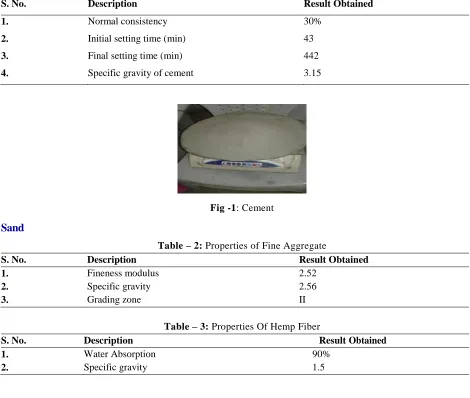
Table – 1: Properties Of Cement
S. No. Description Result Obtained
1. Normal consistency 30%
2. Initial setting time (min) 43
3. Final setting time (min) 442
4. Specific gravity of cement 3.15
Fig -1: Cement
Sand
Table – 2: Properties of Fine Aggregate
S. No. Description Result Obtained
1. Fineness modulus 2.52
2. Specific gravity 2.56
3. Grading zone II
Table – 3: Properties Of Hemp Fiber
S. No. Description Result Obtained
1. Water Absorption 90%
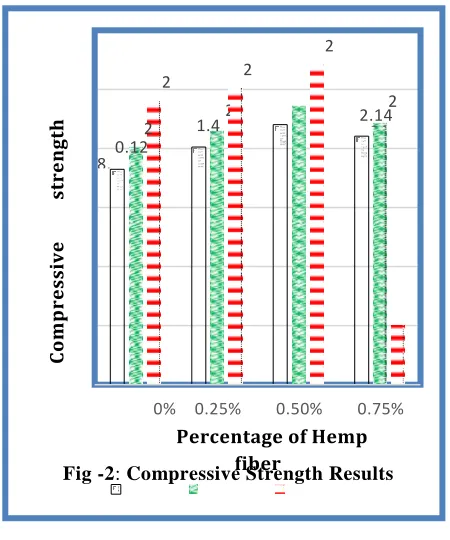
Fig -2: Compressive Strength Results
RESULTS AND DISCUSSION
Compression test
The Compressive strength depends on water-cement ratio, water-cement strength, quality of material, and quality control during production of concrete.
Test specimen of cube size is 150mm×150mm×150mm were casted and cured for 28 days in tap water. After the specimens are dried in open air, subjected to Cube Compression Testing Machine. The results were reported, the
Cube Compressive Strength (𝑓𝑐𝑢) was computed
from the fundamental principle as Calculation
Compressive strength is calculated using the following formula
𝒇𝒄𝒖= load at failure / Cross sectional area = P/As (N/𝑚𝑚2)
Where,
P = Load at failure (N)
As = Area of the specimen (𝑚𝑚2)
Table – 4: Compressive Strength of Concrete with Hemp Fiber S.No. Addition of Hemp
fiber %
Compressive strength (fck ) N/𝒎𝒎𝟐
7th day 14th day 28th day
1 0% 18.25 20.12 24.04
2 0.25% 20.13 21.45 25.12
3 0.50% 22.03 23.65 27.12
4 0.75% 21.05 22.14 26.09
C o m p re ss iv e st re n gt h N /m m 2 3 0 2 5 2 2. 2 2.14 21. 2 0 2 0.12 2 2 1.4 20 1 5 1 0
0% 0.25% 0.50% 0.75%
Copyrights © International Journal of Intellectual Advancements and Research in Engineering Computations,
Split tensile strength test
Determination of split tensile strength of concrete specimens, and the cylinder specimens of diameter to length ratio1:2 was selected, with diameter as 150 mm and the length as 300 mm. After the specimens are dried in open air, subjected to split tensile test under universal testing machine. The rate of loading was adjusted as 0.11 to 0.023 MPa/sec as per ASTM C496-90.while testing the specimens, plywood pieces one at the top and the other at the bottom. The split
Fsp = 2P/πDL (N/mm2) Where,
P = load at failure (N).
D = Diameter of specimen (mm). L = Length of specimen (mm).
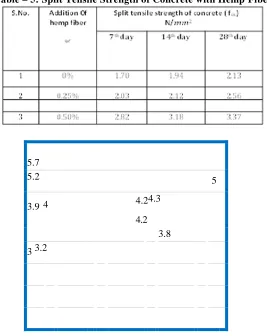
0.50% Hemp fiber the Compressive Strength
value is 3.37 N/mm2, the strength was gradually
increased and reduced to 3.01N/mm2 for 0.75% addition of Hemp fiber. Strength increment is 0.50% more than the nominal mix when Hemp fiber is added upto 0.75%and this percentage the strength decreases.
Fig -3: Split Tensile Strength Results
6 .6
0
% Percentage of Hemp 25%0. 50%0. 75%0.
fiber
7 days 14 days 28 days
Fl
ex
u
ra
l
St
re
n
gt
h
N
/m
m
2
3.37 3.18
3.01
2.82 2.92
2.56 2.13 2.023.1
1.94 2 2.12
1.7
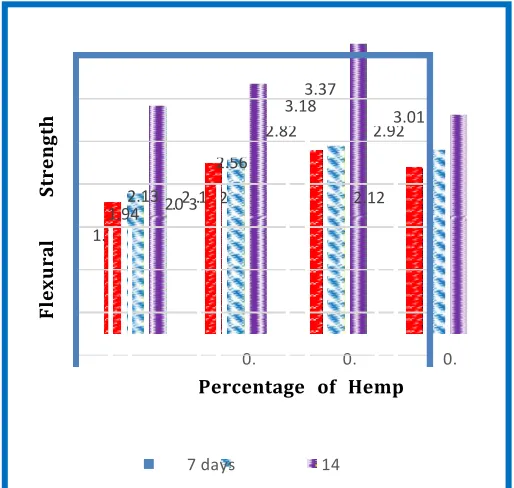
Fig -4: Flexural Strength Result
Table – 5: Split Tensile Strength of Concrete with Hemp Fiber
5.7
5.2 5
3.9 4 4.24.3
4.2
3.8
3 3.2
Sp
li
t
T
en
si
le
St
re
n
gt
h
N
/m
m
Copyrights © International Journal of Intellectual Advancements and Research in Engineering Computations,
Flexural strength test
The beam specimen of size 100mm x 100mm x 500 mm were casted to determine the Flexural strength of concrete with various percentages of Hemp Fiber. Specimens were dried in open air after 28 days at curing and it is subjected to
rupture occurs. The fracture indicated in the tension surface within the middle third at span length. Finally the Flexural strength is calculated by using simple bending equation the bending stress
σ = Pl/𝑏𝑑2 (N/mm2)
Table – 6: Flexural Strength of Concrete with Hemp Fiber S.No. Addition Of hemp fiber
%
Flexural strength of concrete ( fck ) N/𝒎𝒎𝟐
7th day 14th day 28th day
1 0% 3.0 4.0 5.2
2 0.25% 3.2 4.1 5.7
3 0.50% 4.2 4.3 6.6
4 0.75% 3.8 4.2 5.6
In 14th day curing, the flexural strength value for the control concrete was 3.2 MPa and Hemp Fiber
-0.25% was 4.0 and beyond this percentage of adding of hemp Fiber, strength was gradually increased 4.3 MPa for 0.50% addition of Hemp Fiber and the Flexural strength was gradually decreased 4.2 MPa for 0.75 % addition of Hemp Fiber.
In 28th day curing the flexural strength value for the control concrete was 5.2 MPa and Hemp Fiber-0.25% was 5.7 MPa and beyond this percentage of adding of Hemp Fiber, strength was gradually increased and reaching
6.6 MPa for 0.50% addition of Hemp fiber and the Flexural strength was gradually decreased 5.6 MPa for
0.75 % addition of Hemp Fiber.
CONCLUSION
On performing the various test is Mechanical properties, Durability properties are studied and the following conclusions are arrived.
On comparing the results of Hemp concrete with that of conventional concrete, 0.50% additionally adding of Hemp fiber showed maximum Compressive strength value.
On 0.50% addition of Hemp concrete, the Compressive Strength is 20.7%, 17.5% and 12.8% higher than that of the conventional concrete at 7 days, 14 days and 28 days curing respectively.
On comparing the results of Hemp concrete with that of conventional concrete, 0.25%,0.50% and 0.75% additionally adding for Hemp fiber showed maximum Compressive strength value at 28 days 4.49%, 12.8% and 8.52%.
The Split Tensile Strength of Concrete percentage is 65.8%, 63.97% and 58.2%, additionally added for Hemp fiber 0.50%. Hence the Split Tensile Strength value is
higher than that of the conventional concrete at 7 days, 14 days and 28 days curing respectively.
On comparing the results of Hemp concrete with that of conventional concrete, 0.25%, 0.50% and 0.75% additionally adding for Hemp fiber showed maximum Split Tensile Strength value at 28 days 20.18%, 50.21% and 41.31%.
Hence it is concluded that the optimum amount of Hemp fiber is 0.50% which shows improved Mechanical, Durable properties of Hemp concrete.
Hemp fiber 0.50%. Hence the Flexural Strength value is higher than that of the conventional concrete at 7 days, 14 days and 28 days curing respectively.
Hence it is concluded that the Optimum amount of Hemp fiber is 0.50 % which shows improved Mechanical, Durable and Microscopic properties for Hemp Fiber Concrete.
REERENCES
[1]. Awwad, E., Hamad, B., Mabsout, M., and Khatib, H. (2012a). “Sustainable Concrete using Hemp
Fibers,” Institution of Civil Engineers Journal - Construction Materials.
[2]. Awwad, E., Mabsout, M., Hamad, B., Farran, M., and Khatib, H. (2012b). “Studies on Fiber-Journal -
The Construction and Building Materials, Elsevier, Vol. 35, October 2012, pp.710-717.
[3]. Awwad, E., Mabsout, M., Hamad, B., and Khatib, H. (2011). “Preliminary Studies on the Use of
Natural Fibers in Sustainable Concrete,” Journal - The Lebanese Association for the Advancement of Science, Vol. 12, Issue No. 1, June 2011, pp.109-117.
[4]. Awwad, E., Choueiter, D., & Khatib, H. (2013). Concrete Masonry Blocks Reinforced with Local Industrial Hemp Fibers and Hurds. Journal - Eco Build Hemp Construction.
[5]. Boutin, M.-P., Flamin, C., Quinton, S., Gosse, G. & Inra, L. (2005). Study of 42 the environmental characteristics of hemp for the analysis of its life cycle.
[6]. Evrard, A. & De Herde, A. (2005). Bioclimatic envelopes made of lime and hemp concrete. CISBAT 2005, September 2005, Ecole Polytechnique Fédérale de Lausanne, Switzerland.
[7]. Evrard, A., De Herde, A. & Minet, J. (2006). Dynamical interactions between heat and mass flows in Lime-Hemp Concrete. 3rd International Building Physics Conference, Montreal.
[8]. Karni, J. & Karni, E. (1995). Gypsum in hemp concrete construction- origin and properties. Journal - Materials and Structures, vol. 28(176), pp.92-100.