Overview of the Second BUCC Shared Task:
Spotting Parallel Sentences in Comparable Corpora
Pierre Zweigenbaum
LIMSI, CNRS, Universit´e Paris-Saclay,
F-91405 Orsay, France
Serge Sharoff
University of Leeds, Leeds, United Kingdom
Reinhard Rapp
Magdeburg-Stendal University of Applied Sciences and University of Mainz, Germany
Abstract
This paper presents the BUCC 2017 shared task on parallel sentence extrac-tion from comparable corpora. It re-calls the design of the datasets, presents their final construction and statistics and the methods used to evaluate system re-sults. 13 runs were submitted to the shared task by 4 teams, covering three of the four proposed language pairs: French-English (7 runs), German-English (3 runs), and Chinese-English (3 runs). The best F-scores as measured against the gold standard were 0.84 (German-English), 0.80 (French-(German-English), and 0.43 (Chinese-English). Because of the design of the dataset, in which not all gold par-allel sentence pairs are known, these are only minimum values. We examined man-ually a small sample of the false negative sentence pairs for the most precise French-English runs and estimated the number of parallel sentence pairs not yet in the pro-vided gold standard. Adding them to the gold standard leads to revised estimates for the French-English F-scores of at most +1.5pt. This suggests that the BUCC 2017 datasets provide a reasonable approximate evaluation of the parallel sentence spotting task.
1 Introduction
Shared tasks and the associated datasets have proved their worth as a driving force in a num-ber of subfields of Natural Language Process-ing. However, very few shared tasks were orga-nized on the topic of comparable corpora. There-fore, we endeavored to design and organize shared tasks as companions of the BUCC workshop
se-ries on Building and Using Comparable Corpora. The First BUCC Shared Task (Sharoff et al.,
2015) tackled the detection of comparable doc-uments across languages. The Second BUCC Shared Task,1presented here, addresses the
detec-tion of parallel sentences across languages in non-aligned, monolingual corpora.
Let us recall the overall goals, design and prin-ciples of this task, which were introduced in (Zweigenbaum et al.,2016). A bottleneck in sta-tistical machine translation is the scarceness of parallel resources for many language pairs and do-mains. Previous research has shown that this bot-tleneck can be reduced by utilizing parallel por-tions found within comparable corpora (Utiyama and Isahara,2003;Munteanu et al.,2004; Abdul-Rauf and Schwenk, 2009). These are useful for many purposes, including automatic terminol-ogy extraction and the training of statistical MT systems. However, past work relied on meta-information, such as the publication date of news articles or inter-language links in Wikipedia docu-ments, to help select promising sentence pairs be-fore examining them more thoroughly. It is there-fore difficult to separate the heuristic part of the methods that deals with this meta-information in clever ways from the cross-language part of the methods that deals with translation and compara-bility issues. We consider that the latter type of methods is more fundamental and wanted to fo-cus on its evaluation. We thus designed a task in which no meta-information is available on the relation between the two monolingual corpora in which pairs of translated sentences are to be found. In (Zweigenbaum et al.,2016) we showed the difference of this task to PAN’s cross-language plagiarism detection (Potthast et al., 2012), Se-mEval’s cross-language semantic text similarity 1https://comparable.limsi.fr/bucc2017/
bucc2017-task.html
(Agirre et al., 2016), and WMT’s bilingual doc-ument alignment (Buck and Koehn,2016).
The present paper reports the actual organiza-tion of the task as a companion to the BUCC 2017 workshop. We describe the final method we used to prepare bilingual corpora in four language pairs: Chinese-English, French-English, German-English, and Russian-English (Section 2), the evaluation method (Section 3), the participants’ systems (Section 4), the results they obtained (Section5), and conclude (Section6).
2 Corpus preparation
The challenges we faced to prepare corpora for a parallel sentence spotting shared task, and the measures we took to address them, were the fol-lowing.
1. Given two monolingual corpora, it would be very long for human evaluators to find all sentence pairs that are translations of each other. Therefore we decided to insert known parallel sen-tence pairs into existing monolingual corpora. We chose Wikipedia articles (20161201 dumps 2) as
our monolingual corpora and News Commentary (v113) as our source for parallel sentence pairs. In
the remainder of this section we use French and English as a running example of a language pair.
2. These inserted parallel sentence pairs should not be trivially detectable in the monolingual cor-pora. Therefore we strove to insert sentences that are coherent with the context in which they are inserted. In this purpose we aimed to select as insertion points sentences that were similar in topic to the inserted sentences. We implemented this by indexing with the Solr search engine each English sentence of the monolingual corpus (English Wikipedia dump, converted to text and split into sentences) and each French sentence of the monolingual corpus (French Wikipedia dump, converted to text and split into sentences). For each sentence pair in the parallel corpus (French-English News Commentary), we queried Solr to find the most similar French sentence and En-glish sentence for this pair; if hits were found for both languages, we recorded as insertion point for the French parallel sentence the French sentence found, and as insertion point for the English paral-lel sentence the English sentence found. We
per-2http://ftp.acc.umu.se/mirror/
wikimedia.org/dumps/
3http://www.casmacat.eu/corpus/
news-commentary.html
formed the actual insertion after all parallel sen-tence pairs were thus processed.
Additionally, a different distribution of sentence lengths in the original monolingual sentences and in the inserted sentences might give hints about the origin of a sentence. Therefore we aimed at having similar distributions of sentence lengths for both the Wikipedia sentences and the News Com-mentary sentences. In this purpose, we excluded sentences outside a range of lengths (we kept sen-tences between 20 and 40 words long).
We also tried to reduce trivial typographical differences that may be revealing of the source of a sentence, such as the use of certain quota-tion marks and certain systematic conversion is-sues found in Wikipedia texts after conversion from their Wiki source. In this purpose we cus-tomized an existing Wikipedia conversion tool, WikiExtractor.py,4 to include sentence splitting
(with NLTK). Since template processing was the cause of a large number of idiosyncrasies in the converted Wikipedia text, we removed the sen-tences that contained a template.
3. The original monolingual texts should con-tain as few ‘natural’ parallel sentence pairs as pos-sible. Since interlinked Wikipedia articles are a common source of parallel sentence pairs, we en-sured that a given dataset never contained sen-tences from such a pair of documents.
4. When the two sentences in a parallel pair are inserted in the monolingual corpora, there is no particular reason for them to be positioned in sim-ilar locations in the two corpora. Therefore, once a corpus has been generated this way, splitting it into training and test would be likely to separate a number of parallel pairs. Besides, an additional smallsamplesplit was also needed for prospective participants to examine data and decide whether they would be interested, extending the problem further.
To prevent this problem, we split each pair of monolingual corpora, before indexing and parallel sentence insertion, into sample, training and test corpus pairs, respectively with 2%, 49% and 49% of the full corpora (the number and sizes of these splits are specified as parameters to the algorithm). Given as input two sets of Wikipedia pages, the algorithm randomly distributes them into the N splits according to the specified probabilities. It
4https://github.com/attardi/
Pair Sample (2%) Training (49%) Test (49%)
fr en gold fr en gold fr en gold
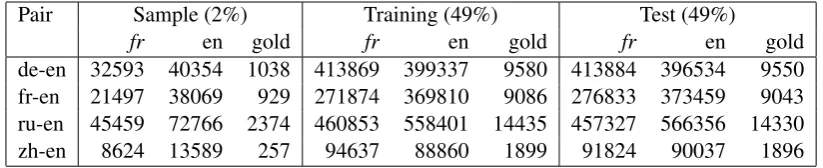
[image:3.595.93.505.62.146.2]de-en 32593 40354 1038 413869 399337 9580 413884 396534 9550 fr-en 21497 38069 929 271874 369810 9086 276833 373459 9043 ru-en 45459 72766 2374 460853 558401 14435 457327 566356 14330 zh-en 8624 13589 257 94637 88860 1899 91824 90037 1896 Table 1: Corpus statistics: number of monolingual sentences (fr, en) and of parallel pairs (gold) for each split and each language pair. Thefrcolumn stands for the non-English language in each pair.
Name Affiliation Language pairs
VIC Vicomtech-IK4, Donostia / San Sebastian, Gipuzkoa, Spain de-en (3), fr-en (3) RALI RALI - DIRO, Universit´e de Montr´eal, Montr´eal, Qu´ebec, Canada fr-en (3) JUNLP Department of Computer Science and Engineering, Jadavpur University, India fr-en (1) zNLP LIMSI, CNRS, Universit´e Paris-Saclay, Orsay, France zh-en (3)
Table 2: Shared task systems
also ensures that no interlinked pair of pages is dis-tributed to the same split. Indexing, searching and sentence insertion were then performed on each split separately. Since the training and test sets for a given language pair were generated with the same process and parameters, they received very similar numbers of parallel sentence pairs.
This process was applied to five languages (Chi-nese (zh), English (en), French (fr), German (de), Russian (ru)) to produce four bilingual datasets, each split into sample, training, and test data. Ta-ble1shows the statistics of the resulting datasets.
3 Evaluation method
Given two sentence-split monolingual corpora, participant systems were expected to identify pairs of sentences that are translations of each other. Each team was allowed to submit up to three runs per language pair.
Evaluation was performed using balanced F-score. In the results of a system, a true positive TP is a pair of sentences that is present in the gold standard and a false positive FP is a pair of sen-tences that is not present in the gold standard. A false negative FN is a pair of sentences present in the gold standard but absent from system re-sults. Precision, Recall and F1-score were then computed using the usual formulas.
Of note, this evaluation is performed on the syn-thetic corpus presented above, using the inserted parallel sentence pairs as the gold standard. There-fore it does not take into account the possible exis-tence of true parallel pairs present in the
monolin-gual corpora beyond the inserted sentence pairs. By avoiding aligned Wikipedia articles, the con-struction of the corpus attempted to reduce the likelihood of such sentence pairs, but indeed it did not suppress it altogether. For these reasons we also performed a limited experiment in which hu-man judges evaluated selected samples of the sys-tem results. The assessment of each sentence pair was performed according to the guidelines of the SemEval 2016 cross-language sentence similarity task (Agirre et al.,2016).
4 Participants and systems
About 17 teams downloaded datasets, among which four teams submitted runs: VIC (Spain) (Azpeitia et al.,2017), RALI (Canada) (Gr´egoire and Langlais, 2017), JUNLP (India) (Mahata et al.,2017), and LIMSI (France: ‘zNLP’) (Zhang and Zweigenbaum,2017). Table2gives more de-tail about teams and runs.
All systems had to include a way to cope with the bilingual dimension of the task. This was addressed with pre-existing dictionaries (LIMSI), machine translation systems (JUNLP, LIMSI), word alignments obtained from parallel corpora (VIC), or bilingual word embeddings trained from parallel corpora (RALI).
sentences (VIC, LIMSI).
JUNLP (Mahata et al., 2017) implemented a baseline method that translates the FR corpus with a Machine Translation system, selects candidate sentence pairs with a suitable length ratio, and chooses the final sentence pairs based on Cosine similarity.
zNLP (Zhang and Zweigenbaum,2017) used a bilingual dictionary to perform word-level trans-lation of the ZH corpus, complemented by calls to an on-line Machine Translation system. They used the Solr search engine to index sentences and search for similar sentences, collecting a number of candidate translations for each ‘source’ sen-tence. They selected the best translation (or none) by training a classifier with Solr score and rank, word overlap, and sentence length features.
RALI (Gr´egoire and Langlais, 2017) experi-mented with a deep learning framework. They trained bilingual word embeddings with Bil-BOWA (Bilingual Bag-of-Words without Align-ments (Gouws et al.,2015)) on the Europarl paral-lel corpus, represented source and target sentences in this common space and used Cosine similarity to select candidate parallel sentence pairs. They also trained a bidirectional recurrent neural net-work with gated recurrent units (BiGRU) on both the source and target languages to build sentence-level continuous representations. They learned a linear transformation of these representations from one language to the other and decided on the par-allelism of two sentences based on the compar-ison of their continuous representations through this transformation.
VIC (Azpeitia et al., 2017) used probabilistic dictionaries acquired by word alignment of par-allel corpora to translate each corpus. They used the Lucune search engine to index sentences and search for similar sentences, collecting a number of candidate translations for each ‘source’ sen-tence, in both directions. Final sentence simi-larity is computed by their STACC method (Set-Theoretic Alignment for Comparable Corpora, (Etchegoyhen and Azpeitia,2016)), which extends basic word overlap by taking into account non-matched words that share a long enough common prefix, as well as numbers and capitalized true-cased tokens. STACC measures word overlap with the Jaccard coefficient. They refined the STACC method by taking into account lexical weights that penalize frequent words.
5 Results and discussion
We first present an evaluation based upon the in-serted translation pairs (Section5.1) then an addi-tional evaluation based upon human judgment of sample system results (Section5.2)
5.1 Automatic evaluation
We present here the evaluation results for the sub-mitted runs for each language in turn. As ex-plained above, these results are based on the ar-tificially inserted translation pairs. In each table we show the precision, recall and F1-score of each run in percentages. Because this synthetic dataset represents an approximation of a real task, there is no point in computing precise scores: we round the computed percentages to the nearest integer.
Additionally, we observed that some partici-pants took into account the prior probability of translation pairs in the training datasets. Given that the test dataset was announced to be gener-ated in the same way as the training dataset, they targeted a number of translation pairs in the test that was consistent with this prior probability. We therefore display this number of translation pairs in the tables too.
Three teams submitted runs on the French-English (fr-en) language pair. In addition to these runs, Table 3 presents the minimum, maximum, median, mean and standard deviation for each measure. The initial JUNLP submission had a bug which was fixed a couple of days later; we show the results of the fixed submission in italics, but did not include it in the additional statistics. The VIC results confirm the strategy described in
run name sys n P (%) R (%) F1 (%)
VIC1 8831 80 79 79
VIC2 7569 87 73 79
VIC3 10768 70 83 76
RALI2 47576 12 63 20
RALI1 57761 10 66 18
RALI3 66201 9 63 15
JUNLP1 38736 3 11 4
min 7569 9 63 15
median 29172 41 70 48
mean 33118 45 71 48
max 66201 87 83 79
[image:4.595.309.520.542.720.2]stddev 24062 34 7 30
Table 3: Evaluation of fr-en runs (n gold=9,043)
VIC1 for F1-score, VIC2 for precision, and VIC3 for recall; the results for German also display the same pattern. The three runs RALI2, RALI1 and RALI3 produce an increasing number of candi-date pairs, resulting in a decrease in precision; this leads to an increase in recall only for RALI1, but always to a decrease in F1-score. Reasons for the lower precisions and (to a lesser extent) recalls of the RALI results are proposed in (Gr´egoire and Langlais, 2017), including the handling of num-bers (improved in their later experiments) and the selection of negative training examples.
Only one team submitted runs on the German-English (de-en) language pair, therefore we do not report min, max and other statistics. The re-sults are displayed in Table4. The precisions and
run name sys n P (%) R (%) F1 (%)
VIC1.de-en 8640 88 80 84
VIC3.de-en 9949 82 85 84
VIC2.de-en 7586 92 73 82
Table 4: Evaluation of de-en runs (n gold=9,550)
F1-scores obtained by VIC for German-English are higher than those they obtained for French-English, with similar recalls. The only difference in the two corpora in terms of statistics is that the German-English dataset was more balanced in its numbers of monolingual sentences, but other dif-ferences linked to the intrinsic properties of Ger-man and French or to the resources used to train the system for these two languages are likely to have an effect too.
One team submitted runs on the Chinese-English (zh-en) language pair, therefore we do not report min, max and other statistics. The results are displayed in Table5. According to (Zhang and
run name sys n P (%) R (%) F1 (%)
zNLP1 1985 42 44 43
zNLP3 1526 46 37 41
zNLP2 1900 19 19 19
Table 5: Evaluation of zh-en runs (n gold=1,896)
Zweigenbaum, 2017), zNLP3 was optimized for precision: this is confirmed by its results on the test set. Overall, the results are lower than the best runs on the fr-en and de-en datasets. Various hy-potheses can be proposed to account for this differ-ence, including the different types and sizes of the resources used for translation in VIC and zNLP,
the specific methods used in the two systems, and differences in intrinsic language properties.
5.2 Complementary human evaluation
Were we to know which ‘natural’ translation pairs existed in the test datasets beyond the translation pairs we inserted, would the results be very dif-ferent? We did not have resources to perform an extensive human evaluation to answer this ques-tion, therefore we designed a minimal experiment on the French-English language pair.
In the VIC and RALI runs, we selected the run with the best precision and randomly drew 20-pair samples. A French native speaker with good command of English examined each sample and scored it according to the grades used in the SemEval 2016 cross-language sentence similarity task (Agirre et al.,2016): (5) The two sentences are completely equivalent, as they mean the same thing; (4) The two sentences are mostly equiva-lent, but some unimportant details differ; (3) The two sentences are roughly equivalent, but some important information differs or is missing; (2) The two sentences are not equivalent, but share some details; (1) The two sentences are not equiv-alent, but are on the same topic; (0) The two sen-tences are on different topics. To check agree-ment, the first two 20-pair samples were scored by a second French native speaker. Besides, in a few situations, the first judge was sometimes un-sure whether to give a score or the next higher score. In these situations, he entered two alternate scores: this created a second series of judgments which differed only in a few places. Altogether, five batches were examined: three for VIC and two for RALI, and for each batch, we had two series of judgments.
For VIC, we sampled 60 sentence pairs from the 978 false positives of the most precise run, Run 2. Out of these sentence pairs, 3–5 were con-sidered as perfect translations (grade 5) and an ad-ditional 8–13 were judged as near-perfect transla-tions (grade 4).
extrapolated these percentages to the whole set of false positives to obtain the number of human-judged true positives that should be added to the automatically evaluated true positives (+TP). We used this additional number to recompute the true positives and the associated precision (P’). Recall cannot be recomputed this way, because to esti-mate the recall for both automatic and ‘natural’ translation pairs, we would need to draw a sam-ple from the full test corpus, and given the low prevalence of ‘natural’ translation pairs, this sam-ple should be quite large. Table6shows the
corre-Evaluation T%FP +TP P’ (%) F1’ (%) base (auto) 0.0 0 87.1 79.4
5 (min) 5.0 49 87.7 79.6
5 (max) 8.3 82 88.2 79.8
4–5 (min) 18.3 179 89.4 80.3 4–5 (max) 30.0 293 91.0 80.9
Table 6: Re-evaluation of precision for VIC’s Run 2. ‘T%FP’ is the percentage of human-assessed good translations in the false positives.
sponding evolution of precision. For information we also recomputed the F1-score (F1’, still with-out changing the recall). We observe that preci-sion is reevaluated with an increase of up to 4pt, whereas F1-score gains up to 1.5pt. This differ-ence cannot be ignored for a precise evaluation, but does not bring drastic changes to the overall conclusions of the shared task.
For RALI, we sampled 40 sentence pairs from the 41,865 false positives of the most precise run, Run 2. Out of these sentence pairs, none was considered as perfect translations nor near-perfect translations (most were related though). This is consistent with the fact that RALI2’s precision was seven times lower than that of VIC2: a much larger sample might be needed to evidence ‘natu-ral’ translation pairs in RALI2’s output.
This limited experiment suggests that ‘natu-ral’ translation pairs are much less frequent in the French-English test set than our artificially inserted translation pairs (or that the VIC2 sys-tem is much better at spotting the inserted transla-tion pairs than ‘natural’ translatransla-tion pairs): Table6
shows that out of 7569 sentence pairs proposed by VIC2, 87% were inserted translation pairs and between 0.6% and 4% were ‘natural’ translation pairs. This would extrapolate to a rate of less than 5% of ‘natural’ translation pairs among the total
translation pairs in the corpus.
An important limitation of this experiment is that it examined only a limited sample of sen-tence pairs, which entails large confidence inter-vals around the reported values. To compute these confidence intervals, we would need to know more or to make hypotheses about the distribution of ‘natural’ translation pairs not only in the system-returned sets of sentence pairs, but also outside these sets, which would require more time.
6 Conclusion
We presented the design and results of the sec-ond BUCC 2017 Shared Task, which consisted in spotting parallel sentences in comparable corpora. Some participants proposed creative methods, and the best results are quite high, with precisions, re-calls and F1-scores between 80% and 88% de-pending on the language pair. The participants’ papers contain directions for further improvement of their methods and results.
To alleviate the need for costly human evalua-tion, we designed a dataset in which known par-allel sentence pairs have been inserted into mono-lingual corpora. Two risks were associated with this strategy. First, some participants might have tried to ‘game’ the task by attempting to discover the inserted sentences, for instance using plagia-rism detection methods; we are glad that no par-ticipant seems to have done so. Second, whereas we could control the inserted translation pairs and try to reduce the likelihood of occurrence of ‘nat-ural’ translation pairs, we could not fully prevent some from occurring; human examination of sam-ple results from the best runs suggests that ‘natu-ral’ translation pairs add only a few percents to the inserted translation pairs, confirming the overall relevance of the BUCC 2017 Shared Task dataset and evaluation.
The BUCC 2017 Shared Task dataset and evalu-ation program can be downloaded from the shared task’s Web page.5
Acknowledgments
We thank the participants for the time they in-vested in this task and L´eonard Zweigenbaum for his help in assessing the French-English transla-tions. This work was partially funded by the Eu-ropean Union’s Horizon 2020 Marie Sklodowska 5https://comparable.limsi.fr/bucc2017/
Curie Innovative Training Networks—European Joint doctorate (ITN-EJD) Under grant agreement No:676207 (MiRoR). Part of this work was sup-ported by a Marie Curie Career Integration Grant within the 7th European Community Framework Programme.
References
Sadaf Abdul-Rauf and Holger Schwenk. 2009.
Exploiting comparable corpora with TER and TERp. In Proceedings of the 2nd Workshop on Building and Using Comparable Corpora: From Parallel to Non-parallel Corpora. Asso-ciation for Computational Linguistics, Strouds-burg, PA, USA, BUCC ’09, pages 46–54.
http://dl.acm.org/citation.cfm?id=1690339.1690351. Eneko Agirre, Carmen Banea, Daniel Cer, Mona
Diab, Aitor Gonzalez-Agirre, Rada Mihalcea, Ger-man Rigau, and Janyce Wiebe. 2016. SemEval-2016 Task 1: Semantic textual similarity, mono-lingual and cross-mono-lingual evaluation. In Proceed-ings of the 10th International Workshop on Semantic Evaluation (SemEval-2016). Association for Com-putational Linguistics, San Diego, California, pages 497–511. http://www.aclweb.org/anthology/S16-1081.
Andoni Azpeitia, Thierry Etchegoyhen, and Eva Mart´ınez Garcia. 2017. Weighted set-theoretic alignment of comparable sentences. InProceedings of the 10th Workshop on Building and Using Com-parable Corpora. Association for Computational Linguistics, Vancouver, Canada, pages 46–50.
http://www.aclweb.org/anthology/W/W17/W17-1009.
Christian Buck and Philipp Koehn. 2016. Findings of the WMT 2016 bilingual document alignment shared task. InProceedings of the First Conference on Machine Translation. Association for Computa-tional Linguistics, Berlin, Germany, pages 554–563.
http://www.aclweb.org/anthology/W16-2347. Thierry Etchegoyhen and Andoni Azpeitia. 2016.
Set-theoretic alignment for comparable corpora. In Proceedings of the 54th Annual Meeting of the Association for Computational Linguistics (Volume 1: Long Papers). Association for Computational Linguistics, Berlin, Germany, pages 2009–2018.
http://www.aclweb.org/anthology/P16-1189. Stephan Gouws, Yoshua Bengio, and Greg Corrado.
2015. BilBOWA: Fast bilingual distributed rep-resentations without word alignments. In Francis Bach and David Blei, editors, Proceedings of the 32nd International Conference on Machine Learn-ing. Lille, France, volume 37 of JMLR Workshop and Conference Proceedings.
Francis Gr´egoire and Philippe Langlais. 2017. BUCC 2017 Shared Task: a first attempt toward a deep
learning framework for identifying parallel sen-tences in comparable corpora. In Proceedings of the 10th Workshop on Building and Using Com-parable Corpora. Association for Computational Linguistics, Vancouver, Canada, pages 51–55.
http://www.aclweb.org/anthology/W/W17/W17-1010.
Sainik Mahata, Dipankar Das, and Sivaji Bandy-opadhyay. 2017. BUCC2017: A hybrid approach for identifying parallel sentences in compa-rable corpora. In Proceedings of the 10th Workshop on Building and Using Compara-ble Corpora. Association for Computational Linguistics, Vancouver, Canada, pages 61–64.
http://www.aclweb.org/anthology/W/W17/W17-1012.
Dragos Stefan Munteanu, Alexander Fraser, and Daniel Marcu. 2004. Improved machine translation perfor-mance via parallel sentence extraction from compa-rable corpora. In Daniel Marcu Susan Dumais and Salim Roukos, editors, HLT-NAACL 2004: Main Proceedings. Association for Computational Lin-guistics, Boston, Massachusetts, USA, pages 265– 272.
Martin Potthast, Tim Gollub, Matthias Hagen, Johannes Kiesel, Maximilian Michel, Arnd Oberl¨ander, Martin Tippmann, Alberto Barr´on-Cede˜no, Parth Gupta, Paolo Rosso, and Benno Stein. 2012. Overview of the 4th international competition on plagiarism detection. In Pamela Forner, Jussi Karlgren, and Christa Womser-Hacker, editors,CLEF 2012 Evaluation Labs and Workshop, Online Working Notes, Rome, Italy, September 17-20, 2012. CEUR-WS.org, volume 1178 of CEUR Workshop Proceedings. http://ceur-ws.org/Vol-1178/CLEF2012wn-PAN-PotthastEt2012.pdf.
Serge Sharoff, Pierre Zweigenbaum, and Reinhard Rapp. 2015. BUCC shared task: Cross-language document similarity. InProceedings of the Eighth Workshop on Building and Using Comparable Cor-pora. Association for Computational Linguistics, Beijing, China, pages 74–78.
Masao Utiyama and Hitoshi Isahara. 2003. Reli-able measures for aligning japanese-english news articles and sentences. In Proceedings of the 41st Annual Meeting of the Association for Com-putational Linguistics. Association for Computa-tional Linguistics, Sapporo, Japan, pages 72–79.
https://doi.org/10.3115/1075096.1075106.
Zheng Zhang and Pierre Zweigenbaum. 2017. zNLP: Identifying parallel sentences in Chinese-English comparable corpora. In Proceedings of the 10th Workshop on Building and Using Compa-rable Corpora. Association for Computational Linguistics, Vancouver, Canada, pages 56–60.
Pierre Zweigenbaum, Serge Sharoff, and Reinhard Rapp. 2016. Towards preparation of the second BUCC shared task: Detecting parallel sentences in comparable corpora. InProceedings of the Ninth Workshop on Building and Using Comparable Corpora. European Language Resources Associ-ation (ELRA), Portoroˇz, Slovenia, pages 38–43.