Abstract— The evolution of information and communication technologies and its introduction into production processes are transforming traditional industry, bringing it to a new level of organizational development. In order to avail the benefits of these technologies to strengthen competitiveness in the global market, a new paradigm is being discussed worldwide. Industry 4.0 or 4th Industrial Revolution are some of the terms used to describe the implementation of "smart" devices that can communicate autonomously along the value chain. In this approach, machines use self-optimization, self-configuration, and artificial intelligence to provide better quality goods and services. In this context, the overall goal of the study is to intensify the discussion and provide an overview of Industry 4.0 to show how combination of advanced technologies and internet can create new opportunities to overcome the current industrial challenges.
Index Terms— CPS, IoT, industry 4.0, smart factory.
I. INTRODUCTION
n the last decades, the development of information and communication technologies (ICT) and its integration into production processes, brought benefits for the entire value chain. The evolution in the capacity of these technologies has leverage industrial productivity, reducing production costs and providing effective solutions to serve customers with quality, speed and cost / benefit [1]. Faced these recent technological developments and a scenario in which there is an increasing demand for customized products, greater complexity, higher quality and reduced costs; the emergence of a new industry model is being discussed worldwide under the topic of Industry 4.0 [2].
Considered by some academics and entrepreneurs as the 4th industrial revolution [3], Industry 4.0 is one of the terms used to describe a high-tech strategy promoted by the
This work has been supported by the project Centro-01-0145-FEDER-000017 - EMaDeS - Energy, Materials and Sustainable Development, co-financed by the Portugal 2020 Program (PT 2020), within the Regional Operational Program of the Center (CENTRO 2020) and the European Union through the European Regional Development Fund (ERDF). The authors wish to thank the opportunity and financial support that permitted to carry on this project. and C-MAST/ Centre for Mechanical and Aerospace Science and Technologies. project UID / EMS / 00151/2013 C-MAST, POCI-01-0145-FEDER-007718.
B. Paiva Santos is the Corresponding Author, is a researcher with the C-MAST and EMaDeS at University of Beira Interior, Electromechanical Department ([email protected]).
F. Charrua-Santos is Professor at University of Beira Interior, Electromechanical Department and member of C-MAST; Adress: Calçada Fonte do Lameiro, Ed. I das Eng, Electromechanical Dept., 6200-001 Covilhã (Tel: 275329754, e-mail: [email protected])).
T.M. Lima is Professor at University of Beira Interior, Electromechanical Department and member of C-MAST; Adress: Calçada Fonte do Lameiro, Ed. I das Eng, Electromechanical Dept., 6200-001 Covilhã (Tel: 275329754, e-mail: [email protected])).
German government that is being implemented by the industry. With implications at all levels of production systems, it encompasses a set of state-of-the-art technologies linked to the internet to make them more flexible and collaborative. In this context, technologies like Cyber-physical systems (CPS) self-organize, monitor processes and create a virtual copy of the real world. Internet of Things (IoT) connects machines, objects and people in real time and Cloud Computing offers storage solutions as well as exchange and management of information allowing production and business processes to be combined to create value for the organizations. These new production structures, equipped with "intelligent" devices connected to the network, where products, machines and production systems obtain communication capabilities, constitute as intelligent factories of the future and are a key to reach the degree of flexibility to overcome the current challenges high variability, customization and reduction of product life cycles.
It is already widely accepted that technologies related to Industry 4.0 will have a significant impact on current industries and the construction of industries of the future [4]. However, companies wishing to carry out a transition to a digitally integrated production model proposed by the Industry 4.0 should evaluate their skills and adapt their strategies to implement them in the appropriate scenarios. Taking this step will involve meeting certain requirements such as: answering security and digital protection issues; standardization of communication interfaces; processes and organization of work; availability of trained labor force; insertion of SMEs; training and professional development; technological basis; research and investment [5].
Thus, whereas some companies are eager to introduce new technologies to improve the quality, efficiency and effectiveness of resources, reduce risks and maintain market competitiveness [6], [7]; there is still a need for a deeper understanding on the subject, in order to facilitate a transition to this new approach. The overall objective of this article is to intensify the discussion and provide an overview of the state of the art of Industry 4.0 and its implications. As specific objectives, it aims to investigate the main features, the current challenges and how emerging technologies can provide opportunities for added value for both organizations and society.
II. INDUSTRY 4.0
A. Background
The industrial sector has always been crucial to the economic development of countries. Since the end of the
Industry 4.0: An Overview
B. Paiva Santos, F. Charrua-Santos, T.M. Lima
18th century, industries have gone through massive changes that revolutionized a way how products are manufactured and brought various benefits, mainly related with productivity increase.
Nowadays, after three industrial revolutions, the combination of advanced technologies and internet is again transforming the industrial landscape and is being called the 4th Industrial Revolution or Industry 4.0 [8].
The Industry 4.0 topic emerges as a long-term strategy of the German government, which was adopted as part of the High-Tech Strategy 2020 Action Plan in 2011 [9], to ensure the competitiveness of its industry. Since then, the German government has institutionalized its commitment to industry in creating a platform led by Ministries of Economics and business, science and trade representatives [2]. The German strategic initiative to apply disruptive ICT innovations in the manufacturing environment has opened up such a wide range of technological opportunities and challenges, which was easily adopted by the European Union in its H2020 program [10] and by other countries under the most diverse names, for example "Industrial Internet" [11] in the United States of America (USA) and "Internet +" [12] in China.
In other words, Industry 4.0 represents a natural evolution of previous industrial systems, from the mechanization of labor in the 18th century to the automation of production in current days. In recent years, the application of automation and information systems such as ERP (Enterprise Resource Planning) and MES (Manufacturing Execution System) have significantly improved productivity in factories. However, there is still a gap in the communication between the ERP level and the shop floor. The data are not exchanged in real time, which leads to delays in decision-making. Faced with the challenges in which current industrial production is, where end customers require increasingly customized products and in small lots, the current production paradigm is not sustainable [13]. In order to achieve flexibility and efficiency, as well as low energy and cost savings in the industrial processes, companies need an integrated framework that allows access to information in real time, not only at the production level, but also beyond the boundaries of the company. Continuously updated information-based decision making enables faster reaction to market changes, improving products and services, customer relationships, reducing wastes and costs and consequently it will impact on profits.
B. Concept
The Industry 4.0 topic emerges from the overlapping of several technological developments involving products and processes [14]. Since the German government presented the Industry 4.0 as one of its main initiatives to take a lead in technological innovation, several academic publications, articles and conferences have been discussing this topic [15]. Reference [16] describes it as a revolution enabled by the widespread application of advanced technologies at the production level to bring new values and services to customers and to the organization itself. The concept takes into account the disruptive potential of the integration of physical objects in the information network that is
revolutionizing the traditional transformation industry [5]. In a holistic view, the Industry 4.0 approach represents a paradigm shift in production processes and business models, setting a new level of development and management for organizations.
C. Technologies
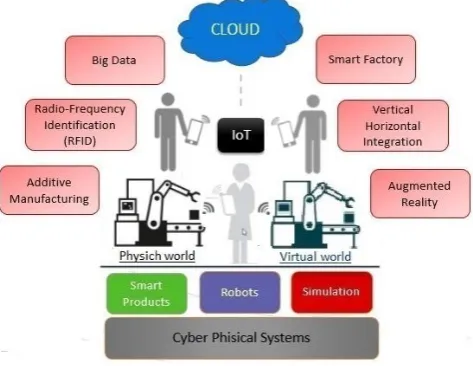
[image:2.595.308.545.520.703.2]In the context of Industry 4.0, CPS consists of "smart" objects (e.g., machines, products or devices) that exchange information autonomously, working in collaboration with the physical world around them. "Smart products”, identified through Radio-Frequency Identification (RIFD) tags, provide information about their location, history, status, and routes. This information allows workstations to "know" which manufacturing steps are being performed for each product and the adaptation needed to perform a specific task. IoT makes all this process easier. IoT connects all these devices to an internet network, allowing the collection of a complex and large sets of data and the exchange of information in real time. For example, through of IoT it is possible to perform the monitoring of the industrial equipment's performance. From information generated by the equipment, invisible problems such as machine degradation or wear of components can be detected. The Internet of Services (IoS) presents a similar approach, but uses services rather than physical entities. "Through IoS, internal and inter-organizational services are offered and used by value chain participants" [2]. With the help of technologies such as Big Data and Cloud Computing, it is possible to provide scalable computing power to store and analyze data from multiple sources and customers to support decision making, optimize operations, save energy, and improve system performance, from design to distribution. Moreover, to allow employees to access them from anywhere is through a tablet or smartphone [17]. The Fig. 1 shows a framework to related technologies of Industry 4.0.
Fig. 1. Technologies related to Industry 4.0.
quantity and complexity, it brings benefits in terms of volume, time and costs. By creating products by adding materials layer by layer, the AM breaks with traditional techniques like machining, bringing greater flexibility to the production environment. The additive processes also allow a greater freedom of design, disregarding the limitations of the previous manufacturing techniques. It is the design that will determine the production and not the other way around. Thus, it provides new functionalities to provide solutions in the manufacture of small batches of complex products, with a high degree of customization, even in mass production environments. In addition, it enables the product development cycle to be shortened until its market launch and to reduce waste, resulting in more efficient processes [19].
The adoption of this technology can also enable a competitive and sustainable local manufacturing. How is expected that labor cost divergences decrease gradually [20], it will possible focusing on establishing local manufacturing industries, mainly where the proximity of the manufacturer to the final customer is critical [20]. However, despite additive manufacturing technology opens up new opportunities, in many instances, the cost of producing a product using additive manufacturing processes exceeds that of traditional methods [21]. Therefore, AM is not intended to completely replace traditional processes, but rather to complement existing processes to help overcome their challenges (eg, multi-material, new geometry, multifunctional).
D. Smart Factory
Smart factory is an industry-leading solution for achieving flexible production objectives, such as time-to-market requirements, production volume targets and cost-saving strategy [22] in dynamic production environments and increasing complexity. Through the cooperation of the above-mentioned technologies, it will be possible to move from a centralized production model to a decentralized model, where materials and machinery can communicate with one another and make autonomous decisions. The result will be "smart" value creation networks capable of responding almost automatically to market changes.
In these connected factories of the future, physical prototypes will be less important. The improvement of the computational potential (clusters and cloud), is increasing the potential of the simulation approaches as important tools of analysis and feedback to support decision making in real-time [23]. Through factory-wide sensing it will be possible to leverage real-time data to build the physical world into a virtual model, which could include machines, products, and humans. This will enable operators to test and optimize machine configurations for the next in-line product in the virtual world prior to their physical transition, thereby reducing machine configuration times and increasing quality [17], besides the safety of production in terms of time and costs.
However, to achieve the vision proposed by the Industry 4.0, it is necessary to integrate the different stages of manufacturing. According [5], the logic underlying of this
industrial transformation involves three types of integration: i) Vertical integration - occurs within Smart Factory, where the cooperation between different hierarchies of information subsystems forms a self-organized system that can be dynamically reconfigured to adapt to different types of products [24]; ii) Horizontal integration - occurs through value networks, it will use new technologies to exchange and manage information among stakeholders, allowing closer collaboration between customers, suppliers and business partners in order to create an efficient ecosystem; iii) End-to-end digital integration - enabled by vertical and horizontal integrations. Thus, it contributes to narrowing the gap between the different stages of manufacturing, as the collection of product information throughout its life cycle is essential to support personalized customer demands.
III. OUTCOMES
With a very ambitious potential, Industry 4.0 promises increased flexibility, mass customization, increased speed, better quality, and improved productivity in manufacturing [25] enabling companies to cope with the global challenges and personalized needs and still to remain profitable. Recent trends like globalization of markets and pressures of meet customer needs require production equipment and processes that be able to adapt more agile and flexible to new products and product variants [26] to gain competitive strength. In this context, the emerging information and communications technologies that will make up the smart factory of future, can help to implement a suitable production mode to achieve these goals. For instance, as sensors, computers and networked machines can communicate easily with each other and with their users in real time, manufacturing processes will become more visible and monitorable, reducing failure rates, which result in more quality and efficiency. Another trend is, that how manufacturing companies and service providers will work more closely together, combining products and services [20], they can sell their know-how or other services, instead of selling end products, allowing other companies or partners to use their skills and knowledge as a service to develop their own product [16].
Some mainly outcomes of this new wave of industrial production include:
- Mass customization, where production must be capable of producing very low or even unitary batches to meet the needs of each customer, improving competitiveness;
- Greater flexibility, enabling the production chain to quickly responsive to change in demands;
- Quality control, through of end-to-end visibility it will possible to optimize processes, inventories, resources and consequently reduce costs;
- New opportunities with the emergence of innovative business models and services that contribute to new forms of value chain interaction (e.g., digital platforms);
- Optimized decision making, due to the use of "smart" products and devices capable of knowing and updating their status, allowing the tracking of production in real time;
and operating in the factory, enabling workers to have a more flexible and diversified career and thus to keep them productive for longer.
IV. CHALLENGES
The increase of the digitalization in the production systems determines changes in the whole value chain, from the way in which the raw materials are acquired until their final use and recovery [27]. The concepts and visions mentioned above are very promising prospects for a near technological development. However, despite the joint effort expended by governments, organizations and academics, and proven success stories, there is still a long, winding road ahead and questions that must be answered before this digital revolution can become a reality.
According [5] security and digital protection; the standardization of communication interfaces; processes and organization of work; the availability of cognitive ability and the SME appear as one of the biggest concerns of companies when it comes to including Industry 4.0 in their business strategy. In addition, collaboration also poses a major challenge to achieve the vision of Industry 4.0
A. Security and Digital Protection
Industries want to keep products, production and their workers safe. To ensure this, they should protect information about customers, suppliers, organizational strategies, and know-how, as well the machines and physical devices. Not to be overlooked is the amount of "smart" devices that are and will be connected to the cloud, which also pose security risks. These confidential materials may be disclosed, for instance, by hackers, which may cause huge profit loss or even legal disputes [24]. In the smart factory context, where autonomous communication between devices prevails, procedures must be established to ensure a level of security appropriate to the risks it represents and the nature of the data to be protected. This involves safeguarding intellectual property, personal data and privacy, operability, environmental protection and workers' health and safety [5] and requires collaboration between governments, IT organizations and industries, working as partners in the development of mechanisms particularly designed to these new environments and promoting best practices.
B. Standardization
Standardization is identified as one of the most important challenges in the implementation of Industry 4.0. In order to ensure the interoperability of systems and to reach their full potential, it is essential to adopt a reference architecture that provides a technical description of standards and enables effective communication between all users and processes, integrating the production, systems and stakeholders of management. Given this, open standards will be crucial in environments 4.0. For example, in the last decade, the introduction of IoT in production systems has contributed to increase the high-volume, heterogeneity and speed of the data generated at the level of production [16]. Without a
standardized approach to analyzing, processing and storing this information, data generated in different formats would remain incompatible worldwide and the 4.0 approach would be limited to local production, restricting its ability to realize economies of scale and achieve productivity gains [5].
C. Work Organization
In a 4.0 environment it will require changes in the organization of work. To this end, the production environment must be adaptable to the process level [16], in order to support the flexibility to provide more personalized products at a reduced cost. For a more competitive view, companies must recognize the strategic importance of workers. Organizations can foster the creativity and skills of workers using the machines to perform monotonous and repetitive tasks or difficult ergonomics and so take advantage of each one's strengths. In this context, novel multimodal HMI can change the current operation of machines and factories by workers [4]. It will allow new modes of interaction (voice-based, gesture recognition) adapted to new work restrictions and oriented from a user perspective. For example, systems based on augmented reality (AR) can incorporate HMI interfaces and assist in cooperation between workers and robots. These are intelligent and multimodal assistance systems capable of putting people at the center of production [16]. Moreover, with data collected from smart machines, the AR interface can reflect the status of a machine as well as the processing behaviors through a visualized model in real time [25], helping to support decision making process by workers.
D. Cognitive Ability
One of the most critical challenges facing Industry 4.0 is related to people. The new scenarios will have significant implications for the nature of the work, as it will transform design, manufacturing, and operation of products and services into production systems [28]. These transformations are the result of the emergence of highly sophisticated technological systems that will increasingly require workers with specific skills [9]. In addition to the technical aspects, this trend also involves a relevant social character. It is well known that as has happened in previous revolutions, new employments will arise, due the emergence of novel business models and others will just disappear. It is therefore imperative that governments invest in research to anticipate what the effects of new ICT technologies will be on the employments of the future, and then it will possible design who will be the workers in the smart factory era. The same way, companies that are committed to the Industry 4.0 paradigm will have to invest in ongoing training and professional development programs that enable operators to deal with new tools and technologies and enable them to systematically capture and reuse their knowledge to remain effective.
E. Small and Medium Enterprises (SME)
value chains by increasing data collection to monitor production [29]. The digitization of SME aims to enable partners throughout the supply chain to: improve products and/or services; reduce costs; manage operations more efficiently by monitoring production performance; improve competitiveness (access to useful data and information and better response to market needs) [5]. To this end, it is necessary to sensitize SME to the opportunities offered by the Industry 4.0 paradigm and to the unequivocal added value that such cooperation can offer under dynamic boundary conditions and in increasingly complex environments. For example, to stay connected to the production chain and to preserve its competitiveness, SME can follow the example of large multinational companies and groups and adopt their technologies and ways of working [5]. SME can also integrate existing supply chains and take advantage of their know-how or focus on mobile and decentralized production units using 3D printing technologies. This integration enables partners to develop common projects based on Open Source platforms, accelerating time to market, innovation and minimization of risks.
F. Collaboration
As reported in [9], collaboration is one of the focuses in the era of Industry 4.0. Such collaboration can exist at various levels inside smart factory and among the most varied players, for example with other industries, research institutions or even business partners. To gain competitive advantage, companies must consider that they can collaborate for the same purpose to gain mutual benefits. In this context, recently a new type of collaboration in manufacturing has attracted attention. Through the Crowdsourced, as it is known, companies can share their manufacturing resources according to their demand or capacity [30]. Services like Cloud solutions will be crucial to this collaborative environment, as it will possible access data analysis not only across plants but across the value chain from anywhere. This way, suppliers can access data in real time, improving resource planning and reducing bursting or overstocking situations [31]. Another type of collaboration, such as engaging customers through feedback or direct customization in manufacturing processes, can lead to product improvements and customer relationships. All these examples prove that collaboration is an important driver to innovation in production.
V. SUMMARY
Industry 4.0 emerges from the overlap of various technological developments. This new paradigm, which faces the challenge of being highly automated and cost-effective, as well as producing custom products in a mass-production environment, has the potential to alter the role of traditional assembly lines by modifying the way goods are produced and services offered.
However, the current debate about Industry 4.0 has yet to give some definitive answers. Despite the considerable amount of material describing the potential of the new
generation of ICTs as enabling technologies for Industry 4.0 environments, many companies still do not have a clear understanding of their implementation and in the face of challenges that still need to be overcome, do not feel prepared to embrace on this new strategy. Issues such as standardization, new forms of work, security and digital protection, cognitive ability and the insertion of SMEs, still need to be systematically answered and analyzed to create an ecosystem that favors the transition to this new environment. In conclusion, Industry 4.0 will mainly involve a change of mentality. As in previous Industrial Revolutions, new processes, products and business models will emerge and consequently will have large social, economic and technological impacts. The fact is that regardless of the hesitation and distrust of this new phenomenon, Industry 4.0 is already happening, so governments, industry professionals, academics and other interested parties must be united to support and contribute to the success of this new paradigm, which promises to redesign the map of industrial production systems.
REFERENCES
[1] C. Cheng, T. Guelfirat, C. Messinger, J. Schmitt, M. Schnelte and P. Weber, "Semantic degrees for industrie 4.0 engineering: deciding on the degree of semantic formalization to select appropriate technologies," in Proc. 10th Joint Meeting on Foundations of Software Engineering (ESEC/FSE 15), Italy, 2015, pp. 1010–1013. [2] M. Hermann, T. Pentek and B. Otto, "Design principles for industrie
4.0 scenarios: a literature review," in Proc.49th Hawaii International Conference on System Sciences (HICSS), USA, 2016, pp. 3928–3937. [3] Bitkom, Vdma and ZVI;, "Implementation strategy industrie 4.0,”
Frankfurt, Report on the results of the industrie 4.0 platform, 2016. [4] J. Posada et al., "Visual computing as a key enabling technology for
industrie 4.0 and industrial internet," IEEE Computer Graphics and Applications, vol. 35, no. 2, pp. 26–40, Mar.-Apr. 2015.
[5] J. Smit, S. Kreutzer, C. Moeller and M. Carlberg, “Industry 4.0,” Policy department A: economic and scientific policy, Rep. European Parliament's Committee on Industry, Research and Energy (ITRE), 2016.
[6] M. Falk, M. Klien and G. Schwarz, “Large manufacturing firms plan to increase their investments in 2015. Results of the wifo spring 2015 investment survey,” WIFO Monatsberichte (monthly reports), vol.88, no.7, pp. 581–591, 2015.
[7] G. Tassey, “Competing in advanced manufacturing: the need for improved growth models and policies,”Journal of Economic Perspectives, vol.28, no.1, pp. 27–48, 2014.
[8] H. Lasi, P. Fettke, H.G. Kemper, T. Feld and M. Hoffmann, “Industry 4.0,” Business & Information Systems Engineering, vol.6, no.4, pp. 239–242, 2014.
[9] H. Kagermann, W. Wahlster and J. Helbig, “Recommendations for implementing the strategic initiative industrie 4.0,” Acatech -Nacional Academy of Science and Engineering, Frankfurt, Final Rep. of the industrie 4.0 working group. Abr. 2013.
[10] European Commission. Horizon 2020: the EU framework programme for research and innovation. (accessed 2017, May). Available: https://ec.europa.eu/programmes/horizon2020/
[11] The Industrial Internet Consortium: A global nonprofit partnership of industry, government and academia, 2014. Available:
http://www.iiconsortium.org/about-us.htm.
[12] K.Q.Li, “Report on the work of the government,” in Proc. Third session of the 12th nacional people’s congress, China, March, 2015. [13] E. Alkaya, M. Bogurcu, F. Ulutas and G.N. Demirer, “Adaptation to
climate change in industry: emproving resource efficiency through sustainable production applications,” Water Environment Research, vol.87, no.1, pp.14–25, Jan. 2015.
[15] T. Bauernhansl, M. Ten Hompel and B. Vogel-Heuse, Industrie 4.0 in Produktion, Automatisierung und Logistik. German: Springer Vieweg, 2014.
[16] A. Khan and K. Turowski, “A survey of current challenges in manufacturing industry and preparation for Industry 4.0,” in Proc. First International Scientific Conference “Intelligent Information Technologies for Industry” (IITI’16), Russia, 2016, pp.15–26. [17] M. Bahrin, F. Othman, N. Azli and M. Talib, “Industry 4.0: a review
on industrial automation and robotic,” Jurnal Teknologi, vol. 78, no.6-13, pp.137–143, 2016.
[18] European Commission. High performance production through 3D-printing. (accessed 2017, Apr.). Available:
http://s3platform.jrc.ec.europa.eu/high-performance-production-through-3d-printing
[19] M. Cotteleer, J. Holdowsky, and M. Mahto, “The 3D opportunity primer: the basics of additive manufacturing,” Deloitte University Press, 2013.
[20] European Commission, “Advancing manufacturing – Advancing Europe,” Commission Staff Working Document, Brussels, Rep. of the task force on advanced manufacturing for clean production, Mar. 2014.
[21] D.S. Thomas and S.W. Gilbert, “Costs and cost effectiveness of additive manufacturing-a Literature review and discussion,” Nacional Institute of Standards and Technology, US Department of Commerce, Dec. 2014.
[22] G. Urbikain, A. Alvarez, L.N. López de Lacalle, M. Arsuaga, M. A. Alonso and F. Veiga, “A reliable turning process by the early use of a deep simulation model at several manufacturing stages,” Machines, vol.5, no.2, pp.15, 2017.
[23] J. Xu, E. Huang, L. Hsieh, L.H. Lee, Q.-S. Jia and C.-H. Chen, “Simulation optimization in the era of Industrial 4.0 and the Industrial Internet,” J Simulation, vol.10, no.4, pp. 310-320, 2016.
[24] S. Wang, J. Wan, D. Li and C. Zhang, “Implementing smart factory of Industrie 4.0: an outlook,” Int. Journal of Distributed Sensor Networks, vol. 12, no.1, pp. 1-10, 2016.
[25] P. Zheng, H. Wang, Z. Sang, et al., “Smart manufacturing systems for Industry 4.0: conceptual framework, scenarios, and future perspectives,” Front. Mech. Eng., 2018.
[26] H. Cheng, P. Zeng, L. Xue, Z, Shi, P. Wang and H. Yu, “Manufacturing ontology development based on Industry 4.0 demonstration production line,” Third International Conference on Trustworthy Systems and Their Applications(TSA), Sept. 2016. [27] Deloitte, “Industry 4.0: an introduction”, Rep., Holanda, 2015. [28] P. Gerbert, M. Lorenz, M. Rüßmann, et al., “Industry 4.0: the future
of productivity and growth in manufacturing industries,” Rep. The Boston Consulting Group (BCG), German, Apr. 2015.
[29] European Commission. SMEs to the Industry 4.0. (accessed 2017, Apr.). Available:
http://s3platform.jrc.ec.europa.eu/sme-integration-to-industry
[30] T. Kaihara, Y. Katsumura, Y. Suginishi and B. Kádár, “Simulation model study for manufacturing effectiveness evaluation in crowdsourced manufacturing,” CIRP Annals – Manufacturing Techonology, vol.66, no.1, pp. 445-448, 2017.