A P r o b a b i l i s t i c M o d e l f o r T e x t C a t e g o r i z a t i o n :
B a s e d o n a S i n g l e R a n d o m V a r i a b l e w i t h M u l t i p l e V a l u e s
M a k o t o I W A Y A M A
Advanced Research Laboratory
Hitachi Ltd.
HATOYAMA
SAITAMA 350-03, JAPAN
i w a y a m a © h a r l , h i t a c h i . co. j pA b s t r a c t
Text categorization is the classification of documents with respect to a set of prede- fined categories. In this paper, w e propose a new probabilistic model for text catego- rization, that is based on a
Single random
Variable with Multiple Values
(SVMV). Com- pared to previous probabilistic models, our model has the following advantages; 1) it considers within-document term frequencies, 2) considers term weighting for target docu- ments, and 3) is less affected by having insuf- ficient training cases. We verify our model's superiority over the others in the task of cat- egorizing news articles from the "Wall Street Journal".1
I n t r o d u c t i o n
Text categorization is the classification of documents with respect to a set of predefined categories. As an example, let us take a look at the following article from the "Wall Street Journal" (1989/11/2).
McDermott International, Inc. said its Bab- cock & Wilcox unit completed the sale of its Bailey Controls Operations to Finmeccanica S.p.A for $295 million. Finmeccanica is an Italian state-owned holding company with in- terests in the mechanical engineering indus- try. Bailey Controls, based in Wickliffe, Ohio, makes computerized industrial controls sys- tems. It employs 2,700 people and has annual revenue of about $370 million.
Two categories (topics) are manually assigned to this article; " T E N D E R OFFERS, MERGERS, ACQUISI- TIONS (TNM)" a n d "COMPUTERS AND INFORMA- TION TECHNOLOGY (CPK)." While there may be cer- tain rules or standards for categorization, it is very difficult for human experts to assign categories con- sistently and efficiently to large numbers of daily in- coming documents. The purpose of this paper is to propose a new probabilistic model for automatic text categorization.
Takenobu T O K U N A G A
Department of Computer Science
Tokyo Institute of Technology
2-12-1, OOKAYAMA, MEGURO-KU
TOKYO 152, JAPAN
t a k e @ c s , t i t ech. ac. j pWhile many text categorization models have been proposed so far, in this paper, we concentrate on the probabilistic models (Robertson and Sparck Jones, 1976; Kwok, 1990; Fuhr, 1989; Lewis, 1992; Croft, 1981; Wong and Yao, 1989; Yu et al., 1989) because these models have solid formal grounding in probabil- ity theory. Section 2 quickly reviews the probabilis- tic models and lists their individual problems. In sec- tion 3, we propose a new probabilistic model based on a
Single random Variable with Multiple Values
(SVMV). Our model is very simple, but solves some problems of the previous models. In section 4, we verify our model's superiority over the others through experi- ments in which we categorize "Wall Street Journal" articles.2 A Brief Survey of Probabilistic Text
Categorization
In this section, we will briefly review three major prob- abilistic models for text categorization. Originally, these models have been exploited for information re- trieval, but the adaptation to text categorization is straightforward.
In a model of probabilistic text categorization,
P(cld ) =
"the probability that a document d is categorized into a category c" (1) is calculated. Usually, a set of categories is defined be- forehand. For every document di, probabilityP(cldi )
is calculated and all the documents are ranked in decreas- ing order according to their probabilities. The largerP(cldi)
a documentdi
has, the more probably it will be categorized into category c. This is called theProb-
abilistic Ranking Principle
(PRP) (Robertson, 1977). Several strategies can be used to assign categories to a document based on PRP (Lewis, 1992).There are several ways to calculate
P(c[d).
Three representatives are (Robertson and Sparck Jones,1976), (Kwok, 1990), and (Fuhr, 1989).
2.1 P r o b a b i l i s t l c R e l e v a n c e W e i g h t i n g ( P R W )
probability
P(c]d).
P(cld)
g(cld )
= log P(~ld) (2)where ~ means "not c", that is "a document is not categorized into c." Since this is a monotonic transfor- mation of
P(cld),
P R P is still satisfied after transfor- mation.Using Bayes' theorem, Eq. (2) becomes
P(d]c)
P(c)
g(cld )
= log ~ + log p(~). (3)Here,
P(c)
is the prior probability that a document is categorized into c. This is estimated from given train- ing data, i.e., the number of documents assigned to the categoryc. P(dl c)
is calculated as follows. If we as- sume that a document consists of a set ofterms
(usually nouns are used for the first approximation) and each term appears independently in a document,P(dlc )
is decomposed toP(dlc)
= l-~
P(T/ = lie)l'~
P ( ~ = 01e) (4)tied t j E e - d
where " c - d" is a set of terms that do not appear in d but appear in the training cases assigned to c. "ti" represents the name of a term and "T/ = 1, 0" represents whether or not the corresponding term '2i" appears in a document. Therefore, P ( T / = 1, 0[c) is the probability that a document does or does not contain the term ti, given that the document is categorized into c. This probability is estimated from the training data; the number of documents that are categorized into c and have the term tl. Substituting Eq. (4) into Eq. (3) yields
P ( ~ = lie )
g(cld) =
log P(T,
1re)
tiedP(e)
+ log
+ ,--, \ - P(Tj = 01c )
log
tieZe-'Ce_d P ( ~ = 0l~ )
(5)
We refer to Robertson and Sparck Jones' formulation
as Probabilistic Relevance Weighting
(PRW).While P R W is the first attempt to formalize well- known relevance weighting (Sparck Jones, 1972; Salton and McGill, 1983) by probability theory, there are sev- eral drawbacks in PRW.
[ P r o b l e m 1] n o w i t h i n - d o c u m e n t t e r m fre- q u e n c i e s
P R W does not make use of within-document term frequencies.
P ( T
= 1, 01c) in Eq. (5) takes into account only the existence/absence of the term t in a document. In general, frequently appearing terms in a document play an important role in information retrieval (Salton and McGill, 1983). Salton and Yang experimentally verified the importance of within-document term fre- quencies in their vector model (Salton and Yang, 1973).[ P r o b l e m 2] n o t e r m w e i g h t i n g for target d o c u m e n t s
In the P R W formulation, there is no factor of term weighting for target documents (i.e.,
P(.Id)).
Accord- ing to Eq. (5), even if a term exists in a target docu- ment, only the importance of the term in a category (i.e.,P ( T
= lie)) is considered for overall probability. Term weighting for target documents would also be necessary for sophisticated information retrieval (Fuhr, 1989; Kwok, 1990).[ P r o b l e m 3] a f f e c t e d b y h a v i n g insufficient training c a s e s
In practical situations, the estimation of
P ( T =
1, 01c ) is not always straightforward. Let us consider the following case. In the training data, we are given R documents that are assigned to c. Among them, r documents have the term t. In this example, the straightforward estimate of
P ( T
-- llc ) is " r / R . " If "r = 0" (i.e., none of the documents in c has t) and the target document d contains the term t,g(c[d)
be- comes - 0 % which means that d is never categorized into c. Robertson and Sparck Jones mentioned other special cases like the above example (Robertson and Sparck Jones, 1976). A well-known remedy for this problem is to use"(r +
0 . 5 ) / ( R + 1)" as the estimate ofP ( T
= lie ) (Robertson and Sparck Jones, 1976). While various smoothing methods (Church and Gale, 1991; Jelinek, 1990) are also applicable to these situa- tions and would be expected to work better, we used the simple "add one" remedy in the following experi- ments.2.2 C o m p o n e n t T h e o r y ( C T )
To solve problems 1 and 2 of PRW, Kwok (1990) stresses the assumption that a document consists of terms. This theory is called the
Component Theory
(CT).
To introduce within-document term frequencies (i.e., to solve problem 1), C T assumes that a document is completely decomposed into its constituting terms. Therefore, rather than counting the number of docu- ments, as in P R W , C T counts the number of terms in a document for probability estimation. This leads to within-document term frequencies. Moreover, to in- corporate term weighting for target documents (i.e., to solve problem 2), C T defines
g(cld ) as
the geometric mean probabilities over components of the target doc- ument d;P(dlc) =
[YIP(TIc)]~
~ P(Tl'c) J "
Following Kwok's derivation,
g(cld)
becomesg(cld) = E P ( T =
tld)(logP ( T - tic )
P ( T ¢ tic)
t e d
P ( T ~ tl'd)~
P(c)
log
P ( T -- ~-~" +
log p ( ~ ) .(6)
+
(7)
For precise derivation, refer to (Kwok, 1990).
Here, note t h a t P ( T = rid ) and P ( T = tic ) represent the frequency of a t e r m t within a target document d and t h a t within a category c respectively. There- fore, C T is not subject to problems 1 and 2. However, problem 3 still affects CT. Furthermore, Fuhr (1989) pointed out t h a t transformation, as in Eq. (6), is not monotonic of P(cld ). It follows then, t h a t C T does not satisfy the probabilistic ranking principle ( P R P ) any more.
2.3 R e t r i e v a l w i t h P r o b a b i l i s t i c I n d e x i n g
(RPI)
Fuhr (1989) solves problem 2 by assuming that a doc- ument is probabilistically indexed by its t e r m vectors. This model is called Retrieval with Probabilistie Index-
ing (RPI).
In RPI, a d o c u m e n t d has a binary vector -- ( T 1 , . . . , Tn) where each component corresponds to a term. 7} = 1 means t h a t the d o c u m e n t d contains the t e r m ti. X is defined as the set of all possible in- dexings, where IX I = 2". Conditioning P(cld ) for each possible indexing gives
P(c[d) = Z P(cld'x)P(:rld)" (8)
~ E X
By assuming conditional independence between c and d given a~ 1 , and using Bayes' theorem, Eq. (8) becomes,
P ( ~ l c ) P ( z l d )
P(cld ) = P(c) Z P ( z ) (9)
: ~ E X
Assuming t h a t each t e r m appears independently in a target document d and in a d o c u m e n t assigned to c, Eq. (9) is rewritten as
1-I(P(7} = llc)P(7} = lid )
P(c]d) = P(c) P(7} = 1)
i
-t P(7} = 0Ic)P(T~ = 01d)).
P(7} -- 0)
(lo)
Here, all the probabilities are estimated from the train- ing d a t a using the same m e t h o d described in Sec- tion 2.1.
Since Eq. (10) includes the factor P ( T = 1,01d) as well as P ( T = 1,01c), R P I takes into account t e r m weighting for target documents. While this in prin- ciple solves problem 2, if we use a simple estimation m e t h o d counting the number of documents which have a term, P ( T = 1,0]d) reduces to 1 or 0 (i.e, binary, not weighted). For example, when a target docu- ment d has a t e r m t, P ( t = 1]d) = 1 and when not,
P ( T = lid ) = 0. In the following experiments we used this binary estimation method, but non binary esti- mates could be used as in (Fuhr, 1989).
1More precisely, P( cld , x) = P( c[x ) which assumes that if we know x, information for c is independent of that for d. This assumption sounds valid because x is a kind of representation of d.
As far as other problems are concerned, R P I still problematic. In particular, because of problem 3,
P(cld) would become an illegitimate value. In our experiments, as well as in Lewis' experiments (1992),
P(cld ) ranges from 0 to more than 101°.
3 A P r o b a b i l i s t i c M o d e l B a s e d o n a S i n g l e R a n d o m V a r i a b l e w i t h M u l t i p l e V a l u e s ( S V M V )
In this section, we propose a new probabilistic model for text categorization, and compare it to the previous three models from several viewpoints. Our model is very simple, but yet solves problems 1, 2, and 3 in PRW.
D o c u m e n t representation of our model is basically the same as CT, t h a t is a d o c u m e n t is a set of its constituting terms. T h e m a j o r difference between our model and others is the way of document characteriza- tion through probabilities. While almost all previous models assume t h a t an event space for a document is whether the document is indexed or not by a t e r m 2, our model characterizes a d o c u m e n t as r a n d o m sam- pling of a term from the t e r m set t h a t represents the document. For example, an event " T = ti" means t h a t a randomly selected t e r m from a d o c u m e n t is ti. If we want to emphasis indexing process like other models, it is possible to interpret "T = ti" as a randomly selected element from a d o c u m e n t being indexed by the t e r m ti.
Formally, our model can be seen as modifying Fuhr's derivation of P(cld ) by replacing an index vector with a single r a n d o m variable whose value is one of possi- ble terms. Conditioning P(cld ) for each possible event gives
P(cld) = ~_~ P(c]d, T = t i ) f ( T = tild). (11)
ti
If we assume conditional independence between c and d, given T = ti, t h a t is P(cid, T = ti) = P(c]T = tl),
we obtain
P(cld) = Z P(cIT = t i ) P ( T = tild). (12)
ti
Using Bayes' theorem, this becomes
Z P ( T = t i l c ) P ( T = ti Id)
P(cld) P ( c )
t, P ( T = ti) (13)
All the probabilities in Eq. (13) can be estimated from given training d a t a based on the following definitions.
• P ( T = t i l c ) is the probability t h a t a randomly selected t e r m in a d o c u m e n t is ti, given t h a t the d o c u m e n t is assigned to c. We used ~ c as the estimator. N C i is the frequency of the t e r m ti in the category c, and N C is the total frequency of terms in c.
,, P ( T = tild) is the probability t h a t a randomly selected term in a target document d is ti. We used ~ D as the estimator. N D i is the frequency of the term ti in the document d, and N D is the total frequency of terms in d.
* P ( T = ti) is the prior probability t h a t a randomly selected term in a randomly selected document is
ti. We used ~ t as the estimator. Ni is the fre- quency of the term ti in the given training doc- uments, and N is the total frequency of terms in the training documents.
• P(c) is the prior probability t h a t a randomly se- lected document is categorized into c. We used D_~ as the estimator. Dc is the frequency of docu- D meats that is categorized to c in the given training documents, and D is the frequency of documents in the training documents.
Here, let us recall the three problems of PRW. Since SVMV's primitive probabilities are based on within- document term frequencies, SVMV does not have prob- lem 1. Furthermore, SVMV does not have problem 2 either because Eq. (13) includes a factor P ( T = tld),
which accomplishes term weighting for a target docu- ment d.
For problem 3, let us reconsider the previous exam- ple; R documents in the training d a t a are categorized into a category c, none of the R documents has term
ti, but a target document d does. If the straightfor- ward estimate of P ( T / = llc ) = 0 or P ( T =
tilc)
= 0 is adopted, the document d would never be categorized into c in the previous models (PRW, CT, and RPI). In SVMV, the probability P(c[d) is much less affected by such estimates. This is because P(cld ) in Eq. (13) takes the sum of each term's weight. In this example, the weight for ti is estimated to be 0 as in the other models, but this little affect the total value of P(c[d).A similar argument applies to all other problems in (Robertson and Sparck Jones, 1976) t h a t are caused by having insufficient training cases. SVMV is formally proven not to suffer from the serious effects (like never being assigned to a category or always being assigned to a category) by having insufficient training cases. In other words, SVMV can directly use the straightfor- ward estimates. In addition, we experimentally verified that the value of P(dlc ) in SVMV is always a legitimate value (i.e., 0 to 1) unlike in RPI.
Table 1 summarizes the characteristics of the four probabilistic models.
T a b l e 1 Summary of the four probabilistic models
PRW CT RPI SVMV
Problem 1 considered no yes no yes Problem 2 considered no yes (yes) yes
Problem 3 considered no no no yes
PRP satisfied yes no ye s yes
As illustrated in the table, SVMV has better character- istics for text categorization compared to the previous
models. In the next section, we will experimentally verify SVMV's superiority.
4 E x p e r i m e n t s
This section describes experiments conducted to eval- uate the performance of our model (SVMV) compared to the other three (PRW, CT, and RPI).
4.1 Data and P r e p r o c e s s i n g
A collection of Wall Street Journal (WSJ) full-text news stories (Liberman, 1991) 3 was used in the experi- ments. We extracted all 12,380 articles from 1989/7/25 to 1989/11/2.
The WSJ articles from 1989 are indexed with 78 categories (topics). Articles having no category were excluded. 8,907 articles remained; each having 1.94 categories on the average. The largest category is "TENDER OFFERS, MERGERS, ACQUISITIONS (TNM)" which encompassed 2,475 articles; the smallest one is "RUBBER (RUB)", assigned to only 2 articles. On the average, one category is assigned to 443 articles.
All 8,907 articles were tagged by the Xerox Part-of- Speech Tagger (Cutting et al., 1992) 4. From the tagged articles, we extracted the root words of nouns using the "ispell" program 5. As a result, each article has a set of root words representing it, and each element in the set (i.e. root word of a noun) corresponds to a term. We did not reduce the number of terms by using stop words list or feature selection method, etc. The number of terms amounts to 32,975.
Before the experiments, we divided 8,907 articles into two sets; one for training (i.e., for probability estimation), and the other for testing. The division was made according to chronology. All articles that appeared from 1989/7/25 to 1989/9/29 went into a training set of 5,820 documents, and all articles from 1989/10/2 to 1989/11/2 went into a test set of 3,087 documents.
4.2 C a t e g o r y A s s i g n m e n t Strategies
In the experiments, the probabilities, P(c), P(Ti =
llc),
P ( T = t i l c ) ,and
so forth, were estimated from the 5,820 training documents, as described in the pre- vious sections. Using these estimates, we calculated the posterior probability (P(cld)) for each document (d) of the 3,087 test documents and each of the 78 categories3We used "ACL/DCI (September 1991)" CD-ROM which is distributed from the Linguistic Data Consortium (LDC). For more details, please contact Mark Liberman
(myl@lmagi. cis. upena, edu).
4The xerox part-of-speech tagger version 1.0 is available via anonymous FTP from the host parc~tp.xerox.cora in the directory pub/tagger.
5Ispell is a program for correcting English spelling. We used the "ispell version 3.0" which is available via anony- mous FTP from the host f t p . a s .ucla. edu in the directory
pub/ispell.
(c). The four probabilistic models are compared in this calculation.
There are several strategies for assigning categories to a document based on the probability
P(cld ).
The simplest one is thek-per-doc
strategy (Field, 1975) that assigns the top k categories to each document. A more sophisticated one is theprobability threshold
strategy, in which all the categories above a user-defined thresh- old are assigned to a document.Lewis proposed the
proportional assignment
strat- egy based on the probabilistic ranking principle (Lewis, 1992). Each category is assigned to its top scoring doc- uments in proportion to the number of times the cat- egory was assigned in the training data. For example, a category assigned to 2% of the training documents would be assigned to the top scoring 0.2% of the test documents if the proportionality constant was 0.1, or to 10% of the test documents if the proportionality constant was 5.0.4.3 R e s u l t s a n d D i s c u s s i o n s
By using a category assignment strategy, several cat- egories are assigned to each test document. The best known measures for evaluating text categoriza- tion models are
recall
andprecision,
calculated by the following equations (Lewis, 1992):the number of categories that are Recall : correctly assigned to documents
the number of categories that should be' assigned to documents
the number of categories that are Precision = correctly assigned to documents
the number of categories that are" assigned to documents
Note that recall and precision have somewhat mutually exclusive characteristics. To raise the recall value, one can simply assign many categories to each document. However, this leads to a degradation in precision; i.e., almost all the assigned categories are false. A
breakeven
point might be used to summarize the balance between recall and precision, the point at which they are equal. For each strategy, we calculated breakeven points by using the four probabilistic models. Table 2 shows the best breakeven points identified for the three strategies along with the used models.
Table 2 Best breakeven points for three category assignment strategies
Breakeven Pts. Prop. assignment 0.63 (by SVMV) Prob. thresholding 0.47 (by SVMV)
k-per-doe 0.43 (by SVMV)
From Table 2, we find that SVMV with proportional assignment gives the best result (0.63). The superior- ity of proportional assignment over the other strategies
has already been reported by Lewis (1992). Our ex- periment verified Lewis' assumption. In addition, for any of the three strategies, SVMV gives the highest breakeven point among the four probabilistic models.
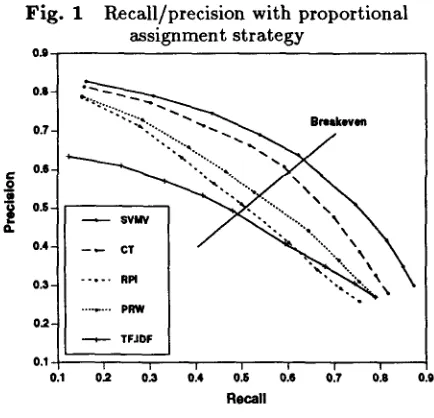
Figure 1 shows the recall/precision trade off for the four probabilistic models with proportional assign- ment strategy. As a reference, the recall/precision curve of a well-known vector model (Salton and Yang, 1973) ("TF.IDF")6 is also presented. Table 3 lists the breakeven point for each model. All the breakeven points were obtained when proportionality constant
w a s about 1.0.
Fig. 1
O J ~ -
Recall/precision with proportional assignment strategy
¢: _o
t 0.
0A-
0.7-
0.1L
0.6-
0A-
0.3 /
0.2-
0.1 0.1
* ' ~ Breakeve~
. . . R M " ° L " . . . . . ~ . - , P m l V
TFJOF
I I I
0., oi,, oI, olo o., 0'.0 0.0
Recall
T a b l e 3 Breakeven points with proportional
assignment strategy
SVMV CT RPI PRW TF.IDF
Breakeven Pts. 0.63 0.60 0.51 0.53 0.48
From Figure 1 and Table 3, we can see that:
• as far as this dataset is concerned, SVMV with
proportional assignment strategy gives the best re- sult among the four probabilistic models,
• the models that consider within-document term frequencies (SVMV, CT) are better than those that do not (PRW, RPI),
Sin the model we used, each element of document vector
[image:5.612.344.561.200.409.2]• the models that consider term weighting for tar-
get documents (SVMV, CT) are better than those that do not (PRW, (RPI)), and
• the models that are less affected by having insuffi- cient training cases (SVMV) are better than those that are (CT, RPI, PRW).
5
Conclusion
We have proposed a new probabilistic model for text categorization. Compared to previous models, our model has the following advantages; 1) it considers within document term frequencies, 2) considers term weighting for target documents, and 3) is less affected by having insufficient training cases. We have also pro- vided empirical results verifying our model's superior- ity over the others in the task of categorizing news articles from the "Wall Street Journal."
There are several directions along which this work could be extended.
• We have to compare our probabilistic model to other non probabilistic models like decision tree/rule based models, one of which has recently been reported to be promising (Apt4 et al., 1994).
• While we used simple document representation in which a document is defined as a set of nouns, there could be considered several improvements, such as using phrasal information (Lewis, 1992), clustering terms (Sparck Jones, 1973), reducing the number of features by using local dictio- nary (Apt4 et al., 1994), etc.
• We are incorporating our probabilistic model into cluster-based text categorization that offers an ef- ficient and effective search strategy.
Acknowledgments
The authors are grateful to Hiroshi Motoda for bene- ficial discussions, and would like to thank the anony- mous reviewers for their useful comments.
References
C. Apt4, F. Damerau, and S. M. Weiss. 1994. Au- tomated learning of decision rules for text catego- rization. ACM Transactions on Office Information Systems. (to appear).
K. W. Church and W. A. Gale. 1991. A comparison of the enhanced Good-Turing and deleted estima- tion methods for estimating probabilities of English bigrams. Computer Speech and Language, 5:19-54. W. B. Croft. 1981. Document representation in prob-
abilistic models of information retrieval. Journal of the American Society for Information Science, 32(6):451-457.
D. Cutting, J. Kupiec, J. Pedersen, and P. Sibun. 1992. A practical part-of-speech tagger. In In Proc. of the Third Conference on Applied Natural Language Pro- cessing.
B. Field. 1975. Towards automatic indexing: Au- tomatic assignment of controlled language indexing and classification from free indexing. Journal of Documentation, 31(4):246-265.
N. Fuhr. 1989. Models for retrieval with probabilis- tic indexing. Information Processing ~ Retrieval,
25(1):55-72.
F. Jelinek. 1990. Self-organized language modeling for speech recognition. In A. Waibel and K. Lee, editors, Readings in Speech Recognition, pages 450- 506. Morgan Kaufmann.
K. L. Kwok. 1990. Experiments with a component theory of probabilistic information retrieval based on single terms as document components. A CM Trans-
actions on Information Systems, 8(4):363-386. D. D. Lewis. 1992. An evaluation of phrasal and clus-
tered representation on a text categorization task. In
Proceedins of the Annual International A CM SIGIR Conference on Research and Development in Infor- mation Retrieval, pages 37-50.
M. Liberman, editor. 1991. A C L / D C I (CD-ROM).
Association for Computational Linguistics Data Collection Initiative, University of Pennsylvania, September.
S. E. Robertson and K. Sparck Jones. 1976. Relevance weighting of search terms. Journal of the American Society for Information Science, 27:129-146.
S. E. Robertson. 1977. The probability ranking prin- ciple in IR. Journal of Documentation, 33:294-304. G. Salton and M. J. McGill. 1983. Introduction to
Modern Information Retrieval. McGraw-Hill Pub- lishing Company.
G. Salton and C. S. Yang. 1973. On the specification of term values in automatic indexing. Journal of Documentation, 29(4):351-372.
K. Sparck Jones. 1972. A statistical interpretation of term specificity and its application in retrieval.
Journal of Documentation, 28(1):11-21.
K. Sparck Jones. 1973. Collection properties influenc- ing automatic term classification performance. In- formation Storage and Retrieval, 9:499-513.
S. K. M. Wong and Y. Y. Yao. 1989. A probability distribution model for information retrieval. Infor- mation Processing ~ Management, 25(1):39-53. C. T. Yu, W. Meng, and S. Park. 1989. A frame-
work for effective retrieval. ACM Transactions on Database Systems, 14(2):147-167.