Munich Personal RePEc Archive
A New Optimal Operation Structure For
Renewable- Based Microgrid Operation
based On Teaching Learning Based
Optimization Algorithm
Tavakoli, Amir and Mirzaei, Farzad and Tashakori, Sajad
Azad University of Shiraz
26 September 2018
Online at
https://mpra.ub.uni-muenchen.de/89203/
A New Optimal Operation Structure For
Renewable- Based Microgrid Operation based
On Teaching Learning Based Optimization
Algorithm
Amir Tavakoli, Farzad Mirzaei, Sajad Tashakori
Azad University of Shiraz, Shiraz, Iran
Abstract: This paper proposes a new optimization framework for the optimal power dispatch in both grid-connected and islanded microgrid modes. Solving the microgrid operation by the evolutionary algorithms can be faster than analytical models due to the complexity of the problem. To demonstrate the efficiency and high performance of the proposed technique, it is applied on the IEEE 33 bus test network. Also, the proposed technique is compared with the analytical model, and also well-known heuristic methods such as particle swarm optimization (PSO), genetic algorithm (GA).
I. Introduction
In the recent years, renewable energies are emerged varies research science due to some significant advantages such as security, sustainability, and environment-friendly [1], [2]. Along with many advantages, there exist some significant challenging associated with the renewable energies such as unpredictability, and their dependency on the weather conditions.
By emerging the renewable energies into the power system, the microgrids has been attracted a lot of attention due to their high potential in using the renewable energies. In the power system operation, the microgrid can be defined as the summation of the loads and distributed energy resources that can operate in both connected and islanded modes [3]- [6]. Microgrid has many advantages such as closeness to the consumers, lower operation cost, higher reliability, higher resiliency, and lower transmission cost due to less transmission line. However, the stable operation and malfunction are the most challenging issues in the microgrid.
many evolutionary algorithms exist [17-25], but TLBO is selected due to two phases of research in the algorithm as explained in section III [26-28].
II. Problem Formulation
The proposed optimization problem is associated with an objective function and constraints as follows:
A. Objective function
The main objective is to minimize the total operation cost as,
𝑀𝑖𝑛 ∑ ∑(𝐹𝑖(𝑃𝑖𝑡)𝐼𝑖𝑡+ 𝑆𝑈𝑖𝑡 + 𝑆𝐷𝑖𝑡) + ∑ 𝜌𝑡𝑃𝑀,𝑡 𝑡
𝑖 𝑡
(1)
where t is the time F is the cost coefficient, P is the power, i is the number of generators, SU and
SD are the startup and shutdown costs respectively, 𝜌 is the cost of power purchased from the main grid and M denotes the main grid.
B. Constraints
The proposed optimization problem is associated with some significant constraints as (2)- (8). Equation (2) presents the power balance constraint. Indeed, this constraint claims that the total generation and purchasing power should be equal to demand at any time interval (D denotes as the total load at hour t). Constraint (3) assure that the purchasing power from the main grid should be within a limit. Constraint (4) guarantees that the output power of each generation units should be within a limit. Also, integer variable I is defined to determine the status of generation units in any time, and it is zero when a unit is off, and it is one when a unit is on. Also, the ramp up/down (UR/DR) limitations are defined in (5) and (6) respectively. Equations (7) and (8) declare the
Minimum up/downtime constraint where Ton and Toff are numbers of successive on and off hours
respectively.
∑ 𝑃𝑖𝑡+ 𝑃𝑀𝑡= 𝑖
∑ 𝐷𝑑𝑡 𝑑
∀𝑡 (2)
−𝑃𝑀𝑚𝑎𝑥≤ 𝑃𝑀,𝑡≤ 𝑃𝑀𝑚𝑎𝑥 ∀𝑡 (3)
𝑃𝑖𝑚𝑖𝑛𝐼𝑖𝑡 ≤ 𝑃𝑖𝑡 ≤ 𝑃𝑖𝑚𝑎𝑥𝐼𝑖𝑡 ∀𝑖 ∈ 𝐺, ∀𝑡 (4)
𝑃𝑖𝑡− 𝑃𝑖(𝑡−1)≤ 𝑈𝑅𝑖 ∀𝑖 ∈ 𝐺, ∀𝑡 (5)
𝑃𝑖(𝑡−1)− 𝑃𝑖𝑡 ≤ 𝐷𝑅𝑖 ∀𝑖 ∈ 𝐺, ∀𝑡 (6)
𝑈𝑇𝑖(𝐼𝑖𝑡− 𝐼𝑖(𝑡−1)) ≤ 𝑇𝑖𝑡𝑜𝑛 ∀𝑖 ∈ 𝐺, ∀𝑡 (7)
𝐷𝑇𝑖(𝐼𝑖(𝑡−1)− 𝐼𝑖𝑡) ≤ 𝑇𝑖𝑡𝑜𝑓𝑓 ∀𝑖 ∈ 𝐺, ∀𝑡 (8)
III.Teaching Learning Based Optimization
This approach which is similar to the other evolutionary approaches is based on population. The population in this approach is completely related to the class population. First, two phases need to be defined.
1) Teaching Phase
2) Learner Phase
Certainly, each student in the class can develop his knowledge based on the mentioned steps: Initially, learning from the teacher of the class and enhancing his knowledge. Then, interaction with other students in the class to improve the knowledge. The first part of this method can be defined as the teacher phase and the second part of this method can be defined as the learner phase.
In this paper, TLBO is applied for unit commitment issue. Actually, the mean value of the first optimization results is considered as a teacher of a class. Next, in the second iteration, the determined result is compared with the other results. If the newly determined result is better than the previous one, it should be exchanged otherwise it is going to be rejected. The difference between knowledge of and their teacher is expressed in equation (9):
𝑑𝜇𝑘 = 𝑇𝑘− 𝑇𝐹𝑘𝜇𝑘 (9)
where 𝜇𝑘denotes the mean value for the class and parameter TFkdenotes the teaching factor which
can be considered as a random variable of 1 or 2. Thus we have:
𝑋𝑛,𝑗𝑘 = 𝑋
𝑝,𝑗𝑘 + 𝑟𝑎𝑛𝑑(𝑑𝜇𝑘) (10)
The combinations of units need to be analyzed in the next phase. Hence, the cost of all the possible units’ combination needs to be computed to find the optimal outcome. Therefore, the following expression can be expressed as follows:
𝑋𝑛 = {𝑋𝑋𝑗+ 𝑟𝑎𝑛𝑑(∆𝑋𝑖−𝑗) 𝑓(𝑋𝑗) < 𝑓(𝑋𝑖) 𝑗+ 𝑟𝑎𝑛𝑑(∆𝑋𝑖−𝑗) 𝑒𝑙𝑠𝑒}
(11)
Fig. 1. TLBO flowchart
IV.Simulation Results
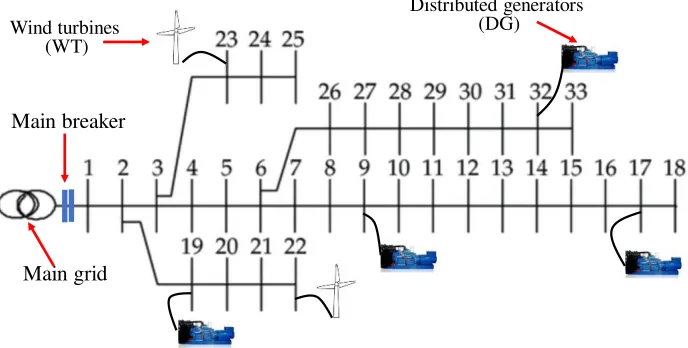
The proposed optimization problem is tested on a modified IEEE 32 bus test network contains two wind turbines (WT), and four distributed generators (DGs) as Fig. 2. The proposed technique is applied to the islanded mode where the main breaker is open.
Fig. 2. Single line diagram of the modified IEEE 33 bus test network
Wind turbines (WT)
Distributed generators (DG)
Main breaker
[image:5.612.149.493.492.666.2]Table I represents the WTs output power for the entire horizon which is 24 hours (day-ahead).
Table I. WTs output power
Hour 1 2 3 4 5 6 7 8 9 10 11 12
WT#1 (KW) 220 220 220 220 220 170 220 190 300 400 620 760
WT#2 (KW) 180 180 180 180 180 140 180 170 250 300 590 595
Hour 13 14 15 16 17 18 19 20 21 22 23 24
WT#1 (KW) 790 600 240 225 170 220 200 220 180 180 160 120
WT#2 (KW) 540 480 180 165 190 160 165 180 150 150 140 100
Also, the distributed generation information is provided in Table II.
Table II. Distributed generation
DG Number Capacity (MW) Cost
($/kWh)
DG1 20000-45000 0.17
DG2 21000-33000 0.21
DG3 10000-21000 0.32
DG4 7000-40000 0.43
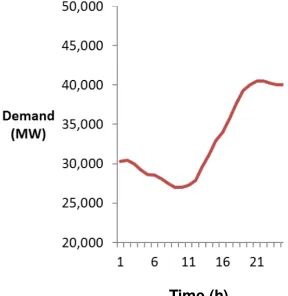
[image:6.612.237.381.497.645.2]The load for the entire horizon is represented in Fig. 3.
By applying the TLBO, the status of the DG can be obtained as Table III. Based on this table, the cheapest units (DG1 and 2) are committed more than others. Also, the most expensive unit (DG4) is off in the entire horizon. However, this DG is considered for the rainy days.
Table III. Status of DG for 24 hours
Hour 1 2 3 4 5 6 7 8 9 10 11 12
DG1 1 1 1 1 1 1 1 1 1 1 1 1
DG2 1 1 1 1 1 1 1 1 1 1 1 1
DG3 0 0 0 0 0 0 0 0 0 0 0 1
DG4 0 0 0 0 0 0 0 0 0 0 0 0
Hour 13 14 15 16 17 18 19 20 21 22 23 24
DG1 1 1 1 1 1 1 1 1 1 1 1 1
DG2 1 1 1 1 1 1 1 1 1 1 1 1
DG3 1 1 1 1 1 1 1 1 0 0 0 0
DG4 0 0 0 0 0 0 0 0 0 0 0 0
Table IV compared the total operational cost of the proposed method with MILP, GA, and PSO algorithms. Although the operational cost of the MILP is lower, the time solution of the proposed method is faster than others, and the difference cost is not significant.
Method Cost (M$) Time to solve (s)
TLBO 24,283 11.1
PSO 27,342 32.2
GA 25,457 27.4
MILP 23,936 15.3
Conclusion
This paper proposed a new approach for optimal operation of a microgrid in the islanded mode based on the new heuristic technique which is known as the teaching learning-based optimization. The proposed method is compared with both analytical and well-known heuristic methods such as PSO and GA. Based on the results, compared to the evolutionary algorithms, the proposed technique is faster with the less operational cost. However, compared to the MILP as a mathematical model, the price of the method is higher. This price would be not considered due to its faster solution time which plays a very significant role in the islanded microgrid.
References
[2] Ashkaboosi, Maryam, Seyed Mehdi Nourani, Peyman Khazaei, Morteza Dabbaghjamanesh, and Amirhossein Moeini. "An optimization technique based on profit of investment and market clearing in wind power systems." American Journal of Electrical and Electronic Engineering 4, no. 3 (2016): 85-91.
[3] Dabbaghjamanesh, Morteza, Shahab Mehraeen, Abdollah Kavousi Fard, and Farzad Ferdowsi. "A New Efficient Stochastic Energy Management Technique for Interconnected AC Microgrids." arXiv preprint arXiv:1803.03320 (2018).
[4] Parhizi, Sina, Hossein Lotfi, Amin Khodaei, and Shay Bahramirad. "State of the Art in Research on Microgrids: A Review." Ieee Access 3, no. 1 (2015): 890-925.
[5] Khodaei, Amin, and Mohammad Shahidehpour. "Microgrid-based co-optimization of generation and transmission planning in power systems." IEEE transactions on power systems 28, no. 2 (2013): 1582-1590.
[6] Dabbaghjamanesh, Morteza, Abdollah Kavousi-Fard, and Shahab Mehraeen. "Effective Scheduling of Reconfigurable Microgrids with Dynamic Thermal Line Rating." IEEE Transactions on Industrial Electronics (2018).
[7] Liu, Guodong, Yan Xu, and Kevin Tomsovic. "Bidding strategy for microgrid in day-ahead market based on hybrid stochastic/robust optimization." IEEE Transactions on Smart Grid 7, no. 1 (2016): 227-237.
[8] Ghaffari, Saeed, and Maryam Ashkaboosi. "Applying Hidden Markov Model Baby Cry Signal Recognition Based on Cybernetic Theory." IJEIR 5, no. 3 (2016): 243-247.
[9] Mirab, Hadi, Reza Fathi, Vahid Jahangiri, Mir Mohammad Ettefagh, and Reza Hassannejad. "Energy harvesting from sea waves with consideration of airy and JONSWAP theory and optimization of energy harvester parameters." Journal of Marine Science and Application 14, no. 4 (2015): 440-449.
[10] Jahangiri, Vahid, Hadi Mirab, Reza Fathi, and Mir Mohammad Ettefagh. "TLP structural health monitoring based on vibration signal of energy harvesting system." Latin American Journal of Solids and Structures 13, no. 5 (2016): 897-915.
[11] Zhang, Yu, Nikolaos Gatsis, and Georgios B. Giannakis. "Robust energy management for microgrids with high-penetration renewables." IEEE Transactions on Sustainable Energy 4, no. 4 (2013): 944-953.
[12] Liao, Gwo-Ching. "Solve environmental economic dispatch of Smart MicroGrid containing distributed generation system–Using chaotic quantum genetic algorithm." International Journal of Electrical Power & Energy Systems 43, no. 1 (2012): 779-787.
[13] Bevrani, Hassan, F. Habibi, P. Babahajyani, Masayuki Watanabe, and Yasunori Mitani. "Intelligent frequency control in an AC microgrid: Online PSO-based fuzzy tuning approach." IEEE transactions on smart grid 3, no. 4 (2012): 1935-1944.
[14] Dabbaghjamanesh, M., A. Moeini, M. Ashkaboosi, P. Khazaei, and K. Mirzapalangi. "High performance control of grid connected cascaded H-Bridge active rectifier based on type II-fuzzy logic controller with low frequency modulation technique." International Journal of Electrical and Computer Engineering (IJECE) 6, no. 2 (2016): 484-494.
[15] Khazaei, Peyman, Morteza Dabbaghjamanesh, Ali Kalantarzadeh, and Hasan Mousavi. "Applying the modified TLBO algorithm to solve the unit commitment problem." In World Automation Congress (WAC), 2016, pp. 1-6. IEEE, 2016.
[16] Rao, Ravipudi V., Vimal J. Savsani, and D. P. Vakharia. "Teaching–learning-based optimization: a novel method for constrained mechanical design optimization problems." Computer-Aided Design 43, no. 3 (2011): 303-315.
[17] Zitzler, Eckart, Marco Laumanns, and Lothar Thiele. "SPEA2: Improving the strength Pareto evolutionary algorithm." TIK-report 103 (2001).
[19] Khazaei, P., S. M. Modares, M. Dabbaghjamanesh, M. Almousa, and A. Moeini. "A high efficiency DC/DC boost converter for photovoltaic applications." International Journal of Soft Computing and Engineering (IJSCE) 6, no. 2 (2016): 2231-2307.
[20] Rakhshan, Mohsen, Navid Vafamand, Mokhtar Shasadeghi, Morteza Dabbaghjamanesh, and Amirhossein Moeini. "Design of networked polynomial control systems with random delays: sum of squares approach." International Journal of Automation and Control 10, no. 1 (2016): 73-86.
[21] Prins, Christian. "A simple and effective evolutionary algorithm for the vehicle routing problem." Computers & Operations Research 31, no. 12 (2004): 1985-2002.
[22] Droste, Stefan, Thomas Jansen, and Ingo Wegener. "On the analysis of the (1+ 1) evolutionary algorithm." Theoretical Computer Science 276, no. 1-2 (2002): 51-81.
[23] Dabbaghjamanesh, Morteza, Shahab Mehraeen, Abdollah Kavousifard, and Mosayeb Afshari Igder. "Effective scheduling operation of coordinated and uncoordinated wind-hydro and pumped-storage in generation units with modified JAYA algorithm." In Industry Applications Society Annual Meeting, 2017 IEEE, pp. 1-8. IEEE, 2017.
[24] Van Veldhuizen, David A., and Gary B. Lamont. "On measuring multiobjective evolutionary algorithm performance." In Evolutionary Computation, 2000. Proceedings of the 2000 Congress on, vol. 1, pp. 204-211. IEEE, 2000.
[25] Yen, Gary G., and Haiming Lu. "Dynamic multiobjective evolutionary algorithm: adaptive cell-based rank and density estimation." IEEE Transactions on Evolutionary Computation7, no. 3 (2003): 253-274.
[26] Taherzadeh, Erfan, Morteza Dabbaghjamanesh, Mohsen Gitizadeh, and Akbar Rahideh. "A New Efficient Fuel Optimization in Blended Charge Depletion/Charge Sustenance Control Strategy for Plug-in Hybrid Electric Vehicles." IEEE Transactions on Intelligent Vehicles (2018).
[27] Ashkaboosi, Maryam, Farnoosh Ashkaboosi, and Seyed Mehdi Nourani. "The Interaction of Cybernetics and Contemporary Economic Graphic Art as" Interactive Graphics"." (2016).