Volume 2, Issue 7, July 2013
Page 321
ABSTRACT
The paper is about preliminary sizing and analysis of a wing box. The main objective is to fix a appropriate structure within the given envelope. Sizing is done by using classical engineering theories and FEA packages (MSC Nastran and MSC Patran).Skin and web are considers as shell elements. Flange, spar and stringer are considered as beam elements. The analysis is carried out with iterations such as, with different sections like Rectangular sections, Z –sections and L- sections, Panel breakings and Varying skin thicknesses. From the analysis structure has been optimally designed which satisfies the strength and stability criteria, which still has a scope for optimization by redesigning components like Ribs and Spars.
Keywords: - aircraft, wing box.
1.
INTRODUCTION
A wing is a surface used to produce an aerodynamic force normal to the direction of motion by traveling in air or another gaseous medium, facilitating flight. It is a specific form of airfoil. The first use of the word was for the foremost limbs of birds, but has been extended to include the wings of insects, bats and pterosaurs and also man-made devices. A wing is an extremely efficient device for generating lift. Its aerodynamic quality, expressed as a Lift-to-drag ratio, can be up to 60 on some gliders and even more. This means that a significantly smaller thrust force can be applied to propel the wing through the air in order to obtain a specified lift. The most common use of wings is to fly by deflecting air downwards to produce lift, but upside-down wings are also commonly used as a way to produce down force and hold objects to the ground.
1.1 Reference Wing
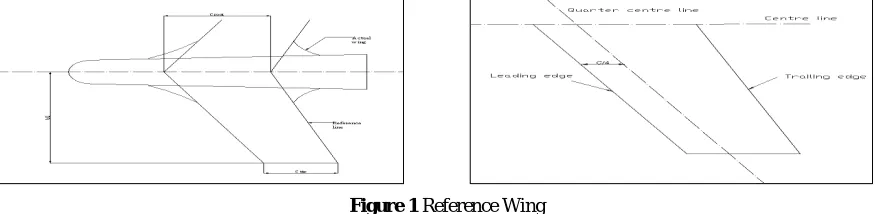
The reference wing is the basic wing geometry used to begin the layout. Following Figure show the key geometric parameters of the reference wing. The reference wing is fictitious and extends through the fuselage to the aircraft centreline. Thus the reference wing area includes the part of the reference wing which sticks into the fuselage. For the reference wing, the root airfoil of the trapezoidal reference wing at the centreline of the aircraft, not where the actual wing connects to the fuselage.
Figure 1 Reference Wing
1.2 Wing loading
The wing loading is the weight of the aircraft divided by the area of the reference wing. As with the thrust to weight ratio, the term “wing loading” normally refers to the takeoff wing loading, but can also refer to combat and other flight conditions. Wing loading affects stall speed, climb rate, takeoff and landing distances, and turn performance. The wing loading determines the design lift coefficient, and impacts drag through its effect upon wetted area and wing span. Wing loading has a strong effect upon sized aircraft takeoff gross weight. If the wing loading is reduced, the wing is larger. This may improve performance, but the additional drag and empty weight due to the larger wing will increase takeoff gross weight to perform the mission.
1.3 Wing Box
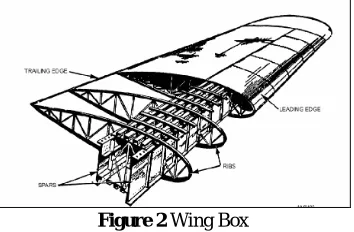
Wing box is a construction of thin skins or webs and stringers. Its main function is distribution of shear, bending and torsion loads at any section of a wing or fuselage. A Practical description of a wing box is rectangular shape with
skin-Statistic and Dynamic Analysis of Typical Wing
Structure of Aircraft using Nastran.
1
Mr. Pritish Chitte, 2 Mr. P. K. Jadhav, 3 Mr. S. S. Bansode
1,2&3Asst. Professor, Mechanical Engineering Department,
Volume 2, Issue 7, July 2013
Page 322
stringer panel on top and bottom connected by two vertical beams(a single cell box) or more vertical beams(a multiple cells box).Box beams have the following characteristics :-● They consist of wide skin-stringer panels which are subjected to shear flow due to bending moment and torsion. ● The thin skins take little of the axial compression load.
● The thin skin carry shear loads very well and even though they may buckle under the loads they do not fail but continue to carry the buckling load plus significant additional shear loads In Level flight- lift is equal to the weight.
● Stringers carry axial loads and shear flow induces a change in axial load
● The usual cross-section of a wing box is unsymmetrical both in shape and in distribution of material Resistance from air to the motion.
● Since conventional wing box taper in plan form and section as well as in area, the effect from taper are accounted for directly.
● It is necessary to compute the principal axes of the beam before the axial stresses can be determined.
Figure 2 Wing Box
2.
Literature review:
Jiyu Sun, Bharat Bhushan[1] in their paper focuses on the effects of structure, mechanical properties, and morphology of dragonfly wings on their flyability, followed by the implications infabrication and modeling. Dragonfly wings possess great stability and high load-bearing capacity during flapping flight, glide, and hover. Scientists have been intrigued by them and have carried out research for biomimetic applications. The mechanical properties of dragonfly wings need to be understood in order to perform simulated models.
Luna Majumder , S.S. Rao[2] discussed about an interval-based automated optimization of aircraft wing structures subjected to landing loads. The interaction between landing gear and flexible airplane structure is considered as a coupled system. The uncertain system parameters are described as interval numbers. The computational aspects of the optimization procedure are illustrated with two examples – symmetric doublewedge airfoil, and supersonic airplane wing. Since, in most cases only the ranges of uncertain parameters are known with their probability distribution functions unknown, the present methodology is expected to be more realistic for the optimum design of aircraft structures under landing loads.
Taeseong Kim et al[3] developed a structural design optimization framework by suggesting a two-level approach for a composite wing to improve the aeroelastic stability of a tiltrotor aircraft. It is known that both the wing and rotor characteristics influence the whirl flutter stability of a tiltrotor aircraft. Therefore, simultaneous multiple objective design optimization processes need to be considered to augment the whirl flutter aeroelastic stability adequately. This type of two-level optimization process is regarded to be more appropriate for the present tiltrotor aircraft aeroelastic stability augmentation problem.
LiviuLibrescu, KaramY.Maalawi[4] in their paper deals with aeroelastic design optimization of a slender, thin-walled wing-type structure against divergence. The main goal is to avoid torsional instability, which might occur at critical flow conditions, by maximizing the divergence speed without the penalty of increasing the total structural mass. Divergence provides a useful measure of the general stiffness level of the wing structure. The model formulation considers a large aspect ratio unswept wing of rectangular planform, while the flow conditions are restricted to those of subsonic incompressible ones. Both continuous and piecewise models are analyzed, where exact analytical solutions are obtained within the context of linear elasticity and aerodynamic strip theories. The final optimization problem is formulated as a nonlinear mathematical programming problem solved by implementing the interior penalty function technique, which interacts to eigenvalue calculation routines. Results show that optimum patterns with decreasing wall thickness from the inboard portion toward the outboard one produce significant improvement in the overall torsional stiffness level. It is also shown that global optimality can be achieved from the proposed mathematical model, provided that the wing is constructed from piecewise uniform portions having not-equally spaced lengths and different torsional rigidities.
Volume 2, Issue 7, July 2013
Page 323
expansion, the interval finite element model for the flutter analysis of wing with certainties is presented, which can give an approximate interval estimation of the varying range of the flutter speed caused by uncertainties.W Kuntjoro et al[6] in their paper describes the use of supe relement for the stress and deflection analysis of a typical Figurehter wing structure. Three methods of analyses were carried out and compared: practical/theoretical analysis; finite element analysis with the conventional element modeling approach; and finite element analysis with the super element modeling. Finite element models of the wing were developed. NASTRAN FE software was used for finite element analysis.
HyunbumPark[7] in the paper discussed about the structural design and forced vibration analysis were performed about the composite main wing structure exited by a pusher type two-stroke reciprocating engine for the WIG (Wing-in-Ground Effect) craft. It was assumed that excitations for the frequency response analysis are the horizontal mode, the vertical mode and the twisted mode which are typical engine vibration modes, and excitation for the transient response analysis is the longitudinal mode with the oscillating propeller thrust. According to the forced vibration analysis results, it was found that the wings kin under the engine mount was unstable. In order to solve this problem, the ant symmetric design method issued in the wing structure. And also, the stiffener ribs beside the engine mount and the rubber pad were finally added. After design modification, the structural analysis, the normal mode analysis, the frequency response analysis and the transient response analysis were performed again for confirming structures safety and vibration behaviors. The modified structural design feature could all aviate effectively the vibration amplitude.
3.
M
ETHODOLOGY,
F
ORMULAE ANDP
ROCEDURE 3.1 Assumptions● Material is homogenous. ● Material is isotropic. ● Material is elastic
● The stringers carry only axial stresses. ● The skins carry only shearing stresses. ● The spar carry bending load.
● Stress concentration factor is neglected
3.2 Symmetrical bending
If one of the axes is an axis of symmetry, the bending can be determined by,
Mz - Bending moment about Z-axis.(Nmm) ; σb - direct stress due to bending (N/mm2) My - Bending moment about Y-axis.(Nmm) ; z, x- the centroidal distances (mm)
3.3 Unsymmetrical bending
If the section is unsymmetrical, then the Bending can be determined by,
2 yz yy zz yz y yy z yz z zz y b I I I y I M I M z I M I M
Where,Mz - Bending moment about Z-axis.(Nmm) My - Bending moment about Y-axis.(Nmm)
Izz, Iyy ,Iyz - are area moment of inertias about z,y and zy(m4) σb - direct stress due to bending (N/mm2)
z, y - the centroidal distances (mm)
3.4 Bending
σb = M*Y/I Where, M=Maximum bending moment (N-mm)
Y = Centroidal distance(mm) I= Moment of inertia (mm4)
3.5 First bending frequency
Volume 2, Issue 7, July 2013
Page 324
where, l = span of the wingE = Young’s modulus
I = Moment of Inertia of the wing m = mass/unit length
4.
ITERATION – I
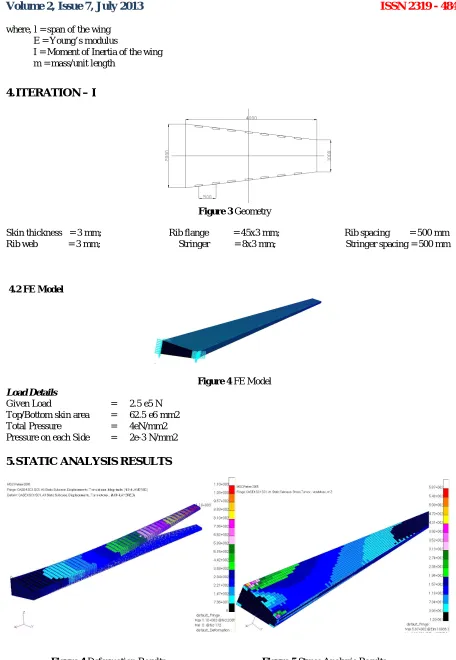
Figure 3 Geometry
Skin thickness = 3 mm; Rib flange = 45x3 mm; Rib spacing = 500 mm Rib web = 3 mm; Stringer = 8x3 mm; Stringer spacing = 500 mm
4.2 FE Model
Figure 4 FE Model Load Details
Given Load = 2.5 e5 N Top/Bottom skin area = 62.5 e6 mm2 Total Pressure = 4eN/mm2 Pressure on each Side = 2e-3 N/mm2
5.
STATIC ANALYSIS RESULTS
Figure 4 Deformation Results Figure 5 Stress Analysis Results
Volume 2, Issue 7, July 2013
Page 325
Table 1 Summary of Results
Iteration Number
Stress Values (N/mm2)
Deformation Values (mm)
Remark
I 587 1100 The Stress near the root section of the model is higher than the material ultimate stress (437 Mpa).
II 359 605 This model fails in Buckling. (buckling factor = 0.025).
III 180 162 This is the required base
6.
Dynamic Analysis
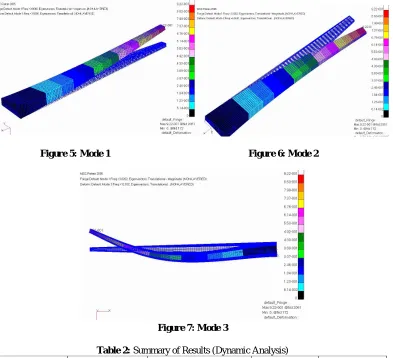
Figure 5: Mode 1 Figure 6: Mode 2
Figure 7: Mode 3
Table 2: Summary of Results (Dynamic Analysis)
Details Stress( N/mm2) Displacement(mm) Eigen Value Weight(kg)
Model 1 587 1100 - 3149
Model 2 180 162 1.03 10600
Volume 2, Issue 7, July 2013
Page 326
7.
Conclusion:
a)A structure has been optimally designed which satisfies the strength and stability criteria, which still has a scope for optimization by redesigning components like Ribs and Spars.
b)By use of FEM and FEM softwares, it is easy to do analysis of Mechanical components like Aerospace parts like Wings and Spars which otherwise it will be very complicated to perform the analysis.
c)No Experimental cost is involved due to use of advanced FEM softwares.
d)We can perform the parametric analysis with the use of different parameters like Material properties, loading condition, boundary condition, mesh resizing by virtue of which we obtain some useful information without experimental cost and we can finally optimize our model.
8.
S
COPE FORF
UTUREW
ORK Sizing of components and primary ribs by considering landing gear location, engine location, jack point and fuel tank.
Detail stress analysis of individual components.
R
EFERENCES[1.] Jiyu Sun, Bharat Bhushan, The structure and mechanical properties of dragonfly wings and their role on fly ability C. R. Mecanique 340 3–17(2012).
[2.] Luna Majumder , S.S. Rao, Interval-based optimization of aircraft wings under landing loads, Computers and Structures 87 225–235(2009).
[3.] Taeseong Kim , Jaehoon Lim , SangJoon Shin , Do-Hyung Kim, Structural design optimization of a tiltrotor aircraft composite wing to enhance whirl flutter stability, Composite Structures 95 283–294 (2013).
[4.] LiviuLibrescu , KaramY.Maalawi, Aeroelastic design optimization of thin-walled subsonic wings against divergence, Thin-Walled Structures 47 89– 97 (2009).
[5.] Wang Xiaojun, Qiu Zhiping, Interval Finite Element Analysis of Wing Flutter, Chinese Journal of Aeronautics 21 134-140 (2008).
[6.] HyunbumPark, A study on forced vibration behaviors of composite main wing structure of the 20 seat class small scale WIG craft, Aerospace Science and Technology.
[7.] W Kuntjoro, AMH Abdul Jalil, J Mahmud, Wing Structure Static Analysis using Superelement, Procedia Engineering 41 1600 – 1606 (2012).
[8.] Lingxiao Zheng, Xiaolin Wang, Afzal Khan, R. R. Vallance and Rajat Mittal, A combined experimental-numerical study of the role of wing flexibility in insect flight, Aerospace Sciences Meeting Including The New Horizons Forum and Aerospace Exposition 5 - 8 January 2009.
Author
:-
Mr.Pritish Chitte received the M.Tech from Vishwesharaiya Technology University, Belgaum and B.E. from Walchand Institute of Technology, Solapur in the year 2011 and 2008 respectively. Also joined the Walchand Nagar Industry for 1 year in the year 2009.After completing the M.Tech degree, he is working as as an Assistant Professor in Walchand Institute of Technology, Solapur.