An Effect of Biogeography Based
Optimization based frequency stabilizer on
Load Frequency Control of an Interconnected
Hydro-Thermal Power System
Dipayan Guha1, Subhankar Mukherjee2, Maumita Das3
Assistant Professor, Department of Electrical Engineering, Dr. B.C.Roy Engineering College, Durgapur,
West Bengal, India
PG Scholar, Department of Electrical Engineering, SKFGI, Mankundu, West Bengal, India
Assistant Professor, Department of Electronics and Communication Engineering, Techno India-Durgapur, Durgapur,
West Bengal, India
ABSTRACT: This paper made an attempt for the effective application of biogeography based optimization (BBO), a bio-inspired optimization method, to optimize gains of classical controller and frequency stabilizer in load frequency problem (LFC) of an interconnected two-area hydro-thermal power system. Thermal unit is equipped with single-stage reheat turbine and hydro unit is studied with electrical governor. Speed governor of both the control areas are studied with dead band (DB) type of linearity. Describing function approach is used to find linear model of DB non-linearity. BBO based integral squared error (ISE) criterion is used to minimize area control error (ACE), which is considered as an objective function for the study. 1% step load perturbation (SLP) in area-1 and MATLAB/SIMULINK
environment is considered for investigating dynamic responses of concerned power system unit.
KEYWORDS: Automatic generation control, superconducting magnetic energy storage, Dead Band, ISE, Biogeography based optimization
I. INTRODUCTION
An interconnected electrical power system generates transports and distributes electrical energy with nominal system frequency and terminal voltage. The main objective of power system operation and control is to balance between power generation and total load demands plus losses in system. Any mismatch between generation and load demand causes deviation of system frequency and tie-line power, which leads to instability of the system operation. In this aspect LFC plays very important role in power system operation and control. It is defined as sudden load perturbation that may continuously disturbed nominal operation of system frequency and tie-line power. Therefore, for stable operation of power system both frequency and tie-line power are made to be constant.
Several researchers proposed different controller scheme such as Artificial Neural Network [14, 15], Fuzzy logic [16], GA based [8, 17] etc. [3] to investigate two-area thermal system with classical type PI-controller, where parameters are optimized by PSO algorithm. State feedback based controller was designed to get better dynamic performance of LFC, but this require availability of all state variables of the system which are not readily available. The advent of intelligent controller has solved LFC problem to some extent but the design and implementation of these controllers are quite complex. That is why most of the power station employed classical controllers in the field of LFC because implementation of this controller is easy.
The internal characteristic of power system network is highly non-linear; therefore optimum values of classical controller parameters are insufficient to give better performance of the system. Sudden small load variation may change the operating point which causes deviation of tie-line power and power frequency from their nominal values. To damp out oscillations within short possible time, Super Magnetic Energy Storage unit is attached with LFC.
In this paper classical controllers are designed through BBO algorithm to study the dynamic responses of hydro-thermal system with governor non-linearity. To further improve controller performance, small size magnetic storage unit is attached with LFC and comparison between different dynamic performances is tabulated in this paper.
II. SYSTEM DESCRIPTION
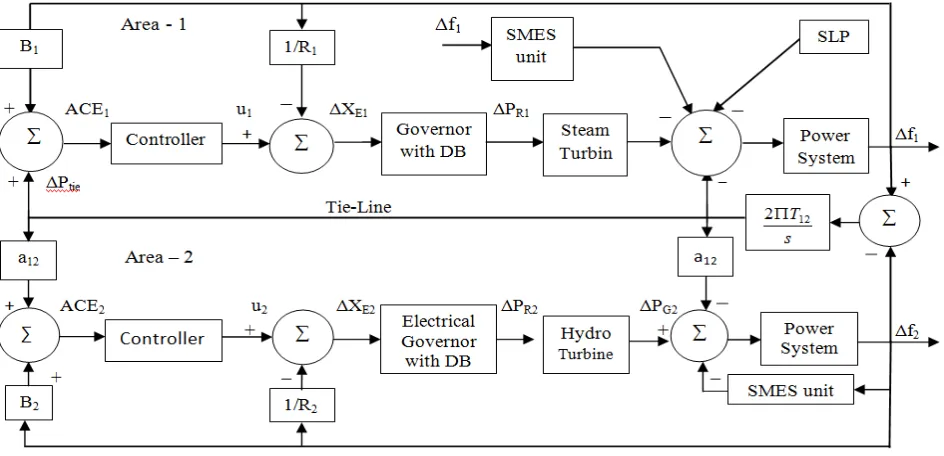
The LFC system investigated for present study is composed of an interconnection of two unequal system of area-1: 1600MW and area-2: 1800MW capacity. 1 is considered with single-stage reheats type thermal system and Area-2 is a hydro system with Electrical type governor. Both thermal and hydro governors are studied with Dead Band type non-linearity. Overall block diagram of test system is shown in Fig. 1. 1% step load perturbation (SLP) in area-1 is considered for study. Nominal values of all parameters are given in Appendix-1. MATLAB version 2009 is used to study the dynamics of an interconnected power system. Integral (I), Proportional plus Integral (PI), Proportional plus Integral plus Derivative (PID) type of controllers are used for this study. Optimum values of controller parameters are determined by Integral Square Error (ISE) criterion through BBO algorithm.
III.GOVERNOR DEAD BAND (GDB)
GDB is defined as the total magnitude of sustained speed change within which there is no resulting changes in valve position. The limiting value of DB is 0.06% [18].
The hysteresis type of non-linearity is expressed as,
)
,
(
f
x
x
y
(1)Where,
x
A
sin(
0t
)
(2)0 0
2
f
andf
0is the fundamental frequency of oscillation in Hz. Since, non-linearity always posse’s continuous oscillations with constant frequency and amplitude, hence it is realistic to consider input as defined in (2). Expanding (1) in Fourier series form [4],
dt
dx
N
x
N
y
y
0 2 1 0
(3)Since, non-linearity is symmetric about the real axis, hence,
y
0
0
.
Therefore, equation (3) can be re-written as, dt dx N x N y . 0 2 1 (4)
Taking Laplace Transform of equation (4), we have
) ( ) ( ) ( 0 2 1 X s
N s s X N s Y 0 2 1 ) ( ) (
N s N s X s Y
(5)
Equation (5) defines the linear model of GDB non-linearity. According to [4], the values of
N
1 andN
2 are considered as 0.8 and (– 0.2), respectively.IV.SUPERCONDUCTING MAGNETIC ENERGY STORAGE (SMES)
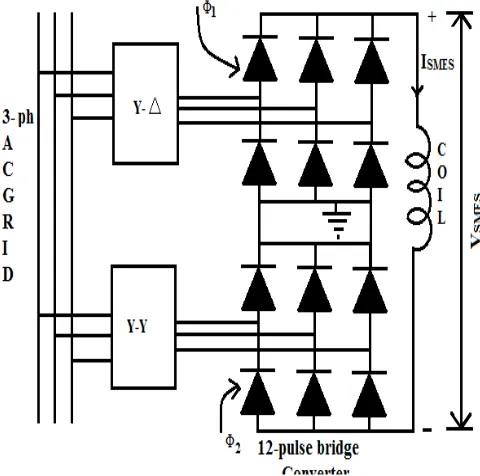
Small load perturbation in any area of an interconnected system causes deviation of frequency and tie-line power, even though the controller parameters are optimized. For this reason, SMES unit installed with interconnected system. As mentioned in [19], best suitable location of placing of SMES unit is at the terminal bus of an area Under normal operating condition, SMES coil is charged to a pre-defined minimum value (less than rated value) from AC power through power converting system. Once the coil is charged, current starts to flow through coil. The coil is continuously immersed in a bath of liquid Helium for cooling. Tripathy et. al. [4] describe that very small size SMES unit (order of 18 MJ or less) is required to improve dynamic response of LFC system.
Fig. 2(a) shows the power circuit diagram of SMES unit. When there is a sudden rise in load, the energy stored into the magnetic field released to power unit. When primary and secondary control loop starts working to restore the frequency and power to nominal value, SMES coil again come back to its initial state. Similar action takes place during sudden release of load.
The proper operation of SMES unit is achieved by applying appropriate voltage across the coil; this can be made by controlling firing angle of Power Conversion System (PCS). The charge stored in the coil at any instant of time is,
2
5 .
0 d
L LI
W , where Land Idare the inductance in Henry and current through coil in KA, respectively.
Fig. 2 (a): Power Circuit Diagram of SMES unit
Fig. 2(b): Transfer Function model of SMES unit
V. BIOGEOGRAPHY BASED OPTIMIZATION
Migration algorithm is defined as [20]
Select Hi randomly with probability i
if
H
iis selectedfor j = 1 to p
select Hj with probability i
if
H
jis selectedrandomly select SIV from Hj
replace a random SIV inHiwith Hj
end
end
end
In BBO, the mutation is used to increase diversity of population so that good solution can be achieved. The mutation rate
(
m
)
can be defined as:
max
1
*
P
P
p
m
imutate (6)
where,
p
mutate is a user defined parameter and pmaxargmax(pi), i0,1,2,,p.Habitat mutation is described as follows [20]
for j 1:N
useiand i to compute the probability Pi
select SIV Hi(j)with probability Pi
if
H
i(
j
)
is selectedrepeat Hi(j) with a randomly generated SIV
end
VI. PARAMETER OPTIMIZATION
A control system is optimum when selected objective function is minimized. Optimum values of controller parameters and SMES units are directly depend on optimality which is computed for proper coordination between the areas and to extract maximum benefits from the system [4]. The controller parameters are to be set to optimal values for maintaining system stability. Integral square error (ISE) criterion is used here for optimization through Bio-Geography Based Optimization (BBO) algorithm. The objective function is to be minimized:
max
1
2
N
i
tie i
i
f
P
T
B
J
(7)Where, J= fitness function,
i i
i D R
B 1 = Biasing factor, Ptie= error in tie-line power, Nmax= maximum number of iteration.
VII.RESULTS AND DISCUSSION
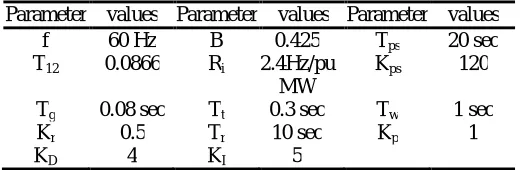
The main objective to perform this simulation is to test effectiveness and superiority of BBO based classical controllers on two-area hydro-thermal system with governor non-linearity. The model of test system under study has been developed in Matlab/Simulink environment and proposed BBO algorithm has been written in (.m file). The objective function (ACE) is evaluated in (.m file) using ISE criterion and used to optimized gains of controller parameters. Simulations were performed on a personal computer having 2.4 GHz core i3 processor with 2 GB RAM in Matlab R2009 environment. The nominal values of system parameters are illustrated in Table 1 and 0.01 p.uMW load variation in area-1 is considered to investigate frequency, tie-line power deviation.
For successful implementation of BBO, optimum gains of different parameters are required to be determined. Owing to the uncertain behavior of BBO, fifty trials have been made to select optimum values of input parameters of same for better optimization of controller parameters and following are found to be best for LFC problem: population size = 40, mutation probability = 0.05, total number of iteration = 100, elitism parameter = 4, maximum immigration and emigration rate = 1.
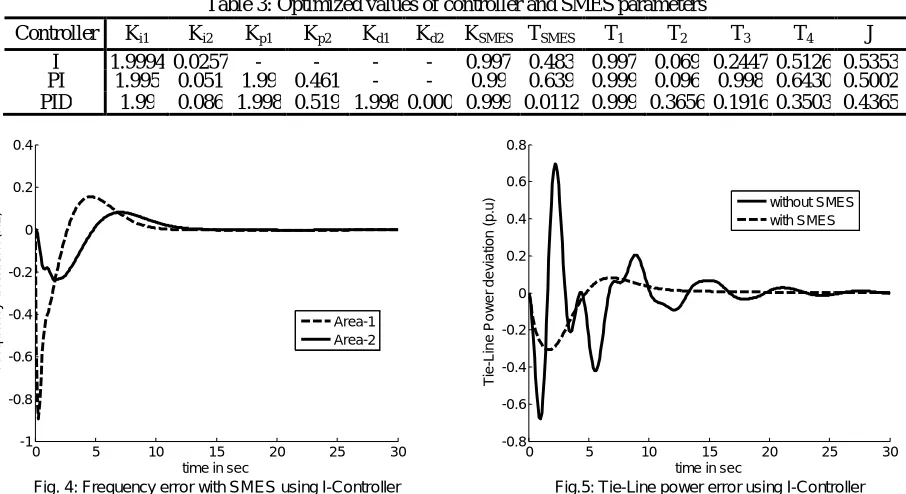
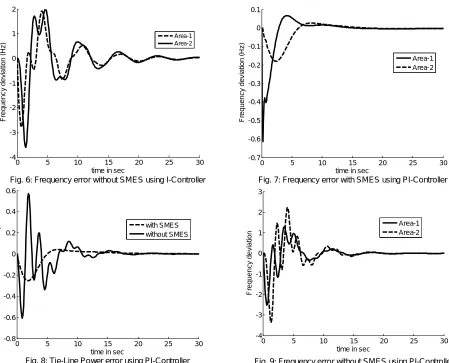
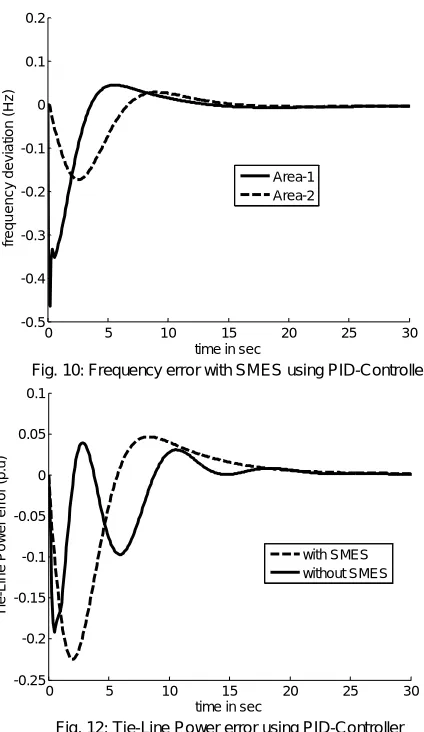
Fig. 3 shows convergence behavior of proposed BBO algorithm under different mode of operation. Dynamic performances of test system under different operating conditions are shown in Fig. 4 to12. The optimum values of all parameters at the end of optimization are tabulated in Table 2 and 3. Transient specifications in terms of settling time, overshoot, undershoot of frequency and tie-line power are given in Table 4 and 5.
Table 1: Nominal values of system parameters
Parameter values Parameter values Parameter values
f 60 Hz B 0.425 Tps 20 sec
T12 0.0866 Ri 2.4Hz/pu
MW
Kps 120
Tg 0.08 sec Tt 0.3 sec Tw 1 sec
Kr 0.5 Tr 10 sec Kp 1
KD 4 KI 5
Table 2: Optimized values of controller parameters using BBO Controller Ki1 Ki2 Kp1 Kp2 Kd1 Kd2 J
I 1.9993 0.0003 - - - - 14.1181
Fig. 3: Convergence curve of BBO algorithm (a) PID controller only, (b) PID-controller and SMES
Table 3: Optimized values of controller and SMES parameters
Controller Ki1 Ki2 Kp1 Kp2 Kd1 Kd2 KSMES TSMES T1 T2 T3 T4 J
I 1.9994 0.0257 - - - - 0.997 0.483 0.997 0.069 0.2447 0.5126 0.5353 PI 1.995 0.051 1.99 0.461 - - 0.99 0.639 0.999 0.096 0.998 0.6430 0.5002 PID 1.99 0.086 1.998 0.519 1.998 0.000 0.999 0.0112 0.999 0.3656 0.1916 0.3503 0.4365
20 40 60 80 100
0.4 0.5 0.6 0.7 0.8 0.9 1 1.1 1.2
number of iteration
fi tn e s s v a lu e s (a)
20 40 60 80 100
5 5.5 6 6.5 7 7.5 8 8.5
number of iteration
fi tn e s s v a lu e s (b)
0 5 10 15 20 25 30
-1 -0.8 -0.6 -0.4 -0.2 0 0.2 0.4
time in sec
F re q u e n c y d e v ia tio n ( Hz )
Fig. 4: Frequency error with SMES using I-Controller
Area-1 Area-2
0 5 10 15 20 25 30
-0.8 -0.6 -0.4 -0.2 0 0.2 0.4 0.6 0.8
time in sec
T ie -L in e P o w e r d e v ia ti o n ( p .u )
Fig.5: Tie-Line power error using I-Controller
Table 4: Transient response specifications without SMES
Controller Area-1 Area-2 Tie-line power
OS US ST OS US ST OS US ST
I 1.912 2.777 23.9 1.978 3.700 23.9 0.695 0.681 24.7 PI 1.284 2.521 15.9 2.232 3.349 17.5 0.608 0.608 17.2 PID 0.561 1.178 15.8 0.598 1.041 15.7 0.192 0.192 21.2
Table 5: Transient Response Specification with SMES unit
Controller Area-1 Area-2 Tie-line power
OS US ST OS US ST OS US ST
I 0.1534 0.8936 9.38 0.0801 0.2401 13.4 0.0815 0.3074 13.7 PI 0.0663 0.6141 12.3 0.0260 0.1801 16.6 0.0416 0.2530 19.6 PID 0.0446 0.4653 11.4 0.0278 0.1733 21.8 0.0465 0.2249 20.4
0 5 10 15 20 25 30
-4 -3 -2 -1 0 1 2
time in sec
F re q u e n c y d e v ia ti o n ( H z )
Fig. 6: Frequency error without SMES using I-Controller
Area-1 Area-2
0 5 10 15 20 25 30
-0.7 -0.6 -0.5 -0.4 -0.3 -0.2 -0.1 0 0.1
time in sec
F re q u e n c y d e v ia ti o n ( H z )
Fig. 7: Frequency error with SMES using PI-Controller
Area-1 Area-2
0 5 10 15 20 25 30
-0.8 -0.6 -0.4 -0.2 0 0.2 0.4 0.6
time in sec
T ie -L in e P o we r d e v ia ti o n ( p .u )
Fig. 8: Tie-Line Power error using PI-Controller
with SMES without SMES
0 5 10 15 20 25 30
-4 -3 -2 -1 0 1 2 3
time in sec
F re q u e n c y d e v ia ti o n
Fig. 9: Frequency error without SMES using PI-Controller
VIII.CONCLUSION
In this article, new gain scheduling of classical controller parameters is proposed for LFC in power system. It has been demonstrated from the dynamic responses that governor dead band has destabilizing effect on power system dynamics. A bio-inspired population based optimization, BBO algorithm is used to optimize controller and frequency stabilizer gains. It has been also concluded that small size SMES unit can effectively die-out transient oscillations. The simulation results shows that performance of PID controller with coordination of SMES unit gives better performance compare to others
REFERENCES
[1] Cohn N, ‘Some aspects of tie-line bias control on interconnected power systems’, Am Inst Elect. Engg. Trans 1957, pp: 1415–36. [2] Elgerd OI, Fosha CE. ‘Optimum megawatt-frequency control of multi-area electric energy systems’, IEEE Trans Power Appar Syst., 1970.
[3] Haluk Gozde et. al., ‘Automatic Generation Control application with craziness based PSO in thermal power system’, Electrical power and
energy systems, vol. 33, 2011, pp: 8-16.
[4] Tripathy et. al., ‘Effect of SMES on AGC considering dead band and boiler dynamics’, Trans. on power systems, vol. 7, No. 3, August 1992.
[5] Ghoshal et. al., ‘Application of GA based optimal integral gains in Fuzzy based active power frequency control of non-reheat and reheat
thermal generating systems’, Electrical power system research, vol. 67, 2003, pp: 79-88.
[6] Tripathy et. al., ‘Sampled data AGC with SMES in power system’, IEEE trans. on Energy Conversion, vol. 12, No. 2, June 1997.
0 5 10 15 20 25 30
-0.5 -0.4 -0.3 -0.2 -0.1 0 0.1 0.2
time in sec
fr e q u e n c y d e v ia ti o n ( H z )
Fig. 10: Frequency error with SMES using PID-Controller
Area-1 Area-2
0 5 10 15 20 25 30
-1.2 -1 -0.8 -0.6 -0.4 -0.2 0 0.2 0.4 0.6
time in sec
F re q u e n c y D e v ia ti o n ( H z )
Fig. 11: Frequency error without SMES using PID controller
Area-2 Area-1
0 5 10 15 20 25 30
-0.25 -0.2 -0.15 -0.1 -0.05 0 0.05 0.1
time in sec
T ie -L in e P o w e r e rr o r (p .u )
Fig. 12: Tie-Line Power error using PID-Controller
[7] Ghoshal, ‘Optimizations of PID gains by partial swarm optimizations in Fuzzy based automatic generation control’, Electric Power System research, vol. 72, 2004, pp: 203-212.
[8] Nidul Sinha et. al., ‘GA optimized PID controllers for AGC of two-area reheat thermal system under deregulated environment’, DRPT-2008,
April-2008.
[9] V.Shanmuga Sundaram et. al., ‘A self tuning approach for AGC in two-area thermal power system with SMES device’, Elixir Elec. Engg.,
vol.39, 2011, pp: 4579-4583.
[10] Jeevithavenkatachalam et. al., ‘Automatic generation control of two-area interconnected power system using PSO’, IOSR-JEEE, vol.6, Issue 1,
May-June 2013, pp: 28-36.
[11] J.Nanda et. al., ‘Automatic Generation control of an interconnected power system in continuous and discrete modes considering GRC’,
IEEPROC, vol.130, January 1983.
[12] J.Nanda et. al., ‘Some new findings on automatic generation control of an interconnected hydro-thermal system with conventional integral
controller’, IEEE Trans. on Energy conversion, vol.21, No.1, March 2006.
[13] Kothari et. al., ‘Sampled data automatic generation control of an interconnected reheat thermal system considering GRC’,IEEE Trans. on
Power System apparatus and systems, vol. PAS 100, No.5, May-1981.
[14] Swasti R.Khuntia et. al., ‘A novel approach for AGC of multi-area power system’, IEEE CC ECE, 2011.
[15] Swasti R.Khuntia et. al., ‘Simulation study for AGC of a multi-area power system by ANFIS approch’, Applied soft computing, vol. 12, 2012,
pp:333-341.
[16] Sathans et.al, ‘Load frequency control of two area multi unit power system with SMES’, 21st Int. conference on system engineering, 2011.
[17] Mokenapalli Vijay et. al., ‘A continuous-Discrete mode of optimal control of AGC for multi area hydrothermal system using GA’.
[18] Tripathi et. al., ‘Sampled data analysis with reheat steam turbine and governor dead band effect’, IEEE Trans. on power apparatus and system,
vol. PAS 103, No.5, May-1984.
[19] Issarachai Ngamroo et. al., ‘Robust decentralized frequency stabilizers desin for SMES taking into consideration system uncertainty’, Electric
power system research, vol.74, 2005, pp: 281-292.