DOI: 10.15662/ijareeie.2014.0307009
PSO Technique for Solving the Economic
Dispatch Problem Considering the Generator
Constraints
Dr. L.V.Narasimha Rao
1Professor, Dept. of EEE, K L University, Guntur, Andhra Pradesh, India 1
ABSTRACT:By economic dispatch means, to find the generation of the different units in a plant so that the total fuel cost is minimum and at same time the total demand and losses at any instant must be met by the total generation. The classical optimizations of continuous functions have been considered. Various factors like optimal dispatch, total cost, incremental cost of delivered power, total system losses, loss coefficients and absolute value of the real power mismatch are evaluated for a simple system by hand calculation. The MATLAB programs were developed to solve Economic Load Dispatch Problem of an n-unit Plant through lambda iterative method and Particle Swarm Optimization
KEYWORDS: frequency hopping sequence (FHS) , optimal power flow (OPF)
I.INTRODUCTION
In a practical power system, the power plants are not located at the same distance from the centre of loads and their fuel costs are different. Also under normal operating conditions, the generating capacity is more than the total load demand and losses. Thus there are many options for scheduling the generation. With large interconnection of electrical networks, the energy crisis in the world and continuous rise in prices, it is very essential to reduce the running charges of electrical energy .i.e. reduce the fuel consumption for meeting a particular demand. In an interconnected power system, the objective is to find the real and reactive power scheduling of each power plant in such a way as to minimize the operating cost. This means that the generators real and reactive powers are allowed to vary within certain limits so as to meet a particular load demand with minimum fuel cost. This is called the optimal power flow (OPF) problem. The OPF is used to optimize the power flow solution of large scale power system. This is done by minimizing selected objective functions. While maintaining an acceptable system performance in terms of generator capability limits and output of the compensating devices. The objective functions, also known as cost functions may present economic costs, system security or other objectives. Efficient reactive power planning enhances operation as well as system security. In this project our aim was to find optimal solution to the Economic dispatch including losses and generating limits .There are several methods to solve Economic load dispatch problem. Hence we considered one of the conventional methods i.e. lambda iterative method and one of the Artificial Intelligence methods i.e. Particle Swarm Optimization. Lambda iterative method was done by considering a specific lambda value and co-ordination equations were derived. From this equation we got a solution in which inequality constraints imposed on generation of each plant and equality condition were satisfied. Particle Swarm Optimization is also used to solve the same problem. In this method various steps involved are Initialization, Evaluation etc. Through all the above process the optimal solution was derived.The results of both the Lambda iterative method and Particle Swarm Optimization method were compared and the best method was identified as Particle Swarm Optimization method
II.ECONOMIC DISPATCH
DOI: 10.15662/ijareeie.2014.0307009
with the message, first selects a path node and a frequency channel to copy the message. After the path and channel selection, the transmitter node negotiates and handshakes with its path node and declares the selected channel frequency to the path. The communication needed for this coordination is assumed to be accomplished by a fixed length frequency hopping sequence (FHS) that is composed of K distinct licensed channels. In each time slot, each node consecutively hops on FHS within a given order to transmit and receive a coordination packet. The aim of coordination packet that is generated by a node with message is to inform its path about the frequency channel decided for the message copying.Furthermore, the coordination packet is assumed to be small enough to be transmitted within slot duration. Instead of a common control channel, FHS provides a diversity to be able to find a vacant channel that can be used to transmit and receive the coordination packet. If a hop of FHS, i.e., a channel, is used by the primary system, the other hops of FHS can be tried to be used to coordinate. This can allow the nodes to use K channels to coordinate with each other rather than a single control channel. Whenever any two nodes are within their communication radius, they are assumed to meet with each other and they are called as contacted. In order to announce its existence, each node periodically broadcasts a beacon message to its contacts using FHS. Whenever a hop of FHS, i.e., a channel, is vacant, each node is assumed to receive the beacon messages from their contacts that are transiently in its communication radius.
III.EFFICIENT COMMUNICATION
The use of electricity is absolutely necessary in modern day-to-day life. The quality of electricity is stated in terms of constant voltage, constant frequency and uninterrupted power supply at minimum cost. To provide uninterrupted power supply and to return profit on the capital investment we need to cut down the cost of generation of electricity. That means proper operation is very important. There are many factors involved in the successful operation of a power system. The system is expected to supply power instantaneously and continuously to meet customer‟s demands under all operating conditions. It is also expected that the voltage supplied to the consumers need to be maintained at or near the nominal rated value. For this proper operating procedure must be observed to avoid damage to equipment or other facilities of the system. All of these operating requirements must be achieved simultaneously with minimum cost for production and distribution of power. Economic factors influenced by actions of operating personnel include the loading of generating equipment, particularly of thermal units, where efficiency of unit and fuel costs are major factors in the cost of power production. Purchase power availability, cost and scheduling of overhaul and/or repairs of equipment all affect operating costs. The cost of generation includes the fixed costs (like salaries and capital cost etc) and Variable costs (like fuel cost, maintenance cost and operation cost etc. An engineer is always concerned with cost of Product and Services. For a power system to return a profit on the capital invested, proper operation is very important.
2.1Development of Economic Load Dispatch Methods
The progress of optimal dispatch goes far back as the early 1920‟s, when engineers were concerned with the problem of economic allocation of generation or the proper division of the load among the generating units available. Prior to 1930, various methods were in use such as: (a) the base load method where the next most efficient unit is loaded to its maximum capability, then the second most efficient unit is loaded, etc., (b). “best point loading,” where units are successively loaded to their lowest heat rate point, beginning with the most efficient unit and working down to the least efficient unit, etc. It was recognized as early as 1930, that the incremental method, later known as the “equal incremental method,” yielded the most economic results. In 1954, co-ordination equation was developed for solving economic dispatch problem. A breakthrough in the mathematical formulation of the economic dispatch problem was achieved by Carpentier in the early 1960‟s who treated the entire work in an exact manner. The solution of Carpentier‟s formulation is a non-linear optimization which has been the subject of much study though the present and its implementation in real time remains a challenge.
Aoki, et al. presented a new Parametric Quadratic Programming method to solve an economic load dispatch problem with dc load flow type network security constraints.
DOI: 10.15662/ijareeie.2014.0307009 Pereira, et al. described a method for the Economic Dispatch with security-constrained dispatch that can take into account the system rescheduling capabilities. The methodology is based on the Bender‟s Decomposition principle which allows the iterative solution of a base-case economic dispatch and separate contingency analysis with generation rescheduling.
Lin, et al. presented a real time economic dispatch method by calculating the penalty factors from a base case data base. The basic strategy of the proposed method assumes that a base case data base of economic dispatch solution is established according to statistical average of system operation data of the daily demand curve.
Zi-Xiong Liang presented a zoom feature applied to the dynamic programming method for solving economic dispatch of a system of thermal generating units including transmission line losses.
Gerald B. Sheble, et al. proposed a genetic-based algorithm to solve aneconomic dispatch problem. The algorithm utilizes payoff information of perspective solutions to evaluate optimality.
K.P. Wong and Y.W. Wong established a hybrid genetic / simulated-annealing approach for solving the thermal generator scheduling problem. It develops a method for encoding generator schedules in the hybrid approach..
T. Yalcinoz and M.J. Short proposed a Neural Networks approach for solving Economic Dispatch problem with transmission capacity constraints.
Allen J. Wood, Bruce F. Wollenberg presented a several classical optimization techniques for solving economic Load dispatch problem. These are Lambda Iteration Method, Gradient method and Dynamic Programming (DP) method, etc.
2.2 Economic Load Dispatch - Thermal Stations
A power system is a mix of different type of generations, out of which thermal, hydro and nuclear power generations contribute the active share. However, economic operation has conveniently been considered by proper scheduling of thermal or hydrogenation only. As for the safety of nuclear station, these types of stations are required to run at its base loads only and there is a little scope for the schedule of nuclear plants in practice.Economy of operation is most significant in case of thermal stations, as the variable costs are much higher compared to other type of generations. This can be considered by looking at various costs of different stations.
Cost Thermal stations
Hydro stations
Nuclear stations 1. Fixed costs 20% 75% 70% 2. Fuel cost 70% 0 20% 3. Other operational costs 10% 25% 10% Table 2.1: Various Costs of different Stations
Obviously the cost of fuel form the major portion of all variable costs and the purpose of economic operation is to reduce the cost of fuel. This is a static optimization problem. This project deals with the economic load dispatch of the thermal plants.
2.3 Generator Operating Cost Curves
The major component of the generator operating cost is the fuel input/hour, while maintenance contributes only to a small extent. The fuel cost is meaningful incase of thermal and nuclear stations. But for the hydro station where the energy storage is „apparently free‟, the operating cost of such is not meaningful.
DOI: 10.15662/ijareeie.2014.0307009 i. Input Output Curve
The input output curve of a unit can be expressed in million kilocalories per hour or directly in terms of Rs./hour versus output in megawatts. The cost curve can be determined experimentally. A typical curve is shown in the fig. Where (MW)min is the minimum-loading limit below which it is uneconomical to operate the unit and (MW)max is
the maximum output limit. By fitting a suitable degree polynomial, an expression for operating cost can be written as Fi(Pgi) Rs/hr at output (Pgi)
Where the suffix i stands for the unit number. It is generally sufficient to fit a second-degree polynomial i.e. Fi(Pgi)= 1/2 ai*P2gi + bi*Pgi + ci
Significance: It specifies efficiency and cost of fuel used per hour as a function of power Generation.
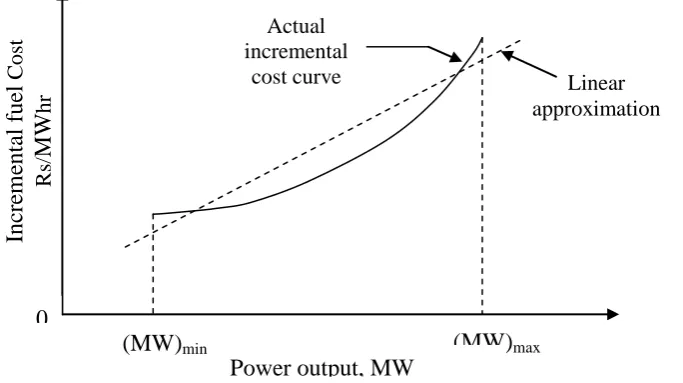
ii. Incremental Fuel Cost Curve
(MW)
min(MW)
maxPower output, MW
0
O
per
at
ing
C
ost
i
n
R
s/
hr
Fig 2.1: Input-Output curve of a generating unit
(MW)
min(MW)
maxPower output, MW
0
Inc
re
m
ental f
ue
l
C
ost
R
s/
MW
hr
Fig 2.2: Incremental fuel cost vs. power out put
Actual
incremental
DOI: 10.15662/ijareeie.2014.0307009
We know that the operating cost of the thermal plant is
Fi(Pgi) = 1/2 ai*P2gi + bi*Pgi + ci
The slope of the cost curve is called the incremental fuel cost curve (IC)i = dFi/dPgi = ai*Pgi + bi
It is expressed in terms of Rs/MWhr. A typical plot of this curve is shown above.For better accuracy incremental fuel cost may be expressed by a number of short line segments (piecewise linearization) alternatively we can fit a polynomial of suitable degree to represent IC curve in the inverse form equation.
Pgi = αi + βi(IC)i + γi(IC) 2
i + ……
Significance: The curve represents the increase in cost rate per increase in one mega watt output.
2.6 Economic Load Dispatch Problem
2.6.1 Economic Dispatch
The objective of economic load dispatch of electric power generation is to schedule the committed generating unit outputs so as to meet the load demand at minimum operating cost while satisfying all units and operational constraints of the power system.
The economic dispatch problem is a constrained optimization problem and it can be mathematically expressed as follows:
n
Minimize FT = Σ Fi(Pi)
i=1 Where, FT : total generation cost (Rs/hr)
n : number of generators
Pi : real power generation of ith generator (MW)
Fi(Pi) : generation cost for Pi
Subject to a number of power systems network equality and inequality constraints. These constraints include:
2.6.2 System Active Power Balance
For power balance, an equality constraint should be satisfied. The total power generated should be the same as total load demand plus the total line losses
n PD + PL - Σ Pi = 0
i=1 Where, PD : total system demand (MW)
PL : transmission loss of the system (MW) 2.6.3 Generation Limits
Generation output of each generator should be laid between maximum and minimum limits. The corresponding inequality constraints for each generator are
Pn,min ≤ Pn ≤ Pn,max
Where, Pn,min : minimum power output limit of nthgenerator (MW)
Pn,max : maximum power output limit of nth generator (MW)
The generation cost functionFn(Pn) is usually expressed asa quadratic polynomial:
Fn(Pn) = anPn2 + bnPn + ci
Where, an , bnandcn are fuel cost coefficients. 2.6.4 Network Losses
DOI: 10.15662/ijareeie.2014.0307009
The latter is commonly used by the power utility industry. In the B coefficients method, network losses are expressed as a quadratic function:
PL = PmBmnPn
Where, Bmn are constants called B coefficients or loss coefficients.
III. ECONOMIC LOAD DISPATCH USING LAMBDA ITERATION METHOD
The detailed Algorithm for solving the economic load dispatch problem using lambda iteration method is given below
Step 1: Read data namely cost-coefficients, B-coefficients, P limits and power demand.
Step 2: Make an initial guess and Δλ for the Lagrange multiplier.
Step 3: Calculate the generations based on equal incremental production cost.
Step 4: Calculate the generations at all buses using the equation 1- (fn/ λ) - mnPm
Pn =
(Fnn/ λ) + 2Bnn
Step 5: For each unit, check the generation limits and impose the limits in case of violation.
If Pn > Pnmax, set Pn = Pnmax
If Pn < Pnmin, set Pn = Pnmin
Step 6: Check if the difference in power at all generator buses between
two Consecutive iterations is less than a prespecified value. If not, go back to step 3.
Step 7: Calculate the loss using the relation PL = PmBmnPn
And calculate mismatch between generator power and demand plu losses.
ΔP = |Σ PG - PL - PD|
Step 8: Check if ΔP is less than є (a specified value)
If yes, stop calculation and calculate cost of generation with these values of powers. Otherwise, go to step 9.
Step 9: Increase λ by Δλ (a suitable step size); if ΔP < 0 or Decrease λ by Δλ (a suitable step size); if ΔP > 0 and repeat from step 4.
DOI: 10.15662/ijareeie.2014.0307009
Flow Chart
Solve for P
n1- (f
n/ λ) -
mnP
mP
n=
(F
nn/ λ) + 2B
nnCheck if P
n> P
n maxn = n+1
No
No
P
n= P
n maxYes
Yes
Check if all buses
have been
accounted
~
No
Check if P
n< P
n minP
n= P
n minIs
|P
ik– P
ik-1|< ε
No
Yes
k=k+
1
Yes
Start
Read unit‟s fuel cost data, P limits,
B coefficient, demand etc
Assume suitable value of λ and Δλ
Determine P
ncorresponding
to incremental cost
production
Set k=0
Set n=1
a
DOI: 10.15662/ijareeie.2014.0307009
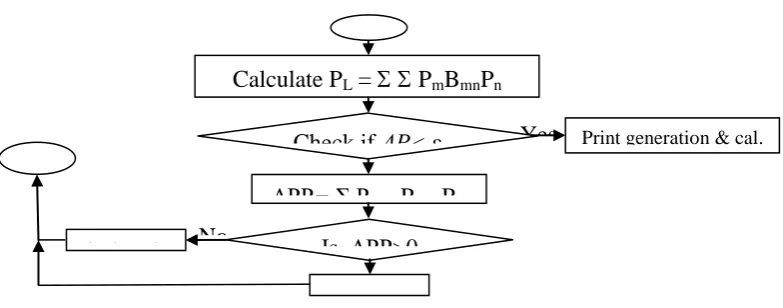
Fig. 3.1 Flow Chart of Lambda Iteration Method for Economic Load Dispatch
VI. PARTICLE SWARM OPTIMIZATION
4.1Outline of the Basic Particle Swarm Optimization:
This project presents a quick solution to the constrained ED problem using the PSO algorithm to search for optimal or near optimal generation quantity of each unit. The search procedures of the proposed method were as shown below.
Step 1: Specify the upper and lower bound generation power of each unit, ancalculate Fmax and Fmin. Initialize
randomly the individuals of the population according to the limit of each unit including individual dimensions, searching points, and velocities. These initial individuals must be feasible candidate solution that satisfies the practical operation constraints.
Step 2: To each individual Pg of the population, employ the B-coefficient lossformula to calculate the transmission loss PL.
Step 3: Calculate the evaluation value of each individual Pgi in the population using the evaluation function
f given by (4).
Step 4: Compare each individual‟s evaluation value with its pbest. The bestevaluation value among the pbests is denoted as gbest.
Step 5: Modify the member velocity v of each individual Pgi according to (5Vid(t+1) = ω. Vi(t) + C1*rand ()*(pbestid -
Pgid(t)) + C2*Rand ()*(gbestd - Pgid(t))
i = 1, 2. . . n; d=1, 2 . . . m Where n is the population size, m is the number of units, and the ω value is set by (3).
Step 6: If Vid(t+1) > Vdmax, then Vid(t+1) = Vdmax.
If Vid(t+1) < Vdmin, then Vid(t+1) = Vdmin.
Step 7: Modify the member position of each individual Pgi according to (6)
Pgid(t+1) = Pgid(t) + vid(t+1) → (6)
Pgid(t+1) must satisfy the constraints, namely the prohibited operating Zones and ramp rate limits. If Pgid(t+1)
violates the constraints the Pgid (t+1)
must be modified toward the near margin of the feasible solution.
Step 8: If the evaluation value of each individuals is better than the previouspbest, the current value is set to be pbest. If the best pbest is better than gbest, the value is set to be best.
Step 9: If the number of iterations reaches the maximum, then go to step 10. Otherwise, go to step 2.
Yes
ΔPP
=
Σ P
G- P
L- P
DCalculate P
L= P
mB
mnP
nand
ΔP
= |Σ P
G- P
L- P
D|
No
~
Check if
ΔP<
ε
Print generation & cal. cost of generationIs ΔPP>0
λ=λ+Δλ
a
DOI: 10.15662/ijareeie.2014.0307009 Step 10: The individual that generates the latest gbest is the optimal generatiopower of each unit with the minimum total generation cost.
Flow chart
Start
Update best of local bests as gbest
Initialize particles with random
Position (P) and Velocity vector (V)
Calculate fitness for each population
Update the population local best
Define the parameter of PSO constants
C
1, C
2, Particle (P), and Dimension (D)
Update particles Velocity using (5) and
Position using (6)
If iteration
Completed
DOI: 10.15662/ijareeie.2014.0307009
V. MATLAB
% PURE ECONOMIC DISPATCH PROBLEM USING LAMBDA ITERATION METHOD clear all
clc
opf=fopen('lamb_eco.doc','w+'); no_units=6;
Pd=1450;
a=[0.0070 0.0095 0.0090 0.0090 0.0080 0.0075]; b=[7 10 8.5 11 10.5 12];
c=[240 200 300 150 200 120]; Pmax=[500 200 300 150 200 120]; Pmin=[100 50 80 50 50 50];
B=[ 0.000017 0.000012 0.000007 -0.000001 -0.000005 -0.000002 0.000012 0.000014 0.000009 0.000001 -0.000006 -0.000001 0.000007 0.000009 0.000031 0.000000 -0.000010 -0.000006 -0.000001 0.000001 0.000000 0.000024 -0.000006 -0.000008 -0.000005 -0.000006 -0.000010 -0.000006 0.000129 -0.000002 -0.000002 -0.000001 -0.000006 -0.000008 -0.000002 0.000150 ];
itermax=1000; epsilon=0.1; alpha=2*a; clc
Pg=zeros(no_units,1); del_lambda=0.010; tic;deltaP=10;iter=0; EPd=Pd/no_units;
while abs(deltaP)>epsilon && iter< itermax iter=iter+1;
for i=1:no_units
sigma=B(i,:)*Pg-B(i,i)*Pg(i);
Pg(i)=(1-(b(i)/lambda)-(2*sigma))/(alpha(i)/lambda+2*B(i,i)); if Pg(i)<Pmin(i)
Pg(i)=Pmin(i); end
if Pg(i)>Pmax(i) Pg(i)=Pmax(i); end
end
P_loss=Pg'*B*Pg; Pt=sum(Pg);
deltaP=Pt-Pd-P_loss; error(iter)=deltaP;
if deltaP>0
lambda=lambda-del_lambda; end
if deltaP<0
DOI: 10.15662/ijareeie.2014.0307009
end
fprintf(opf,'\n ECONOMIC DISPATCH USING LAMBDA ITERATION METHOD\n'); if iter<itermax
fprintf(opf,'\n Problem converged in %d iterations\n',iter); else
fprintf(opf,'\n Problem diverged in %d iterations\n',iter); end
fprintf(opf,'\n Optimal Lambda = %g\n',lambda); for i=1:no_units
fprintf(opf,'\n Pgen(%d)=%g MW',i,Pg(i)); end
fprintf(opf,'\n Total Power Generation, P_total = %g MW\n',Pt); fprintf(opf,'\n Total Power Demand = %g MW',Pd); fprintf(opf,'\n Total Power Loss = %g MW',P_loss); fprintf(opf,'\n\n Error= %g\n',deltaP);
Ft=0.0;
for i=1:no_units
F(i)=c(i)+b(i)*Pg(i)+a(i)*Pg(i)*Pg(i);
fprintf(opf,'\n Fuel cost of Gen.(%d)= %g Rs/Hr',i,F(i)); Ft=Ft+F(i);
end
fprintf(opf,'\n Total fuel cost= %g Rs/Hr\n',Ft); runtime=toc;
fprintf(opf,'\n CPU time = %g sec.\n\n',runtime); fclose('all')
5.1 Code for particle swarm optimization
% Particle swarm optimization clear all;
clc;
opf=fopen('pso_eco.doc','w+'); no_units=6;
Pd=1200;
a=[240 200 300 150 200 120]; b=[7 10 8.5 11 10.5 12];
c=[0.0070 0.0095 0.0090 0.0090 0.0080 0.0075]; pmax=[500 200 300 150 200 120];
pmin=[100 50 80 50 50 50];
B=[ 0.000017 0.000012 0.000007 -0.000001 -0.000005 -0.000002 0.000012 0.000014 0.000009 0.000001 -0.000006 -0.000001 0.000007 0.000009 0.000031 0.000000 -0.000010 -0.000006 -0.000001 0.000001 0.000000 0.000024 -0.000006 -0.000008 -0.000005 -0.000006 -0.000010 -0.000006 0.000129 -0.000002 -0.000002 -0.000001 -0.000006 -0.000008 -0.000002 0.000150 ];
no_part=60; itermax=1000; alpha=b; beta=2*c; for i=1:no_units
DOI: 10.15662/ijareeie.2014.0307009
Lambda_max(i)=alpha(i)+beta(i)*pmax(i); end
lambda_min=min(Lambda_min); lambda_max=max(Lambda_max); lambda_min=lambda_min'; lambda_max=lambda_max'; for i=1:no_part
part(i)= unifrnd(lambda_min,lambda_max); end
Pbest=zeros(1,no_part);
vel_max=(lambda_max-lambda_min)/10; for i=1:no_part
vel(i)= unifrnd(-vel_max,vel_max); end
c1=2; c2=2; psi=c1+c2;
K=2/abs(2-psi-sqrt(psi*psi-4*psi)); Gbest=0.0;
P=zeros(no_part,no_units); tic;
for iter=1:itermax for i=1:no_part for k=1:no_units temp=0; for j=1:no_units if j~=k
temp=temp+B(k,j)*P(i,j); end
end end
temp=2*temp; for j=1:no_units
Nr(j)=1-(alpha(j)/part(i))-temp; Dr(j)=(beta(j)/part(i))+(2*B(j,j)); if P(i,j)>pmax(j)
P(i,j)=pmax(j); end
if P(i,j)<pmin(j) P(i,j)=pmin(j); end
end P_loss=0; for k=1:no_units for j=1:no_units
P_loss=P_loss+(P(i,k)*B(k,j)*P(i,j)); end
end
Pgen(i)=0.0; for j=1:no_units
DOI: 10.15662/ijareeie.2014.0307009
error(i)=Pgen(i)-Pd-P_loss; fit(i)= 1.0/(100.0+abs(error(i))/Pd); if Pbest(i)<fit(i)
Pbest(i)=fit(i); Pbest_part(i)=part(i); end
if Gbest<Pbest(i) Gbest=Pbest(i);
Gbest_part=Pbest_part(i); end
Wmin=0.4; Wmax=0.9;
W=Wmax-((Wmax-Wmin)*iter/itermax);
vel(i)=K*(W*vel(i)+c1*rand()*(Pbest_part(i)-part(i))+c2*rand()*(Gbest_part-part(i))); if abs(vel(i))>vel_max
if vel(i)<0.0 vel(i)=-vel_max; end
if vel(i)>0.0 vel(i)=vel_max; end
end
tpart=part(i)+vel(i); for k=1:no_units ttemp=0; for j=1:no_units if j~=k
ttemp=ttemp+B(k,j)*P(i,j); end
end end
ttemp=2*ttemp; for j=1:no_units
Nr(j)=1-(alpha(j)/tpart)-ttemp; Dr(j)=(beta(j)/tpart)+2*B(j,j); if tp(j)>pmax(j)
tp(j)=pmax(j); end
if tp(j)<pmin(j) tp(j)=pmin(j); end
end tP_loss=0; for k=1:no_units for j=1:no_units
tP_loss=tP_loss+(tp(k)*B(k,j)*tp(j)); end
end tpgen=0.0;
for j=1:no_units, tpgen=tpgen+tp(j); end
DOI: 10.15662/ijareeie.2014.0307009
Error(iter)=terror;
tfit= 1.0/(1.0+abs(terror)/Pd); if tfit>fit(i)
part(i)=tpart; Pbest(i)=tfit; Pbest_part(i)=part(i); end
if Gbest<Pbest(i) Gbest=Pbest(i);
Gbest_part=Pbest_part(i); end
end
if abs(terror)<0.01 break;
end end
runtime=toc;
fprintf(opf,'\n ECONOMIC DISPATCH USING PSO\n'); fprintf(opf,'\n Problem converged in %d iterations\n',iter); fprintf(opf,'\n Optimal Lambda= %g\n',Gbest_part); for j=1:no_units
fprintf(opf,'\n Pgen(%d)= %g MW',j,tp(j)); end
fprintf(opf,'\n Total Power Generation = %g MW\n',sum(tp)); fprintf(opf,'\n Total Power Demand = %g MW',Pd); fprintf(opf,'\n Total Power Loss = %g MW\n',tP_loss); fprintf(opf,'\n Error= %g\n',terror);
total_cost=0.0; for j=1:no_units
Fuel_cost(j)=a(j)+b(j)*tp(j)+c(j)*tp(j)*tp(j); total_cost=total_cost+Fuel_cost(j); end
for j=1:no_unitsfprintf(opf,'\n Fuel cost of Gen.(%d)= %g Rs/Hr',j,Fuel_cost(j)); end
fprintf(opf,'\n Total fuel cost= %g Rs/Hr\n',total_cost); fprintf(opf,'\n cpu time = %g sec.',runtime);
fclose('all');
Using the Trust-Worthy algorithm it defines a threshold value to the SUs to overcome the PUE attacks. It enables CR-Networks nodes to efficiently utilize the available spectrum channels. Nodes, which can easily find various licensed channel opportunities without interfering the primary system increases. This reveals that it has a potential to be able to convert the various network conditions into a performance improvement.
VI .RESULTS
DOI: 10.15662/ijareeie.2014.0307009
S.No
Load
demand(MW) (MW)
P
1 (MW)P
2 (MW)P
3 (MW)P
4 (MW)P
5 (MW)P
6 (MW)P
LFuel cost (Rs./Hr)
1. 500 216.388 50 85.702 50 50 50 1.991 6106.21
2. 700 312.282 73.420 159.487 50 59.14 50 4.164 8288.81
3. 1000 391.557 132.135 220.812 93.182 122.043 50 8.127 11957.20
4. 1200 434.380 163.796 254.043 128.659 155.661 76.594 11.307 14559.00
5. 1350 466.385 187.465 278.916 150 180.562 101.657 14.212 16586.10
6. 1450 497.113 200 300 150 200 120 16.739 17980.10
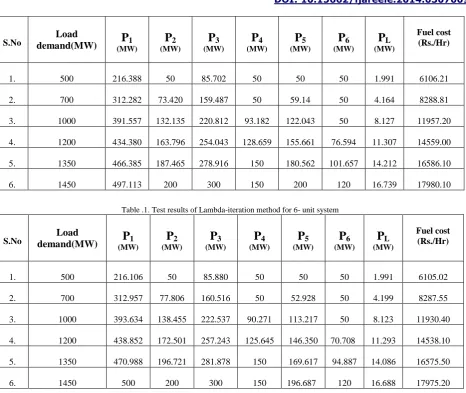
Table .1. Test results of Lambda-iteration method for 6- unit system
S.No demand(MW) Load
P
1(MW)
P
2 (MW)P
3 (MW)P
4 (MW)P
5 (MW)P
6 (MW)P
L (MW)Fuel cost (Rs./Hr)
1. 500 216.106 50 85.880 50 50 50 1.991 6105.02
2. 700 312.957 77.806 160.516 50 52.928 50 4.199 8287.55
3. 1000 393.634 138.455 222.537 90.271 113.217 50 8.123 11930.40
4. 1200 438.852 172.501 257.243 125.645 146.350 70.708 11.293 14538.10
5. 1350 470.988 196.721 281.878 150 169.617 94.887 14.086 16575.50
6. 1450 500 200 300 150 196.687 120 16.688 17975.20
TABLE .2.TEST RESULTS OF PSO METHOD FOR 6- UNIT SYSTEM
VII.CONCLUSIONSANDFUTURESCOPE
DOI: 10.15662/ijareeie.2014.0307009 REFERENCES
[1] Lin Lu, Qi Luo, Jun-yong Liu, Chuan Long, “An Improved Particle Swarm Optimization Algorithm”, IEEE International Conference On Granular Computing, pp. 486-490, 2008.
[2] A. Immanuel Selvakumar, Member, IEEE, and K. Thanushkodi, “A New Particle Swarm Optimization Solution to Nonconvex Economic M Dispatch Problems”, IEEE TRANSACTIONS ON POWER SYSTEMS, VOL. 22, NO. 1, pp. 42-51, FEBRUARY 2007.
[3] T. O. Ting, Student Member, IEEE, M. V. C. Rao, and C. K. Loo, Member, IEEE, “A Novel Approach for Unit Commitment Problem via an Effective Hybrid Particle Swarm Optimization”, IEEE TRANSACTIONS ON POWER SYSTEMS, VOL. 21, NO. 1,pp. 411-418, FEBRUARY 2006.
[4] Zwe-Lee Gaing, “Particle Swarm Optimization to solving the EconomicDispatch Considering the Generator Constraints”, IEEE Trans. On Power Systems, Vol.18, No.3, pp. 1187-1195, August 2003.
[5] P. Venkatesh, R. Gnanadass, and Narayana Prasad Padhy, “Comparison and application of evolutionary Programming techniques to combined economic Emission dispatch with line flow constraints”, IEEE Trans, on Power Syst., Vol. 18, No. 2, pp. 688-697, May 2003.
[6] Hirotaka Yoshida, Kenichi Kawata, Yoshikazu Fukuyama, Member, IEEE, Shinichi Takayama, and Yosuke Nakanishi, Member, IEEE,“A Particle Swarm Optimization for Reactive Power and Voltage Control Considering Voltage Security Assessment”, IEEE TRANSACTIONS ON POWER SYSTEMS, VOL. 15, NO. 4, pp. 1232-1239, NOVEMBER 2000.
[7] Angeline, P. J. “Using selection to improve particle swarm optimization”,Proceedings of IEEE Congress on Evolutionary Computation 1998 Anchorage,Alaska, USA, 1998b.
[8] H. T. Yang, P. C. Yang, and C. L. Huang, “Evolutionary programming based economic dispatch for units with non-smooth fuel cost functions”, IEEE Trans. on Power Systems, Vol. 11, No. 1, pp. 112-118, Feb. 1996.
[9] J. Kennedy and R. C. Eberhart, “Particle swarm optimization,” Proceedings of IEEE International Conference on Neural Networks (ICNN‟95), Vol. IV, pp. 1942-1948, Perth, Australia, 1995.
[10]B H Chowdhury and S Rahman, “A Review of Recent Advances in Economic Dispatch”, IEEE Transactions on Power System, Vol 5, no 4, pp. 1248-1259, 1990.
[11]D W Ross and S Kim, “Dynamic Economic Dispatch of Generation”, IEEE Transactions on Power Apparatus and Systems, pp. 2060, November/December1980.
[12]HAPP, H.H, “Optimal power dispatch”, IEEE Trans., PAS-93, pp. 820- 830, 1974.
[13]T.E. Bechert and H.G. Kwatny, “On the Optimal Dynamic Dispatch of Real Power”, IEEE Transactions on Power Apparatus and Systems, pp. 889,May/June 1972.