ISSN(Online): 2320-9801 ISSN (Print): 2320-9798
I
nternational
J
ournal of
I
nnovative
R
esearch in
C
omputer
and
C
ommunication
E
ngineering
(An ISO 3297: 2007 Certified Organization)
Vol. 4, Issue 4, April 2016
Classification and Identification of rice grains
using Neural Network
Anusha Anchan, Shabari Shedthi B
M.Tech Student, Dept. of CSE., NMAMIT, Nitte, Karkala, Karnataka, India
Asst. Professor, Dept. of CSE., NMAMIT, Nitte, Karkala, Karnataka, India
ABSTRACT:An Agricultural industry is too oldest and most widespread industry in the world. Classification and quality evaluation of rice grains is a challenge since manual classification that are being usedin this industry which may not be objective or efficient. All important decisions about variety of rice grain are based on the different features of rice grain. An automated system is introduced which can be used for rice grain type identification and classification where digital imaging is recognized as an efficient technique to extract the features from rice grains in a non-contact manner. Images are acquired for rice using camera. Image Pre-processing techniques, Segmentations, Feature extractionare the checks that are performed on the acquired image. The morphological features are extracted from the image are given to Neural Network Pattern Recognition Tool. This effort has been proposed to categorize and identify the specified rice sample based on its morphological features.
KEYWORDS: Poaceae, Rice grains;oryza sativa; oryza
glaberrima;Smoothing,;Segmentation;NeuralNetwork;Backpropagation.
I. INTRODUCTION
Rice is a grass cereal belonging to the Poaceae family. It is a seed belongs to the grass type calledoryza sativa or oryza glaberrima. Rice is produced in several areas throughout the world. India is the second leading producer of rice in the entire world, preceded by China. Commercial value, genetic characteristics and quality depend on the rice variety type. The grade and price of rice is decided by these factors, hence development and dissemination of new technology is an important factor determining the future of agriculture.
An accurate identification of rice seeds is very important when classifying rise verities.Manual classification methods are being used largely by local industry to differentiate rice grains on basis of geometric parameters.The exactness of classification scrutiny via human assessment scheme is different from person to person according to the inspector’s physical status such as working hassle, point of view.This work proposes a method that processes the captured still digital image of rice grains and extract the relevant features. Morphological features of rice grains are used to check the types of rice.Image processing techniques are applied to extract various features of rice grains and classifies the grains based on morphological features. The collected features are then used in Neural Network Pattern Recognition system for categorizing of rice granules.
II. RELATED WORK
Substantial work for classifying and grading of rice grains has been reported. Neelamegam et al., [1]described a method for gradation and classification of different rice grains.An artificial neural network approach is used in the Identification and classification of the rice grain samples. Sukhvir Kaur et al., [2] presented a work on Geometric Feature Extraction of Selected Rice Grains using Image Processing Techniques.
ISSN(Online): 2320-9801 ISSN (Print): 2320-9798
I
nternational
J
ournal of
I
nnovative
R
esearch in
C
omputer
and
C
ommunication
E
ngineering
(An ISO 3297: 2007 Certified Organization)
Vol. 4, Issue 4, April 2016
used to evaluate the quality of rice for the present Agmark Standards formulated with the help of digital image processing technique on MATLAB. G Ajay et al [5] presented an automatic evaluation method for the determination of the quality of milled rice.
Veena.H et al [6] presented an automatic evaluation method for determination of quality of milled rice. An automated system is introduced which is used for grain type identification and analysis of rice quality (i.e. Basmati, Boiled and Delhi) and grade (i.e. grade 1, grade 2, and grade3) ]using Probabilistic Neural Network by Megha R. Siddagangappa et al [7].Paper proposed a new principal component analysis based approach for classification of different variety of basmati rice by Rubi Kambo et al [8]. Vidya Patil et al [9] proposed a work where image processing technique was used as an attempt to automate the process which overcomes the drawbacks of manual process. This paper provides the quality assessment of rice grains based on its size. Harpreet Kaur et al [10] made a study the showed the use of support vector machine inclassifying and grading the rice grain.
III. PROPOSED METHODOLOGY
An architecture of proposed rice grain identification system is shown in Fig 1.An objective of the project is to design a rice grain classification and identification system using its morphological features, which classifies the type of rice grains using Neural Network.
Fig1 An architecture of a system
ISSN(Online): 2320-9801 ISSN (Print): 2320-9798
I
nternational
J
ournal of
I
nnovative
R
esearch in
C
omputer
and
C
ommunication
E
ngineering
(An ISO 3297: 2007 Certified Organization)
Vol. 4, Issue 4, April 2016
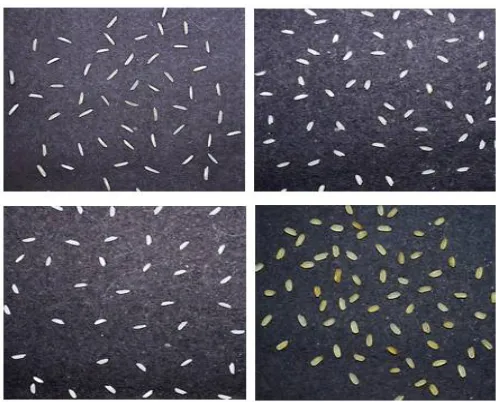
Fig 2 Rice grain samples
Image Pre-processing
The aim of pre-processing is an improvement of image data that suppresses unwanted distortion or enhances some image features for further processing. For human viewing, Image Enhancement improves the quality and clarity of images. Removing noise and blur, rising contrast and enlightening details from images are example of enhancement operation.Pre-processing stepscarried out in this work are using matlab tools:
i. Gray scale conversion.
ii. Smoothing using median filtering.
iii. Background subtraction.
iv. Image segmentation.
v. Area opening
vi. Labelling of regions.
Grey Scale Image
Grey scaledigital image is an image in which the value of each pixel is a single sample, that is, it carries only intensity information. Images of this sort, also known as black-and-white, are composed exclusively of shades of gray, varying from black at the weakest intensity to white at the strongest. = rgb2gray(RGB) converts the true color image RGB to the grayscale intensity image I. rgb2gray converts RGB images to grayscale by eliminating the hue and saturation information while retaining the luminance.
Median Filtering
Median filtering is a nonlinear process useful in reducing impulsive, or salt-and-pepper noise. It is also useful in preserving edges in an image while reducing random noise. In a median filter,[11] a window slides along the image, and the median intensity value of the pixels within the window becomes the output intensity of the pixel being processed. Median filtering smooth the image and is thus useful in reducing noise.Unlike lowpass filtering, median filtering can preserve discontinuities in a step function and can smooth a few pixels whose values differ significantly from their surroundings without affecting the other pixels.
Background subtraction
ISSN(Online): 2320-9801 ISSN (Print): 2320-9798
I
nternational
J
ournal of
I
nnovative
R
esearch in
C
omputer
and
C
ommunication
E
ngineering
(An ISO 3297: 2007 Certified Organization)
Vol. 4, Issue 4, April 2016
objects in its foreground. Background subtraction provides important cues for numerous applications in computer vision. Background of an image may not be not homogeneous,(the top is brighter than the bottom) such cases the background is set to zero. Then, each row will be updated by subtracting its minimal value.
Image segmentation
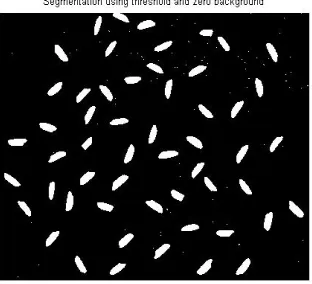
The goal of segmentation is to simplify and/or change the representation of an image into something that is more meaningful and easier to analyze. Image segmentation is typically used to locate objects and boundaries (lines, curves, etc.) in images.This work carried out segmentation of an image into foreground and background using global threshold.Segmentation using a global threshold where binary image is computed B by threshold. Fig 3shows segmentation of input image using global threshold at threshold value 55.
In this case, B(i,j) = 1 if I(i,j)>th, else B(i,j) = 0. Ideally, B(i,j) = 1 if the pixel (i,j) belongs to the rice region, and it is 0 if it belongs to the background.
Fig 3 Segmentation of rice image at threshold =55
Area opening
It is also known as elimination of small regions or isolated pixels. The new segmentation image might have isolated pixels. They correspond to noise in the background. In this part, those pixels are eliminated using the function bwareaopen(BW, P) removes from a binary image all connected components (objects) that have fewer than P pixels.
Labelling of regions and connected components
In order to perform a pattern recognition approach each isolatedregion is labelled using the command 'bwlabel'.L = bwlabel(BW, n) returns a matrix L, of the same size as BW, containing labels for the connected objects in BW. Function bwconncomp() [CC = bwconncomp(BW)] returns the connected components CC found in BW. The binary image BW can have any dimension. CC is a structure with four fields. bwconncomp uses a default connectivity of 8 for two dimensions.
Feature Extraction
Features of Rice grains are extracted usingthe function regionprops().The features extracted in this work are: Area, Major Axis Length, Minor Axis Length,Eccentricity and Perimeter.
Training of Neural Network
ISSN(Online): 2320-9801 ISSN (Print): 2320-9798
I
nternational
J
ournal of
I
nnovative
R
esearch in
C
omputer
and
C
ommunication
E
ngineering
(An ISO 3297: 2007 Certified Organization)
Vol. 4, Issue 4, April 2016
Neural Network Architecture
The default network for pattern recognition problems is, patternnet, is a feedforward network which is created using a function patternet() with number of hidden layer size as an argument.
The pattern recognition neural network is built with
Five neurons in input layer.
‘n’neurons in the hidden layer where n>1
Four neurons in the output layer.
The number of neurons in input layer depends upon the number of input elements(features) and number of neurons in output layer is equal to the number of elements in the target vector.The neural network training performance mainly depends on the number of hidden layer neurons. Usually as the number of hidden layer neurons increased performance of the neural network is also elevated. But consequence of increasing the number of neurons will complicate the network. This work has a provision for setting any number of hidden layer size during neural network training.
Five features considered are Area, Major axis Length, Minor axis Length, Eccentricity and perimeter. This work is carried out by considering 20 sample images of four types of rice grains i.e Basmathi, Sona Masuri, Paraboiled and Jeera rice. Each image contains approximately 50 grains. This system is also designed to take any number of sample images for input feature dataset creation.
Training Network
Asupervised learning backpropagation algorithm is used to find the function that best maps the set of inputs to its correct output and these are used to train feedforward network.The matlab neural network tool provides various backpropagation algorithms to train a pattern recognition neural network. These algorithms are implemented as a functions in matlab. These functions take network, Feature dataset and Target Dataset as input arguments. Yield of these functions are newly trained network (net) and training record (tr).
Input Vector: Input vector is a 5x1119 matrix, representing static data: 4 features of 1119 rice grains.
Target Vector: Target vector is a 5x1119 matrix, representing static data: 4 classes to which input data is mapped.
Present work provides anoption for selecting one among the twotraining functions listed below.
Leven berg-Marquardt back propagation.
Scaled conjugate gradient back propagation.
ISSN(Online): 2320-9801 ISSN (Print): 2320-9798
I
nternational
J
ournal of
I
nnovative
R
esearch in
C
omputer
and
C
ommunication
E
ngineering
(An ISO 3297: 2007 Certified Organization)
Vol. 4, Issue 4, April 2016
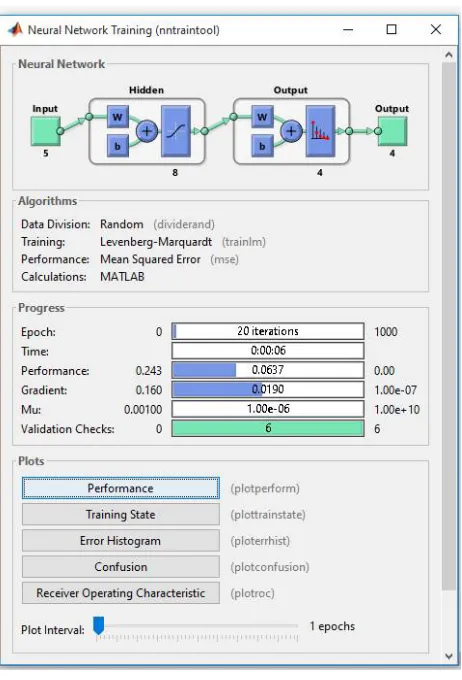
Fig 4An algorithm and its progression.
IV. EXPERIMENTAL RESULTS
Experiments are carried out with 20 sample rice images each containing 50-100 rice grains. These sample images are used to create the input feature dataset. Once training feature dataset and Target dataset is created the feedforward pattern recognition neural network is created and trained.
ISSN(Online): 2320-9801 ISSN (Print): 2320-9798
I
nternational
J
ournal of
I
nnovative
R
esearch in
C
omputer
and
C
ommunication
E
ngineering
(An ISO 3297: 2007 Certified Organization)
Vol. 4, Issue 4, April 2016
Table 1 Rice Classification Result
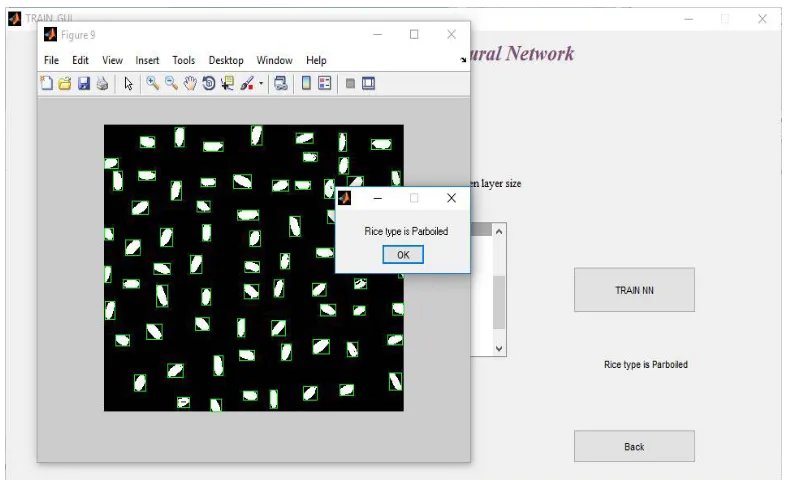
Once the network is trained it is used to identify the type of the rice. It is clear from the Table 1 that network trained with Levenberg Marquardt with 8 hidden layer neurons is well trained.Based on this training performance, the best trained network is used for identification of rice type. Fig 5 shows the result of experiment where Parboiled rice image was taken as test input and it was successfully identified by the system.Given any new rice image the trained network is able to identify the type of rice successfully.
Fig 5 Experimental Result
Training Algorithm Performance
Algorithm 4
5
6 7 8Levenberg-Marquardt
74.4 74.9 82.1 85.4 91.3
Scaledconjugate gradient.
ISSN(Online): 2320-9801 ISSN (Print): 2320-9798
I
nternational
J
ournal of
I
nnovative
R
esearch in
C
omputer
and
C
ommunication
E
ngineering
(An ISO 3297: 2007 Certified Organization)
Vol. 4, Issue 4, April 2016
V. CONCLUSION AND FUTURE WORK
The processing of imagery and the vigilant assortment of the variety measured in this effort for extracting features from rice granules significantly abridged the intricacy of the classification problem. This work presents classification accuracies for rice grains obtained through image processing with neural network architecture. Neural Network Pattern Recognition Tool is lucratively applied in grading rice granules. The developed Neural Network is adapted for classifying and identifying added grains with the accuracy of 91.3%.
The preliminary work presented in this paper could be further enhanced by focusing on different sampling methods, sample sizes, sample pre-processing techniques, different features and different neural network models to match the requirements of the rice industry.
REFERENCES
1. Neelamegam, P., Abirami, S.Vishnu Priya, K.Rubalya Valantina, S.” Analysis of Rice Granules using Image Processing and Neural
Network Pattern Recognition Tool” Information & Communication Technologies (ICT), IEEE Conference ,879 - 884,11-12 April 2013.
2. Sukhvir Kaur, Derminder Singh .” Geometric Feature Extraction of Selected Rice Grains using Image Processing Techniques”
International Journal of Computer Applications (0975 – 8887)Volume 124 – No.8, August 2015.
3. Abirami. S, Neelamegam. P, Kala. H “Analysis of Rice
Granules using Image Processing and Neural Network Pattern Recognition Tool” International Journal of Computer Applications (0975 – 8887) Volume 96– No.7, June 2014.
4. Priyankaran Tanck, Bipan Kaushal ,”A New Technique of Quality Analysis for Rice Grading for Agmark Standards” International Journal
of Innovative Technology and Exploring Engineering (IJITEE) 2278-3075, Volume-3, Issue-12, May 2014.
5. G.Ajay, M.Suneel, K.Kiran Kumar, P.Siva Prasad, “Quality Evaluation of Rice Grains Using Morphological Methods” International
Journal of Soft Computing and Engineering (IJSCE): 2231-2307, Volume-2, Issue-6, January 2013.
6. Veena.H Latharani T R, “An efficient method for classification of rice grains using Morphological process” International Journal of
Innovative Research in Advanced Engineering (IJIRAE) 2278-2311, Volume 1,Issue 1,April 2014.
7. Megha R. Siddagangappa, “Classification and Quality Analysis of Food Grains” IOSR Journal of Computer Engineering
(IOSR-JCE)-ISSN: 2278-0661,p-(IOSR-JCE)-ISSN: 2278-8727, PP 01-10, Volume 16, Issue 4, Ver. III, Jul – Aug. 2014.
8. Rubi Kambo, Amit Yerpude “Classification of Basmati Rice Grain Variety using Image Processing and Principal Component Analysis “
International Journal of Computer Trends and Technology (IJCTT) ISSN: 2231-5381, Volume 11, number 2, May 2014.
9. Vidya Patil, V. S. Malemath,” Quality Analysis and Grading of Rice Grain Images” International Journal of Innovative Research in
Computer and Communication Engineering (An ISO 3297: 2007 Certified Organization), Volume 3, Issue 6, June 2015.
10. Xue-Bin LI, Xiao-Ling YU,”Influence of Sample Size on Prediction of Animal Phenotype Value Using Back-Propagation Artificial
Neural Network with Variable Hidden Neurons” IEEE conference, 2009.
11. http://homepages.inf.ed.ac.uk/rbf/HIPR2/median.htm
BIOGRAPHY
Anusha Anchan is M.Tech student pursuing degree in Computer Science Department, NMAMIT, Nitte, Karnataka.She received Bachelor of Engineering (BE) degree in 2010 from Visvesvaraya Technological University, Belgaum, Karnataka. Her research interests are Neural Networks, Data mimingand Machine Learning.