An Adaptive Approach of Decomposition and
Restoration of Single Blur Image Using Blind
Deconvolution
Prof. Neeraj Bhargava , Surbhi Sharma, Sammah Rasheed
HOD, Dept. of Computer Science, MDSU Ajmer (Raj.), India M. Tech Scholar, Dept. of Computer Science, MDSU Ajmer (Raj.), India M. Tech Scholar, Dept. of Computer Science, MDSU Ajmer (Raj.), India
ABSTRACT: Observed images of a scene are usually degraded by blurring due to atmospheric turbulence and inappropriate camera settings. The images are further degraded by the various noises present in the environment and the system. Therefore it is essential to get a sharp clean image from the noisy blurred image. In digital imaging, blurring is a bandwidth reduction of the image due to imperfect image construction process which gives poor image quality. Some blurring always arises in the recording of a digital image. Along with these blurring effects, noise always corrupts any recorded image. Reconstructing process is divided into two categories, first is nonblind in which the blurring function is given and the degradation process is inverted using one of the restoration algorithms and second blind where blurring operator is not known. Deconvolution using blind method is very complex process where image recovery is performed with little or no prior knowledge of the degrading PSF. The PSF represent the impulse response of a point source.
In this paper Blind Deconvolution method has been implemented to deblur a single image. PSNR and MSE value has been calculated.
KEYWORDS: Blind Deconvolution, Image, Noise. PSNR, MSE
I. INTRODUCTION
A very large portion of digital image processing is devoted to image restoration. This includes research in algorithm development and routine goal oriented image processing. Image restoration is the removal or reduction of degradations that are incurred while the image is being obtained [1]. Degradation comes from blurring as well as noise due to electronic and photometric sources. Blurring is a form of bandwidth reduction of the image caused by the imperfect image formation process such as relative motion between the camera and the original scene or by an optical system that is out of focus [2]. When aerial photographs are produced for remote sensing purposes, blurs are introduced by atmospheric turbulence, aberrations in the optical system and relative motion between camera and ground. In addition to these blurring effects, the recorded image is corrupted by noises too. A noise is introduced in the transmission medium due to a noisy channel, errors during the measurement process and during quantization of the data for digital storage. Each element in the imaging chain such as lenses, film, digitizer, etc. contributes to the degradation.
needed for analyzing images of unique events, and in forensic science where potentially useful photographic evidence is sometimes of extremely bad quality [2].
Let us now consider the representation of a digital image. A 2- dimensional digital image can be represented as a 2- dimensional array of data s(x,y), where (x,y) represent the pixel location. The pixel value corresponds to the brightness of the image at location (x,y). Some of the most frequently used image types are binary, gray-scale and color images [3].
Binary images are the simplest type of images and can take only two discrete values, black and white. Black is represented with the value ‘0‘ while white with ‘1‘. Note that a binary image is generally created from a gray-scale image. A binary image finds applications in computer vision areas where the general shape or outline information of the image is needed.
They are also referred to as 1 bit/pixel images. Gray-scale images are known as monochrome or one-color images. The images used for experimentation purposes in this thesis are all gray-scale images. They contain no color information. They represent the brightness of the image.
This image contains 8 bits/pixel data, which means it can have up to 256 (0-255) different brightness levels. A ‘0‘represents black and ‘255‘ denotes white. In between values from 1 to 254 represent the different gray levels. As they contain the intensity information, they are also referred to as intensity images. Color images are considered as three band monochrome images, where each band is of a different color. Each band provides the brightness information of the corresponding spectral band. Typical color images are red, green and blue images and are also referred to as RGB images. This is a 24 bits/pixel image.
In this paper, a analysis is made on the Blind deconvolution denoising algorithms, their efficacy and elaboration.
II. LITERATURE SURVEY
A review of previous work carried out in the field of Image Denoising Technique and the methodology adopted to reduce their limitation is summarized as follows:
Punam Patil & R.B.Wagh (IEEE 2013)in their paper ―Implementation of Restoration of Blurred Image Using Blind Deconvolution Algorithm‖ used Blind deconvolution technique for restoring the image. They found that Gaussian Filter
gives efficient implementation that allows it to create a very blurry blur image in a relatively short time. Improvement in Canny method is shown to detect strong and weak edges of an image and it shows better quantity edges than traditional canny edge detection method. The advantage of using this Blind Deconvolution algorithm is to deblur the degraded image without prior knowledge of PSF and additive noise. But in other algorithms, we should have the knowledge over the blurring parameters.
The main aim of their work is to restore a degraded image in which blurred image is produced with Gaussian filter and Gaussian noise then further to find the ring effect using canny edge detection then deblurring the image using blind deconvolution algorithm which is effectively used when no information about the distortion (blurring and noise) is known.
Sandeep P and Tony Jacob (IEEE 2013) , in their paper ―Image restoration for multiple copies: A GMM based‖
they have addressed the problem of utilizing multiple degraded observations of an image for better image restoration. They proposed an algorithm which utilizes the correlated information from all different observations to produce better reconstruction quality. Different experiments con- ducted to evaluate the performance demonstrates effectiveness of the algorithm in using correlation among multiple observations.
like to exploit the correlation among them for better image recovery. In this work, they have extended the GMM based method to the multiple observations scenario, where we estimate the original image by utilizing the collective information available from all degraded copies.
Dongqing Xu (IEEE 2013) in their paper ―The Image Restoration Method Based on Image Segmentation and Multiple Feature Fusion they consider the local correlation of natural image, uses Mean Shift clustering segmentation algorithm to separate the original input image, limits the search scope in the related texture region to find the best matching block; at the same time for finding matching algorithm of the most suitable texture block, through theanalysis of image texture feature, the structure characteristics and the distance between repair block and similar block, this paper puts forward a kind of texture similarity block matching algorithm based on texture, structure and the distance. Experiments has showed that, comparing with the Criminis repair algorithm, this paper improves the repair effect on the structural texture image, and effectively increases the computational efficiency. But this algorithm still has deficiency, in the aspect of calculating the priority which only considers data item and confidence item, not considers their weights and other image characteristics can influence repair block filling sequence that is what this paper needs to study further.
III. DESIGN METHODOLOGY
The algorithm maximizes the likelihood that the resulting image, when convolved with the resulting PSF, is an instance of the blurred image, assuming Poisson noise statistics. The blind deconvolution algorithm can be used effectively when no information about thedistortion (blurring and noise) is known. MATLABsoftware will beused to implement this research work. Proposed algorithm for the research methodology can be illustrated as follows:
III.I Steps for Deblurring with the Blind Deconvolution Algorithm:
READ THE IMAGE
CONVERT THE INPUT IMAGE IN GRAY SCALE
CREATE THE MIN FILTER RESULT
CREATE THE NOISY IMAGE
IV. RESULT ANALYSIS
As discussed the methodology adopted for the implementation of blind deconvolution algorithm to find out the deblur image using weighted array system it is important to consider the image size. Here 255×255 image size is taken. In order to get noise free image when the apriori knowledge of the PSF is not known blind deconvolution algorithm gives the way to get noise free Image. Several techniques have been proposed for the denoising of an image when the user has the apriori knowledge of the feature of image in terms of PSF. But when it is unknown the retrieval of the image becomes complex.
In the base paper canny edge detection technique has been used to find out the PSF appropriate to the original image.
CREATE THE GAUSSIAN PSF OF THE IMAGE
GAUSSIAN BLURRED IMAGE GENERATE
BY USING THE RANDOM & GAUSSIAN PSF DEBLUR
THE IMAGE
ANALYZE THE DEBLUR USING RANDOM AND
GAUSSIAN PSF
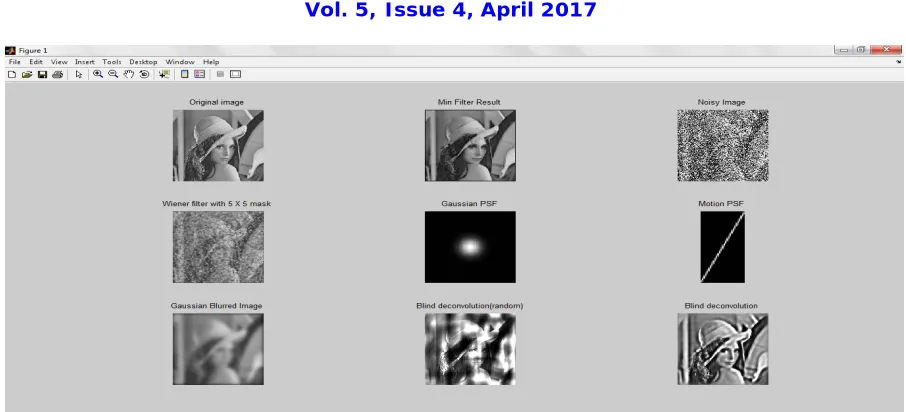
Figure 1(a) Original Image(b)Min Filter Result(c)Noisy Image(d)Wiener filter with 5X5 mask(e)Gaussian PSF(f)Motion PSF (g)Gaussian Blurred Image(h)Random Blind Deconvolution (i)Deblurred Image
In this way we find the range of blur in terms of PSF. Now the task is to get the accurate PSF value which will facilitate the deblurring process. Deblurring with random PSF has been shown in Figure. Now deblurring is take place with the help of gaussian PSF value which is the PSF related to the original PSF. This will define our threshold region where from we have to estimate the actual PSF which will reduce the blur at optimum level. Deblurring with motion PSF has been shown in Figure.
Figure 3: Deblurring with Motion PSF. Now we can find out the PSF of deblurred image obtained by using the gaussian PSF.
Figure 4: Reconstructed Image
IV.I Quality Measurements
In order to evaluate the quality of watermarked image, the following signal-to-noise ratio (SNR) & MSE equation is used:
OR
SNR = 10* log10∑ ∑ 2(i, j) ∑ ∑ [ (i, j) -- Iw (i, j)]2
MSE = ∑ ( ’ − )2
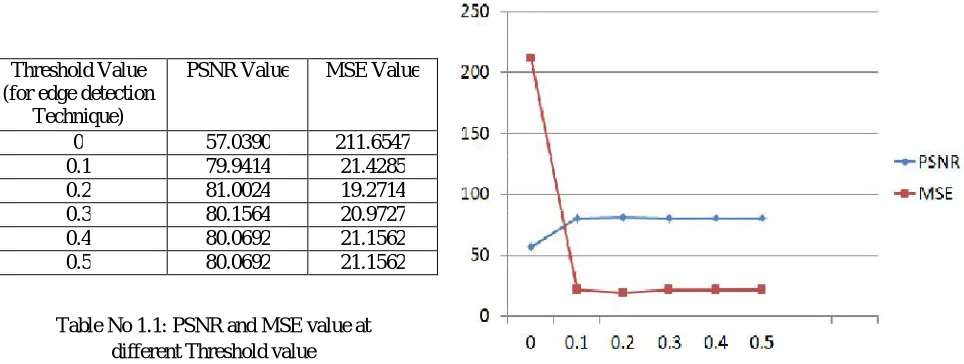
PSNR and MSE calculated by applying the blind deconvolution method at various threshold level has been tabulated here in table number 1.1
PSNR and MSE calculated by applying the blind deconvolution method at various threshold level has been tabulated here in table number 1.1
V. CONCLUSION
The blind deconvolution is a powerful tool to restore images with little or no a priori knowledgeabout the PSF that blurred the image. Especially blind deconvolution with TV regularization seems to be very suitable since it is able to restore signals with edges in them.In this paper Blind Deconvolution method has been implemented to deblur a single image. PSNR and MSE value has been calculated. The result shows that at threshold value 0.2 the PSNR value is maximum and MSE is minimum which the desired condition is.
Threshold Value (for edge detection
Technique)
PSNR Value MSE Value
0 57.0390 211.6547 0.1 79.9414 21.4285 0.2 81.0024 19.2714 0.3 80.1564 20.9727 0.4 80.0692 21.1562 0.5 80.0692 21.1562
Table No 1.1: PSNR and MSE value at different Threshold value
REFERENCES
[1] Deepa Kundur, Student Member, and Dimitrios Hatzinakos,―A Novel Blind Deconvolution Scheme for Image Restoration Using Recursive Filtering ,‖ IEEE Transactions On Signal Processing, Vol. 46, no. 2, February 1998.
[2] Xiumei Kang, Qingjin Peng, Gabriel Thomas and Yu, ―Blind Image Restoration Using The Cepstrum Method‖ IEEE CCECE/CCGEI, Ottawa, May 2006.
[3] Punam Patil & R.B.Wagh ―Implementation of Restoration of Blurred Image Using Blind Deconvolution Algorithm‖ IEEE 2013.
[4] Xiang Zhu, Member, IEEE, Scott Cohen, Member, IEEE, Stephen Schiller, Member, IEEE, and Peyman Milanfar, Fellow, IEEE Estimating Spatially Varying Defocus Blur From A Single Image, IEEE TRANSACTIONS ON IMAGE PROCESSING, VOL. 22, NO. 12, DECEMBER 2013.
[5] A. Levin, Y. Weiss, F. Durand, and W. T. Freeman, ―Understanding and evaluating blind deconvolution algorithms,‖ in Proc. IEEE CVPR, Aug. 2009, pp. 1964–1971.
[6] L. Xu and J. Jia, ―Two-phase kernel estimation for robust motion deblurring,‖ in Proc. ECCV, 2010, pp. 157–170.
[7] O.Whyte, J. Sivic, A. Zisserman, and J. Ponce, ―Non-uniform deblurring for shaken images,‖ in Proc. IEEE CVPR, Jun. 2010, pp. 491–498.
[8] A. Chakrabarti, T. Zickler, and W. T. Freeman, ―Analyzing spatially varying blur,‖ in Proc. IEEE CVPR, Jun. 2010, pp. 2512–2519.
[9] S. Bae and F. Durand, ―Defocus magnification,‖ Comput. Graph. Forum, vol. 26, no. 3, pp. 571–579, 2007.