www.ijiset.com
Genetic Algorithm Solution for ELD by Equal Incremental
Cost Criterion
Vikas Kumar Nishad#, Anupam Masih* #
Electrical Engineering, Sam Higginbottom University of Agriculture Technology and Sciences Allahabad, Uttar Pradesh India.
*Assistant Professor, Dept. of Electrical Engineering, SIET, SHUATS, Allahabad, Uttar Pradesh, India
Abstract
—
In a down to earth control framework, the power plants are not situated at a similar separation from the focal point of burdens and their fuel costs are extraordinary. Additionally, under typical working conditions, the era limit is more than the aggregate load request and misfortunes. Accordingly, there are numerous alternatives for planning era. In an interconnected power framework, the goal is to locate the genuine and receptive power booking of each power plant so as to limit the working expense. This implies the generator's genuine and receptive forces are permitted to fluctuate inside specific points of confinement in order to take care of a specific load demand with least fuel cost. This is called ideal power stream issue. In this task, ECONOMIC LOAD DISPATCH (ELD) of genuine power era is considered. Economic Load Dispatch (ELD) is the planning of generators to limit add up to working expense of generator units subjected to balance requirement of energy adjust inside the base and most extreme working cutoff points of the producing units. By and large by disregarding valve point stacking impacts, financial load dispatch can be illuminated either by lambda pursuit or era look techniques. In this undertaking, valve point stacking impacts of the creating units are considered. To understand monetary load dispatch, two of smart pursuit strategies are viewed as, to be specific, hereditary calculation and example look techniques.Keywords: Economic Load Dispatch, Genetic Algorithm.
1. INTRODUCTION
The Electrical power frameworks are planned and worked to meet the persistent variety of energy request. In control framework limiting, the operation cost is essential. Economic Load Dispatch (ELD) is a strategy to plan the power generator yields as for the heap requests, and to work the power framework most monetarily, or at the end of the day, we can state that primary goal of monetary load dispatch is to dispense the ideal power era from various units at the least cost conceivable while meeting all framework imperatives Over the years, numerous endeavors have been made to tackle the ELD issue, fusing various types of requirements or different targets through different scientific programming and advancement procedures. The regular strategies incorporate Newton-Raphson technique, Lambda Iteration strategy, Base Point and Participation Factor technique, Gradient strategy, and so on [1]. Nonetheless, these traditional dispatch calculations require the incremental cost bends to be
monotonically expanding or piece-wise direct [2]. The info/yield attributes of present day units are naturally exceedingly nonlinear (with valve-point impact, rate limits and so on) and having different nearby least focuses in the cost work. Their attributes are approximated to meet the prerequisites of established dispatch calculations prompting problematic arrangements and hence, bringing about immense income misfortune over the time. Thought of very nonlinear qualities of the units requires exceptionally vigorous calculations to abstain from stalling out at nearby optima [3]. The traditional analytics based systems flop in tackling these sorts of issues. In this regard, stochastic pursuit calculations like hereditary calculation (GA) [4]-[9], developmental methodology (ES) [10]-[12], transformative programming (EP) [13], molecule swarm enhancement (PSO) [14] and mimicked tempering (SA) may end up being exceptionally productive in taking care of exceedingly nonlinear ELD issue with no limitations on the state of the cost bends. In spite of the fact that these heuristic strategies don't generally ensure the worldwide ideal arrangement, they by and large give a quick and sensible arrangement (problematic or close worldwide ideal).
2.
E
CONOMICL
OADD
ISPATCH2.1 Economic load dispatch
The Economic Dispatch can be characterized as the way toward dispensing era levels to the producing units, so the framework stack is provided totally and generally financially. For an interconnected framework, it is important to limit the costs. The financial load dispatch is utilized to characterize the creation level of each plant, with the goal that the aggregate cost of era and transmission is least for an endorsed calendar of load. The goal of financial load dispatch is to limit the general cost of era.
2.2 Generator Operating Cost
The aggregate cost of operation incorporates the fuel cost, cost of work, supplies and support. By and large, expenses of work, supplies and support are settled rates of approaching fuel costs. The power yield of fossil plants is expanded successively by opening an arrangement of valves to its steam turbine at the bay. The throttling misfortunes are extensive
www.ijiset.com when a valve is quite recently opened and little when it is completely opened.
Figure 1 Simple model of a fossil plant
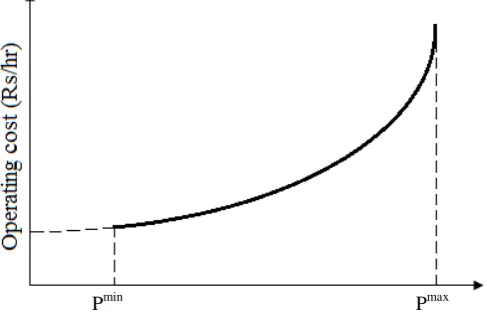
Figure 1.shows the simple model of a fossil plant dispatching purposes. The cost is usually approximated by one or more quadratic segments. The operating cost of the plant has the form shown in Figure 2.
Pmin Pmax
Figure 2 Operating costs of a fossil fired generator
The fuel cost bend may have various discontinuities. The discontinuities happen when the yield control is reached out by utilizing extra boilers, steam condensers, or other hardware. They may likewise show up if the cost speaks to the operation of a whole power station, and henceforth cost has discontinuities on paralleling of generators. Inside the congruity go the incremental fuel cost might be communicated by various short line fragments or piece-wise linearization.
The Pmin is the minimum loading limit below which, operating the unit proves to be uneconomical (or may be technically infeasible) and Pmax is the maximum output limit.
3. FORMULATION OF ELD PROBLEM
3.1Objective Function
The objective of the economic dispatch problem is to minimize the total fuel cost of thermal power units subjected to the equality and inequality constraints of a power system. The simplified cost function of each generator can be represented as a quadratic function as given in (2) .
Where ai ,bi ,ci are cost coefficients for
i
th unit, ( ) F P is thetotal cost of generation,
P
gi is the generation ofi
th plant.3.2 Equality and Inequality Constraints
3.2.1 Active power balance equation
For power balance, an equality constraint should be satisfied. The total generated power should be the same as total load demand plus the total transmission line loss.
where PD is the total load demand and Ploss is the total line loss.
4. GENETIC ALGORITHM
A Genetic Algorithm (GA) is a hunt method utilized as a part of processing to discover correct or rough answers for advancement and pursuit issues. Hereditary calculations are sorted as worldwide inquiry heuristics. Hereditary calculations are a specific class of Evolutionary Algorithms (EA) that utilization methods propelled by transformative science, for example, legacy, change, choice, and hybrid. Hereditary calculations are actualized in a PC reproduction in which a populace of conceptual portrayals (called chromosomes or the genotype of the genome) of applicant arrangements (called people, animals, or phenotypes) to an advancement issue advances toward better arrangements. Customarily, arrangements are spoken to in double as series of 1s, however different encodings are additionally conceivable. The development more often than not begins from a populace of haphazardly created people and occurs in eras. In every era, the wellness of each person in the populace is assessed, different people are stochastically chosen from the present populace (in view of their wellness), and altered (recombined and potentially arbitrarily transformed) to shape another populace. The new populace is then utilized as a part of the following emphasis of the calculation. Regularly, the calculation ends when either a most extreme number of eras has been delivered, or an agreeable wellness level has been gone after the populace. In the event that the calculation has ended because of a most extreme number of eras, an acceptable arrangement might possibly have been come to. When we have the hereditary portrayal and the wellness work characterized, GA continues to instate a populace of arrangements haphazardly, and afterward enhance it through tedious use of change, hybrid, reversal, and choice administrators.
4.1 Representation
Hereditary Algorithms are gotten from an investigation of natural frameworks. In natural frameworks advancement happens on
www.ijiset.com natural gadgets used to encode the structure of living creatures. These natural gadgets are known as chromosomes. A living being is just a decoded structure of the chromosomes. Regular determination is the connection amongst chromosomes and the execution of their decoded structures. In GA, the plan factors or highlights that portray an individual are spoken to in a requested rundown called a string. Each outline variable relates to a quality and the series of qualities compares to a chromosome. Chromosomes are made of discrete units called qualities.
4.2 Encoding
Typically, a chromosome compares to a remarkable arrangement x in the arrangement space. This requires a mapping instrument between the arrangement space and the chromosomes. This mapping is called an encoding. Truth be told, GA chips away at the encoding of an issue, not on the issue itself. The use of a hereditary calculation to an issue begins with the encoding. The encoding determines a mapping that changes a conceivable answer for the issue into a structure containing an accumulation of choice factors that are significant to the issue.
4.3 Decoding
Interpreting is the procedure of change of the paired structure of the chromosomes into decimal reciprocals of the component esteems. Normally this procedure is done after de-catenation of the whole chromosome to singular chromosomes. The decoded include values are utilized to process the issue attributes like the goal work, wellness esteems, imperative infringement and framework factual qualities like fluctuation, standard deviation and rate of merging. The phases of determination, hybrid, change and so on are rehashed till some end condition is come to.
The equivalent decimal integer of binary string ⁁ is obtained as
4.4 Initialization
At first numerous individual arrangements are haphazardly created to shape an underlying populace. The populace estimate relies upon the idea of the issue, yet normally contains a few hundreds or thousands of conceivable arrangements. Customarily, the populace is created arbitrarily, covering the whole scope of conceivable arrangements. Once in a while, the arrangements might be "seeded" in territories where ideal arrangements are probably going to be found.
4.5 Evaluation
Reasonableness of the arrangements is resolved from the underlying arrangement of arrangement of the issue. For this reasonableness assurance, we utilize a capacity called wellness work. This capacity is gotten from the target work and utilized as a part of progressive hereditary operation. The assessment work is a strategy for building up the wellness of
every chromosome in the populace and is especially application orientated. Since Genetic Algorithms continue toward advancing the fittest chromosomes and the execution is exceedingly touchy to the wellness esteems. On account of streamlining schedules, the wellness is the estimation of the target capacity to be advanced. Punishment capacities can likewise be joined into the goal work, keeping in mind the end goal to accomplish an obliged issue.
4.6 Fitness Function
The Genetic calculation depends on Darwin's rule that "The applicants, which can survive, will live, others would bite the dust". This essential is utilized to discover wellness estimation of the procedure for taking care of amplification issues. Minimization issues are generally moved into expansion issues utilizing some reasonable changes. Wellness esteem f (x) is gotten from the target work and is utilized as a part of progressive hereditary operations. The wellness work for expansion issue can be utilized the same as target work F(X ) The wellness work for the augmentation issue is:
f (x) = F(X ) (7)
For minimization problems, the fitness function is an equivalent maximization problem chosen such that the optimum point remains unchanged. The following fitness function is often used in minimization problems:
F(X ) = 1/(1+ f (x)) (8)
Here
f
(
x
)
is fitness function and F(X ) is objective function.4.7 Selection
Amid each progressive era, an extent of the current populace is chosen to breed another era. Singular arrangements are chosen through a wellness based process, where fitter arrangements (as measured by a wellness work) are regularly more prone to be chosen. Certain determination techniques rate the wellness of every arrangement and specially select the best arrangements. Different strategies rate just an irregular specimen of the populace, as this procedure might be exceptionally tedious. Most capacities are stochastic and planned with the goal that a little extent of less fit arrangements are chosen. This helps keep the decent variety of the populace huge, counteracting untimely meeting on poor arrangements. Mainstream and all around examined determination strategies incorporate roulette wheel choice and competition choice.
4.8 Reproduction
The following stage is to create a moment era populace of arrangements from those chose through hereditary administrators: hybrid (likewise called recombination), and additionally change. For each new answer for be created, a couple of "parent" arrangements is chosen for reproducing from the pool chose beforehand. By delivering a "youngster"
www.ijiset.com arrangement utilizing the above strategies for hybrid and transformation, another arrangement is made which normally shares a considerable lot of the qualities of its "folks". Unseasoned parents are chosen for each new kid, and the procedure proceeds until the point that another populace of arrangements of suitable size is produced. Despite the fact that proliferation strategies that depend on the utilization of two guardians are more "science roused," some exploration proposes more than two "guardians" are smarter to be utilized to recreate a decent quality chromosome. These procedures at last outcome in the cutting edge populace of chromosomes that is not the same as the underlying era. For the most part the normal wellness will have expanded by this strategy for the populace, since just the best living beings from the original are chosen for rearing, alongside a little extent of less fit arrangements, for reasons as of now said above.
4.9 Termination
This generational process is repeated until a termination condition has been reached. Common terminating conditions are:
1.) A solution is found that satisfies minimum criteria 2.) Fixed number of generations reached
3.) Allocated budget (computation time/money) reached 4.) The highest ranking solution's fitness is reaching or has reached a plateau such that successive iterations no longer produce better results
5.) Manual inspection
6.) Combinations of the above.
4.9 Genetic Algorithm
1. Select a reference plant. For better convergence chose a
plant which has maximum capacity and range. In this
program It is considered as plant 1. The reference plant
allocation is fixed by the equations (A3&A4).
2. Convert the constrained optimization problem as an
unconstrained problem by penalty function method.
∑∑
∑
∑
= =
= =
−
−
+
ni n
j
j i ij n
i i n
i
i
abs
P
D
B
P
P
P
Minimize
1 1 1
1
i
(
)
1000
*
(
)
F
3. This software contain two examples gatest.m and
gatest.1.By running the programs as they are in the
default folder. The allocation minimum fuel cost and
transmission losses can be determined.
The Example system is taken from the book Power System Analysis by Prof Haadi Sadaat
5. RESULT
Legitimate decision of hereditary calculation parameters is the main undertaking in choosing the test execution of hereditary calculation. Parameters incorporate populace estimate, hybrid, transformation probabilities and kind of best wellness esteem choice. For each situation quantities of trails are made to touch base at these parameters. If there should arise an occurrence of 5generator case populace are differed in numerous extents of number factors of the enhancement issue. Last populace measure is shown in the wake of expanding and diminishing populace estimate from the esteem demonstrated. For every one of the cases considered wellness esteem choice is finished by a property of elitism. Transformation and hybrid probabilities are set to 0.05 and 0.65 individually. The quantity of capacity checks made for each experiment is shown. It‟s clear from that as number of plan factors expands the capacity check increments to look through the ideal incentive to the predefined resilience of limitation. Time of calculation additionally increments as the plan factors increments. On as opposed to the hereditary calculation, design look does not require any parameters. Example look performs, nearby hunt by lessening in size of thesearch space in Pg number of univariate bearings and thus probability of number of capacity assessments increments. This capacity check and time of processing the hunt is shown in table (2). Any recreation, especially a stochastic and irregular strategy ought to touch base at same endless supply of reproductions.
www.ijiset.com
6. CONCLUSION
In this Study, Genetic Algorithm is effectively actualized to limit the fuel cost of the generators on two distinctive arrangements of issues with two diverse load requests. It has been watched that hereditary calculation is fit for upgrading any sort of issues independent of load request.
REFERENCE
[1] A. J. Wood, B. F. Wollenberg, “Power generation, operation and control”, John Wiley & Sons, New York, 1984.
[2] Nidul Sinha, Chakrabarthi R. and P. K. Chattopadhyay, “Evolutionary programming techniques for economic load dispatch”, IEEE Transactions on evolutionary computation, Vol. 7, pp.83- 94, 2003.
[3] Nidul Sinha, Chakrabarti, P. K. Chatopadhyay, “Improved fast evolutionary program for economic load dispatch with non-smooth cost curves”, IE (I) Journal. EL Vol. 85, 2004.
[4] Hiroyuki Mori, Takuya Horiguchi, “Genetic algorithm based approach to economic load dispatching”, IEEE Transactions on power systems, Vol. 1, pp. 145-150, 1993.
[5] C. L. Chiang, “Genetic – based algorithm for power economic load dispatch,” IET Gener. Transm. Distrib, 1, (2), pp. 261-269, 2007.
[6] S. H. Ling, H. K. Lam, H. F. Leung and Y. S. Lee, “Improved genetic algorithm for economic load dispatch with valve- point loadings”, IEEE Transactions on power systems, Vol. 1, pp. 442 – 447, 2003.
[7] R. Ouiddir, M. Rahli and L. Abdelhakem – Korid, “Economic dispatch using genetic algorithm: application to western algeria’s electrical power network”, Journal of Information Science and Engineering 21, pp. 659 – 668, 2005.
[8] Mimoun Younes, Mostafa Rahli, “Economic power dispatch using the combination of two genetic
algorithms”, Journal of Electrical and Electronics Engineering, Vol. 6, pp. 175-181, 2006.
[9] Chira Achayuthakan, S.C.Srivastava, “A genetic algorithm based economic load dispatch solution for eastern region of egat system having combined cycle and cogeneration plants”, IEEE Transactions on power systems, Vol. 1, pp. 165-170, 1998.
[10] Mimoun Younes, Mostefa Rahli, Lahouri
Abdelhakem Koridak, “Economic power dispatch using Evolutionary Algorithm”, Journal of Electrical Engineering Vol. 57, No. 4, pp. 211-217, 2006. [11] June Ho Park, Sung Oh Yang, Hwa Seok Lee, Young
Moon Park, “Economic load dispatch using evolutionary algorithms”, IEEE Transactions on power systems, Vol. 2, pp. 441-445, 1996.
[12] Giridhar Kumaran, V. S. R. K. Mouly, “Using evolutionary computation to solve the economic load dispatch problem”, IEEE Transactions on power systems, Vol. 3, pp. 296-301, 2001.
[13] J. H. Park, S. O. Yang, K. J. Mun, H. S. Lee and J. W. Jung, “An application of evolutionary computations to economic load dispatch with piecewise quadratic cost functions”, IEEE Transactions on power systems, Vol. 69, pp.
289-294, 1998.
[14] R. C. Eberhart and J. Kennedy, “A new optimizer using particle swarm theory”, Proceedings of the 6th. International Symposium on Micro Machine and Human Science, Nagoya, Japan, pp. 39-43, 1995. [15] Ah King R. T. F. and Rughooputh H. C. S., “Elitist
Multiobjective Evolutionary Algorithm for Environmental/Economic Dispatch”, IEEE Congress on Evolutionary Computation, Canberra, Australia, vol. 2, pp. 1108-1114, 2003.