INTERACTIVE GENETIC ALGORITHM WITH RELEVANCE FEEDBACK FOR CONTENT BASED
*,1
Janarthanam
1
Department of Computer Science,
2
Department of Computer Science, Erode Arts and Science College, Erode
ARTICLE INFO ABSTRACT
The prime goal of the CBIR system is to construct meaningful descriptions of physical attributes from images. Physical features and mathematical features are two such typical descriptions. To extract physical features such as color, texture, edge, structure or
of the proposed solutions are variations of the color histogram initially proposed for object recognition. Since color histogram lacked spatial information methods liable to produce false positives especially whe
genetic algorithmic procedures for computing a very large number of highly selective features and comparing the features for some relevant images using only selected features can c
the given relevant images for image retrieval. This research present our review on benchmark image datasets, color spaces which are used for implementation of CBIR process, image content as color, texture and shape attributes, and feat
formation and reduction techniques, image indexing applied in the process of retrieval along with various classifiers with their effect in retrieval process, effect of relevance feedback and its importance in retrieval.
Copyright©2016, Janarthanam and Sukumaran. This
unrestricted use, distribution, and reproduction in any medium, provided the original work is properly cited.
INTRODUCTION
Content Based Image Retrieval gains importance over last few decades in multimedia domain for specific applications like medical and remote sensing (Kokare et al., 2002
got interest in CBIR because of its wide variety of and huge research has done in terms of visual features, extraction techniques, similarity measures for basic image retrieval process and the additional approaches as relevance feedback, region based image retrieval by incorporating segmentation, indexing and classification methods using clustering Fuzzy and Neural networks, semantic CBIR with new visual descriptors to improve the perfor
CBIR systems. The major difficulty lies in the gap between low-level image features (Datta et al., 2005
2008) and high-level image semantics. In target search the user already knows that there exists a certain image in the database. The user’s recollection of the image may be more or less exact. Moreover, depending on the system’s flexibility, the
*Corresponding author: Janarthanam, S.
Assistant Professor, Department of Computer Science, Gobi Arts & Science College, Gobichettipalayam, Erode
ISSN: 0975-833X
Article History: Received 20th May, 2016
Received in revised form 28th June, 2016
Accepted 17th July, 2016
Published online 31st July,2016
Citation: Janarthanam S. and Sukumaran S. 2016 International Journal of Current Research, 8, (07), 34948 Key words: Cbir, Feature extraction, Gabor filters, Genetic algorithm, Similarity measures, Image retrieval.
RESEARCH ARTICLE
INTERACTIVE GENETIC ALGORITHM WITH RELEVANCE FEEDBACK FOR CONTENT BASED
IMAGE RETRIEVAL
Janarthanam, S. and
2Sukumaran S.
Department of Computer Science, Gobi Arts & Science College, Gobichettipalayam, Erode
Department of Computer Science, Erode Arts and Science College, Erode
ABSTRACT
prime goal of the CBIR system is to construct meaningful descriptions of physical attributes from images. Physical features and mathematical features are two such typical descriptions. To extract physical features such as color, texture, edge, structure or a combination of two or more. The majority of the proposed solutions are variations of the color histogram initially proposed for object recognition. Since color histogram lacked spatial information methods liable to produce false positives especially when the database was large. We proposed a method called image retrieval using genetic algorithmic procedures for computing a very large number of highly selective features and comparing the features for some relevant images using only selected features can c
the given relevant images for image retrieval. This research present our review on benchmark image datasets, color spaces which are used for implementation of CBIR process, image content as color, texture and shape attributes, and feature extraction techniques, similarity measures, feature set formation and reduction techniques, image indexing applied in the process of retrieval along with various classifiers with their effect in retrieval process, effect of relevance feedback and its
mportance in retrieval.
This is an open access article distributed under the Creative Commons Att use, distribution, and reproduction in any medium, provided the original work is properly cited.
Content Based Image Retrieval gains importance over last few decades in multimedia domain for specific applications like ., 2002). Many people because of its wide variety of applications and huge research has done in terms of visual features, feature extraction techniques, similarity measures for basic image and the additional approaches as relevance feedback, region based image retrieval by incorporating indexing and classification methods using clustering Fuzzy and Neural networks, semantic CBIR with new visual descriptors to improve the performance of existing The major difficulty lies in the gap between 2005; Sumana et al., In target search the user already knows that there exists a certain image in the image recollection of the image may be more or less exact. Moreover, depending on the system’s flexibility, the
Department of Computer Science, Gobi Arts &
user is able to transfer varying proportion of her information about the image to the system so that it can be used as a specification in a database search
In this paper, a user-oriented mech based on an image retrieval using
(IGA) is proposed. To reduce the gap between the retrieval results and the users' expectation, the IGA is employed to help the users identify the images that are most sa
users' need (Huang et al., 2010
organized as follows: In section 2, a brief review of the Discrete Wavelet Transformation is presented. The proposed method (IGA) is given in section 3. Section 4 describes experimental results and the performance evaluation of the proposed method. Finally, conclusion is presented in section 5 respectively.
Related work
Recent works combine Genetic Algorithms (GA) or
Genetic Algorithms (IGA) to explore the solution space with a SVM (Dong Liu et al., 2011; Ashok and Esther
a Nearest Neighbor classifier (Alnihoud
feedback. In these works, the user does not provide any query International Journal of Current Research
Vol. 8, Issue, 07, pp.34948-34954, July, 2016
INTERNATIONAL
2016. “Interactive genetic algorithm with relevance feedback for content based image retrieval 34948-34954.
INTERACTIVE GENETIC ALGORITHM WITH RELEVANCE FEEDBACK FOR CONTENT BASED
Gobi Arts & Science College, Gobichettipalayam, Erode
Department of Computer Science, Erode Arts and Science College, Erode
prime goal of the CBIR system is to construct meaningful descriptions of physical attributes from images. Physical features and mathematical features are two such typical descriptions. To extract a combination of two or more. The majority of the proposed solutions are variations of the color histogram initially proposed for object recognition. Since color histogram lacked spatial information methods liable to produce false n the database was large. We proposed a method called image retrieval using genetic algorithmic procedures for computing a very large number of highly selective features and comparing the features for some relevant images using only selected features can capture similarity in the given relevant images for image retrieval. This research present our review on benchmark image datasets, color spaces which are used for implementation of CBIR process, image content as color, ure extraction techniques, similarity measures, feature set formation and reduction techniques, image indexing applied in the process of retrieval along with various classifiers with their effect in retrieval process, effect of relevance feedback and its
is an open access article distributed under the Creative Commons Attribution License, which permits
able to transfer varying proportion of her information about the image to the system so that it can be used as a specification in a database search (Subrahmanyam et al., 2009). oriented mechanism for CBIR method retrieval using interactive genetic algorithm (IGA) is proposed. To reduce the gap between the retrieval and the users' expectation, the IGA is employed to help the users identify the images that are most satisfied to the ., 2010). The rest of the paper is organized as follows: In section 2, a brief review of the Discrete Wavelet Transformation is presented. The proposed method (IGA) is given in section 3. Section 4 describes tal results and the performance evaluation of the proposed method. Finally, conclusion is presented in section 5
Recent works combine Genetic Algorithms (GA) or Interactive Genetic Algorithms (IGA) to explore the solution space with a Ashok and Esther, 2011) or with Alnihoud, 2012) to integrate user these works, the user does not provide any query
INTERNATIONAL JOURNAL OF CURRENT RESEARCH
image but browse the database to collect content of interest. In other recent works, CBIR systems requiring from the user to provide an image query have also been discussed. In (Bansal et al., 2012), two content-based image retrieval frameworks with relevance feedback based on genetic programming are presented. The first frame work exploits only the user indication of relevant images, while the second considers also the images indicated as non-relevant. To overcome the problem, the very recent work of Lai et al. presents an IGA to address CBIR context (Jayaprabha and Somasundaram, 2012). The proposed method is inspired, but the present work prefers to combine an multi objective IGA with is more precisely retrieve
the images of interest with less annotations and local feature-based semantic clustering method that significantly reduced the scope of image retrieval and improved the efficiency of the method (Ahmed J. Afifi and Wesam M. Ashour, 2012).
Low level image features
The most frequently used low level visual features to provide a description of the features it is necessary to divide them into two categories, namely global and local (Srinagesh et al., 2013). The color, texture and edges and are extracted from the image in its entirety. The local feature on the contrary, as the name suggests, are involved in the assessment of the most significant areas of the image.
Color
The color is one of the most important low-level feature for an image, it strongly robust with respect to translation and rotation. Secondly, a picture can be zoomed in or zoomed out without its color distribution is significantly altered. Color is immediately perceived by human beings probably a similarity between images perceived by the user corresponds to the similarity of color features. A very simple description of the colors of an image can be done using a vector H =(h(1),...,h(i),...,h(N)) of a vector space of dimension equal to the number N of colors in the image and the h(i) is the percentage of pixels in the image of the ith color. The graphical representation of the vector H is called color histogram (Amoda and Kulkarni, 2013; Santhosh and Trueman, 2014). The color histogram descriptors scalable color descriptoris included in the standard sets of the color spaces that can be used to calculate them.
Texture
Texture can be considered as repeating patterns of local variation of pixel intensities. Unlike colour, texture occurs in a region than at a point. A number of techniques have been used for measuring the texture features such as Gabor filter (Yasmin et al., 2013), fractals (Dubey et al., 2010), wavelets, co-occurrence matrix etc. Using these texture features like contrast, coarseness, directionality and regularity can be measured. The ray level co-occurrence matrix (GLCM) is statistical method of examining texture that considers the spatial relationship of pixels (Zhang et al., 2012) showing how often a pixel with the intensity (gray-level) value i occurs in aspecific spatial relationship to a pixel with the value j. Gabor filter (or Gabor wavelet) is widely adopted to extract texture
features from the images for image retrieval (Pylarinos et al., 2013) and has been shown to be very efficient. Manjunath and Ma (Bhuravarjula and Kumar, 2012) have shown that image retrieval using Gabor features outperforms that using Pyramid-structured wavelet transform (PWT) features, tree Pyramid-structured wavelet transform (TWT) features and multi- resolution simultaneous autoregressive model (MRSAR) features. The feature is computed by filtering the image with a bank of orientation and scale sensitive filters and computing the mean and standard deviation of the output in the frequency domain. Filtering an image I(x, y) with Gabor filters gmn designed according to (Kavitha et al., 2011) results in its Gabor wavelet transform:
( , ) ( , ) ( l, l) l l...(1)
Wmn x y fI x y g mn x x yy dx dy
The mean and standard deviation of the magnitude |Wmn| are used to for the feature vector. The outputs of filters at different scales will be over differing ranges. For this reason each element of the feature vector is normalized using the standard deviation of that element across the entire database.
Shape
The shape features are extracted using the edge histogram descriptor (EHD). It represents the local edge distribution by dividing image space into 4×4 sub images and representing the local distribution of each sub image by a histogram (Hadi A. Alnabriss et al., 2014). The fact that the EHD consists of the local-edge histograms only, makes it very flexible. Shape descriptors (representation and description techniques) are categorized into two categories in a broad sense, i.e., contour based and region based methods. The categorization is done on the basis of whether the shape descriptors extract the shape features using the contour or boundary of the object or take the whole region of the object. Furthermore, each of these two is divided into two classes structural and global approaches respectively. For the edge image is scanned from four directions (right to left, left to right, top to bottom, bottom to top) and the first layer of the edge occurred is detected as image contour. To avoid discontinuities in object boundary the contour images are resampled. After the object contour has been detected the first step in shape representation for an object is to locate the central point of the object. In our work, shape based image retrieval experiment is performed on a color image database.
Proposed model
Image preprocessing
Images captured by camera or any sensing systems, distortions can occur due to change in the intensity levels or due to poor illumination or poor contrast level. Image Pre-processing (Khellah, 2011) brings out certain features in an image. Also highlight certain characteristics of the results more accurate and precise than the original image for the application. Aquantitative comparison showed a significant improvement in the presence of decomposition and an appropriate weighted similarity measure based on interactive genetic algorithms allows the converging towarda better results.
Feature Extraction
Gabor filters (Datta et al., 2005) are a group of wavelets, with each wavelet capturing energy at a specific frequency and a specific direction. Expanding a signal using this basis provides a localized frequency description, therefore capturing local features/energy of the signal. Texture features can then be extracted from this group of energy distributions. The scale (frequency) and orientation tunable property of Gabor filter makes it especially useful for texture analysis. Gabor Elementary Functions are Gaussians modulated by complex sinusoids. In two dimensions they are represented by
2 2
2 2
1
2 2
1
( , )
...(2)
2
x
x y
x y
jw
x y
g x y
e
Let g(x,y) be the mother wavelet. Then a self-similar filter dictionary can be obtained by appropriate dilations and translations of g(x,y) through the generation function
( , ) m ( , )...(3)
mn
g x y a g x y
Where a>1,m,n are integer.
( cos sin )...(4)
m
x a x y
( cos sin )...(5)
m
y a y x
Where n
k
and k be the total number of orientation.
Filtering the image I(x, y) with gK(x, y) results in
( , ) ( , ) ...(6)
mn mn i i i i
w
I x y g xx yy dx dyThe mean µmn and the standard deviation σmn of the energy
[image:3.595.52.553.55.384.2]distribution of the multi resolution transform coefficients are used to capture the image information and, thus, to form the feature vector f
...(7)
mn wmndxdy
2
( ) ...(8)
mn wmn mn dxdy
By considering the scales and number of orientations, the resulting feature vectors are computed as follows
11 11
[ , ,... ks, ks]...(9)
f
Histograms are useful because they are relatively insensitive to position and orientation changes and sufficiently accurate (Ahmed J. Afifi and Wesam M. Ashour, 2012). However, they do not capture spatial relationship of color regions and thus, they have limited discriminating power. Many publications focus on color indexing techniques based on global color distributions. Color correlogram and color coherence vector can combine the spatial correlation of color regions as well as the global distribution of local spatial correlation of colors. These techniques perform better than traditional color histograms when used for content-based image retrieval. But they require very expensive computation. Color moments have been successfully used in content based image retrieval systems. In order to improve the discriminating power of color index divide the image horizontally into three equal non overlapping regions and from each of the three regions. Extract from each color channel the first three moments of the color distribution and store the 27 floating point numbers in the index of the image. If interpret the color distribution of images as the probability distribution, color distribution are characterized by its moments (Srinagesh et al., 2013). The value of the ith color channel at the jth image pixel is Iij and the number of pixels is
N, then the index entries related to this color channel and the region ‘r’ are shown as
,
1
1
...(10)
N
r i ij
j
E I
N
1/ 2 2
, ,
1
1
( ) ...(11)
N
r i ij r i
j
I E N
1/3 3
, ,
1
1
( ) ...(12)
N
r i ij r i
j
S I E
N
The entries Er,I are the average color of the region r. The entries
σr,I and Sr,I are the variance and the skewness of each color
channel in this region ‘r’. So, the feature vector fc of length n is
given by:
1,1 1,1 1,1 , , ,
{ , , ,... , , }...(13)
c r i r i r i
f E S E S
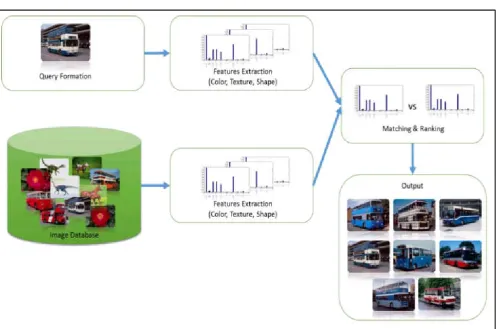
r represents the region and i represents the color channel. The color histogram of each image is stored in the database. By specifying the query image, the system registers the proportion of each color of the query image and goes through allimages in the database to find the color histograms match of
the query most closely. The color histograms are used to represent the color distribution in an image.
Relevance Feedback
Relevance feedback (RF) is a commonly accepted method to improve the effectiveness of retrieval systems interactively. Basically, it is composed of three steps: (a) an initial search is made by the system for a user-supplied query pattern, returning a small number of images; (b) the user then indicates which of the retrieved images are useful (relevant); (c)finally, the system automatically reformulates the original query based upon user’s relevance judgments. This process can continue to iterate until the user is satisfied. RF strategies help to alleviate the semantic gap problem, since it allows the CBIR system to learn user’s image perceptions.
Similarity Measures
The following algorithm is proposed to determine the similarity between query image and an image in the image database:
Step 1. Input query image I
Step 2. Convert RGB color space image into HSV color space. Step 3.Partition the image into three equal non-overlapping
horizontalregions.
Step 4.Calculate the moments Er,i , σr,i , μr,i or each color channel of region to get n numbers from the query image I.
Step 5. Calculate the Distance dj(Hj,I) between the two images using Eq.(14) and store in an array d.
, 1
( , ) ( , )...(14)
i j
r
j j r j
r
d H I d H I
Where r is the number of regions.
Step 6. The array d is sorted in ascending order. The image corresponding to the first element of d is the most similar image compared with the query image I.
The Interactive genetic algorithm (IGA) has been previously optimized and adapted for distance has been used. The weight is to be assigned to individual content features. The task of the IGA consists of finding the weight that maximizes the retrieval accuracy to the context defined by the query image. The System accepts explicit and implicit feedback and sends the explicit feedback to the retrieval system and at the same time sends the implicit feedback to the log session. Then sends the processed data to log database. The coefficients of the reference image are compared with each and every image in the database.
Integrated Genetic Algorithm with Relevance Feedback Start
User inputs a query image (Query by example).
Initially feature extraction of all the database images of is performed.
Feature extraction of each query image is performed
Similarity measurement using Interactive genetic algorithm is done Result is displayed.
If user satisfied then result displayed is final result and searching get finished
Else if user does not satisfied then user’s feedback(explicit) is taken on retrieved result and similarity function is
again calculated using genetic algorithm and by adjusting the user judgment and implicit feedback.
Log database is created.
User repeats this steps until and unless he is not satisfied. End
The retrieval result using only single feature may be inefficient. It may either retrieve images not similar to query image or may fail to retrieve images similar to query image. Hence, to produce efficient results use combination of color and texture features. The similarity between query and target image is measured from two types of characteristic features which includes color and texture features. Two types of characteristics of images represent different aspects of property. So, during similarity measure, appropriate weights are considered to combine the features. The distance between the query image and the image in the database is calculated as follows
1 1 2 2...(15)
dw d w d
The w1 is the weight of the color features, w2 is the weight of
the texture features and d1 and d2 are the distances calculated
using color moments.
EXPREMENTS AND RESULTS
The performance of a retrieval system can be measured interms of its precision and recall. Precision measures the ability of the system to retrieve only models that are relevant, while Recall measures the ability of the system to retrieve all models that are relevant.
Precision
The retrieval precision pq for a given query q is the ratio
[image:5.595.309.555.570.734.2]between the number of relevant images found by the system at a given iteration i and the total number of images retrieved in the same iteration.
...(15)
q
Number of relevant images retrieved p
Total number of images retrieved
Pq measures, the capability of correct retrieval of the system in a single iteration. The mean percentage of the precision on the total number Q of queries is
1
1
(%) 100...(16)
Q
q q
p p
Q
Recall
The recall rqis instead defined as the ratio between the number
of relevant images retrieved up to a certain iteration i for a query q from the system and the number of relevant images for the same query that are in the database.
...(17)
q
Number of relevant images retrieved r
Total number of relevant images
r is possible to evaluate the system’s ability to retrieve images relevant to each new iteration. It is also possible a variation in recall measure obtained changing the denominator of Eq. (17) with the minimum between the number of relevant images in the dataset, and the total number of images evaluated by the user. In this way it is possible to take into account the maximum number of relevant images that can be actually retrieved.
The mean percentage of recall on the total number of queries is
1
1
(%) 100...(18)
Q
q q
r r
Q
F-Measure
F-measure to combine the precision and the recall in a unique performance measure as,
.
2.
p r
...(19)
f
p
r
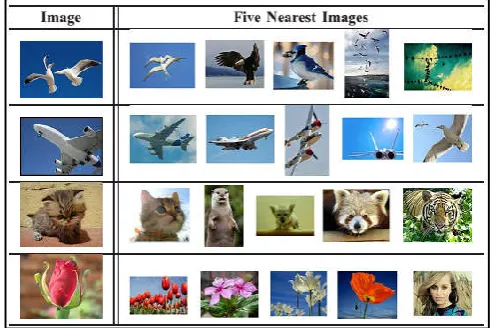
The proposed method has been implemented using Matlab 7.3 and tested on a general-purpose WANG database containing 1,000 images of the Corel stock photo, in JPEG format of size 384x256 and 256x386.Only simple features of image information cannot get comprehensive description of image content.
Consider the color and texture features combining not only be able to express more image information, but also to describe image from the different aspects for more detailed information in order to obtain better search results. Feature Extraction Techniques includes both text and visual features. In the visual features the scope can be classified as low level and high level features.
[image:6.595.311.557.50.209.2]The features selection to represent the keys of a CBIR system because the perceptions are subjectivity and the complex composition of visual data, the best representation for given visual features. Multiple approaches introduced for each of the visual features and for characterizes the feature from a different perspective Comparison of precision obtained by proposed method with other retrieval systems.
Table 1. Parameter Values for Different Class Features
Class Color Texture Shape Combined
Africa 0.36 0.21 0.34 0.41
Beaches 0.27 0.35 0.21 0.32
Building 0.38 0.5 0.24 0.37
Bus 0.45 0.22 0.51 0.66
Dinosaur 0.26 0.29 0.39 0.43
Elephant 0.30 0.24 0.26 0.39
[image:6.595.41.282.261.334.2]The following Figure 1 shows the Feature set parameter values of the proposed system of WANG dataset are given as
Figure 3. Resultant Graph of Feature set
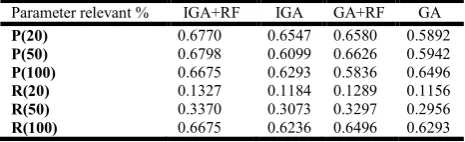
Table 2. Retrieval Efficiency of the Proposed Method
Parameter relevant % IGA+RF IGA GA+RF GA
P(20) 0.6770 0.6547 0.6580 0.5892
P(50) 0.6798 0.6099 0.6626 0.5942
P(100) 0.6675 0.6293 0.5836 0.6496
R(20) 0.1327 0.1184 0.1289 0.1156
R(50) 0.3370 0.3073 0.3297 0.2956
R(100) 0.6675 0.6236 0.6496 0.6293
[image:6.595.38.290.379.540.2]The precision parameter tells us something about the amount of noise in the returned image set. It is the ratio of relevant returned images to the number of total returned images. The recall parameter on the other hand tells us how many relevant images was returned relative to the number of total relevant images; it is calculated as the ration of returned relevant images to the number of total relevant images.
Figure 4. Comparison Result of IGA with RF
Conclusion
The proposed combination of reliable processing leading to precise feature extraction and broader color descriptors applied to foreground shape leads to encouraging results for foreground based image retrieval for better precision and recall measures. The results of proposed independent approaches, based on – whole image color codes, foreground shape and
foreground color codes have shown applicability
and suitability of the methods for image retrieval. Various proposed methods put together for development of application specific CBIR-similar-image retrieval for images containing complex background, produces results endorsing the effectiveness of methods.
REFERENCES
Ahmed J. Afifi, Wesam M. Ashour, 2012. “Content-Based Image Retrieval Using Invariant Color and Texture Features”, IEEE, 978-1-4673-2181-5/12.
Alnihoud J. 2012. “Content-Based Image Retrieval System Based on Self Organizing Map, Fuzzy Color Histogram and Subtractive Fuzzy Clustering,” the International Arab Journal of Information Technology, vol. 9, no. 5. pp. 452-458.
Amoda, N., Kulkarni, R. K. 2013. “Efficient Image Retrievalusing Region Based Image Retreival”, Signal & Image Processing: An International Journal (SIPIJ), Vol. 4, No.3, pp. 17-29, June.
Ashok D. and Esther J. 2011. “Comparative Study on CBIR Based by Color Histogram, Gabor and Wavelet
Transform,” International Journal of Computer
Applications, vol. 17, no. 3, pp. 37-44.
Bansal M., Gurpreet K., and Maninder K. 2012. “Content-Based Image Retrieval “Content-Based on Color,” International Journal of Computer Science and Technology, vol. 3, no. 1, pp. 295-297.
Bhuravarjula, H.H. and Kumar, V.N.S. 2012. A Novel Content Based Image Retrieval Using Variance Color Moment. International Journal of Computational Engineering Research, 1, 93-99.
[image:6.595.46.279.586.657.2]Datta, R., J. Li, J. Z. Wang, 2005. ”Content-Based Image Retrieval Approachesand Trends of the New Age”, Proceedings of the 7th ACM SIGMM international workshop on Multimedia information retrieval, pp. 253-262.
Dong Liu, Xian-Sheng Hua, and Hong-Jiang Zhang, 2011. Content-based tag processing for internet social images. Multimedia Tools Appl., 51:723–738, January.
Dubey, R.S., R. Choubey, J. Bhattacharga, 2010. “Multi
Feature Content Based Image Retrieval”, (IJCSE)
International Journal on Computer Science and Engineering, vol. 02, No. 06, pp. 2145-2149.
Hadi A. Alnabriss, Ibrahim S.I. Abuhaiba, 2014. “Improved image Retrieval with Color And Angle Representation”, I.J. Information Technology and Computer Science, No.06, pp 68-81.
Huang Z.C., P.P.K. Chan, W.W.Y. Ng, D.S. Yeung, 2010. “Content-based image retrieval using color moment and Gabor texture feature”, in Poceedings of the IEEE Ninth International Conference on Machine Learning and Cybernetics, Qingdao, pp. 719-724.
Jayaprabha P. and Somasundaram M. 2012. “Content Based Image Retrieval Methods using Graphical Image Retrieval Algorithm,” Computer Science and Application, vol. 1, no. 1. pp. 9-14.
Kavitha, H., Rao, B.P. and Govardhan, A. 2011. Image Retrieval Based on Color and Texture Features of the ImageSub-Blocks. International Journal of Computer Applications, 15, 33-37.
Khellah, F. M. 2011. Texture classification using dominant neighborhood structure. IEEE Transactions on Image Processing, Vol. 20, No. 11, 3270–3279.
Kokare M., B. N. Chatterji, and P. K. Biswas, 2002. “A survey on current content based image retrieval methods,” IETE J. Res., vol. 48, no. 3&4, pp. 261–271.
Murala, S. Maheshwari, R.P. Balasubramanian, R. 2012. Local tetra patterns: A new feature descriptor for content-based image retrieval. IEEE Transactions on Image Processing Vol. 21, No. 5, 2874–2886.
Pylarinos D., K. Theofilatos, K. Siderakis, E. Thalassinakis 2013. “Discharges Classification using Genetic Algorithms and Feature Selection Algorithms on Time and Frequency
Domain Data Extracted from Leakage Current
M”asurements" ETASR - Engineering, Technology & Applied Science Research, Vol. 3, No. 6, Pp 544-548. Santhosh, D., Trueman, T. E. 2014. “Artificial Neural Network
Technique for CBIR Based on Query Image Feature Extraction”, International Journal of Innovative Research in Computer, Vol. 2, Special Issue 3, pp. 223-230, July. Srinagesh, A., Aravinda, K., SaradhiVarma, G., P., Govardhan,
A., SreeLatha, M. 2013. “A Modified ShapeFeature Extraction Technique for Image Retrieval”, International Journal of Emerging Science and Engineering (IJESE), Volume-1, Issue 8, pp. 9-13, June.
Subrahmanyam M., A. B. Gonde, and R. P. Maheshwari, 2009. “Color and texture features for image indexing and retrieval,” in Proc. IACC, pp. 1411–1416.
Sumana I., M. Islam, D. S. Zhang and G. Lu, 2008. "Content Based Image Retrieval Using Curvelet Transform," a camera ready presentation In Proc. Of IEEE International Workshop on Multimedia Signal Processing Cairns, Queensland, Australia, ISBN 978-1-4244-2295-1, pp.11-16, October 8-10.
Yasmin, M., Sharif, M., Sajjad, M. 2013. “Use of Low Level Features for Content Based Image Retrieval: Survey”, Research Journal of Recent Sciences, Vol. 2(11), pp. 65-75, November.
Zhang L., Z. Zhou, H. Li, 2012. Binary Gabor pattern: an efficient and robust descriptor for texture classification, Proc. ICIP pp.81–84.