University of Warwick institutional repository: http://go.warwick.ac.uk/wrap
A Thesis Submitted for the Degree of PhD at the University of Warwick
http://go.warwick.ac.uk/wrap/56288
This thesis is made available online and is protected by original copyright. Please scroll down to view the document itself.
Performance Analyses and Design
for Cognitive Radios
By
Liang Tang
A thesis submitted in partial fulfillment of the requirements for the degree of
Doctor of Philosophy
School of Engineering
Table of Contents
Table of Contents . . . i
Acknowledgments . . . vi
Declaration . . . viii
List of Figures . . . ix
List of Abbreviations . . . xvii
List of Important Symbols . . . xix
Abstract . . . xxiii
List of Publications . . . xxv
1 Introduction 1 1.1 Introduction to Cognitive Radios . . . 1
1.1.1 Frequency Spectrum Management . . . 2
1.1.2 Historical Development of Cognitive Radio . . . 6
1.1.3 Spectrum Access Techniques . . . 10
1.2 IEEE 802.22 Standard Overview . . . 13
1.2.1 The IEEE 802.22 WRAN Standard . . . 14
1.2.2 Superframe and Frame Structure . . . 15
1.3 Thesis Outline . . . 16
1.3.1 Research Motivation . . . 16
2 Cognitive Radio Overview 22
2.1 Introduction . . . 22
2.2 Spectrum Estimation Overview . . . 23
2.2.1 Geolocation Database . . . 24
2.2.2 Beacon . . . 25
2.2.3 Secondary User Local Spectrum Sensing . . . 25
2.3 Spectrum Sensing Algorithms . . . 28
2.3.1 Matched Filter . . . 30
2.3.2 Energy Detection . . . 30
2.3.3 Cyclostationary Feature Detection . . . 32
2.3.4 Covariance-Matrix-Based Detection . . . 33
2.4 Secondary Transmission Overview . . . 36
2.5 Summary . . . 38
3 Sensing-Throughput Tradeoff with Primary User Traffic 39 3.1 Introduction . . . 39
3.2 Conventional Sensing-Throughput Tradeoff . . . 41
3.3 Dynamic Primary User Traffic Model . . . 44
3.4 Sensing-Throughput Tradeoff with Primary User Traffic . . . 48
3.4.1 Spectrum Sensing Performance . . . 48
3.4.2 Secondary User Transmission . . . 52
3.5 Numerical Results and Discussions . . . 55
3.6 Conclusions . . . 62
4 Spectrum Sensing with Multiple Status Changes in Primary User
4.1 Introduction . . . 64
4.2 Primary User Multiple Changes Traffic Model . . . 66
4.3 Spectrum Sensing with Primary User Multiple Changes Traffic . . . . 71
4.3.1 Conditional Probability of False Alarm . . . 74
4.3.2 Conditional Probability of Detection . . . 77
4.3.3 Unconditional Probability of False Alarm and Detection . . . 79
4.4 Numerical Results and Discussions . . . 80
4.5 Conclusions . . . 87
5 Adaptive-Modulation-Based Cognitive Radio 88 5.1 Introduction . . . 88
5.2 Conventional Adaptive Modulation . . . 90
5.2.1 Adaptive Continuous Rate Scheme . . . 91
5.2.2 Adaptive Discrete Rate Scheme . . . 92
5.3 Adaptive Modulation in Cognitive Radio . . . 94
5.4 Adaptive Continuous Rate Scheme in Cognitive Radio . . . 95
5.4.1 BER Performance . . . 95
5.4.2 Link Spectrum Efficiency Performance . . . 101
5.4.3 Numerical Results and Discussions . . . 103
5.5 Adaptive Discrete Rate Scheme in Cognitive Radio . . . 108
5.5.1 BER Performance . . . 108
5.5.2 Link Spectral Efficiency Performance . . . 112
5.5.3 Numerical Results and Discussions . . . 113
5.6 Conclusions . . . 121
6.1 Introduction . . . 122
6.2 Traditional Frame Structure . . . 125
6.2.1 Energy Detection . . . 126
6.2.2 Covariance-Matrix-Based Detection . . . 128
6.2.3 Numerical Results and Discussions . . . 130
6.3 Ideal Upper Bound Performance of the Novel Structure . . . 132
6.3.1 Novel Structure Model . . . 132
6.3.2 Numerical Results and Discussions . . . 136
6.4 Realistic Analysis of the Novel Structure . . . 142
6.4.1 Decoding . . . 143
6.4.2 Spectrum Sensing Performance . . . 145
6.4.3 Secondary User Transmission . . . 148
6.4.4 Covariance-Matrix-Based Detection . . . 149
6.4.5 Numerical Results and Discussions . . . 151
6.5 Effect of Fading Channels . . . 165
6.6 Effect of Coded Signals . . . 172
6.6.1 Golay(23,12) . . . 172
6.6.2 Hamming(7,4) . . . 174
6.7 Conclusions . . . 177
7 Conclusions and Future Work 178 7.1 Introduction . . . 178
7.2 Conclusions and Contributions . . . 178
7.2.1 Dynamic Primary User Traffic and Primary User Multiple Changes Traffic . . . 179
7.2.3 Analysis of the Novel Structure for Cognitive Radio . . . 183
7.2.4 Additional Observations . . . 187
7.3 Future Research Directions . . . 187
Acknowledgments
I would like to thank all of those who have helped and supported me along this long
but fulfilling journey.
First and foremost, I would like to express my heartfelt gratitude to my
super-visor, Dr. Yunfei Chen. This work would not have been possible without his warm
support, patient guidance, constructive suggestions and valuable time. I have been
extremely lucky, as one simply could not wish for a better or friendlier supervisor.
It has been a privilege to be his student, and I will always be grateful for the
op-portunities he has given me. I am also extremely indebted for his help in obtaining
me the funding for my study at Warwick.
I would also like to sincerely acknowledge my second supervisor, Prof. Evor
Hines, and the Director of Graduate Studies, Dr. Mark Leeson, for providing me
the lab spaces and resources for my research.
My sincere thanks also goes to my examiners Dr. Tardi Tjahjadi and Prof.
Lie-Liang Yang, for their constructive feedback.
Most importantly, I would like to thanks my beloved parents for being proud of
me and having faith in me. Their constant encouragement, unconditional sacrifices,
and continuous support both financially and emotionally throughout my life were the
love, I would not have had the courage to embark on this journey.
It is my fortune to thank my husband, for his companionship along the way. He
was always beside me during the happy and hard moments to push me and motivate
me. A journey is easier when you travel together. Interdependence is certainly more
valuable than independence. Thank you does not seem sufficient but it is said with
appreciation.
I would also like to take this opportunity to show my deep appreciation to my
parents-in-law, for their understanding, patience and everyday interest into my life.
Last but not the least, I would also like to dedicate this thesis to the memory
of my grandfather, Shucheng (1918-1991), who is a constant source of inspiration. I
Declaration
This thesis is submitted in partial fulfillment for the degree of Doctor of Philosophy
under the regulations set out by the Graduate School at the University of Warwick.
This thesis is solely composed of research completed by Liang Tang, except where
stated, under the supervision of Dr. Yunfei Chen and Prof. Evor Hines between the
dates of July 2009 and September 2012. No part of this work has been previously
submitted to any institution for admission to a higher degree.
Liang Tang
List of Figures
Figure 1.1 Spectrum allocations in the UK. . . 2
Figure 1.2 Spectrum allocations in the USA. . . 3
Figure 1.3 Measurements of spectrum utilization in downtown Berkeley
in the USA. . . 4
Figure 1.4 Measurements of average spectrum utilization over six
differ-ent locations in the USA in 2004. . . 5
Figure 1.5 The concept of spectrum underlay. . . 10
Figure 1.6 The concept of spectrum overlay. . . 12
Figure 1.7 The IEEE 802.22 WRAN standard superframe structure . . . 15
Figure 2.1 Comparison of different spectrum estimation methods. . . 23
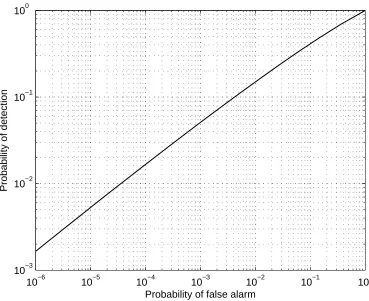
Figure 2.2 Example of ROC curve of the spectrum sensing performance. . 29
Figure 3.1 Scenarios for the dynamic primary user traffic model with one
primary user occupancy status change. . . 46
Figure 3.2 The ROC curves of the spectrum sensing performance for the
chi-square distribution, Gaussian approximation and the simulation
results. . . 55
Figure 3.3 The ROC curves of the sensing performance for the
conven-tional model and the new model with dynamic primary user traffic
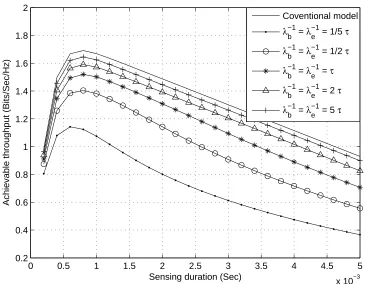
Figure 3.4 Comparison of the average achievable throughput of the
con-ventional model and the new model with dynamic primary user traffic,
with γp = 0 dB. . . 58
Figure 3.5 Comparison of the average achievable throughput between the
conventional model and the model with dynamic primary user traffic,
with γp =−10 dB. . . 59
Figure 3.6 The average achievable throughput verses the
sensing-duration-frame-duration ratio. . . 60
Figure 3.7 The optimal sensing time for different busy and idle channel
holding time, λ−b1 and λ−1
e . . . 61
Figure 4.1 Scenarios for the primary user traffic with multiple occupancy
status changes. . . 69
Figure 4.2 The ROC curves of the spectrum sensing performance with
primary user multiple changes traffic for exponentially distributed
channel holding times, with λ−1
b =λ−e1 = 1/5τ. . . 80
Figure 4.3 The ROC curves of spectrum sensing performance with
pri-mary user multiple changes traffic for exponentially distributed
chan-nel holding times, with λ−b1 =λ−1
e =τ. . . 81
Figure 4.4 The spectrum sensing performance for different received
pri-mary user SNR. . . 82
Figure 4.5 The ROC curves of spectrum sensing performance with the
primary user multiple changes traffic for Gamma distributed channel
Figure 4.6 The ROC curves of spectrum sensing performance with the
primary user multiple changes traffic for Erlang distributed channel
holding times. . . 84
Figure 4.7 The ROC curves of spectrum sensing performance with the
pri-mary user multiple changes traffic for log-normal distributed channel
holding times. . . 85
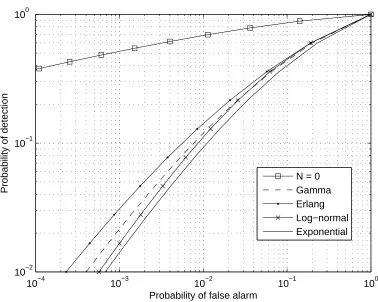
Figure 4.8 Comparison of the ROC curves of spectrum sensing
perfor-mance for differently distributed channel holding times, with N = 5. . 86 Figure 5.1 Comparison of the BER performance for the conventional
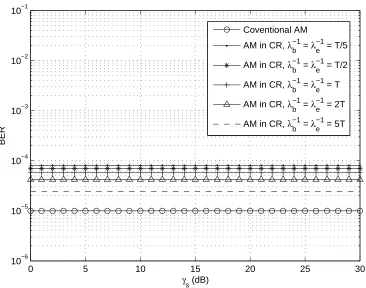
adaptive modulation with the BER performance for the adaptive
modulation in cognitive radio with ACR scheme and different channel
holding times, with γp = 0 dB. . . 104
Figure 5.2 Comparison of the BER performance for the conventional
adaptive modulation with the BER performance for the adaptive
modulation in cognitive radio with ACR scheme and different
val-ues of γp, with λ−b1 =λ−e1 =T. . . 105
Figure 5.3 Comparison of the link SE performance for the conventional
adaptive modulation with the link SE performance for the adaptive
modulation in cognitive radio with ACR scheme and different values
of λ−b1 =λ−1
e , with γp = 0 dB. . . 106
Figure 5.4 Comparison of the link SE performance for the conventional
adaptive modulation with the link SE performance for the adaptive
modulation in cognitive radio with ACR scheme and different values
Figure 5.5 Comparison of the BER performance for the conventional
adaptive modulation with the BER performance for the adaptive
modulation in cognitive radio with ADR scheme and different channel
holding times, with γp = 0 dB. . . 114
Figure 5.6 Comparison of the BER performance for the conventional
adaptive modulation with the BER performance for the adaptive
modulation in cognitive radio with ADR scheme and different
val-ues of γp, with λ−b1 =λ−e1 =T. . . 115
Figure 5.7 Comparison of the BER performance for the conventional
ADR scheme with the BER performance for the ADR scheme in
cog-nitive radio for different values ofK, with γp = 0 dB,λb−1 =λ−e1 =T
and m = 2. . . 116 Figure 5.8 Comparison of the BER performance for the conventional
ADR scheme with the BER performance for the ADR scheme in
cog-nitive radio for different values ofK, with γp = 0 dB,λb−1 =λ−e1 =T
and m = 1. . . 117 Figure 5.9 Comparison of the BER performance for the conventional
ADR scheme with the BER performance for the ADR scheme in
cog-nitive radio for different values ofK, with γp = 0 dB,λb−1 =λ−e1 =T
and m = 1. . . 118 Figure 5.10 Comparison of the link SE performance for the conventional
adaptive modulation with the link SE performance for the adaptive
modulation in cognitive radio with ADR scheme and different primary
Figure 5.11 Comparison of the link SE performance for the conventional
adaptive modulation with the link SE performance for the adaptive
modulation in cognitive radio with ADR scheme and different values
of K, with λ−b1 =λ−1
e =T. . . 120
Figure 6.1 The individual achievable throughput of the Xth frame in the
traditional structure model, with γs= 5 dB. . . 131
Figure 6.2 The total achievable throughput of U consecutive frames in
the traditional structure model, with γs= 5 dB. . . 132
Figure 6.3 The novel structure. . . 133
Figure 6.4 The spectrum sensing in the novel structure. . . 134
Figure 6.5 Comparison of the ROC curves of the spectrum sensing
per-formance for the traditional structure and the ideal case of the novel
structure. . . 137
Figure 6.6 The individual achievable throughput of theXth frame for the
traditional structure and the ideal case of the novel structure when
the energy detection is applied. . . 138
Figure 6.7 The individual achievable throughput of the Xth frame for
the traditional structure and the ideal case of the novel structure
when the maximum-eigenvalue detection and the covariance-based
detection are applied. . . 139
Figure 6.8 Total achievable throughput of U consecutive frames for the
traditional structure and the ideal case of the novel structure when
Figure 6.9 Total achievable throughput of U consecutive frames for the traditional structure and the ideal case of the novel structure when
the maximum-eigenvalue detection and the covariance-based
detec-tion are applied. . . 141
Figure 6.10 The ROC curves of spectrum sensing performance for the
tra-ditional structure and the novel structure when the energy detection
is applied, with γs = 0 dB. . . 152
Figure 6.11 The ROC curves of spectrum sensing performance for the
tra-ditional structure and the novel structure when the energy detection
is applied, with γs = 5 dB. . . 153
Figure 6.12 Individual achievable throughput of Xth frame for the
tra-ditional structure and the novel structure model when the energy
detection is applied, with λ−b1 =λ−1
e = 10T. . . 154
Figure 6.13 Individual achievable throughput of Xth frame for the tradi-tional structure and the novel structure when the energy detection is
applied, with λ−b1 =λ−1
e =T. . . 155
Figure 6.14 Total achievable throughput of U consecutive frames for the traditional structure and the novel structure model when the energy
detection is applied. . . 156
Figure 6.15 The saturation threshold of the novel structure for different
values of γp. . . 157
Figure 6.16 The saturation threshold of the novel structure for different
Figure 6.17 The ROC curves of spectrum sensing performance for the
traditional structure and the novel structure when the
maximum-eigenvalue detection is applied. . . 160
Figure 6.18 Individual achievable throughput of Xth frame for the
tradi-tional structure and the novel structure when the maximum-eigenvalue
detection is applied. . . 161
Figure 6.19 Total achievable throughput of U consecutive frames for the traditional structure and the novel structure when the
maximum-eigenvalue detection is applied. . . 162
Figure 6.20 The ROC curves of spectrum sensing performance for the
tra-ditional structure and the novel structure when the covariance-based
detection is applied. . . 163
Figure 6.21 Individual achievable throughput of Xth frame for the
tradi-tional structure and the novel structure when the covariance-based
detection is applied. . . 164
Figure 6.22 Total achievable throughput of U consecutive frames for the traditional structure and the novel structure when the
covariance-based detection is applied. . . 166
Figure 6.23 Primary user and secondary user fading channels. . . 167
Figure 6.24 The effect of fading on the ROC curves of the spectrum
sens-ing performance for the novel structure when the energy detection is
applied, with γp = 0 dB andγpu= 0 dB. . . 170
Figure 6.25 The effect of fading on the ROC curves of the spectrum
sens-ing performance for the novel structure when the energy detection is
Figure 6.26 The effect of fading on the ROC curves of the spectrum
sens-ing performance for different structure when the energy detection is
applied. . . 172
Figure 6.27 The effect of fading on the individual achievable throughput
of the realistic case of the novel structure. . . 173
Figure 6.28 The effect of fading on the total achievable throughput of the
realistic case of the novel structure. . . 174
Figure 6.29 The effect of the ECC on the ROC curves of spectrum sensing
List of Abbreviations
ACR Adaptive Continuous Rate
AM Adaptive Modulation
AWGN Additive White Gaussian Noise
BER Bit Error Rate
CDF Cumulative Distribution Function
CLT Central Limit Theorem
COVA Covariance-based detection
CPE Consumer Premises Equipment
CR Cognitive Radio
CSA Concurrent Spectrum Access
DARPA Defence Advanced Research Projects Agency
DSA Dynamic Spectrum Access
DySPAN Dynamic Spectrum Access Networks
E2R End-to-End Reconfigurability
ED Energy Detection
FCC Federal Communications Commission
iid independent and identically distributed
ITU International Telecommunication Union
ITU-R International Telecommunication Union
Radiocommunica-tion SecRadiocommunica-tion
MAC Media Access Layer
ME Maximum-eigenvalue detection
NSF National Science Foundation
OFCOM The Office of Communications
OSA Opportunistic Spectrum Access
P2MP Point to Multipoint
PDF Probability Density Function
PMF Probability Mass Function
PHY Physical Layer
QoS Quality of Service
RKRL Radio Knowledge Representation Language
ROC Receiver Operation Characteristic
SE Spectral Efficiency
SPTF Spectrum Policy Task Force
SNR Signal-to-noise ratio
UHF Ultra High Frequency
VHF Very High Frequency
WRAN Wireless Regional Area Networks
List of Important Symbols
C(·) Channel capacity for different hypothesis
fc Carrier frequency
fs Sampling frequency
fα Probability mass function of idle channel holding time
fβ Probability mass function of busy channel holding time
fγ Probability density function of the channel SNR in
Nakagami-m fading channel
fY Probability density function of Y
fXα Probability mass function of idle channel holding time in novel
structure
fXβ Probability mass function of busy channel holding time in novel
structure
Fα(t) Cumulative distribution function of idle channel holding time
Fβ(t) Cumulative distribution function of busy channel holding time
Γ(·) Gamma function, Γ(x) =R0∞tx−1e−tdt.
Γ(·,·) Incomplete gamma function, Γ (x, z) =
Z z
0
tx−1e−tdt.
h(·) Fading coefficient for different channels
i Sample index
I Number of samples in the spectrum sensing slot
Iz(·) z-th order modified Bessel function of the first kind, Iz(x) =
x
2
zX∞
j=0
(x2/4)j
j!Γ (z+j+ 1).
j Sample index
J Number of samples in the secondary frame
k Index of possible different regions of the SDR
k(·) Shape parameters of different distributions
K0H(·) The total number of samples during the sensing period that
contain only noise for different hypothesis
K1H(·) The total number of samples during the sensing period that
contain signal and noise for different hypothesis
m m parameter of Nakagami-m fading channel
M Constellation size
N Maximum number of primary user occupancy status changes
pb Instant probability of busy channel
pe Instant probability of idle channel
Pd(·) Probability of detection for different hypothesis
Pf a(·) Probability of false alarm for different hypothesis
Pber(·) BER for different cases
Pser(·) Symbol error rate for different cases
Pmo Probability of missed opportunity
Pmd Probability of mis-detection
P(·) Probability of different hypothesis occurring
ˆ
Q(·) Q-function, Q(t) = √1 2π
R∞
t e− u2/2
du.
Qm(·) Marcum Q-function, Qm(x, z) =
Z ∞
z
tm
xm−1e−
t2+x2
2 I
m−1(xt)dt.
R(·) Achievable throughput for different cases
s(t) Primary user signal received at the secondary user
ss,j Secondary user signal samples
Sp Primary user signal power
Ss Secondary user signal power
ts Symbol duration
tζ Secondary user signal symbol duration
T Frame duration
U Total number of secondary frames
w0 Noise power
w(t) Additive white Gaussian noise
W Bandwidth
X Frame index
y(t) Received signal at the secondary user
Y(·) Test statistics for spectrum sensing in different hypothesis
α Symbol at which primary user arrival occurs
β Symbol at which primary user departure occurs
γ SNR
∆(·) Minimum number of samples required
θmax Maximum eigenvalue of the covariance matrix of the received
signal
θmin Minimum eigenvalue of the covariance matrix of the received
µ(·) Mean
σ2
(·) Variance
τ Spectrum sensing slot duration
˜
τ Optimal spectrum sensing time
Ψ(·) Decision threshold for different cases
Abstract
Cognitive radio has been proposed as a promising solution to the conflict between
the spectrum scarcity and spectrum under-utilization. As the demand increases for
wireless communication services, cognitive radio technology attracts huge attention
from both commercial industries and academic researches. The purpose of this
the-sis is to provide an analytical evaluation of the cognitive radio system performance
while taking into consideration of some realistic conditions. Several problems are
investigated in this thesis. First, by adopting a dynamic primary user traffic model
with one primary user occupancy status change and exponentially distributed
chan-nel holding times, its effect on the cognitive radio system performance is evaluated.
In the evaluation, the sensing-throughput tradeoff of the cognitive radio is used
as the examination criteria, while energy detection is applied during the spectrum
sensing. The thesis then takes the investigation further by establishing a primary
user multiple changes traffic model which considers multiple primary user occupancy
status changes and any reasonable channel holding time distributions. The effect of
the primary user multiple changes traffic on the spectrum sensing performance is
in-vestigated while the channel holding times are assumed to be exponential, Gamma,
Erlang and log-normal distributed. The analytical evaluation of cognitive radio is
per-formance of the adaptive modulation in cognitive radio system is investigated. The
effect of the cognitive radio distinctive features on the performance of both the
adap-tive continuous rate scheme and the adapadap-tive discrete rate scheme of the adapadap-tive
modulation are examined. The BER performance and the link spectral efficiency
performance are derived for both schemes.
A novel frame structure where the spectrum sensing is performed by using the
recovered received secondary frames is also evaluated in this thesis. A realistic
scenario which considers the secondary user signal decoding errors is examined for
the novel structure, while an ideal upper bound performance is given when the
decoding process is assumed perfect. By extending the system to include multiple
consecutive secondary frames, the performance of the novel structure is compared
to the performance of the traditional frame structure proposed by the IEEE 802.22
WRAN standard. The effect of the primary user multiple changes traffic is also
examined for the novel structure.
Several major findings are made from the analytical evaluations presented in
this thesis. Through numerical examinations, it was shown that, first, the dynamic
primary user traffic degrades the performance of cognitive radio systems. Second,
the degree of the performance degradation of the cognitive radio systems is related
to the number of primary user status changes and the primary user traffic intensity.
Different primary user channel holding times distributions also lead to different
sensitivities of the system performance to the primary user traffic. Third, cognitive
radio distinctive features degrades the performance of the adaptive modulation.
When the novel structure is applied for cognitive radio, a higher secondary achievable
List of Publications
Journal Papers
1. L. Tang, Y. Chen, A. Nallanathan and E. L. Hines, “Performance evaluation
of spectrum sensing using recovered secondary frames with decoding errors,”
IEEE Transactions on Wireless Communications, vol. 11, no. 8, pp. 2934
-2945, August 2012.
2. L. Tang, Y. Chen, E. L. Hines and M. -S. Alouini, “Performance analysis of
spectrum sensing with multiple status changes in primary user traffic,”IEEE
Communications Letters, vol. 16, no. 6, pp. 874 -877, June 2012.
3. Y. Chen, M. -S. Alouini, L. Tang and F. Khan, “Analytical evaluation of
adaptive-modulation-based opportunistic cognitive radio in Nakagami-m fad-ing channels,” IEEE Transactions on Vehicular Technology, vol. 61, no. 7,
pp. 3294 -3300, September 2012.
4. L. Tang, Y. Chen, E. L. Hines and M. -S. Alouini, “Effect of primary user
traffic on sensing-throughput tradeoff for cognitive radios”,IEEE Transactions
on Wireless Communications, vol. 10, no. 4, pp. 1063 -1068, April 2011.
sens-ing without dedicated senssens-ing period for cognitive radios”,Wireless
Commu-nications and Mobile Computing, submitted.
Conference Papers
1. L. Tang, Y. Chen, A. Nallanathan and E. L. Hines, “Spectrum sensing based
on recovered secondary frame in the presence of realistic decoding error”,IEEE
International Conference on Communications (ICC 2012), pp. 1 -5, June
2012.
2. Y. Chen, M.-S. Alouini and L. Tang, “Performance analysis of adaptive
mod-ulation for cognitive radios with opportunistic access”, IEEE International
Chapter 1
Introduction
1.1
Introduction to Cognitive Radios
In the past two decades, the desire for high data rate wireless communications has
increased extensively, as a consequence of the transition from voice-only
communi-cation to multimedia type applicommuni-cations [1]. Since the emergence of the new wireless
devices and applications, consumers’ interests in the wireless services has seen an
unprecedented rise. According to the prediction study conducted by the
Interna-tional Telecommunication Union Radiocommunication Section (ITU-R), there will
be further strong growth in the market demand of the wireless communication for
the years to come [2].
Radio frequency spectrum is a fundamental component that enables wireless
communications [3]. The development of new wireless devices and the enhancement
of the existing ones both place enormous demand for the frequency spectrum, which
1.1. INTRODUCTION TO COGNITIVE RADIOS
[image:31.595.122.550.159.471.2]1.1.1
Frequency Spectrum Management
Figure 1.1: Spectrum allocations in the UK [4].
Currently, the frequency spectrum is regulated by the International
Telecommu-nication Union (ITU) internationally, and by the governmental agencies and
regu-latory bodies nationally, such as The Office of Communications (Ofcom) in the UK
and the Federal Communications Commission (FCC) in the USA [6]. With them
regulating the communication industry, the vast majority of the frequency spectrum
is restricted to licensed-only access. The wireless service providers can purchase the
license to exclusively utilize a band of certain frequency within a large geographic
region. The purchases are generally for a finite and long period of time with renewal
1.1. INTRODUCTION TO COGNITIVE RADIOS
Figure 1.2: Spectrum allocations in the USA [5].
regulation, only the dedicated license holders have the rights to exploit the
allo-cated spectrum, and the service providers without the legal license are forbidden
from utilizing the spectrum regardless of its current occupancy status. Hence,
pro-tections against the unlicensed user interference can be guaranteed for the licensed
user under this regulation.
Fig. 1.1 and Fig. 1.2 present the frequency spectrum allocations for the UK
and the USA, respectively, where each colour indicates a different type of service.
As shown, since the spectrum allocation is performed locally according to the
ge-ographic locations, the detailed allocations in the two charts varies. However in
both cases, most frequency spectrum bands of up to 300 GHz has been allocated
1.1. INTRODUCTION TO COGNITIVE RADIOS
related literatures, words such as “congested”, “over crowded” start to frequently
appear. Due to the naturally limiting availability of the frequency spectrum,
spec-trum scarcity is becoming an exceeding significant problem, and it is a common
belief that the economically usable frequencies are running out [9].
0
1
2
3
4
5
6
-100
-110
-120
-130
-140
-150
Frequency (GHz)
M
ea
su
re
d
P
ow
er
(d
B
)
Heavy Use
Medium Use
[image:33.595.136.520.245.513.2]Sparse Use
Figure 1.3: Measurements of spectrum utilization in downtown Berkeley in the USA. Adapted from [10].
However, after many researches being conducted on the spectrum utilizations in
diverse locations, it has been shown that the utilizations of many allocated
spec-trum bands are very inefficient [7, 12–18]. According to the FCC, the occupancy of
the allocated spectrum is sporadic with a high time and spatial variation ranging
from 15% - 85% [7]. Fig. 1.3 illustrates the results of a utilization measurement
performed in downtown Berkeley in the USA. As can be seen, there were portions
1.1. INTRODUCTION TO COGNITIVE RADIOS
PLM, amateur, others: 30→54 MHz TV 2-6, RC: 54→88 MHz Air traffic control, Aero nav: 108→ 138 MHz Fixed mobile, amateur, others: 138→ 174 MHz TV 7-13: 174→ 216 MHz Maritime mobile, amateur, others: 216→ 225 MHz Fixed mobile, Aero, others: 225→ 406 MHz Amateur, fixed, mobile, radiolocation: 406→ 470 MHz TV 14-20: 470→ 512 MHz TV 21-36: 512→ 608 MHz TV 37-51: 608→ 698 MHz TV 52-69: 698→ 806 MHz Cell phone and SMR: 806→ 902 MHz Unlicensed: 902→ 928 MHz Paging, SMS, fixed, BX aux, and FMS: 928→ 906 MHz IFF, TACA, GPS, others: 960 →1240 MHz Amateur: 1240→1300 MHz Aero radar, military: 1300→1400 MHz Space/satellite, fixed mobile, telemetry: 1400→1525 MHz Mobile satellite, GPS, meteorological: 1525→1710 MHz Fixed, fixed mobile: 1710→1850 MHz PCS, Asyn, Iso: 1850→1990 MHz TV aux: 1990→2110 MHz Common carriers, private, MDS: 2110→2200 MHz Space operation, fixed: 2200→2300 MHz Amateur, WCS, DARS: 2300→2360 MHz Telemetry: 2360→2390 MHz U-PCS, ISM (unlicensed): 2390→2500 MHz ITFS, MMDS: 2500 →2686 MHz Surveillance radar: 2686→2900 MHz
[image:34.595.98.463.139.484.2]0% 25%
Figure 1.4: Measurements of average spectrum utilization over six different locations in the USA in 2004. Adapted from [11].
significantly under-utilized. To be more specific, the actual utilization of the 3−4 GHz frequency band in Berkeley was only 0.5 % and became even less in the 4−5 GHz band [10].
Another example is the study of the frequency spectrum utilization between 30
MHz and 3 GHz in [13]. By measuring and averaging the spectrum utilization over
six different locations in the USA in 2004, it was found that the average utilization
of the allocated spectrum was only 5.2 %, as shown in Fig. 1.4.
1.1. INTRODUCTION TO COGNITIVE RADIOS
of the spectrum below 15 GHz is allocated to defence purpose, which was accessed
by the Ministry of Defence for virtually free until the late 1990s [19]. However,
a spectrum demand study by the PA Consulting together with the Prof. Cave’s
audit report have identified that additional spectrum utilization opportunities in
this frequency band may exist [19, 20]. Measurements in other countries have also
shown similar results, such as Singapore [14], New Zealand [16], China [17] and
Germany [18].
As the list goes on, all these measurement results seem to be contradictory to
the concern of spectrum scarcity. It is obvious that the spectrum scarcity faced
by the governmental agencies and regulatory bodies today, is essentially an
arti-ficial result caused by the traditional static spectrum allocation policies and the
inefficient utilization by the license holders, rather than any physical shortage of
the spectrum resource itself. Therefore, in order to solve the conflict between the
spectrum scarcity and the under-utilization, and maintaining the sustainable
devel-opment of the wireless communication industry, a new flexible, efficient and reliable
communication paradigm is needed to achieve a more intensive and comprehensive
utilization of the frequency spectrum. Prompted by this observation, cognitive radio
is proposed as a promising solution.
1.1.2
Historical Development of Cognitive Radio
Cognitive radio is an intelligent radio technology built on the software-defined radio
platform [21]. It removes the licensing barriers and facilitates the development of
the secondary markets in the spectrum utilization through the concept of dynamic
spectrum access (DSA) [22]. In cognitive radio terminology, DSA means two types
1.1. INTRODUCTION TO COGNITIVE RADIOS
secondary user. The primary user is the license holder who has higher priority
and legacy rights to utilize the specific spectrum band. The secondary user is
the cognitive user who has lower priority to the spectrum band and operates on
a dynamic basis under strict conditions. The secondary user should be equipped
with the ability to obtain awareness of its surrounding radio environment such that
the intelligent secondary exploitation of the licensed spectrum can be achieved.
At all time, the secondary user should not cause any harmful interference to the
primary user, so that the operation of the primary user is protected even if it is not
exclusively utilizing the licensed spectrum [1].
By using the cognitive radio techniques, more flexible exploitation and efficient
utilization of the allocated frequency spectrum can be achieved. This state-of-art
technology, is consequently widely expected to be the next Big Bang in the wireless
communications [23, 24].
Unlike the conventional radio technology which has a history that dates back to
the 1901 [25], despite the rapid development in cognitive radio, it is a relatively new
technology. The concept of cognitive radio was first proposed by Dr. Mitola in [26]
in 1999, where he described the term as the radio knowledge representation language
(RKRL) that could enhance the flexibility of personal wireless services. The
follow-ing year, in his doctoral thesis at the Royal Institute of Technology, Sweden [27],
Dr. Mitola further explained the idea of RKRL and presented a conceptual overview
of cognitive radio as an exciting multidisciplinary subject. At the same time, the
Defense Advanced Research Projects Agency (DARPA) in the USA conducted a
series of measurements that indicated the allocated spectrum was not utilized very
efficiently in the USA. Two years later in 2002, the NeXt Generation (XG) project
1.1. INTRODUCTION TO COGNITIVE RADIOS
concepts for the time domain and spatial domain sharing of the spectrum with
mul-tiple devices for military communications [22]. In the same year, the FCC Spectrum
Policy Task Force (SPTF) also conducted measurements on the spectrum
utiliza-tion and concluded that the spectrum under-utilizautiliza-tion is a bigger problem than the
spectrum scarcity [12]. For this reason, the SPTF recommended the development
of new regulations that allow more intensive spectrum usage. In 2003, the National
Science Foundation (NSF) in the USA joined the research on DSA and started their
research projects in the spectrum measurements. Also proposed by the SPTF, the
first cognitive radio workshop was held in Washington DC, USA, in 2003 [28]. The
workshop was followed by a cognitive radio conference in 2004, held in Las Vegas,
USA [28].
The year before the conference, cognitive radio has also started to draw
atten-tions in the Europe. The DSA technologies are included by the European Union
(EU) Information Society Technologies as part of the Sixth Framework Program.
Research projects in DSA and spectrum measurements have also been started. In
2004, the EU initiated the End-to-End Reconfigurability (E2R) Project in the
In-formation Society Technologies. In the same year, the FCC issued the Notice of
Proposed Rulemaking on Facilitating Opportunities for Flexible, Efficient, and
Re-liable Spectrum Use Employing Cognitive Radio Technologies [29]. In 2005, the
DARPA XG and NSF projects started in 2002 and 2003 have completed their
spec-trum measurements. It was found that only less than 10 % of the specspec-trum under
3 GHz was utilized in time-space [25]. At the same time, the IEEE began to hold
annual conference on Dynamic Spectrum Access Networks (DySPAN). In 2007, the
FCC started the testing of prototype devices for un-licensed usage of the un-utilized
1.1. INTRODUCTION TO COGNITIVE RADIOS
usage of the un-occupied spectrum without causing interference was created by an
Ofcom Consultation. In 2008, the End-to-End Efficiency (E3) project was initiated
in the Europe with 21 industry and academia partners [22]. Around the same time,
several research projects were also stated, such as the Wireless World New Radio
Initiated+ (WINNER+), the Self-Optimisation and Self-configuRATion in wirelEss
networkS (SOCRATES), and the Reconfigurable OFDMA-based cooperative
Net-worKs Enabled by Agile SpecTrum Use (ROCKET). Also in 2008, opportunistic
spectrum access was successfully demonstrated by the DARPA XG project. In
2010, the first phone call over a cognitive radio network was made in the center for
wireless communications at the University of Oulu, Finland.
Until today, the development of cognitive radio technology is still continuing.
As well as the regulatory researches, there are now also significant industrial
in-volvements of many big name companies from different industries, such as Philips
and Samsung from the consumer electronics industry, Alcatel-Lucent, Ericsson and
Motorola from the mobile equipment industry, BT and Orange from the network
operates, Microsoft and Google from the Internet and softwares industry, and HP
and Dell from the computer industry [30].
While the definitions of cognitive radio are still being perfected by industry and
academia [31], the definition made by the FCC has been widely adopted [29]
“A radio or system that senses its operational electromagnetic
envi-ronment and can dynamically and autonomously adjust its radio
operat-ing parameters to modify system operation, such as maximize throughput,
mitigate interference, facilitate interoperability, and access secondary
1.1. INTRODUCTION TO COGNITIVE RADIOS
1.1.3
Spectrum Access Techniques
A keyword can be recognized from the above definition for cognitive radio:
dy-namic. Accessing the licensed spectrum in a dynamic manner is essentially the key
of cognitive radio. This requires the secondary user to be equipped with cognitive
capability and reconfigurability [32]. Cognitive capability refers to the ability to
obtain awareness of the surrounding radio environment through means of sensing
and capturing information. With the cognitive capability, the secondary user can
gather information and identify the best available spectrum bands for operation.
Reconfigurability refers to the secondary user’s ability of dynamically programming
its operational parameters such as the transmission frequency, bandwidth, power,
modulation scheme, etc., according to the gathered radio environment information.
With the reconfigurability, the secondary user can achieve optimal performance in
its chosen spectrum bands [32].
Depending on the cognitive capability, the secondary user can achieve DSA using
different approaches. The accessing approaches are generally divided into two
cate-gories: the spectrum underlay approach [9] and the spectrum overlay approach [33].
Power Frequency
Time Primary User
Secondary User
1.1. INTRODUCTION TO COGNITIVE RADIOS
The spectrum underlay is also referred to as the concurrent spectrum access
(CSA) [34]. As illustrated by Fig. 1.5, in CSA, the secondary user coexists with the
active primary user, and is permitted to transmit simultaneously with the primary
user. Since the primary user has the priority in the licensed channel, the secondary
user transmitter must ensure that its transmission power is restrained at all time.
By doing so, the secondary user is always operating below the noise floor of the
primary user and the interference caused to the primary user is limited to within
the tolerable level [35]. However, this approach imposes some fundamental
con-straints on the secondary user resulting in major disadvantages. First, due to the
restrained transmission power, the secondary user can only operate with extremely
low power and thus within a very short range [36]. In most cases, spread spectrum
techniques have to be adopted by the secondary user to achieve short-range high
data rate communication. Second, the secondary user is also required to predict the
interference temperature limit of the primary user and the interference power level
that is received at a particular primary user receiver [37, 38]. Achieving an
accu-rate prediction of these parameters can be complicated. Hence, the secondary user
implemented spectrum underlay tends to be complex in terms of hardware design.
Moreover, in case of estimation errors occurring at the secondary user, this approach
also imposes potential threats to the quality of service (QoS) of the primary user.
The spectrum overlay is also referred to as opportunistic spectrum access (OSA)
[39]. As the name states, in OSA, the secondary user accesses the licensed spectrum
in an opportunistic manner. Through capturing its surrounding radio environment
information, the secondary user identifies un-utilized frequency spectrum bands.
These un-utilized bands are licensed spectrum that are not being occupied by the
lo-1.1. INTRODUCTION TO COGNITIVE RADIOS
Power
Frequency
[image:41.595.152.539.137.340.2]Time Primary User Secondary User
Figure 1.6: The concept of spectrum overlay. Adapted from [7].
cation. They are also named as spectrum holes or white space. Upon finding these
spectrum holes, the secondary user reconfigures its operating parameters to achieve
optimal performance in the chosen spectrum band. In some literatures, this is also
referred to as the “listen-before-talk” etiquette [40]. In OSA, the secondary user
is only permitted to utilize the spectrum when the primary user is inactive, as
il-lustrated by Fig. 1.6. In this case, the secondary user transmission power is not
refrained as the primary user interference tolerance level is no longer an operation
condition [7]. Hence, most transmission techniques can be applied. Instead, as the
primary user has the right to reclaim the licensed channel at any time, the secondary
user has to be constantly aware of the channel occupancy status. This requires the
secondary user to frequently monitor the channel status through database
knowl-edge, spectrum sensing or other methods, which will be discussed in more detail in
later chapters. Upon acknowledging the primary user’s arrival, the secondary user
1.2. IEEE 802.22 STANDARD OVERVIEW
Owing to the aforementioned limitations of the spectrum underlay approach, the
spectrum overlay is a much more widely adopted approach in many researches. For
this reason, in this thesis, the research will be focused on cognitive radio systems
implementing the spectrum overlay approach.
1.2
IEEE 802.22 Standard Overview
The introduction to cognitive radio will not be complete without mentioning the
IEEE 802.22 standard, which is the first world wide standard based on the cognitive
radio technologies [41].
Broadcasting TV operates in the licensed channel in both the very high frequency
(VHF) band and the ultra high frequency (UHF) band. In most developed countries,
such as the US and UK, most of the EU and many other countries in the world,
the switchover from analogue TV to digital TV is either completed or in progress.
As a result of the switchover, large portions of the VHF and UHF analogue TV
spectrum are or will become available due to the higher spectrum efficiency of the
digital TV. Some of these vacated channels are being reallocated through auctions,
for instance, the proposed auctions of 800 MHz and 2.6 GHz frequency bands for the 4G network in the UK. Furthermore, due to the interference planning issues
among the co-channel or adjacent channel stations, there are typically a few digital
TV channels not being utilized in a given geographic location. Thus, the capacity
of un-utilized TV spectrum is significant. According to the research conducted by
the Ofcom, around 100 MHz of un-utilized spectrum is available at 90% of the UK,
whereas around 150 MHz of un-utillized spectrum is available at 50 % of the UK
locations.
1.2. IEEE 802.22 STANDARD OVERVIEW
un-utilized TV channels in the VHF and UHF bands [29]. Following the proposal,
the IEEE 802.22 working group on Wireless Regional Area Networks (WRANs) was
formed in October 2004. From then on, there has been overwhelming interests to
develop a WRAN system operating on the TV white space using the cognitive radio
techniques. In 2008, prototypes were put forward to the FCC by Adaptrum , I2R,
Microsoft, Motorola and Phillips [42]. In the November of the same year, the FCC
released a Second Report and Order that issued permission for the opportunistic
utilization of the TV white space.
1.2.1
The IEEE 802.22 WRAN Standard
The IEEE 802.22 standard also known as the IEEE 802.22 WRAN standard is the
first standard developed for the WRANs defining both the Physical Layer (PHY)
and the Media Access Layer (MAC) functionalities [43]. It was expected to be
finalized in 2010, but was published in July 2011 in the end [44]. While the initial
geographical focus was in the North America, the standard enables the secondary
utilization of the VHF and UHF TV bands between 54−862 MHz in the USA, with a debating extension to 41−910 MHz [45]. This corresponds to the TV channels 5−13 in the VHF band and 14−51 in the UHF band [46]. Each channel has a bandwidth of 6, 7 or 8 MHz. The application of the IEEE 802.22 WRAN standard
is the broadband access to the rural areas in the USA where are normally hard
to reach and the population density is typically very low. The broadband access
service is restricted to a non-interfering basis, such that no harmful interference can
be caused to the TV broadcasting and other licensed low-power devices operating
in the channel, such as the wireless microphones.
1.2. IEEE 802.22 STANDARD OVERVIEW
in a point to multipoint basis (P2MP), consisting of a base station and multiple
customer-premises equipments (CPEs) [47]. The base station controls the spectrum
access for all the CPEs attached to it. The broadband access achieved through
implementing the standard will cover rural areas of up to 100 km from each base
station and serving up to 255 fixed CPEs with outdoor directional antennas located
at 10 m above ground level [45].
1.2.2
Superframe and Frame Structure
The IEEE 802.22 WRAN standard enables flexible and efficient utilization of the
TV white space through cognitive capability, while reliably protecting both the TV
broadcasting and the wireless microphone signals. One of the IEEE 802.22 WRAN
standard features that is particularly worth noticing, is the proposed superframe
structure, as this structure is widely used in cognitive radio researches and will
hence be adopted in this thesis.
Superframe Superframe
Superframe
Frame #1 Frame #2 Frame #16
Spectrum Estimation
[image:44.595.127.538.487.691.2]Secondary Transmission
1.3. THESIS OUTLINE
In order to fulfill the no harmful interference regulation of the standard, the
secondary user is required to be aware of any existing primary user signals with a
signal to noise ratio (SNR) of as low as−21 dB [1]. This means it is crucial for the secondary user to constantly monitor the channel occupancy status. For this
rea-son, the IEEE 802.22 MAC employs a superframe structure, such that the primary
user protection and the secondary data transmission can be efficiently managed. As
illustrated by Fig. 1.7, the operation of the secondary user is divided into multiple
consecutive superframes in the time domain, whilst each superframe is then
subdi-vided into multiple consecutive MAC frames. In the IEEE 802.22 WRAN standard,
there are 16 MAC frames each with a duration of 10 ms in one superframe [48].
The MAC frames are then further subdivided, where each MAC frame consists of
two slots. In the sense of cognitive radio with OSA approach, the MAC frame is
divided into a spectrum estimation slot and a secondary data transmission slot. By
employing this structure, the spectrum estimation and secondary data transmission
is performed chronologically and periodically, such that constant awareness of the
channel status can be achieved. Here, spectrum estimation refers to obtaining
in-formation of the channel occupancy status by using cognitive capability. A more
comprehensive discussion on the spectrum estimation is presented in Chapter 2.
1.3
Thesis Outline
1.3.1
Research Motivation
In this thesis, the research is focused on cognitive radio systems implementing the
spectrum overlay approach for the reasons given above. As previously mentioned,
1.3. THESIS OUTLINE
claim the spectrum band at anytime regardless of the secondary user’s occupancy
status. As required by the regulation, the secondary user is obliged to ensure its high
level of awareness of the primary user’s arrival at the licensed channel and vacate
the channel immediately, in order to prevent causing harmful interference to the
primary user. In most literatures [49–54], by adopting the superframe structure, this
is achieved through the periodic spectrum estimation. However, in these literatures,
the cognitive radio system models are established based on an assumption that the
primary user’s channel holding time is always longer than the secondary MAC frame
duration. This implies that the primary user always has a constant occupancy status
within an entire secondary MAC frame. In other words, they have assumed that
the primary user is either always active or always inactive during both the spectrum
estimation slot and the secondary data transmission slot. However, in reality, this
might not always be the case, especially when the primary user network has a high
traffic rate or when a long MAC frame duration is chosen by the secondary user.
Thus, part of the secondary MAC frame may see an occupied licensed channel while
part of the frame may see an idle licensed channel. In these cases, the conventional
performance evaluations for cognitive radios are no longer accurate. Therefore,
it is worth reformulating some of the performance evaluations for cognitive radio
while taking the realistic dynamic primary user traffic scenarios into account. By
incorporating a dynamic primary user traffic model, the examination of its effect on
various system performances can provide a valuable contribution to future system
designs for cognitive radios.
On the other hand, to achieve the secondary utilization of the licensed
spec-trum through carrying out the secondary data transmission is the ultimate goal
trans-1.3. THESIS OUTLINE
mission enhancing techniques, such as adaptive modulation, to the cognitive radio
systems. However, due to the un-licensed utilization nature of the cognitive radio, its
transmission performance exhibits unique characteristics. Therefore, some special
considerations must be included when evaluating the performances of these
tech-niques in cognitive radio system. Hence, it will be of great interest to investigate
the performance of transmission enhancing techniques in cognitive radio systems
with consideration of the distinctive cognitive radio features. Such investigation
will provide significant enhancement to the performance prediction capabilities for
future applications of transmission enhancing techniques in cognitive radio systems.
The maximization of the achievable throughput is not limited to the means of
transmission techniques, but also the transmission time itself. In the aforementioned
MAC frame structure, the chronological coexistence of the spectrum estimation
slot and the secondary data transmission slot in the same MAC frame potentially
imposes one of the major design challenges for cognitive radio systems. As will be
discussed in more details later in Chapter 3, the choice of the duration for each slot
is a popular research topic in cognitive radio. Nevertheless, this problem can also be
explored from a different perspective, where the choice of the optimal durations are
not required. To maximize the secondary transmission time and hence the achievable
throughput, the entire secondary MAC frame could be used to perform spectrum
estimation and data transmission simultaneously. By presenting and evaluating the
performance of cognitive radio system with such structure, the investigation would
have important contributions for the future direction of cognitive radio research, as
1.3. THESIS OUTLINE
1.3.2
Chapter Outlines
Motivated by the above reasons, the performance of the cognitive radio system
is analytically evaluated in this thesis, while taking into consideration of realistic
conditions. Several practical issues of cognitive radio system are examined.
Math-ematical derivations are provided for the discussion and in most cases, closed-form
equations are derived. Numerical results are also provided to verify the derivations.
In Chapter 2, a comprehensive overview of the cognitive radio technology is
pre-sented. The details of the two main aspects of cognitive radio is introduced: the
spectrum estimation and the secondary data transmission. A review of different
spectrum estimation technologies are provided, where their performance merit and
limitations are discussed. Different spectrum sensing algorithms are also presented
with their advantages and disadvantages analyzed. A review of the secondary data
transmission in a conventional cognitive radio system is also provided. Some
funda-mental theoretical details are also given, such that it can be used as a reference for
comparison purpose for the performance evaluations presented in the later chapters.
In Chapter 3, the effect of the dynamic primary user traffic on the tradeoff
be-tween the spectrum sensing quality and the achievable throughput is analyzed. The
analysis adopts a dynamic primary user traffic model that takes into consideration
of one primary user occupancy status changes, while assuming exponentially
dis-tributed channel holding times. By implementing energy detection for the spectrum
sensing, the performance of the new system model with dynamic primary user traffic
is derived and thereafter compared to the performance of the conventional model.
Chapter 4 further develops the dynamic primary user traffic model presented in
the Chapter 3 to include multiple primary user occupancy status changes and any
1.3. THESIS OUTLINE
user multiple changes traffic model, its effect on the energy detection performance
is investigated. Closed-form expressions for the spectrum sensing qualities are
de-rived. By comparing the performances of the cognitive radio system with different
numbers of primary user status changes, a lower boundary of the spectrum
sens-ing performance is predicted. The effect of different primary user channel holdsens-ing
distributions are also examined.
In Chapter 5, the performance of the adaptive modulation in cognitive radio are
investigated. Different to the existing literatures on adaptive modulation, in this
investigation, the distinctive characteristics of the cognitive radio are taken into
consideration, such as the spectrum sensing errors, the secondary transmission
in-terference caused by the active primary user, and the dynamic primary user traffic.
Both the adaptive continuous rate (ACR) scheme and the adaptive discrete rate
(ADR) scheme for the adaptive modulation are examined. Theoretical derivations
are presented for both the bit error rate (BER) performance and the link spectral
ef-ficiency (SE) performance. The performance of the adaptive modulation in cognitive
radio is then compared to the performance the conventional adaptive modulation.
Chapter 6 evaluates the performance of a novel structure for cognitive radio
where the spectrum sensing is performed by using the recovered received secondary
frames. Unlike previous work, in this evaluation, the practical secondary user
de-coding errors are taken into consideration. The performance of the novel structure
applying different spectrum sensing algorithms are examined. By presenting the
analysis for a realistic case of the novel structure, the chapter presented a
com-prehensive comparison between the novel structure and the traditional model that
adopts the IEEE 802.22 MAC frame structure. Moreover, the analysis has also been
real-1.3. THESIS OUTLINE
istic scenario where the secondary transmission achievable throughput is affected
by the accumulated decoding errors, which has also not been previously considered.
Both the receiver operating characteristics (ROC) curves for the spectrum
sens-ing and the achievable throughput for the secondary data transmission are derived.
Effects of fading channel and error control codes (ECC) are also investigated.
Finally in Chapter 7, the executive conclusion of this thesis is given. The research
results and findings are summarized with their potential impact analyzed. Possible
Chapter 2
Cognitive Radio Overview
2.1
Introduction
A comprehensive overview of the cognitive radio technology is provided in this
chap-ter to form a theoretical foundation for the rest of this thesis.
Defined by the fundamental concept and objectives of cognitive radio, the two
main aspects of cognitive radio technology are to identify the unoccupied spectrum
holes through necessary observations of the surrounding radio environment, and
to achieve the secondary utilization of the licensed spectrum on an opportunistic
basis. To accomplish these, two major functions of the cognitive radio system can
be concluded: the spectrum estimation and the secondary data transmission. This
can also be recognized from the defined superframe and MAC frame structure of
the IEEE 802.22 WRAN. In this chapter, a detailed overview is provided for both
of these functions.
First, in Section 2.2, an overview of the spectrum estimation techniques are
presented, while their performance merits and limitations are introduced. At the
2.2. SPECTRUM ESTIMATION OVERVIEW
as the focus for the rest of the thesis with reasons provided. In Section 2.3, the
chosen spectrum estimation technology is elaborated. Different types of algorithms
belonging in this category are introduced. The advantages and disadvantages of
each algorithm are also discussed. In Section 2.4, an overview of the secondary data
transmission in cognitive radio system is presented. Finally, in Section 2.5, a brief
summary is given for the discussions in this chapter.
Spectrum Estimation
Geolocation Database
Beacon Secondary User
Local Sensing
Primary User Transmitter Detection
(Spectrum Sensing)
Primary User Receiver Detection
Matched Filter Detection
Energy
Detection Feature
Detection
Covariance-Matrix-Based
Detection Cyclostationary
Figure 2.1: Comparison of different spectrum estimation methods.
2.2
Spectrum Estimation Overview
As the fundamental concept of the cognitive radio implementing OSA indicates, the
secondary user can only utilize the licensed channel if it is considered as a spectrum
hole. Thus, accurate identification of the spectrum holes is the first crucial step
toward the realization of cognitive radio systems. Spectrum estimation enables the
secondary user to perceive the presence of the primary user and the appearance of
2.2. SPECTRUM ESTIMATION OVERVIEW
identification. As illustrated by Fig. 2.1, there are several techniques that can be
used by the secondary user to achieve spectrum estimation: geolocation database,
beacon and secondary user local spectrum sensing.
2.2.1
Geolocation Database
For some wireless communication services, such as the TV broadcasting, the primary
user spectrum utilization patterns including the transmission power, the frequency
bands and the operating durations, etc., are predetermined for specific geographic
locations. In this case, a geolocation database of the spectrum utilization pattern
can be established [55–62]. By equipping the secondary user with a Global
Posi-tioning System (GPS) or other similar technologies, the geolocation database can
acquire its position information and feedback the channel occupancy information in
return [11,34]. However, this method has several practical problems. First, to
estab-lish the geolocation database, the primary user is required to register its operating
information. This forces the primary user to adjust its existing system. Secondly,
after the establishment of the geolocation database, the associated maintaining and
operating issues create further challenges which may be complicated and expensive.
Thirdly, an alternative band is also needed so that the channel occupancy
infor-mation held by the database can be transmitted to the secondary user. Finally,
while the GPS can provide the secondary user position information with enough
ac-curacy in outdoor environments, its performance significantly degrades deep inside
2.2. SPECTRUM ESTIMATION OVERVIEW
2.2.2
Beacon
There are two different ways for the secondary user to achieve spectrum estimation
by using beacon. First, an instruction beacon can be sent out by the primary user to
indicate the availability of the licensed channel [63]. The secondary user can consider
the channel to be occupied by the primary user upon receiving of the instruction
beacon, whereas the channel can be considered as idle if the instruction beacon
is not received by the secondary user within a certain amount of time. However,
to achieve this, necessary beacon transmitting structure is required, leading to the
operating and maintaining issues associated with it. In the case of the beacon
transmitting structure being operated by the primary user, modifications to the
existing primary user infrastructure also becomes compulsory. Moreover, unreliable
spectrum estimation performance can also occur when the transmitted beacon is
lost due to fading and shadowing, causing potential threats to the primary user
QoS.
On the other hand, sensing beacon can also be sent out by the secondary user [64].
Upon receiving of its own beacon, the secondary user can determine the licensed
channel occupancy status by comparing it to the original beacon signal. However,
sensing beacon transmitted by the secondary user can create significant interference
to the primary user if proper precautions have not been taken into consideration.
2.2.3
Secondary User Local Spectrum Sensing
The spectrum estimation can also be achieved through secondary user local
spec-trum sensing. Performed by the secondary user transmitter, it estimates the channel
occupancy status through collecting and analyzing the local measurements of the
com-2.2. SPECTRUM ESTIMATION OVERVIEW
plexity, this method depends solely on the secondary user and requires no further
modifications to the exiting primary user infrastructure.
Following the MAC frame structure, the secondary user transmitter perform
local spectrum sensing during the spectrum estimation slot of the frame. The local
spectrum sensing can be further divided into two sub-categorizes: primary user
receiver detection and primary user transmitter detection.
• Primary user receiver detection
The secondary user local spectrum sensing can be performed through detecting
the active primary user receiver [65–67]. It is the most obvious and efficient
way of avoiding causing interference to the primary user, since it is the primary
user receiver that requires protection from the harmful interference.
Generally, when the primary user receiver is receiving data from the active
primary user transmitter, the received signal needs to be converted from the
carrier frequency to intermediate frequency to prepare for further processing.
While performing the conversion, the RF front-end of the receiver emits local
oscillator leakage power. By exploring this power, the secondary user can
determine the occupancy status of the primary user [65]. However, while this
detection is possible in theory, it is almost impractical in reality. As the local
oscillator leakage signal power is typically extremely low and the accurate
detection of such power would be extremely difficult. Currently, this is only
achievable in the detection of the TV receivers, used by British Broadcast to
find fee evaders [66]. For this reason, most recent work focuses on the detection
of the primary user transmitter [7].
![Figure 1.1: Spectrum allocations in the UK [4].](https://thumb-us.123doks.com/thumbv2/123dok_us/9653706.467356/31.595.122.550.159.471/figure-spectrum-allocations-in-the-uk.webp)
![Figure 1.2: Spectrum allocations in the USA [5].](https://thumb-us.123doks.com/thumbv2/123dok_us/9653706.467356/32.595.125.548.128.414/figure-spectrum-allocations-in-the-usa.webp)
![Figure 1.3: Measurements of spectrum utilization in downtown Berkeley in the USA.Adapted from [10].](https://thumb-us.123doks.com/thumbv2/123dok_us/9653706.467356/33.595.136.520.245.513/figure-measurements-spectrum-utilization-downtown-berkeley-usa-adapted.webp)

![Figure 1.6: The concept of spectrum overlay. Adapted from [7].](https://thumb-us.123doks.com/thumbv2/123dok_us/9653706.467356/41.595.152.539.137.340/figure-concept-spectrum-overlay-adapted.webp)
![Figure 1.7: IEEE 802.22 WRAN standard superframe structure. Adapted from [48].](https://thumb-us.123doks.com/thumbv2/123dok_us/9653706.467356/44.595.127.538.487.691/figure-ieee-wran-standard-superframe-structure-adapted.webp)